4-4-4 Fertilizer: Rates, Timing, and Top Picks
4-4-4 fertilizer is a balanced organic blend that feeds plants slowly instead of all at once. The numbers look small next to a bag of 10-10-10. That low analysis is the whole point, and it changes how much you spread and when.
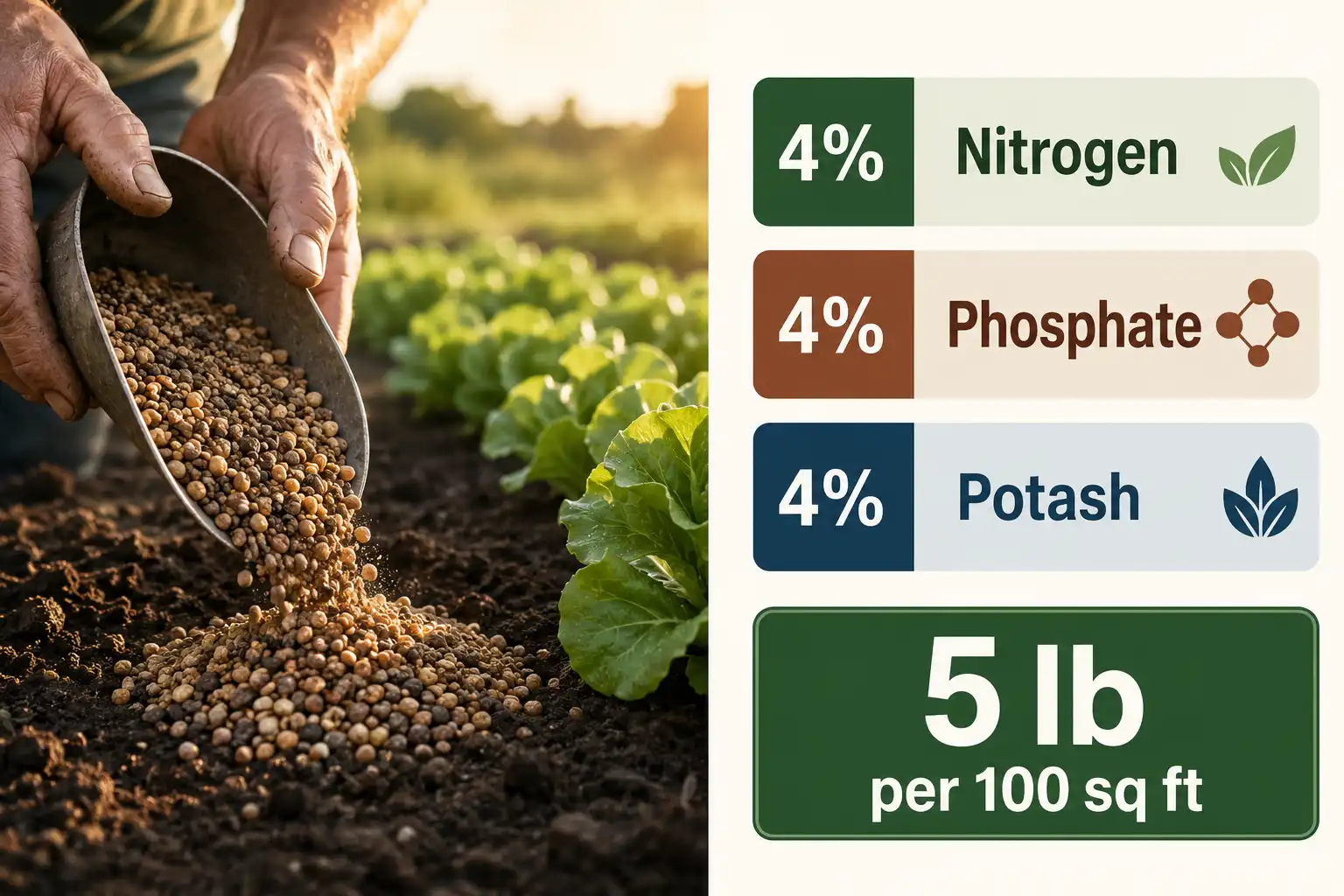
4-4-4 fertilizer supplies 4% nitrogen, 4% phosphate, and 4% potash by weight. Spread about 5 pounds per 100 square feet for most vegetables, work it in, then water. Nutrients release over four to eight weeks.
What Is 4-4-4 Fertilizer?
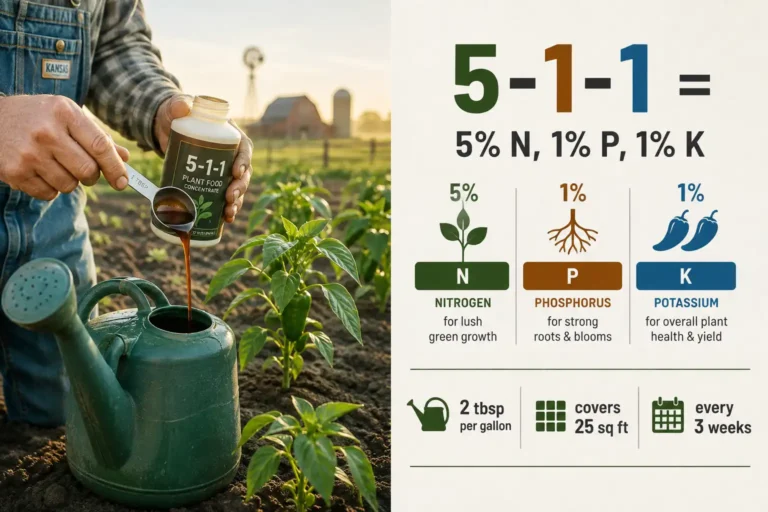
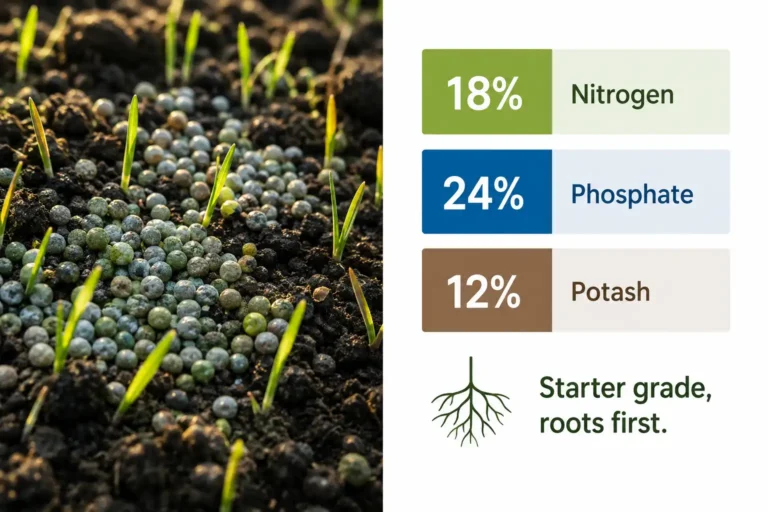
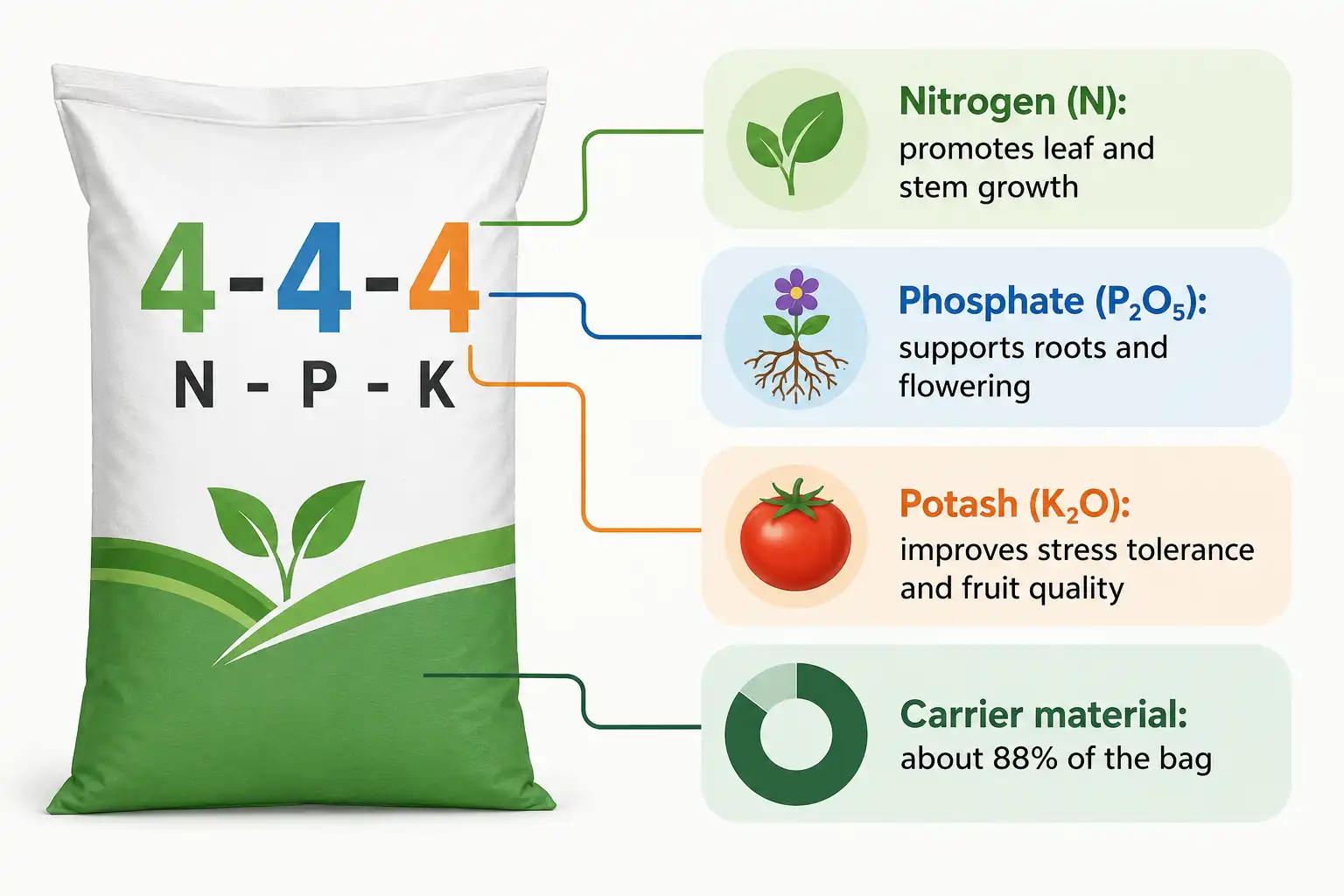
4-4-4 fertilizer is a low-analysis blend carrying 4% nitrogen, 4% phosphate, and 4% potash by weight. Those three numbers make up the guaranteed analysis printed on every bag sold in the United States.
So a 100 pound bag holds 4 pounds of nitrogen, 4 pounds of phosphate, and 4 pounds of potash. The other 88 pounds are carrier material. That carrier is not dead weight. In most blends it is composted meals, mined minerals, and organic matter that feeds soil biology.
Also see: 21 0 0 Fertilizer Guide
Here is what a common 10 pound bag actually delivers.
| What the label says | What 10 pounds contains |
|---|---|
| 4% nitrogen (N) | 0.4 lb nitrogen |
| 4% phosphate (P2O5) | 0.4 lb phosphate, about 0.18 lb actual phosphorus |
| 4% potash (K2O) | 0.4 lb potash, about 0.33 lb actual potassium |
| Roughly 88% carrier | 8.8 lb of meals, minerals, and organic matter |
New to the label math? Our guide to what NPK numbers mean for crops covers every grade on the shelf.
Is 4-4-4 Really Balanced?
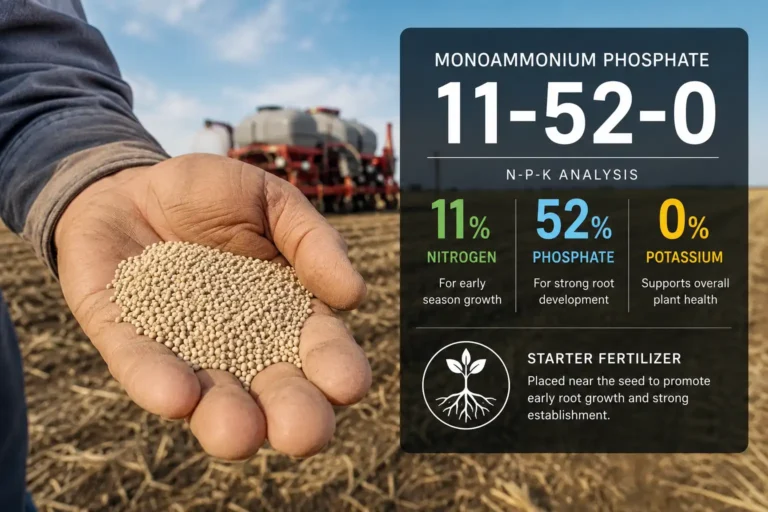
Not in strict elemental terms, no. Labels report phosphorus as phosphate and potassium as potash. Both are oxide forms left over from old lab methods.
Mississippi State University Extension gives the conversions. Multiply phosphate by 0.44 for actual phosphorus. Multiply potash by 0.83 for actual potassium.
Run those numbers and 4-4-4 lands closer to 4-1.8-3.3. So you apply more than twice as much nitrogen as phosphorus. That matters once you track soil test results across several seasons.
What Goes Into a Bag of 4-4-4?
Most 4-4-4 blends combine slow-release meals with mined minerals. Manufacturers pick ingredients that break down at different speeds on purpose. That staggered release is what keeps a granular organic fertilizer working past the first rain.
| Common ingredient | Supplies | Release speed |
|---|---|---|
| Feather meal | Nitrogen | Slow, 6 to 12 weeks |
| Blood meal | Nitrogen | Fast for an organic source |
| Bone meal | Phosphorus, calcium | Slow |
| Alfalfa meal | Nitrogen, trace growth compounds | Moderate |
| Composted poultry litter | Nitrogen, phosphorus, potassium | Moderate |
| Sulfate of potash | Potassium, sulfur | Fast |
| Kelp meal | Micronutrients | Slow |
| Gypsum and rock dust | Calcium, sulfur, trace minerals | Very slow |
Check the ingredient panel before you buy. Two bags can both read 4-4-4 and behave nothing alike. A blend heavy on blood meal greens up in two weeks. One built on bone meal and rock dust takes most of a season.
What Does 4-4-4 Fertilizer Do for Plants?
It supplies steady nitrogen without pushing the soft, floppy growth a heavy synthetic shot causes. Beyond that, it builds soil while it feeds.
Here is what you actually get:
- Low burn risk. Nutrients release through microbial breakdown, not salt dissolution. So seedlings and transplants tolerate it well.
- Steady nitrogen. Feeding runs four to eight weeks instead of two.
- Added organic matter. Roughly 88% of the bag is carrier, and much of it feeds soil life.
- Micronutrients and calcium. Most blends carry them without a separate product.
- Forgiving margins. Overshoot the rate a little and plants shrug it off.
Now the honest limits. It works slowly in cold ground. It costs more per pound of nutrient than a high-analysis grade. And you have to spread a lot of it to hit a real nitrogen target.
What Crops Is 4-4-4 Fertilizer Best For?
4-4-4 fertilizer suits vegetables that grow steadily over a long window. Crops needing one hard nitrogen push are a poorer fit.
| Crop group | Fits 4-4-4? | Notes |
|---|---|---|
| Leafy greens (lettuce, kale, spinach) | Excellent | Steady nitrogen keeps leaves tender |
| Tomatoes and peppers | Very good | Pair with extra potassium once fruit sets |
| Root crops (carrots, beets, radish) | Good | Heavy rates push tops over roots |
| Onions and garlic | Very good | Feed early, stop once bulbs swell |
| Squash, cucumbers, melons | Very good | Side dress at first vine run |
| Beans and peas | Light rate only | They fix their own nitrogen |
| Herbs and container plants | Excellent | Low burn risk in small soil volumes |
| Sweet corn | Fair | Needs more nitrogen than this grade delivers cheaply |
| Established berries and perennials | Excellent | One spring top dress carries them |
Tomatoes are the crop people ask me about most. A 4-4-4 works fine as the base feed. Still, potassium matters more after the first fruit sets. Our article on how to fertilize tomatoes at each stage walks through that shift.
Field corn and soybeans change the math entirely. In Kansas, an all natural fertilizer for vegetable garden work does not pencil out at field scale. Nitrogen cost per acre decides that, not preference.
How Much 4-4-4 Fertilizer Per 100 Square Feet?
Apply about 5 pounds per 100 square feet for average vegetables. Heavy feeders take 7.5 pounds. Light feeders take 2.5 pounds.
That comes straight from the nitrogen math. University of Maryland Extension puts the general vegetable target at 2 pounds of nitrogen per 1,000 square feet. That works out to 0.2 pounds per 100 square feet. Heavy feeders like tomatoes, broccoli, and beets get 0.3 pounds.
Divide the nitrogen you need by the nitrogen in the bag:
0.2 lb nitrogen ÷ 0.04 = 5 lb of 4-4-4 fertilizer per 100 square feet
| Situation | Nitrogen target | 4-4-4 needed |
|---|---|---|
| Average vegetables, 100 sq ft | 0.2 lb N | 5 lb |
| Heavy feeders, 100 sq ft | 0.3 lb N | 7.5 lb |
| Light feeders and legumes, 100 sq ft | 0.1 lb N | 2.5 lb |
| Average vegetables, 1,000 sq ft | 2 lb N | 50 lb |
| 4 ft by 8 ft raised bed (32 sq ft) | 0.06 lb N | 1.6 lb, about 3 cups |
| Side dress, per 10 ft of row | Light feed | About 1 cup |
| Containers, per gallon of mix | Light feed | 1 to 2 tablespoons |
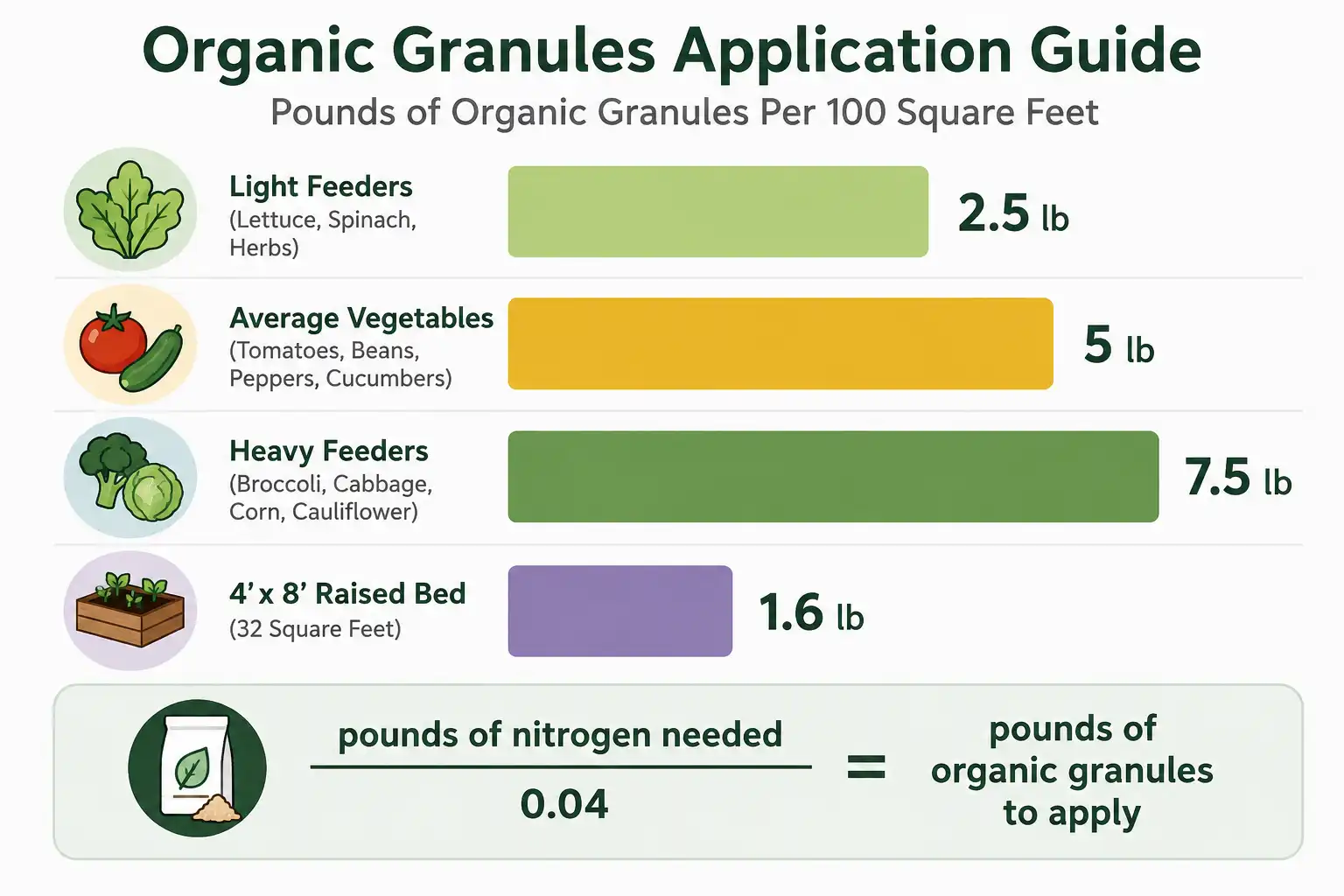
Those numbers usually run heavier than the bag directions. Label rates are set conservatively for people who never test their soil. So check your own results before committing to a rate garden-wide. A soil test kit you can run at home removes the guesswork cheaply.
Converting Any Recommendation to 4-4-4
Divide the pounds of nitrogen you need by 0.04. That is the whole method.
Say your soil test calls for 1.5 pounds of nitrogen per 1,000 square feet. Then 1.5 ÷ 0.04 = 37.5 pounds of product. Iowa State University Extension teaches this same division for every grade. So it carries over to whatever you buy next.
When Should You Apply 4-4-4 Fertilizer?
Apply it two to three weeks before planting, once soil holds above 50°F. Soil microbes convert organic nitrogen into a form roots can absorb. Below 50°F those microbes go quiet and the granules just sit there.
That head start matters more than people expect. Mineralization needs warmth and moisture together. Dry soil stalls it almost as hard as cold soil does.
| Timing | What to do | Why |
|---|---|---|
| 2 to 3 weeks before planting | Broadcast and work in the full base rate | Gives microbes a head start |
| At transplant | Band a light rate below the root ball | Feeds new roots directly |
| 4 to 6 weeks after planting | Side dress heavy feeders | Covers mid-season demand |
| First fruit set | Side dress tomatoes, squash, peppers | Fruit fill pulls hard on reserves |
| Early fall | Top dress perennials and garlic beds | Soil is still warm enough to break it down |
| Winter | Skip it | Microbes are dormant and nitrogen leaches |
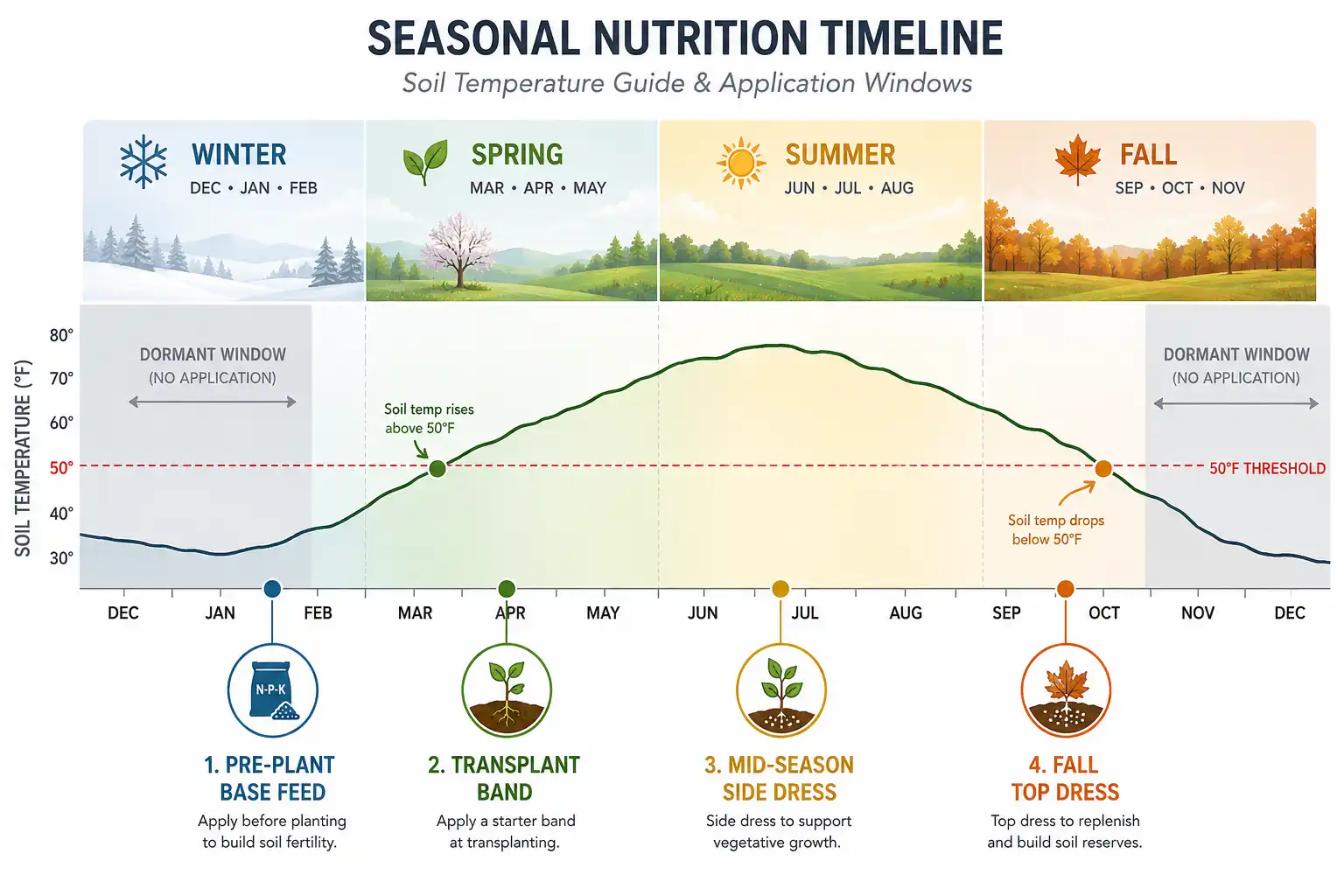
In zone 6a, soil temperature usually crosses 50°F in mid to late April. Yours will differ. So check with a soil thermometer rather than a calendar date.
How to Apply 4-4-4 Fertilizer
Three methods cover nearly every situation. Pick based on whether the ground is bare or already planted.
Broadcast and Incorporate
Use this on bare beds before planting. Weigh the product first, because volume estimates run wildly off with organic granules.
- Measure your bed and calculate the rate from the table above.
- Weigh the fertilizer rather than scooping by eye.
- Spread it evenly in two passes at right angles.
- Work it into the top 4 to 6 inches with a rake, fork, or tiller.
- Water it in thoroughly.
- Wait two weeks before you plant.
Incorporation matters more than people think. Granules left on a dry surface do almost nothing. Microbes need soil contact and moisture to go to work.
Side Dressing Growing Plants
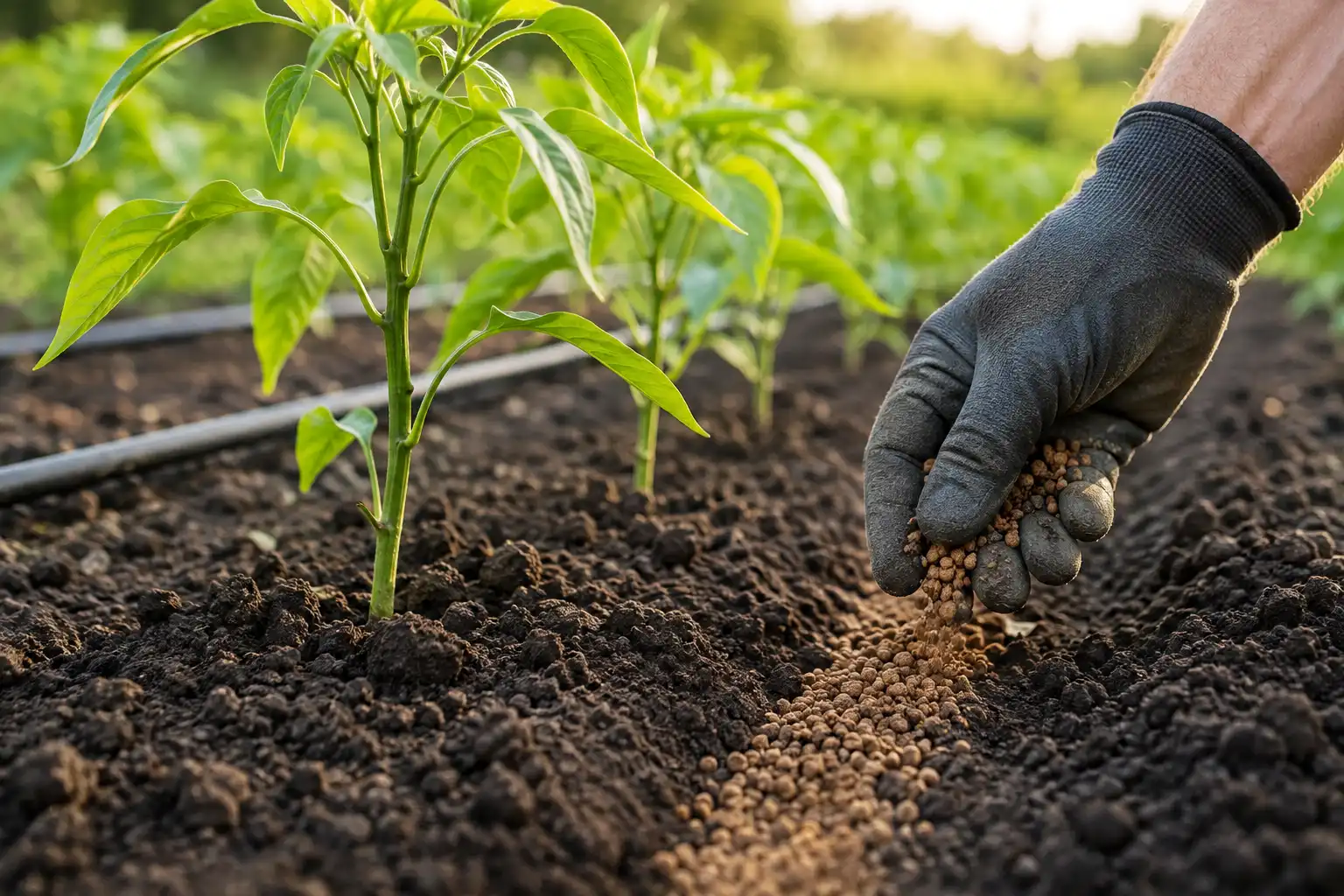
Side dressing feeds crops that have already pulled down the base application. Scatter a band of granules 4 to 6 inches out from the stem. Then scratch it into the top inch and water.
Keep the granules off leaves and crowns. Wet organic material sitting against a stem invites rot. For row crops, run a shallow furrow beside the row, drop the fertilizer in, and cover it.
Containers and Raised Beds
Containers need a lighter hand. Mix 1 to 2 tablespoons per gallon of potting mix at planting. Then top dress the same amount every six to eight weeks.
Raised beds behave more like open ground. So use the standard 5 pounds per 100 square feet. Then adjust after your first season based on crop performance.
Does 4-4-4 Really Feed All Season?
Partly, and less than the bag math suggests. Plants cannot use organic nitrogen directly. Soil microbes must mineralize it first. Only a share of that nitrogen converts during the first growing season.
Ohio State University Extension estimates first-year availability of organic nitrogen at roughly one third for manures and composts. Meal-based blends run higher because they break down faster. Even so, a 10 pound bag will not deliver its full 0.4 pounds of nitrogen to this year’s crop.
That changes how you plan. Two practical consequences follow.
- Year one underperforms year three. Repeat applications build a residual pool that keeps releasing.
- Cold springs need a supplement. A liquid feed for vegetable plants bridges the gap until soil warms.
The trade-offs between organic and synthetic fertilizer sources come down to this timing question. Neither one wins everywhere.
4-4-4 vs 10-10-10 and Other Grades
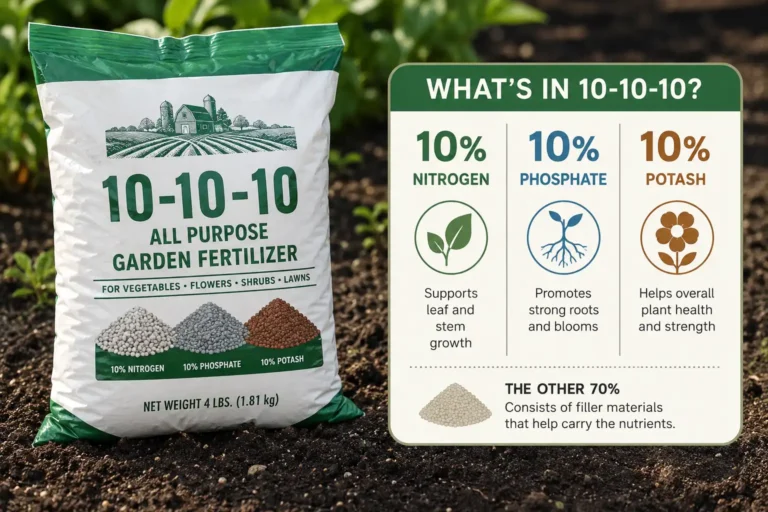
The difference is concentration, not capability. You need 2.5 times the weight of 4-4-4 to match the nitrogen in 10-10-10.
| Grade | Nitrogen per 10 lb | Typical type | Best use |
|---|---|---|---|
| 4-4-4 | 0.4 lb | Organic, slow release | Vegetable beds, containers, season-long feeding |
| 5-5-5 | 0.5 lb | Organic, slow release | Same jobs, slightly stronger |
| 8-8-8 | 0.8 lb | Usually synthetic | General garden use, faster response |
| 10-10-10 | 1.0 lb | Synthetic, fast release | Quick correction, larger plots |
| 5-10-10 | 0.5 lb | Synthetic | Root crops and fruiting crops |
| 46-0-0 | 4.6 lb | Synthetic urea | Nitrogen only, field scale |
So which belongs in your shed? A 10-10-10 fertilizer grade costs less per pound of nutrient and works faster in cold soil. The 4-4-4 wins on burn safety, soil building, and organic compliance.
Keep both. High-analysis grades handle field-scale acreage. The 4-4-4 handles garden beds and transplant trays.
The Phosphorus Problem With Repeat 4-4-4 Use
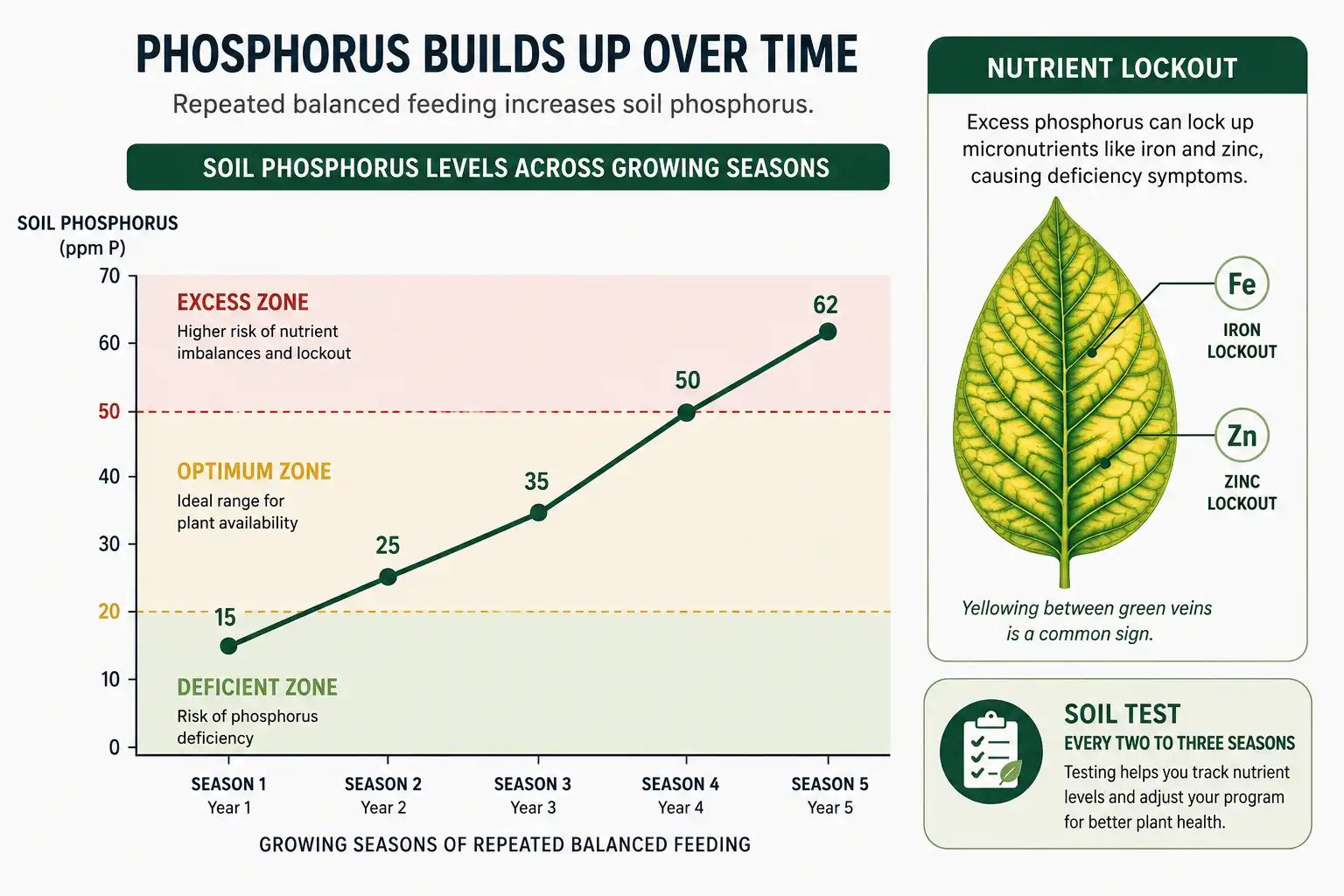
Feeding to hit a nitrogen target with 4-4-4 applies the same weight of phosphate every time. Nitrogen leaches and volatilizes. Phosphorus stays put and accumulates.
Most established garden beds already test high in phosphorus. Texas A&M AgriLife Extension warns that excess soil phosphorus blocks iron and zinc uptake. That happens even when the soil test shows enough of both. Yellowing between leaf veins on shallow-rooted plants is often the first sign. Runoff into surface water is the other cost.
So test every two or three seasons. If phosphorus reads high, switch to a low-phosphorus nitrogen source. Blood meal and feather meal both work. Then hold the 4-4-4 for new ground.
6 Best 4-4-4 Fertilizers
The best 4-4-4 fertilizer for most vegetable gardens is the Gaia Green All Purpose Soil Supplement. The bulk bag covers roughly 440 square feet and carries the OMRI seal. For fast response in cool soil, the TPS Plant Foods liquid works within days. On a tight budget, Burpee Natural Purpose delivers the same analysis.
| Product | Form | Size | Organic listing | Best for |
|---|---|---|---|---|
| Gaia Green All Purpose Soil Supplement | Dry granules | 22 lb | OMRI Listed | Large beds and market gardens |
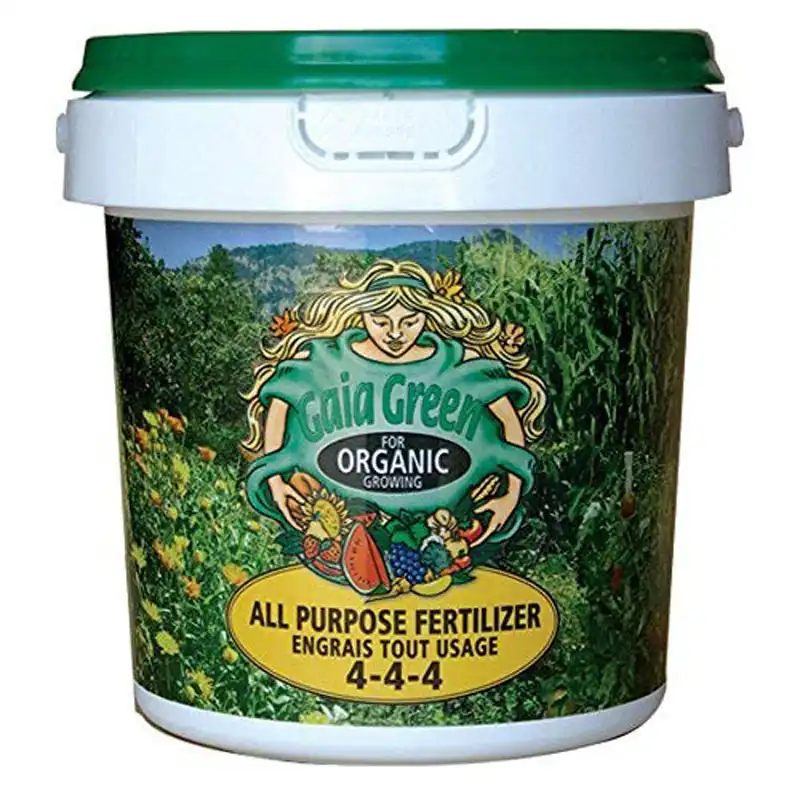
| Gaia Green Organic All Purpose | Dry blend | 4.4 lb | Organic labeled | Mid-size home gardens |
| TPS Plant Foods Liquid | Liquid concentrate | 32 fl oz | Not organic listed | Fast response and containers |
| Jobe’s Organics All Purpose Granular | Granules | Two 4 lb bags | Organic labeled | Faster breakdown |
| Burpee Natural Purpose | Granules | 4 lb | OMRI Listed | Best value |
| HollandBasics Gaia Green All Purpose | Granules | 4.4 lb | Ecocert Canada | Deepest ingredient blend |
1. Gaia Green All Purpose Soil Supplement
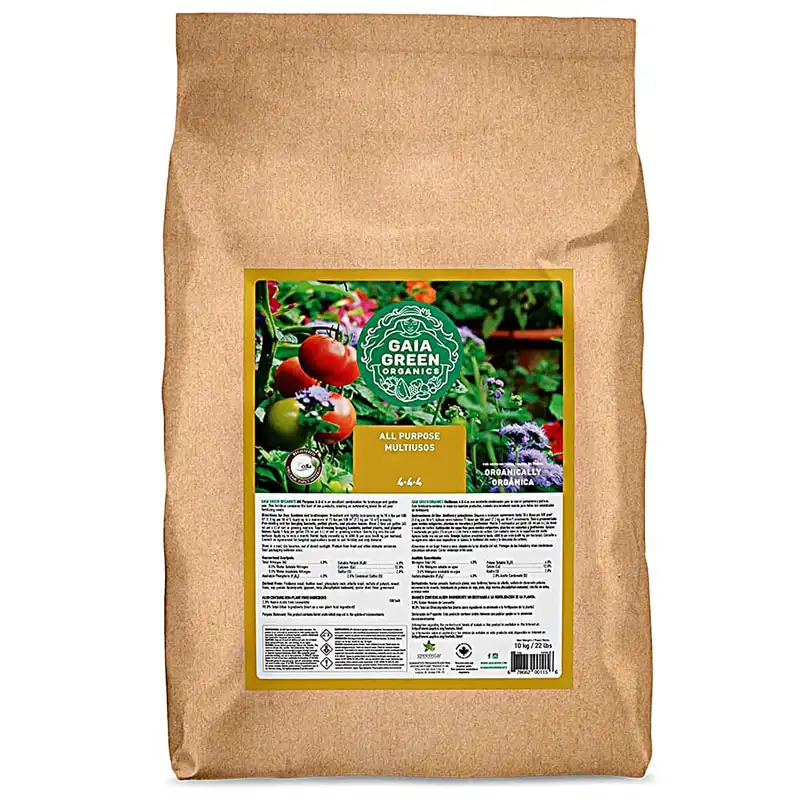
This is the bag best suited to feeding more than a couple of beds. The 22 pound size covers roughly 440 square feet at the standard rate. So it handles a decent market garden without a second trip. The blend runs high in organic matter, which helps sandy ground hold water and helps heavy clay drain. Nutrients come from ingredients with staggered release rates. That keeps it working well past the first month. Fair warning though: it throws serious dust. Wear a mask and pick a still morning to spread it.
Specs
- Form: dry granules
- Size: 10 kg (22.05 lb)
- Coverage: about 440 sq ft at garden rate
- Application: top dress, side dress, or incorporate
2. Gaia Green Organic All Purpose Fertilizer
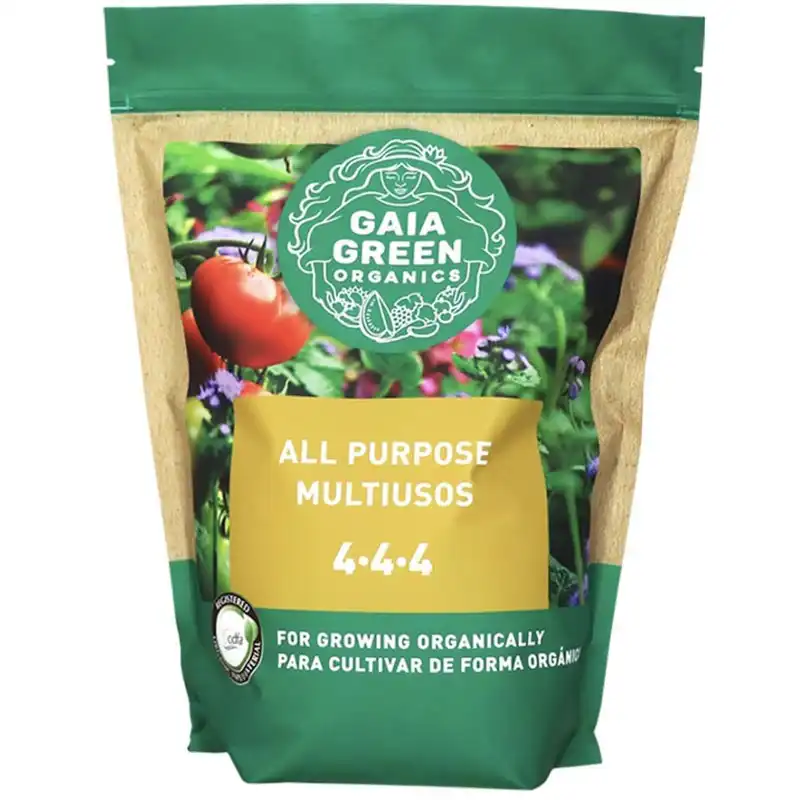
This is the fine powder form of the All Purpose blend, in a backyard-sized tub. The 4.4 pound bag covers close to 88 square feet at the full rate. That is roughly three raised beds. Growers consistently report better leaf color and heavier yields from it. What stands out to me is the smell, or the lack of one. Most organic blends announce themselves for days after spreading, and this one does not. It grinds finer than the bulk bag, so it works into potting mix cleanly. That fine texture also means you should mask up and skip windy afternoons.
Specs
- Form: dry blend
- Size: 2 kg (4.41 lb)
- Coverage: about 88 sq ft at garden rate
- Application: top dress or work into soil
3. TPS Plant Foods 4-4-4 Liquid Fertilizer
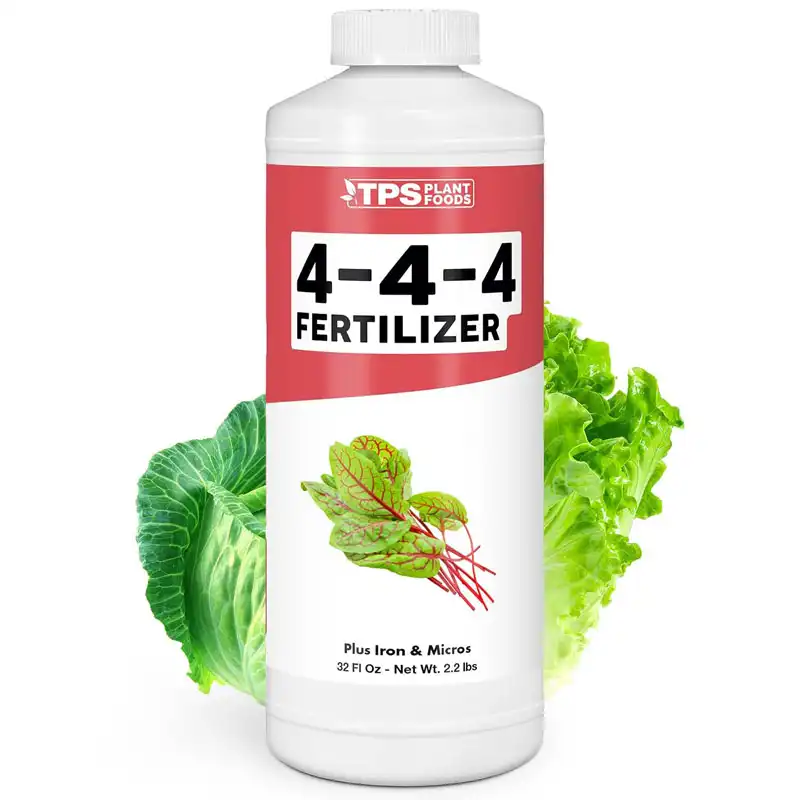
Liquid solves the one problem granules cannot: cold soil. Roots take up dissolved nutrients without waiting on microbes. Use it for early transplants and container crops. One quart makes 16 to 32 gallons at 1 to 2 ounces per gallon. An ounce covers about 50 square feet. It also carries iron, sulfur, copper, and manganese plus seaweed extract. Two things to know before you buy. It does not carry an organic listing, and it contains no magnesium. So heavy fruiting crops in containers will want a calcium-magnesium supplement alongside it.
Specs
- Form: liquid concentrate
- Size: 32 fl oz (1 quart)
- Dilution: 1 to 2 oz per gallon
- Shelf life: about 2 years stored cool
4. Jobe’s Organics All Purpose Granular Fertilizer
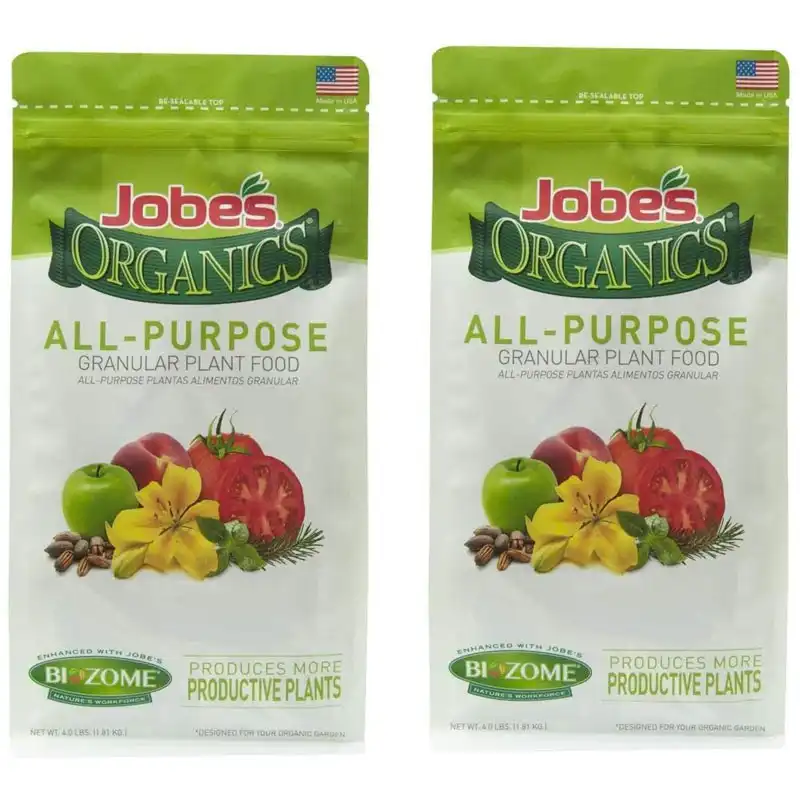
The selling point here is the Biozome additive. That is a microbial package meant to speed organic matter breakdown. It targets the real weakness of granular organic feeding, which is the lag before nutrients show up. The two-bag pack covers roughly 160 square feet at the standard rate. Jobe’s claims about 20% more coverage than comparable organic products. Reapply every four to six weeks through the season. It is not water soluble, so it needs incorporation and moisture to do anything. A few growers report gnats around the bag, which comes with the territory on meal-based products.
Specs
- Form: granules
- Size: two 4 lb bags
- Coverage: about 160 sq ft at garden rate
- Reapply: every 4 to 6 weeks
5. Burpee Natural Purpose Organic Granular Plant Food
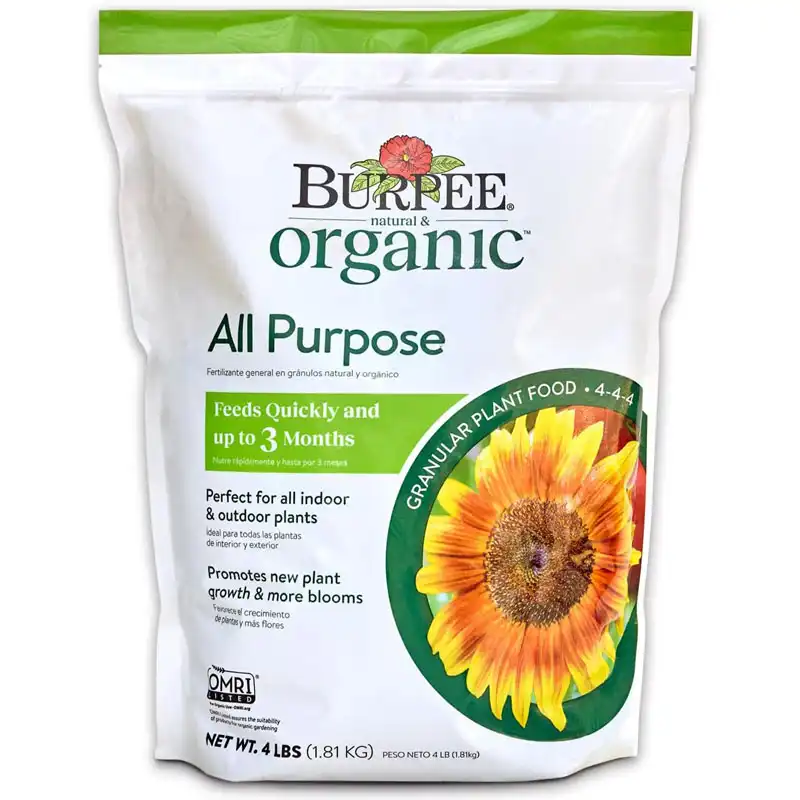
This is the cheapest way into a 4-4-4 program. The ingredient panel is honest too: composted poultry litter, feather meal, and sulfate of potash. Burpee rates the 4 pound bag at 120 to 213 square feet. That runs lighter than the extension rate math. It also carries calcium and beneficial microbes, and it keeps feeding for around three months. The catch is the smell. It runs strong for the first few days. The bag also throws enough dust to warrant gloves and a mask. Keep this one outdoors.
Specs
- Form: granules
- Size: 4 lb
- Coverage: 120 to 213 sq ft per label
- Ingredients: poultry litter, feather meal, sulfate of potash
6. HollandBasics 4-4-4 Organic All Purpose Fertilizer
This is the granulated form of the Gaia Green All Purpose blend, sold through a Canadian distributor. Granules broadcast far more evenly than the powder version, which matters on lawns and wider beds. The ingredient panel is the deepest of any bag here. Sixteen inputs go in, including feather meal, blood meal, fishbone meal, insect frass, humic acid, and glacial rock dust. One spec stands out. Of the 4% total nitrogen, 3% is water soluble. So it feeds faster than most meal-based blends. The listing claims Ecocert Canada approval, which is a Canadian standard rather than the OMRI seal.
Specs
- Form: granules
- Size: 2 kg (4.41 lb)
- Analysis: 4% N, 3% of it water soluble
- Label rate: about 4.4 lb per 100 sq ft
What to Look For Before You Buy
Start with the seal, then match the form to the job. Those two calls decide most of it.
Look for OMRI Listed, not “certified organic.” This trips up a lot of buyers. The USDA organic seal applies to food and fiber, not to fertilizer inputs. No federal standard governs the word organic on a fertilizer label. The Organic Materials Review Institute fills that gap. It reviews ingredients and manufacturing against National Organic Program standards. So the OMRI seal is the claim that carries weight.
Match the form to the season. Granules suit pre-plant feeding and long-season crops. Liquids suit cold soil, containers, and quick correction. Many growers run both.
Size the bag with math, not guesswork. Divide your square footage by 100, then multiply by 5. A 500 square foot garden needs about 25 pounds per full application.
Read the ingredient panel. Blood meal and poultry litter act fast. Bone meal and rock dust act slowly. The panel tells you more than the three numbers do.
Expect dust and odor. Meal-based products smell and throw dust. That is normal, not a defect. Gloves and a mask handle it.
Still weighing brands? This roundup of organic fertilizer picks for vegetable beds covers options outside this grade.
FAQs on 4-4-4 Fertilizers
Can 4-4-4 fertilizer burn plants?
How often should you apply 4-4-4 fertilizer?
Is 4-4-4 good for tomatoes?
Can you use 4-4-4 on a lawn?
Can you mix 4-4-4 with compost?
Does 4-4-4 fertilizer expire?
Where to Start on Your Ground
Test your soil first. Then spread 5 pounds per 100 square feet two weeks before planting and work it in. That single step puts you ahead of most gardeners using this grade.
After that, watch the crop rather than the calendar. Side dress heavy feeders when growth slows. Skip the ones already thriving. And pull a soil test every couple of seasons, so phosphorus does not creep up while you feed for nitrogen.