How to Fertilize Tomatoes: Rates, Timing, and Method
Tomato plants pull nutrients hard from first flower through last pick. Feed them wrong and you get tall vines carrying almost no fruit. Knowing how to fertilize tomatoes at the right rate and the right stage keeps growth balanced and fruit set steady all season.
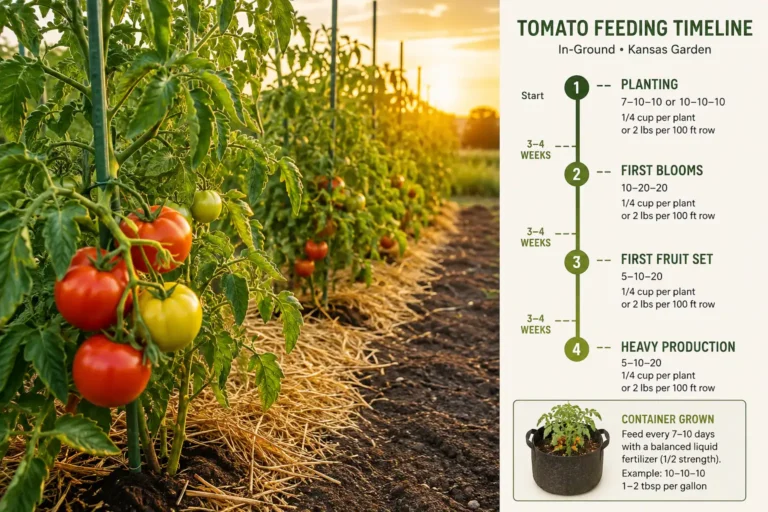
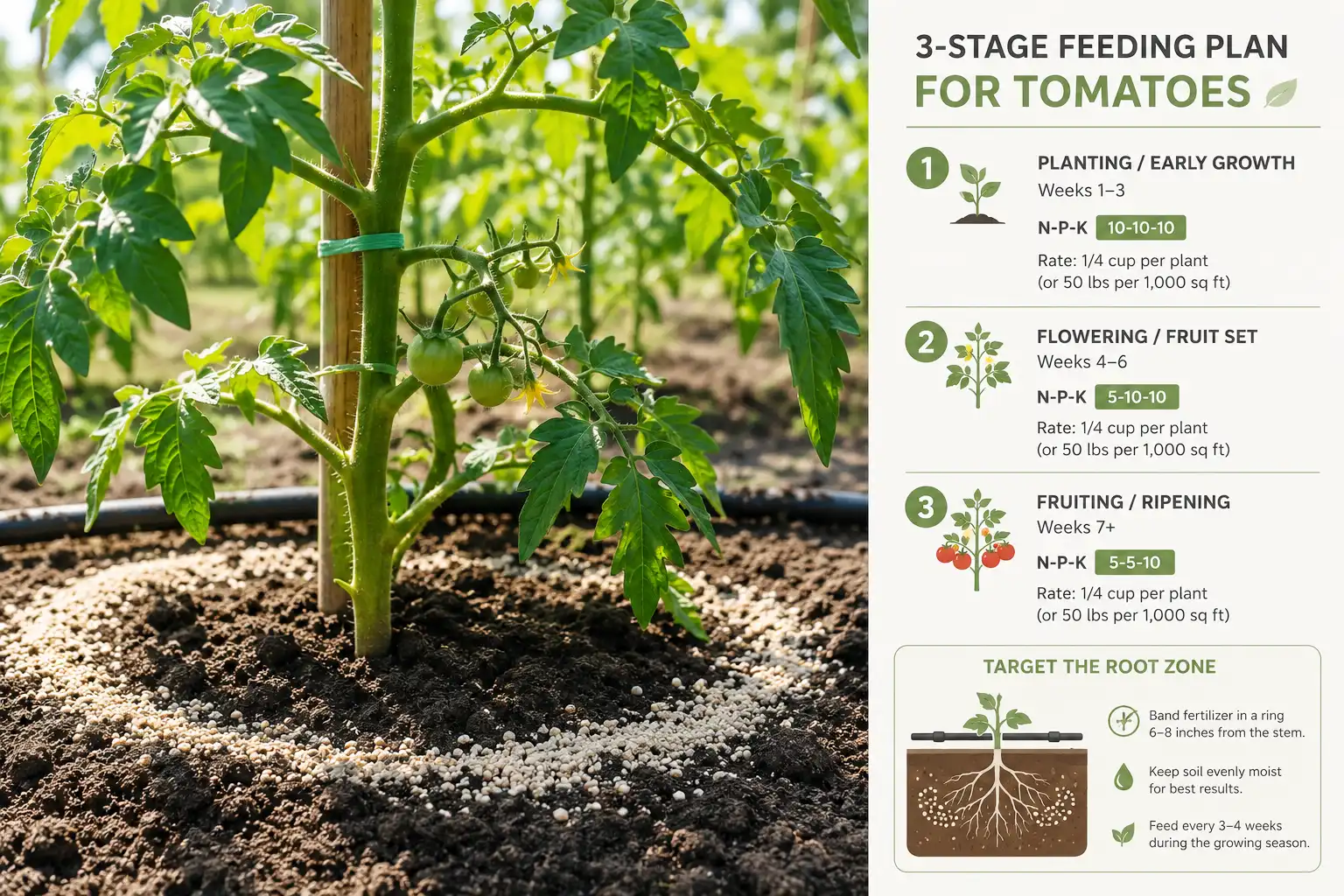
Fertilize tomatoes comes down to three passes. Work a low nitrogen, high phosphorus grade into the bed before planting. Water in a starter solution at transplant. Then sidedress at first fruit set and every three weeks after.
How to Fertilize Tomatoes Through the Season
Tomatoes need fertilizer at three points, and timing matters more than brand. Early nitrogen builds leaves. Late nitrogen builds leaves too, which is the problem. So you front load phosphorus and potassium, hold nitrogen back, then release it once fruit already sits on the vine.
Growers usually ask how and when to fertilize tomatoes in the same breath. Both answers sit in one table.
| Stage | Timing | What to apply | Rate |
|---|---|---|---|
| Bed prep | 1 to 2 weeks before setting plants | Low N, high P complete grade such as 8-32-16, 6-24-24, or 5-10-10 | 1 to 2 lb per 100 sq ft |
| Transplant day | Once soil holds above 60 degrees F | Starter solution, 2 tbsp of 5-10-10 in 1 gallon water | 1 pint per plant |
| First fruit set | First fruits at golf ball size | Calcium nitrate, or 10-10-10 | 3.5 lb calcium nitrate or 5 lb of 10-10-10 per 100 ft of row |
| Peak harvest | Every 3 to 4 weeks after the first sidedress | Same grade as the first sidedress | Same rate |
| Late season | 3 to 4 weeks before average first frost | Nothing | Stop nitrogen |
When to Stop Fertilizing Tomato Plants
Stop nitrogen three to four weeks ahead of your average first frost. Around Topeka that lands in mid September. After that date, extra nitrogen pushes shoots the plant cannot ripen. Determinate types finish earlier, so two sidedresses usually cover them. Indeterminate vines keep setting fruit, so they earn the full every three week schedule.
Learn more: Fertilizing Onions
Test Your Soil Before You Buy a Single Bag
A soil test tells you which of the three numbers you actually need. Tomatoes want a pH between 6.2 and 6.8. Inside that window, phosphorus and calcium stay available to roots. Below 6.0, both start locking up, and no amount of fertilizer fixes that.
Send a sample to your state lab. K-State Research and Extension runs one, and most land grant universities do the same for a small fee. Ask for pH, phosphorus, potassium, calcium, and organic matter. The same soil testing steps that work for a field crop work at bed scale.
Older garden ground often tests high in phosphorus already. Adding more does nothing and runs off with the next hard rain. East beds have grown vegetables for eleven seasons, so they get a maintenance rate near 1 lb per 100 sq ft instead of the full 2 lb.
What NPK Ratio Tomato Plants Need
Tomatoes need moderate nitrogen, high phosphorus, and medium to high potassium. University of Missouri Extension points to 8-32-16 and 6-24-24 as strong pre-plant grades. If your co-op stocks only basics, a 10-20-10 or 5-10-10 works at a slightly higher rate.
Nitrogen source matters as much as amount. Nitrate nitrogen helps calcium move into the plant. Ammonium nitrogen competes with calcium at the root surface. So skip urea and ammonium nitrate here, then reach for calcium nitrate at sidedress time. For a breakdown of tomato fertilizer choices by product type, that comparison covers granular, liquid, and organic picks.
Potassium earns real attention during fruit fill. Short potassium shows up as uneven ripening and pale yellow shoulders on otherwise red fruit. Kansas silt loams usually test adequate. Sandy ground and container mixes run short fast.
How Much Fertilizer to Use on Tomatoes
Rate follows your soil test. Absent one, here are the working numbers most extension programs land on.
- Pre-plant, no soil test: 1.5 to 2 lb of a complete garden grade per 100 sq ft, worked into the top 6 inches
- Pre-plant, fertility already good: 1 lb per 100 sq ft
- Per plant instead of per bed: one tomato covers about 5 sq ft, so divide the 100 sq ft rate by 20
- Sidedress: 0.5 lb of actual nitrogen per 100 ft of row, which equals 5 lb of 10-10-10 or 3.5 lb of calcium nitrate
- Field scale: roughly 150 lb of nitrogen per acre for the season, with 100 to 120 lb going on as a single sidedress
UC IPM adds one adjustment worth knowing. If soil nitrate nitrogen tests above 15 ppm in the top foot before sidedressing, cut that sidedress to 50 lb per acre. Anything past that gets wasted.
How to Apply Fertilizer to Tomato Plants
Three methods cover the whole season. Each one places nutrients somewhere different, so they are not interchangeable.
How to Apply Tomato Fertilizer Before Planting
Broadcast the granular across the bed, then till or spade it into the top 6 inches. Do this a week or two ahead so rain carries it down into the root zone. Phosphorus barely moves through soil, so a surface application does very little. Getting it down where roots will reach is the entire point.
Starter Solution at Transplant
Mix 2 tablespoons of the 5-10-10 grade or 5-10-5 into 1 gallon of water. Pour about 1 pint around each plant right after setting it. You can also pour 1 cup into the hole and let it soak in first. That small shot of soluble phosphorus drives root growth while soil is still cool. Cool spring soil is exactly when phosphorus uptake stalls, which is why transplants sometimes turn purple in May.
How to Add Fertilizer to Tomato Plants as a Sidedress
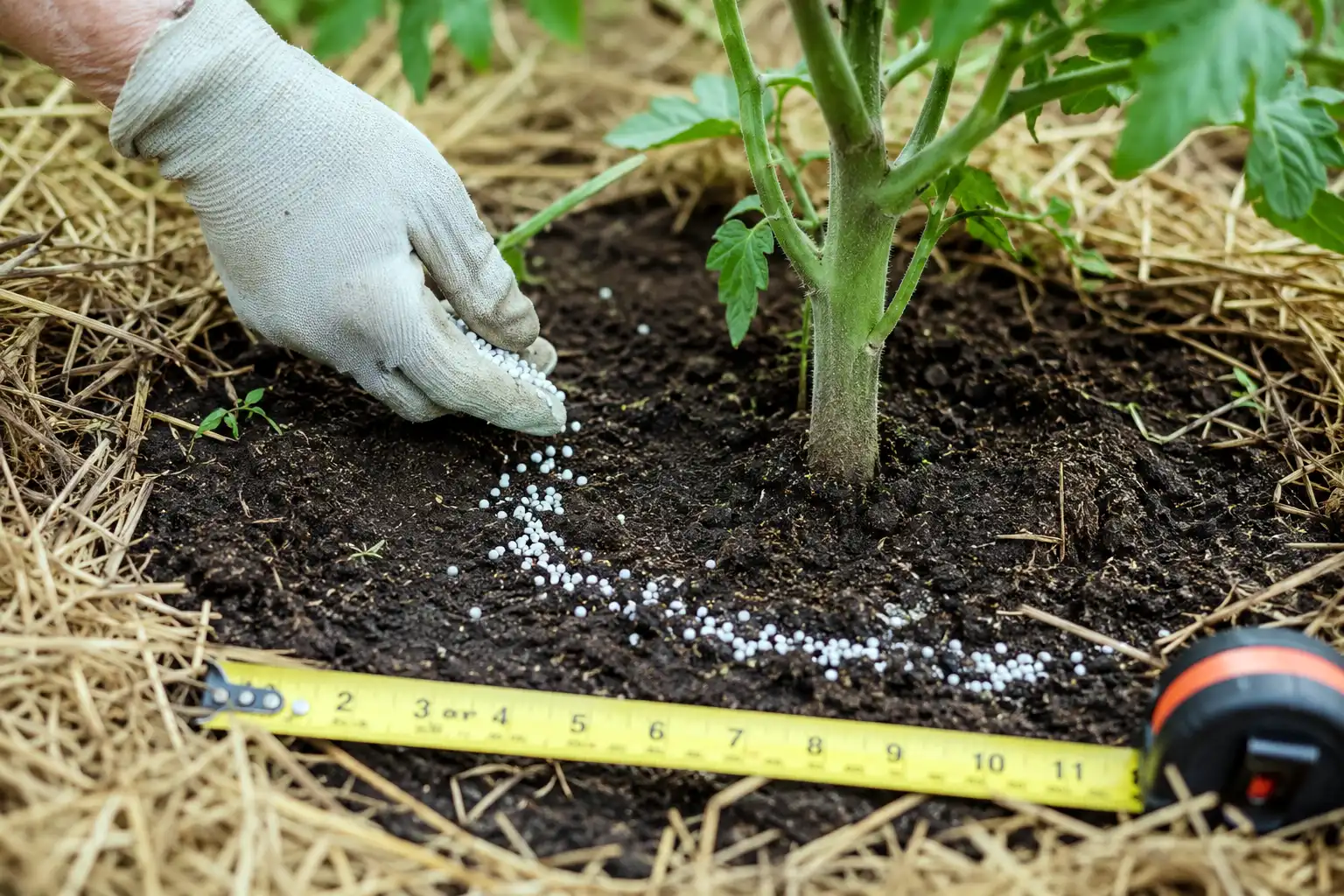
Wait until the first fruits reach golf ball size, then band the granular 6 inches out from the stem. Scratch it into the top inch of soil and water it in. Keep granules off the leaves, since fertilizer salt burns wet foliage. NDSU Extension is firm on this timing: do not sidedress until fruit has set. Feeding earlier grows vines instead of tomatoes.
How to Apply Liquid Fertilizer to Tomatoes
Mix liquid fertilizer to label strength, then pour it onto moist soil at the base of the plant. Dry soil plus concentrated fertilizer burns roots. So water first, feed second.
Liquid works fastest once a plant already shows a shortage. Pale lower leaves on a fruiting plant call for a soluble nitrogen source, and color usually returns within a week. Granular takes two to three weeks to show that same response.
Past a dozen plants, a hose end sprayer beats refilling watering cans. Set the dilution, walk the row, then drench the root zone rather than the canopy. Foliar feeding has a place for micronutrients, but roots take up nitrogen, phosphorus, and potassium far better than leaves do.
Skip liquid feeding during afternoon heat. Early morning gives the plant time to move nutrients before midday stress closes stomata down.
How to Fertilize Tomatoes in Containers and Grow Bags
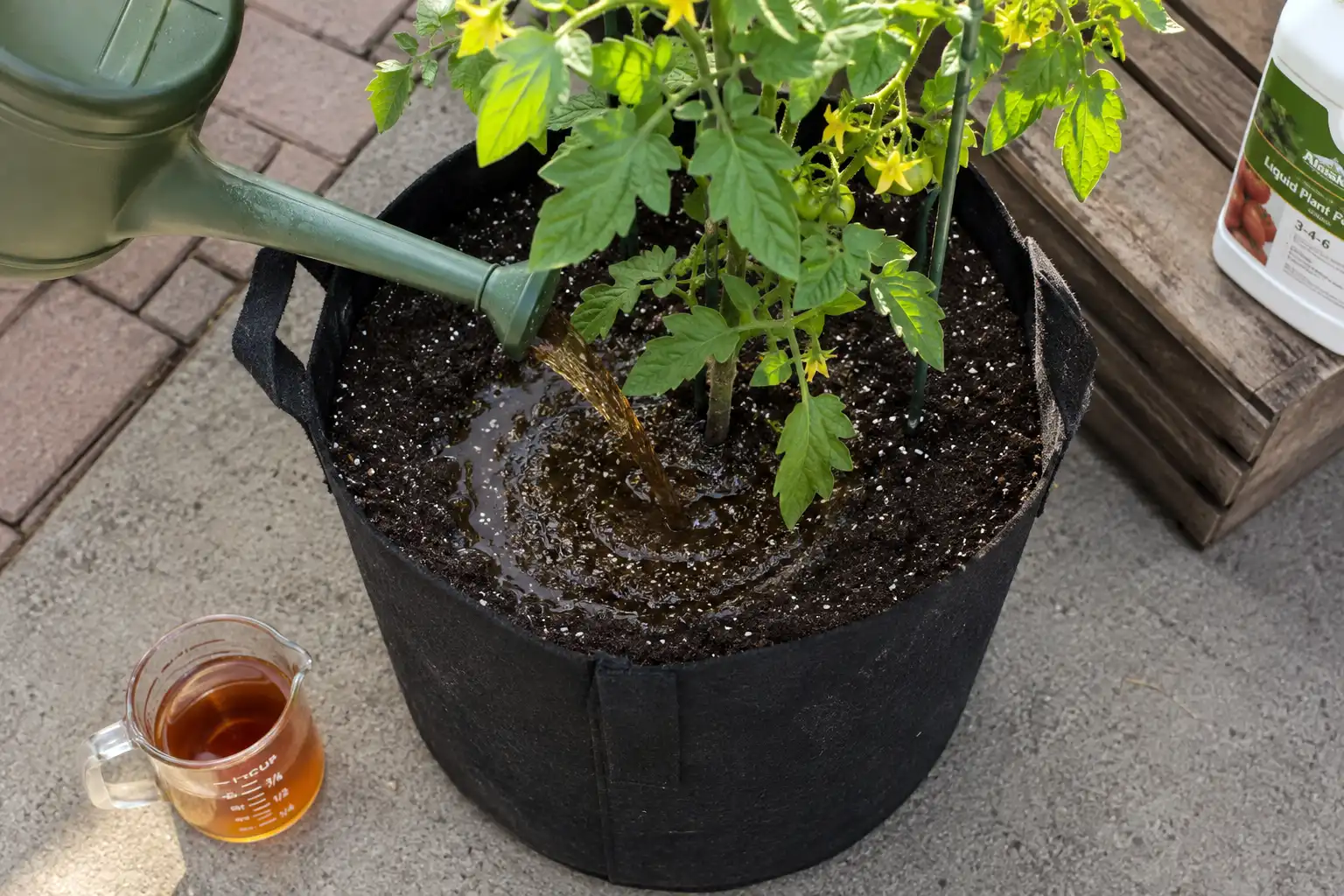
Container tomatoes need feeding more often than field plants, because every watering flushes nutrients out the drain holes. Mix a slow release granular into the potting mix at planting. Then start liquid feeding two to four weeks later.
Run half strength liquid every 7 to 10 days once flowers appear. University of Minnesota Extension recommends a low and often approach over heavy occasional doses, since light frequent feeding cuts leaching losses. Half a scoop weekly beats a full scoop every second week.
Watch for white crust on the mix surface or around the rim. That crust is salt buildup from accumulated fertilizer. Flush the container with plain water until it drains freely, then resume at half strength.
Pot size changes the schedule too. A 5 gallon bag needs weekly feeding. A 20 gallon container can stretch to every other week. The same rule applies to tomatoes grown in containers, whether bags, buckets, or half barrels.
How to Fertilize a Tomato Plant Organically
Organic feeding works well, but it runs on a slower clock. Soil microbes must break the material down before roots can use it. So put organic sources down earlier than you would a synthetic grade.
- Compost: 1 to 2 inches worked into the bed at prep, supplying slow nitrogen plus organic matter that holds moisture
- Bone meal: phosphorus for the planting hole, roughly 1 tablespoon per plant mixed into soil below the root ball
- Blood meal: fast organic nitrogen for a mid season correction, used sparingly
- Fish emulsion: liquid nitrogen ready within days, useful as a rescue feed for pale plants
- Sul-Po-Mag or greensand: potassium and magnesium for sandy ground
- Gypsum: 1 to 2 lb per 100 sq ft when a soil test shows low calcium at correct pH
Cold soil slows mineralization to a crawl. In zone 6a that means an April compost application releases little nitrogen until late May. Plan timing around that lag instead of fighting it.
Reading the Plant Before You Reach for the Bag
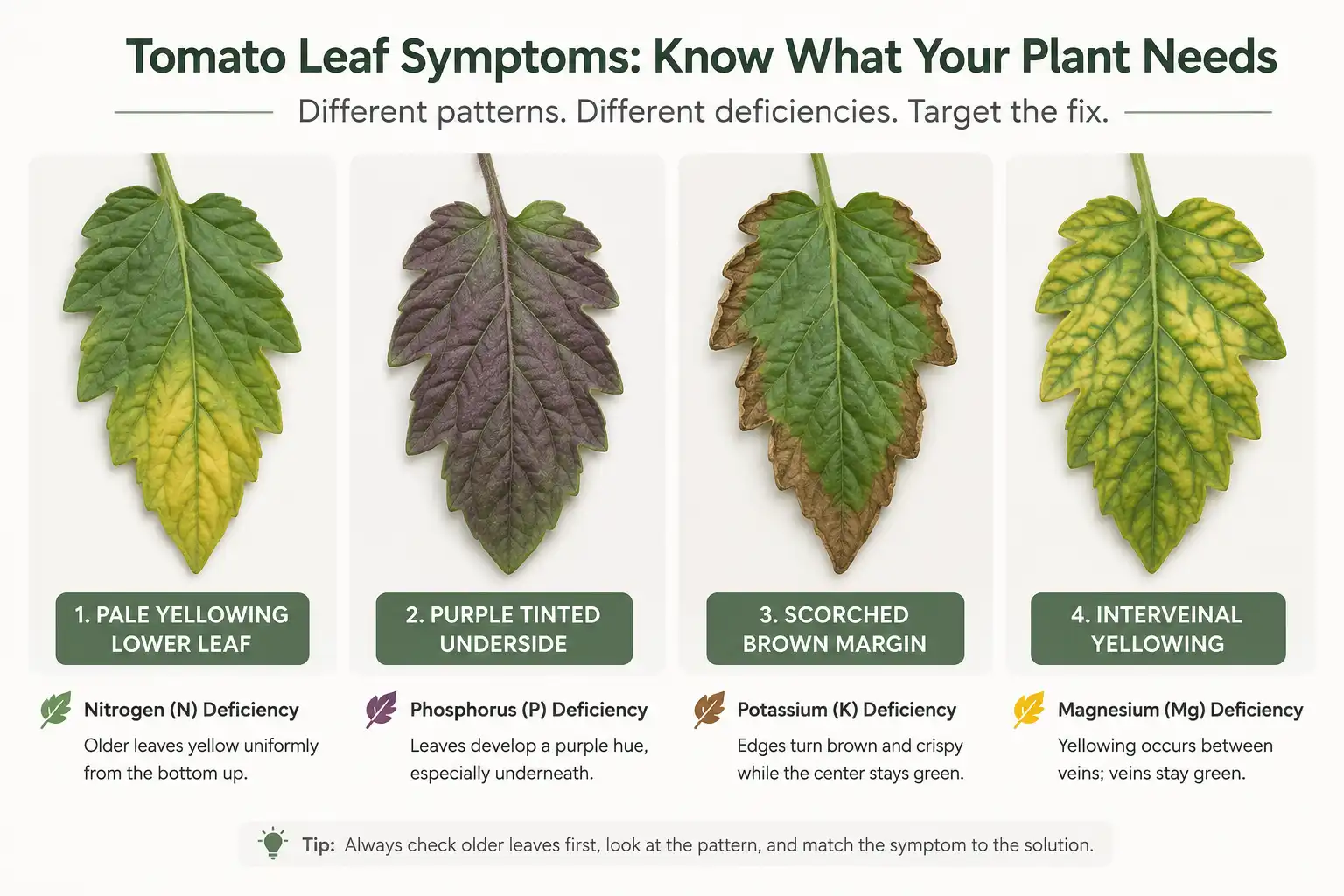
Leaf symptoms tell you what a plant is short on, and they beat guessing every time. Below is what each shortage looks like on a tomato.
| What you see | Likely cause | What to do |
|---|---|---|
| Pale green to yellow lower leaves, thin upright plant | Nitrogen short | Sidedress or liquid feed with a nitrate source |
| Purple tint on undersides of older leaves, stunted, slow to mature | Phosphorus short, often cool soil | Starter solution now, warmer soil helps |
| Browning or scorched leaf margins, yellow shoulders on fruit | Potassium short | Potassium sulfate sidedress |
| Yellowing between veins on older leaves, veins stay green | Magnesium short | Sul-Po-Mag or dolomitic lime per soil test |
| Mottled yellowing on new growth, veins stay green | Iron or manganese short, often high pH | Check pH before adding anything |
| Dark green lush vines, thick stems, few flowers | Too much nitrogen | Stop feeding, keep watering normally |
Excess nitrogen fools plenty of growers. The plant looks terrific. Then flowers drop, ripening drags, and fruit splits. So confirm the shortage before adding more of anything.
Why Fertilizer Choice Drives Blossom End Rot
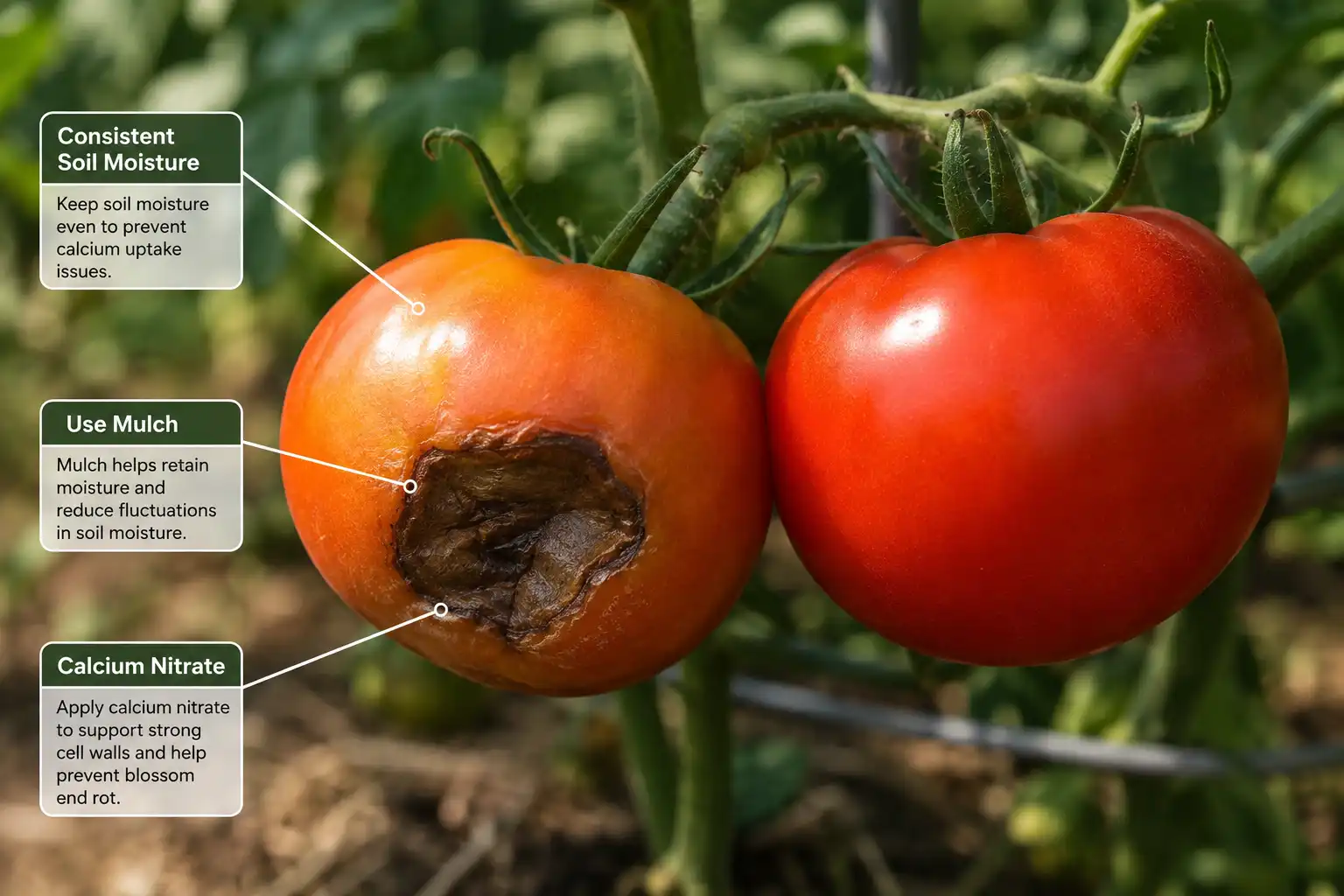
Blossom end rot starts when calcium fails to reach the fruit, and fertilizer decisions make that better or worse. Most soils already hold plenty of calcium. Water movement carries it, so uneven moisture is the real driver.
Three fertilizer habits raise your risk:
- Heavy ammonium nitrogen. Ammonium competes with calcium for root uptake, while calcium nitrate avoids that fight
- Overfeeding nitrogen. Lush leaves pull calcium away from developing fruit, so vines should look green rather than lush
- Sidedressing too early. Feeding before fruit set drives leaf growth at exactly the wrong moment
Hold pH near 6.5 so calcium stays available. Then mulch to keep soil moisture steady. Pair that with steady water on your tomatoes instead of a heavy soaking after every dry spell.
Epsom salts do not fix blossom end rot. Epsom salt is magnesium sulfate, and excess magnesium can actually reduce calcium uptake. So apply it only when a soil test shows magnesium running low.
FAQs About Fertilizing Tomato Plants
How much to fertilize tomatoes if I skipped the soil test?
Can I use lawn fertilizer on tomato plants?
How do I fertilize my tomato plants without burning them?
Should determinate and indeterminate tomatoes get different feeding?
Does more fertilizer mean more tomatoes?
Final Thoughts
Three passes, then stop. A low nitrogen grade goes in during bed prep. A starter solution goes on transplant day. Calcium nitrate follows once the first fruits hit golf ball size, and again every three weeks until mid September. A soil test sets the rate, and the plants show whether it was set right. Green but not lush stays the target.