10 20 20 Fertilizer: What It Feeds, When to Use It, and Top Picks
10-20-20 fertilizer carries twice as much phosphate and potash as nitrogen. That ratio earns its keep on some ground and wastes money on the rest. Below is how to read a soil test, figure the rate, and pick a bag worth hauling home.
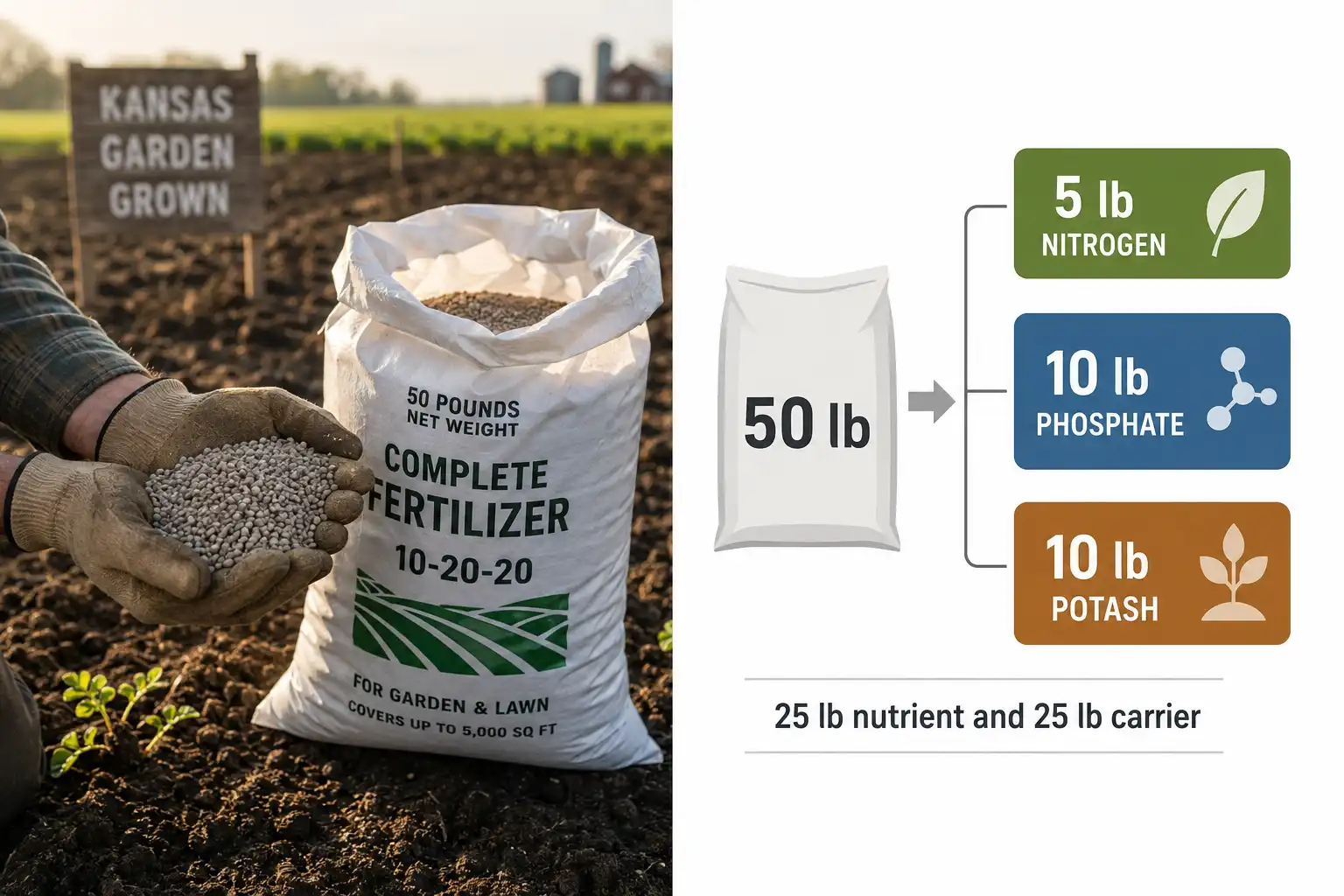
10-20-20 fertilizer supplies 10% nitrogen, 20% available phosphate, and 20% soluble potash. A 50-pound bag holds 5 pounds of nitrogen, 10 of phosphate, and 10 of potash. Use it when a soil test shows phosphorus and potassium running low.
What Is 10-20-20 Fertilizer?
10-20-20 fertilizer is a dry blend guaranteeing 10% total nitrogen, 20% available phosphate, and 20% soluble potash by weight. Those three numbers cover half the bag. The other half is carrier material that spreads the nutrients evenly across your ground.
Here is what that means in pounds.
| Bag size | Nitrogen (N) | Phosphate (P2O5) | Potash (K2O) | Total nutrient | Carrier |
|---|---|---|---|---|---|
| 50 lb | 5.0 lb | 10.0 lb | 10.0 lb | 25.0 lb | 25.0 lb |
| 40 lb | 4.0 lb | 8.0 lb | 8.0 lb | 20.0 lb | 20.0 lb |
| 25 lb | 2.5 lb | 5.0 lb | 5.0 lb | 12.5 lb | 12.5 lb |
| 10 lb | 1.0 lb | 2.0 lb | 2.0 lb | 5.0 lb | 5.0 lb |
One detail trips up plenty of growers. The second and third numbers are not raw phosphorus and potassium. They report oxide forms, so multiply phosphate by 0.44 for actual phosphorus and potash by 0.83 for actual potassium. A 50-pound bag therefore delivers about 4.4 pounds of phosphorus and 8.3 pounds of potassium. Our guide to NPK ratios for row crops walks through the math behind those labels.
Most dry blends at this grade build the phosphate from monoammonium phosphate and the potash from muriate of potash. Some use sulfate of potash instead. Check the guaranteed analysis panel, because the potash source matters on chloride-sensitive crops.
What Does Each Number in 10-20-20 Actually Do?
Each number feeds a different part of the plant. The 1-2-2 ratio tilts this bag toward roots and fruit, not leaves.
The 10% Nitrogen
Nitrogen drives leaf and stem growth and puts color in the canopy. At 10%, this grade offers a maintenance dose rather than a push. Corn, wheat, and leafy greens all need far more nitrogen than this grade supplies. So plan a separate nitrogen source for those crops.
The 20% Phosphate
Phosphate feeds root development, early vigor, and energy transfer inside the plant. It barely moves in soil, so placement matters more than timing. Cold spring ground also slows uptake. That is why phosphorus deficiency shows as purple seedlings in April, then fades by June.
The 20% Potash
Potash handles water regulation, stalk strength, and stress tolerance. It also drives quality traits growers get paid on. Potato specific gravity, tomato firmness, and standability in corn all trace back to potassium supply.
When Does 10-20-20 Fertilizer Make Sense?
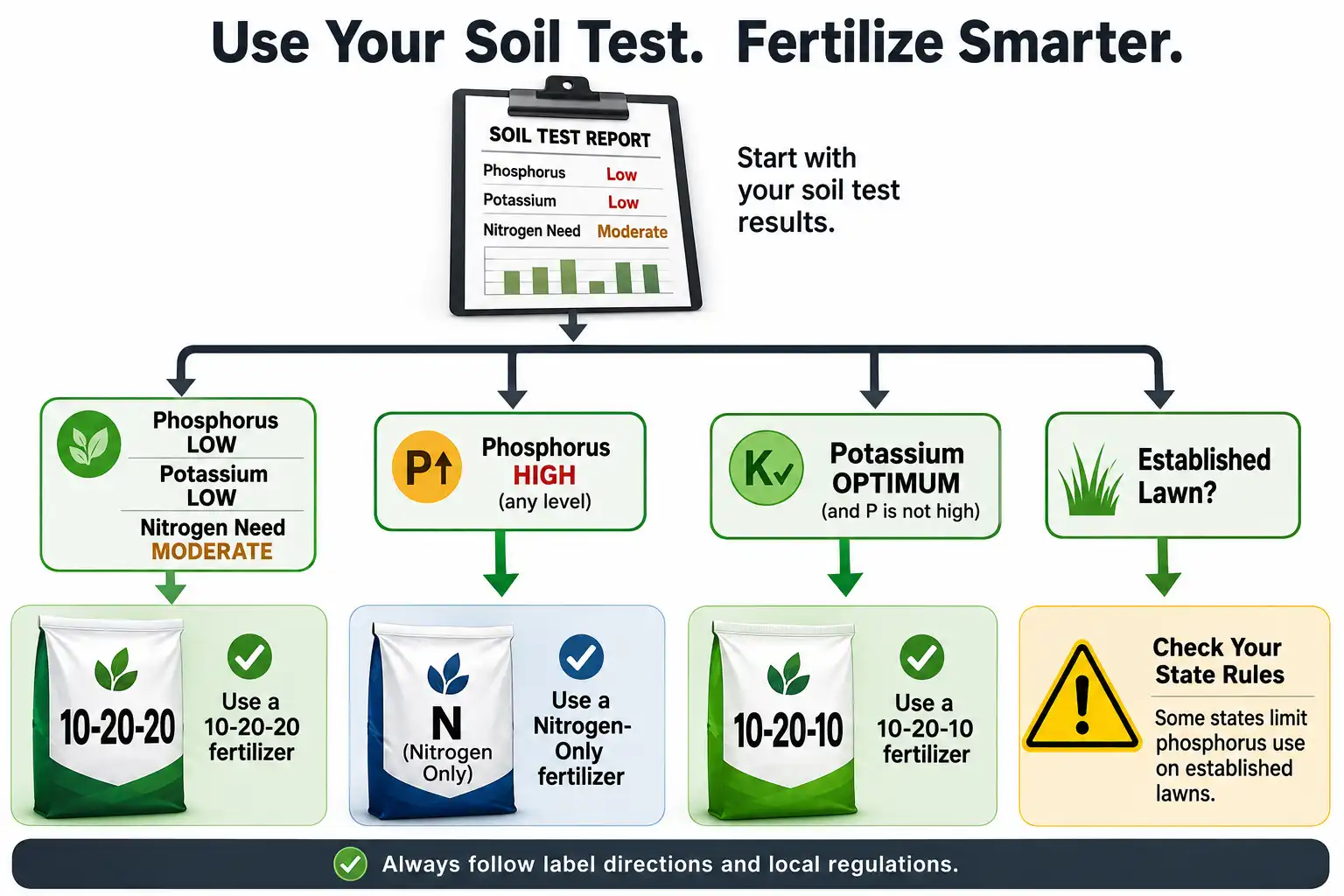
10-20-20 fertilizer makes sense when a soil test shows phosphorus and potassium testing low or medium. Nitrogen needs stay modest, or come from another source. Outside of that, you are buying nutrients your ground already holds.
Pull a soil sample before you buy anything. Sample the top 6 inches. Mix 10 to 15 cores per field or bed. Then send it to a lab reporting Bray P-1 or Mehlich-3 phosphorus. Gardens deserve a test every two or three years. Fields deserve one every rotation. A soil test kit you can pull samples with costs a fraction of one wasted bag.
K-State Research and Extension puts the response threshold plainly. When soil test phosphorus sits below 20 ppm, there is a strong chance phosphorus fertilizer pays. Above the optimum range, the yield response flattens out.
Situations where this grade fits:
- New lawn seeding or sod, where starter phosphate really helps
- Pre-plant vegetable beds testing low in both phosphorus and potassium
- Transplant setting for tomatoes, peppers, and eggplant
- Broadcast phosphorus and potassium rebuild on fields where nitrogen comes separately
- Orchards, vineyards, and bramble rows on low-potassium ground
Situations where it does not:
- Soils already testing high or very high in phosphorus
- Leafy crops that mostly want nitrogen
- Established lawns in states restricting phosphate
- Any sidedress or in-season nitrogen pass
Which Crops Benefit Most From 10-20-20 Fertilizer?
Fruiting crops and root crops on low-testing ground get the most out of 10-20-20 fertilizer. Both pull heavy potassium, and both respond to early phosphorus.
Tomatoes and peppers. Set transplants into ground carrying enough phosphate and potash, then follow with nitrogen once fruit sets. This grade covers the pre-plant side well, but it does not carry a full season alone. This breakdown on how to fertilize tomatoes through fruit set lays out the follow-up schedule.
Potatoes and sweet potatoes. Potatoes pull more potassium than almost anything else in the garden. One caution though. University of Minnesota Extension reports lower specific gravity in potatoes fed potassium chloride. Potassium sulfate often finishes tubers denser. If you grow for frying or chipping, check the potash source on the tag.
Carrots, beets, and onions. Root crops respond to available phosphorus during early root sizing. Keep nitrogen moderate, or you grow tops instead of roots.
Grapes and fruit trees. Work it into the root zone before establishment. After that, most bearing vines want potassium and nitrogen more than phosphate.
Field crops. This blend carries broadcast phosphorus and potassium ahead of corn or soybeans. The nitrogen program always runs separately.
How Much 10-20-20 Fertilizer Do You Need?
Figure the rate from whichever nutrient your soil test flags hardest. Then check what the other two bring along. The formula stays the same every time.
Pounds of product = pounds of nutrient needed ÷ (percent of that nutrient ÷ 100)
Say your report calls for 40 pounds of phosphate per acre. Divide 40 by 0.20 and you get 200 pounds of product per acre. That same 200 pounds also drops 20 pounds of nitrogen and 40 pounds of potash.
Garden and Raised Bed Rates
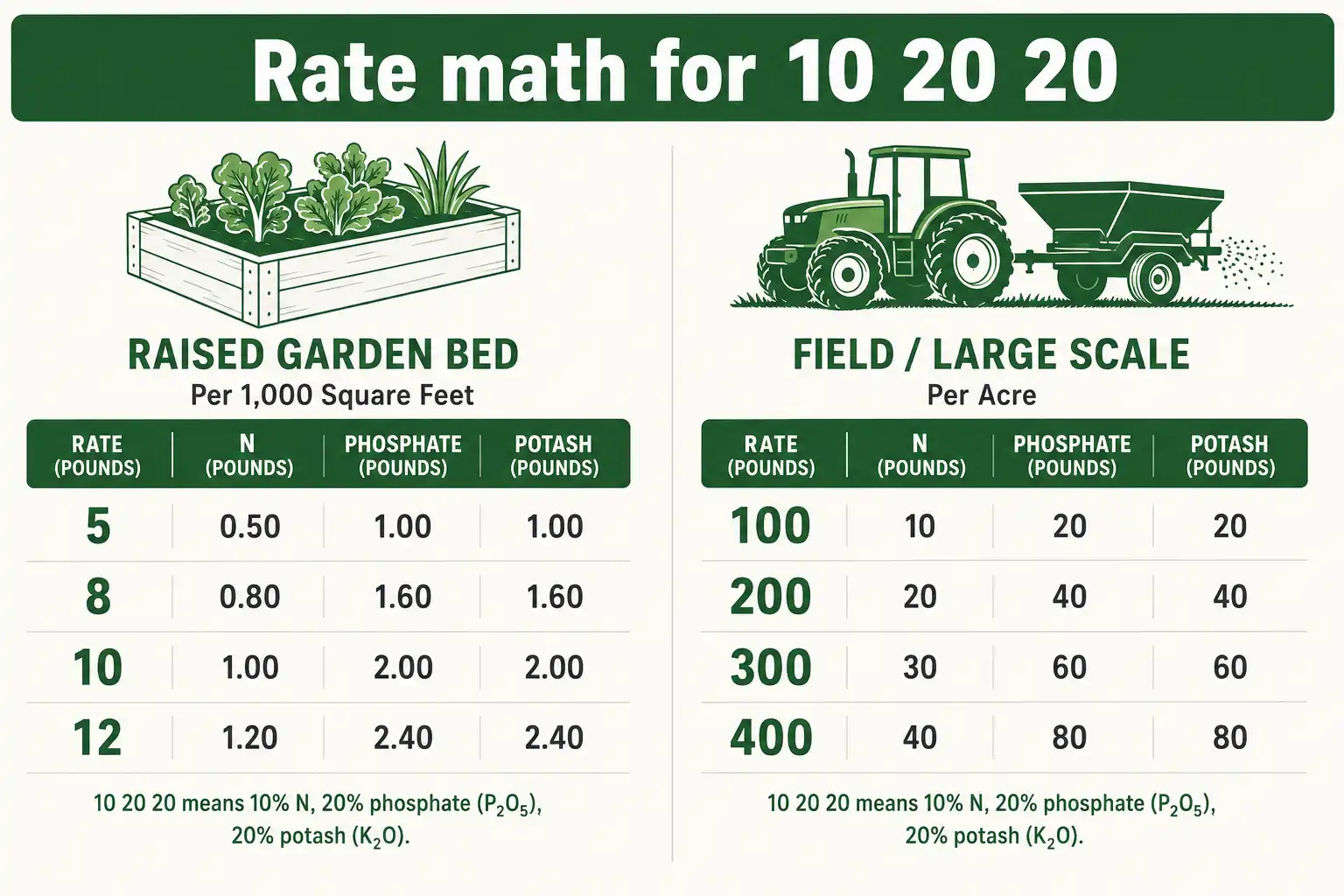
Ten pounds per 1,000 square feet delivers 1 pound of nitrogen. It also drops 2 pounds each of phosphate and potash. Most pre-plant garden recommendations on low-testing ground land between 8 and 12 pounds per 1,000 square feet.
| Rate per 1,000 sq ft | Nitrogen | Phosphate | Potash | Acre equivalent |
|---|---|---|---|---|
| 5 lb | 0.5 lb | 1.0 lb | 1.0 lb | 218 lb/acre |
| 8 lb | 0.8 lb | 1.6 lb | 1.6 lb | 348 lb/acre |
| 10 lb | 1.0 lb | 2.0 lb | 2.0 lb | 435 lb/acre |
| 12 lb | 1.2 lb | 2.4 lb | 2.4 lb | 523 lb/acre |
Two conversions save a lot of guessing. One pound per 1,000 square feet equals roughly 43.5 pounds per acre. So when a lab reports pounds per acre, divide by 43.5 to get your small-plot rate. Missouri Extension also offers a handy field measure: two cups of dry fertilizer weighs about one pound.
Field and Per-Acre Rates
| Rate per acre | Nitrogen | Phosphate | Potash |
|---|---|---|---|
| 100 lb | 10 lb | 20 lb | 20 lb |
| 200 lb | 20 lb | 40 lb | 40 lb |
| 300 lb | 30 lb | 60 lb | 60 lb |
| 400 lb | 40 lb | 80 lb | 80 lb |
Watch the nitrogen column as rates climb. At 400 pounds per acre you have only 40 pounds of nitrogen, which falls far short of what corn needs. The phosphate and potash, meanwhile, hit 80 pounds each. That imbalance is exactly why this grade works as a phosphorus and potassium carrier rather than a complete program.
How Do You Apply 10-20-20 Fertilizer?
Broadcast it and work it into the top 4 to 6 inches before planting. Or band it 2 inches to the side and 2 inches below the seed. Both placements put phosphate and potash where roots find them.
Here is the sequence.
- Pull a soil test and read the phosphorus and potassium recommendation.
- Convert that recommendation into pounds of product using the formula above.
- Calibrate on a measured strip before you cover the whole field, since granule size changes throw rate off. Running a spreader built for fertilizer granules makes that step far easier.
- Split the rate and make two half-rate passes at right angles. Skips and streaks disappear that way.
- Incorporate with a tiller, disk, or field cultivator. Phosphorus and potassium barely move once they land, so surface granules stay right where they fall.
- Water in a quarter to half an inch if rain is not coming, especially with powder blends.
Why In-Furrow Placement Is Skipped With This Grade
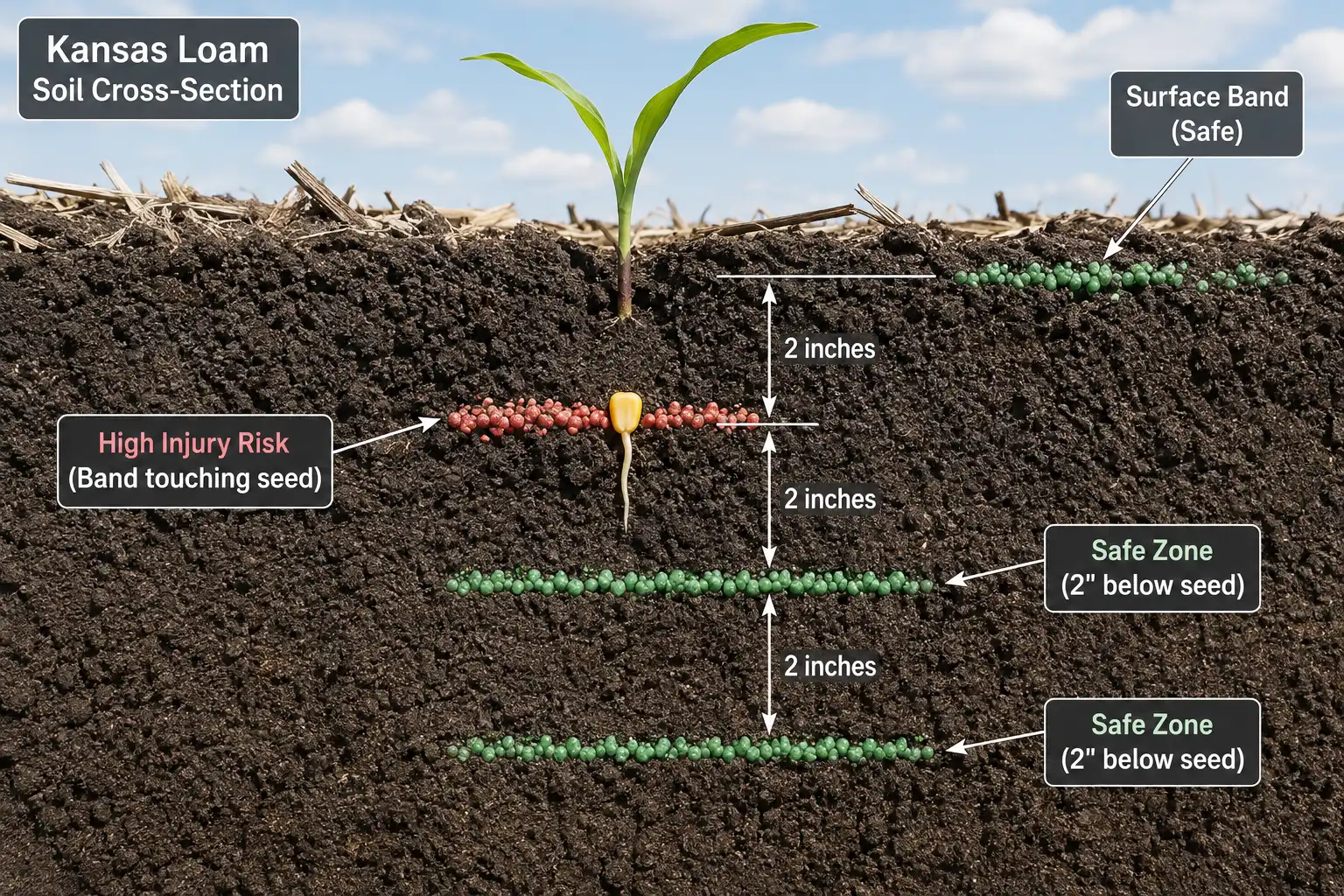
10-20-20 puts 30% of the bag into nitrogen plus potassium, and that combination burns seed. K-State research puts the injury threshold at 6 to 8 pounds of nitrogen plus potassium in direct seed contact. That figure covers 30-inch rows. At just 25 pounds of product per acre you already hit 7.5 pounds combined. Yet that rate delivers only 5 pounds of phosphate. The numbers simply do not work.
Kansas irrigated corn trials near Scandia showed what happens when growers push it. Plots with no starter, a 2×2 band, or a surface band finished around 30,000 to 31,000 plants per acre. In-furrow starter dropped the stand to roughly 25,000, and a heavier in-furrow rate cut it past 20,000. Move the fertilizer 2 inches over and 2 inches down, and the salt problem goes away.
Powder Versus Granular
Powder blends dissolve fast and settle into soil quickly. They also drift on a breezy day and cake up in humid storage. Granules meter cleanly through a broadcast or drop spreader and stay put in the hopper. For beds under a few hundred square feet, powder works fine. Past that, granules save real time.
Storage Between Seasons
Keep partial bags sealed, dry, and off a concrete floor. Dry blends pull moisture straight out of the air and set up into bricks. A sealed tote in a shed holds them fine through a Kansas winter.
Does the High Phosphate in 10-20-20 Really Mean More Blooms?
No. Flowering responds to day length, temperature, plant age, and hormones, not to extra phosphate in the soil. That “bloom booster” reputation on high-phosphorus grades oversells what the nutrient actually does.
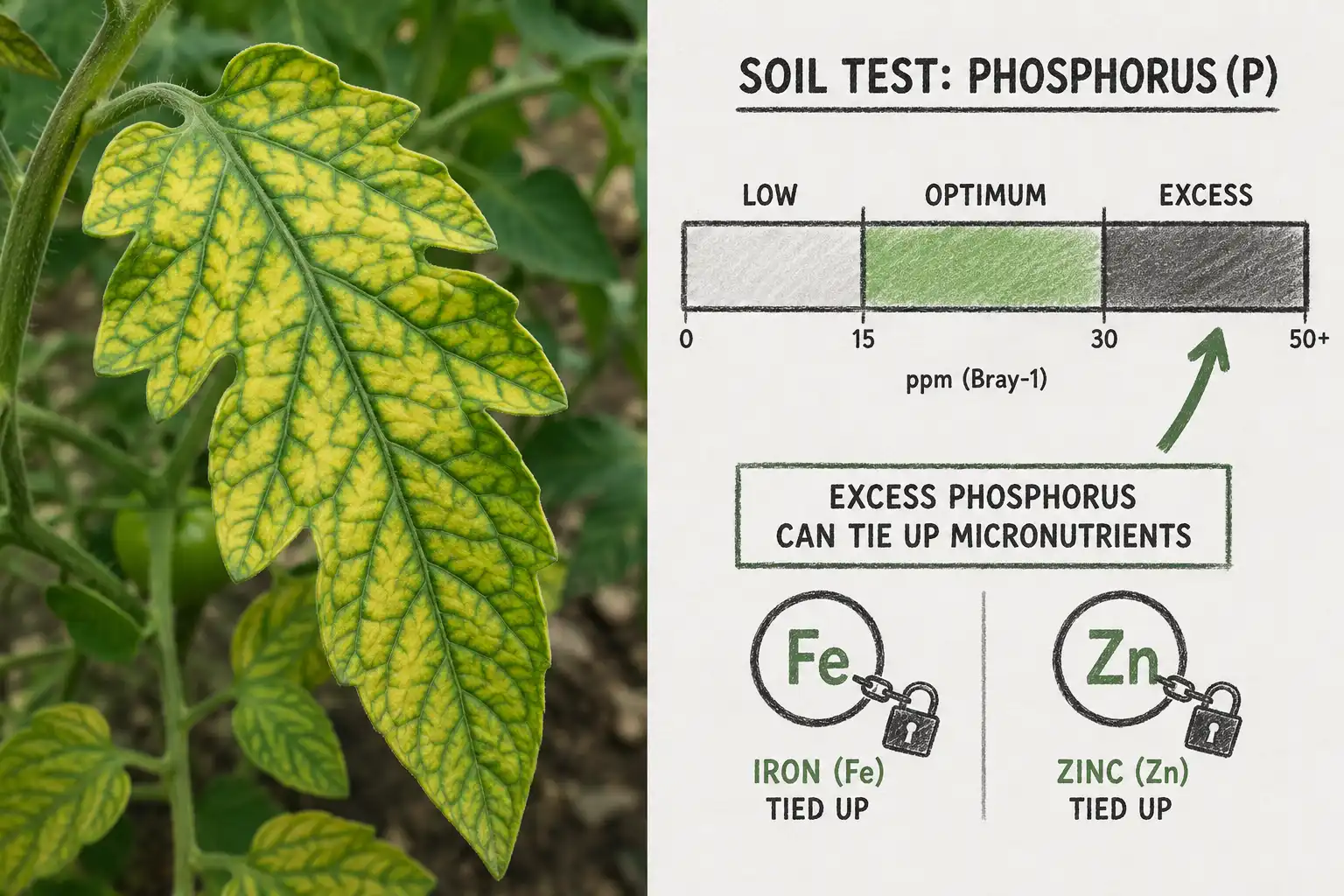
NDSU Extension states it directly. High phosphorus fertilizers do not necessarily produce more flowers. Most garden soils already carry plenty of phosphorus. Where phosphorus really runs short, adding it fixes stunted growth and delayed flowering. Past sufficiency, more phosphate buys nothing.
Worse, surplus phosphorus creates its own trouble. Excess soil phosphorus ties up iron and zinc, which shows up as yellowing between leaf veins and stalled growth. Cornell turf research found no performance gain above 4 ppm soil phosphorus on the Morgan test. So a grade like this belongs on ground that tests low, not on ground you simply want blooming harder.
Where 10-20-20 Fertilizer Goes Wrong
Most problems with this grade start with skipping the soil test. The rest come from spreading it where the law says no.
Established lawns in phosphorus-restricted states. About a dozen states restrict phosphate on turf. Most allow it only when a soil test documents deficiency. Minnesota led the way. Michigan, New York, Maryland, Washington, Virginia, Vermont, New Jersey, Maine, Illinois, and Pennsylvania followed. Florida adds county ordinances on top. New seeding and sod establishment usually stay exempt. Check your state rules before you spread a 20% phosphate product on an established lawn.
Water quality. Phosphorus feeds algae once it reaches a lake or stream. Saturated ground and heavy rain move it fast, so timing and incorporation both matter.
Trusting bag coverage claims. Run the arithmetic yourself. A 50-pound bag at 10% nitrogen holds 5 pounds of nitrogen. At 1 pound of nitrogen per 1,000 square feet, that bag covers 5,000 square feet, not more. Some tags list wider coverage figures, which simply means a lighter nitrogen rate than the headline suggests.
Chloride on sensitive crops. Muriate of potash carries chloride. Potatoes, tobacco, and some tree fruits show sensitivity, so sulfate-based potash suits those better.
Buying by ratio instead of by report. The ratio on the bag tells you nothing about your dirt. The lab report does.
How Does 10-20-20 Compare to Other Fertilizer Grades?
10-20-20 sits between a general-purpose blend and a phosphorus-heavy rebuild grade. It matches a balanced 20-20-20 on phosphate and potash, but carries half the nitrogen. At the same spread rate, it doubles the phosphate and potash of an even 10-10-10 blend.
Sometimes nitrogen already sits fine while phosphorus and potassium run short. A low nitrogen 3-18-18 mix pushes further in that direction.
| Grade | Ratio | Per 50 lb bag (N / P2O5 / K2O) | Where it fits |
|---|---|---|---|
| 10-20-20 | 1-2-2 | 5 / 10 / 10 | Low P and K ground, fruiting and root crops |
| 10-10-10 | 1-1-1 | 5 / 5 / 5 | Maintenance where all three test medium |
| 5-10-10 | 1-2-2 | 2.5 / 5 / 5 | Same ratio at half strength, gentler on seedlings |
| 3-18-18 | 1-6-6 | 1.5 / 9 / 9 | P and K rebuild with almost no nitrogen |
| 20-20-20 | 1-1-1 | 10 / 10 / 10 | Water-soluble feeding and fertigation |
| 0-20-20 | 0-1-1 | 0 / 10 / 10 | Legumes and pastures that fix their own nitrogen |
Notice the pattern. Ratio tells you the balance, and the analysis tells you the strength. Two bags can share a 1-2-2 ratio and still differ by half in what they actually deliver.
Best 10-20-20 Fertilizer Products Worth Considering
Two products cover most situations at this grade. One is a powder for beds and trees. The other is a granular bag for larger ground.
Supply Solutions Power Bloom 10-20-20
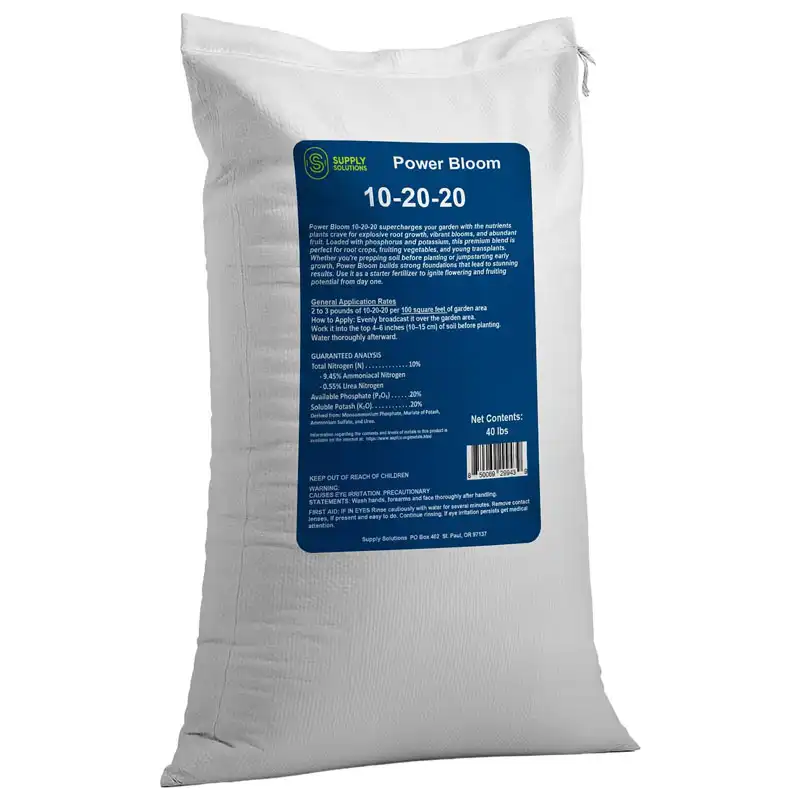
This one comes as a fine powder rather than a pellet, which changes how you handle it. Powder settles into loose bed soil fast and waters in without sitting on the surface for days. It works well across vegetable beds, flowering shrubs, and young fruit trees when hand-spreading is already the method. The smaller bag sizes suit a garden that never finishes a 50-pound sack in one season. Wind is the catch. Pick a calm morning, spread it, then work it in and water.
Specs: Powder form; 40 lb bag plus 5, 10, and 25 lb options; labeled for vegetables, ornamentals, and fruit trees; hand or shovel application
10-20-20 Camp Fertilizer, 50 lb
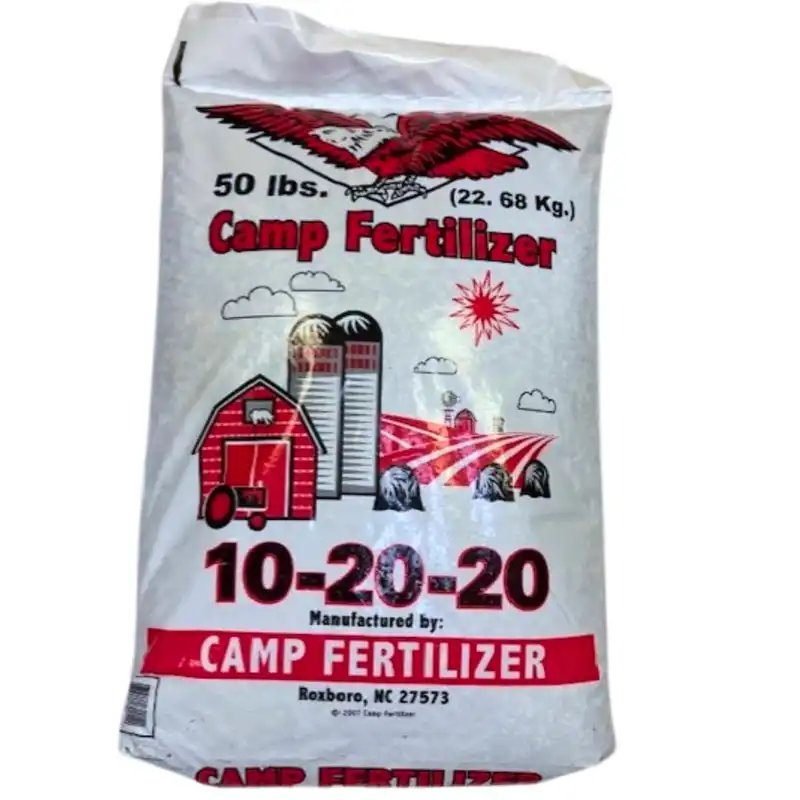
This is the granular version of the same grade. It suits ground you cover with a spreader or behind a tractor. Even granule sizing matters more than growers expect, because inconsistent pellets throw an uneven pattern and stripe the field. A 50-pound bag delivers 5 pounds of nitrogen, 10 of phosphate, and 10 of potash. That covers 5,000 square feet at a 1 pound nitrogen rate. Read the coverage figure on any tag against that math before you plan your passes.
Specs: Granular; 50 lb bag; broadcast spreader application; 10% N, 20% phosphate, 20% potash
FAQs About 10-20-20 Fertilizer
How often should you apply 10-20-20 fertilizer?
Can 10-20-20 fertilizer burn plants?
Is 10-20-20 the same as 10-20-10?
Does 10-20-20 fertilizer work for lawns?
Bottom Lines
Keep this grade around for one job. It rebuilds phosphorus and potassium on ground that tests low, before anything goes in. It shines on transplant beds, potato rows, and new seedings. And it falls flat as a season-long program, because 10% nitrogen never keeps up with a hungry crop.
So test first, calculate the rate from the nutrient you actually need, and keep the granules off your seed. Do those three things and this bag pays for itself. Skip them and you are just paying to raise a soil test number that was already fine.