When to Spray Fungicide on Soybeans (R3 Timing Guide)
Knowing when to spray fungicide on soybeans comes down to growth stage, disease pressure, and weather. The beginning pod stage, called R3, is the most reliable window for most foliar diseases. White mold is the main exception, and some diseases do not respond to spraying at all.
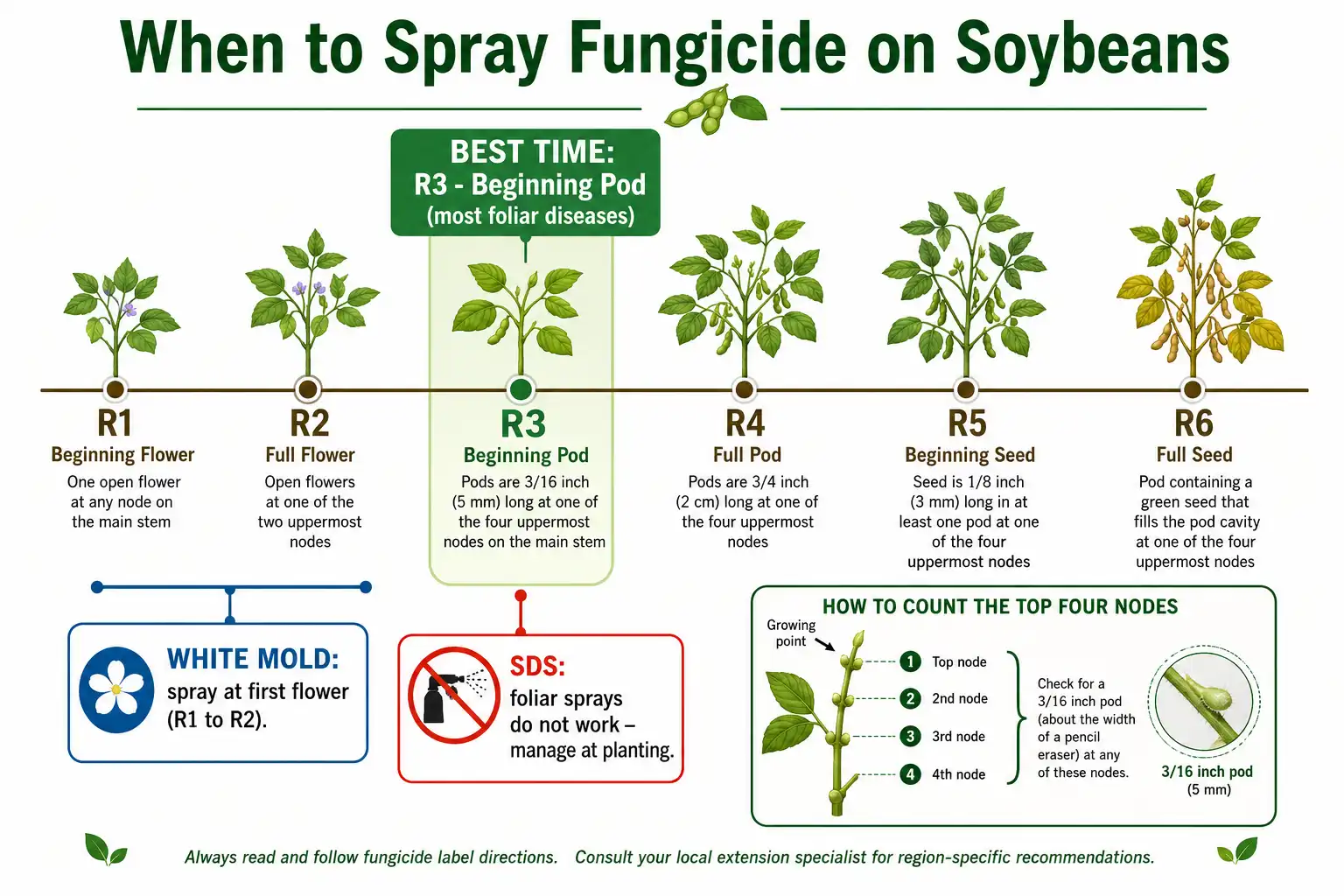
Spray most foliar fungicides at the R3 growth stage, when a pod 3/16 inch long sits at one of the top four nodes. For white mold, spray earlier, at first flower (R1) to early R2. Sudden death syndrome cannot be controlled with a foliar spray.
The Best Time to Spray Fungicide on Soybeans
The best time to spray fungicide on soybeans is the R3 growth stage, also called beginning pod. This is the most consistent window for protecting yield against foliar diseases. University trials across the Corn Belt point to the same stage year after year.
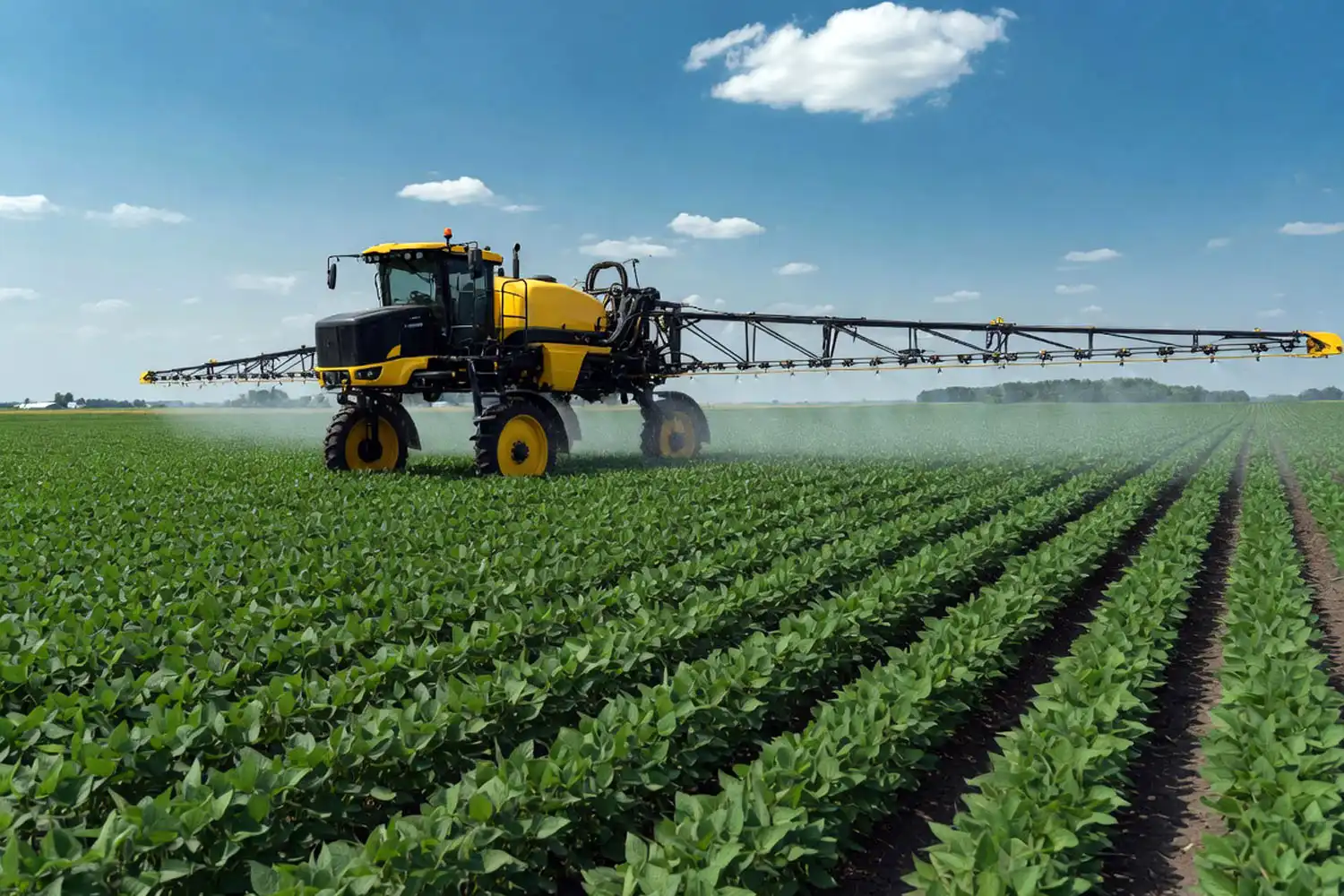
R3 is not the only stage that works. The effective window for most foliar diseases runs from about R3 to R5. A spray at R3 protects the leaves and the pods as they form, which is where yield is set. Going earlier than R2 usually gives weaker, less consistent returns. Going later than R5 often misses the payback, because the plant has nearly finished filling seed.
In south-central Kansas, R3 serves as the anchor date, with scouting and weather deciding whether the field needs it at all. Getting good at staging the crop before you spray is what keeps that timing tight.
How Do You Identify the R3 Stage?
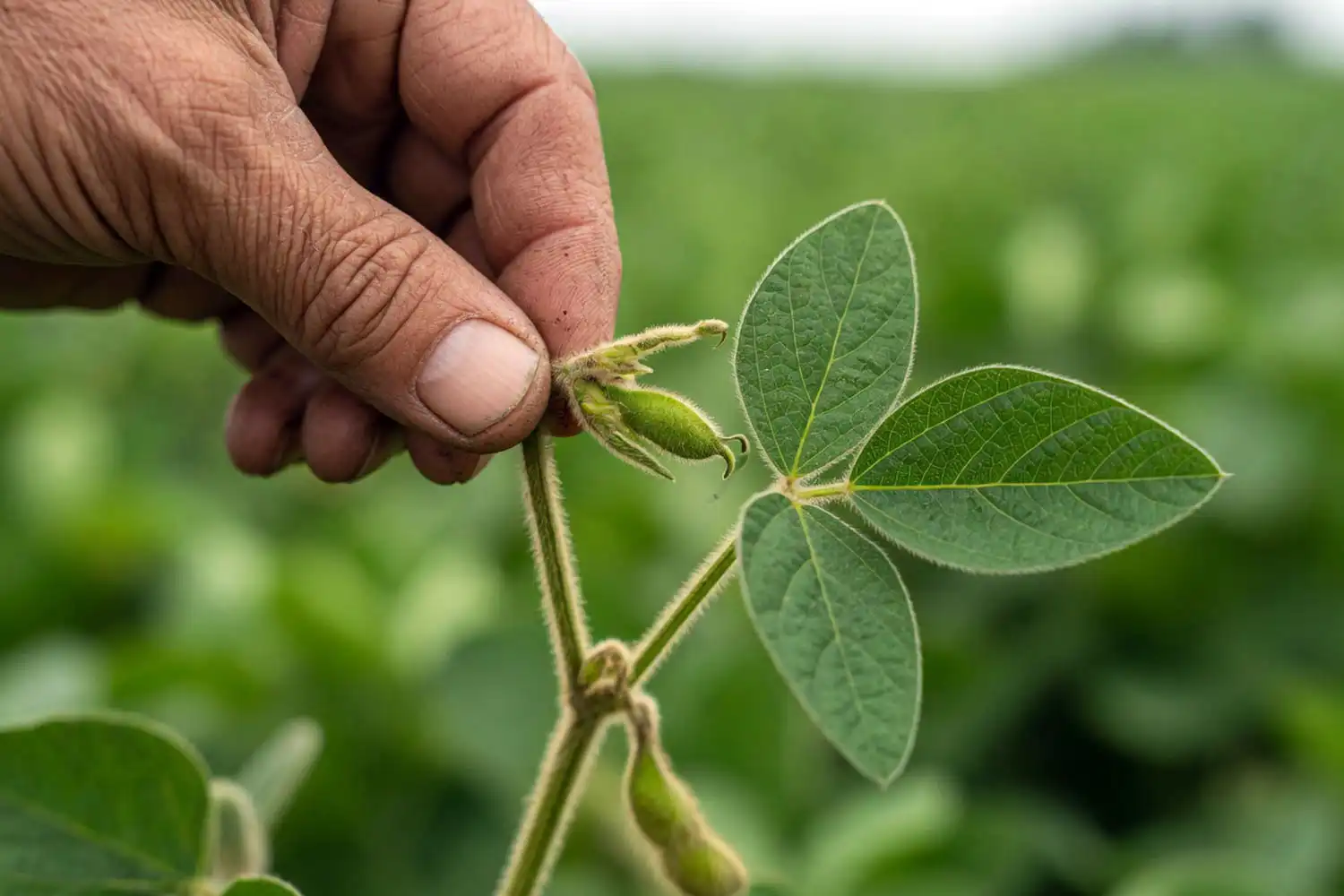
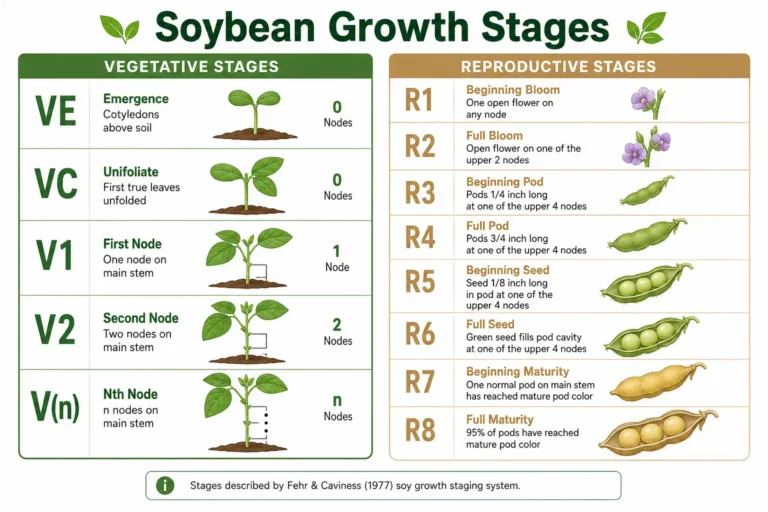
You identify R3 when a soybean pod about 3/16 inch long appears at one of the four uppermost nodes that has a fully developed leaf. That single pod is the trigger. It tells you the plant has moved from flowering into pod set.
Here is the quick field check. Find the top of the main stem. Locate the highest node with a fully unrolled leaf. Count that node and three more down the stem. If any of those top four nodes carries a pod at least 3/16 inch long, and less than 3/4 inch, the plant is at R3. Check several plants across the field. When about half the field has reached R3, the field is ready to spray.
Soybean Reproductive Stages That Matter for Spraying
Soybean reproductive stages run from R1 through R6, and three of them drive spray decisions. Knowing the stage by name keeps your timing tight. Here is a short reference.
|
Stage |
Name |
What you see |
Spray relevance |
|---|---|---|---|
|
R1 |
Beginning bloom |
One open flower on the plant |
Start white mold sprays |
|
R2 |
Full bloom |
Open flower at one of the top two nodes |
White mold window closing |
|
R3 |
Beginning pod |
Pod 3/16 inch at a top node |
Best timing for foliar diseases |
|
R4 |
Full pod |
Pod 3/4 inch at a top node |
Late edge of the foliar window |
|
R5 |
Beginning seed |
Seed starting to fill a pod |
Last useful foliar timing |
|
R6 |
Full seed |
Pod filled with green seed |
Too late to spray |
Most foliar sprays land at R3. White mold sprays land earlier, at R1 to R2. For the full picture of each phase, the guide on how the crop develops from planting to harvest walks through the plant from emergence to maturity.
When Do You Spray for White Mold?
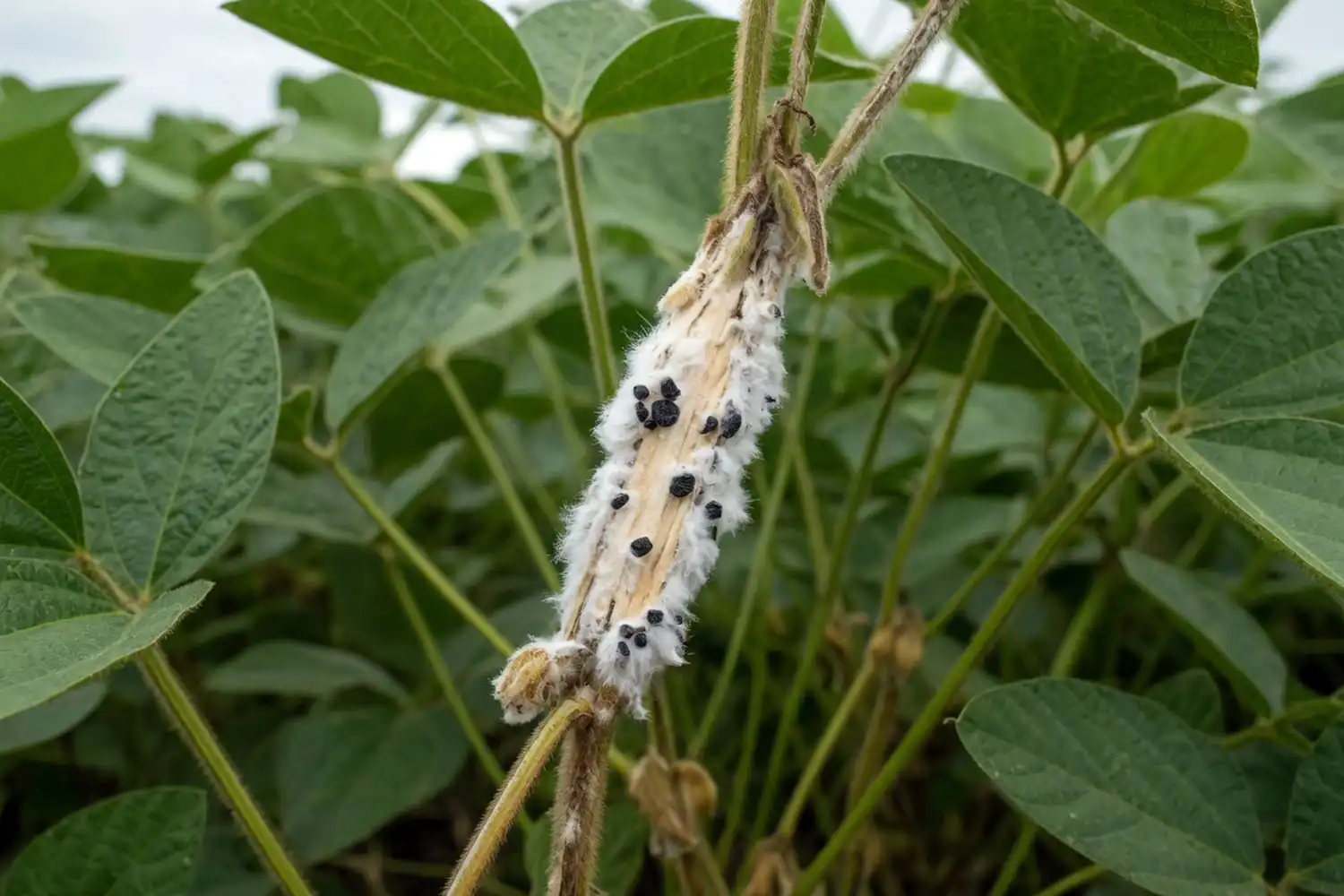
Spray for white mold at first flower, between R1 and early R2, well before you ever see symptoms. White mold, caused by the fungus Sclerotinia sclerotiorum, works differently from leaf diseases. The fungus infects through dying flower petals, so the spray has to be on the plant while it is blooming.
This is a protect-ahead disease. By the time you see the bleached stems and white fuzzy growth, it is too late to save those plants. The decision rests on field history and weather, not on visible disease.
Cool, wet, humid weather during bloom raises the risk, especially below 85 degrees Fahrenheit with long periods of leaf wetness. Thick canopies that close early hold moisture near the soil and make it worse. Coverage matters as much as timing. The spray needs to reach deep into the canopy where the flowers are, not just the top leaves. In high-risk fields, a second pass a week or two later may be needed. It is one of the tougher diseases to manage and rarely yields to a single spray.
Which Diseases Cannot Be Sprayed Away?
Sudden death syndrome (SDS) cannot be controlled with a foliar fungicide. The infection lives in the roots, caused by the soilborne fungus Fusarium virguliforme. By the time the yellow blotches and browning show up between the leaf veins, usually around R3 and later, the damage is already done from below. Spraying the canopy does nothing for it.
SDS is managed before the season, not during it. Choose tolerant varieties. Treat the seed with a product that has proven SDS activity, such as one containing fluopyram, on fields with a history of the disease. Improve drainage and reduce compaction where you can. These soilborne problems that start at the seedling stage are handled at planting, not with a spray in July.
A few other root and stem problems fall in the same camp. If the trouble starts below ground, a foliar spray is the wrong tool. Correct diagnosis comes first, so you do not spend money on a spray that cannot help.
Should You Spray Soybeans Every Year?
No, you should not spray soybeans on a fixed schedule every year. A fungicide pays off when disease risk and yield potential are both high. It loses money when sprayed into a clean, low-risk field out of habit.
Weigh these factors before you spray:
- Yield potential. High-yield fields have more to protect and more to gain from a spray.
- Disease history. Fields that carried frogeye, brown spot, or white mold before are likely to see them again.
- Variety. Some varieties are rated susceptible to common diseases, and those carry more risk.
- Weather. Warm, humid, wet stretches favor most foliar diseases. Cool and wet at bloom favors white mold.
- Scouting. Walk the field and check the lower and middle canopy, where disease usually starts.
- Price. Run the math on bushels saved against the cost of the product and the application.
Clean rotations lower the odds before any spray decision comes up. A solid rotation plan breaks disease cycles and cuts the inoculum that overwinters in residue. The R3 spray still gives the most consistent return when conditions call for one, but the call should be earned, not automatic.
Picking the Right Fungicide and Avoiding Resistance
Pick a fungicide with more than one mode of action, and rotate those modes across seasons. This is the heart of resistance management. Leaning on a single mode of action year after year breeds fungi that shrug it off.
Three FRAC groups show up most on soybeans: group 3 (DMI triazoles), group 7 (SDHI), and group 11 (QoI strobilurins). Group 11 is high-risk for resistance because a single gene change can defeat it. That has already happened with frogeye leaf spot.
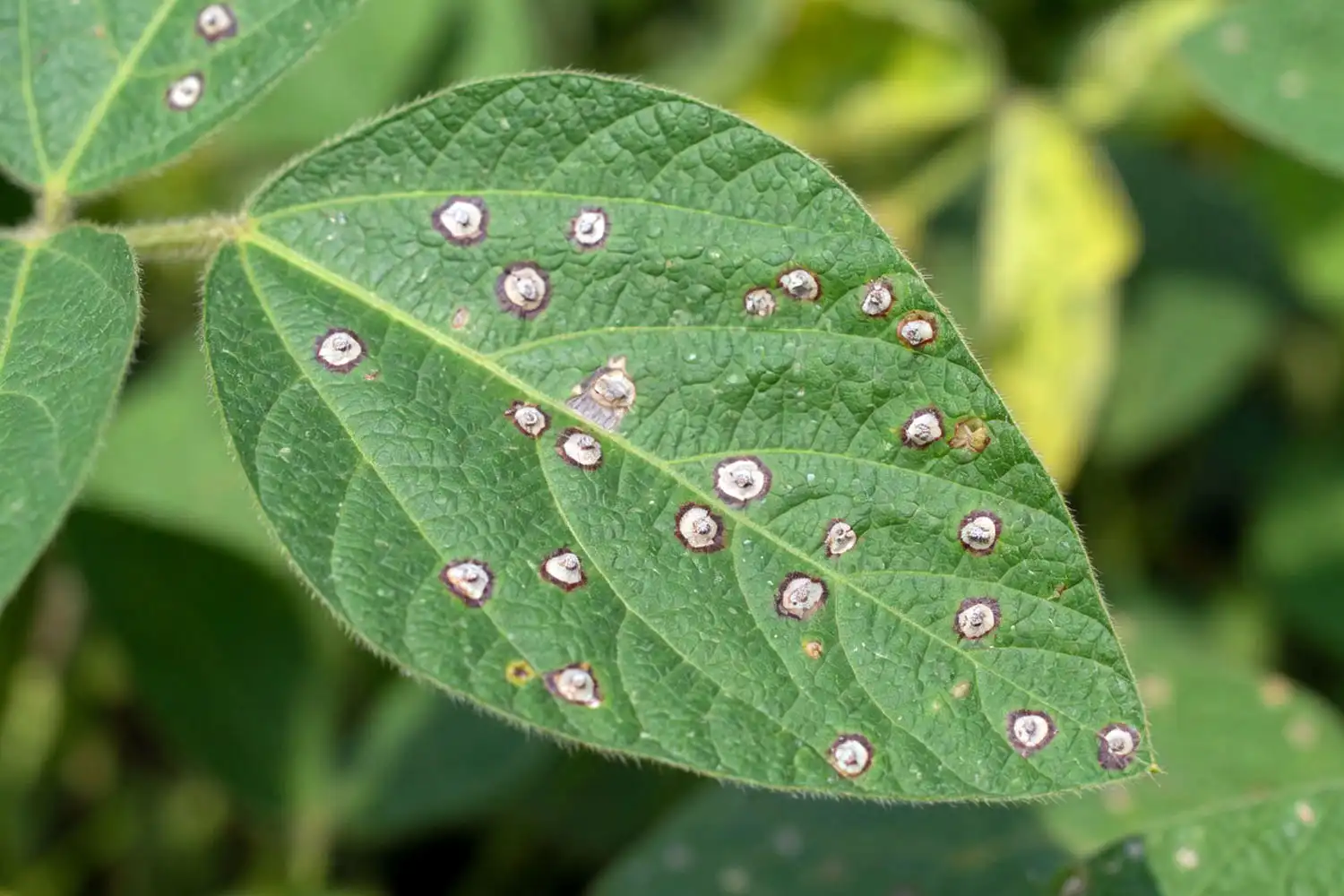
Frogeye leaf spot, caused by Cercospora sojina, has developed widespread resistance to group 11 strobilurins across many states. Where that resistance exists, a solo strobilurin performs like an untreated field. The fix is a premix that pairs modes of action, such as a triazole plus an SDHI, or a triazole plus a strobilurin. Check the label for the FRAC group numbers before you buy. If frogeye keeps showing up after a spray, send leaf samples to a plant diagnostic lab to check for resistance. Matching both the product and the timing of a spray application to the disease is what protects yield.
The Crop Protection Network publishes updated fungicide efficacy tables by disease each year. They are worth a look before you settle on a product.
Common Mistakes When Spraying Soybean Fungicide
The most common mistake is spraying too late, after disease has already taken hold. A few more to avoid:
- Spraying a solo group 11 product where frogeye resistance exists.
- Treating white mold at R3 or later, when the window has nearly closed.
- Poor canopy coverage, especially for white mold deep in the canopy.
- Spraying a clean, low-risk field with no yield or disease justification.
- Trying to spray away a root disease like SDS that no foliar product can touch.
- Skipping the label and missing the rate, timing, or preharvest interval.
Each one wastes money or invites resistance. Good timing and the right product do most of the work.
Getting Fungicide Timing Right on Your Soybeans
Fungicide timing on soybeans is mostly about matching the spray to the disease and the stage. R3 is the anchor for foliar diseases. White mold gets an earlier spray at R1 to R2. SDS gets handled before the season, not with a foliar pass. Scout your fields, watch the weather, check the variety, and run the numbers. When the risk is real and the yield is there, a well-timed R3 application protects the crop you have worked all season to grow.