How Late Can You Plant Soybeans Without Losing Yield
You missed the prime window. Rain, a wheat harvest, or a failed corn stand pushed you into June or July with seed still in the shed. Here is exactly how late can you plant soybeans, what yield to expect, and how to manage a late crop.
You can plant soybeans through early July in most of the US and still harvest a crop. Yield drops about 0.3 to 0.5 bushels per acre per day after mid May, so plant as soon as conditions allow.
How Late Can You Plant Soybeans by Region?
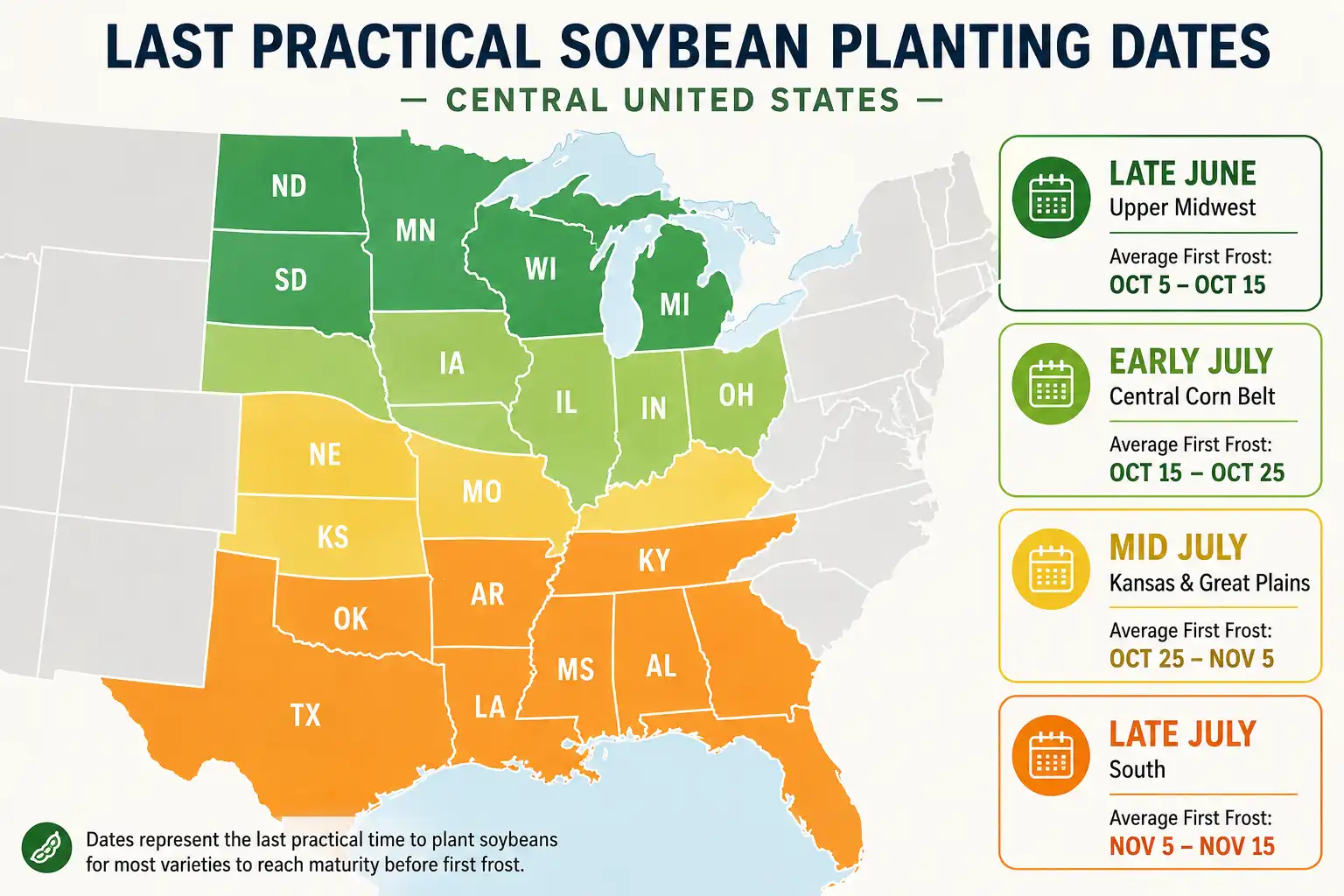
Most regions can plant soybeans until late June or early July, but the cutoff moves earlier the farther north you farm. Soybeans need roughly 90 days between emergence and your average first fall frost to reach physiological maturity. Count backward from that frost date and you have your real deadline.
Here is how to break it down:
- Upper Midwest (Minnesota, Wisconsin, the Dakotas): Late June is the practical limit. Frost arrives in late September, so July planting rarely pays.
- Central Corn Belt (Iowa, Illinois, Indiana, Nebraska): Plant through July 1 to July 4. After that, yield potential falls below what covers your costs in most years.
- Kansas and the central Great Plains: soybeans get planted through mid July in this region, mostly as double-crop beans behind wheat. The first freeze usually holds off until mid to late October.
- The South (Missouri Bootheel, Arkansas, Mississippi Delta): Mid to late July works. Long falls and late frost dates give double-crop beans plenty of runway.
Soybeans handle late planting better than corn does. They flower based on day length, not just heat units, so a late-planted bean compresses its vegetative stage and races to flowering. That flexibility is why finish corn first when both crops are behind, then come back to beans.
How Much Yield Do You Lose Planting Soybeans Late?
Expect to lose roughly 0.3 to 0.5 bushels per acre for every day you plant after mid May, and the loss accelerates as you push into summer. University of Minnesota trials put June 1 planting at about 85 percent of full yield potential and July 1 planting near 50 percent. Michigan State Extension data shows the daily penalty climbing from 0.4 bushels per acre on June 1 to a full bushel per day by July 1.
K-State Research and Extension trials in Kansas show maximum yield slipping about 0.3 bushels per acre per day across the season. Mid April beans hit 80 to 90 bushels in those trials. Mid July beans landed closer to 50. That is a real hit, but 50-bushel beans planted in July still beat an empty field.
One thing the data also shows: late-planted soybeans are more consistent year to year. The yield ceiling is lower, but the floor is higher. Double-crop beans can outperform expectations when August rains show up.
Why the loss happens comes down to canopy. Late beans flower with only a few nodes on the main stem. Fewer nodes means fewer pods, shorter plants, and lower pod set. You cannot fix that with fertilizer. You can only manage around it, which is what the rest of this guide covers.
Should You Switch to an Earlier Maturity Group?
Stay with your adapted full-season variety until about June 15 to June 20, then drop back 0.5 of a maturity group. Late-planted soybeans mature faster than the calendar suggests. A three day planting delay only pushes maturity back about one day, because warm weather and shortening days speed up development after flowering.
Working rules:
- Before June 15: Plant your normal full-season maturity group. In northeast Kansas, that is a Group 3.5 to 4.0 bean. Full-season varieties build more canopy before flowering and out-yield short-season beans planted on the same June date.
- June 15 to July 1: Drop 0.5 MG. A 4.0 becomes a 3.5.
- After July 1: Drop no more than 0.7 to 1.0 MG from your adapted group. Going shorter than that backfires. Ultra-early beans planted late flower almost immediately, stay ankle high, and set pods so close to the dirt your combine head leaves them in the field.
Double-crop beans are the exception. K-State recommends keeping your normal maturity or going slightly later behind wheat, because the bigger canopy is worth more than the earlier finish in most Kansas falls. Follow that advice and it has held up on the fields.
For keeping planning windows straight across a whole operation, this crop planting calendar walks through how to sequence every crop.
How to Manage Late Planted Soybeans
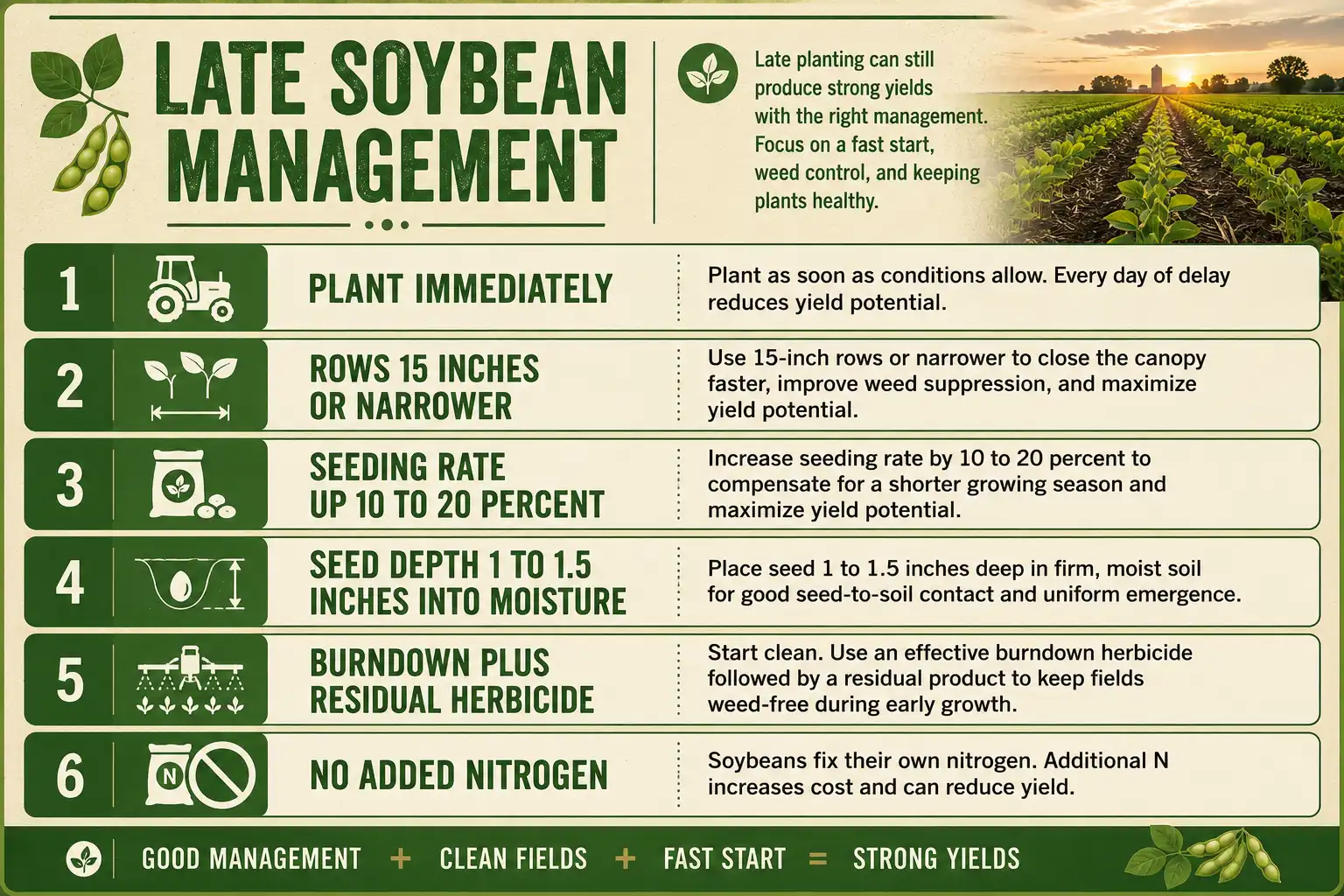
Plant into moisture, narrow your rows, and raise your seeding rate. Those three moves recover more lost yield than anything else you control in a late-planting situation. Here is the order to work in:
- Plant the day conditions allow. Every day matters more in June than in April. Do not wait on a perfect seedbed.
- Narrow the rows to 15 inches or less. Drill double-crop beans in 7.5 inch rows. Narrow rows close the canopy faster, capture more sunlight during the shortened season, and choke out weeds. Extension trials credit narrow rows with a 5 to 10 percent yield bump in late plantings.
- Bump seeding rates 10 to 20 percent. Late beans branch less, so you need more plants carrying pods. Seeding rates typically get pushed from a normal 130,000 seeds per acre up to about 150,000 to 160,000 for late June and July planting. Higher populations also raise pod height, which saves beans at harvest.
- Seed 1 to 1.5 inches deep into moisture. July topsoil dries fast. Chase moisture with depth rather than dusting seed in shallow, but do not bury beans past 2 inches.
- Get burndown and residual herbicide right. Summer annual weeds like waterhemp and Palmer amaranth are already up and running by late June. Late beans cannot afford early competition. Pair a clean start with a residual, and check labels for carryover from any wheat herbicides if you are double cropping. Solid weed control in your fields matters double when the canopy closes late.
- Skip the urge to add nitrogen. Inoculated beans fix their own. Spend that money on seed and weed control instead. If you are unsure what your field actually needs, a soil test before planting settles it for a few dollars an acre.
Can You Plant Soybeans After Wheat Harvest?
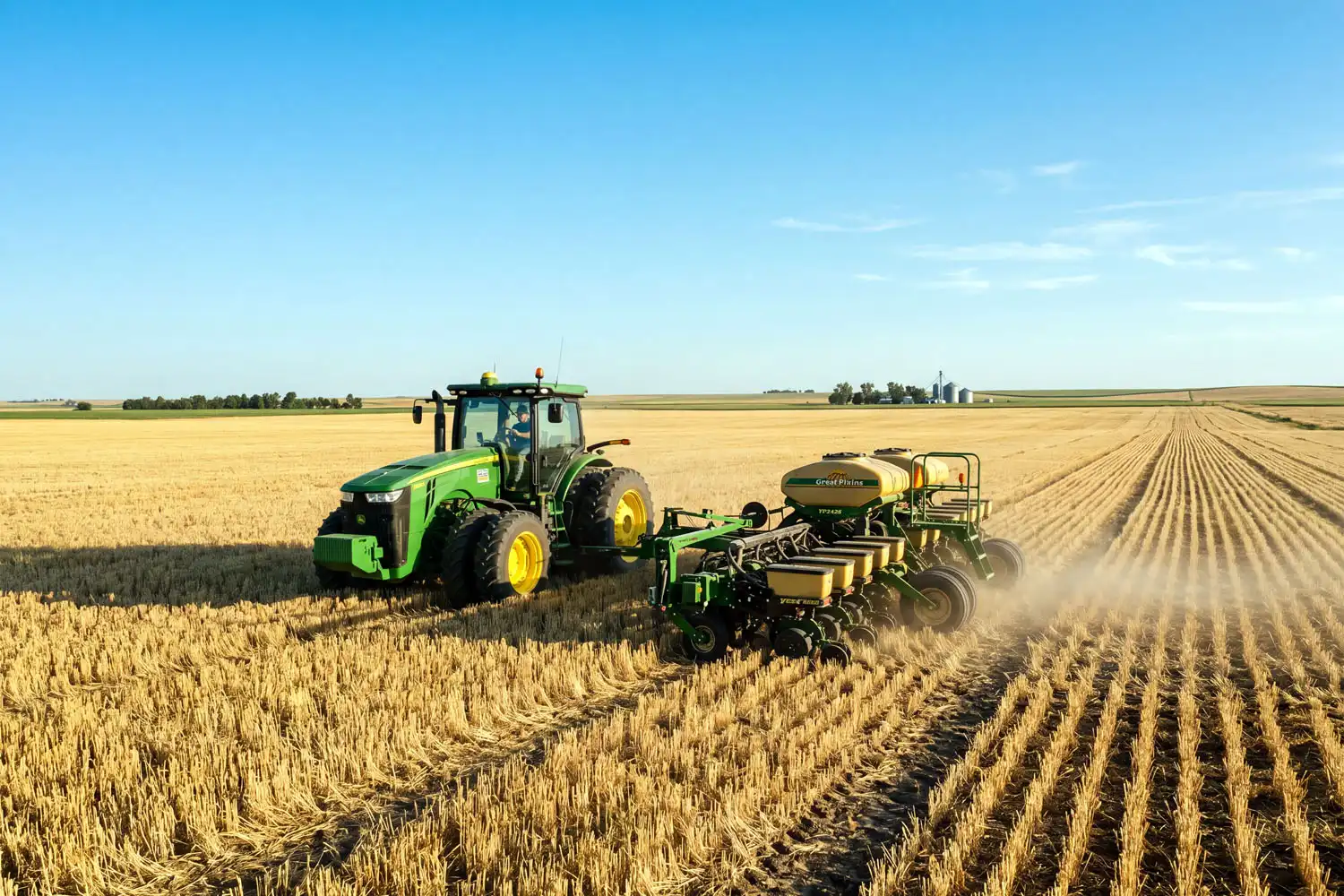
Yes, double-crop soybeans after winter wheat are the most common late-planted beans in the country, and they work well from Kansas eastward and south. Cut wheat in late June here near Topeka, and the drill follows the combine within a day or two when soil moisture cooperates. Oklahoma State research backs that urgency: wheat residue itself does not hurt bean yields, so you can plant within hours of harvest if there is moisture to reach.
Expect 20 to 35 bushels per acre from double-crop beans in central and eastern Kansas, sometimes more with timely August rain. That is well under full-season yield, but the wheat crop already paid the land costs. Knowing exactly when to plant winter wheat the previous fall sets up an earlier harvest and buys your beans an extra week of season.
Two cautions. First, check herbicide carryover. Sulfonylurea products applied to wheat can stunt beans planted the same summer. Read the rotation restrictions before the drill rolls. Second, if July turns hot and dry, emergence suffers. Seed into moisture or wait for a rain, because beans germinated in dust rarely make a stand worth keeping.
What About Crop Insurance Final Plant Dates?
Crop insurance, not agronomy, sets the hard deadline for many farms. The USDA Risk Management Agency assigns each county a final planting date for full coverage. Across the Midwest and Plains, soybean final plant dates run from June 10 to June 25 depending on the county.
Plant after your final date and your guarantee drops 1 percent per day through the late planting period, which runs 25 days for full-season beans. After that window closes, coverage falls to 60 percent of the original guarantee. Double-crop (FAC) soybeans carry their own later final plant dates in approved counties, often around July 5, with a shorter late planting period.
Three moves to make every year:
- Confirming the county’s final plant date with a crop insurance agent before June is recommended, since RMA adjusts these.
- Report any late-planted acres within the required window.
- Run the math on planting late versus a prevented planting payment. Past early July in marginal moisture, prevented planting plus a cover crop sometimes pencils out better than mudding in beans. A good cover crop on those acres protects the soil and keeps the payment intact.
When Is It Too Late to Plant Soybeans?
It is too late to plant soybeans when fewer than 90 days remain before your average first fall frost. A bean that has not reached the R7 growth stage, where one pod on the main stem shows mature color, will take heavy damage from a hard freeze. Green, frost-killed beans shrivel, stay green at the elevator, and pull dockage.
Run this check before you plant late:
- Find your average first 28°F freeze date. For Topeka, that is around the third week of October.
- Subtract 90 days. That puts the absolute cutoff in the third week of July.
- Subtract another 5 to 7 days for emergence in dry soil.
If the calendar fails that test, put the seed away. Plant a forage sorghum, a cover crop, or leave the field for an early winter wheat planting instead. A failed bean crop costs seed, fuel, and herbicide with nothing back.
Late Planting Line in the Sand
July 15 is the wall for soybeans, and only double-crop acres get planted that late. Full-season fields that are not in by July 1 switch to something else. Late beans pay when you plant fast, narrow the rows, raise the population, and keep maturity close to your adapted group. They fail when you treat them like May beans. Watch the frost calendar, check your insurance dates, and make the call with a pencil, not a hunch.