How Much Water Do Soybeans Need for Top Yield in 2026
How much water do soybeans need is the question that decides your yield in a dry July. A soybean crop uses 20 to 26 inches of water across the season. Timing matters more than the total, and pod fill is where it counts.
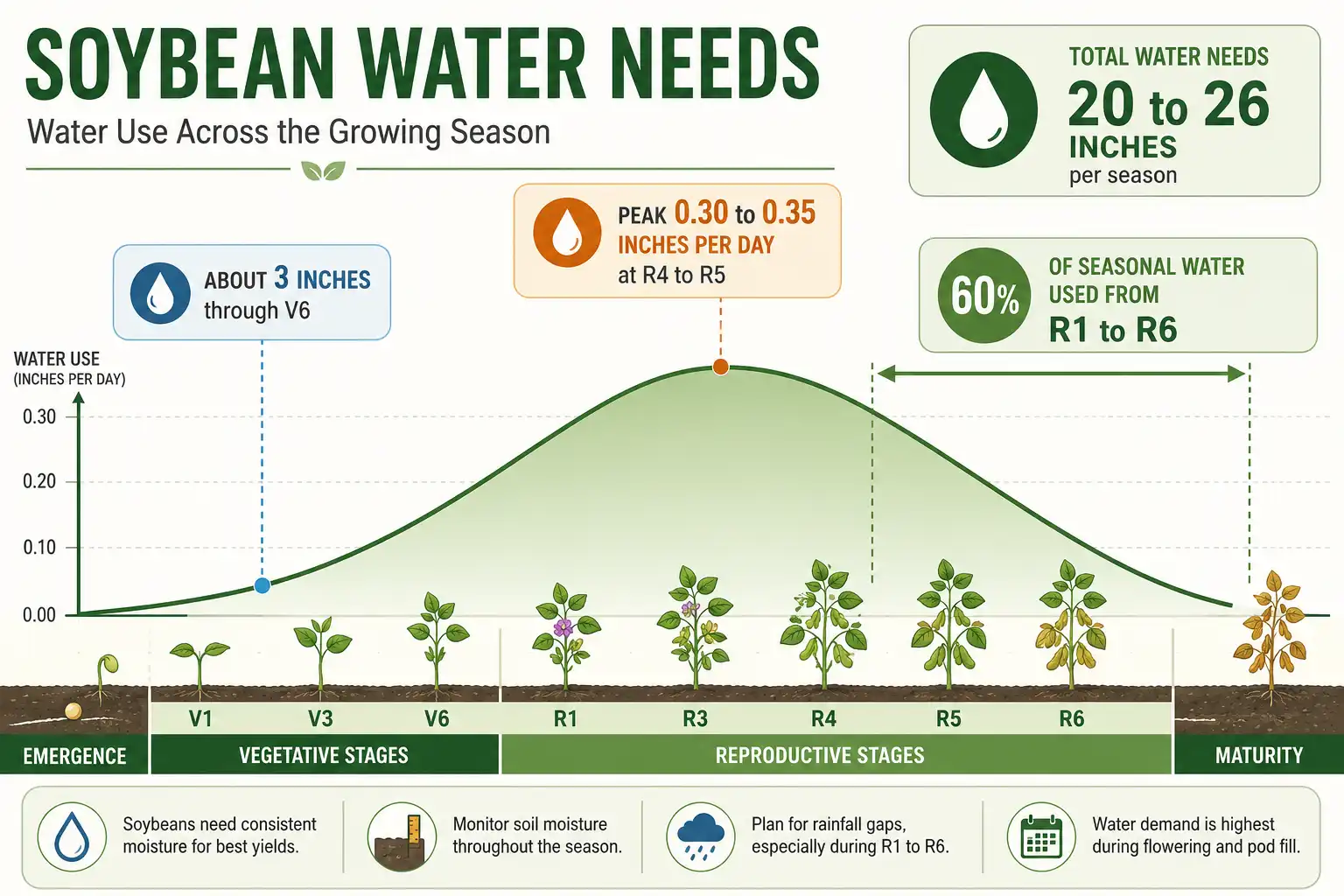
Soybeans need 20 to 26 inches of water over a full growing season. Most of that, around 60 percent, gets used during the reproductive stages from R1 to R6. Peak daily use hits 0.30 to 0.35 inches during pod development and seed fill.
How Much Water Do Soybeans Need Per Season
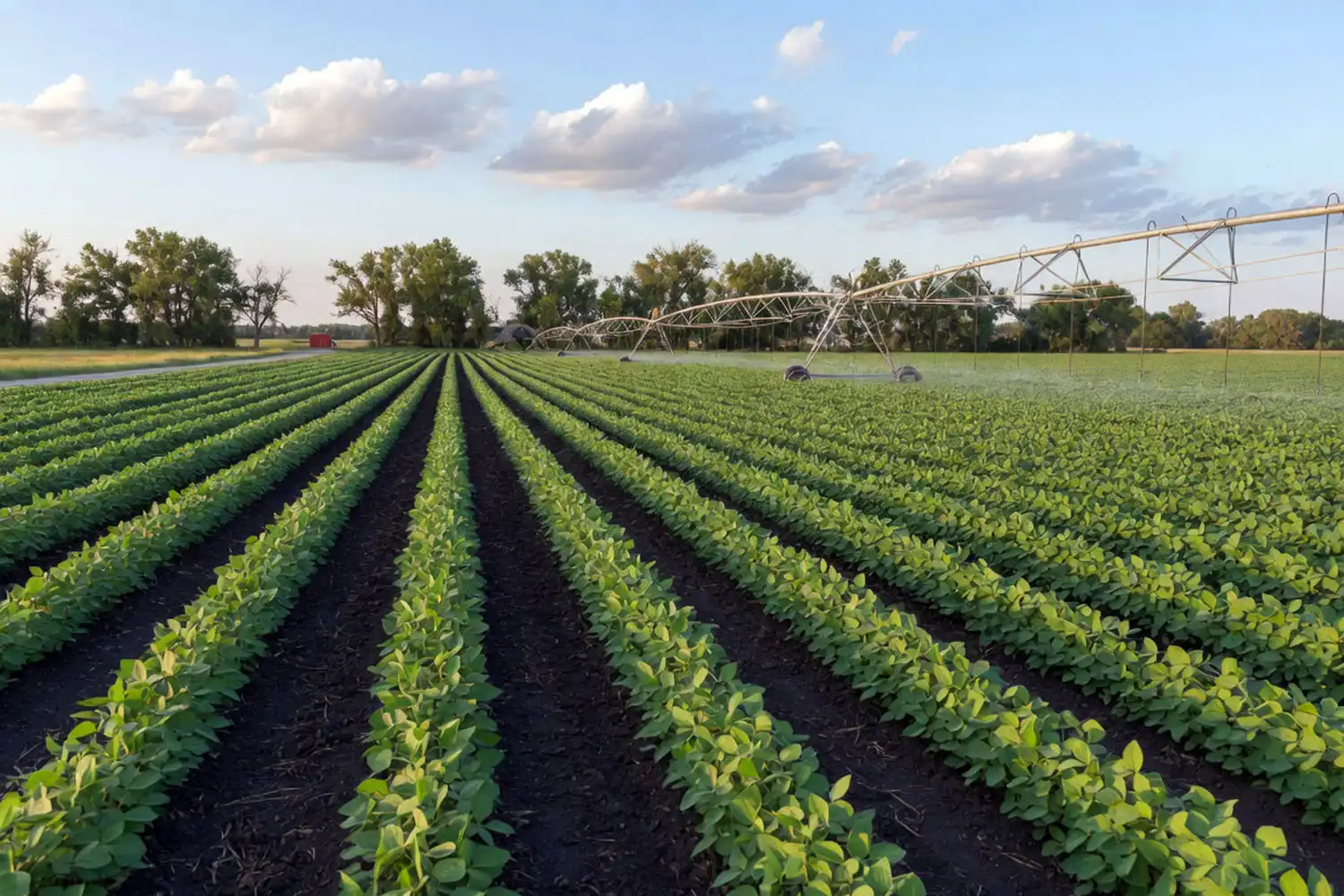
A full soybean crop uses 20 to 26 inches of water from planting to harvest. Estimated seasonal water requirements for soybean range from 20 to 26 inches depending on planting date, maturity, growth stage, location, and weather. That water comes from three sources: stored soil moisture, rainfall, and irrigation if you have it.
In Kansas, 26 inches of rain during the growing season is rarely reached. So it helps to use the moisture the soil holds over winter, then watch the sky through summer. Most years the crop pulls what it needs from stored water and timely rains. Dry years are a different story, and that is when knowing the water curve pays off.
Soybeans use slightly less water than corn over a season. Seasonal soybean water use can range from 20 to 26 inches during the growing season compared to a typical range of 21 to 28 inches for corn. The number depends on how long your variety runs and how hot your summer gets.
Water Needs by Growth Stage
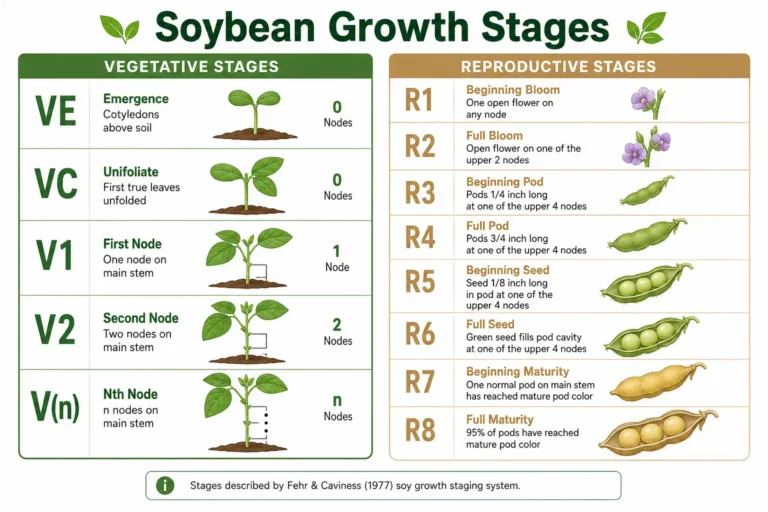
Soybean water use is not flat. It follows a bell curve. Use starts low at emergence, climbs through flowering, peaks during pod fill, then drops as the crop matures. Water use in early vegetative growth is very low and begins to increase as reproductive growth stages are approached. Peak water use then occurs from full flower through early pod development, R2 to R3, and then begins to decrease as the plants mature.
Matching your water to this curve is the whole job. If you want a deeper look at how to put numbers on it field by field, our guide on how to calculate water needs for crops walks through the math.
Germination and Early Vegetative (VE to V6)
Soybeans need very little water early. Total use from emergence through V6 runs about 3 inches. Estimates for total consumptive water use from emergence through V6 is about 3.0 inches. Stored soil moisture and normal rain usually cover this stretch.
Resist the urge to water early. Too much water early in the season can prolong the vegetative growth stage, which can result in delays in flowering, increase plant height, and lodging. Wet soil early also raises the risk of root and crown rot. Limiting early-season irrigation can stimulate soybean plants to develop stronger, healthier root systems that penetrate deeper into the soil profile. Treat the vegetative weeks as a time to check equipment, not run it.
Flowering (R1 to R2)
Water use roughly doubles once flowering starts. Daily use climbs toward 0.25 inches per day. During these early reproductive stages, daily water use can approach .25 inches of water per day. Total consumptive water use by the crop during R1 and R2 stages is estimated to be about 3.75 inches.
This is where to start active irrigation management if the season is dry. The plant is setting the flowers that become pods. Stress now means fewer pods later.
Pod Development and Seed Fill (R3 to R6)
This is the make-or-break window. R3 through R6 is when soybeans are most sensitive to water stress, and it uses the most water of any stage. Adequate water is most critical during pod development and seed fill (R3 to R6). Daily use peaks here.
The numbers are steep. On average, daily water use increases to about .32 inches per day during the R3 through R5 stages, then begins to decline at R6. In extreme cases of hot and windy conditions, daily ET may approach .50 inches per day. Total use across this window is large. The total amount of water consumed from R3 through R6 may be 13.5 inches or higher.
Miss water here and you pay for it at the scale. During these stages, water stress can reduce yields by 10 to 50 percent through pod abortion, reduced seed numbers, and smaller seed size. If you only have water for one stretch of the season, this is the stretch.
Maturity (R7 to R8)
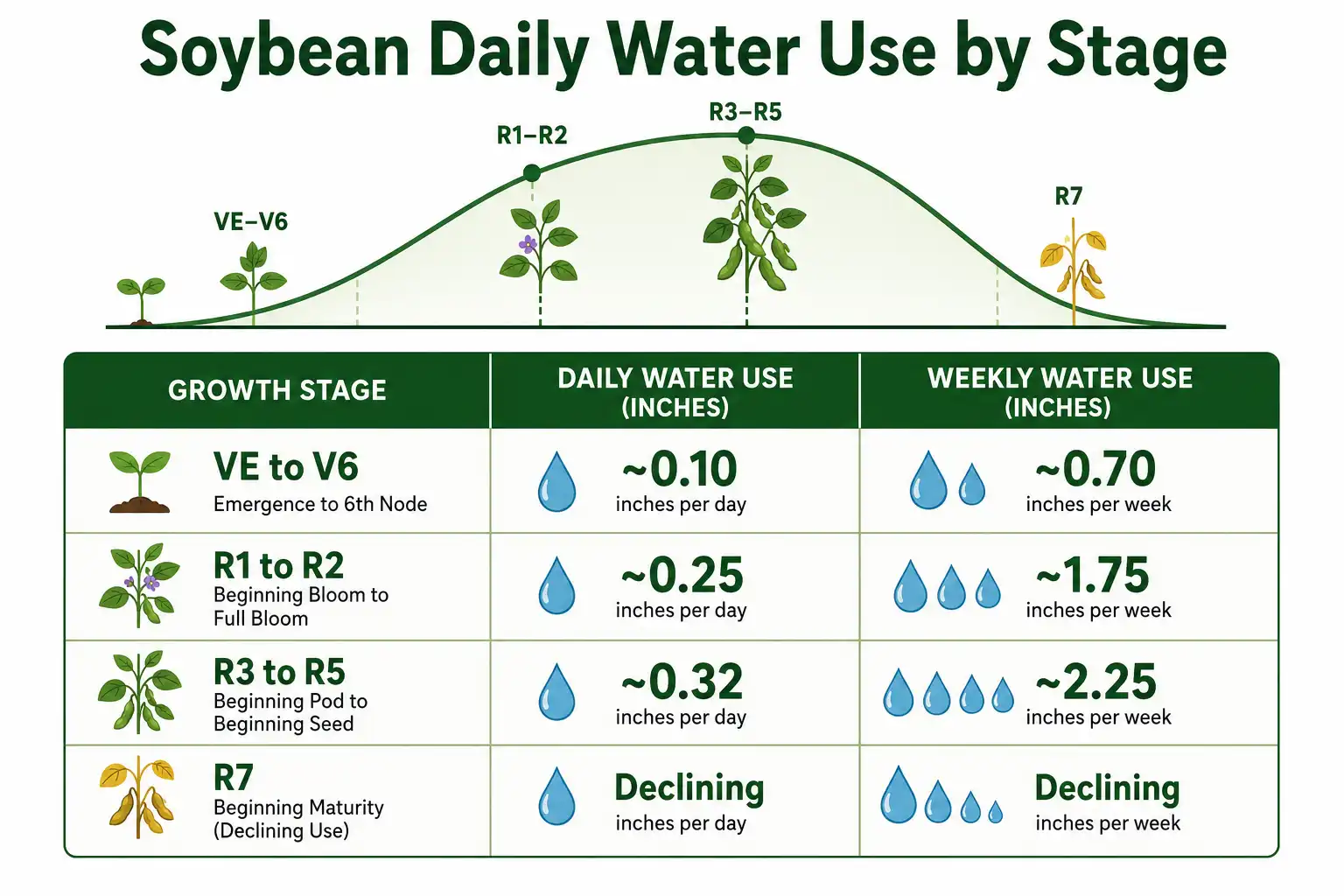
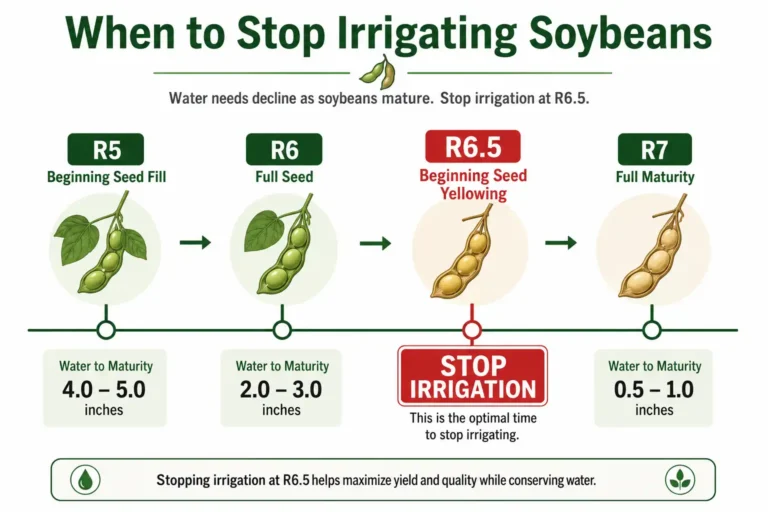
Water demand falls off fast at maturity. Soybean plants need less water during R7 than during R6, and roughly 0.3 to 1.4 inches per week to get from R7 to full maturity. The crop spends only about 10 days in R7, so total need here is small. Between R7 and maturity soybean only needs around an inch of water in total.
That said, do not check out completely. Even though soybean needs only a small amount of water in R7, yield losses due to insufficient water during this growth stage can be as high as 0.75 bu/acre/day on sandy soils. Late in the season, letting the profile dry down firms the ground for harvest and saves any off-season rain for the following year.
Daily Water Use at Peak
At peak, plan for up to 0.35 inches per day. The typical peak water use rate is about 0.35 inch per day as typical for all summer-grown field crops, which normally occurs near the beginning of the pod fill stage. That sets your irrigation ceiling.
The math is simple. Knowing that ET can be as high as 0.3 inches per day allows an irrigator to know that, at maximum, 2.1 inches of irrigation per week needs to be applied during peak water use if no rainfall has been received. So during a hot, dry pod-fill stretch, the crop can want over 2 inches a week. Rain counts against that total, so subtracting every inch the sky gives before running the pivot is the recommended step.
How Rainfall and Irrigation Work Together
Rain and stored soil moisture do most of the work. Irrigation fills the gap. The trick is knowing how much your soil already holds before you add more. Most water uptake happens shallow. About 70 percent of water uptake for soybeans occurs in the top 12 inches of the soil profile, with less than 30 percent of water uptake occurring between 12 and 24 inches deep. Manage the top 2 to 3 feet and you manage the crop.
A 50 percent depletion rule keeps timing simple after flowering. In most cases, growers should use a MAD of 50 percent as a threshold for initiating irrigation. When half the available water in your root zone is gone, it is time to water. A silt loam shows how this works in practice. A silt loam soil with a water holding capacity of 2.0 inches per foot would have a total of 6.0 inches of stored water at field capacity in the top 3 feet of the profile. At 50 percent depletion, that means about 3 inches used and 3 inches left.
If you irrigate, a soaking less often beats light sprinkles. Soybean producers that apply 5 to 7 days worth of water at a time lose less water to canopy evaporation than more frequent applications. Whether you run a pivot or drip lines, the same logic holds, and our comparison of sprinkler irrigation and drip can help you pick the system that fits your acres.
Signs Soybeans Need Water
Soybeans tell you when they are short. The clearest sign is leaf flipping. When soybean is drought stressed, the leaves will flip over to show their silvery-green undersides. This is a defensive mechanism they use to reflect more light, reducing the amount of sunlight the plant takes in. Under harder stress, the leaflets clamp together. Under severe drought, the trifoliate will clinch together, resulting in a sandwiched center.
But do not wait for visible wilting to act. Plenty of yield slips away with no obvious symptom at all. Such yield-limiting soil water deficits frequently occur with no obvious outward signs of water stress such as leaf wilting, but result in fewer pods, reduced single-seed weight, and hastened crop maturity. That is why tracking soil moisture with a meter is more reliable than trusting sight alone. A simple soil moisture meter takes the guesswork out and tells you what the root zone actually holds.
How Soil Type Changes the Picture
Soil type sets how much water your field can bank between rains. Sandy soils hold little, so they dry out fast and need water more often. Heavier silt loams and clay loams hold more, which buys you time during a dry stretch. The seasonal need stays about the same, but the schedule shifts with texture.
Rooting depth matters too. Early in the growing season, the roots may be concentrated in the surface twelve inches. As the season progresses, roots can extend down to five feet. Deeper roots reach deeper water, which is one more reason not to baby the crop early. Healthy soil structure helps roots get down there, and our notes on soil testing for farming cover how to check what you are working with.
Your variety and planting date factor in as well. A longer-maturity bean in a hot zone runs the high end of the range. If you are still setting up your season, the full walkthrough on growing soybeans ties water planning into the rest of the crop calendar.
Bottom Line for Your Field
Soybeans need 20 to 26 inches of water across the season, but the calendar matters more than the total. Go light early, watch stored moisture and rain through the vegetative weeks, and protect water hard from R3 through R6. That pod-fill window is where your yield is won or lost. Track soil moisture, subtract rainfall from your weekly need, and water when the root zone hits 50 percent depletion. Do that, and most seasons take care of themselves.