How Deep to Plant Soybeans for Fast, Even Emergence
Soybean seed is less forgiving on depth than most farmers think. Knowing how deep to plant soybeans, and when to adjust that depth, decides whether you get a fast, even stand or a field full of gaps.
Plant soybeans 1 to 1.5 inches deep in most conditions, and always place seed into at least a half inch of moist soil. In dry or sandy ground, go deeper, up to 2 inches, but never past 2.5.
How Deep Should You Plant Soybeans?
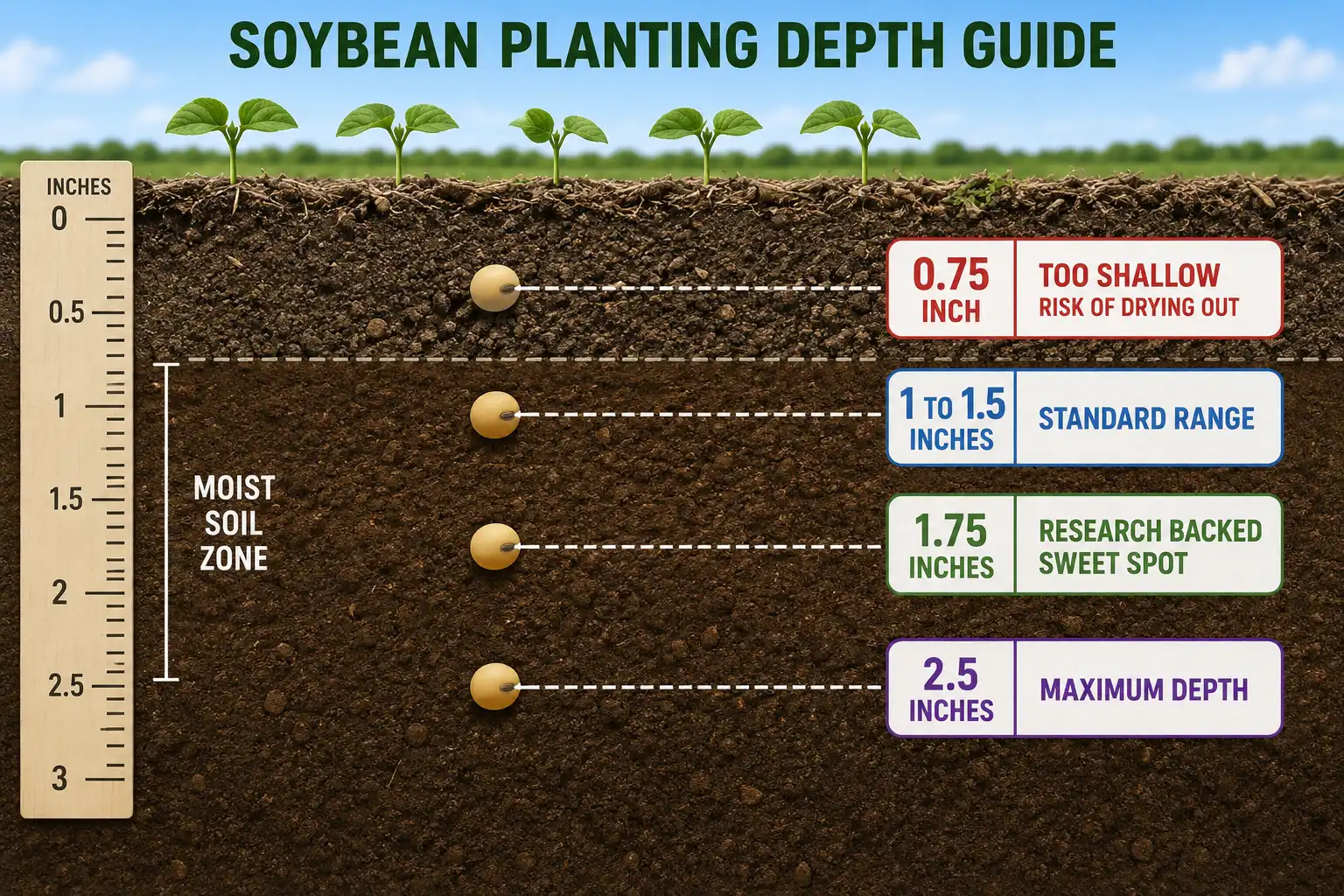
Soybeans should go in at 1 to 1.5 inches deep under normal spring conditions. That range comes from decades of land grant research, and it still holds. K-State Research and Extension puts optimum seed placement between 1 and 2 inches, with anything past 2 inches putting final emergence at risk.
The depth itself is only half the rule. The other half is moisture. Seed needs to sit in at least 0.5 inch of moist soil because a soybean must absorb half its weight in water before germination starts. Corn needs less. So a soybean dropped into a dry furrow just sits there, and that is how you get a stand that comes up in waves over two weeks.
University of Nebraska research adds a wrinkle worth knowing. A three-year study across conventional, strip-till, and no-till fields found the highest yields at 1.75 inches, with yield losses showing up shallower than 1.25 inches and deeper than 2.25 inches. The deeper placement gave seed more stable moisture and temperature. At 1.5 inches as the default and push toward 1.75 when the top inch is drying out.
Why Planting Depth Matters More for Soybeans Than Corn
Depth matters more for soybeans because of how the plant emerges. A soybean seedling pulls its cotyledons up through the soil on a bent stem called the hypocotyl. That arch has limited pushing power. Corn pushes a tough coleoptile spike upward and leaves its seed below ground, so it tolerates deep placement and crusted soil far better.
Every extra quarter inch of depth forces the hypocotyl to spend more of the seed’s stored energy before it ever reaches sunlight. Plant too deep and seedlings run out of fuel below the surface. They also spend more days in the ground, which gives Pythium, Phytophthora, and other seedling pathogens a longer window to attack. If you have ever dealt with damping off in young seedlings, you know how fast those gaps appear.
Uneven depth is just as costly as wrong depth. Seeds at 1 inch and seeds at 2 inches in the same pass emerge days apart. The late plants act like weeds against their earlier neighbors all season.
What Happens If You Plant Soybeans Too Shallow?
Seed planted under 1 inch dries out before it finishes germinating. The top inch of soil swings hard in both moisture and temperature, especially on tilled ground. A seed can take in water, start to swell, then die when that shallow zone bakes out between rains. That is the worst outcome in farming: paying for seed that quits halfway.
Shallow placement causes three other problems worth watching for:
- Poor seed-to-soil contact. In high residue fields, shallow-run openers can leave seed sitting in loose trash instead of firm soil.
- Herbicide injury. Seed placed too close to the surface can sit in the treated zone of pre-emergence herbicides like metribuzin, and that stunts or kills seedlings.
- Shallow early rooting. Plants that start in the top inch root shallow at first, which hurts in a dry June.
If your planter is set right but seed still ends up shallow, check downforce. Worn gauge wheels and light downforce on the outside rows of center-fill planters put seed at three quarters of an inch while the monitor says 1.5.
What Happens If You Plant Soybeans Too Deep?
Planting past 2.5 inches costs you stand. The hypocotyl exhausts its carbohydrate reserves pushing up through that much soil, so emergence is delayed, seedlings come up weak, and some never make it. Iowa State University Extension flags anything over 2 inches as added risk, and 2.5 inches is the hard floor for almost every variety.
Crusting turns deep planting into a disaster. A half inch of pounding rain on tilled silty clay loam forms a crust that a deep-planted soybean cannot crack. The hypocotyl snaps, and you are looking at replant decisions by the V1 stage of the neighboring fields. Tillage choices play into this, and fields managed under no-till systems crust far less because residue breaks the force of raindrops.
If you must plant deep, two adjustments lower the risk. Pick a large-seeded variety, since bigger seed carries more stored energy. And use a fungicide seed treatment, because more days underground means more disease exposure.
How to Adjust Soybean Planting Depth by Soil and Conditions
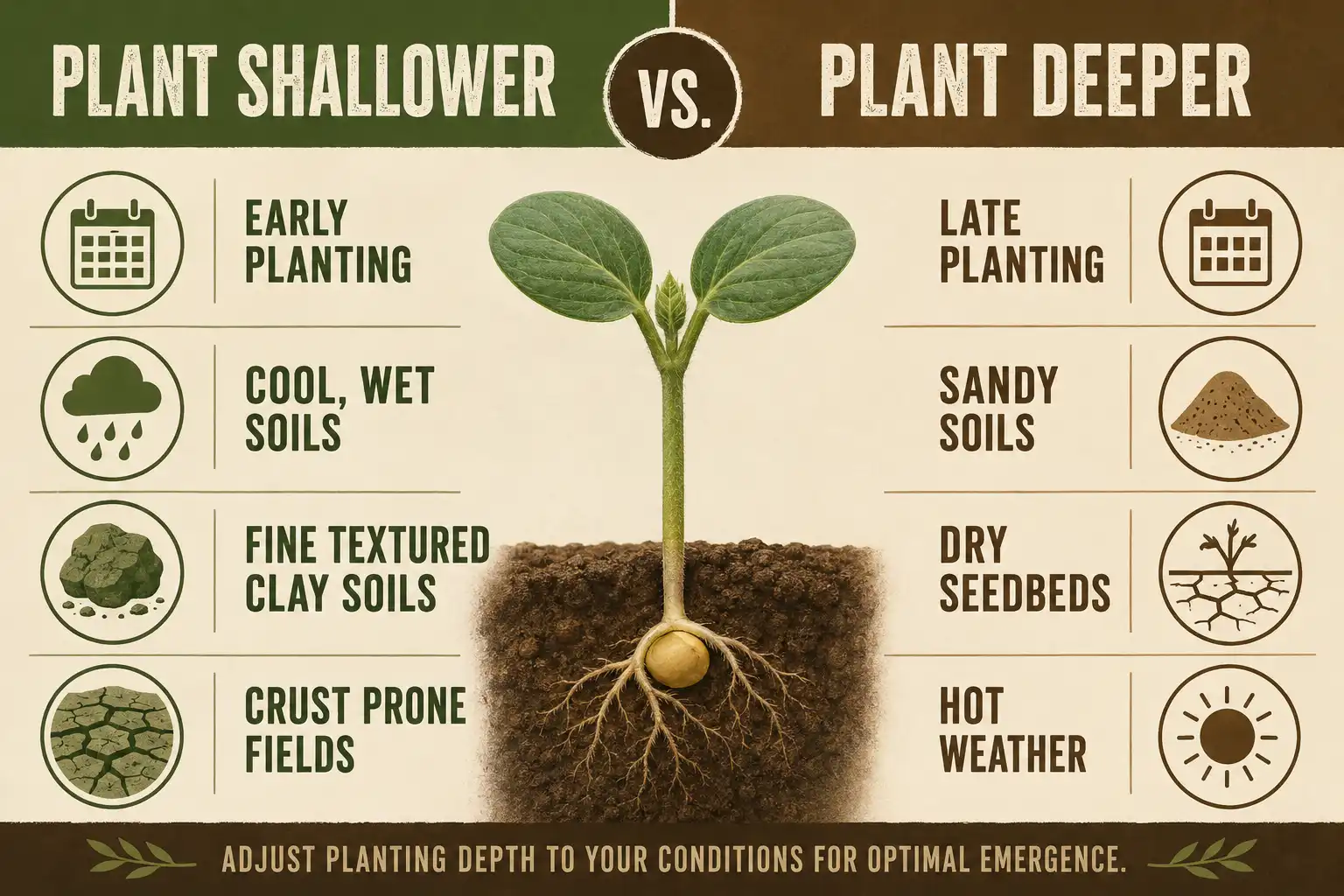
Set depth by the field in front of you, not by one number for the whole farm. These are the adjustments that have held up for me in the Great Plains and match current extension guidance.
Sandy or Coarse Soils
Plant at the deep end, 1.5 to 2 inches. Sandy ground drains fast and the surface dries out quickly, so shallow seed loses moisture before it germinates. Coarse soils almost never crust, which makes the deeper placement safe.
Heavy Clay and Crust-Prone Soils
Stay at 1 to 1.25 inches. Fine-textured soils hold moisture near the surface, so seed does not need depth to find water. Keeping the hypocotyl trip short gives seedlings their best shot at breaking through if rain seals the surface. Knowing your ground helps here, and a basic soil test for your fields tells you texture and organic matter, both of which drive crusting risk.
Cold, Wet, Early-Planted Ground
Use 1 to 1.5 inches when planting in late April or early May. Shallower seed sits in warmer soil and emerges days sooner, which shortens the disease window. Wait for soil temperatures near 60°F at seeding depth before rolling. A soil moisture meter with a temperature readout makes that call easy each morning.
Hot, Dry, Late-Planted Ground
Go deeper, 1.75 to 2 inches, and chase moisture. June-planted beans in Kansas almost always need the deeper setting because the top two inches have already dried out.
No-Till and High Residue Fields
Run 1.5 inches as the floor and verify constantly. Residue fools planters. Openers ride over corn stalks and place seed in trash instead of soil, so what the monitor calls 1.5 inches may be a half inch of actual soil cover. Dig behind the planter every time residue cover changes.
Should You Plant Soybeans Deeper to Reach Moisture in a Dry Spring?
Yes, planting deeper to moisture beats planting into dust in almost every case. When the seed zone is dry, drop to 2 inches, or 2.5 in soils that do not crust, to put seed a half inch into uniform moisture. Germination starts immediately and the stand comes up together.
The option to avoid is marginal moisture. Seed placed where soil is damp but not wet can imbibe enough water to swell, then stall and die when the moisture runs out. Unless a solid rain is coming within 48 hours, that middle ground is the riskiest place on the depth chart.
There is a third play for severe drought: plant shallow at about 1 inch into bone-dry soil and wait for rain. The seed stays dormant and safe until a half inch of rainfall wakes it up. This approach works well on dryland corners in western Kansas-style dry years. It works, but emergence depends entirely on the next rain, so it pairs best with patience and a treated seed.
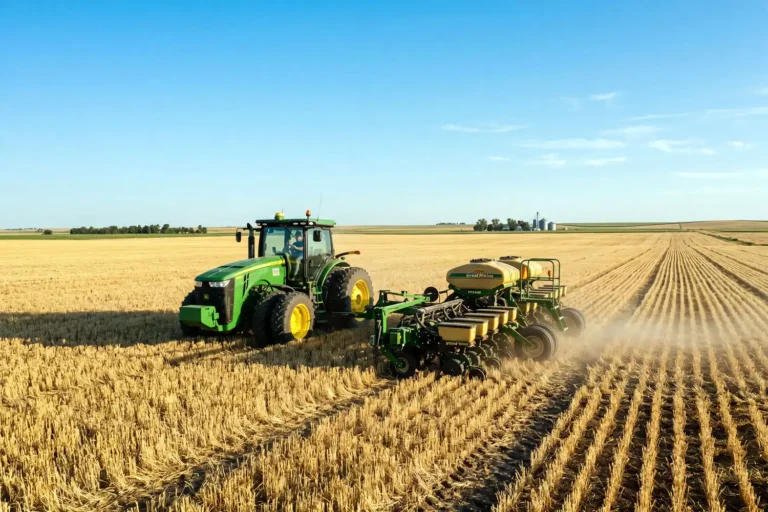
How to Set and Check Planter Depth for Soybeans
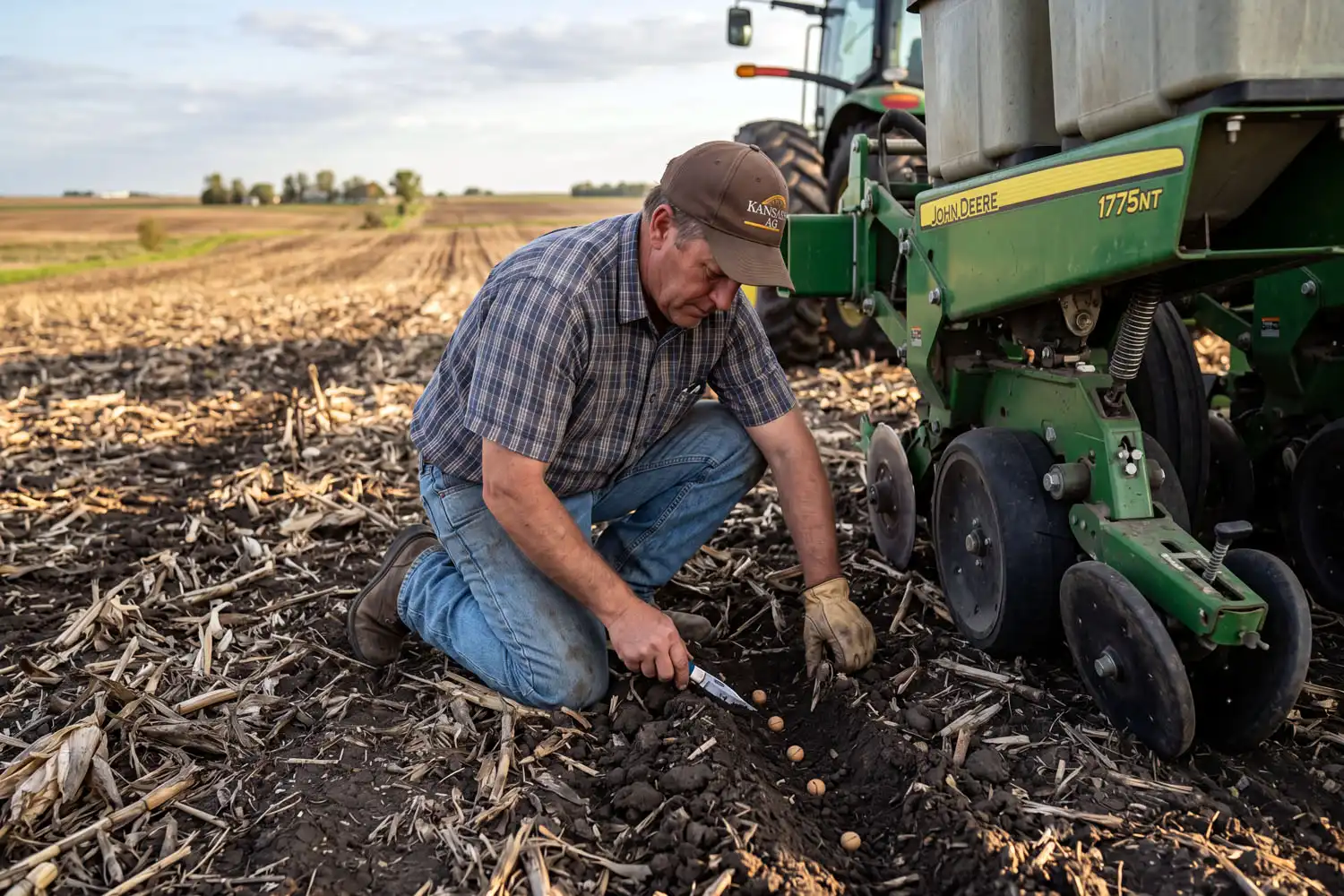
Setting depth takes ten minutes. Skipping the check can cost ten bushels. Here is the process on the first pass of every field:
- Set the depth stop. Adjust the gauge wheel handle or depth cam on each row unit to your target, usually the 1.5 inch notch to start.
- Plant 50 feet at field speed. Slow test passes lie to you. Row units bounce differently at 5 mph than at 2.
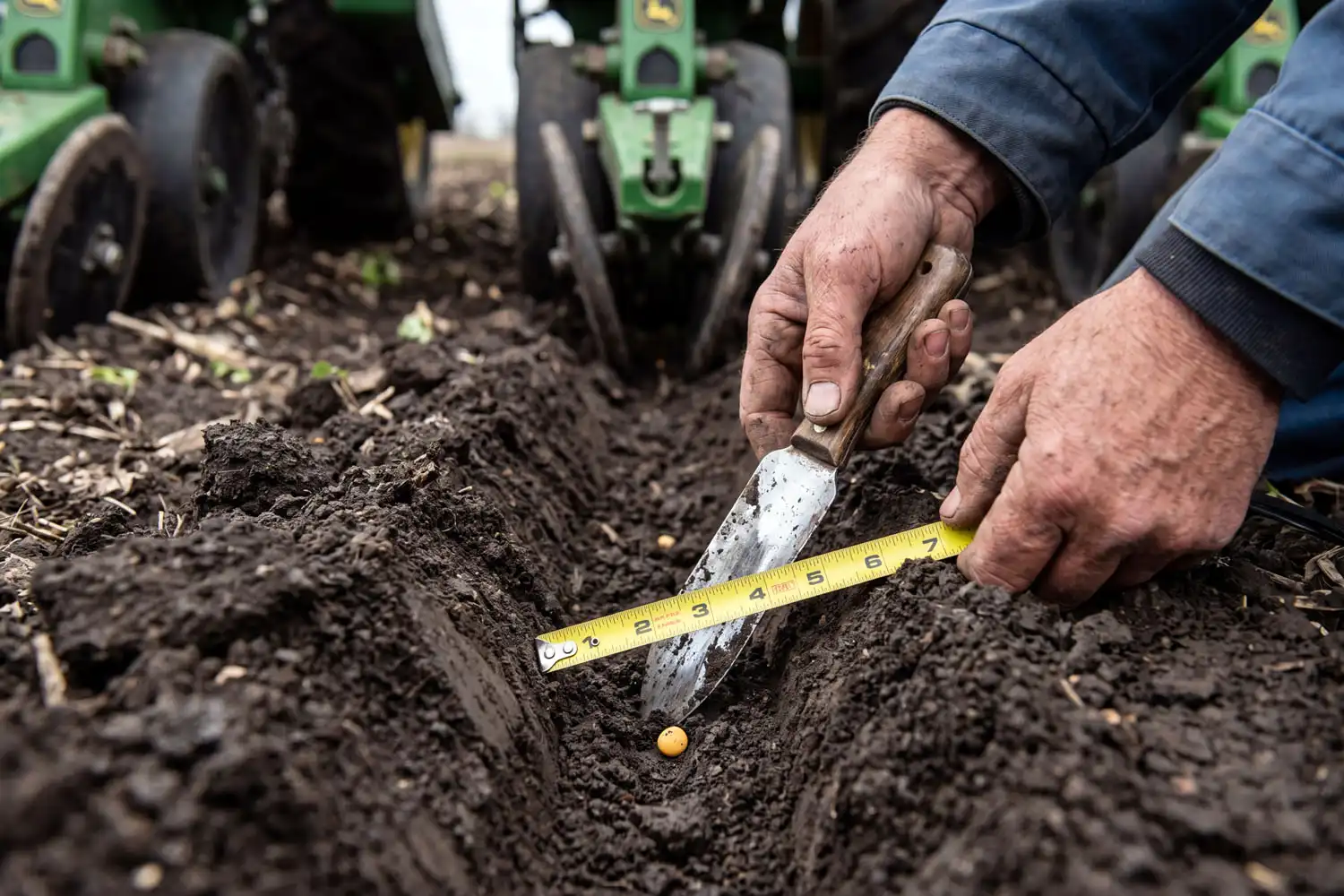
- Dig the furrow open. Use a knife or trowel to carefully expose seed in three or four spots per row checked. Measure from the soil surface to the seed.
- Check seed-to-soil contact and moisture. Seed should sit in firm, moist soil with the furrow closed above it, not in an open slot or loose residue.
- Check multiple rows, especially the wings. Center-fill planters get heavy in the middle and light on the ends. Outside rows commonly run a quarter to half inch shallow.
- Recheck when anything changes. New field, different residue, a rain, or a tillage change all shift effective depth.
Planters hold depth better than drills or air seeders. If you seed beans with a drill, check twice as often, because depth surveys have found most drilled fields running off target, usually too deep. Small-plot growers face the same issue in miniature, and a quality garden seeder with a depth-adjustable shoe beats hand-scratching furrows for consistency.
One more lever matters: downforce. Too little and openers ride up over firm spots, planting shallow. Too much and you sidewall compact, which restricts early roots. In variable fields it is better to adjust downforce by zone than accept seed bouncing between 1 and 2 inches.
Does Planting Depth Change With Seeding Rate and Row Spacing?
Depth and population interact more than most people realize. The Nebraska depth trials showed that yield losses from off-target depth were biggest at low populations of 105,000 seeds per acre or less. At higher rates, the stand had enough plants to compensate for the seedlings lost at the extremes. So if you run lean seeding rates to cut seed cost, your depth accuracy has to be tighter.
Row width plays a small role too. Narrow drilled rows put fewer seeds per foot of row, which means less combined pushing power against a crust than 30-inch planter rows deliver. Whatever your setup, get plant spacing for your crops and depth dialed in together, because uniform stands come from both.
Variety matters at the margins. Large-seeded varieties emerge from deeper placement than small-seeded ones, and modern seed treatments let beans tolerate cool, deep seedbeds that would have wrecked a stand twenty years ago.
Where to Set the Planter
On the ground outside Topeka, the planter starts every season at 1.5 inches. Early beans into cool no-till go in at 1.25 to 1.5. June beans chasing moisture go to 1.75 or 2. Pass 2.5 inches, and leave a field without digging behind the planter. Depth is a free yield decision. Get seed a half inch into moisture, keep it under 2 inches when you can, and check it with your own knife instead of trusting the monitor.