How to Grow Soybeans From Planting to Harvest (2026 Guide)
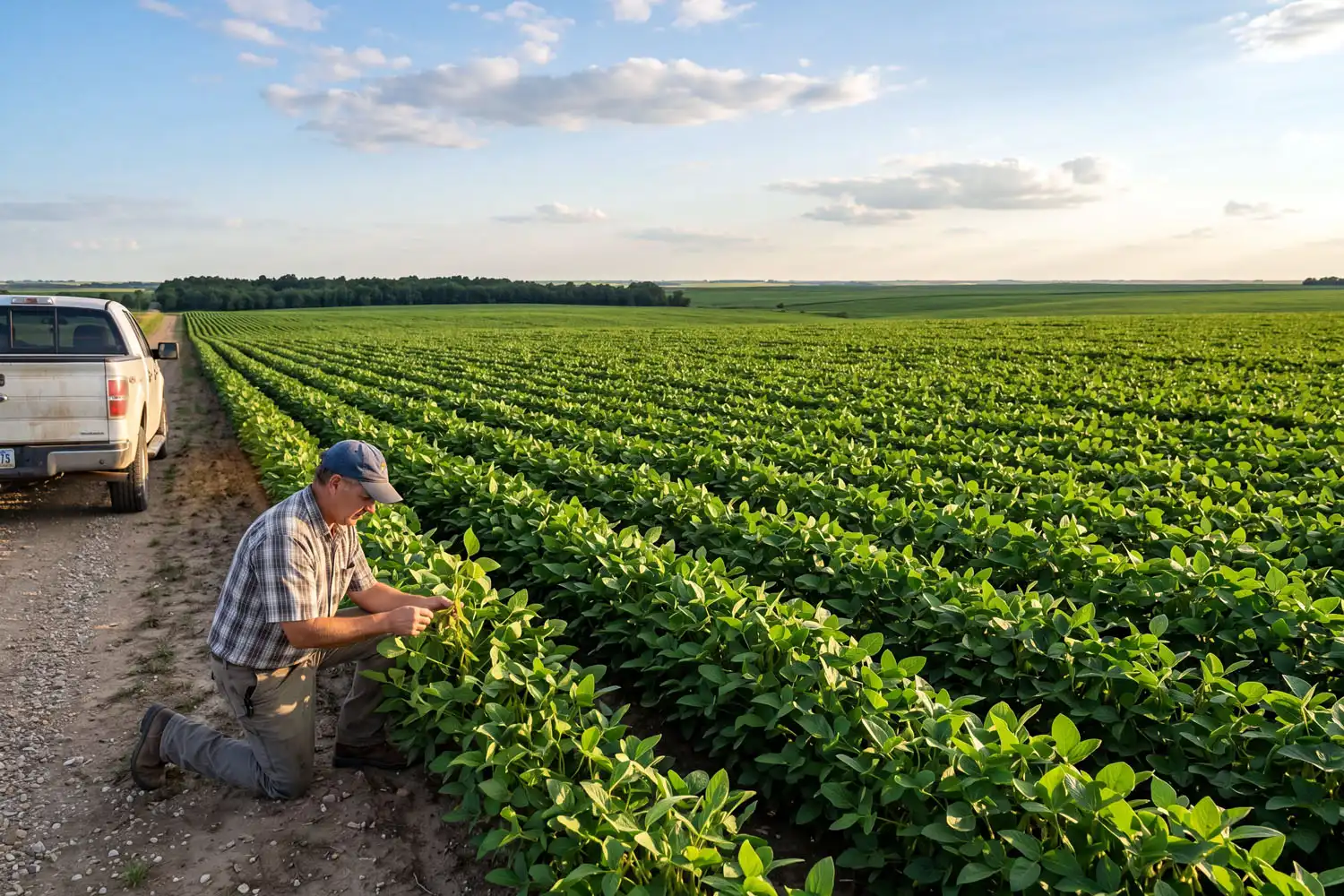
Growing soybeans rewards good decisions more than good luck. Planting date, seed depth, and weed timing decide most of your yield before August.
Plant soybeans 1 to 1.5 inches deep once soil hits 60°F, usually May. Seed 100,000 to 140,000 seeds per acre, inoculate new ground, control weeds early, and harvest at 13 percent moisture.
This guide covers how to grow soybeans from variety selection through harvest, based on what works on the fields outside Topeka.
What Soybeans Need to Grow Well
Soybeans (Glycine max) need full sun, warm soil, and a pH between 6.0 and 6.8. They handle a wide range of soil types, but they punish compaction and standing water.
The crop is a legume. It fixes its own nitrogen through Bradyrhizobium japonicum bacteria living in root nodules. That changes how you fertilize, and cover that below.
Plan for 20 to 26 inches of water across the season from rain, stored soil moisture, or irrigation. In northeast Kansas, rainfall covers most of that in a normal year. Western growers lean harder on irrigation.
One more thing before seed goes in the ground. Know your rotation. Beans following corn or wheat almost always outperform beans following beans. Disease and soybean cyst nematode pressure build fast in continuous soybeans, so a solid crop rotation schedule is the cheapest yield insurance you can buy.
How Do You Choose a Soybean Variety?
Pick a variety by maturity group first, then by disease resistance, then by yield data from trials near you. Maturity groups run from 000 in the far north to 8 in the Deep South. Around Topeka, plant groups 3.5 to 4.5. Iowa runs groups 2 to 3. Mississippi runs 4 to 5.
After maturity, check three boxes on every seed tag:
- SCN resistance. Soybean cyst nematode is the top yield robber in the country. Most resistance still comes from the PI 88788 source, and nematodes are adapting to it, so rotate resistance sources when you can.
- Sudden death syndrome and phytophthora scores. These matter most on wet, heavy ground and early planted fields.
- Herbicide trait. Enlist E3, XtendFlex, or conventional. Match the trait to your weed program and your neighbors’ spray plans.
There are far more options than most growers realize. If you want background on how varieties break down, our guide covers the types of soybeans grown across the US.
When to Plant Soybeans
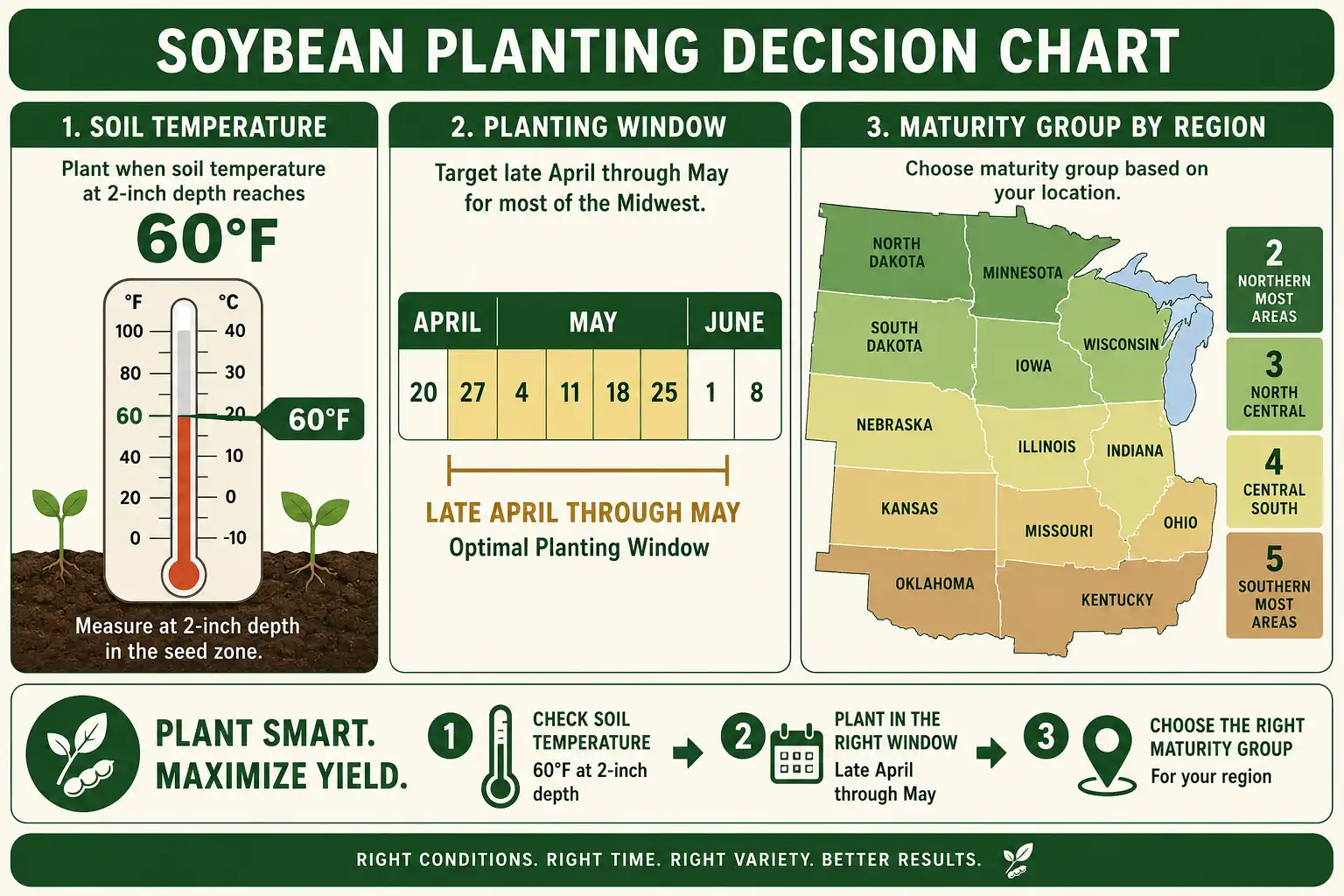
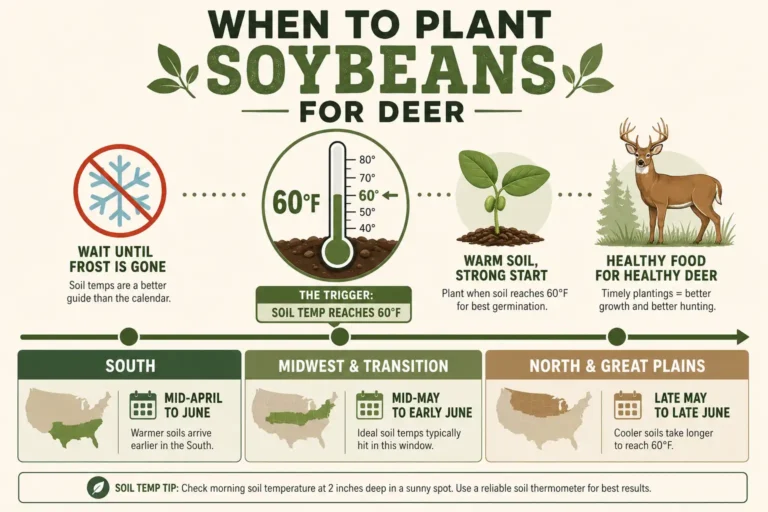
Plant soybeans when soil temperature at seeding depth reaches 60°F and the forecast looks stable. For most of the Corn Belt and eastern Kansas, that means late April through May. K-State Research and Extension data shows seedlings planted into soil colder than 60°F emerge slowly and lack vigor.
Earlier planting generally wins. Kansas trials show yield dropping roughly 0.3 bushels per acre for every day planting slips past mid spring. Ohio research puts the loss at 0.25 to 1 bushel per day after mid May. Early planted beans build more nodes, and nodes carry pods.
That said, cold soil water below 45°F can injure seed within the first 24 hours of imbibition. If you push the calendar, use a fungicide and insecticide seed treatment and a variety with strong emergence scores.
In drier areas with shallow soils, late May to early June planting is often more consistent. Those beans bloom and fill seed in late August and September, after the worst heat has passed.
How to Prepare the Field for Soybeans
Start with a soil test six months before planting. It tells you pH, phosphorus, and potassium levels, which drive every fertility decision. Pull cores every other year, and testing your soil before beans matters more than before corn because you cannot fix problems with in-season nitrogen.
Here is what the test results should guide:
Lime. Target pH 6.0 to 6.8. Acid soils below 6.0 cut nodulation and lock up molybdenum, which the nitrogen fixing bacteria need. Apply lime in fall so it has time to react.
Phosphorus and potassium. A 60 bushel crop removes around 48 pounds of P2O5 and over 80 pounds of K2O per acre. If your test shows P below about 20 ppm or K below your state’s critical level, apply fertilizer before planting. Above critical levels, extra P and K rarely pay. Skip in-furrow fertilizer with beans. Seed is salt sensitive, and research shows banding near the seed risks stand loss for no yield gain.
Nitrogen. Do not apply it. Nodulated soybeans fix what they need, and added N delays nodulation. The exception is first-time soybean ground, where a small starter amount can carry seedlings until nodules take over.
Tillage. Beans do fine in no-till, strip-till, or conventional systems. Run mostly no-till because it holds moisture through July heat. Whatever the system, the seedbed needs to be firm and free of crusting risk.
How to Plant Soybeans Step by Step
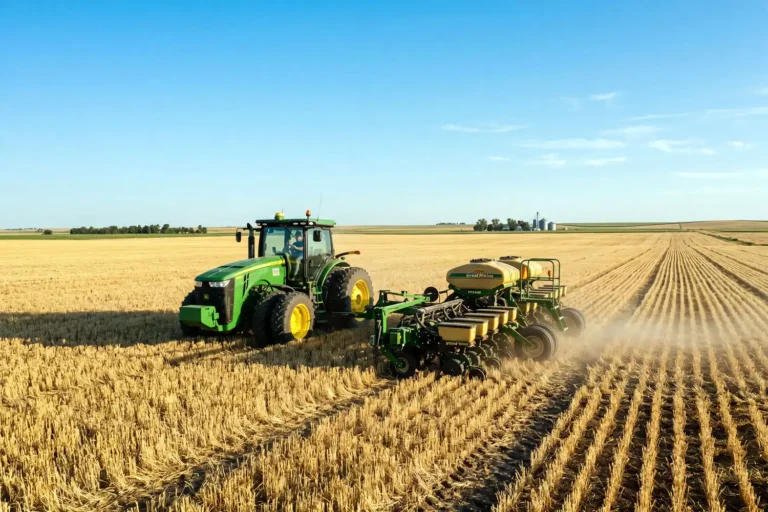
Planting soybeans takes five decisions: inoculant, depth, rate, spacing, and timing. Get these right and the crop mostly takes care of itself until weeds show up.
Step 1: Inoculate when it counts. If the field has not grown soybeans in the past 3 years, treat seed with a Bradyrhizobium japonicum inoculant. It costs a few dollars an acre and prevents the pale, nitrogen starved beans that show up every year on new ground. Fields with recent soybean history usually carry enough native bacteria.
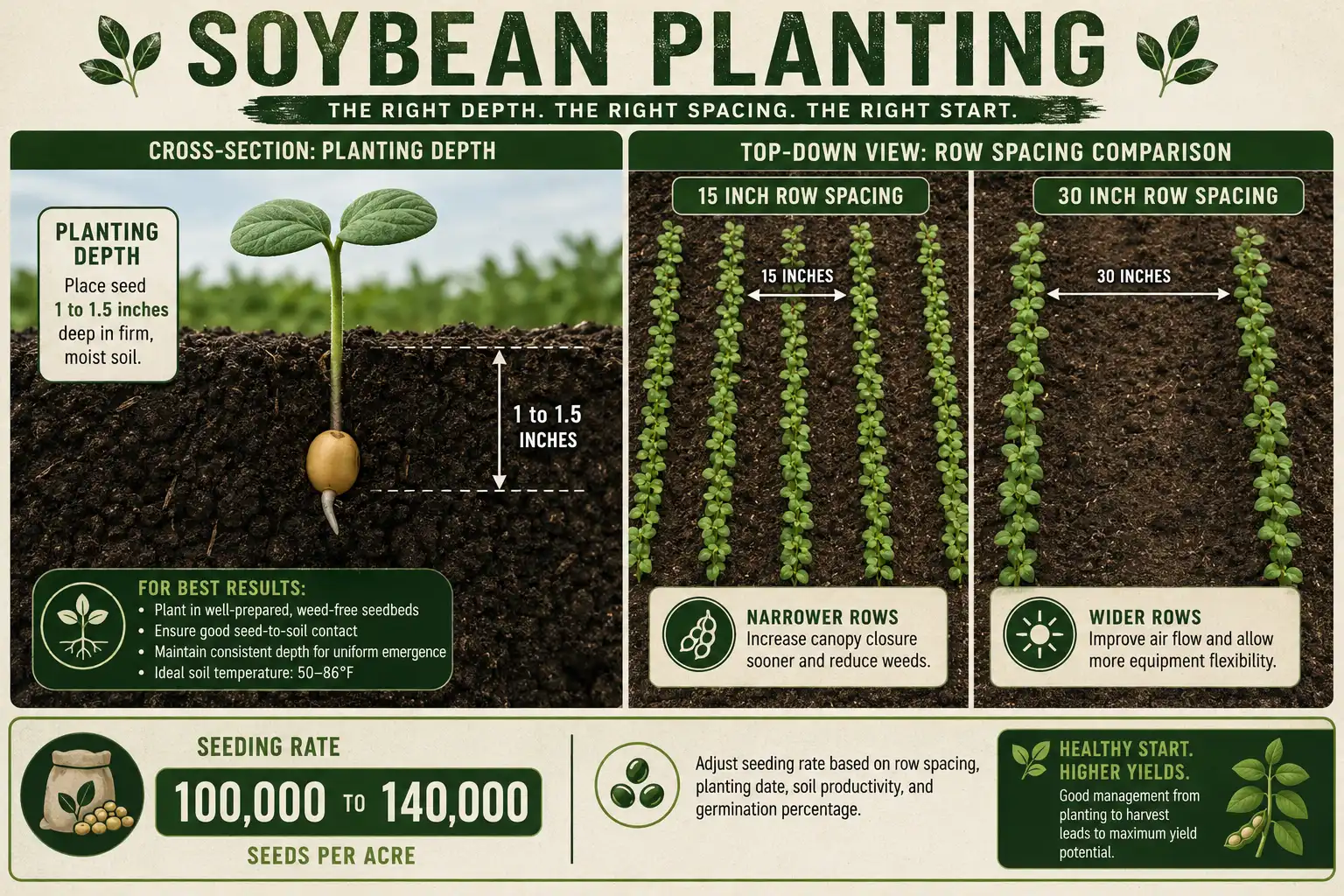
Step 2: Set depth at 1 to 1.5 inches. Plant into moisture, but never deeper than 2 inches. On heavy clay that crusts, stay shallow at 0.75 to 1 inch. Uniform depth gives uniform emergence, and even stands out-yield ragged ones.
Step 3: Seed 100,000 to 140,000 seeds per acre. The target is about 100,000 standing plants per acre at harvest in narrow rows, or 80,000 in 30 inch rows. Assume 80 to 90 percent emergence and back-calculate. Drop 130,000 on dryland ground. Bump rates 10 to 20 percent for June planting or rough seedbeds. High yield irrigated ground can justify 160,000.
Step 4: Pick your row spacing. Fifteen inch rows yield 2 to 7 percent more than 30 inch rows in most trials, mainly through faster canopy closure that shades out weeds. Thirty inch rows still make sense if you share a planter with corn or farm white mold country. Drills work but waste seed through poor placement, so plan on higher rates.
Step 5: Plant when conditions allow, not when the calendar says. Mudding beans in causes sidewall compaction that haunts the crop all season. Proper seed spacing and singulation from a well calibrated planter beats an early date in bad conditions.
How Much Water Do Soybeans Need?
Soybeans use 20 to 26 inches of water per season, and more than 60 percent of it goes through the plant between flowering and seed fill. Daily use runs near 0.05 to 0.1 inches at the seedling stage, climbs past 0.25 inches at flowering, and peaks around 0.3 inches or more per day during pod fill in hot, windy weather.
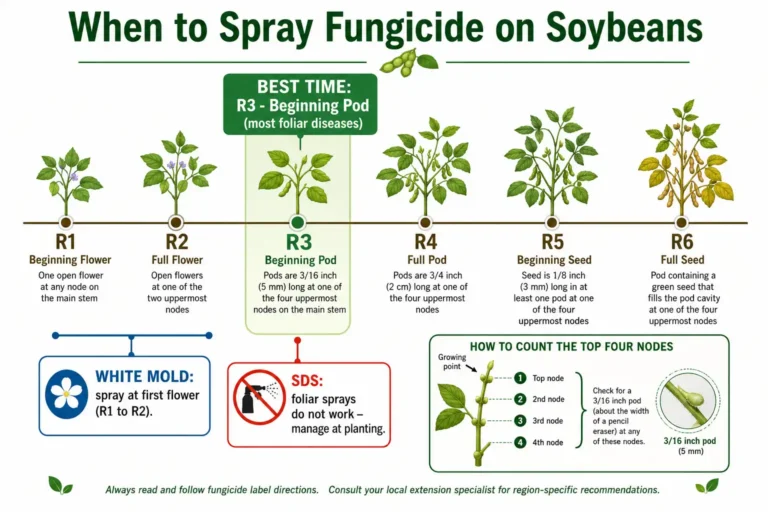
The critical window is R3 through R6, beginning pod through full seed. Drought stress there aborts pods and shrinks seed, and you cannot buy that yield back later. If you irrigate, hold your water for this window. Early season irrigation on decent soils mostly grows shallow roots and disease.
Dryland growers like me manage water differently. Residue cover, reduced tillage, and planting dates that push seed fill into cooler weather all stretch stored moisture further.
How Do You Control Weeds in Soybeans?
Start clean and stay clean for the first 6 weeks. That sentence is the whole program. Beans that face waterhemp or Palmer amaranth competition from emergence through canopy lose bushels you never see.
Program, and what extension agronomists across the Great Plains recommend:
- Burndown or tillage so zero weeds are up at planting.
- A full rate residual pre-emergence herbicide at planting. Group 15 plus another effective site of action.
- Post application before weeds hit 4 inches, usually with a second residual layered in.
- Canopy closure as the final pass. Narrow rows shade the middles weeks earlier.
Herbicide resistant pigweeds keep spreading, so rotating effective sites of action is not optional anymore. our guide covers the broader toolbox, including cultural and mechanical options, in our guide on controlling weeds in field crops.
What Pests and Diseases Hit Soybeans Hardest?
Soybean cyst nematode causes more yield loss than any other soybean pest in North America, and it often shows no symptoms above ground. Sample fields for SCN every few years and rotate resistant varieties.
Beyond SCN, scout for these on a weekly walk:
- Bean leaf beetles clip cotyledons and early leaves, worst on the earliest planted fields in the area.
- Stink bugs and pod feeders during R4 to R6. They pierce seeds and invite disease.
- Sudden death syndrome and phytophthora root rot on wet soils, managed mainly through variety selection and drainage.
- White mold in dense canopies up north. Wider rows and lower populations help there.
- Frogeye leaf spot and septoria in warm, humid Augusts. A foliar fungicide at R3 pays in heavy pressure years, not every year.
Thresholds matter. Spraying defoliators before beans lose 20 percent leaf area in reproductive stages wastes money and flares spider mites.
When and How to Harvest Soybeans
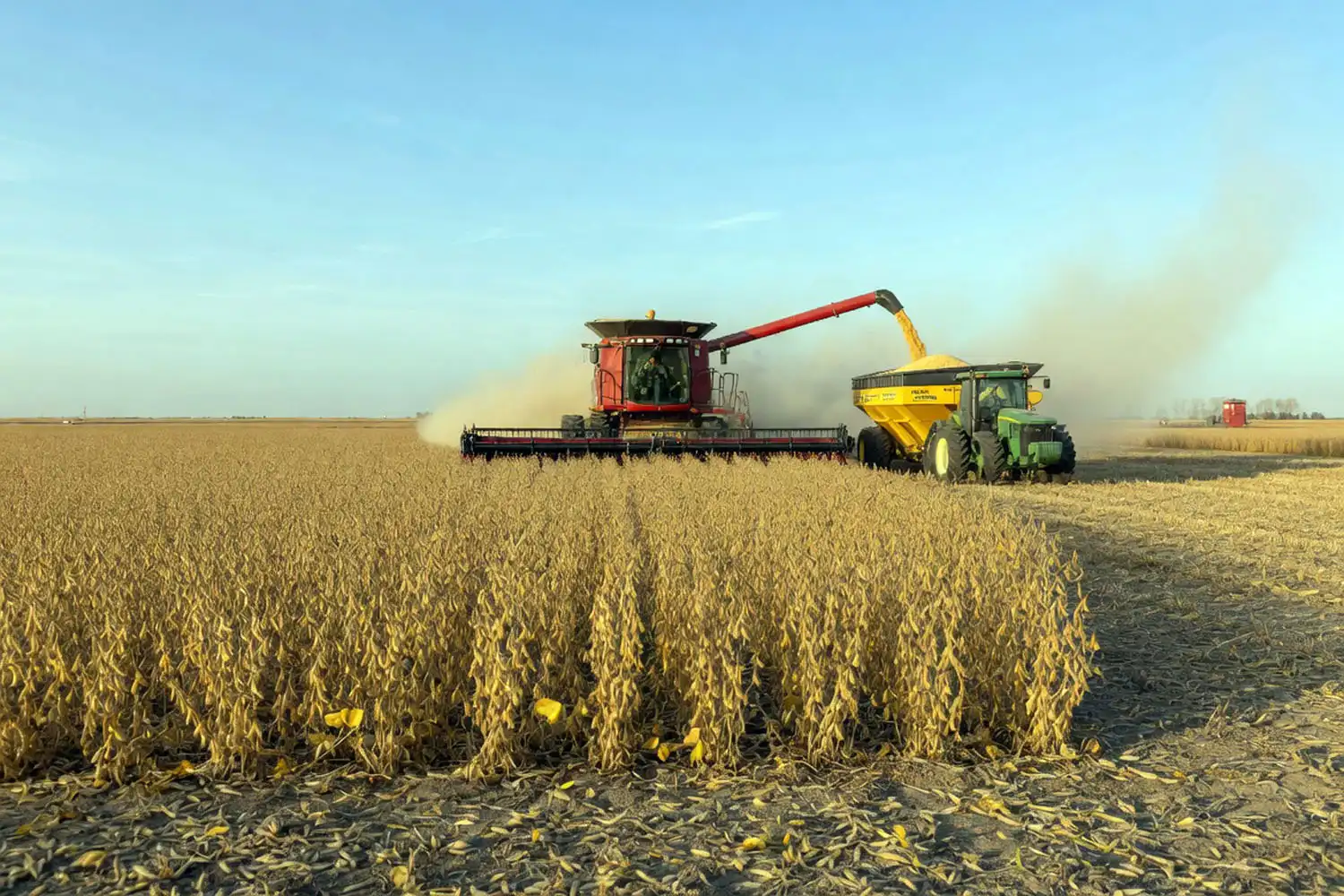
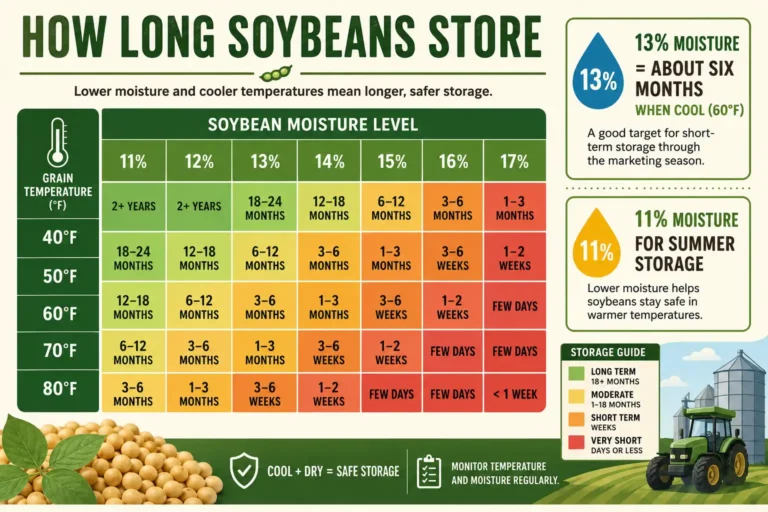
Harvest soybeans when 95 percent of pods have turned their mature tan color and grain moisture sits between 13 and 15 percent. At 13 percent you hit the elevator standard with no dock and no give-away. Every point drier than 13 is weight, and money, left in the field.
A few rules to run the combine by:
- Start at 14 to 15 percent moisture rather than waiting. Beans dry faster than they look, and shattering risk jumps once moisture drops near 11 percent.
- Count beans behind the machine. Four to five beans per square foot on the ground equals a full bushel per acre lost.
- Slow down for green stems. Tough material needs reduced ground speed and more aggressive rotor settings.
- Avoid hot, dry afternoons in brittle fields. Shatter loss at the header is worst then.
- Check moisture in the tank, not by feel. A handheld grain moisture meter settles arguments before the elevator does.
Knowing the general signs of crop maturity helps too, and the same logic in the piece on judging harvest readiness applies straight to beans.
Store at 13 percent moisture or below for winter storage, 11 percent for storage into summer. Beans crack easier than corn, so keep auger speeds full and drop heights short.
How Long Do Soybeans Take to Grow?
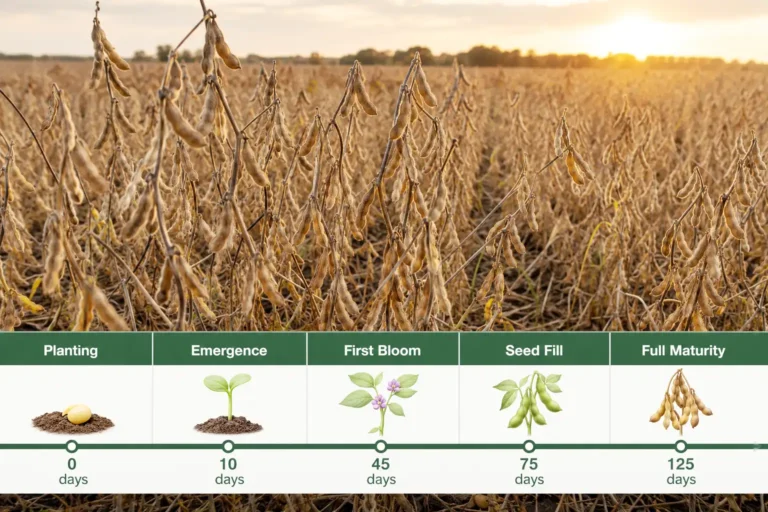
Soybeans take 90 to 130 days from planting to harvest, depending on maturity group and weather. Group 4 beans planted in mid May usually combine in early October. Earlier maturity groups finish faster, and heat units during the season move that window by a week or two either direction.
A rough season timeline for a May planted crop:
- Emergence: 5 to 10 days after planting in 60°F+ soil
- Flowering (R1): late June to mid July
- Pod fill (R3 to R6): late July through early September
- Maturity (R8): mid September to October
Soybeans are photoperiod sensitive. Shortening days trigger flowering, which is why a group 4 bean planted June 25 still matures only a couple weeks behind one planted May 10.
Bottom Lines
Bean program is simple. Soil test in fall, lime if needed, no nitrogen ever. Plant a group 4 SCN resistant variety at 130,000 seeds in 15 inch rows once soil holds 60°F. Residual herbicide down at planting, post pass at 3 weeks, then let the canopy work. Hold irrigation or pray for rain at pod fill. Combine at 14 percent and quit by 13. The growers who struggle with soybeans usually skipped one of those steps, not all of them. Fix the weakest link first, and the crop pays you back.