How Many Pounds of Soybeans to Plant Per Acre (2026 Guide)
Figuring out how many pounds of soybeans to plant per acre comes down to two things: your target plant population and your seed size. Most growers land between 40 and 65 pounds per acre.
Plan on 40 to 65 pounds of soybean seed per acre. That covers a target of 120,000 to 180,000 seeds per acre at an average seed size near 2,800 seeds per pound. Drills need the higher end.
How Many Pounds of Soybeans to Plant Per Acre
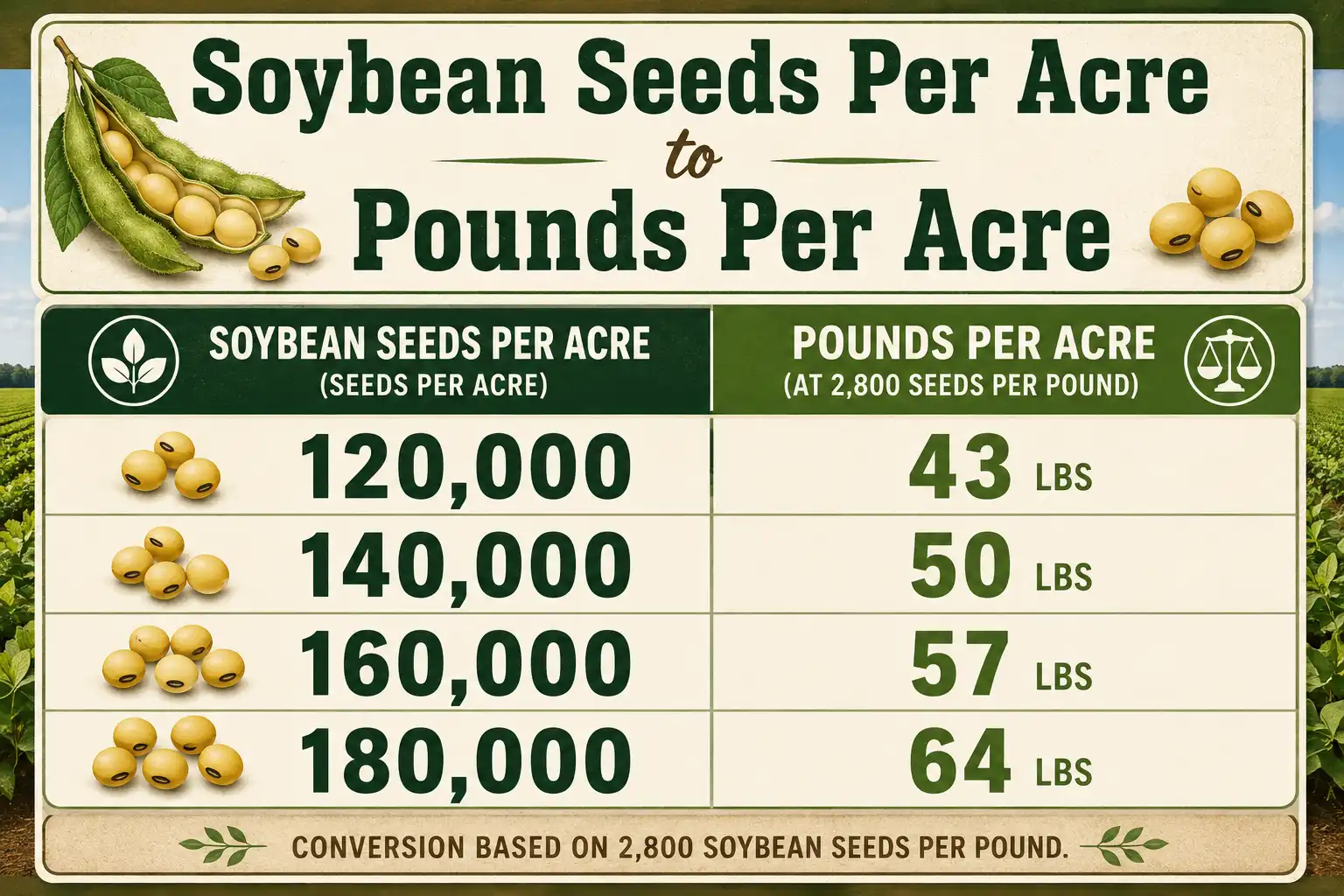
Most soybean fields take 40 to 65 pounds of seed per acre. The exact number depends on your target population and how big the seed is. At an average seed size of 2,800 seeds per pound, the math is simple:
- 120,000 seeds per acre is about 43 pounds
- 140,000 seeds per acre is about 50 pounds
- 160,000 seeds per acre is about 57 pounds
- 180,000 seeds per acre is about 64 pounds
Most dryland beans get planted in that 50 to 57 pound window. That typically results in a final stand near 100,000 to 120,000 plants per acre. That is where soybeans pay best for me.
Why Soybeans Are Sold by Seed Count, Not Weight
Seed companies sell soybeans by seed count now, not by the pound. A standard bag holds 140,000 seeds. Years back, growers bought 50-pound bags and figured rates by weight. That changed once seed prices climbed and traits like glyphosate tolerance raised the value of every seed.
Here is why weight alone misleads you. Soybean seed size swings a lot. One lot might run 2,500 seeds per pound. Another runs 3,500. Same 50 pounds, very different seed counts. So a pound figure only works once you read the seeds-per-pound number off the bag tag. If you grow more than one of the common types of soybeans, expect that number to differ from variety to variety too.
How to Calculate Pounds of Soybean Seed Per Acre
Divide your target seeds per acre by the seeds per pound printed on the tag. That gives you pounds per acre.
Example: targeting 140,000 seeds per acre. Tag says 2,800 seeds per pound. So 140,000 divided by 2,800 equals 50 pounds per acre.
Run it again with smaller seed. Same 140,000 target, but the tag reads 3,400 seeds per pound. Now 140,000 divided by 3,400 equals 41 pounds per acre. Same field, same stand goal, nine fewer pounds. That is why the rate should never be set by weight without checking the tag first.
Setting Your Target Plant Population
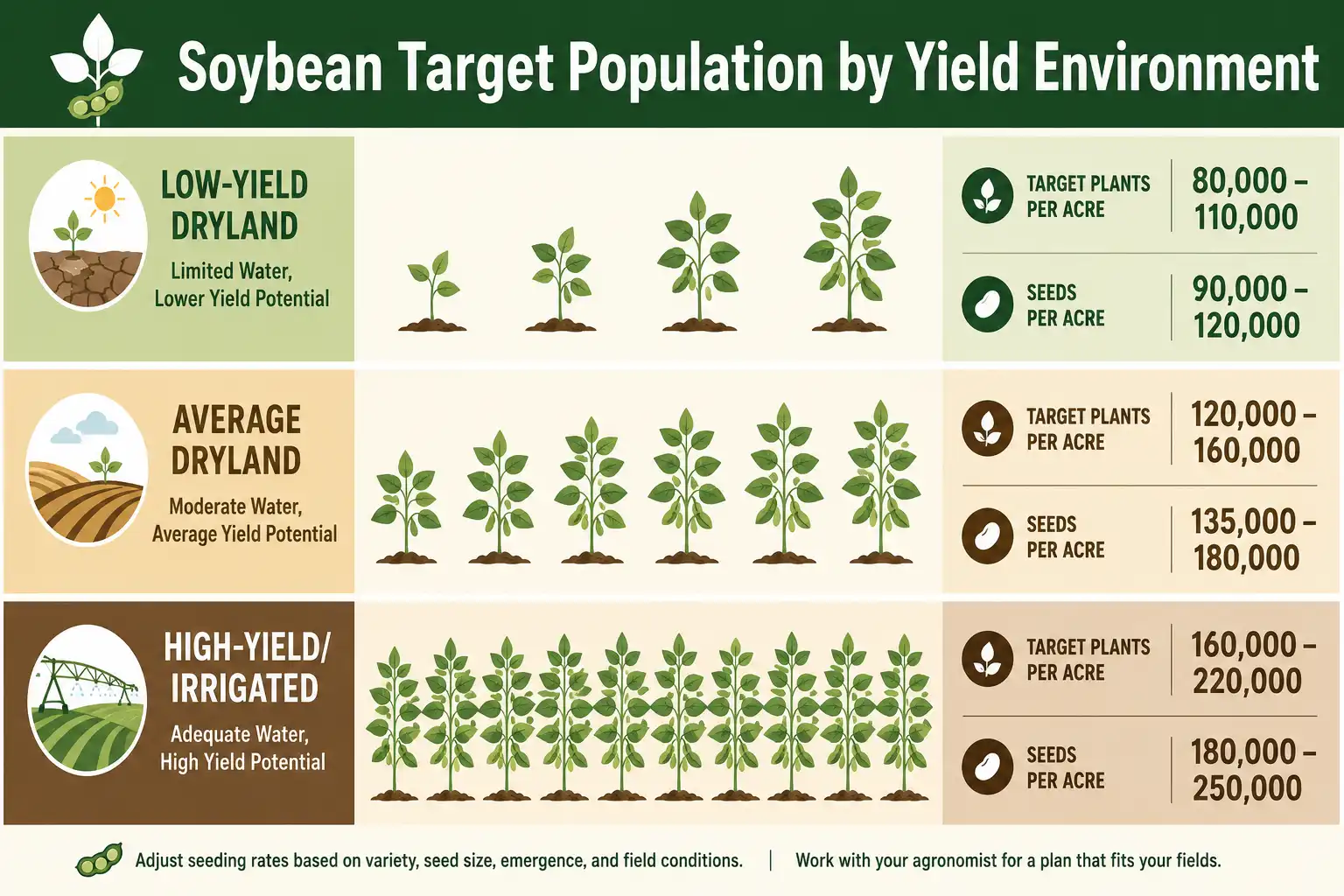
Your yield environment sets the target, and the target sets the pounds. K-State Research and Extension data across Kansas shows soybeans adjust hard to their conditions. Low-yield ground needs fewer plants. High-yield ground rewards more.
Here is what the research points to for final stand:
- Low-yield dryland (under 30 bu/acre): 70,000 to 75,000 plants per acre. Seed near 85,000 to 90,000 to hit it.
- Average dryland (40 to 50 bu/acre): aim for 100,000 to 120,000 plants. Seed 120,000 to 140,000.
- High-yield or irrigated (50+ bu/acre): final stand near 105,000 to 150,000 plants. Seed 130,000 to 160,000 or more.
Those seed figures assume about 80% emergence with a planter. A good soil testing routine helps you gauge which yield bracket your field really sits in. In the Great Plains, dryland beans rarely need a heavy rate. Water is the limit here, not plant count.
How Seed Size Changes Your Pounds Per Acre
Seed size is the single biggest reason two fields at the same seeding rate need different pounds. Big seed means fewer seeds per pound, so you need more pounds. Small seed means more seeds per pound, so you need fewer pounds.
Drought and heat during pod fill shrink the seed. A stressed crop might produce 3,500-seed-per-pound beans. A wet, easy year can give you 2,500-seed-per-pound beans. Because of that swing, you always read the seeds-per-pound number off the bag. It is printed there for exactly this reason.
Planter vs Drill: How Equipment Changes the Rate
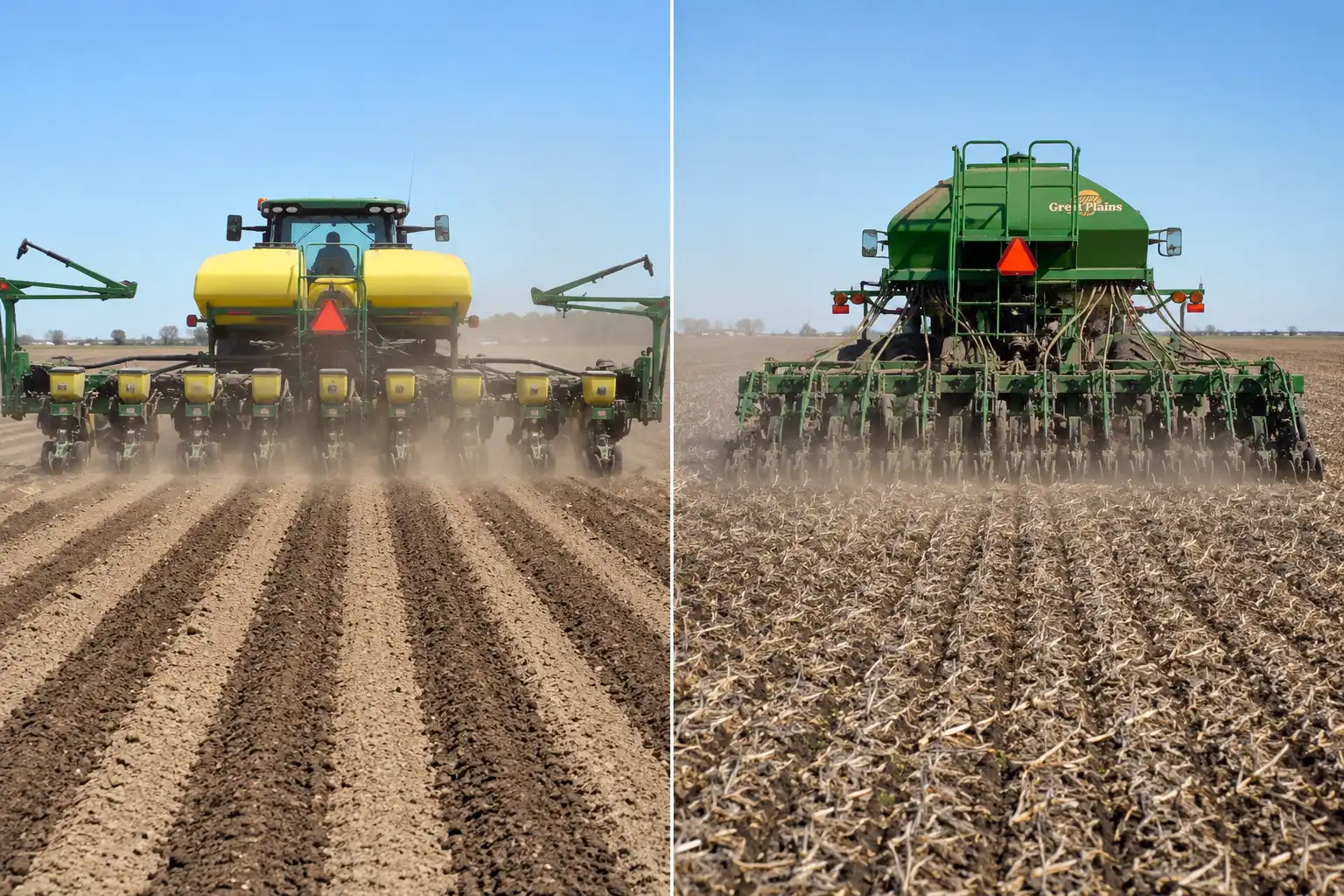
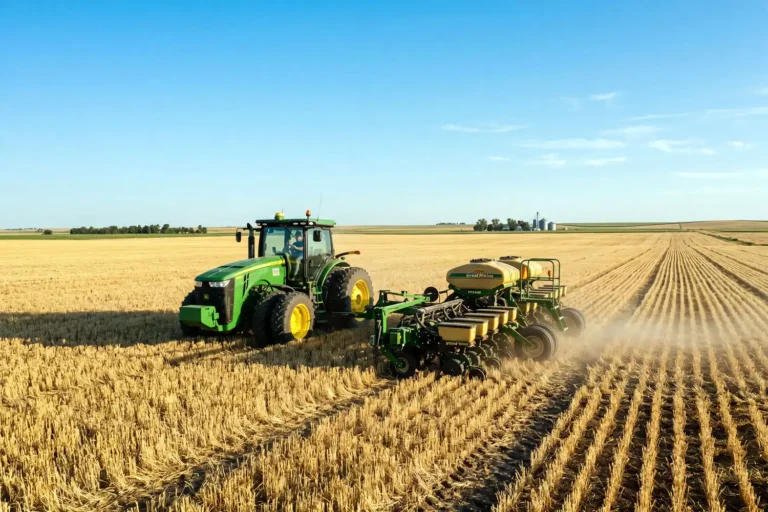
Drills need more seed per acre than planters because they place seed less precisely. A planter sets seed at even depth with good soil contact, so emergence runs around 80%. A drill drops emergence closer to 65%. So you bump the rate to cover that loss.
Rule of thumb for a 100,000 to 120,000 plant target:
- Planter (15 or 30 inch rows): 120,000 to 140,000 seeds per acre
- Air drill: 140,000 to 160,000 seeds per acre
- No-till drill: 160,000 to 180,000 seeds per acre
In pounds at 2,800 seeds per pound, that is roughly 43 to 50 with a planter and 57 to 64 with a no-till drill. Narrow rows and tight plant spacing close the canopy faster, which also helps shade out weeds.
Does Planting More Seed Mean More Yield?
No. Past a certain point, extra seed adds cost without adding bushels. Soybeans branch and set more pods when they have room. So a stand of 100,000 healthy plants can match or beat a thicker stand.
Thin stands can sometimes deliver surprising results. Research out of the Corn Belt backs this up. A final stand of 100,000 plants per acre hits more than 95% of full yield in most fields. Going heavier mostly raises your seed bill and your lodging risk. If you want to increase your yield, put your effort into variety, fertility, and hitting the right planting window before you crank up the rate. That is where real bushels come from.
Common Seeding Rate Mistakes
A few errors cost growers money every spring.
- Setting rate by pounds without checking seeds per pound. Seed size shifts every year.
- Running planter rates through a drill. You will come up short on stand.
- Over-seeding good ground. More plants past 120,000 rarely pays.
- Ignoring emergence. Cold, wet, or crusted soil drops your stand below target, so plan for it.
Bottom Line for Your Field
Start with your target plant population, then convert to pounds using the seeds-per-pound number on the tag. For most fields, 40 to 65 pounds per acre covers it. Run 50 to 57 pounds on dryland with a planter and bump it up for the drill. Check your seed size every season, because it moves. And remember, a clean 100,000-plant stand beats an overcrowded one almost every time.