How to Stage Soybeans for Better Spray Timing
Knowing how to stage soybeans tells you exactly where your crop sits in its life cycle. That single skill drives your spray timing, scouting calls, and harvest decisions. Soybeans move through vegetative and reproductive stages, and reading them right keeps you from guessing all season.
Stage soybeans by counting main-stem nodes that carry a fully developed leaf. Those are your V stages. After flowering, switch to R stages set by flowers, pods, and seeds. A field hits a stage once half the plants reach it.
Why Staging Soybeans Matters
Staging matters because nearly every in-season decision rides on it. Herbicide labels set cutoffs by growth stage, not by calendar date. Fungicide windows for white mold open at specific reproductive stages. Frost and hail damage hit yield differently depending on the stage your crop is in.
Staging fields is the recommended step before making any spray pass. Height fools you. Two fields planted the same week can look different but sit at the same stage. Read the plant, not the tape measure. That habit has saved me more than one wasted application.
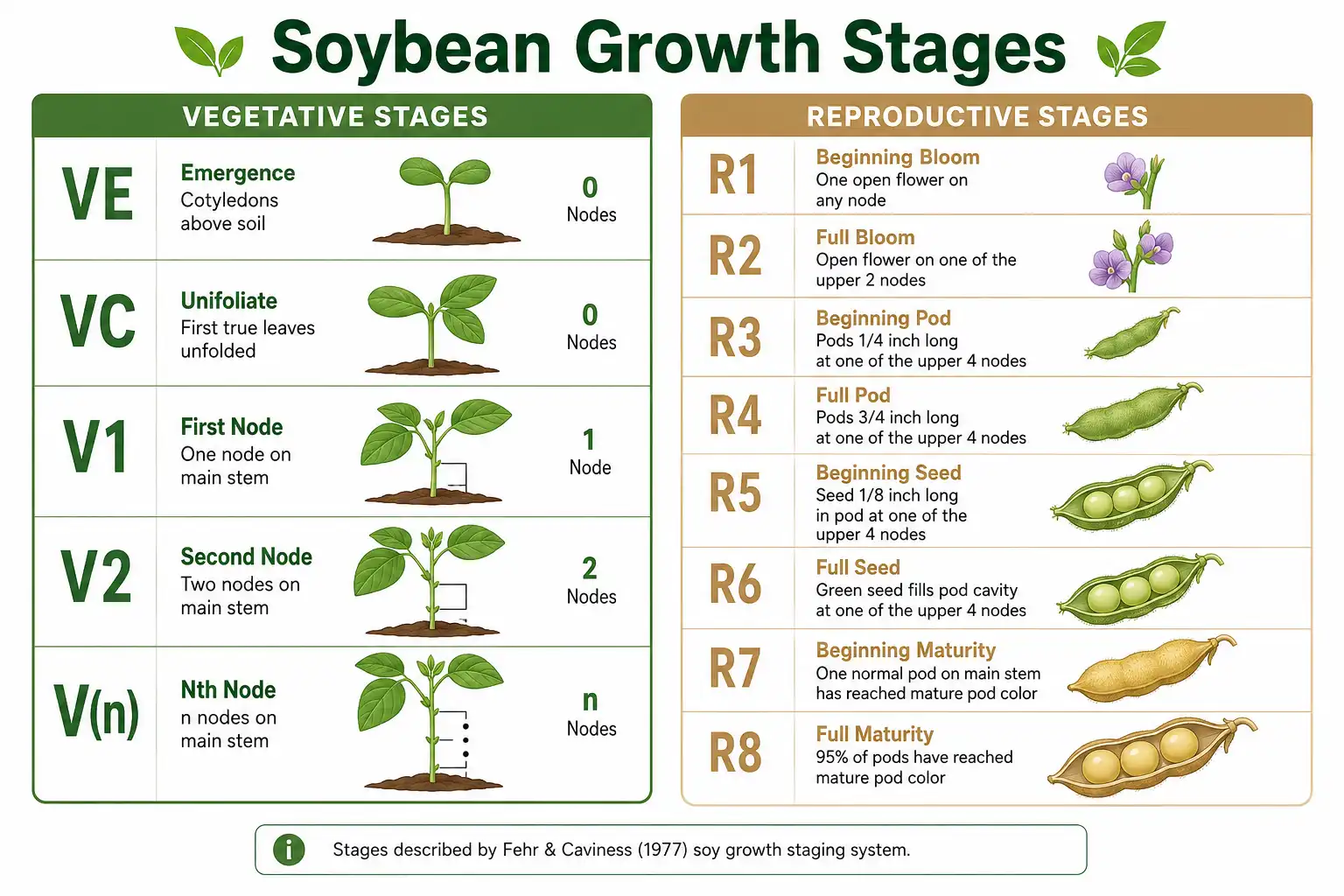
The staging system itself comes from Glycine max research published by W.R. Fehr and C.E. Caviness in 1977. Iowa State University Extension still uses that framework today. It splits the plant’s life into two phases: vegetative (V) and reproductive (R).
The Two Phases: Vegetative and Reproductive
Vegetative stages cover emergence through the start of flowering. They track leaf and node development. Reproductive stages cover flowering through full maturity. They track flowers, pods, and seeds.
Your variety’s growth habit shapes how these overlap. Indeterminate types keep adding nodes after flowering starts. Determinate types stop vegetative growth once they flower. Most beans grown across the Corn Belt and the Great Plains fall into early to mid maturity groups, and they lean indeterminate.
How Do You Count a Soybean Node?
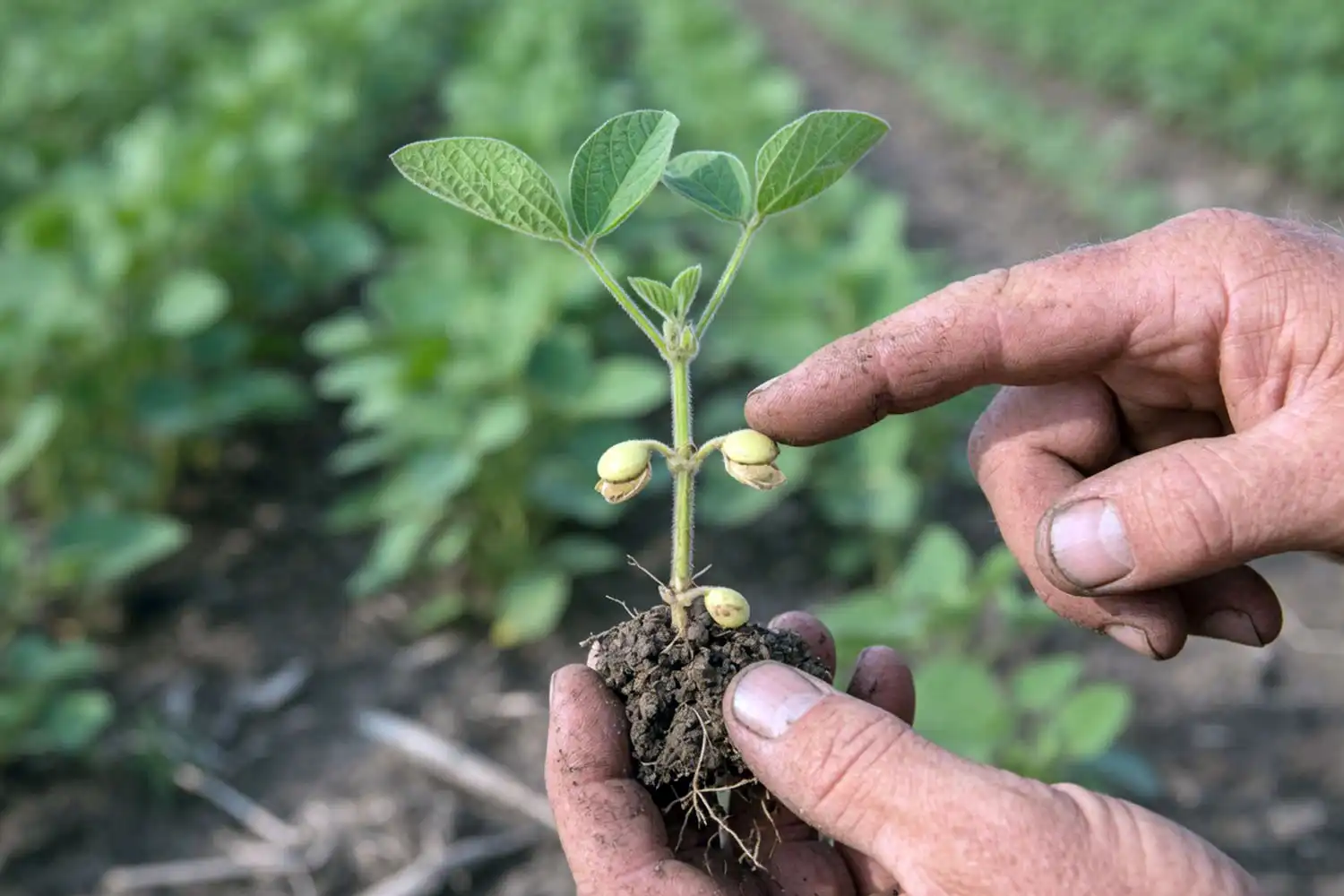
A node is the point on the main stem where a leaf attaches, or once attached. Staging starts here, so learn to spot one cleanly.
The key is the “fully developed leaf” rule. A leaf counts as fully developed once the leaf at the node directly above it has unrolled enough that its leaflet edges no longer touch. In plain terms, the next leaf up has to open before the one below it gets counted.
Start your count at the bottom. The cotyledon node holds the two seed leaves. Just above it sits the unifoliolate node, which carries two single leaves opposite each other. Every node above that carries a trifoliate leaf with three leaflets. You count nodes upward from the unifoliolate node.
Vegetative Stages: VE Through V(n)
Vegetative stages run by node count, beginning at emergence. Here is how each one reads in the field.
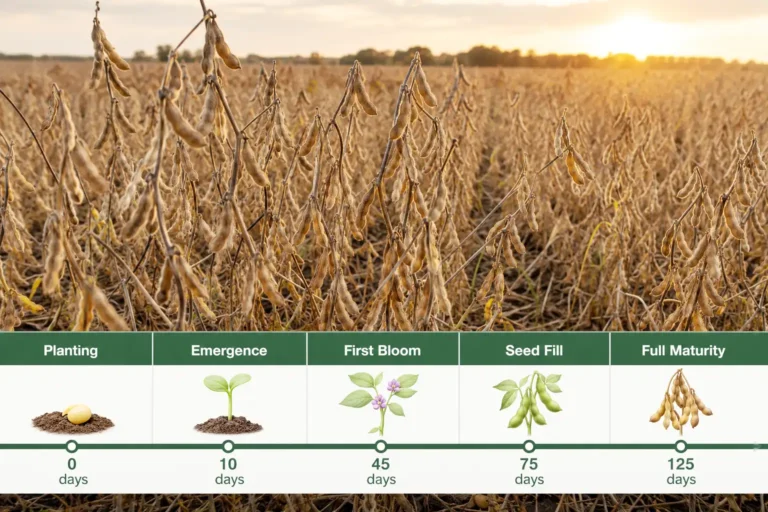
- VE (Emergence): The cotyledons break through the soil surface. This usually lands 5 to 15 days after planting, depending on soil temperature and moisture. Cool, crusted ground slows it down.
- VC (Cotyledon): The two unifoliolate leaves unroll far enough that their edges stop touching.
- V1 (First node): The plant has one set of fully developed trifoliate leaves above the unifoliolate node.
- V2 (Second node): Two trifoliate leaves are fully developed.
- V(n) (nth node): The “n” is simply the number of main-stem nodes with a fully developed leaf, counted up from the unifoliolate node. So a plant at V5 has five.
Early V stages run about five days apart. After V5, the plant adds nodes faster, often every three days in warm weather. Getting emergence right sets the tone for the whole season, which is why pay close attention to planting depth for fast, even emergence before the seed ever goes in.
If your stand comes up slow or uneven, your stages will spread out across the field. That ties back to how long soybeans take to germinate under your conditions. Cold soil stretches that window and scatters your stand.
Reproductive Stages: R1 Through R8
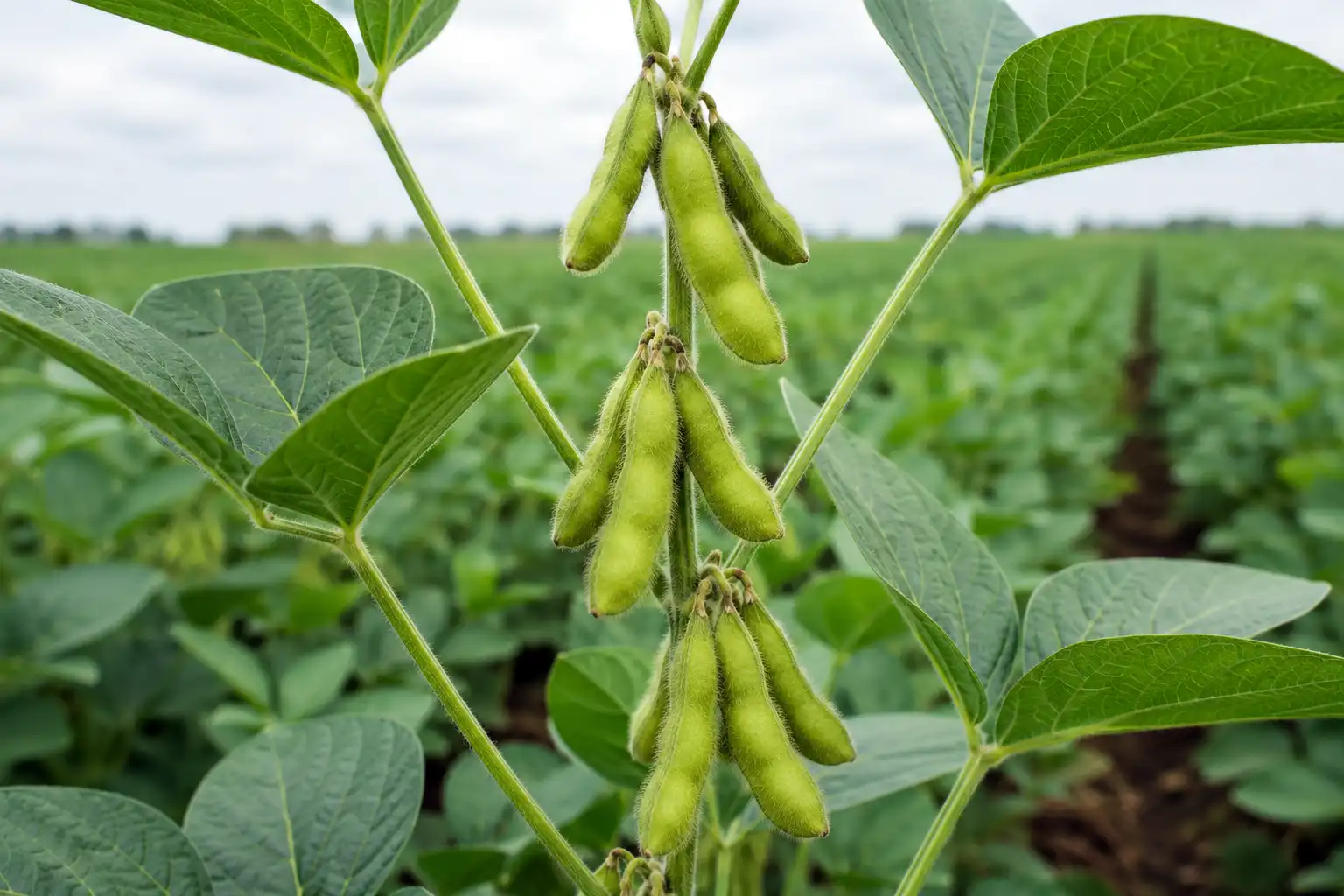
Reproductive stages start at the first flower. From here, you stop counting nodes and start reading flowers, pods, and seeds on the upper part of the plant.
One rule carries through most of these stages. You look at the uppermost nodes that have a fully developed leaf. For R1 and R2, that means the top nodes. For R3 through R6, you check the four uppermost nodes.
- R1 (Beginning bloom): At least one open flower sits on any node of the main stem. Flowers typically start around nodes three through six, then spread up and down.
- R2 (Full bloom): An open flower appears at one of the two uppermost nodes with a fully developed leaf. The plant has reached roughly half its final height.
- R3 (Beginning pod): A pod 3/16 inch long shows at one of the four uppermost nodes.
- R4 (Full pod): A pod 3/4 inch long shows at one of the four uppermost nodes. This is a critical yield-setting stage.
- R5 (Beginning seed): A seed 1/8 inch long fills a pod at one of the four uppermost nodes.
- R6 (Full seed): A green seed fills the pod cavity at one of the four uppermost nodes. The crop is at peak dry weight.
- R7 (Beginning maturity): One normal pod on the main stem reaches its mature color, tan or brown.
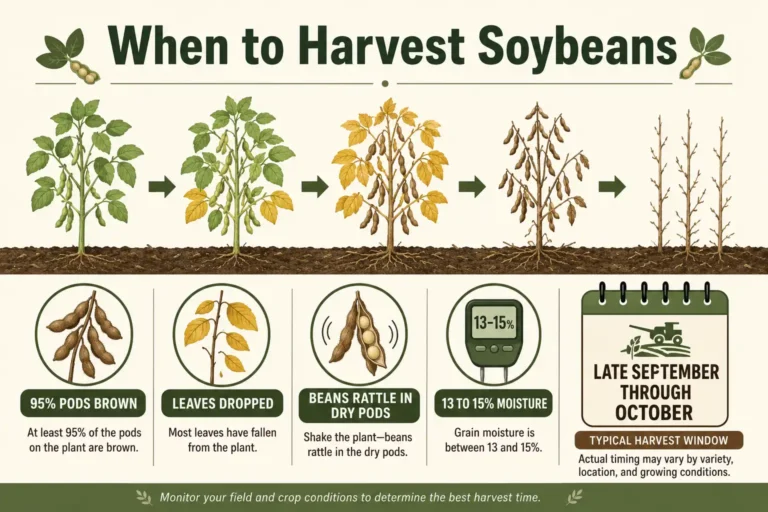
- R8 (Full maturity): 95 percent of pods have reached mature color. After R8, the crop needs 5 to 10 days of drying weather to drop below 15 percent moisture.
R5 through R6 is where yield gets made or lost. Seed fill demands water, so this stretch shapes irrigation thinking. If you run a system, this is when water timing matters most. A dry spell at R5 cuts pod and seed weight fast.
The 50% Rule for Staging a Field
A field reaches a given stage once at least half its plants are at or beyond that stage. One plant does not set the call for the whole field.
So walk it. Check 10 to 20 plants from a few spots, skipping the field edges and any odd patches. Take the stage that the majority shares. Uneven emergence widens the spread, which is one more reason a clean, uniform stand pays off.
How Staging Guides Your Spray and Scouting Calls
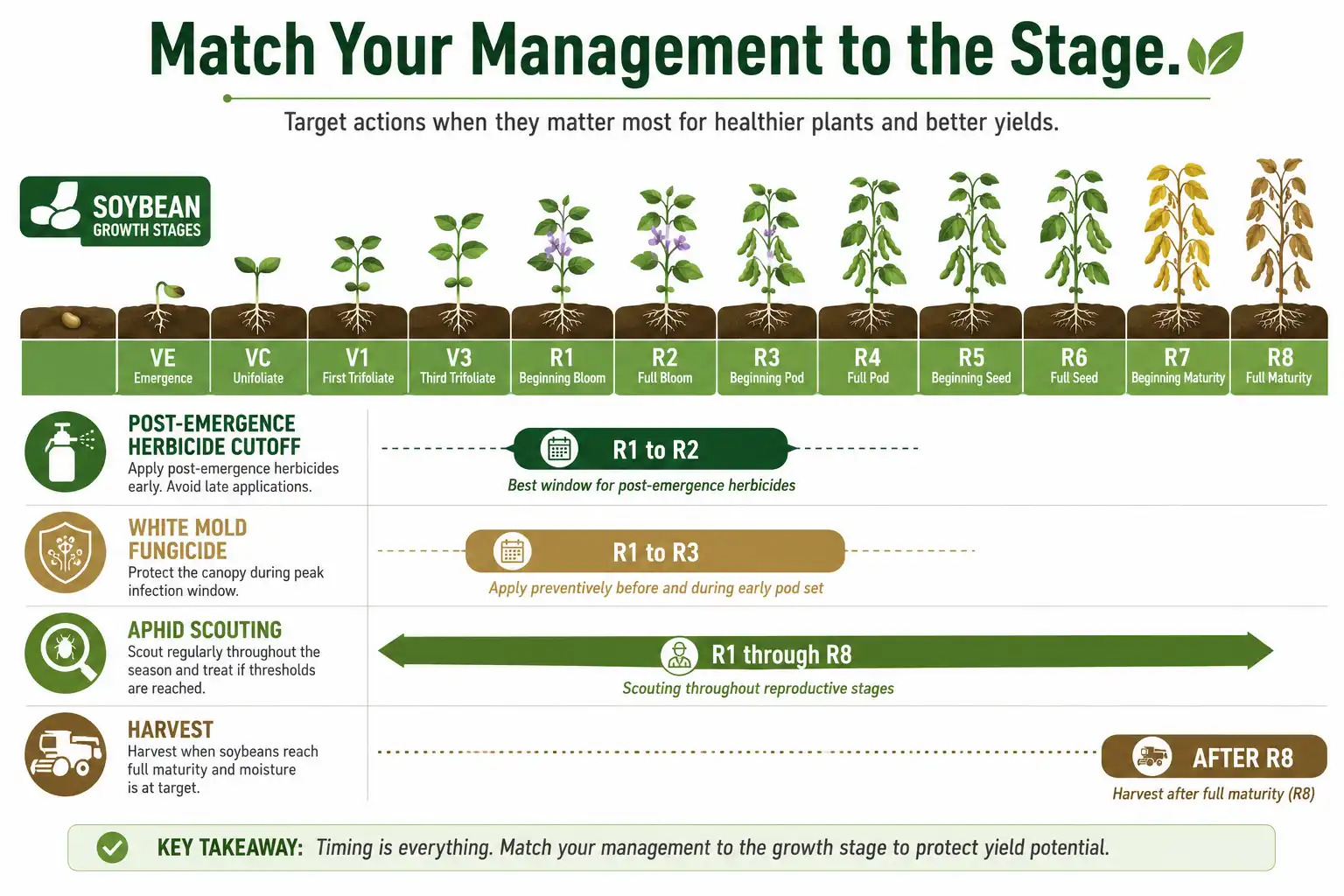
Most management cutoffs run off growth stage, so staging turns into action here. Get the stage wrong and you risk crop injury, a wasted pass, or a label violation.
Post-emergence herbicide labels set their own stage limits. Many soybean herbicides cut off at R1 or R2, and the limit changes by product and trait platform. Read your current label and match the pass to the stage, never to plant height. Knowing when to use pesticides by stage keeps you legal and effective.
Disease and insect calls track stages too. Fungicide for white mold goes on around R1 to R3 to protect flowers. Start scouting hard for soybean aphid through the R stages, since thresholds there guide whether a spray pays. Frost or hail before R5 hurts less than the same damage during seed fill.
For a fuller picture of how the crop develops start to finish, our guide on growing soybeans from planting to harvest walks through each phase. Timing also depends on getting the season started right, so when you plant soybeans feeds straight into how your stages line up against frost and heat.
Common Mistakes at the Co-op
Three errors come up again and again. They all lead to bad staging.
First, folks count by height. Weather stretches or shortens a plant without changing its true stage. Always read nodes, flowers, and pods instead.
Second, people miscount the bottom of the plant. The cotyledon node and the unifoliolate node are easy to mix up. Find the two single unifoliolate leaves first, then count trifoliates upward from there.
Third, some call a stage off one tall plant. Remember the 50 percent rule and check a real sample across the field.
How to Use Staging in Field Management
Staging is the backbone of in-season management. Before any spray, walk the field and pin down the stage. That shows whether a herbicide pass is still legal, whether a fungicide window is open, and how much concern a coming dry spell deserves.
Learn the fully-developed-leaf rule and the 50 percent rule first. Those two ideas carry you through every stage. Knowing how the crop moves from seed to harvest also helps you plan, and the breakdown of how long soybeans take from seed to harvest lays out that whole timeline. Stage the crop, then let the stage make the call.