How to Plant Concord Grapes: Spacing, Depth, and Timing
Concord vines live for decades, so the first hour in the ground shapes the next thirty years. Knowing how to plant concord grapes correctly settles root depth, spacing, and trunk position before a single leaf opens.
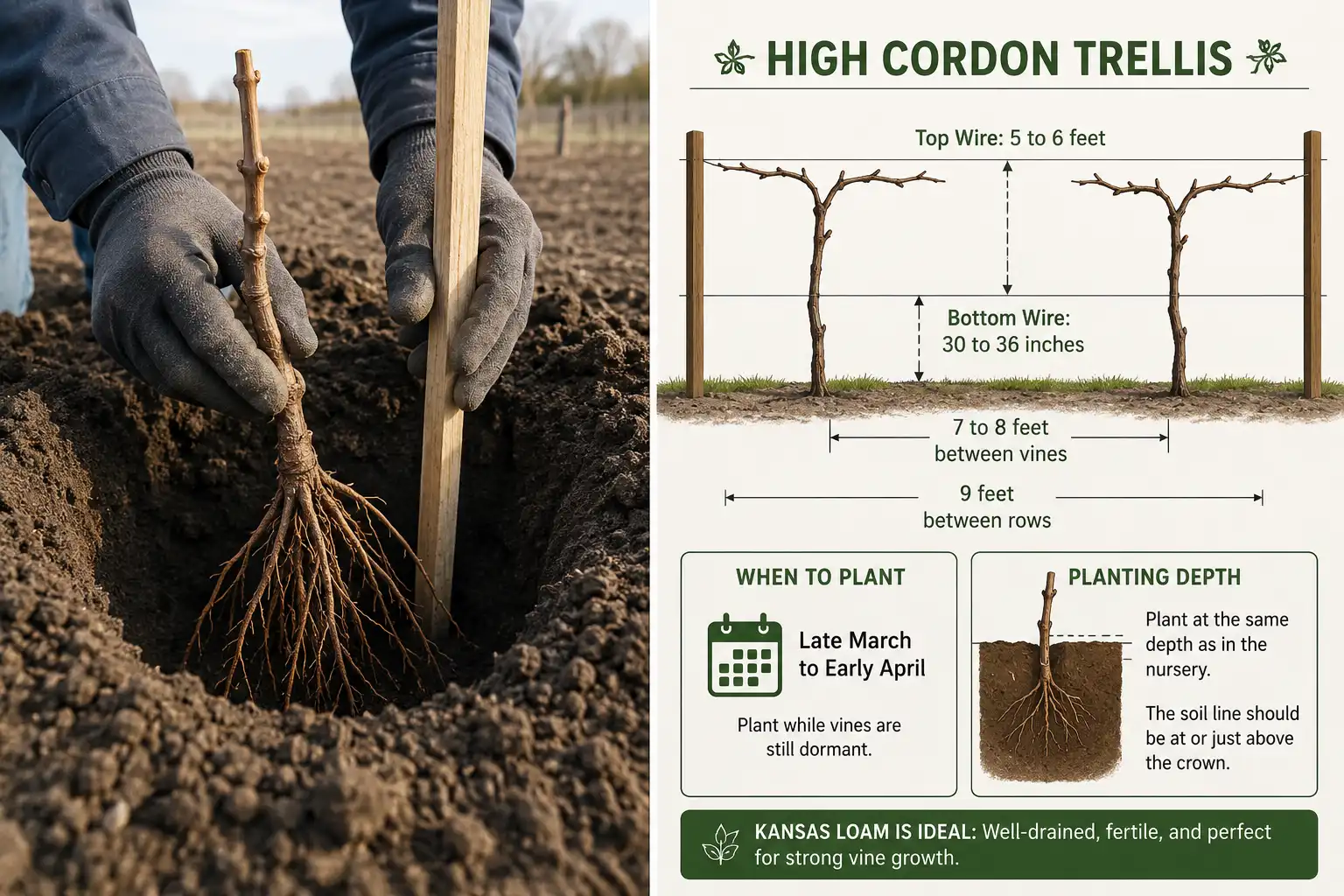
To plant Concord grapes, set dormant bare root vines in late March or early April. Space them 7 to 8 feet apart in 9 foot rows. Plant at nursery depth, then prune to one cane with two buds.
Where Concord Vines Belong on Your Place
Concord wants full sun and drainage ahead of everything else. So give it 6 to 8 hours of direct light. Soil should drain freely and run 4 to 6 feet deep for root development. K-State Research and Extension calls well drained soil essential no matter how good the rest of the soil looks.
Skip low spots. Cold air settles there, and green shoots burn at roughly 30°F. Gentle slopes with air movement dry the canopy faster, so black rot and powdery mildew pressure drops.
Run rows north to south when the layout allows. That way both sides of the canopy catch light through the day.
Most growers overlook one more site factor on working farms. Grape leaves show 2,4-D damage at very low drift rates. Concord is no tougher about it than any other vine. So keep new plantings away from pasture, wheat, and lawn spray zones. If that is impossible, plant on the upwind side and use grow tubes on young trunks.
Also check your water source. Two or three seasons of hand watering is normal here. So hauling buckets 400 feet gets old fast.
Learn next: Grow Seedless Grapes at Home
Soil pH and Ground Prep for a Labrusca Vine
Concord tolerates more acid soil than most grapes. Cornell puts native American types like Concord at pH 5.5 to 6.0. French hybrids want 6.0, and vinifera sits closer to 6.5. Anything above 7.3, common on western Kansas ground, calls for elemental sulfur instead of lime.
Pull soil samples a full year ahead. A soil testing kit gives you a fast pH read at home. Still, a lab test through your extension office returns the full nutrient picture. Lime also reacts slowly. So work dolomitic limestone into the top 6 inches the season before planting, not the week of.
Then clear out perennial weeds. Field bindweed and smooth brome will beat a first year vine to every drop of water. So till the strip, break up any compaction layer, and mix organic matter into heavy clay.
Go easy on fertility. Rich ground pushes leaf and cane growth at the expense of fruit, and Concord already grows vigorously without help. If your organic matter sits near 3 percent, leave it alone.
When to Plant Concord Grapes
Plant in late March to early April across most of Kansas, while the vines are still fully dormant. K-State sets that window, and it holds up well in zone 6a near Topeka. Get vines in the ground before budbreak, and well before hot dry weather shows up.
Wait until soil crumbles in your hand instead of smearing. Working wet ground wrecks structure right where new roots need air.
Fall planting carries real risk across the Great Plains. Freeze and thaw cycles heave young vines out of the ground before roots anchor them. Our notes on the best planting time for grapes cover windows in other regions.
What Kind of Concord Vines Should You Buy?
Buy dormant, one or two year old rooted vines on their own roots. Concord almost never needs a rootstock. Nearly all of the 30,000 Concord acres in the Lake Erie belt grow own rooted. That works because Concord tolerates grape phylloxera well enough to live with the damage.
Grafted vines add cost plus a graft union, and that union suffers winter injury first. So skip grafted stock unless a nematode problem turns up in your soil test.
Ask for virus tested plants. Virus infected vines never recover, and symptoms can hide for years.
If vines arrive before your site is ready, heel them in. Cover the roots with moist soil in the shade, and they hold fine for weeks. Never park them in a bucket of water for days. For background on what separates this variety from other bunch types, see our rundown of Concord grape traits.
How Far Apart Should Concord Vines Be Planted?
Space Concord 7 to 8 feet apart down the row. K-State puts vigorous American cultivars at that spacing, and Concord is vigorous. Rows run 9 feet for a backyard block. Widen to 9 or 11 feet where a tractor and sprayer go through.
Crowding Concord backfires. The vine fills its space in two seasons, and a shaded canopy raises disease pressure right when clusters are sizing.
Set line posts 24 feet apart. Three vines then fit between each pair at 8 foot spacing. End posts go bigger and deeper, since they anchor the whole wire load.
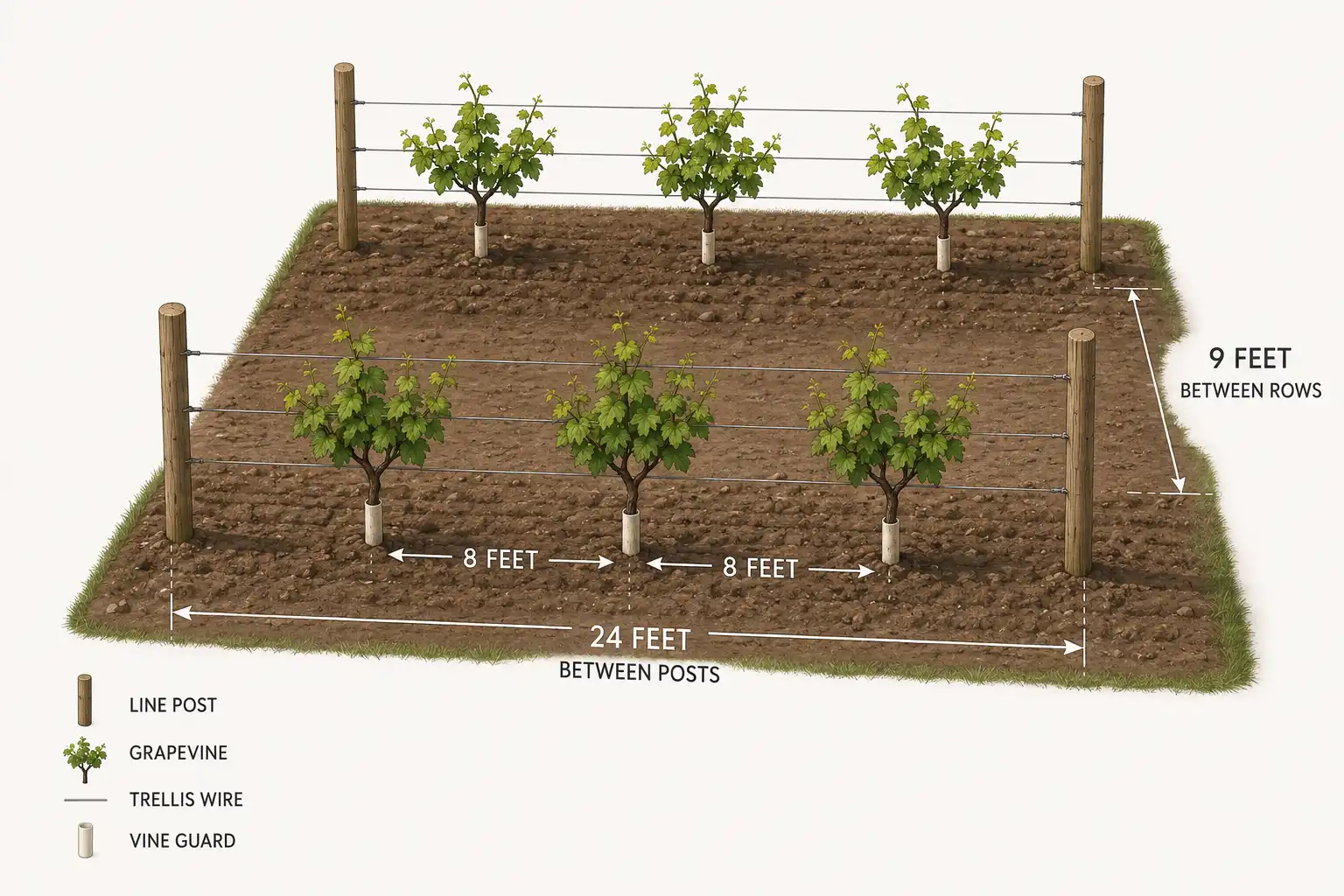
Run the math before you order. A 100 foot row at 8 foot spacing holds 12 vines. At 10 to 20 pounds per mature vine, that single row carries 120 to 240 pounds of fruit.
How to Plant Concord Grapes Step by Step
Work through these steps in order on planting day.
- Soak the roots. Set bare root vines in water 3 to 4 hours before planting. Do not push past 6 hours, because soaked tissue starts to break down.
- Trim the roots. Cut broken ends off, then shorten long roots to 6 to 12 inches with clean shears.
- Dig wide, not deep. The hole needs room to fan roots out without bending any of them. A few inches deeper than the longest root is plenty.
- Match nursery depth. Find the old soil line on the trunk and set the vine right at it. The lowest bud on the cane should sit just above the surface.
- Fan roots down and out. Point them away from the trunk, then backfill in layers and firm each layer by hand.
- Water 2 to 3 gallons per vine. That settles soil into the root zone and closes air pockets.
- Prune to one cane with two buds. Remove every other cane. All of the vine’s stored energy then goes into one shoot.
- Stake each vine. A stake or grow tube keeps the trunk straight from day one, and a tube also shields the base from herbicide spray.
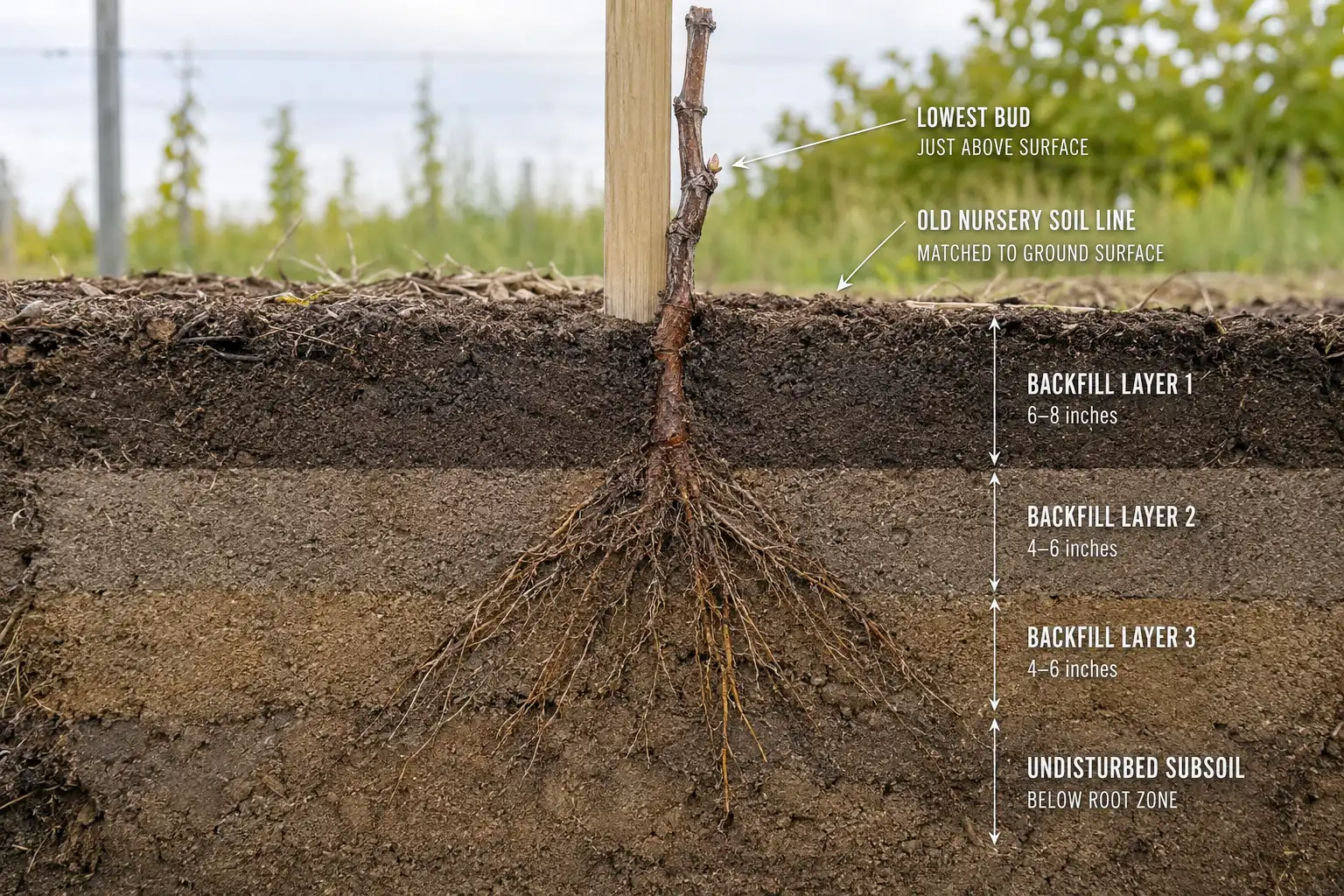
Planting too deep is the mistake most often. Buried buds rot instead of pushing, and the trunk never sets up straight. That same depth rule applies to any bunch grape, as covered in the walkthrough on planting grapes of any variety.
What Trellis Does Concord Need?
Concord needs a high cordon trellis, because the vine trails downward instead of climbing upright. Native cultivars such as Concord, Catawba, and Norton all share that trailing habit. So a single curtain bilateral cordon fits them. K-State names that system best for vigorous, cold hardy varieties.
Set the top wire 5 to 6 feet above ground. Then run the bottom wire 30 to 36 inches up, mostly for trunk support and drip tubing. A higher top wire puts more sunlight into the canopy.
Build the trellis during the first or second growing season. Waiting past that costs you training time you cannot get back. Also tighten the wires every spring before new growth loads them down.
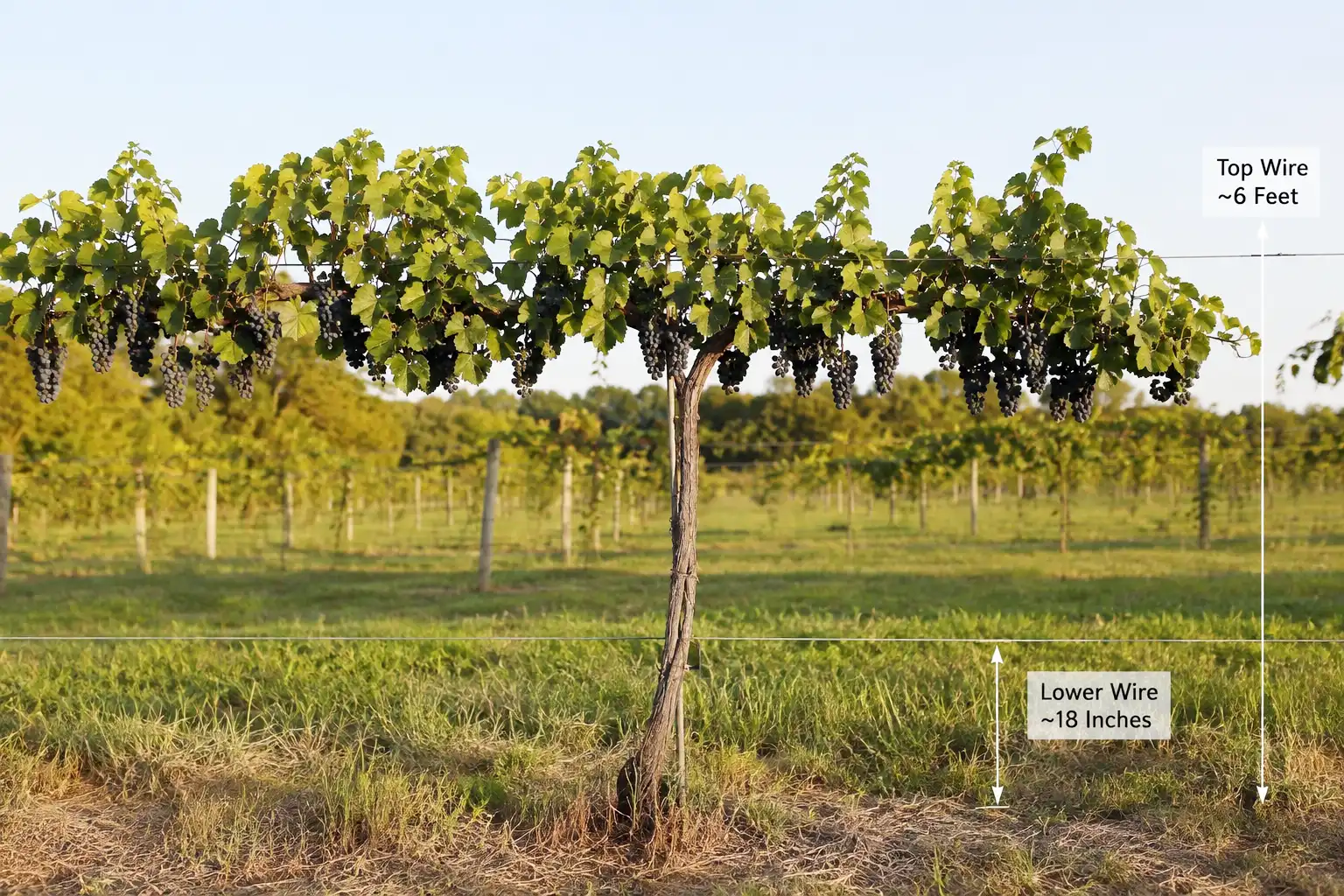
Umbrella Kniffin works better for weaker vines or sites with winter injury history. Four cane Kniffin shades the lower wire, so production and fruit quality both slip.
First Year Care After Planting
Water and weed control decide your first season. Young vines want 1/2 to 1 inch of water per week through the growing season. Two drip emitters rated at 1/2 gallon per hour, placed 12 inches out on each side, handle that cleanly. This breakdown of weekly water needs for grapevines lays out the full schedule.
Keep a 3 foot weed free strip around every vine. Then cultivate shallow so you never tear into new roots.
Fertilize lightly or not at all. K-State calls for half a cup of 10-10-10 or 12-12-12 per vine as growth starts. Then repeat one month later. Band it 1 to 1.5 feet out from the trunk, then work it 2 inches deep. Skip heavy nitrogen entirely.
Pull every flower cluster this year. Fruit competes with root growth, and roots are the whole point of season one.
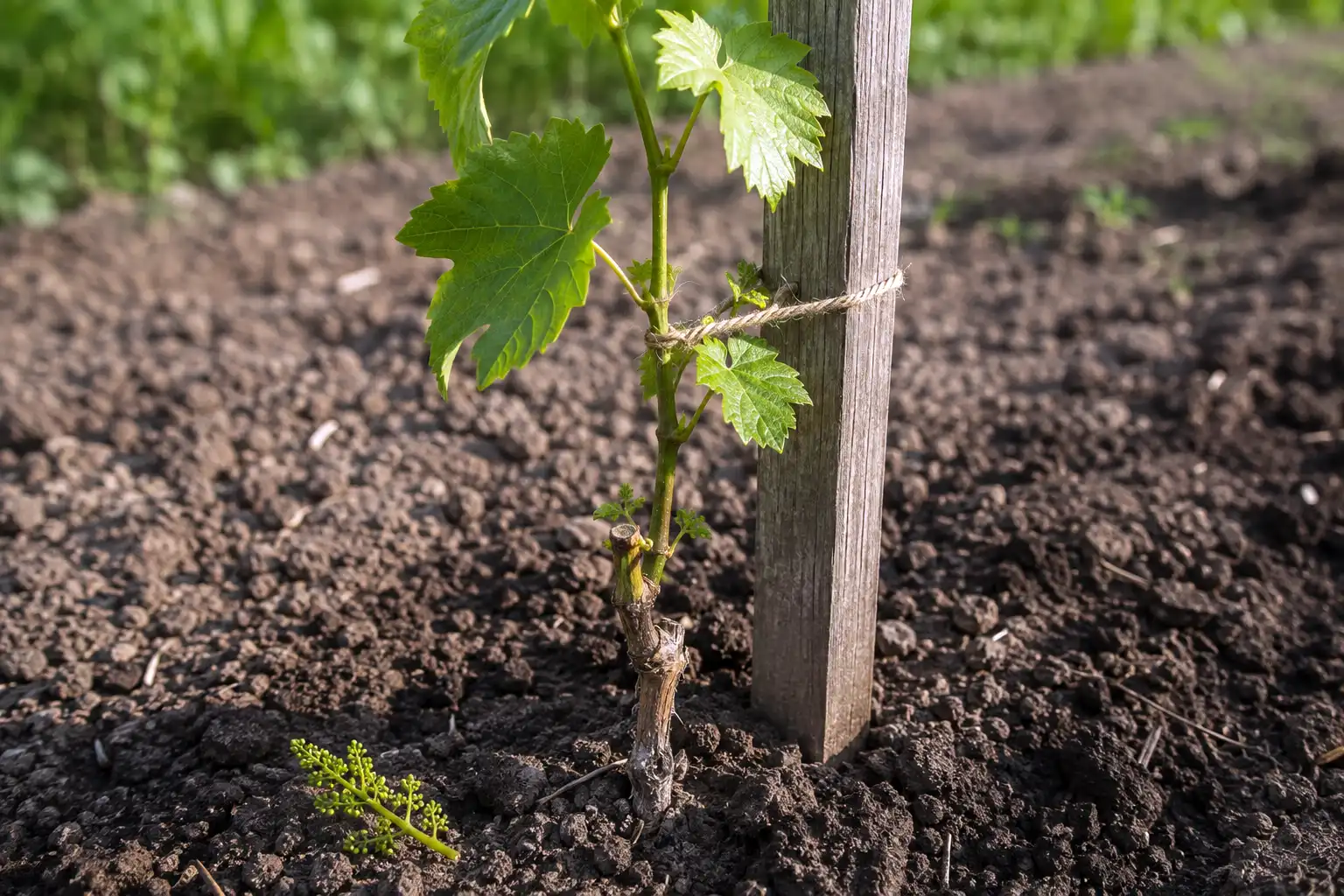
Once shoots push and frost risk passes, keep the two strongest and rub off the rest. Later in summer, pick the single best shoot as your permanent trunk. Then tie it to the stake every 10 inches.
Should You Mulch a New Concord Planting?
Mulch the row middles, but leave bare soil right around each trunk. Extension guidance splits on this, so here are both sides. University of Minnesota Extension warns against mulching grapes, because mulch holds soil temperature down and grape roots want warm soil. K-State recommends several inches of organic mulch for weed suppression.
Both points hold true, so split the difference. Mulch the row middles for weed control and moisture. Leave 12 inches around each trunk bare, so spring soil warms on schedule.
Kansas summers tip the decision toward some mulch. July heat and wind pull moisture out of a young root zone fast. If you farm a cooler, wetter zone 4 or 5 site, follow the Minnesota advice and skip it.
How Much Cold and Heat Can Concord Take?
Concord grows well in USDA hardiness zones 4 through 8, which covers every county in Kansas. Dormant canes handle roughly -15°F without injury. That hardiness is exactly why Concord sits on the K-State recommended variety list.
Green tissue is far more tender. Shoots after budbreak burn at about 30°F. So a late April frost following a warm March can erase a young vine’s whole season of growth.
Heat brings a separate problem. K-State notes that Concord ripens unevenly in Kansas during hot summers or under heavy crop loads. Balanced pruning and honest cluster thinning fix most of that once vines reach bearing age.
Getting From New Planting to First Real Crop
Expect your first small crop in year three. Season one builds roots and one straight trunk. Season two forms the two cordons along the top wire.
In the second dormant season, cut most cordon laterals back to two bud renewal spurs. Then leave 2 to 4 canes as fruiting spurs with 3 to 5 buds each. Those give you a few clusters the following summer.
From year three forward, hold 4 to 6 fruiting spurs plus the same number of renewal spurs on each cordon. Remove 80 to 90 percent of last season’s wood every dormant season. Our guide to pruning grapes walks through each cut.
Also plan for black rot before it finds you. It ranks as the top grape disease across Kansas, and Concord is susceptible along with phomopsis. A dormant lime sulfur spray starts the program. Then early protectant sprays at 2 to 4 inches of new growth keep it in check.
Final Words on Planting Concord Grapes
Get the site and the spacing right, and Concord mostly handles itself after that. Plant in early April, 8 feet apart, in 9 foot rows. Every vine goes in at nursery depth, cut back to one cane with two buds. After that, the strip should be kept clean, watered weekly, with every cluster removed the first year. The trellis goes up that same season with the top wire at 6 feet. Nothing else in the first three years moves the needle as much as those few choices.