Do Grapes Grow on Trees? Here Is What Grapes Really Grow On
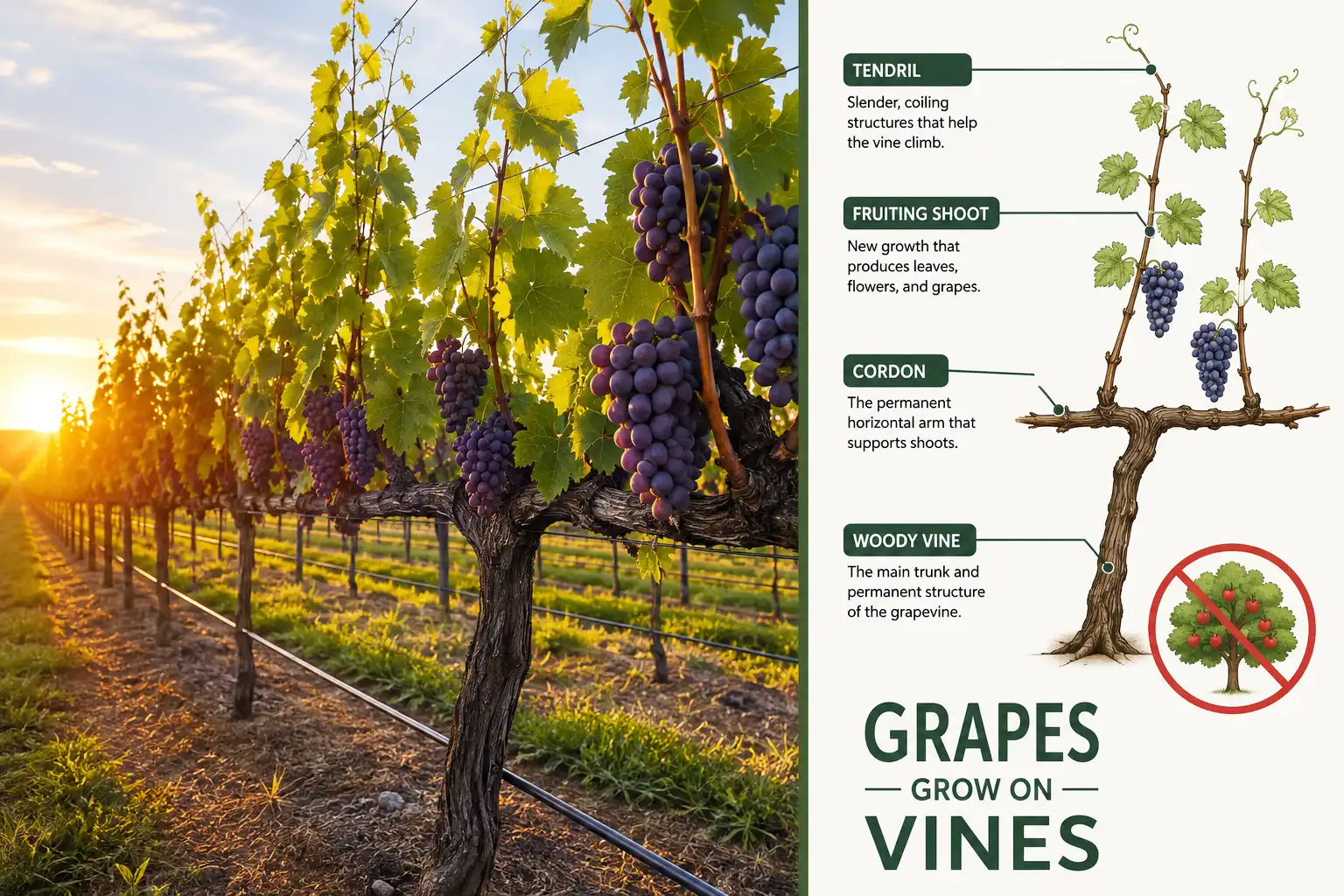
Grape clusters hanging 30 feet up in a tree canopy confuse a lot of people. So do grapes grow on trees, or is something else going on? The botany behind it is simple, and knowing it changes how you plant and support the crop.
Grapes grow on woody perennial vines, not on trees. People who ask do grapes grow on trees usually saw a wild vine. It climbed 40 feet into a tree canopy and fruited up there.
Do Grapes Grow on Trees?
No. Grapes grow on vines. Every true grape sits in the genus Vitis, inside the family Vitaceae, and every species in that genus climbs. Botanists call a woody climber like this a liana.
The difference comes down to support. A tree builds a stiff, self-supporting trunk and holds its own canopy up. A grapevine skips that step. It puts very little tissue into rigid structural wood. Instead it spends that energy on fast shoot growth and wide water-conducting vessels. Then it grabs whatever stands nearby and climbs.
So a grapevine dropped in an open field just sprawls across the ground. Give it a fence, a wire, an arbor, or a tree trunk, and it goes straight up.
| Feature | Grapevine (Vitis) | Fruit tree (apple, peach) |
|---|---|---|
| Support | Needs an external structure | Self-supporting trunk |
| Trunk wood | Soft, ring-porous, flexible | Dense and rigid |
| Shoot growth per season | 10 to 20 feet | 1 to 3 feet |
| Climbing organs | Forked tendrils | None |
| Fruiting wood | Current season shoots off one-year-old wood | Spurs on two-year-old and older wood |
| Winter pruning | Cut off 80 to 90 percent of last year’s growth | Cut off 10 to 20 percent |
| Useful life | 30 to 100 years | 20 to 50 years |
What Do Grapes Grow On?
Grapes grow on a woody perennial vine that lives for decades. A well-kept vine in northeast Kansas can crop for 30 years or longer. Some old head-trained blocks in California still carry fruit past their hundredth birthday.
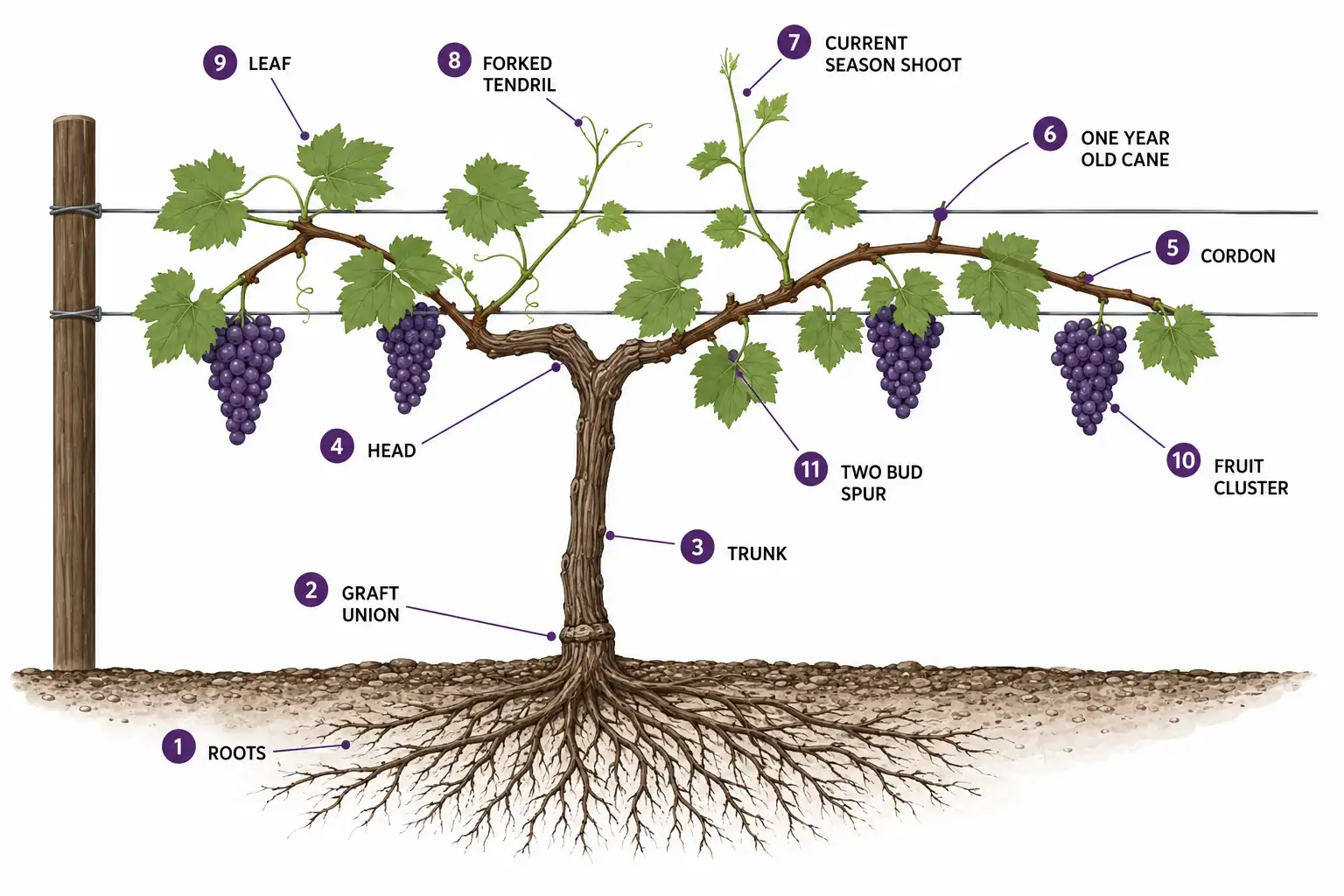
The vine splits into permanent parts and yearly parts. That split drives every pruning cut you will ever make. The fruit itself counts as a true berry. This piece on what fruit category grapes fall into covers that botany.
The Parts of a Grapevine
| Part | What it is | How long it lasts |
|---|---|---|
| Roots | Anchor and feeder system, often 4 to 6 feet deep | Permanent |
| Trunk | The main vertical stem | Permanent |
| Head | Top of the trunk where the arms start | Permanent |
| Cordon | Horizontal arm running along the fruiting wire | Two years or more |
| Cane | Last summer’s shoot, now brown and woody | One year |
| Spur | A cane cut back to two to four buds | One year |
| Shoot | This season’s green growth with leaves and fruit | One season |
| Tendril | Forked gripper sitting opposite a leaf | One season |
How Tendrils Grab and Climb
Tendrils do all the climbing work. They are modified shoots, and they sit opposite the leaves along each growing shoot. A tendril sweeps in slow circles until it bumps into something solid. Then it coils tight and hardens into wood within a few days.
That grip holds hard, but it has no judgment. A tendril will take a trellis wire, a fence rail, a corn stalk, or a hackberry branch. It cannot tell one from the other. That is exactly how wild grapes end up 40 feet in the air.
Why People Think Grapes Grow on Trees
Three things drive the confusion, and all three make sense once you spot them.
First, wild grapevines really do fruit high in tree canopies. From below you see clusters dangling off branches, while the vine stem disappears into the brush at ground level.
Second, backyard grapes often grow overhead on arbors and pergolas. Fruit hangs down above your head, the same way apples do.
Third, several unrelated plants carry the word grape in their name and are genuinely trees. Sea grape and the Brazilian grape tree both fit that description.
Wild Grapevines Climbing Trees: What Is Really Happening
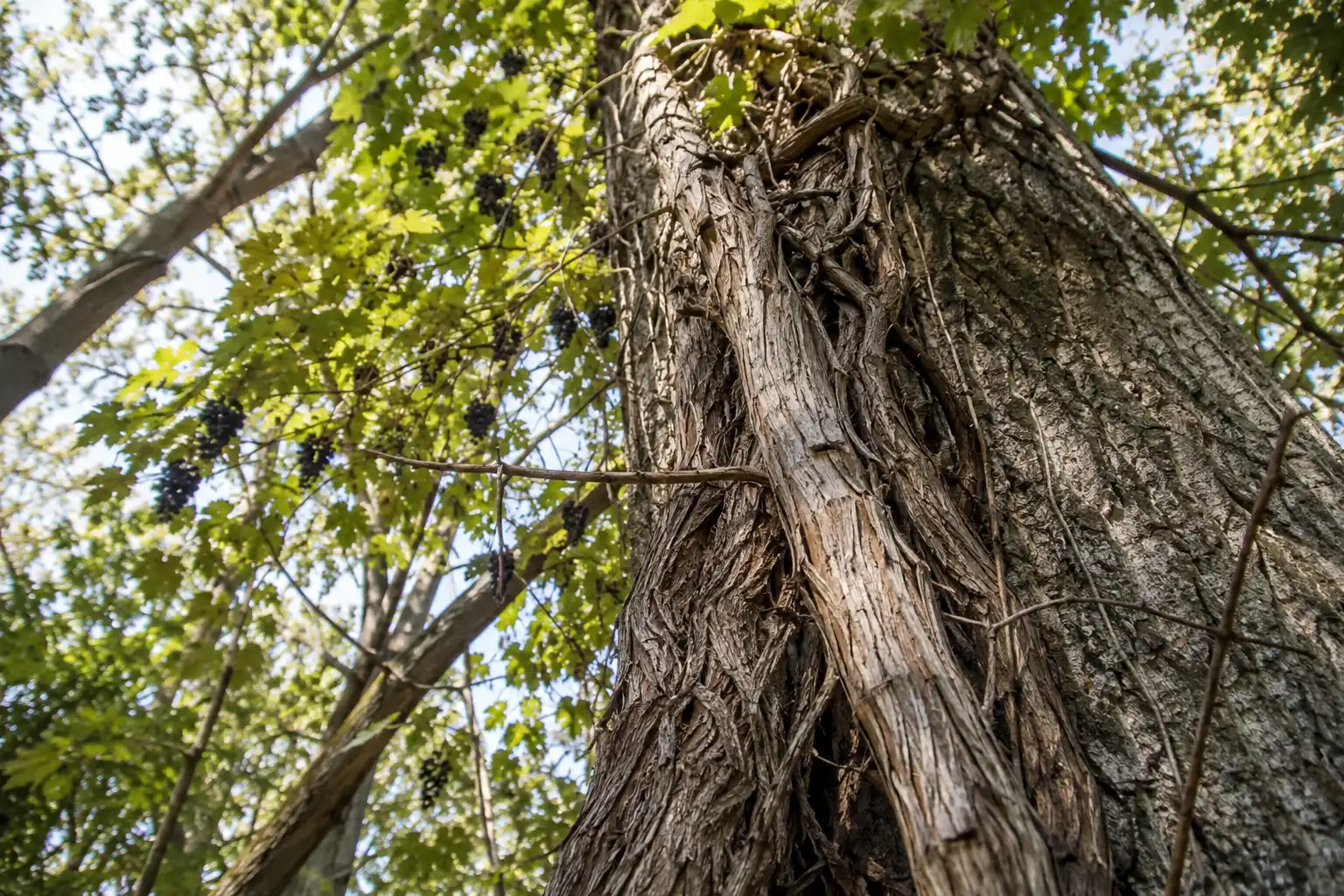
The vine roots in the soil, not in the tree. It climbed the trunk to reach sunlight, then spread its leaves across the canopy where light hits hardest.
Wild grapes across the eastern and central US cover several species:
- Riverbank grape (Vitis riparia)
- Fox grape (Vitis labrusca)
- Summer grape (Vitis aestivalis)
- Frost grape (Vitis vulpina)
Along creek bottoms near Topeka, riverbank grape is the one into most. Penn State Extension reports wild grape stems reaching 50 feet as they climb trees and spread through the canopy. Those same species underpin the commercial grape growing regions of the Midwest. Breeders leaned hard on their cold hardiness and disease resistance.
One more oddity trips people up. Many wild Vitis species are dioecious, so male plants flower every spring and never set a single grape. A big vigorous vine with no fruit on it is usually just a male.
Should You Cut Wild Grapevines Out of Your Trees?
Yes, in most cases, if the timber matters to you. Grapevines shade out the host canopy, pile weight on limbs that snap under ice, and bend young trunks off plumb. Over enough seasons they kill the tree outright.
Cutting works because grape cannot handle shade. Here is the method used along a timber edge:
- Sever the vine one to two feet above the ground with loppers or a handsaw.
- Leave the top hanging in the canopy. It will dry out and drop on its own.
- Expect the stump to resprout that same summer.
- Under a closed canopy, those sprouts starve out within about three years.
- In a young stand under 18 feet tall, sprouts can reach the crowns again, so check back each fall.
Keep a few vines if wildlife matters more than timber value. Wild grapes feed songbirds, wild turkeys, deer, and raccoons, and dozens of moth species use the foliage. Several are left along the fencerow, well away from any tree intended to be kept.
Can Grapes Grow on Trees Instead of a Trellis?
Physically yes, practically no. A grapevine will happily climb an apple tree or a hackberry and fruit up there. You just will not like what you get.
Here is what goes wrong:
- Fruit ripens 20 feet overhead and out of reach.
- Canopy shade slows sugar accumulation, so clusters stay sour.
- Airflow drops, and black rot plus downy mildew move in fast.
- Spray coverage becomes impossible above head height.
- The vine slowly kills a tree you actually wanted.
So the honest answer to can grapes grow on trees is no, at least not if you want a crop you can pick.
The Vine That Looks Like a Tree
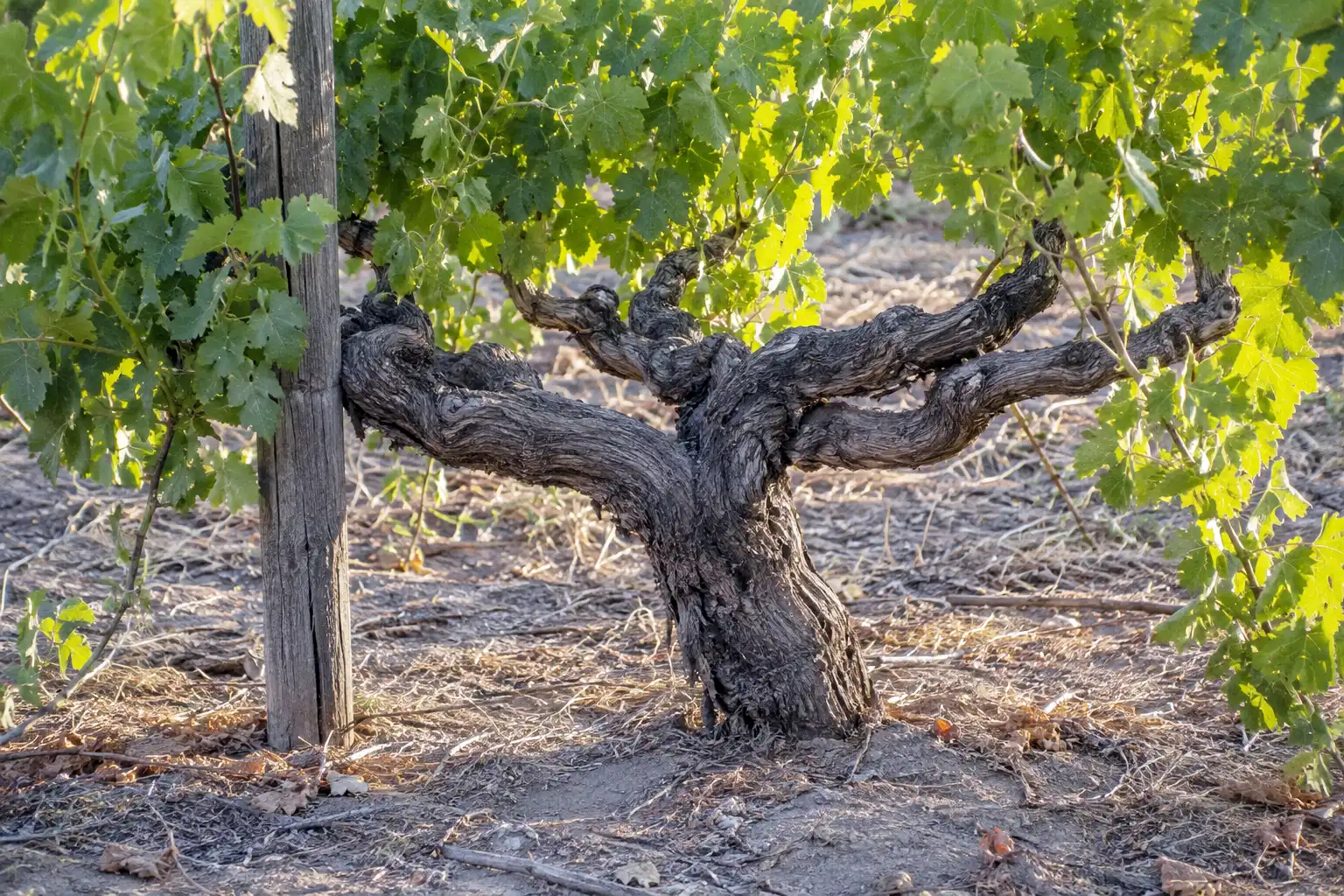
One training style does produce a tree-shaped grapevine. Growers call it head training, or gobelet in France and bush vine in Australia. The trunk stays short, roughly 12 to 20 inches, and permanent arms radiate from the top like a goblet. Old Zinfandel and Carignane blocks around Lodi still look this way.
Those vines stand free on a single stake, so at a glance they read as knee-high trees. They remain vines. That short trunk only holds itself up because hard spur pruning keeps the top small every winter.
Head training suits dry, sunny country with light disease pressure. It fits poorly in humid Midwest summers. In USDA hardiness zone 6a, a wire trellis is recommended for airflow.
What Grapes Grow On in a Vineyard or Backyard
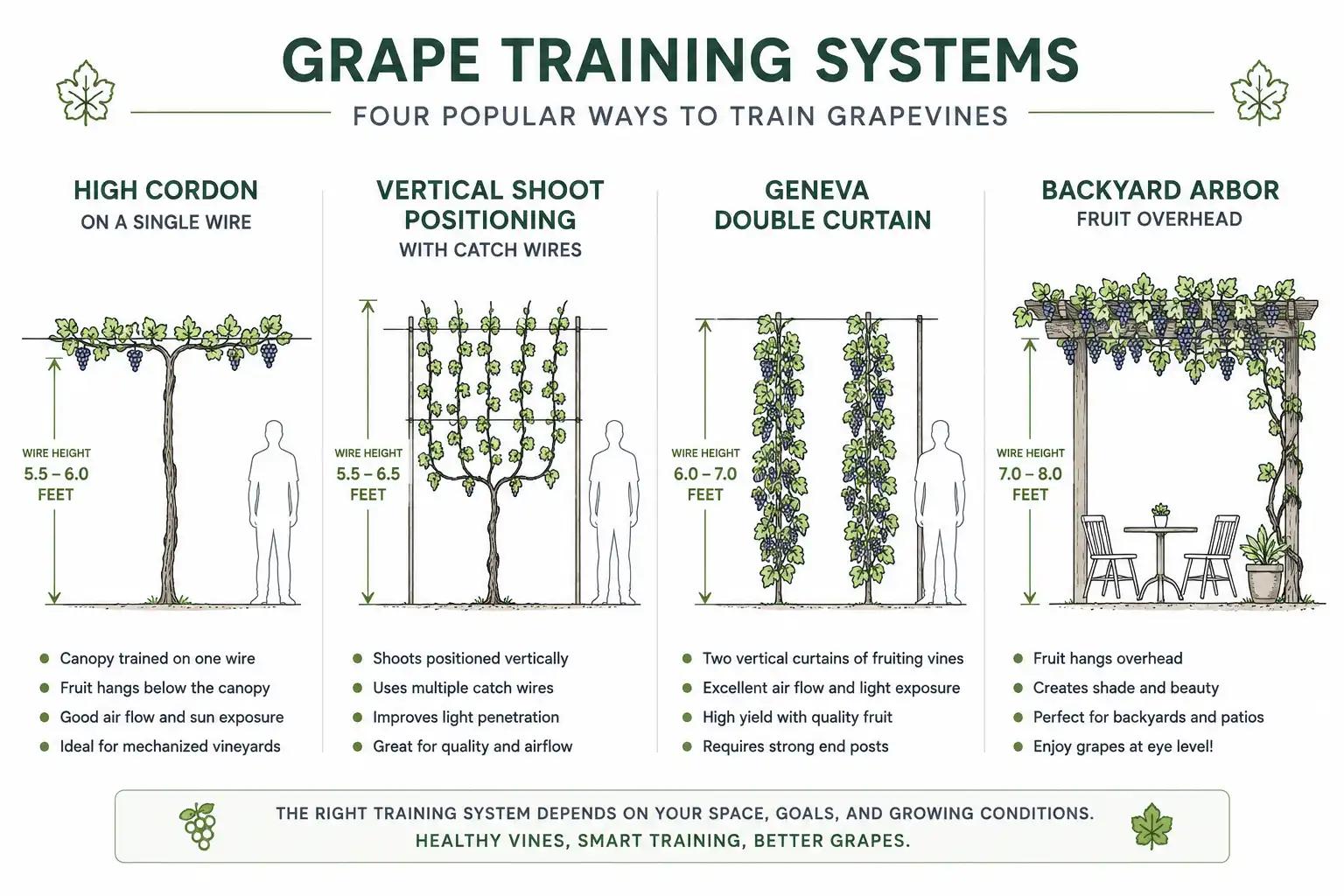
Grapes grow on a trellis, an arbor, or a heavy-duty fence. The structure carries the entire crop load, so put it up before the second growing season starts.
| Training system | Fruiting wire height | Best fit |
|---|---|---|
| High cordon, single curtain | 5.5 to 6 feet | Vigorous American and hybrid varieties, easiest backyard option |
| Vertical shoot positioning | 3 to 3.5 feet with catch wires above | Vinifera and moderate-vigor hybrids |
| Geneva Double Curtain | 6 feet, two hanging curtains | High-vigor vines on deep bottomland soils |
| Four-arm Kniffin | 3 feet and 5.5 feet | Older backyard standard for Concord and Catawba |
| Arbor or pergola | About 7 feet overhead | Shade plus fruit, but harder to spray and net |
K-State Research and Extension spaces backyard vines 6 to 8 feet apart in the row. Rows sit 8 to 10 feet apart. The Johnson County demonstration garden runs Beta and Catawba on high cordon. Mars goes on a modified Munson trellis. That pairing makes a solid local template.
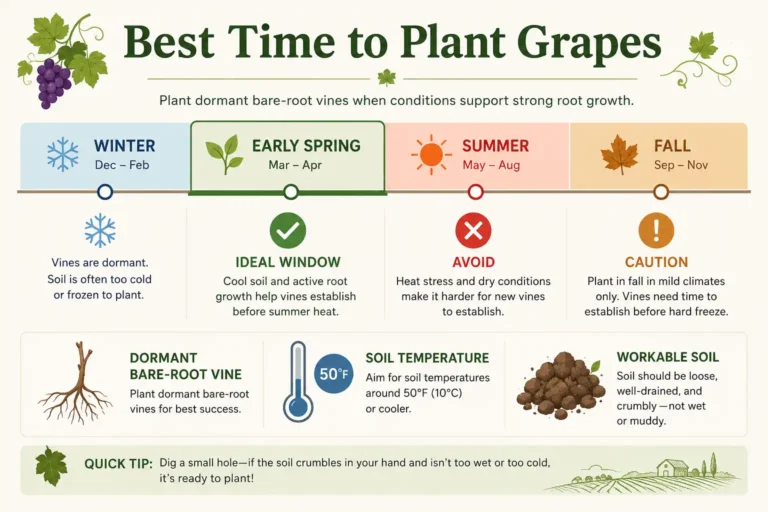
Build the trellis like a good fence. End posts anchor the whole run, so set them deeper and heavier than the line posts. Use 10 to 12 gauge wire for the fruiting wire, since that wire carries the weight. A mature vine plus a full crop gets heavy, and Great Plains wind piles on more load. Starting from bare ground? Our walkthrough on growing grapes covers site prep, planting depth, and the first two training years.
Plan for birds if you train vines overhead. Clusters hanging in the open on an arbor are easy pickings. Netting to keep birds off the fruit also fits a straight wire row better than a pergola.
Where the Fruit Forms on a Grapevine
Fruit forms on current-season shoots that push from one-year-old wood. That one fact separates grapes from tree fruit more than anything else does.
Walk the sequence:
- Last summer’s green shoot hardens off into a brown cane.
- That cane carries compound buds at every node.
- You prune in late winter, keeping the cane or trimming it to a two to four bud spur.
- Each retained bud pushes a fresh green shoot in spring.
- Flower clusters appear on that shoot, usually at nodes three through six.
- Those clusters set and ripen by late summer.
Apples work another way. An apple tree fruits on spurs two years old and older. Those spurs keep producing for a decade. A grape spur only holds the position. The vine builds brand new fruiting wood every single year.
That is why dormant pruning strips off 80 to 90 percent of last season’s growth. Skip it, and the vine turns into a tangle of small, poorly colored clusters. So pruning grapes every winter is not optional. Late February through early March works well in Kansas.
Plants Called Grape Trees That Are Not True Grapes
Two of them show up constantly in searches, and neither one sits in the genus Vitis.
| Plant | Botanical name | Family | What it actually is |
|---|---|---|---|
| Sea grape | Coccoloba uvifera | Polygonaceae | Coastal tree or large shrub, 10 to 30 feet tall, native to Florida and the Caribbean, edible fruit in hanging clusters |
| Jaboticaba (Brazilian grape tree) | Plinia cauliflora | Myrtaceae | Slow-growing evergreen tree, 10 to 16 feet in Florida, fruit forms directly on the trunk and older branches |
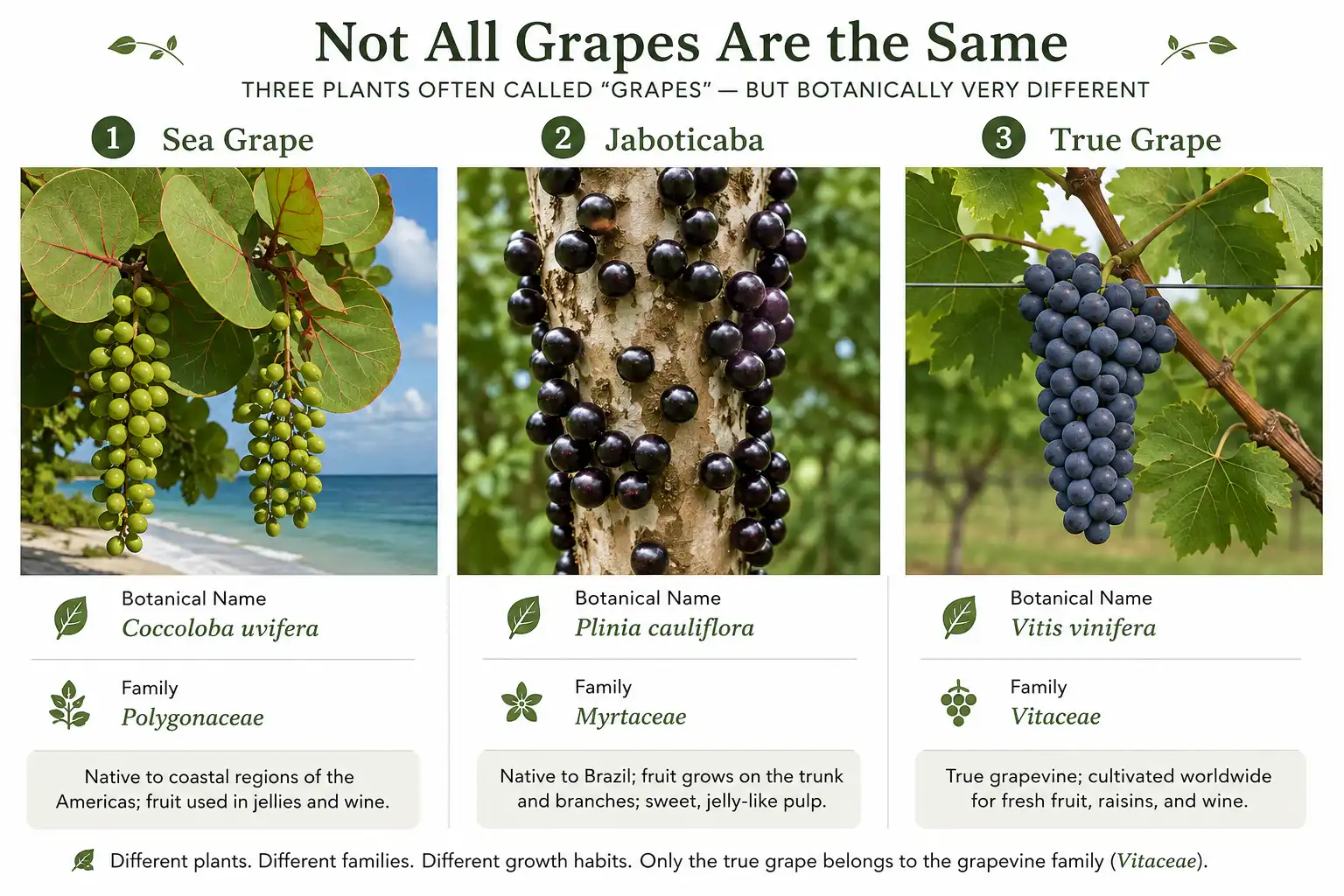
Both carry round, dark, grape-like fruit in clusters, so the nicknames stuck. UF/IFAS lists jaboticaba as a South Florida plant for zones 10a through 11b. Sea grape holds the beach strand along the southern peninsula. Neither one survives a Kansas winter, and neither one is a grape.
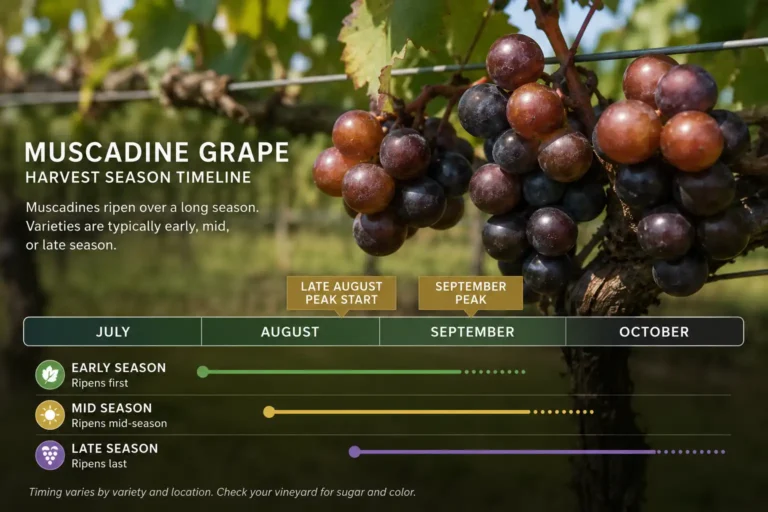
Muscadines catch the same label down south, because old vines build thick trunks on heavy arbors. Muscadine grapes are Vitis rotundifolia, though, so they count as true grapes on true vines.
What This Means When You Plant Your Own Vines
Plan for a vine, not a tree. Set the support structure first, then plant into it. Give each vine 6 to 8 feet of row. Run the fruiting wire high enough for good airflow. Then count on cutting most of last year’s wood off every winter.
If you spot grapes hanging in a tree on your place, follow the stem down to the ground. You will find a vine every time.