Best pH Meter for Soil Testing: 8 Picks and Real Accuracy Data
A soil pH reading only helps you if it repeats. Probe length, accuracy rating, and calibration decide that, and cheap testers miss on all three. So the best pH meter for soil testing is the one that reaches the root zone and holds its calibration. This guide compares accuracy, probe length, calibration, and durability across top picks. So you can match the right tool to your garden, lawn, or hydroponic setup.
For most gardeners and small farms, the Apera GroStar GS2 is the best pH meter for soil testing. It reads straight in soil and takes a replaceable glass spear probe. On a tight budget, the Sonkir MS02 3-in-1 covers basic pH, moisture, and light readings without batteries. Hydroponic and indoor growers do best with the Bluelab Soil pH Pen.
Best pH Meter for Soil Testing: 8 Picks Compared
| Preview |
#1
Best Overall
|
#2
Hydroponics Pick
|
#3
Budget Pick
|
#4
|
#5
|
#6
|
#7
|
#8
|
| Title | Apera GroStar GS2 | Bluelab Soil pH Pen | Sonkir MS02 3-in-1 Soil pH Meter | VIVOSUN 4-in-1 Digital pH Meter | Yoyomax Digital 4-in-1 Soil Tester | Kelway HB-2 Soil Acidity and Moisture Tester | YAMRON 4-in-1 Soil Moisture Meter | Hanna Instruments HI98103 |
| Price |
$257.00 – 08.31.2026 See Latest Price |
$179.93 – 08.31.2026 See Latest Price |
$8.99 – 08.31.2026 See Latest Price |
$27.99 – 08.31.2026 See Latest Price |
$45.99 – 08.31.2026 See Latest Price |
$143.21 – 08.31.2026 See Latest Price |
$32.98 – 08.31.2026 See Latest Price |
$71.99 – 08.31.2026 See Latest Price |
| Overall Score | ||||||||
| How it reads | Glass spear probe, direct in soil | Glass probe, direct in media | Two metal prongs, analog dial | Glass tip, liquid only | Two metal prongs, analog dial | Two metal plates, no power | Two metal prongs, digital | Glass electrode, liquid only |
| pH scale | 0 to 14.0 | 0.0 to 14.0 | 3.5 to 8.0 | 0 to 14.0 | 3.5 to 9.0 | 3.5 to 8.0 | 3.5 to 9.0 | 0.0 to 14.0 |
| Calibration | Two point, pH 4 and 7 | Two point, pH 7 then 4 | None | Manual, buffer solutions | None | Zero adjust screw | None | Auto, one or two point |
| Probe length | 8.6 inches | 13.2 inches | 7.9 inches | 8.31 inches | 12.95 inches | 6.5 inches | 12.6 inches | 8.4 inches |
| Probe type | Replaceable Swiss LabSen spear sensor | Lab-quality glass with ATC | Copper and aluminum, 0.2 in diameter | Plastic body with sensitive probe | Two metal probes, copper and aluminum | Two sensitive metal electrodes | 8-inch (200mm) long metal probe | Replaceable electrode |
Why Soil pH Matters for Plant Health
Soil pH controls how plants absorb nutrients. At a pH below 5.5, phosphorus and calcium lock up. Above 7.5, iron and manganese become unavailable. Most vegetables grow best between 6.0 and 7.0. Blueberries prefer 4.5 to 5.5. Lawns sit happy near 6.5.
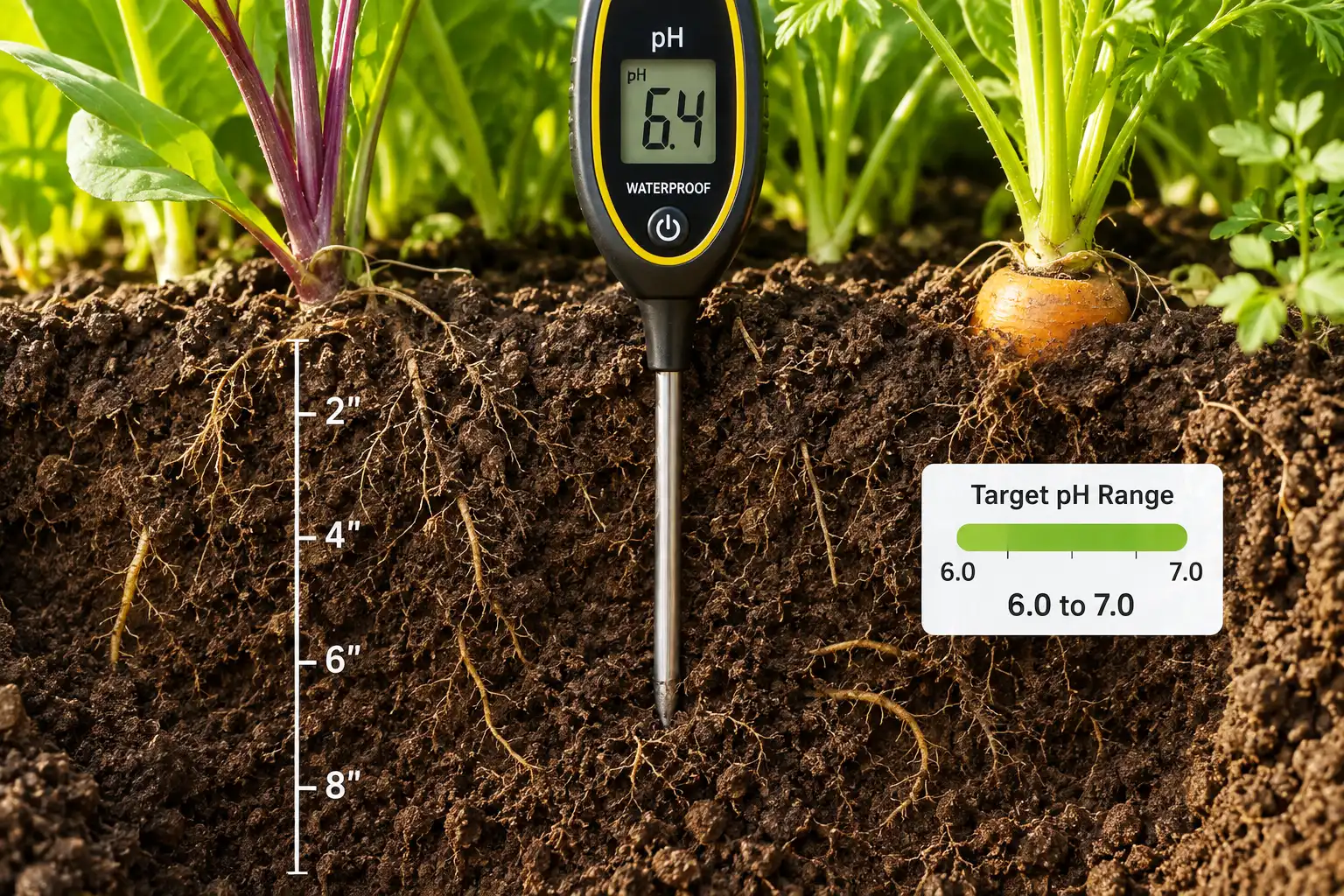
Penn State Extension puts numbers behind that. As pH drops below 5.5, aluminum and manganese become more available and can reach toxic levels. Excess aluminum interferes with root growth and blocks calcium and magnesium uptake. For most agronomic crops, Penn State sets the working range at 6.0 to 7.0.
Disease pressure tracks pH too. UF/IFAS Extension reports that common scab of potato increases above pH 5.2, then falls off sharply below it. Clubroot of brassicas peaks below 5.7, drops between 5.7 and 6.2, and nearly disappears above 7.3.
Penn State also flags a side effect growers often miss. Below pH 6.0, triazine herbicide activity falls off. Above 7.0, other chemistries can carry over into the next crop. So a single reading changes your lime plan, your variety choice, and your spray plan at once.
pH Targets by Crop
| Crop or situation | pH target | What drives the target |
|---|---|---|
| Alfalfa, clover | 6.5 to 7.0 | Nodulation and nitrogen fixation stall in acid ground |
| Corn, soybeans, wheat | 6.0 to 7.0 | Phosphorus availability plus aluminum control |
| Most garden vegetables | 6.0 to 7.0 | Widest window for macronutrients and micronutrients |
| Lawns and turf | Near 6.5 | Steady nitrogen use and strong root density |
| Brassicas on clubroot ground | 5.7 to 6.2, or above 7.3 | Severity drops outside the 5.7 threshold |
| Potatoes, scab susceptible | Below 5.2 | Scab increases as pH climbs past 5.2 |
| Blueberries | 4.5 to 5.5 | Iron and manganese stay plant available |
| Asparagus | Up to 8.0 | Tolerates alkaline ground better than most crops |
University of Delaware Cooperative Extension frames this as a target pH, not a universal number. Target pH shifts with crop and with soil organic matter. Soils above 6 percent organic matter carry a lower target than mineral soils growing the same crop. A standing soil testing routine keeps those targets honest year to year.
The 8 Best pH Meters for Soil Testing: Reviews
Every review below draws on official product documentation, published spec sheets, and aggregated verified-buyer feedback. No meter here was tested by this site.
1. Apera Instruments GroStar GS2 Soil pH Pen
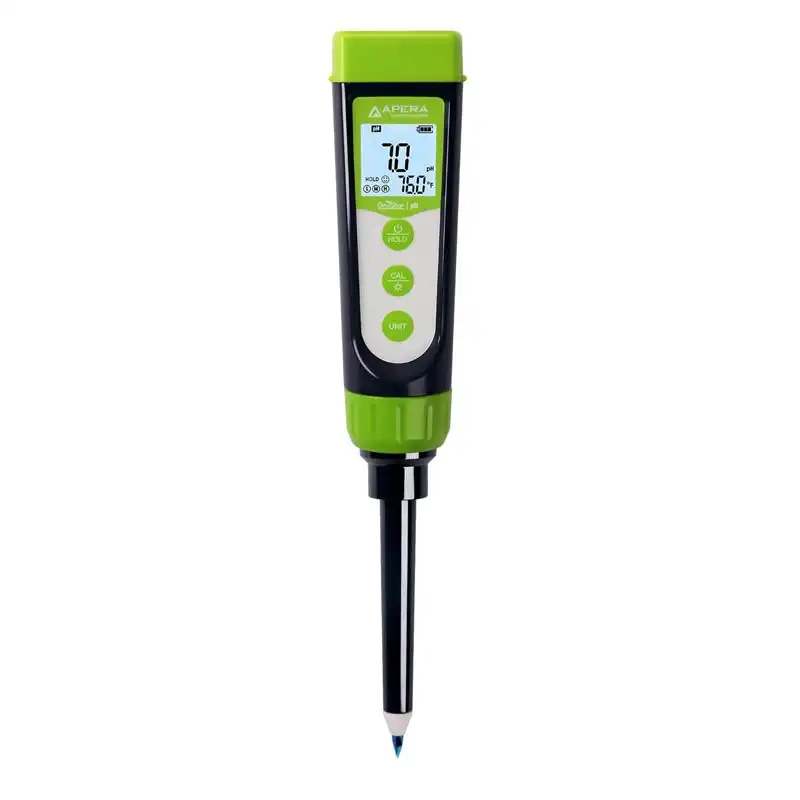
The Apera GroStar GS2 is a lab-grade soil pH pen from Apera Instruments. The Columbus, Ohio company has built water analysis sensors since 1991. It measures pH straight in soil, coco, and rockwool without slurry mixing. A PTFE ring junction resists clogging from soil particles.
Best for: serious vegetable growers, organic farms, and indoor cultivation where accuracy matters week to week.
On acid-loving crops, a 0.2 pH error changes the lime decision. Best for growers who need lab-comparable precision in the field.
PROS
- Reads pH directly in soil
- Replaceable Swiss spear probe
- Calibration solutions included
- IP67 waterproof body
CONS
- Highest cost in this group
- Probe needs KCl storage solution
| Range | 0 to 14.0 pH, 32 to 122 °F |
| Accuracy | ±0.1 pH with automatic temperature compensation |
| Calibration | 1 to 3-point auto (pH 4.0, 7.0, 10.0) |
| Probe | Replaceable Swiss LabSen spear sensor |
| Waterproof | IP67, 4 AAA batteries |
Owner reports consistently credit the replaceable probe for multi-season service life.
2. Bluelab PENSOILPH Soil pH Pen
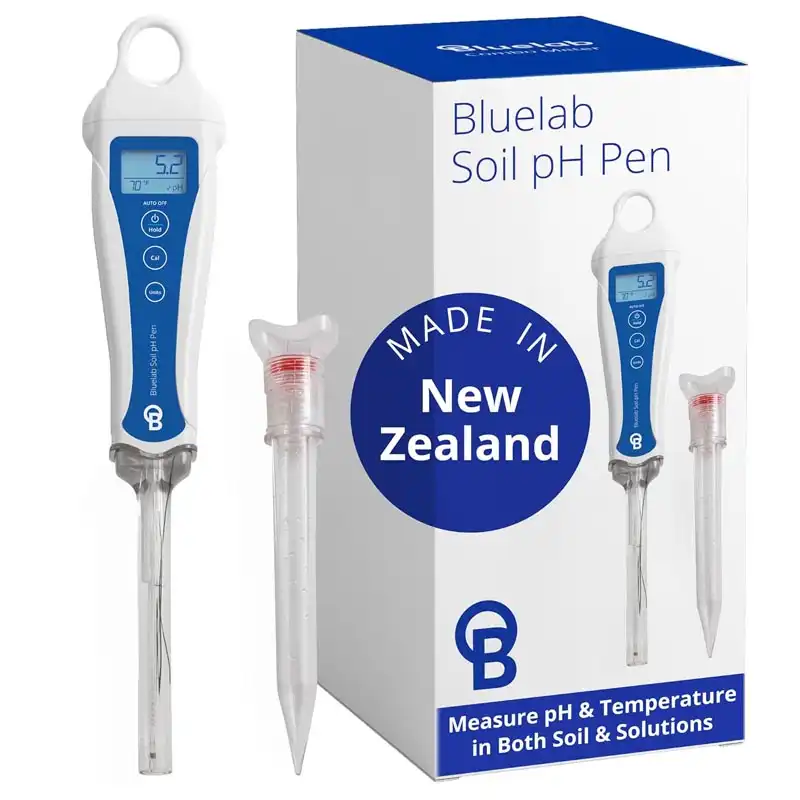
The Bluelab Soil pH Pen comes from Bluelab Corporation in New Zealand. Bluelab has led hydroponic testing equipment since the 1990s. It reads pH directly in soil, coco, rockwool, and nutrient solutions with a lab-quality glass probe. The storage cap doubles as a dibber, so you read at root depth.
Best for: hydroponic, coco, and indoor growers who track pH across both substrate and reservoir.
Coco coir swings pH faster than field soil, so weekly checks catch drift early. Best for indoor and hydroponic growers who want pro-grade pH tracking.
PROS
- Reads media without slurry
- Storage cap doubles as dibber
- Fully waterproof housing
- Simple two point calibration
CONS
- Dried probe needs 24 hour rehydration
| Length | 13.2 inches, 2.4 oz |
| Probe | Lab-quality glass with ATC |
| Power | 1 AAA battery |
| Warranty | 1-year limited |
| Extras | Storage cap included |
Owner reports consistently credit the KCl storage cap for stable readings.
3. Sonkir MS02 3-in-1 Soil pH Meter
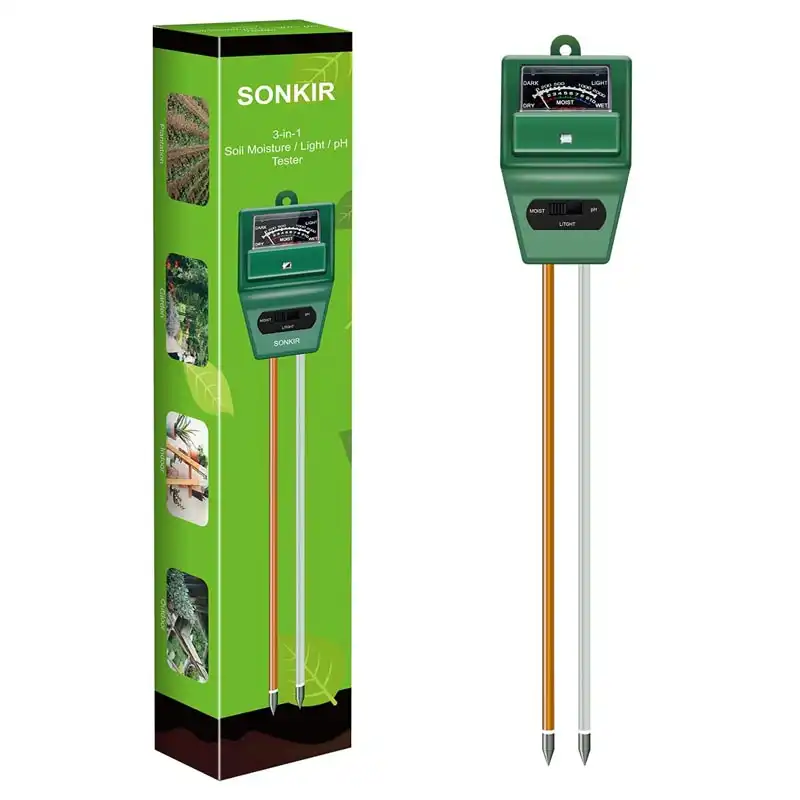
The Sonkir MS02 is a 3-in-1 analog soil meter with one of the largest owner bases in home gardening. It tests pH, soil moisture, and sunlight with one switch and zero batteries. Two dissimilar metal prongs generate the signal, so nothing needs charging.
Best for: casual home gardeners, raised beds, and houseplant owners who need quick directional readings.
On raised beds, the dial flags a badly acidic or alkaline spot fast. Best for gardeners who need a low-cost first meter without fuss.
PROS
- No batteries required
- Three readings, one dial
- Compact for container checks
- Push and read operation
CONS
- Needle pH is directional only
- Not usable in liquids
| pH Range | 3.5 to 8 (3.5 to 6.5 acidic, 7 to 8 alkaline) |
| Probe Length | 7.9 inches |
| Probe Material | Copper and aluminum (0.2 in diameter) |
| Power | No batteries needed |
| Total Size | 11.5 x 2.0 x 1.5 inches |
Owner reports consistently praise the moisture and light functions above the pH dial.
4. VIVOSUN 4-in-1 Digital pH Meter
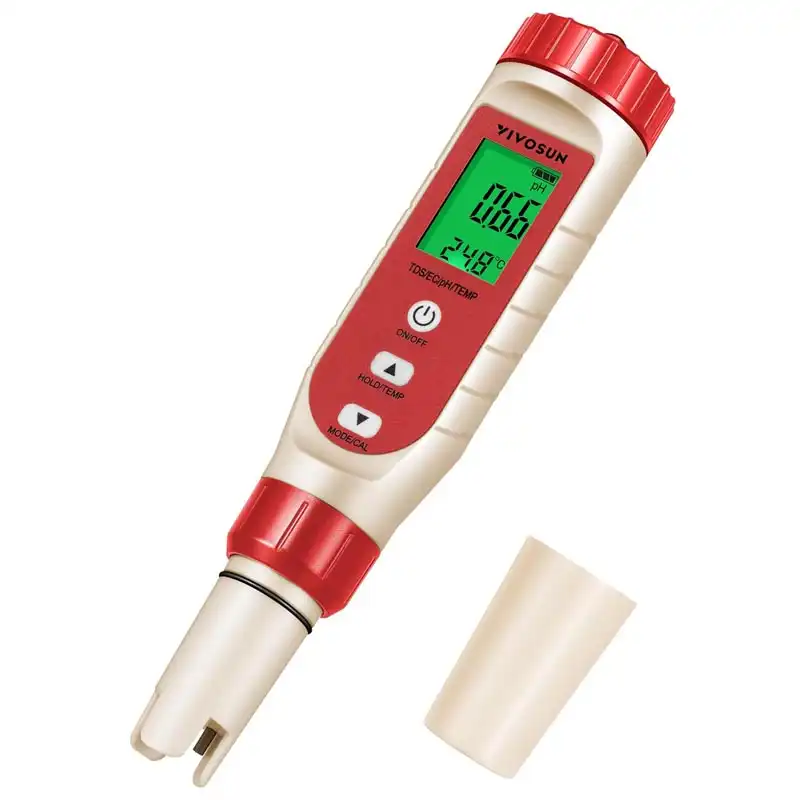
The VIVOSUN 4-in-1 is a digital water pH pen built for liquid testing. It measures pH, TDS, EC, and temperature, making it strong for hydroponic reservoirs and soil slurry tests. The electrode suits liquids, so it never goes straight into the ground.
Best for: hydroponic growers and gardeners running soil slurry tests for lab-style accuracy.
A 1:1 soil-to-distilled-water mix turns this pen into a soil tool. Best for growers who blend hydroponic monitoring with soil slurry testing.
PROS
- Four readings, one pen
- Suits the slurry method
- Temperature compensation built in
- Doubles for reservoir checks
CONS
- Cannot read soil directly
- Tip needs rinsing between samples
| Functions | pH, TDS, EC, temperature |
| ATC | Yes |
| Size | 8.31 x 3.27 x 2.01 inches, 3.52 oz |
| Material | Plastic body with sensitive probe |
| Use | Liquids only, not direct soil |
Owner reports consistently stress rinsing the tip between samples.
5. Yoyomax Digital 4-in-1 Soil Tester
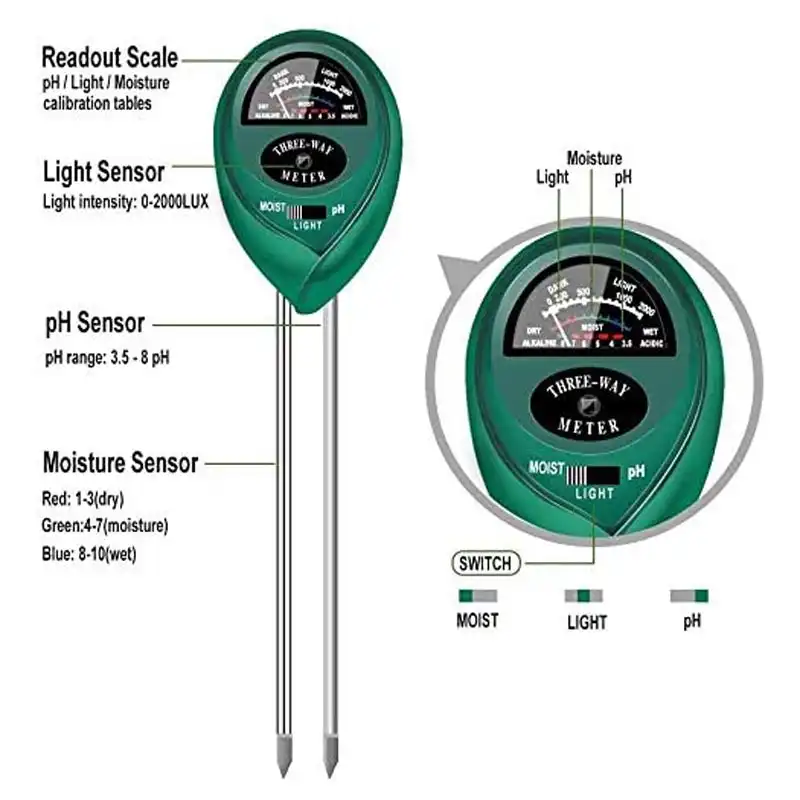
The Yoyomax Soil Test Kit is a no-frills analog soil tester for gardeners who want plug-and-read simplicity. It measures pH, moisture, and light with no batteries to swap. Insertion runs 2 to 4 inches, which sits above the feeder root zone.
The 10-minute read time suits spot checks, not a full sampling round. Best for casual gardeners who want a dependable second meter.
Best for: beginner gardeners, container plant owners, and anyone who wants a backup meter for quick checks.
PROS
- No batteries needed
- Three functions, one probe
- Light and portable
- Low cost spare unit
CONS
- Slow to stabilize
- Shallow 2 to 4 inch insertion
| Functions | pH, moisture, sunlight |
| Probe Insertion | 2 to 4 inches |
| Power | No batteries |
| Read Time | 10 minutes for stable result |
| Use | Soil only, no liquids |
Owner reports consistently describe it as a second tester, not a primary meter.
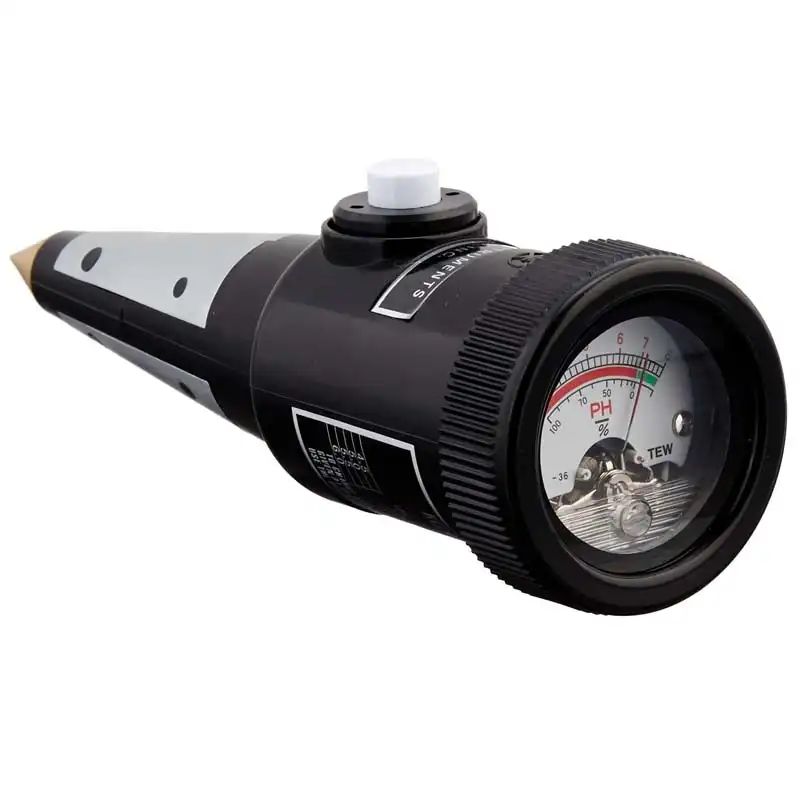
6. Kelway HB-2 Soil Acidity and Moisture Tester
The Kelway HB-2 is the analog meter trusted by professional landscapers, golf course managers, and turf specialists. It reads pH and moisture with a sensitive electrode that needs no batteries or chemicals. Two dissimilar metal plates make their own current in moist soil. The manual calls for three minutes in place before you read.
Best for: turf managers, professional landscapers, and gardeners who want proven analog reliability.
Turf work rewards fast repeat readings across a large area. Best for pros and serious gardeners who value field-built reliability.
PROS
- No batteries or buffers
- Reads pH and moisture
- Belt sized at 6.5 inches
- Zero adjust screw for drift
CONS
- Not intended above pH 7.5
- Conditioning film needs replacing
| pH Range | 3.5 to 8, accuracy ±0.2 |
| Moisture Range | 0 to 100%, accuracy ±10% |
| Probe Length | 6.5 inches |
| Power | None required |
| Includes | Leather-style case with belt loop |
Owner reports consistently note long service life with clean plates.
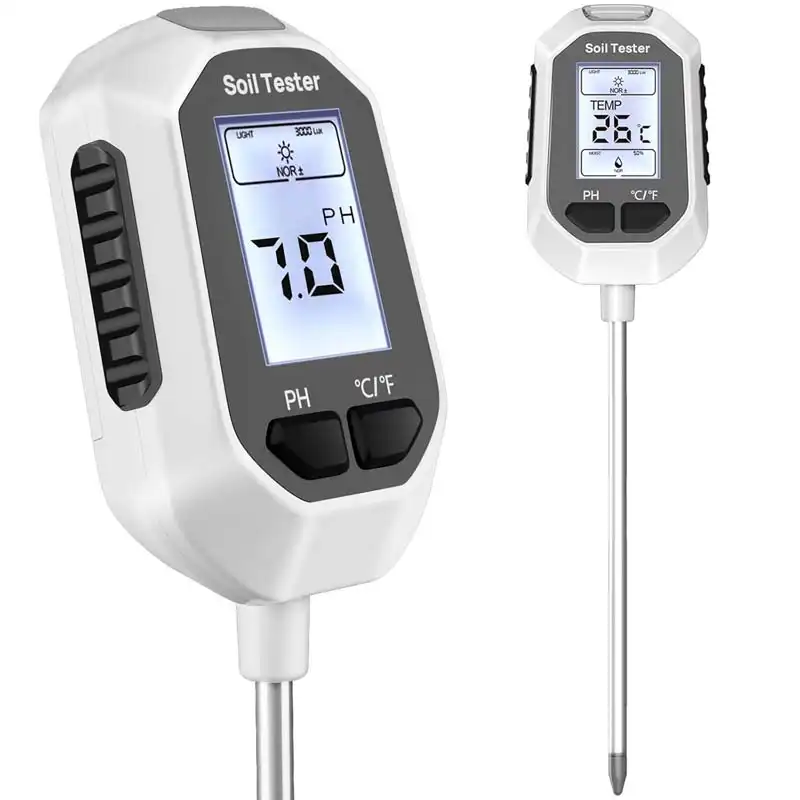
7. YAMRON 4-in-1 Soil Moisture Meter
The YAMRON 4-in-1 is a digital soil tester with a backlit LCD and a 45-degree rotating head. It tracks pH, moisture, temperature, and sunlight on one screen. The 12.6 inch body reaches deeper than most dial testers.
Best for: data-driven gardeners who track multiple soil and environment metrics together.
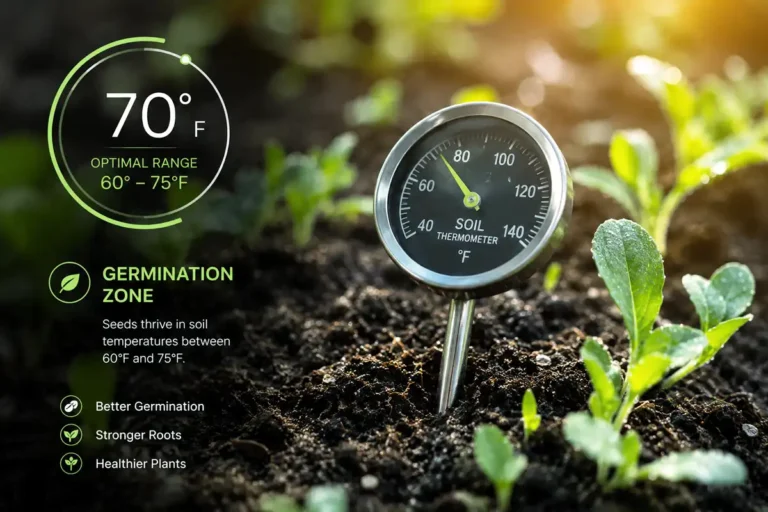
Soil temperature and pH together answer the planting-time question. Best for gardeners who want a digital all-in-one without buying a pro pen.
PROS
- Four functions, one probe
- Backlit screen reads easily
- 45 degree rotating head
- 12.6 inch probe length
CONS
- Batteries not included
- Needle pH stays approximate
| Functions | pH, moisture, temperature, sunlight |
| Length | 12.6 inches |
| Temperature Range | 32 to 122 °F, ±1.8 °F |
| Power | 4 AAA batteries |
| Display | Large backlit LCD with low-battery alert |
Owner reports consistently highlight the backlit screen and quick response.
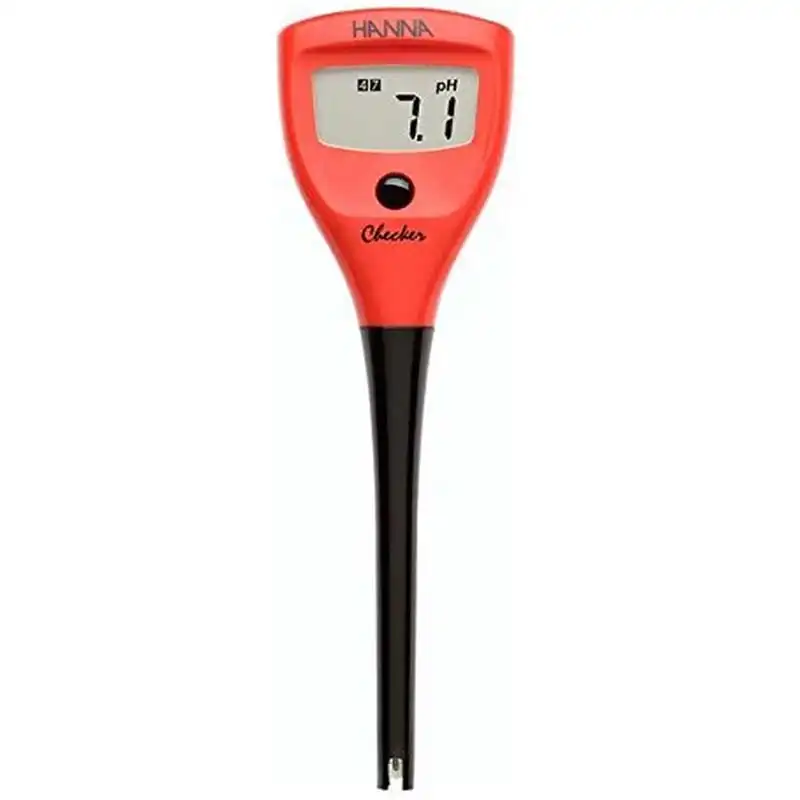
8. Hanna Instruments HI98103 Checker pH Tester
The Hanna HI98103 Checker comes from Hanna Instruments, a global leader in pH measurement since 1978. It delivers dependable 0.1 pH resolution at a price most home growers can swing. The HI1271 electrode unscrews, so a worn probe becomes a parts swap.
Best for: precision-focused gardeners, hydroponic growers, and slurry-method soil testers.
Nutrient solutions and soil slurry both read cleanly here. Best for growers who want lab-grade resolution without paying lab-grade prices.
PROS
- Glass electrode, not prongs
- Automatic buffer recognition
- Replaceable HI1271 electrode
- Long CR2032 battery life
CONS
- Resolution stops at 0.1 pH
- Calibration buffers sold separately
- Liquids and slurry only, never direct soil
| Range | 0.0 to 14.0 pH, accuracy ±0.2 pH at 25 °C |
| Resolution | 0.1 pH |
| Calibration | Automatic one or two point, buffer recognition |
| Battery Life | About 1,000 hours on one CR2032 |
| Probe | Replaceable HI1271 electrode |
Owner reports consistently credit the screw-off electrode for long meter life.
How to Choose the Best Soil pH Meter
Picking a soil pH meter comes down to six things. Get these right and the rest sorts itself out.
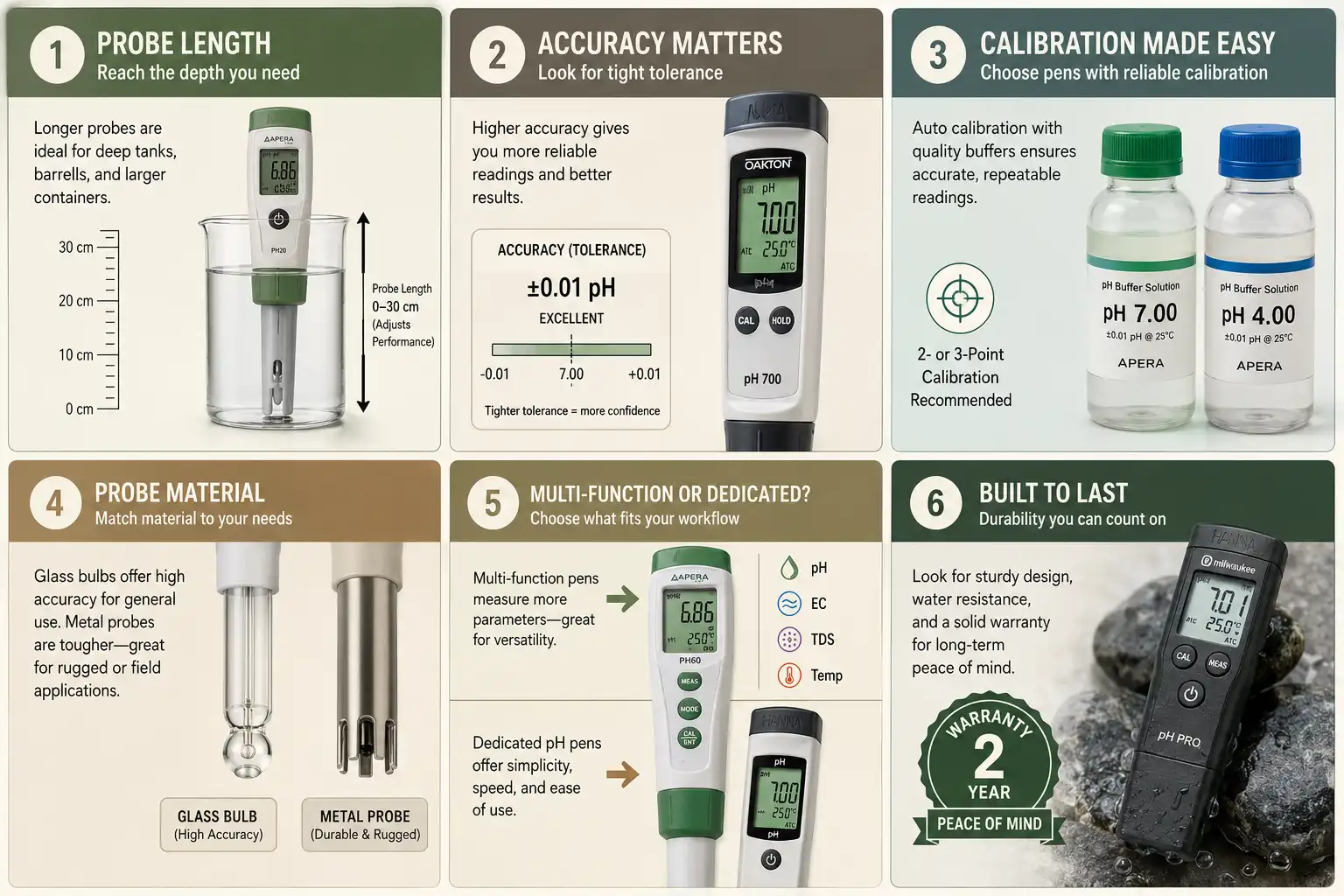
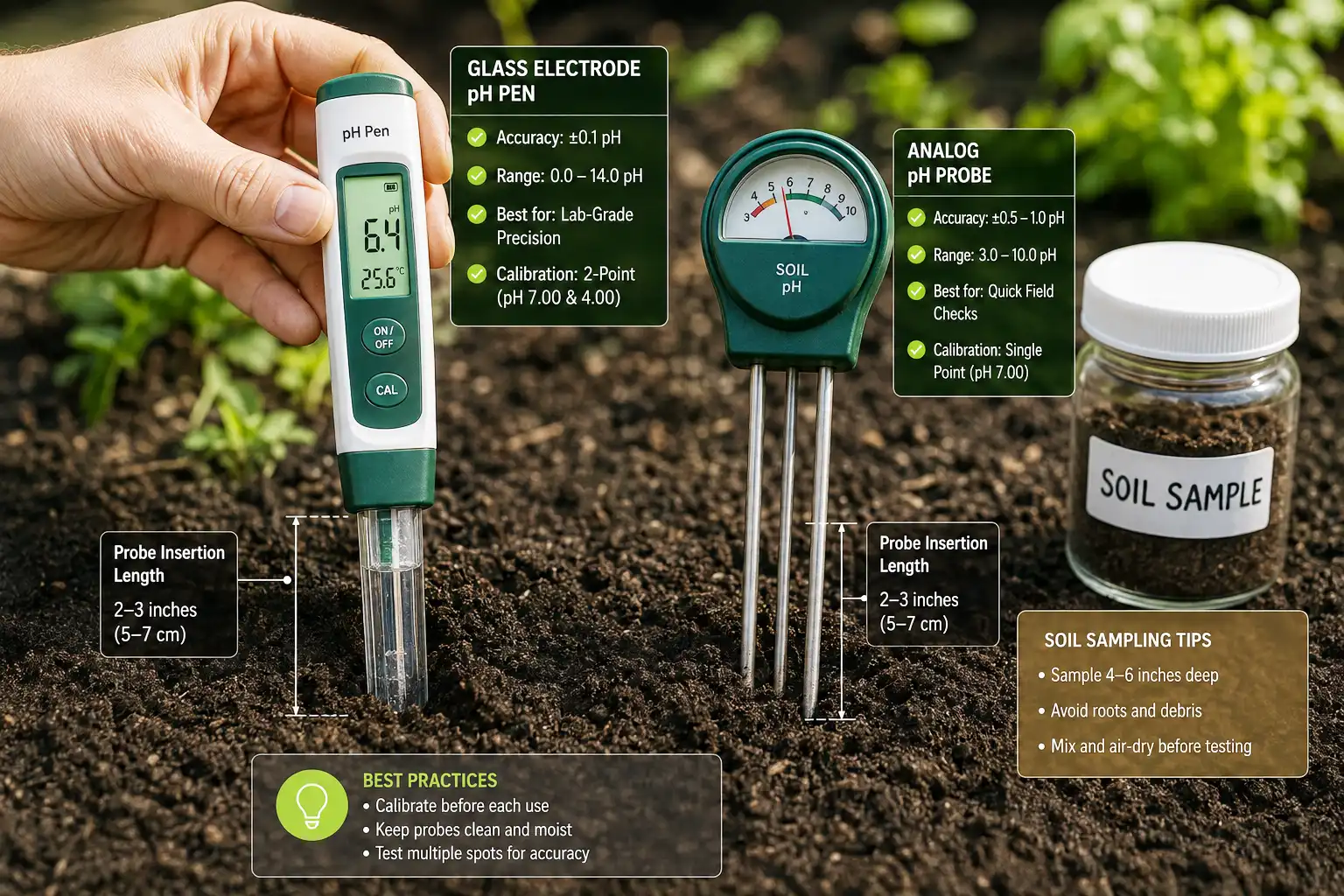
- Probe length. Aim for 7 to 8 inches minimum. Most feeder roots sit 4 to 8 inches down. A short probe reads the surface, where readings drift with rain and sun.
- Accuracy rating. Lab-grade digital pens hit ±0.1 pH. Prong-style analog probes are far looser, and extension testing shows they can miss by more than 2 pH units. If you grow acid-loving crops like blueberries, pay for the digital accuracy.
- Calibration capability. One-point calibration handles routine checks. Two-point (pH 4.0 and 7.0) covers most home use. Three-point (pH 4.0, 7.0, 10.0) gives lab-level precision for serious growers.
- Probe material. Stainless steel resists corrosion. Cheap copper probes oxidize within a season. Glass-bulb electrodes deliver the best accuracy but break if dropped, so look for an impact-resistant spear tip.
- Multi-function or dedicated. Combo meters track pH, moisture, and light in one tool. Dedicated pH pens give cleaner readings. Pick combo for casual gardening, dedicated for precision work.
- Durability and warranty. A 12-month warranty signals the maker stands behind the build. Check for replaceable probes on premium pens. They turn a costly meter into a long-term investment.
Types of Soil pH Testers Compared
Four main types of pH testers reach the market. Each fits a different job.
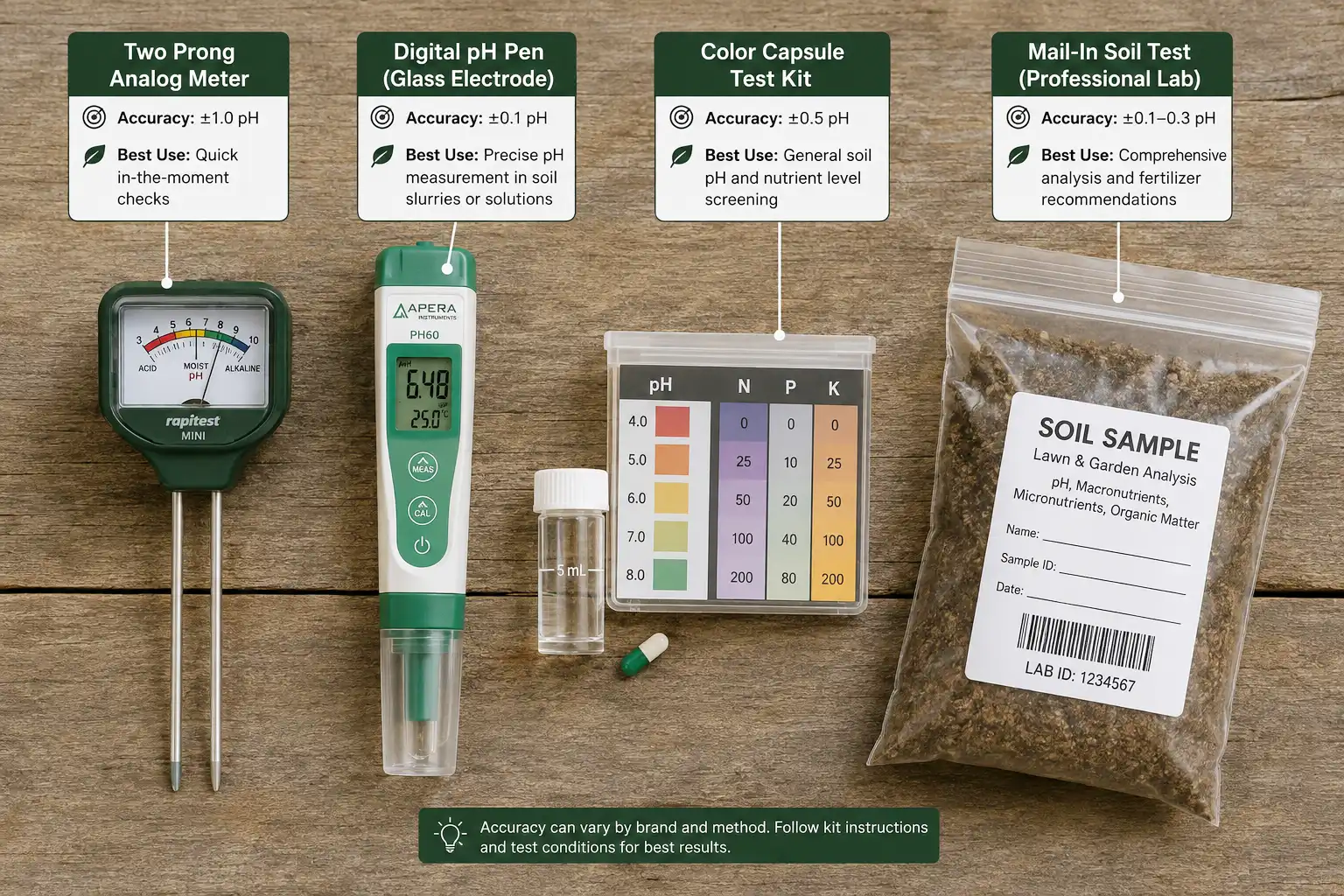
Analog probe meters (lowest cost) work without batteries. Two metal prongs measure soil conductivity. Cheap, fast, and rough on accuracy. Good for tracking moisture trends across the season, less useful for a pH decision.
Digital pH pens (mid to premium) use a glass electrode and a calibrated circuit. Readings match lab results within 0.1 to 0.2 pH when calibrated. Best pick for serious gardeners and small farms.
Chemical test kits (low cost) use color-change capsules and a vial. Mix soil with distilled water, add the powder, compare colors. Single-use but useful for one-time checks before planting. Several soil test kit options bundle pH with nitrogen, phosphorus, and potassium in the same box.
University extension lab tests deliver pH plus nutrient profiles. The gold standard. Cost varies by state lab. A pH-only test runs a few dollars, while a full panel can pass a hundred dollars, as Oregon State notes. Run one annually and use a meter for monitoring between tests. Combining lab data with field meter readings sharpens any program to improve soil fertility naturally.
How Accurate Are Soil pH Meters?
A calibrated hand-held glass electrode meter tracks laboratory results closely, while prong-style probes do not. Oregon State University Small Farms Program summarized a national comparison of in-field pH methods. Researchers benchmarked each method against the average result from 82 participating laboratories. The hand-held meter came closest to that average. The prong probe returned the same reading for three different sample groups.
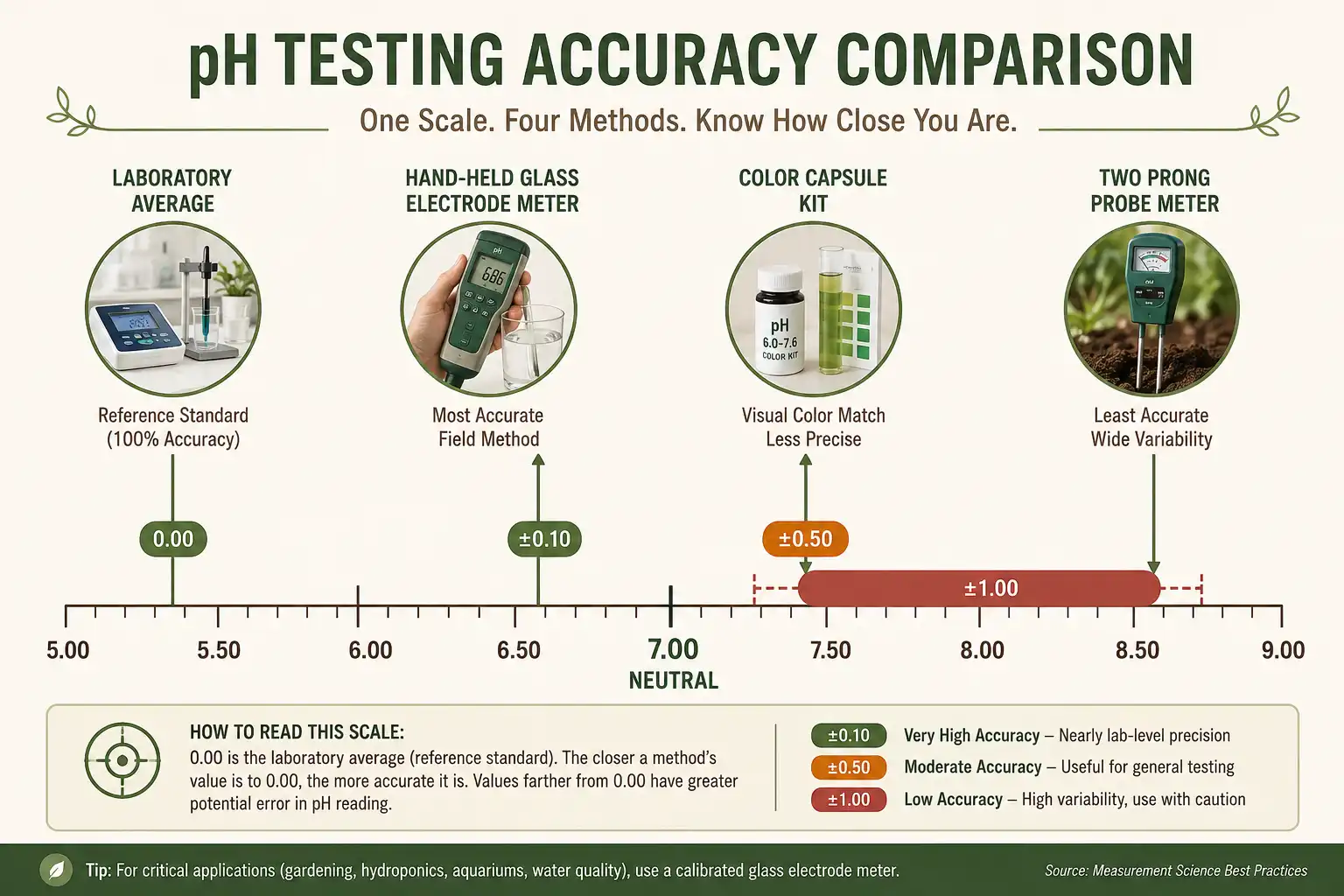
That last point matters for buying decisions. Oregon State reported the probe could not separate samples more than 2.0 pH units apart. So the report calls it unacceptable for estimating field pH. Color kits landed between the probe and the hand-held meter.
Michigan State University Extension gives growers the same steer. Its horticulture staff recommend a glass electrode meter and advise against metal skewer style testers. The instruments most used in horticulture come from Hanna, Bluelab, and Apera Instruments. Even an inexpensive pen-style meter can reach 0.1 pH on a soil or compost slurry.
Two practical rules follow. First, accuracy tracks the sensor, not the feature count. Second, treat every in-field reading as an estimate. A reading near the edge of your crop’s range deserves lab confirmation. Send a sample before buying amendments.
How to Use a Soil pH Meter Correctly
Follow these steps for accurate readings every time.
- Clear leaves, mulch, and debris from a 6-inch patch.
- If the soil reads dry, moisten it with distilled water and wait 30 minutes.
- Insert the probe 4 to 6 inches into the root zone at a slight angle.
- Hold the probe steady for 60 seconds until the reading settles.
- Take 3 to 5 readings across the bed and average them.
- Wipe the probe clean with a soft cloth before storing.
For water-style pH pens, run a soil slurry test instead. Mix 1 part soil with 1 part distilled water. Stir, wait 15 to 30 minutes, and test the clear liquid on top. This protects the glass electrode and matches lab procedure.
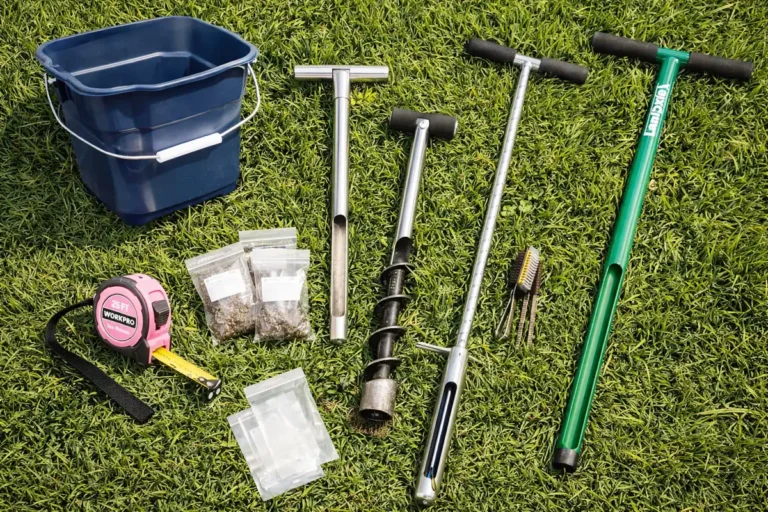
Pull your samples the way a lab would. A probe or auger holds depth consistent, while a trowel rarely does. So decent tools for soil sampling pay for themselves.
One detail matters when your meter disagrees with a lab report. Oregon State notes that labs use saturated paste, 1:1, and 1:2 soil-to-water ratios. Acidic soils read slightly higher as the water share rises. That gap runs about 0.1 to 0.2 pH units. So ask your lab which ratio it uses, then copy it at home.
When to Test
Timing changes the answer. Oregon State reports the highest soil pH readings in late winter and early spring, before fertilizer goes on. Seasonal swings commonly run 0.3 to 0.5 units. Sandy soils can move more than a full unit between spring and fall.
Two rules follow from that. Test the same month every year, and treat a mid-season reading as a check rather than a baseline. That habit keeps results comparable year over year.
How to Calibrate and Maintain Your Soil pH Meter
Digital meters need calibration before first use and on a schedule after that. Cornell University’s soil health guidance recommends calibrating with buffer solution after powering on. Repeat after every 10 to 12 measurements. Use fresh buffer solutions at pH 4.0, 7.0, and 10.0. Old buffers drift and ruin accuracy. Rinse the probe with distilled water between buffer dips.
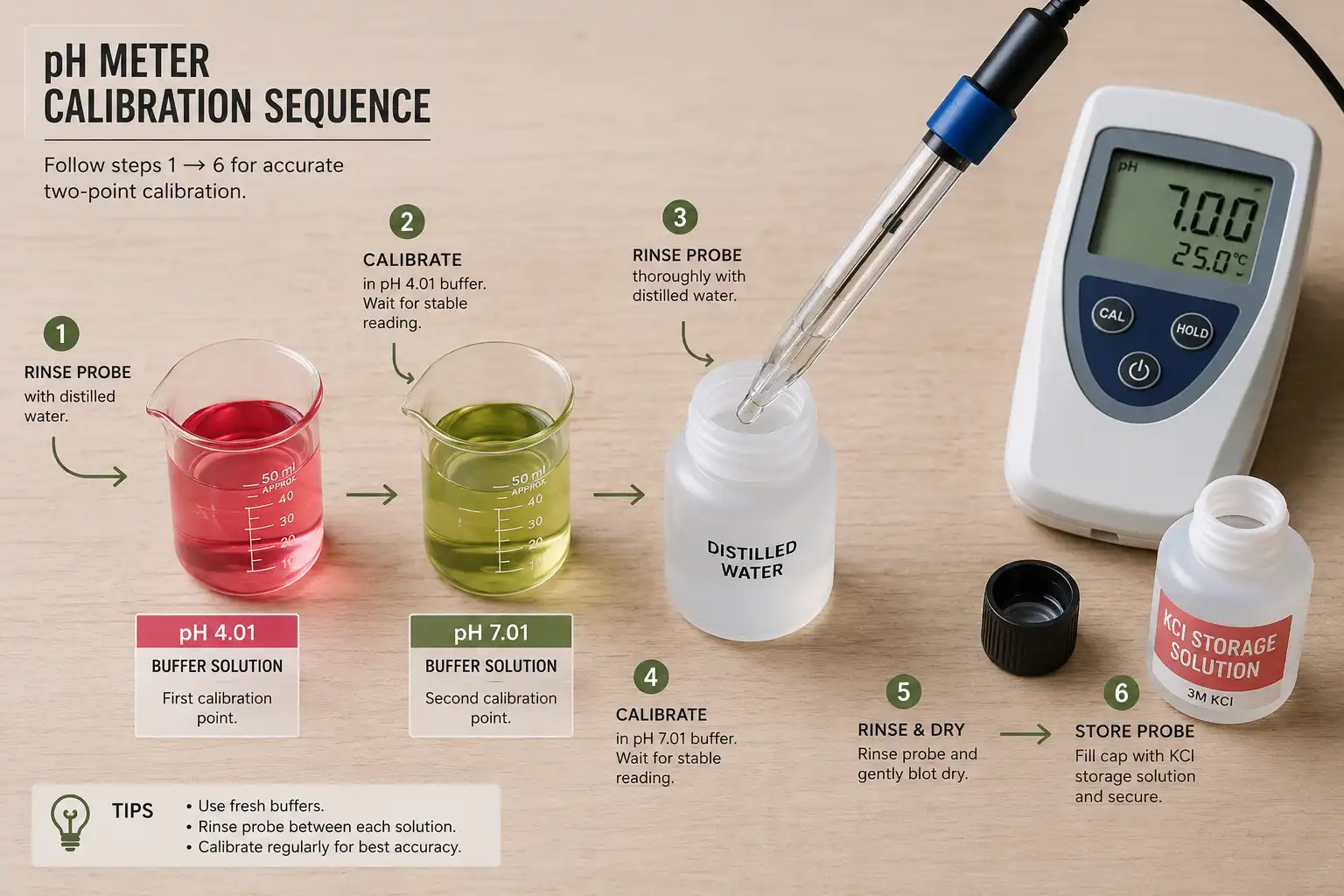
Store digital probes in proper electrode storage solution, never plain distilled water. Distilled water leaches ions out of the bulb and shortens probe life. Both Apera and Bluelab documentation say the same thing. Bluelab adds that a dried probe needs 24 hours in KCl to recover.
For analog meters, never leave the probe in soil between readings. The metal corrodes within hours. Wipe with a dry cloth after each use. If readings turn sluggish, polish the prongs with fine sandpaper to restore conductivity. Kelway supplies conditioning film for exactly this job, since fingerprints and soil film block the current.
Cornell adds one filter worth applying before you buy. Extra decimal places rarely change a management decision, since most growers need pH to one decimal only. Cheap instruments also break sooner, so weigh build quality against printed resolution.
Common Soil pH Meter Problems and Fixes
- Meter stuck at 7.0. The soil is too dry, or the probe sits at its default rest reading. Add distilled water, wait 30 minutes, retest.
- Inconsistent readings across the same bed. Probe corrosion or low moisture. Clean the probe and rewet the test spot.
- Probe won’t insert. Soil is rocky or compacted. Pre-water the area or pre-drill a 6-inch hole with a thin rod.
- Readings drift over weeks. Recalibrate with fresh buffer. If drift stays, the electrode is failing and needs replacement.
- Digital pen reads “null” in soil. It’s a water-style pen used the wrong way. Run the slurry method described above.
- Meter disagrees with the lab by 0.2. Check the soil-to-water ratio your lab uses. That gap is normal between methods, not a fault.
How to Adjust Soil pH After Testing
Once you have a reading, the fix is straightforward. Acidic soil below 6.0 needs lime. Alkaline soil above 7.5 needs elemental sulfur.
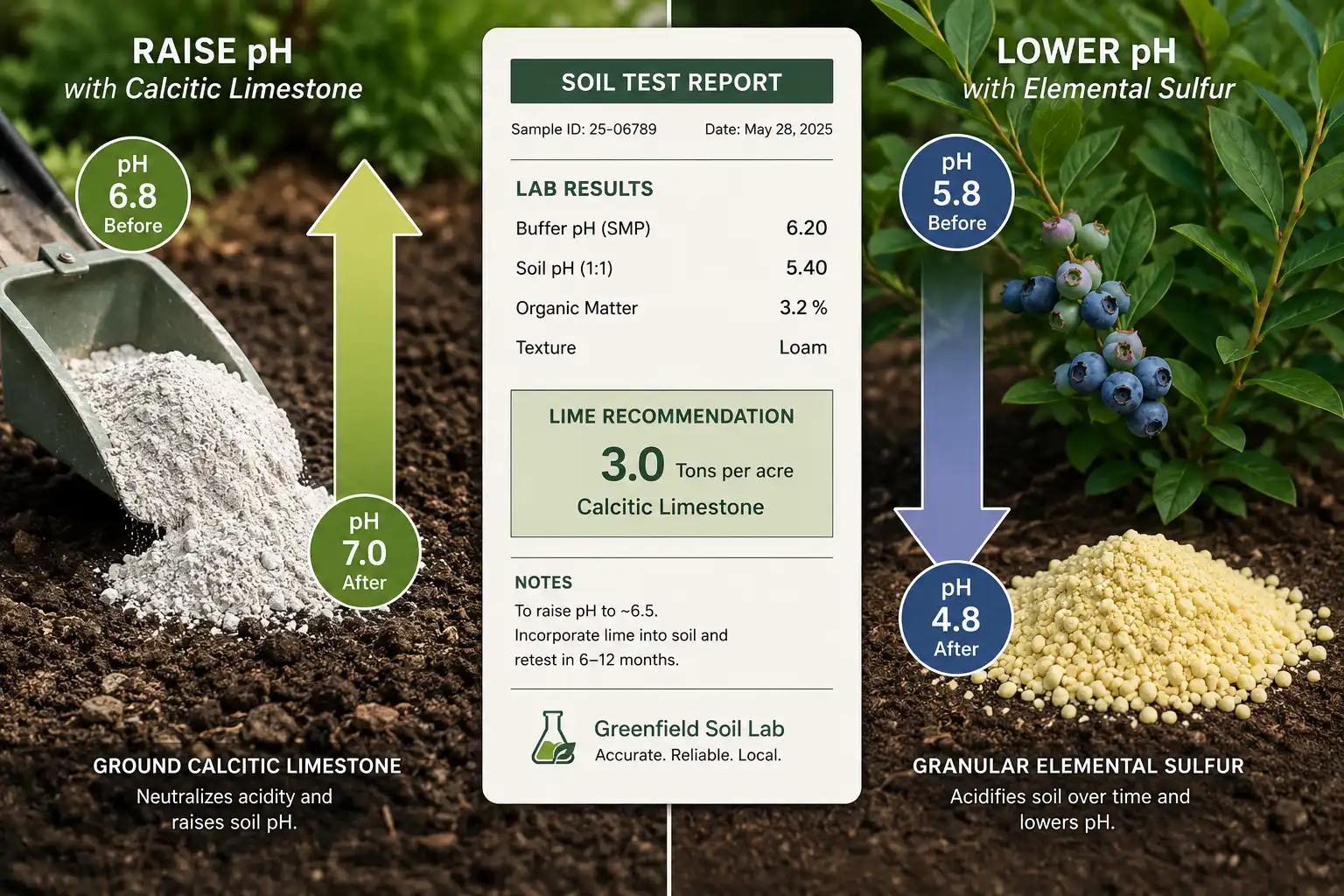
Calcitic lime raises pH and adds calcium. Dolomitic lime adds magnesium too, useful on light Midwest soils. Elemental sulfur lowers pH slowly over 6 to 12 months as soil bacteria oxidize it.
Lime quality varies as much as lime type. Penn State Extension rates liming materials by calcium carbonate equivalent and by fineness, since finer grinds react faster. Penn State also flags a common mistake. Gypsum and Epsom salts supply calcium and magnesium, but neither one raises pH.
Application rates depend on soil texture, current pH, and target pH. Sandy soils need less lime than clay soils. A meter reading alone cannot size the rate, and University of Delaware Cooperative Extension explains why. The lab runs a buffer pH test to measure reserve acidity, and that result drives the recommendation. Two fields reading 5.6 can still need very different tonnage. Combining amendments with compost in your farming routine buffers pH swings and feeds soil biology at the same time.
Delaware Extension adds one caution on the sulfur side. Acidification only pays on acid-loving crops such as blueberries or scab-susceptible potatoes. Treating broad acreage rarely returns the cost.
Retest 60 to 90 days after applying lime, and later still after sulfur. Watch for signs of micronutrient deficiency during the adjustment period, since pH shifts change which nutrients plants can reach.
FAQs on Soil Testing pH Meter
Are soil pH meters accurate?
How often should I calibrate a soil pH meter?
Do I need to wet the soil before testing?
Can I use a water pH pen to test soil?
How deep should the probe go for an accurate reading?
What pH level is best for most garden vegetables?
Why does my soil pH meter always read 7?
How long do soil pH meters last?
Key Points to Carry Into the Field
A soil pH meter pays for itself the first time it diagnoses a stubborn garden problem. For accuracy, pick a digital pen with two-point or three-point calibration and a probe that reaches 7 inches. For quick budget checks, a 3-in-1 analog meter spots major issues. Test the same month each year and average 3 to 5 spots per bed. Then send one sample to a lab before any large amendment purchase.