What to Fertilize Onions With: A Full Feeding Guide for 2026
Onion bulbs stay small when the feeding program misses. Most of that traces back to nitrogen timing, not the bag you bought. Knowing what to fertilize onions with comes down to sulfur, split nitrogen, and a hard stop at bulbing.
Fertilize onions with a sulfur bearing nitrogen source such as ammonium sulfate 21-0-0. Set phosphorus and potassium by soil test. Split the nitrogen across the season, then stop at bulb initiation.
Are Onions Heavy Feeders?
Yes, onions are heavy feeders, but not in the way most people mean. They do not pull enormous total tonnage out of the ground. A bulb crop removes roughly 140 pounds of nitrogen per acre. Phosphorus removal runs only 20 to 25 pounds. Corn pulls far more of both.
The problem sits in the roots. Onion roots are shallow, sparsely branched, and nearly hairless. Most feeder roots stay in the top 12 inches, and many sit in the top 6. So the plant cannot scavenge the way a taproot crop does. It needs a high concentration of available nutrients sitting right in that shallow zone.
That single fact drives every decision below. Onions are inefficient feeders rather than greedy ones. They leave residual nutrients behind at harvest because they never reached them.
Two practical results follow. First, placement beats volume. Banding phosphorus near the row does more than broadcasting twice as much across the field. Second, timing beats total. A correct seasonal amount applied at the wrong stage still gives you small bulbs and thick necks.
Learn more: When to Water Onions
What Type of Fertilizer for Onions Works Best
Onions want nitrogen and sulfur as the two headline nutrients. Phosphorus and potassium follow the soil test. Here is how each one behaves in an onion field.
Nitrogen
Nitrogen drives leaf count, and leaf count sets bulb size. Every leaf the plant builds before bulbing becomes a ring in the finished bulb. So early and mid season nitrogen buys you bulb diameter. Late nitrogen just buys you neck.
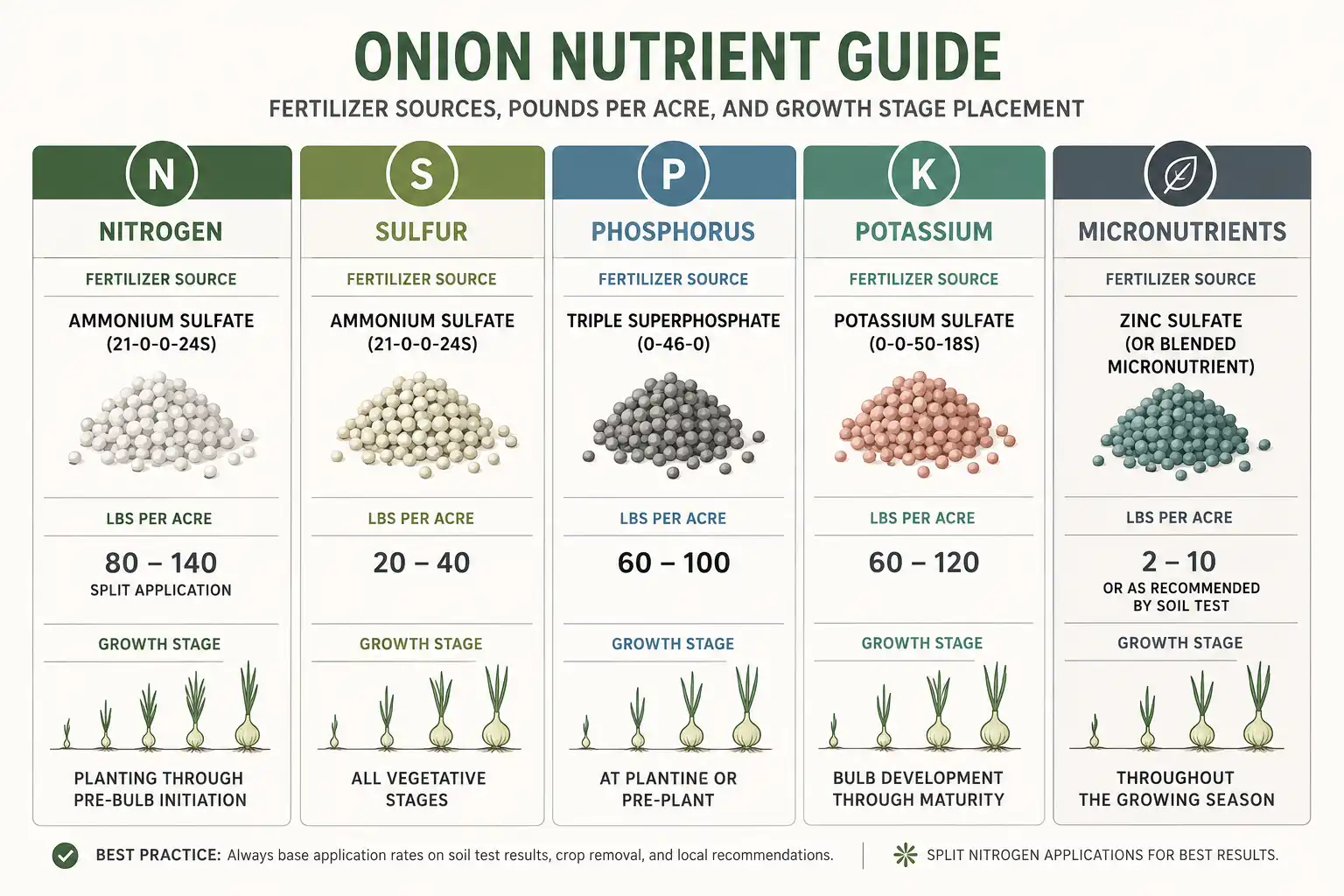
NC State Extension targets 120 to 150 pounds of total nitrogen per acre for commercial bulb onions. University of Georgia work found a wider practical range. Dry years may need only 75 pounds, while wet years take 135 or more, since leaching moves the target. Apply 30 to 40 percent before planting and side-dress the rest.
Common sources behave differently:
- Ammonium sulfate (21-0-0) carries about 24 percent sulfur and mildly acidifies soil. This is the default choice on alkaline ground.
- Urea (46-0-0) gives the cheapest unit of nitrogen. Work it in or water it in, though, because surface urea loses nitrogen to the air. The way urea fertilizer behaves on warm soil surfaces catches a lot of growers.
- Calcium nitrate (15.5-0-0) suits acidic soils and delivers nitrate that roots take up immediately.
- UAN (32-0-0) works well through drip for anyone fertigating.
Keep any single application under 100 pounds of nitrogen per acre. Onion roots burn easily.
Sulfur
Sulfur ranks second, and onions carry a genuinely high requirement. It builds the sulfur compounds that create onion flavor and pungency. Sandy, low organic matter soils run short first.
Sulfur also cuts both ways. University of Georgia research on Vidalia ground showed that sulfur binds to clay and accumulates. That pushes onions sharp and hot. Sandy soils let sulfur leach, which keeps bulbs mild. So if you are growing sweet onions, hold sulfur to what the crop needs and no more. For pungent storage onions, ammonium sulfate or gypsum will get you there.
Phosphorus
Apply phosphorus before planting, banded 2 to 3 inches below and beside the seed line. Cold spring soil slows phosphorus movement, and shallow onion roots cannot chase it. That combination makes banded starter phosphorus pay even on soils testing medium.
Onions remove very little, so resist the urge to pile it on. Follow the test.
Potassium
Apply potassium before planting, and choose the form carefully. Potassium sulfate (0-0-50) delivers potassium plus sulfur without much salt. Muriate of potash (0-0-60) costs less, but the chloride and salt load can damage onion roots at higher rates. On light soils, the sulfate form is the better fit.
Micronutrients
Zinc and boron come up short in some fields. Correct them only after a soil or tissue test confirms it, because boron turns toxic fast. Guessing at micronutrient shortages causes more damage than the original problem.
Why the Soil Test Comes Before the Bag
A soil test tells you two things a fertilizer label never will: your phosphorus and potassium reserves, and your pH. Both change what you should buy.
Target a pH of 6.0 to 7.0, with 6.2 to 6.8 as the sweet spot. Below 6.0, apply lime the fall before. Above 7.0, iron and manganese lock up, and you will see pale new leaves that no amount of nitrogen fixes. Elemental sulfur lowers pH slowly, so plan a season ahead.
Many soils already hold plenty of phosphorus. University of Minnesota Extension advises skipping extra phosphorus unless the report calls for it. That holds true across the Great Plains too. Pull a proper soil test every two to three years from the top 6 to 8 inches. Sample the onion ground separately if it sits on different soil than the rest of the farm.
Test results also tell you whether the grades on the shelf make sense. Once you know your numbers, comparing fertilizer grades for onions becomes arithmetic instead of guesswork.
What to Fertilize Onions With at Each Growth Stage
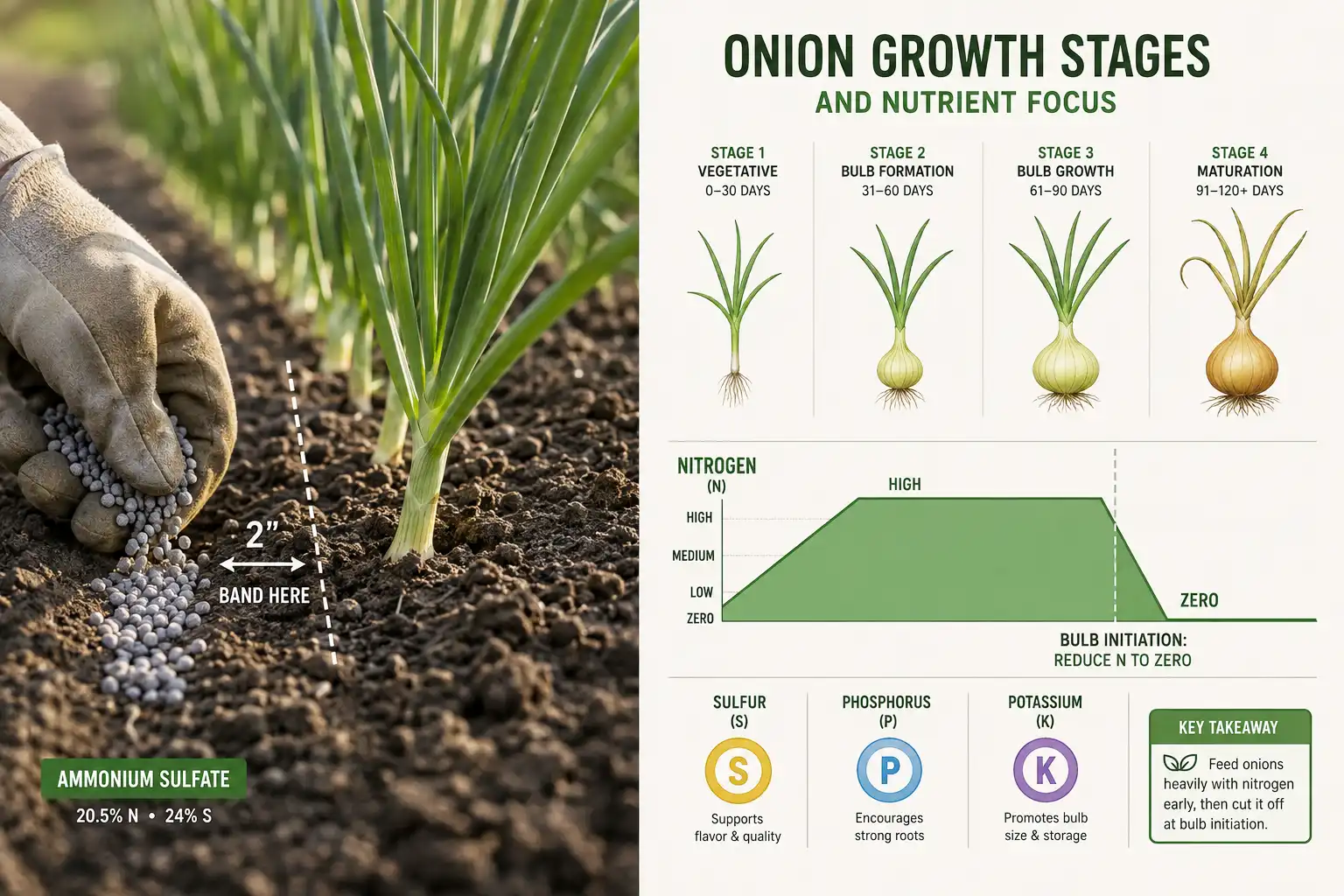
Onions barely feed for the first two months, then eat hard for six weeks. Match the schedule to that curve.
| Stage | When | Apply | Why |
|---|---|---|---|
| Preplant | 2 to 3 weeks before planting | All P and K per test, 30 to 40% of total N, sulfur on sandy ground | Shallow roots need it already in place |
| Emergence to 3 leaf | 50 to 70 days after planting | Little or nothing | Growth is slow and demand is low |
| Leaf building | Tops 4 to 6 inches, repeat every 2 to 3 weeks | Nitrogen side-dress | Each new leaf becomes a bulb ring |
| Bulb initiation | Necks thicken, soil cracks over the bulb | Final nitrogen, then stop | Past this point nitrogen hurts |
| Bulb swelling to harvest | Last 4 to 6 weeks | Nothing | Firm necks and storage quality |
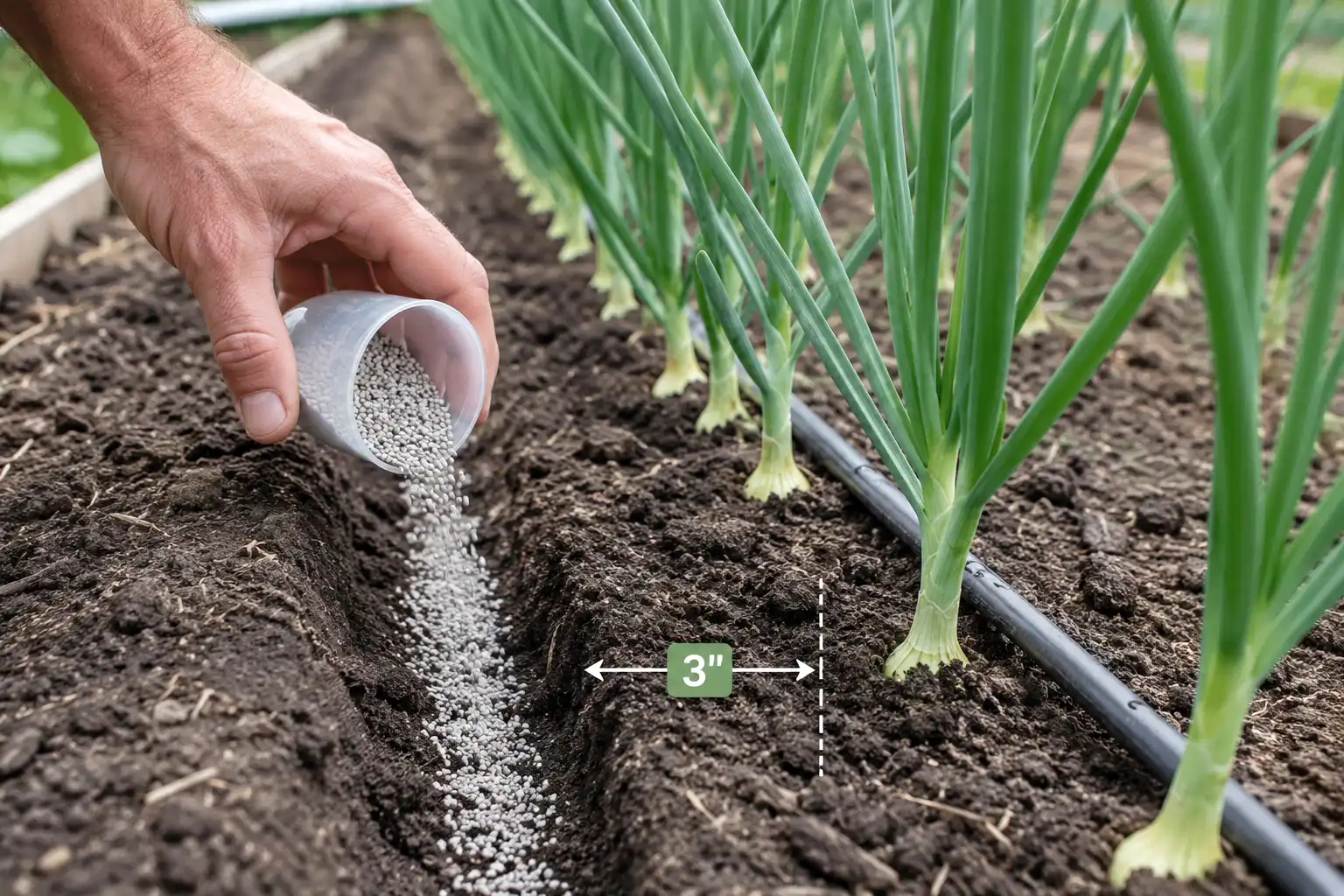
Side-dress 2 to 3 inches off the row, never against the plant. Then water it in. Dry granules sitting on dry soil do nothing, and granules touching the bulb burn it.
Peak uptake runs 1.5 to 3.5 pounds of nitrogen per acre per day during bulb development. That is why splitting matters. A single preplant dump leaches away long before the crop wants it.
When to Stop Nitrogen on Onions
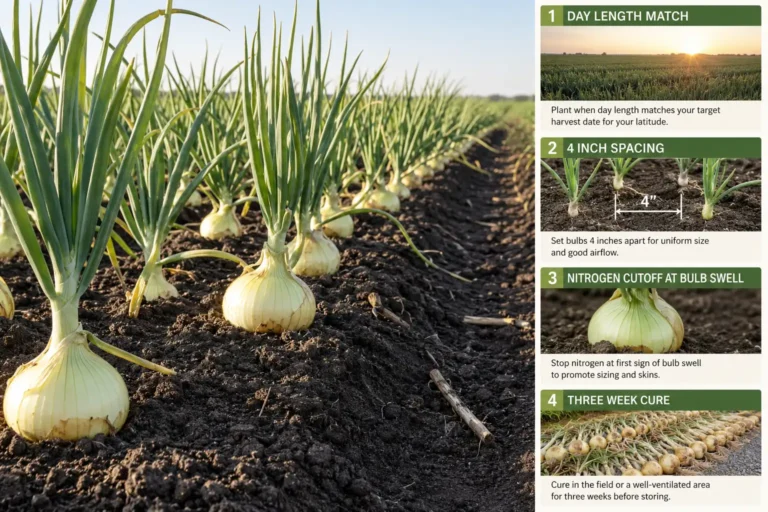
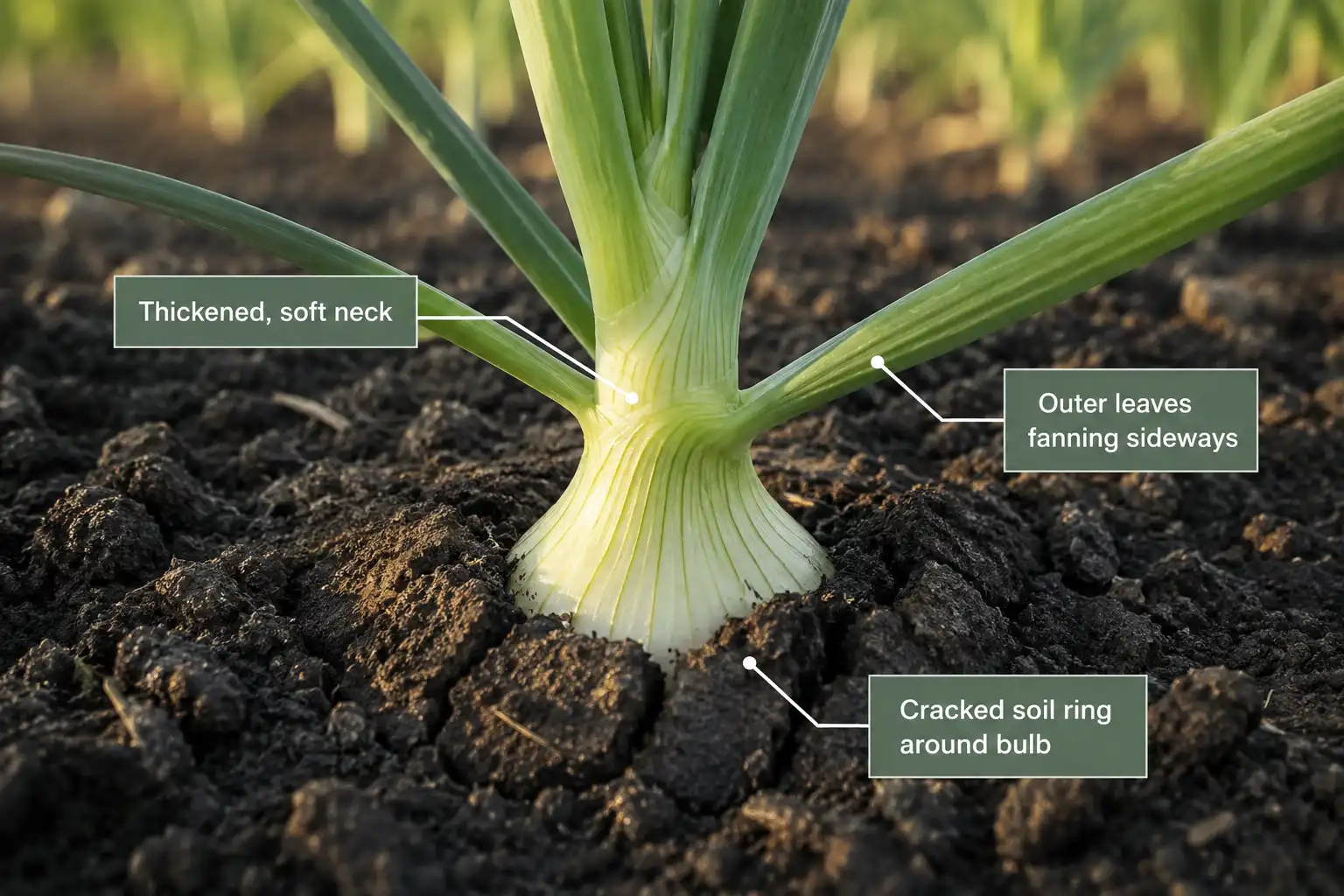
Stop nitrogen at bulb initiation, which arrives well before harvest. Three signs mark it. The neck thickens and softens. The outer leaves fan outward instead of standing up. Soil cracks as the bulb pushes it aside.
Feeding past that point causes real damage:
- Thick necks that refuse to cure
- Delayed maturity and a compressed harvest window
- Soft bulbs with green flesh
- Doubles and splits from basal plate splitting
- Early sprouting in storage
- Bacterial rot during storage
University of Minnesota Extension flags the same list. An overfed onion looks impressive in July and fails in November.
If you miss the exact bulbing date, use the fallback rule: no nitrogen within 3 to 4 weeks of expected harvest. In USDA hardiness zone 6a, spring transplanted onions hit bulb initiation in mid June. So the last nitrogen application goes out around the first week of June.
Fertilizer Rates for Rows, Raised Beds, and Containers
Garden scale rates work out to roughly 3 to 4 pounds of actual nitrogen per 1,000 square feet. Split that into thirds across the season.
Row garden. Apply ammonium sulfate 21-0-0 at about 1/2 cup per 10 feet of row every 3 weeks until bulbing. University of Minnesota Extension gives an alternative with urea 45-0-0. Apply 0.25 to 0.5 pounds per 25 feet of row, once or twice per season.
Raised beds. Work 2 inches of finished compost into the top 6 inches before planting, then side-dress like a row garden. Compost alone will not carry an onion crop. It does improve the moisture holding that shallow roots depend on.
Containers. Nutrients leach out the bottom every time you water, so switch to liquid feeding. Use a balanced soluble fertilizer at half label strength every 10 to 14 days. Stop at bulbing like everywhere else. Anyone growing onions in a 5 gallon bucket should expect to feed more often than in ground rows.
Organic Fertilizers That Work on Onions
Organic sources work on onions as long as you start earlier. They must mineralize before roots can use them, and soil temperature controls that release rate.
| Source | Analysis | Best use |
|---|---|---|
| Blood meal | 12-0-0 | Fast organic nitrogen for side-dressing |
| Feather meal | 12-0-0 | Slow release, apply preplant |
| Fish emulsion | 5-1-1 | Liquid, quick response, containers |
| Alfalfa meal | 3-1-2 | Broad preplant feed |
| Composted manure | Varies | Preplant only, never fresh |
| Bone meal | 3-15-0 | Phosphorus, only if the test is low |
| Langbeinite | 0-0-22 | Potassium plus sulfur and magnesium |
| Gypsum | Calcium sulfate | Sulfur without changing pH |
Never use fresh manure. It carries pathogens, weed seed, and unpredictable nitrogen release. Compost it fully first, or apply it the fall before. The tradeoffs between organic and synthetic fertilizer matter more on onions than on most crops. That mineralization lag runs against a short feeding window.
How to Read Onion Deficiency Symptoms
Diagnose before you feed. Onion symptoms point clearly if you know the pattern.
| What you see | Likely cause | What to do |
|---|---|---|
| Oldest leaves yellow first, plant stunted | Nitrogen shortage | Side-dress nitrogen now if still pre-bulbing |
| Whole plant dull, purple cast on young plants | Phosphorus availability, often cold soil | Band phosphorus next season, wait for warmth |
| Leaf tips die back, older leaves scorch at margins | Potassium shortage | Soil test, correct preplant next year |
| Youngest leaves pale while older stay dark | Sulfur shortage | Ammonium sulfate or gypsum |
| Yellowing between veins on new growth | Iron or manganese lockup from high pH | Lower pH, adding nitrogen will not help |
| Heavy tops, small bulbs | Excess or late nitrogen | Stop nitrogen immediately |
| Thick necks, doubles, poor curing | Nitrogen continued past bulbing | Cut off earlier next season |
Note the top two rows. Yellow lower leaves mean feed, and yellow upper leaves mean sulfur or pH. Feeding nitrogen for a pH problem makes the plant worse.
Fertilizer Mistakes That Cost Bulb Size
These are the errors most often on onion ground.
- Front loading all the nitrogen. It leaches past those shallow roots before bulbing.
- Feeding through bulb initiation. The most common cause of thick necks and storage rot.
- Piling on phosphorus. Onions remove very little, and excess ties up zinc.
- Heavy muriate of potash. Chloride and salt injure onion roots.
- Fertilizing dry soil. Nutrients need moisture to move into the root zone.
- Granules against the plant. Salt burn on the basal plate ends that bulb.
- Skipping sulfur on sand. Cheap to fix, and it shows up in flavor and yield.
Do Green Onions Need the Same Fertilizer?
No, green onions follow a simpler rule: keep feeding nitrogen right up to harvest. You are harvesting leaves, so there is no bulb to protect and no reason to stop.
Feed scallions light nitrogen every 2 weeks through the whole cycle. Skip the bulbing cutoff entirely. Sulfur still matters for flavor, though the pungency concern eases since you harvest young. Anyone raising bunching onions should plan on that continuous feed instead of the bulb onion schedule.
Bottom Line for Your Onion Rows
Feed onions a sulfur bearing nitrogen source and split it into three or four applications. Set phosphorus and potassium by soil test rather than habit. Band the phosphorus, keep pH between 6.2 and 6.8, and place every side-dress a few inches off the row.
Then quit. The hardest part of onion fertility is stopping nitrogen while the plants still look hungry. Bulb size was already decided by leaf count. Everything you add after bulbing goes into neck instead of onion.