Best Hose End Sprayer for Liquid Fertilizer: Top 8 Picks 2026
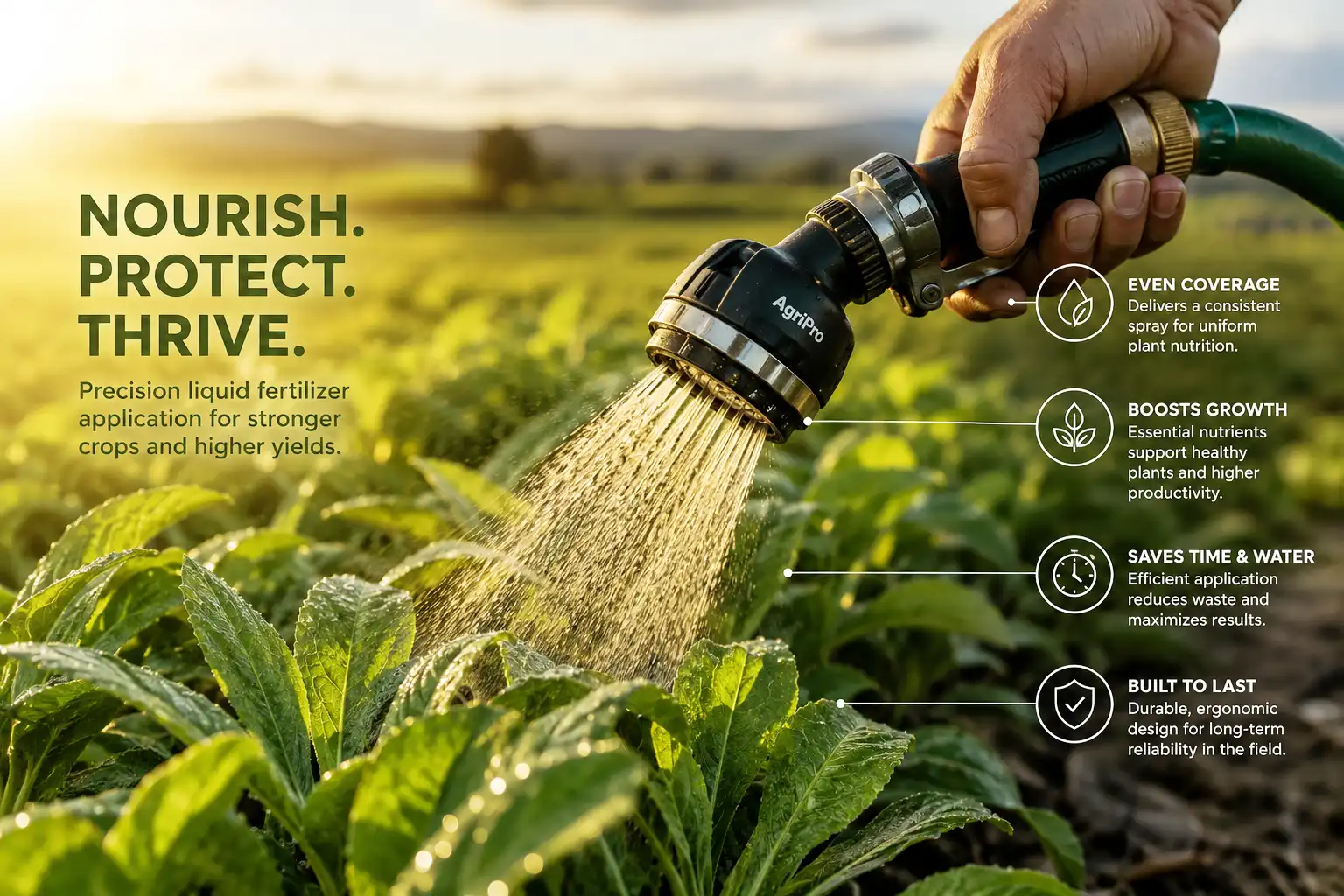
A hose end sprayer for liquid fertilizer mixes the feed with water as you spray, so you skip the hand-mixed watering cans. It feeds a lawn or vegetable garden fast and even. Below covers the top picks and how to dial in the right dose.
For most liquid feeds, the best hose end sprayer for liquid fertilizer is the Ortho Dial N Spray, thanks to 14 dilution settings. For water-soluble powders, pick the Chapin G390 with backflow protection. Calibrate once, then spray evenly.
A Quick Comparison: Top Hose End Sprayers for Liquid Fertilizer
| Sprayer | Best for | Tank | Dilution control | Price |
|---|---|---|---|---|
| Ortho Dial N Spray | Best overall | 32 oz | 14 settings (1 tsp to 8 oz/gal) | $15.97 |
| Chapin G390 | Water-soluble feed | 32 oz | Fixed 1 oz/gal | $9.99 |
| Chapin G364D | Adjustable mixing | 32 oz | 16 ratios | $39.99 |
| VENETIO 8-Dial | Container gardens | 16 oz | 8 settings | $25.87 |
| Miracle-Gro LiquaFeed | Easy liquid feeding | 16 oz | Fixed (FEED or WATER) | $17.87 |
| Miracle-Gro Performance Organics | Organic feeding | 12 oz | 3 settings | $17.48 |
| Miracle-Gro Garden Feeder | Budget buy | 16 oz | Fixed, auto-mix | $12.98 |
| RL Flo-Master Chameleon | Light use only | 32 oz | Dial (1 tsp to 8 oz/gal) | $24.98 |
How a Hose End Sprayer Works With Liquid Fertilizer
A hose end sprayer works by using the venturi effect to pull concentrate into the water flow. Water rushing through the head creates suction. That suction draws liquid fertilizer up a siphon tube from the jar, then mixes it at a set dilution ratio as the spray leaves the spray nozzle. Some folks call this style a venturi sprayer.
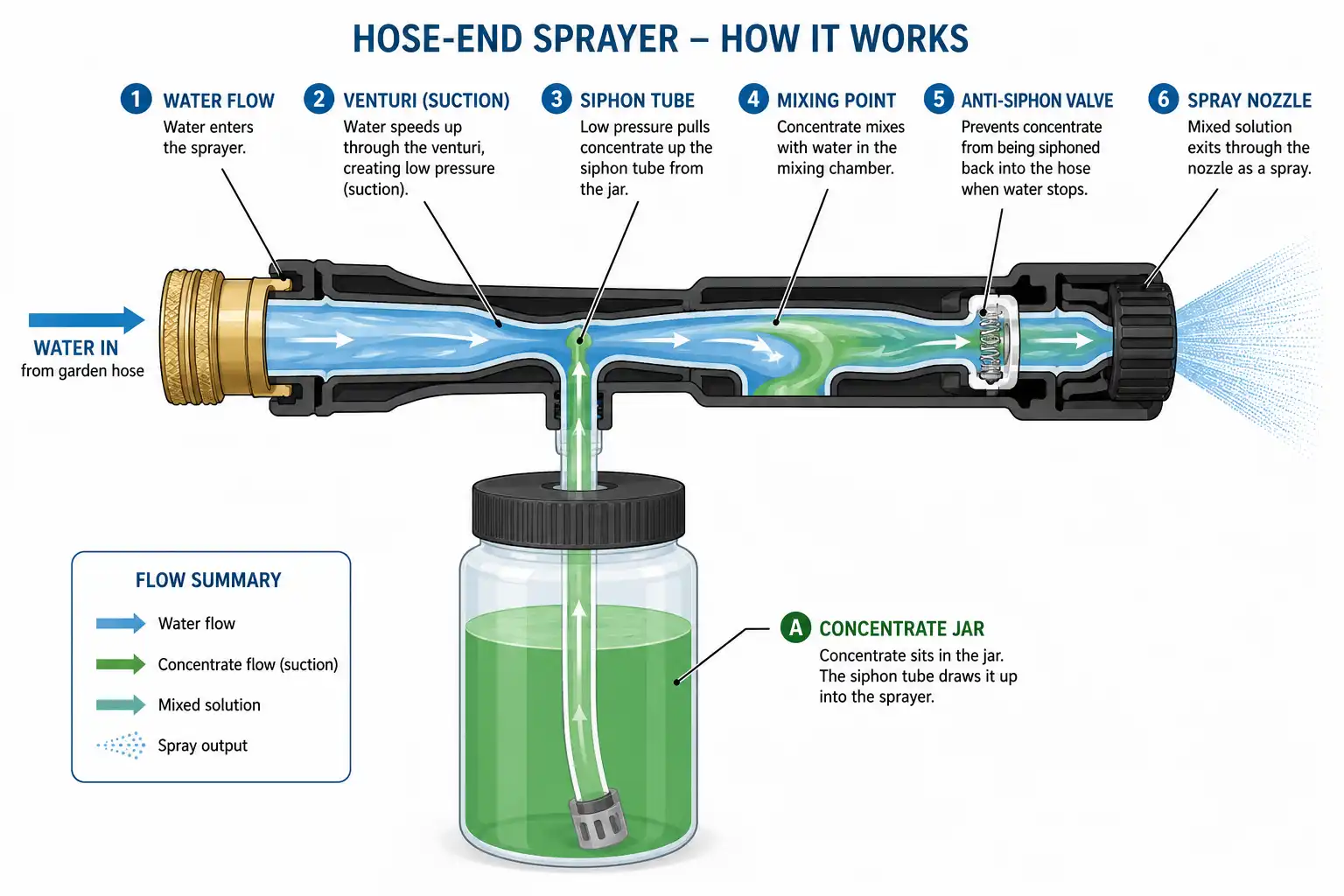
Two families do this job. An adjustable dial sprayer lets you set the dose in ounces per gallon, so you match the label exactly. Fixed-ratio feeders pull concentrated fertilizer at one preset rate, like 16 to 1, which trades control for simplicity.
Either way, your water pressure and flow rate drive the system. Faster flow means stronger suction and more concentrate per gallon.
One part matters most for safety. The anti-siphon valve gives you backflow prevention, so fertilizer never gets pulled back into your household water line when pressure drops.
The 8 Best Hose End Sprayers for Liquid Fertilizer: Reviews
Here are eight worth knowing, from the one to reach for first to the one only trusted for a light job.
1. Ortho Dial N Spray Hose End Sprayer for Liquid Fertilizer
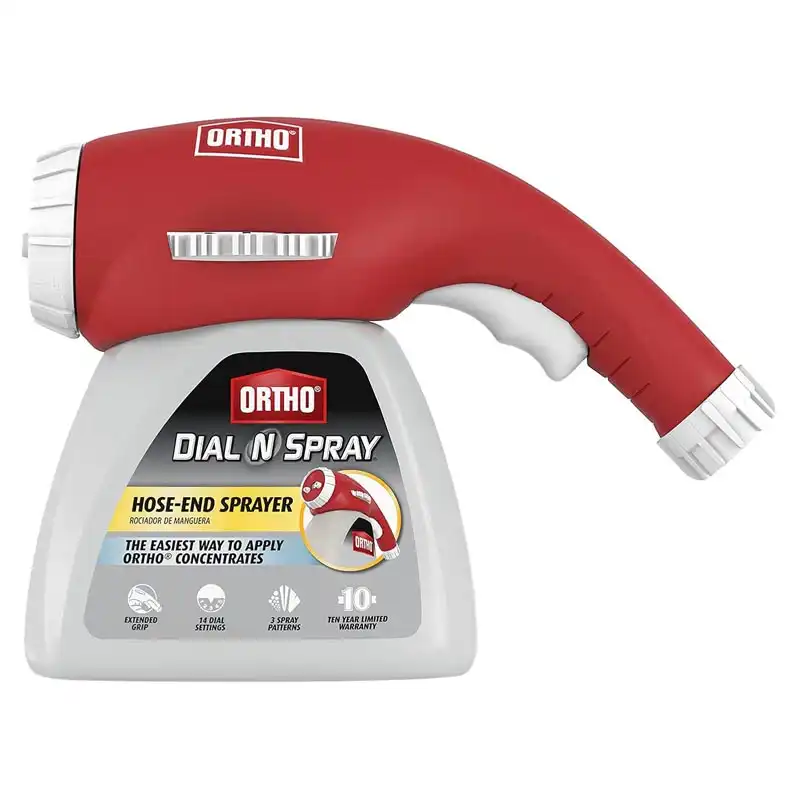
Ortho is a household name in lawn and garden care, and the Ortho Dial N Spray is the most well-rounded hose end sprayer here. You pour in concentrate, set the dial, and spray. It handles liquid fertilizer, weed killers, and fungicides. With 14 dilution settings and three spray patterns, it fits almost any job. Reviewers rate its mixing and even coverage very highly. Best for homeowners who want one reliable tool for the whole yard.
PROS
- 14 precise dilution settings
- Three useful spray patterns
- Even, consistent coverage
- Built-in anti-backflow device
CONS
- Suction tube kinks easily
Specifications:
- Tank: 32 oz
- Flow rate: 2 gal per minute
- Pressure: 40 to 80 PSI
- Warranty: 1 year
2. Chapin G390 Hose End Sprayer for Water-Soluble Fertilizer
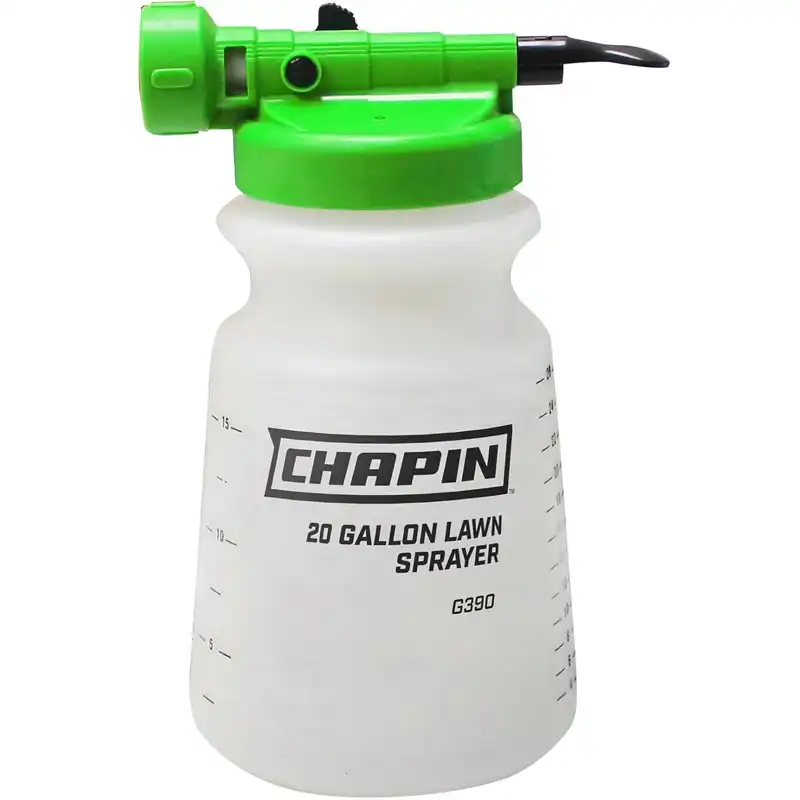
Chapin has built sprayers in the USA for over a century, and the Chapin G390 is the simple, budget pick. It uses a fixed 1 oz per gallon ratio, so there is no dial to fuss with. Fill the 32 oz poly tank, attach to the garden hose, and the fingertip control starts the spray. It works best with water-soluble fertilizer and liquid weed killers. A built-in anti-siphon valve guards your water line. Best for small lawns and basic feeding without dilution math.
PROS
- Very affordable price
- Fixed ratio, foolproof
- Anti-siphon backflow protection
- Made in the USA
CONS
- Threads strip if overtightened
Specifications:
- Tank: 32 oz poly
- Output: up to 20 gallons
- Warranty: lifetime limited
- Material: chemical-resistant plastic
3. Chapin G364D Professional Hose End Sprayer
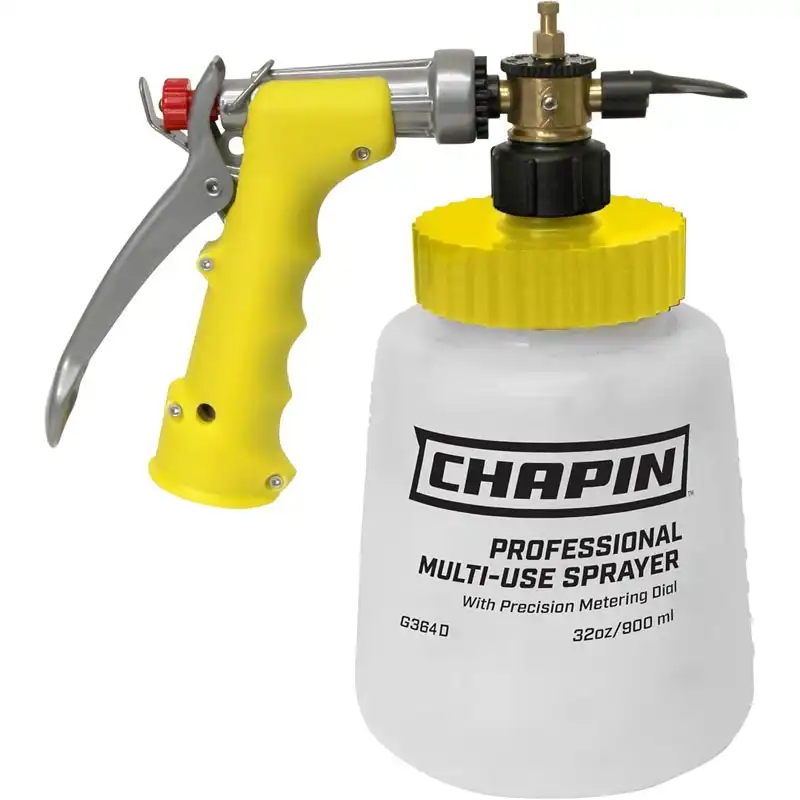
The Chapin G364D is the pro-grade big brother to the G390, also made in the USA. Its metering dial offers 16 mixing ratios, so you fine-tune the dose from light to heavy. One fill of the 32 oz chemical-resistant tank mixes up to 320 gallons of finished spray, far more than most rivals. A removable fan nozzle and comfort-grip handle round it out. The anti-siphon valve prevents backflow. Best for users who switch between fertilizer, herbicide, and pest control on the same lawn.
PROS
- 16 adjustable mixing ratios
- Huge 320-gallon capacity
- Comfort-grip reduces fatigue
- Lifetime limited warranty
CONS
- High price tag
Specifications:
- Tank: 32 oz poly
- Hose: 12.5 ft included
- Weight: 1.2 lbs
- Pressure: 40 to 80 PSI
4. VENETIO 8-Dial Hose Attachment Spray Gun
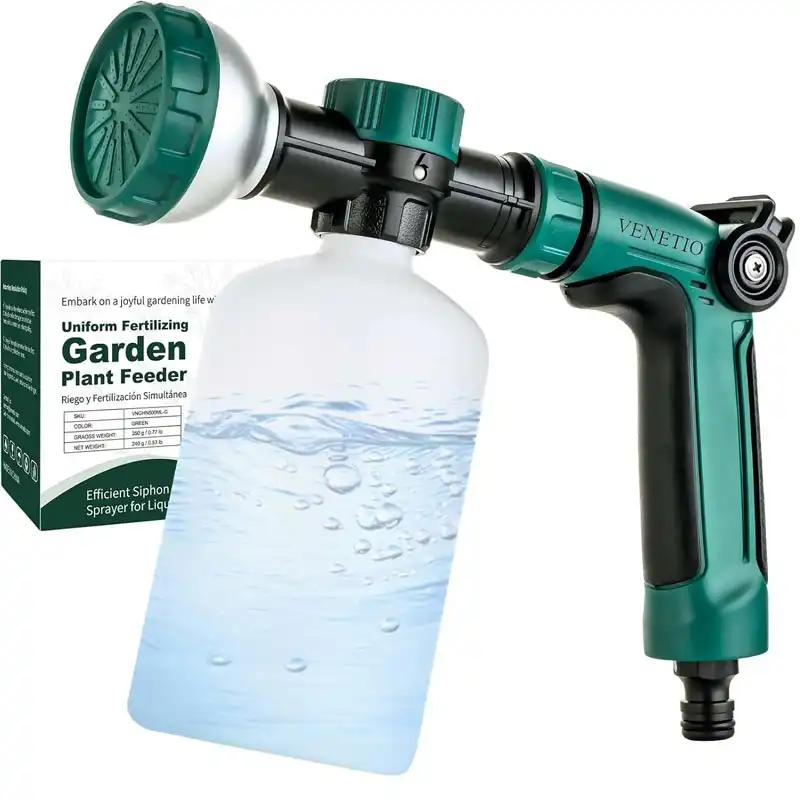
The VENETIO 8-Dial is a newer hose end sprayer built around precision and a leak-proof design. Its 8 dilution settings let you dial feeding intensity for delicate flowers up to shrubs. The 16 oz bottle has measurement markings and covers about 540 sq ft per fill. Owners praise its tight seals and clog-resistant pore filter. Tough ABS plastic holds up to daily use. An anti-backflow device keeps your water clean. Best for container gardens and feeding many pots with accurate, even nutrient delivery.
PROS
- 8 precise dilution settings
- Genuinely leak-proof seals
- Clog-resistant pore filter
- Comfortable thumb-trigger control
CONS
- Settings take some practice
- 16 oz needs refilling
Specifications:
- Tank: 16 oz
- Material: impact-resistant ABS
- Filter: replaceable pore screen
- Warranty: 1 year (with registration)
5. Miracle-Gro LiquaFeed Advance Starter Kit
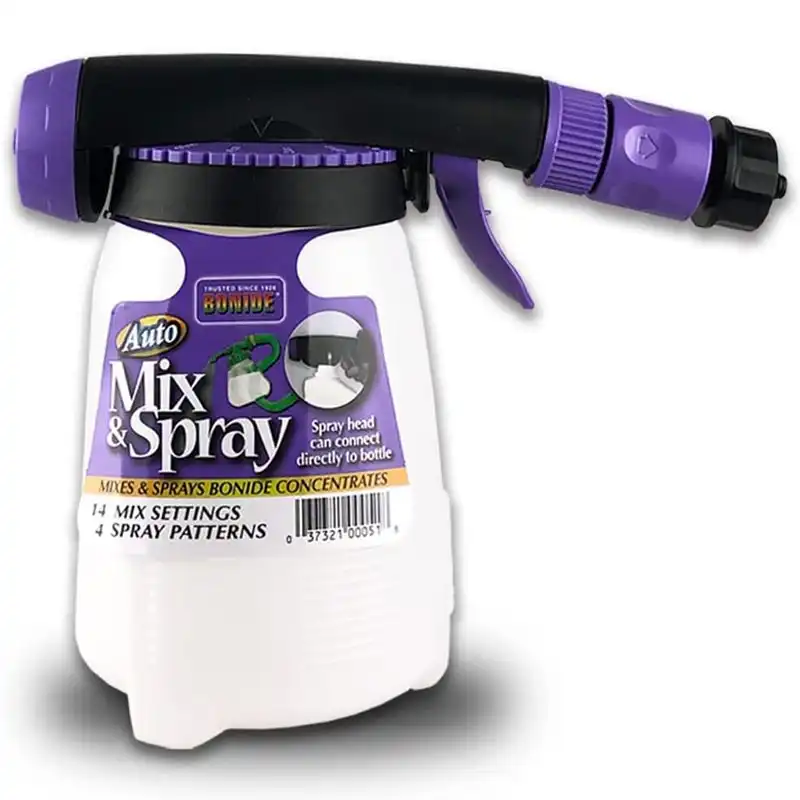
Miracle-Gro LiquaFeed swaps the powder jar for a snap-in liquid bottle, made by the Scotts Company. A dial flips between FEED and WATER, so you feed and rinse without unhooking. The 12-4-8 all-purpose formula covers 400 sq ft per bottle. Four spray patterns reach from delicate plants out to 18 feet. The locking trigger eases hand strain, which folks with arthritis appreciate. Refill bottles include tomato and bloom formulas. Best for gardeners who want truly hands-off liquid fertilizer feeding.
PROS
- Snap-in liquid bottles
- FEED and WATER dial
- Locking trigger eases strain
- Multiple refill formulas
CONS
- Thin plastic feels brittle
Specifications:
- Bottle: 16 oz
- NPK: 12-4-8 all-purpose
- Coverage: 400 sq ft
- Pressure: 40 to 80 PSI
6. Miracle-Gro Performance Organics Garden Feeder
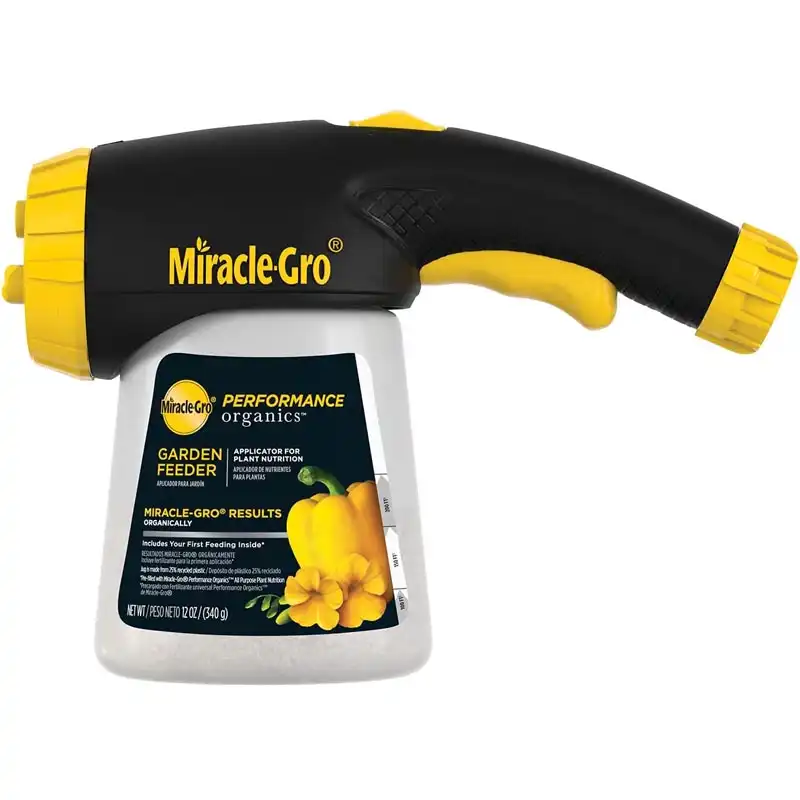
This is the organic liquid fertilizer option from Miracle-Gro, carrying an 11-3-8 NPK ratio plus calcium, iron, zinc, and other micronutrients. The 12 oz water-soluble formula makes about 20 gallons and covers 200 sq ft. Three dial settings adjust the spray. You feed every 7 to 14 days while you water. The jug uses 25% recycled plastic. Plant-health results draw strong praise. Best for gardeners who want an organic feed for vegetables, herbs, and flowers without hand-mixing.
PROS
- Organic 11-3-8 formula
- Added micronutrients included
- No pre-mixing needed
- Strong plant-health results
CONS
- Powder clumps in humidity
Specifications:
- Container: 12 oz
- Form: water-soluble powder
- Coverage: 200 sq ft
- Pressure: 40 to 82 PSI
7. Miracle-Gro Garden Feeder
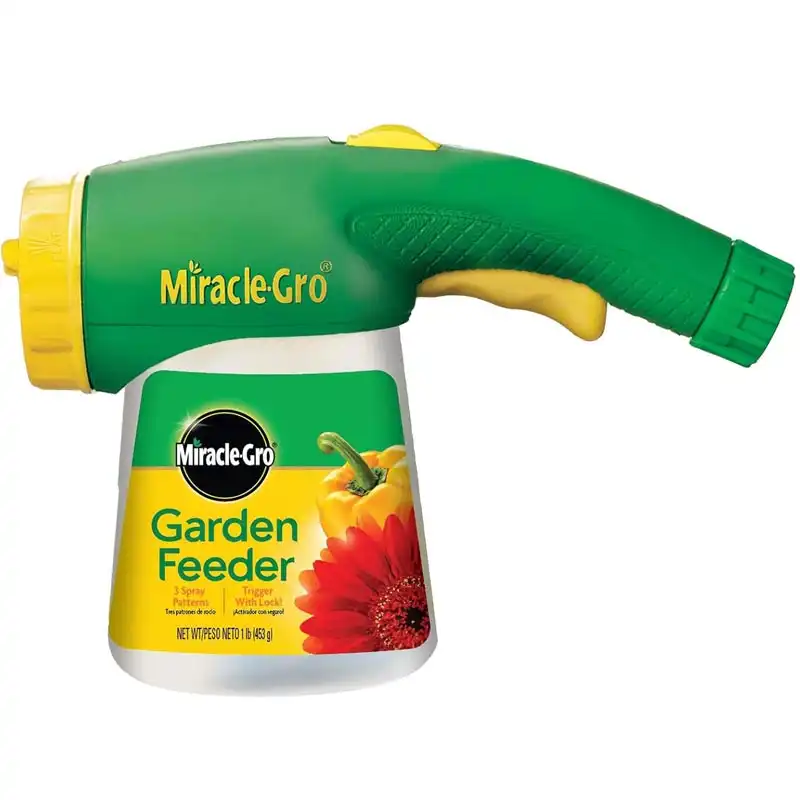
The Miracle-Gro Garden Feeder is the cheapest way onto this list, and it arrives pre-filled with 1 lb of 24-8-16 plant food. Fill the jar, attach to the hose, turn on the water, and squeeze. It covers up to 500 sq ft in about 12 minutes. Three spray patterns suit different plants. It tolerates a wide 30 to 80 PSI range. Best for budget gardeners who feed with water-soluble fertilizer on small to medium plots.
PROS
- Lowest price here
- Comes pre-filled, ready
- Wide pressure tolerance
- Covers 500 sq ft
CONS
- Cheap, short-lived plastic
Specifications:
- Jar: 16 oz
- NPK: 24-8-16 included
- Coverage: 500 sq ft
- Pressure: 30 to 80 PSI
8. RL Flo-Master Chameleon Hose End Sprayer
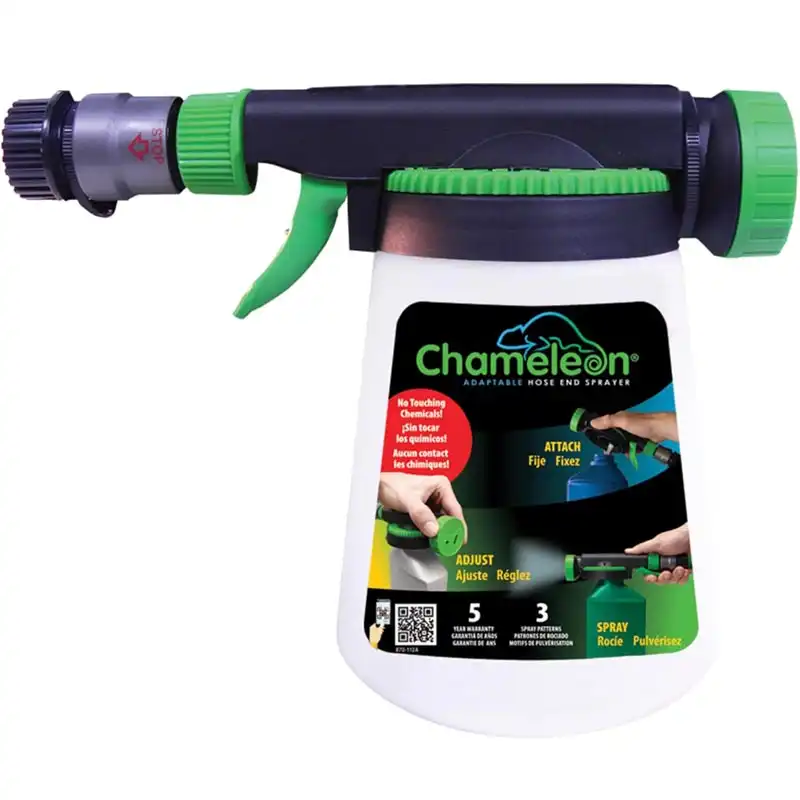
The RL Flo-Master Chameleon, from Root Lowell Manufacturing, attaches by quick-connect and clips onto most concentrate bottles directly. It offers three spray patterns and a dial from 1 tsp to 8 oz per gallon. On paper it is flexible and fast. In practice, owner reviews are rough. Leaks at the connection and broken plastic fittings are common, often within the first few uses. Spray reach is also weak. Best only for very light, occasional use, so keep expectations modest.
PROS
- Quick-connect hose fitting
- Clips onto concentrate bottles
- Three switchable spray patterns
- Adjustable dilution dial
CONS
- High price
Specifications:
- Tank: 32 oz
- Material: resin plastic
- Connection: quick-connect, barb
- Patterns: fan, shower, stream
How to Choose a Hose End Sprayer for Liquid Fertilizer
Match your dilution control and tank size to the job. A big lawn wants broadcast coverage and a larger jar. A vegetable bed wants gentle, accurate feeding. Here are the factors worth weighing before buying.
Fixed-Ratio vs Adjustable-Dial Dilution
An adjustable dial wins for flexibility; a fixed ratio wins for simplicity. A dial sprayer lets you set the exact ounces per gallon the label calls for, so one tool covers fertilizer, weed control, and foliar feeds at different rates. A fixed-ratio siphon sprayer or feeder pulls one preset blend, which is foolproof but locks you into a single rate. For mixed jobs around a farm yard, keep an adjustable dial on hand.
Tank Capacity and Coverage
Pick capacity by how much finished spray you need in one pass. Most jars hold 16 to 32 oz of concentrate. A 32 oz jar can mix into roughly 20 gallons of finished spray at a typical lawn rate, enough to feed a few thousand square feet before you refill. Smaller 16 oz jars suit raised beds and container plants. Match the jar to your acreage, so you are not stopping to refill every few minutes.
Anti-Siphon and Backflow Protection
Always choose a sprayer with built-in backflow prevention. This is the single most important safety feature. An anti-siphon valve, also called a vacuum breaker, stops fertilizer from siphoning back into your drinking water if house pressure drops. Many codes require it on any hose bib used for fertigation, the same rule that applies to a timed drip irrigation kit. The Chapin G390 builds this in. If a cheap sprayer skips it, add a separate vacuum breaker at the spigot.
Spray Pattern
Choose the pattern that fits the plant. A fan or broadcast pattern covers turf and large beds fast. A shower or rose pattern lays down a soft flow that will not flatten transplants or seedlings. A jet stream reaches tall vines and shrub tops. The best spray nozzle designs let you switch patterns on the fly, so you can feed a lawn and then ease off for tender starts.
Build Quality and Hose Fitting
Look for chemical-resistant HDPE poly and a fitting that matches your garden hose. Thick poly jars resist cracking and shrug off organic liquid fertilizer, fish products, and salts. Whether you lean toward organic or synthetic feeds, chemical resistance keeps the jar from degrading. A universal or quick-connect thread saves you swapping adapters. A clear jar also helps, making it easy to watch the concentrate level mid-pass.
How to Apply Liquid Fertilizer With a Hose End Sprayer
Read the label rate first, set the dial, then walk a steady, overlapping pattern. Pick a feed whose NPK numbers match the crop, then follow the routine on the fields.
- Read the label. Note the application rate, usually in ounces per 1,000 square feet or ounces per gallon.
- Fill the jar. Pour in undiluted liquid concentrate, or dissolve water-soluble fertilizer powder fully so it will not clog the siphon tube.
- Set the dial. Turn it to the label’s ounces per gallon. Skip this step on a fixed-ratio feeder.
- Connect with the sprayer off. Thread it onto the garden hose, then open the spigot.
- Spray edge to center. Walk at a steady pace and overlap each pass by about a third for even coverage.
- Rinse. Run clean water through the head for 30 seconds to clear residue.
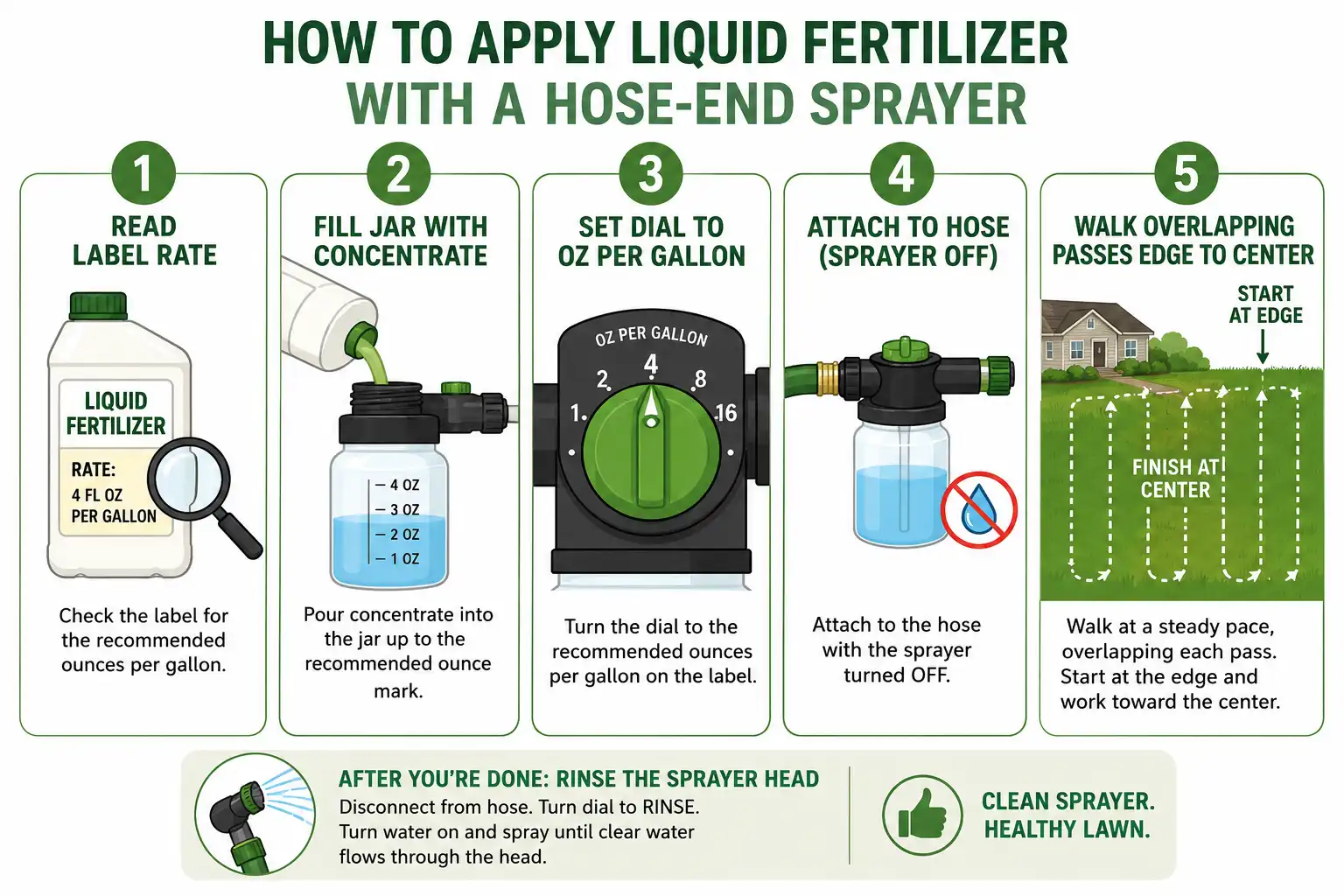
Walking speed sets your rate. Move too slow and you over-apply. Move too fast and you starve the crop. Keep the same pace you used to calibrate.
How to Calculate Dilution and Calibrate Your Sprayer
Set the dial to your label rate divided by the gallons of spray you put down per 1,000 square feet. That single number, in ounces per gallon, is your calibration.
Here is the formula:
Dial setting (oz per gallon) = label rate (oz per 1,000 sq ft) ÷ your water use (gallons per 1,000 sq ft)
Run the 30-second bucket test to find your water use:
- With plain water in the jar, spray into a bucket for 30 seconds. Double what you collect to get gallons per minute (GPM).
- Spray your lawn at your normal pace for one minute, then measure the square feet you covered.
- Divide to get gallons per 1,000 sq ft.
A worked example: the label says 6 oz per 1,000 sq ft. A bucket test showing 4 gallons per 1,000 sq ft laid down is the target. So 6 ÷ 4 = 1.5. Set the dial to 1.5 oz per gallon. If spray is left over, the pace was too fast. If it runs out early, the pace was too slow.
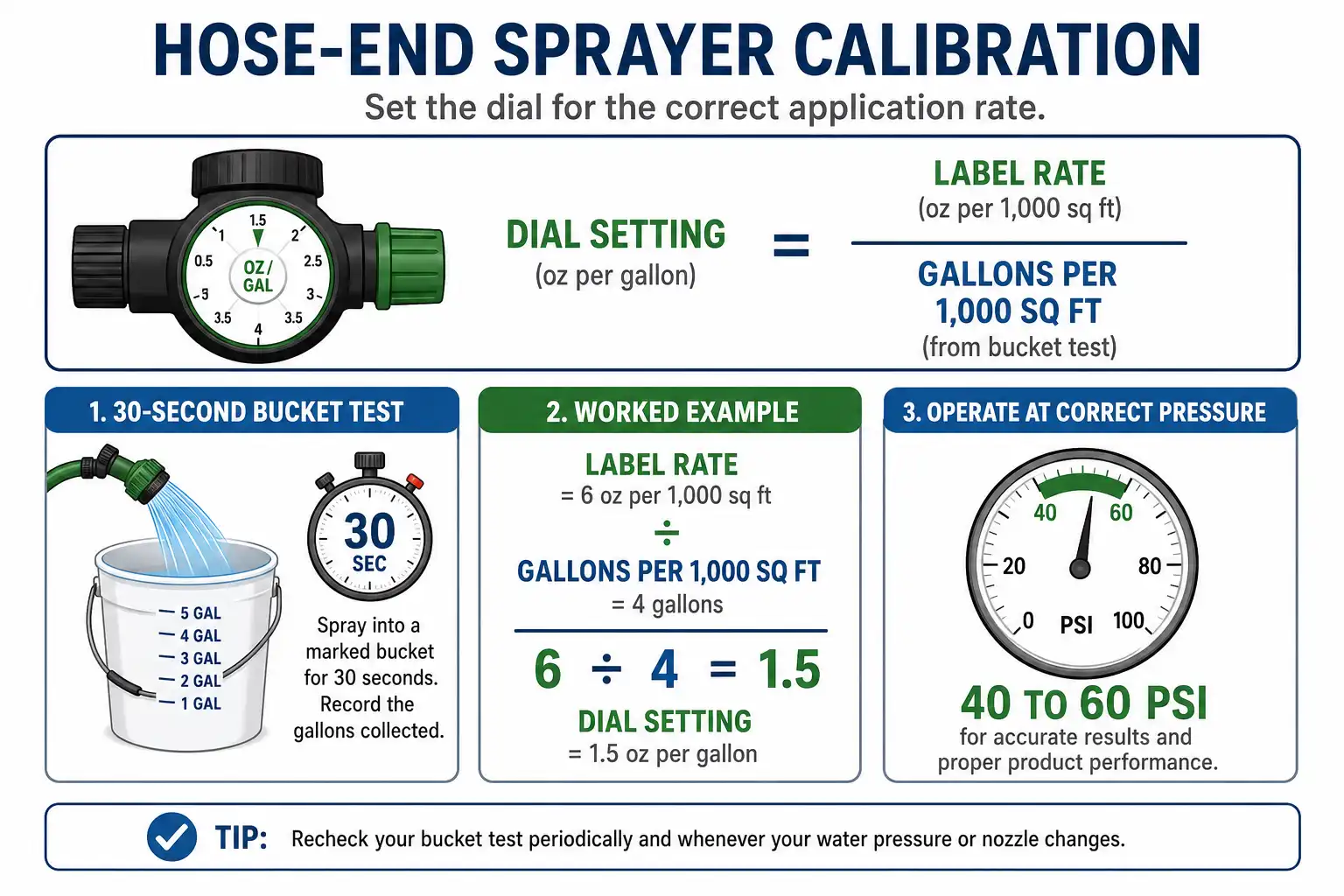
One more thing about water pressure. Hold steady at 40 to 60 PSI and your dose stays accurate within about 10 to 15 percent. Big pressure swings change the siphon rate, so always calibrate at the pressure you actually spray with.
Mistakes That Waste Fertilizer or Burn Plants
Most waste and foliar burn come from going too slow or running thick product through the siphon. Fix these and your feed lands clean.
Walking too slow burns turf. You dump too much concentrate on one strip, so keep your calibrated pace.
Thick organics clog the siphon tube. Fish emulsion, liquid seaweed, and molasses are too heavy for the screen. Cut them with equal parts water first, then recalculate your rate.
Skipping the rinse ruins the next job. Never reuse a sprayer that held herbicide until you flush it clear. Trace weed killer will damage whatever you feed next.
Spraying in wind causes drift. Feed in calm, early-morning conditions, so the spray hits the target and not the neighbor’s beds.
Blasting seedlings flattens them. Switch to the shower pattern on tender starts, so the jet does not knock them over. Check the filter screen often too, since a clogged screen throws off your dose.
Hose End Sprayer vs Backpack Sprayer for Fertilizer
A hose-end sprayer wins for fast, broad feeding across a lawn or garden. A backpack sprayer wins for precise, repeatable inputs where hose reach is a hassle. That is the whole trade-off.
Reach for the hose-end when you want speed and dead-on precision is not critical, like a general NPK feed or a foliar feeding pass over beds. The water does the mixing, so you cover ground fast.
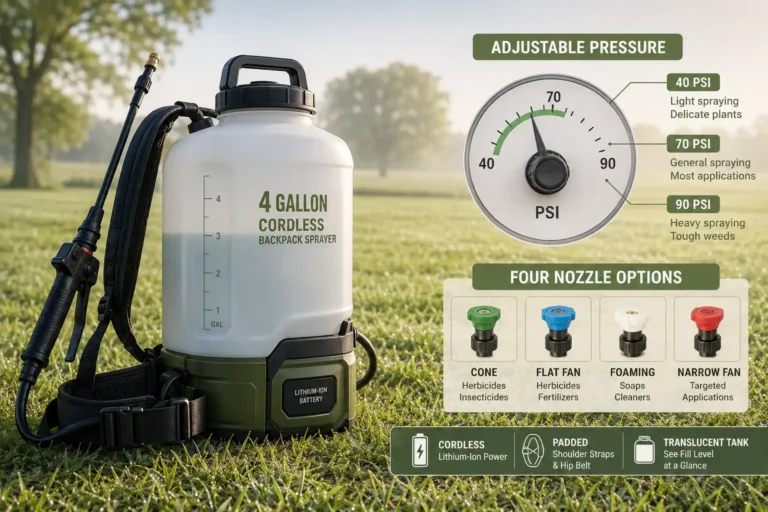
Reach for a battery backpack when the job demands tight calibration and precision, like plant growth regulators, iron on turf, or spot work far from a spigot. You carry the tank, set a constant pressure, and hit exact rates.
Keep both on the farm. For the full rundown on powered units, see our guide to picking a battery-powered backpack sprayer for bigger acreage.
FAQs about Hose End Sprayer for Liquid Fertilizer
How to use hose end sprayer for fertilizer?
How to mix liquid fertilizer in hose end sprayer?
Does hose end sprayer dilute fertilizer?
What dilution ratio should I use for liquid fertilizer?
Can you put granular fertilizer in a hose-end sprayer?
How do you clean a hose-end sprayer?
How accurate are hose-end sprayers?
How much fertilizer to put in hose end sprayer?
How to calibrate hose end sprayer?
Final Thoughts
For all-around feeding, the Ortho Dial N Spray is the pick, since its dial matches almost any label rate. For water-soluble powders, the Chapin G390 is a solid pick for its backflow protection. Whatever you choose, build two habits. Calibrate the sprayer once with the bucket test. Then rinse it clean after every job. Do that, and your liquid fertilizer lands even, every single pass.