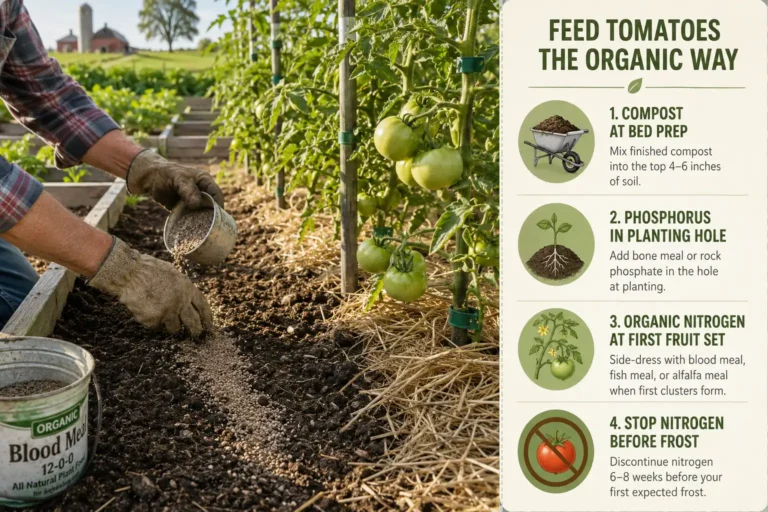
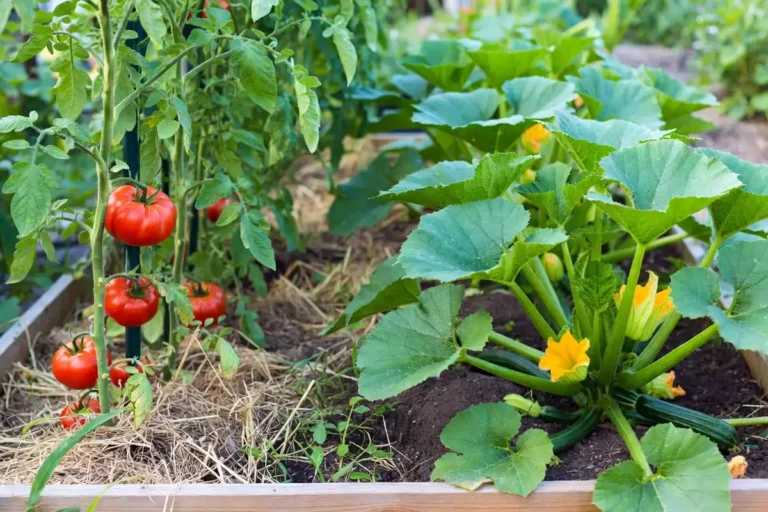
How Often to Fertilize Tomatoes: A Full Season Feeding Schedule
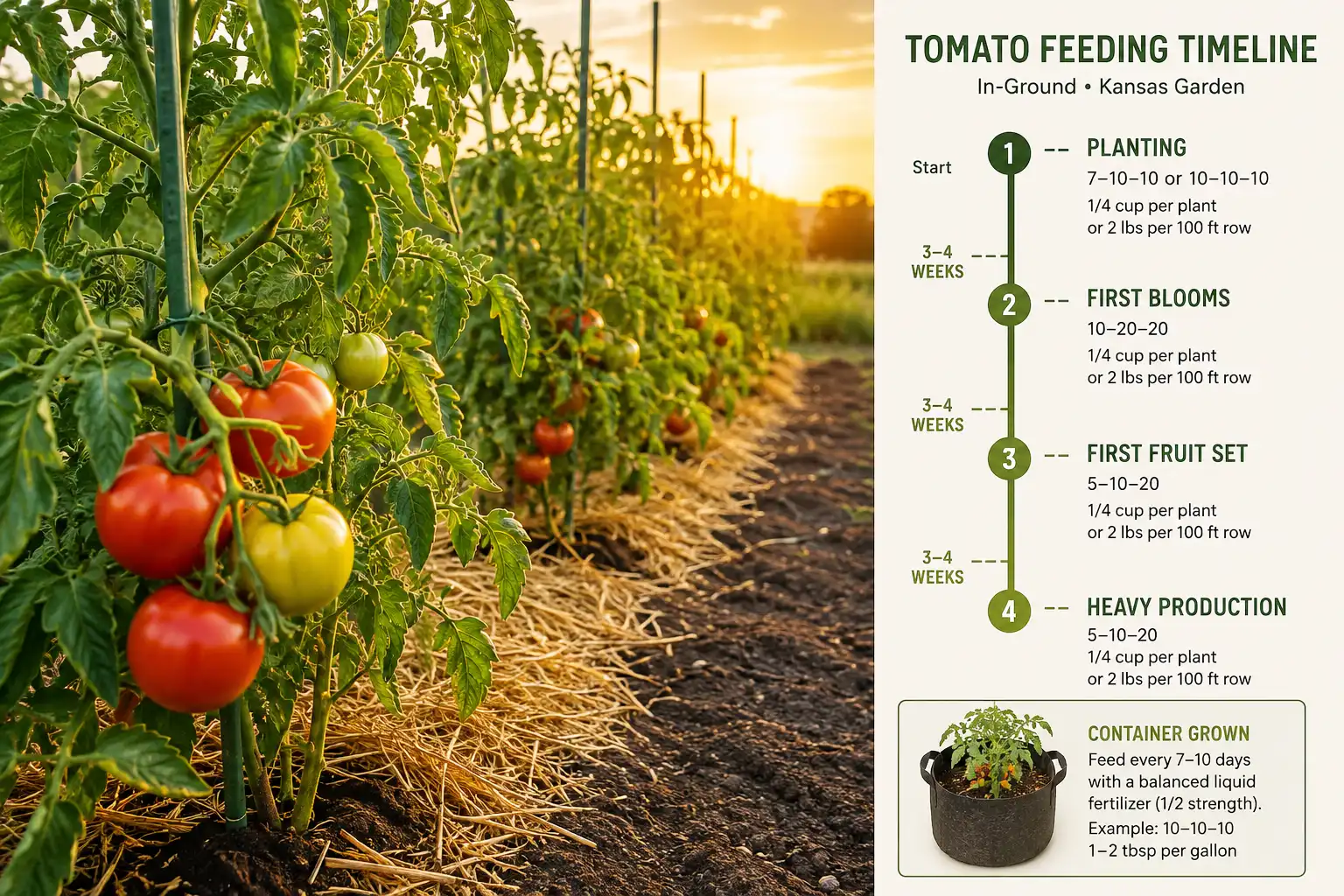
Tomato plants pull nutrients hard from first bloom through the last picking, so one feeding at planting will not carry them. Knowing how often to fertilize tomatoes keeps vines productive instead of leafy. Timing matters more than which bag you buy.
Fertilize tomatoes every three to four weeks in the ground, starting when the first fruits reach quarter size. Containers need feeding every one to two weeks. How often to fertilize tomatoes also shifts with soil type and rainfall.
Also know: Guide to Fertilize Tomatoes
How Often Do Tomatoes Need to Be Fertilized?
Tomatoes need three to four feedings per season in garden soil, spaced three to four weeks apart. Hold the first one until the earliest fruits reach about the size of a quarter. Before fruit set, nitrogen demand stays modest.
K-State Research and Extension times the first sidedress one to two weeks before the first tomato ripens. The second comes about two weeks after you pick that first ripe fruit. A third follows roughly a month later. That spacing feeds the vine through fruit fill without building a wall of foliage.
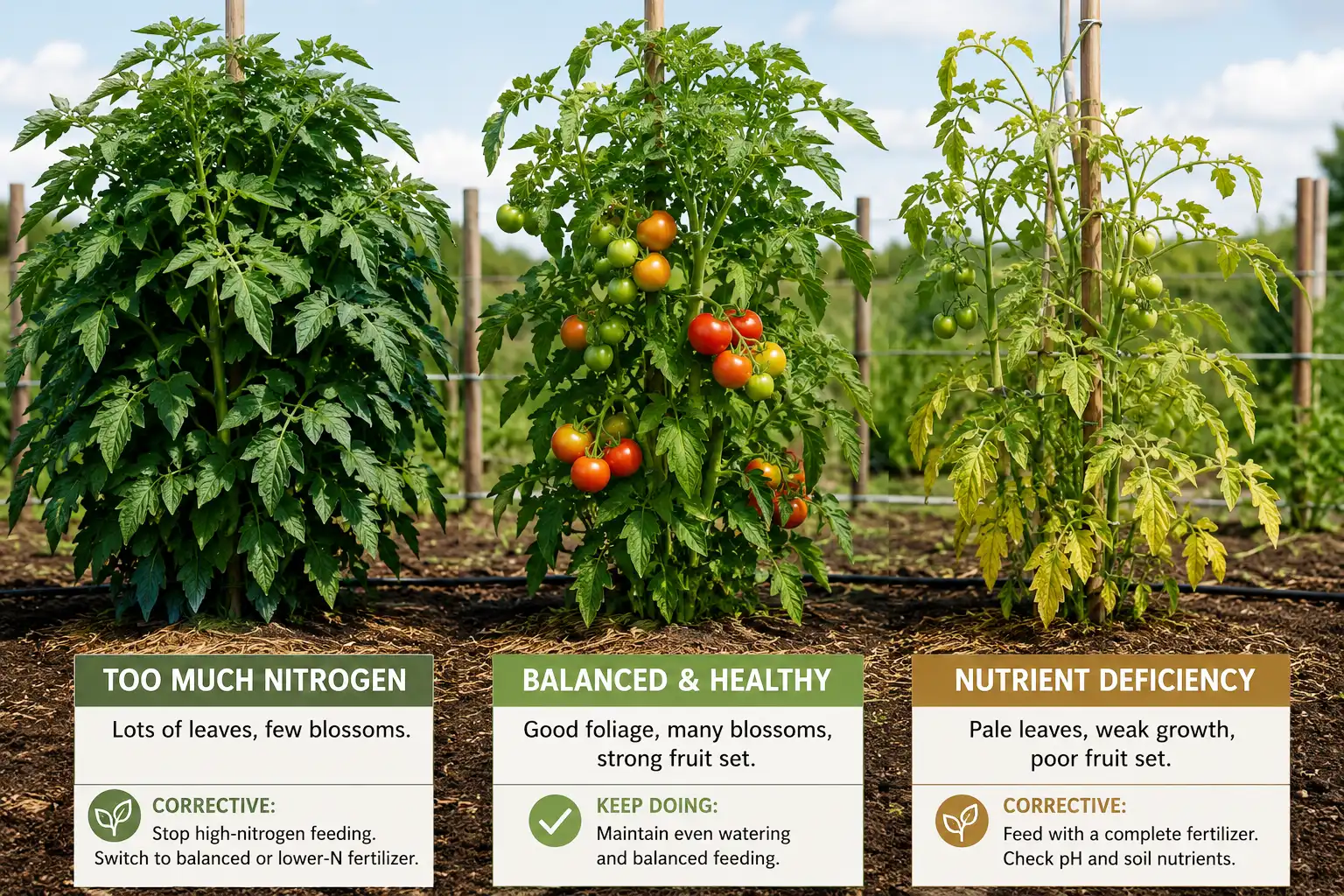
Early nitrogen causes the most trouble on the rows. Feed heavily at transplant and you get thick stems, dark leaves, and blossoms that drop off. So wait until fruit is sizing, then hold a steady interval.
How Often to Fertilize Tomatoes Through Each Growth Stage
| Stage | When it happens | What to apply | Rate |
|---|---|---|---|
| Bed prep | 1 to 2 weeks before planting | Balanced dry fertilizer worked into the top 6 inches | 1.5 lb of 10-10-10 per 100 sq ft |
| Transplant | Planting day | Diluted starter solution, higher middle number | About 1 cup of solution per plant |
| First sidedress | First fruits at quarter size, roughly 4 to 6 weeks after transplant | Nitrogen source | 1 tbsp of 21-0-0 per plant, or 1 lb of 10-10-10 per 100 sq ft |
| Second sidedress | 2 weeks after the first ripe tomato | Same source | 1 tbsp per plant |
| Third sidedress | 4 weeks after the second | Same source, mainly for long season vines | 1 tbsp per plant |
Those figures follow University of Georgia Extension and K-State sidedress guides. A 10-10-10 blend suits a bed that tested low across the board. Once phosphorus and potassium already sit at adequate levels, ammonium sulfate at 21-0-0 supplies nitrogen alone and skips the excess.
Oklahoma State University Extension uses a slightly different cue for the first pass: fruit that is roughly one third grown. Either signal lands in the same window. Missouri Extension waits for first fruits near 2 inches across. After that, repeat every three to four weeks while vines stay healthy.
How Many Times to Fertilize Tomatoes in One Season?
Plan on three or four applications for determinate varieties and four to six for long season vines. Determinate plants set one concentrated crop, so feeding past that flush wastes fertilizer. Celebrity and Roma types fall in this group.
Indeterminate tomato types keep flowering until frost, so they earn every extra round. On rows, a Big Beefsteak vine set out in mid May takes five feedings. Feeding stops in late September. A determinate paste tomato in the same bed takes three.
Also count what the soil already holds. If you turned in finished compost or aged manure last fall, drop one application from the plan. Rich beds carry the crop further on their own.
How Often to Fertilize Tomato Plants in the Ground
Feed in-ground tomatoes every three to four weeks once fruit sets, and place the fertilizer where roots can reach it. Most tomato roots sit in a band 24 to 30 inches wide along the row.
Here is the method:
- Scratch a shallow furrow 6 to 10 inches out from the stem, about 2 inches deep.
- Spread the measured fertilizer along that furrow in a narrow band.
- Cover the band with soil and pull mulch back over it.
- Water deeply right after, at least half an inch, so the nutrients move into the root zone.
- Keep dry granules off leaves and stems, since salt burn shows up fast in July heat.
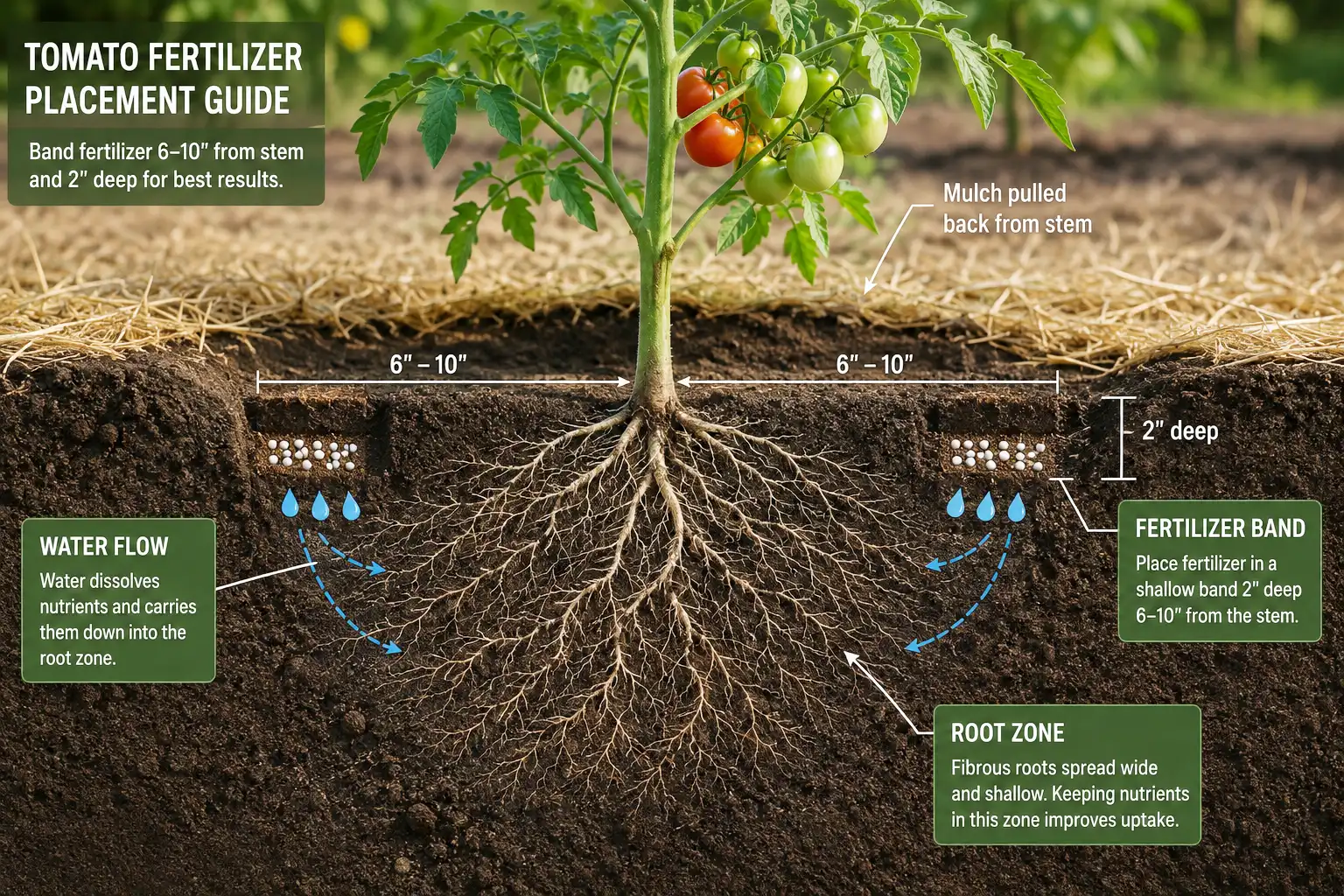
Never dump fertilizer against the stem. That concentration burns feeder roots and stalls the plant for a week or more.
How Often to Fertilize Tomato Plants in Containers and Grow Bags
Feed container tomatoes every one to two weeks with a soluble fertilizer. Every watering flushes nutrients out the drain holes. Iowa State University Extension recommends a soluble 20-20-20 or 15-30-15 on that interval, mixed into the water you already apply.
Most potting mixes carry a starter charge that lasts about two weeks, or two to three good waterings. University of Minnesota Extension suggests beginning regular feedings two to six weeks after planting, depending on mix and growth rate. If the bag lists a coated slow release fertilizer, wait until midsummer before adding liquid.
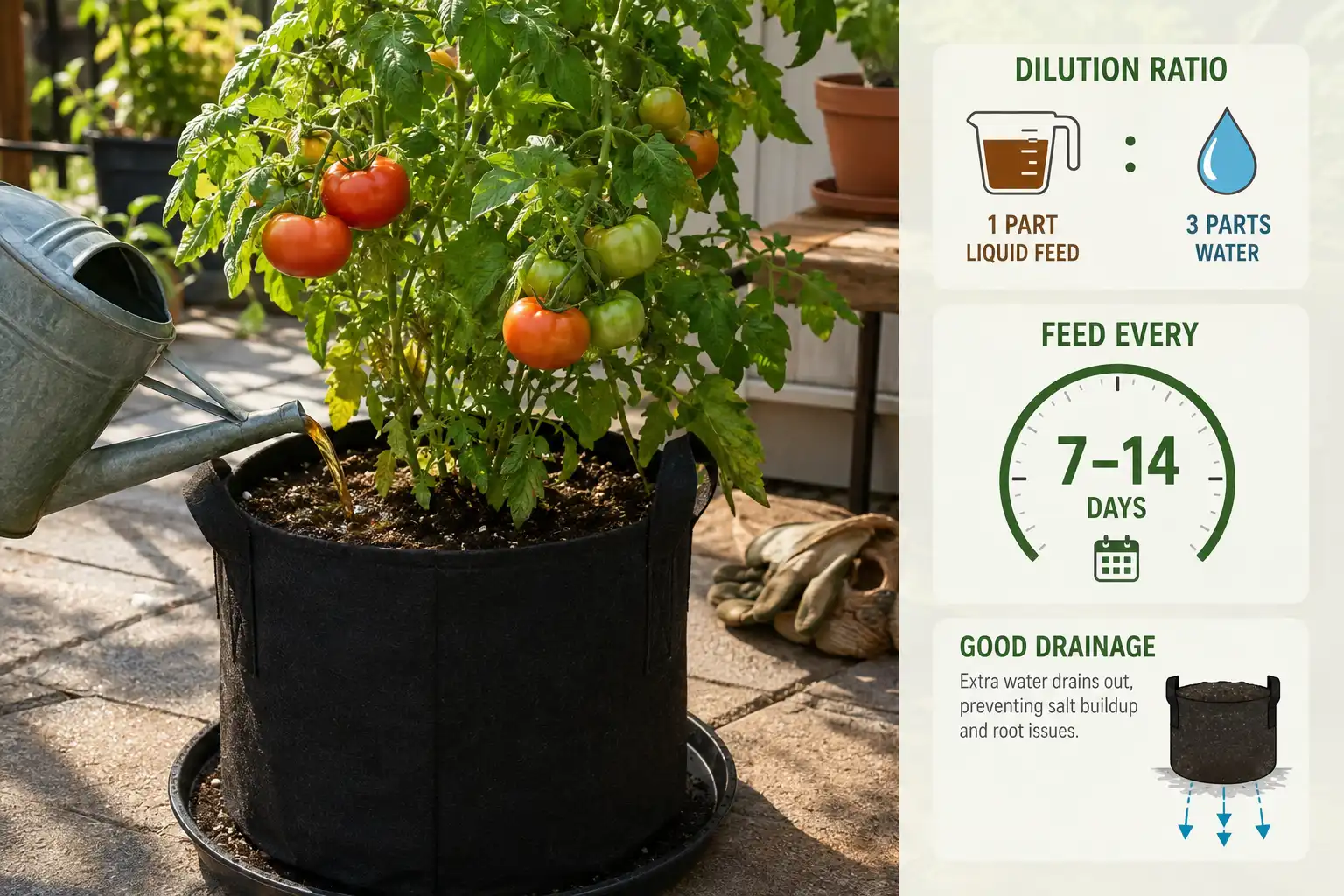
A lighter dose more often beats a heavy dose now and then. Run half the label rate weekly rather than full rate every two weeks. That habit keeps salts from building up in the mix, which matters in container grown tomatoes sitting in July sun.
Switch ratios once fruit sets. Before flowering, a balanced 1-1-1 ratio works. After the first fruit reaches cherry size, move to a higher potassium blend for better color and firmness.
How Fertilizer Type Changes How Often You Apply It
The product in your hand sets the interval as much as the plant does. Fast nitrate sources move quickly and run out quickly. Coated and organic sources release slowly, so they stretch further between passes.
| Fertilizer type | Typical interval | Notes |
|---|---|---|
| Dry granular, 10-10-10 or 8-8-8 | Every 3 to 4 weeks | Band it and water it in; the standard garden schedule |
| Ammonium sulfate 21-0-0 or calcium nitrate 15-0-0 | Every 3 to 4 weeks | Nitrogen only; calcium nitrate also helps hold off blossom end rot |
| Water soluble liquid, 20-20-20 | Every 7 to 14 days | Half strength weekly works better than full strength biweekly |
| Coated slow release | Once at planting, again at 8 to 12 weeks | Read the release window on the label, not the season length |
| Dry organic, 4-2-3 or 6-2-2 | Every 3 to 4 weeks | Texas A&M AgriLife suggests double or triple the synthetic rate |
| Fish and kelp liquid | Every 10 to 14 days | Mild enough for young transplants |
| Compost side layer | Once or twice per season | Steady but slow; treat it as a base, not a fix |
Match the ratio to the stage rather than buying one bag for the whole season. picks and the reasoning behind them sit in our notes on tomato fertilizer options for garden and field use.
How Often to Water and Fertilize Tomato Plants Together
Water and fertilizer run on separate clocks. Water deeply once or twice a week in the ground, roughly 1 to 1.5 inches total. Feed only every three to four weeks. In containers, the two overlap because you mix the feed into the water.
Steady moisture matters more than the fertilizer bag for fruit quality. Uneven watering plus heavy nitrogen brings on blossom end rot, since excess ammoniacal nitrogen slows calcium uptake. So mulch 2 inches deep, then keep the interval regular through Kansas heat spells. full approach to watering tomatoes covers depth and timing in more detail.
Always water after a dry sidedress. Granules sitting on dry soil do nothing, and a hard rain later can dump the whole dose at once.
Rain, Soil Texture, and Heat All Shift the Interval
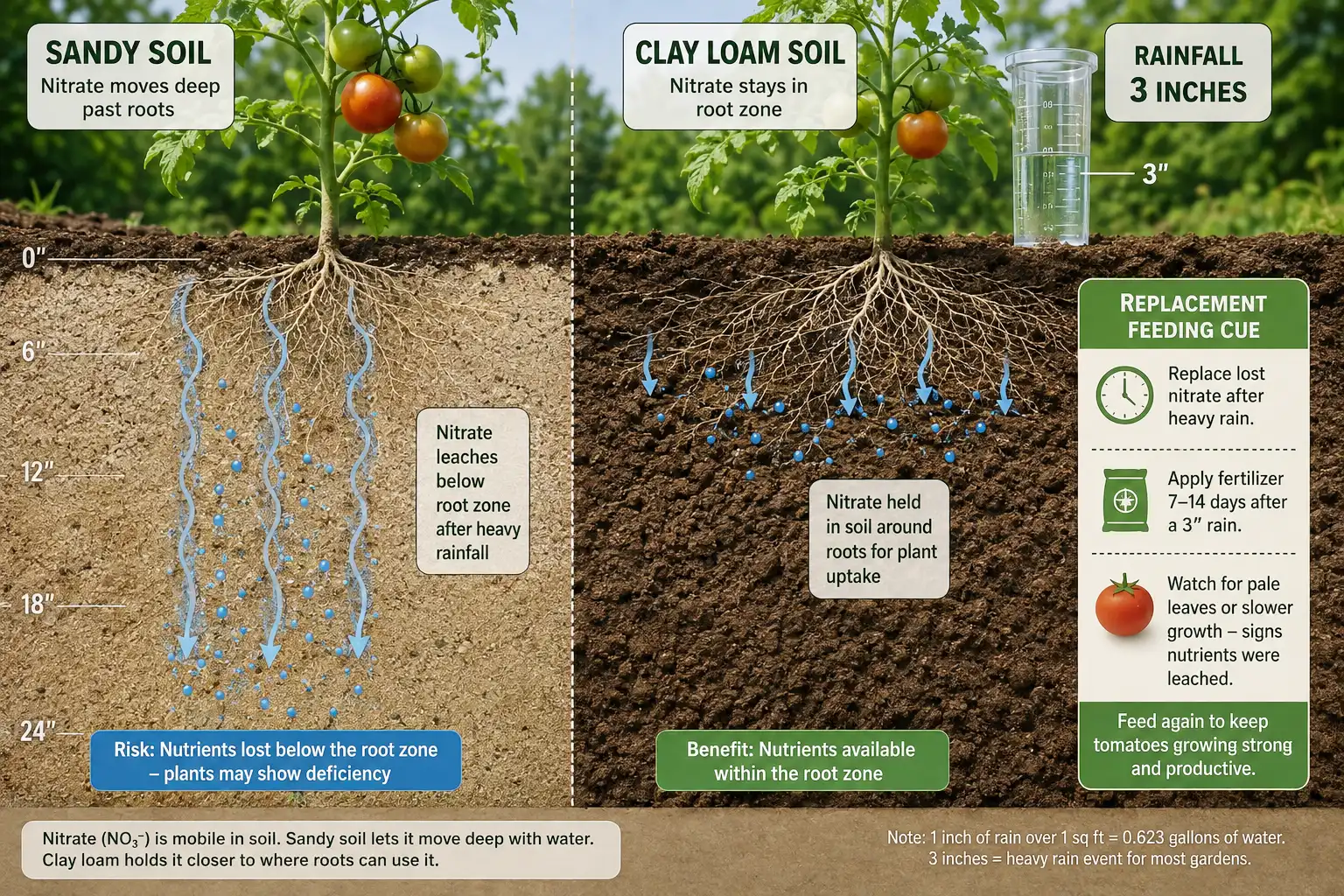
Sandy soil needs feeding more often than heavy clay, because water moves nitrate through it fast. UF/IFAS uses a leaching rain rule. After 3 inches of rain in three days, add a light replacement feeding. The same goes for 4 inches in seven days. That rule saves a crop after a Great Plains thunderstorm week.
Clay holds nutrients longer, so silt loam beds run the standard three to four week interval without adjustment. Texas A&M AgriLife tightens intervals to seven to ten days on deep sand with a long southern season. Compare that to a cool northern season, where three feedings finish the job.
Heat plays in too. Above 90°F, fruit set slows and the plant uses less nitrogen. Skip a round during a long hot stretch, then resume once night temperatures drop back under 75°F.
Start With a Soil Test, Not a Bag
A soil test sets your rate and tells you which nutrient to skip. Without one, you guess on phosphorus and potassium, and most established garden beds already run high on phosphorus. Adding more wastes money and can tie up zinc in the soil.
Target a pH between 6.4 and 6.8 for tomatoes. Below 6.0, calcium and magnesium uptake drop off, and blossom end rot shows up more often. A soil testing kit you can use at home gives you pH and a rough nutrient read in an afternoon. For anything beyond that, send a sample to your state lab through the county extension office.
Retest every two or three years. Nutrient levels drift, especially in beds that get compost every fall.
How Long to Fertilize Tomatoes Before You Stop
Stop nitrogen two to three weeks before your first expected frost so plants push ripening instead of new growth. Around Topeka in USDA hardiness zone 6a, first frost lands in mid October. So the last feeding goes down in late September.
Determinate plants come off the schedule earlier. Once the main flush turns color, more nitrogen adds nothing. Cut them off after the second sidedress.
Watch the plant, not only the calendar. If a vine still sets flowers in early September and looks healthy, one more light feeding pays. If it shows disease pressure or heavy leaf loss, feeding will not bring it back.
How Often to Fertilize Tomatoes and Peppers in the Same Bed
Peppers need fewer feedings than tomatoes. So run the bed on the tomato calendar, then skip peppers on the last round. K-State recommends one tablespoon of nitrogen fertilizer per pepper plant after the first fruit sets. Tomatoes take that first pass plus two more.
A practical split for a mixed bed:
- First fruit set: feed both crops
- Four weeks later: feed both, at a lighter rate on peppers
- Four weeks after that: tomatoes only
Peppers pushed with too much nitrogen drop blossoms just like tomatoes, though they show it sooner. Eggplant follows the pepper timing closely.
Signs You Are Fertilizing Too Often or Not Enough
| What you see | Likely cause | What to do |
|---|---|---|
| Thick dark leaves, curled tips, few blossoms | Too much nitrogen, or feedings too close together | Skip the next round, keep watering steady |
| Big vine, small fruit, cracked skins | Over feeding plus uneven moisture | Hold nitrogen, mulch, water on a set interval |
| Pale lower leaves moving up the plant | Nitrogen running short | Feed now, then resume a three week cycle |
| Sunken dark patch on the bottom of the fruit | Uneven water plus excess ammoniacal nitrogen | Steady moisture, switch to calcium nitrate |
| Yellow margins on older leaves, weak fruit color | Potassium short | Move to a higher potassium blend |
| Purple leaf undersides on young plants | Cold soil limiting phosphorus uptake | Wait for warm soil; usually not a true shortage |
| White crust on container mix | Salt buildup from heavy liquid feeding | Flush the pot, then feed at half rate |
FAQs About Tomato Feeding Frequency
How often do I need to fertilize my tomato plants if I worked compost into the bed?
How frequently to fertilize tomatoes in a raised bed?
Can I fertilize tomatoes every week?
Should I fertilize tomatoes while they are flowering?
How often do you need to fertilize tomatoes with Epsom salt?
Final Thoughts
Three to four feedings, three to four weeks apart, starting at quarter size fruit. That covers most garden tomatoes in the ground. Containers get half strength liquid every week instead.
Let the soil test set the rate. Let the fruit set the start date. Then stop nitrogen about three weeks before frost. Feeding on a schedule beats feeding by feel. It keeps the vine putting sugar into fruit rather than leaves.