Can You Plant Lettuce and Onions Together? Yes, Here’s How
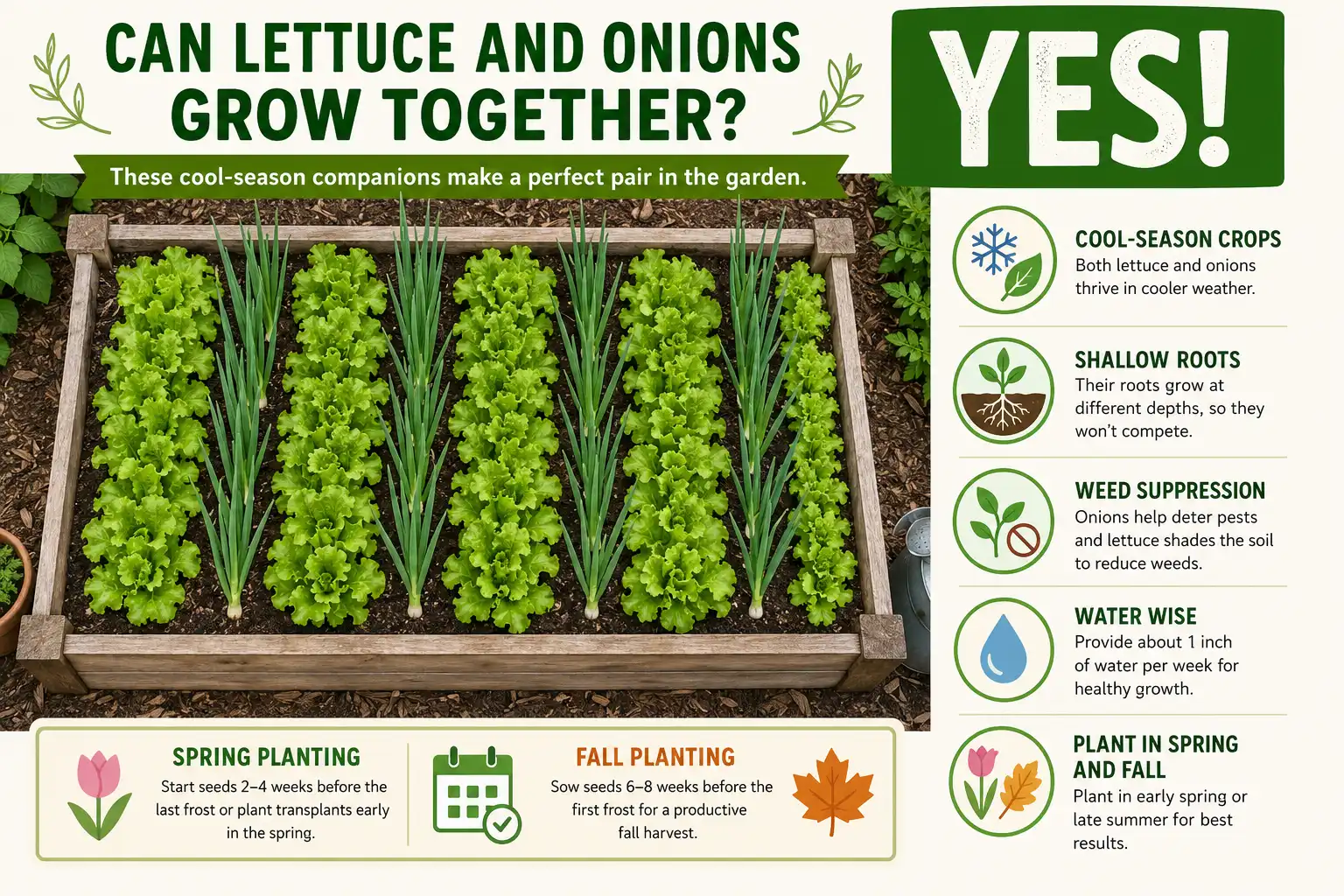
Lettuce and onions sit in many of the same garden beds for good reason. Both run on cool weather, both stay compact, and they barely compete for the same space. So can you plant lettuce and onions together?
Yes, you can plant lettuce and onions together, and they make one of the better cool-season pairings. Onions grow upright while lettuce stays low, so they share a bed without crowding, and the lettuce smothers weeds between the onion rows.
Can You Plant Lettuce and Onions Together?
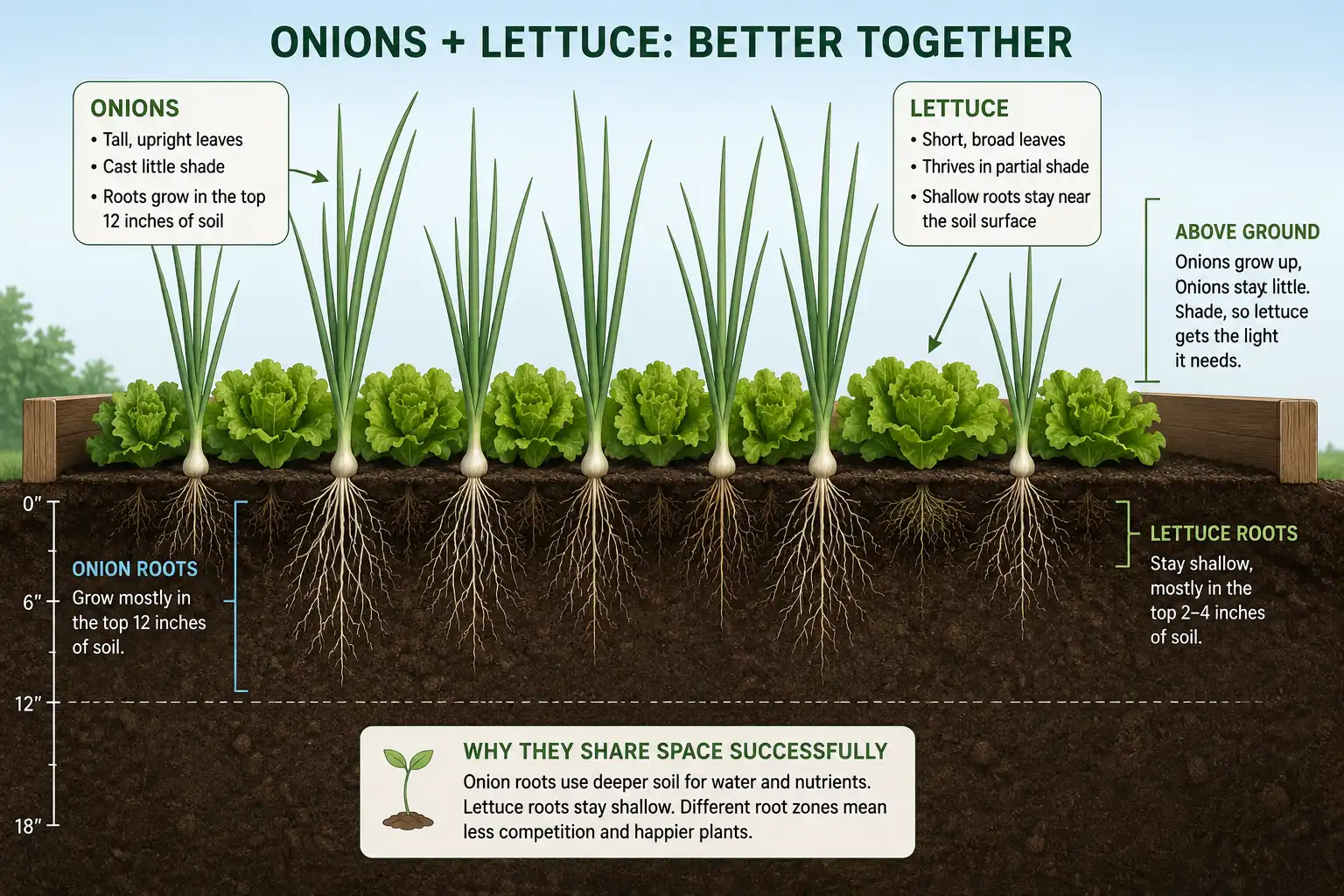
Yes, lettuce and onions grow well together because their shapes and root zones fit instead of fight.
Onions grow straight up. Their thin, cylindrical leaves shoot skyward and cast almost no shade. Lettuce does the opposite. It stays short and spreads a broad, low mat of leaves under the onion tops. So sunlight reaches both crops, and the two leaf forms stack rather than block each other.
The roots tell the same story. Onions, members of the Allium cepa family, keep most of their feeder roots in the top foot of soil. Lettuce roots run even shallower. Because of that shallow habit, lettuce slips into a bed without digging into the onion’s main zone. If you want the details on how deep lettuce roots reachour guide covers that separately.
Both are cool-season crops, too. They like the same temperature range, go in during the same windows, and ask for similar care. That shared schedule is what makes this pairing so easy to manage.
What You Gain by Pairing Lettuce With Onions
You gain weed control, tighter use of space, and a possible pest break, all from one shared bed.
Onions are weak weed competitors. So are carrots. Those upright leaves leave bare soil between the rows, and weeds rush into that open ground. Lettuce fills the gap. Its broad leaves shade the soil and work as a living mulch, or smother crop, between the onion rows. Less bare dirt means far less weeding. That benefit alone covers the cost of the pairing.
Then there is space. Lettuce matures fast, usually in 30 to 60 days. It comes off the bed long before onions size up and need the full room. So you pull two crops from a single footprint. Researchers track this with the Land Equivalent Ratio. A mixed bed of lettuce and onions often grows more total food than the same bed planted to either crop alone.
Lettuce is a natural filler crop in general. Tuck it under taller plants too. That is the same move made when growing lettuce alongside tomatoes, because it asks for so little room.
Do Onions Repel Pests From Lettuce?
Maybe, but do not count on it. The pest angle is the weakest part of this pairing.
Onions carry sulfur compounds. Those give onions their sharp smell, and many soft-bodied pests, like aphids, find that smell off-putting. The theory says an onion row masks nearby lettuce and throws pests off the scent. Still, the University of Minnesota Extension warns that plenty of companion-planting pest claims lack solid research behind them, and some studies even disagree. The strongest allium evidence sits with the way onions pair beside carrots, where onions help cut carrot fly damage. So for lettuce, treat any pest break as a bonus, not the reason you plant.
How to Plant Lettuce and Onions Together
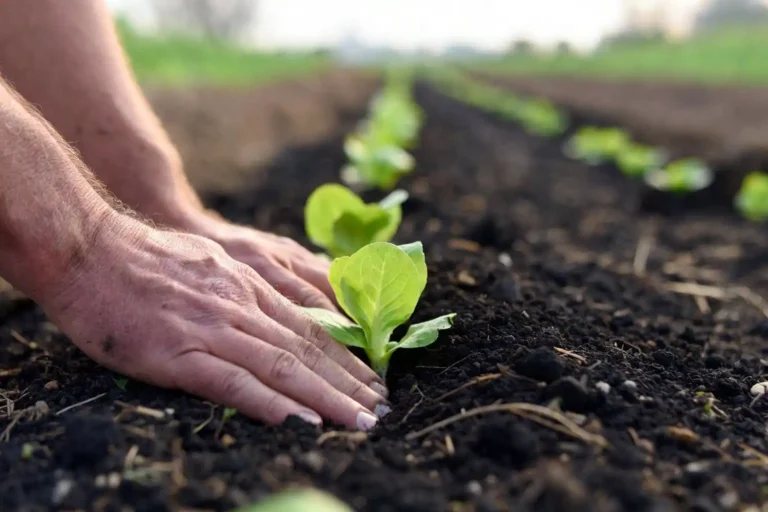
Plant your onions in rows first, then sow or transplant lettuce in the open strips between those rows.
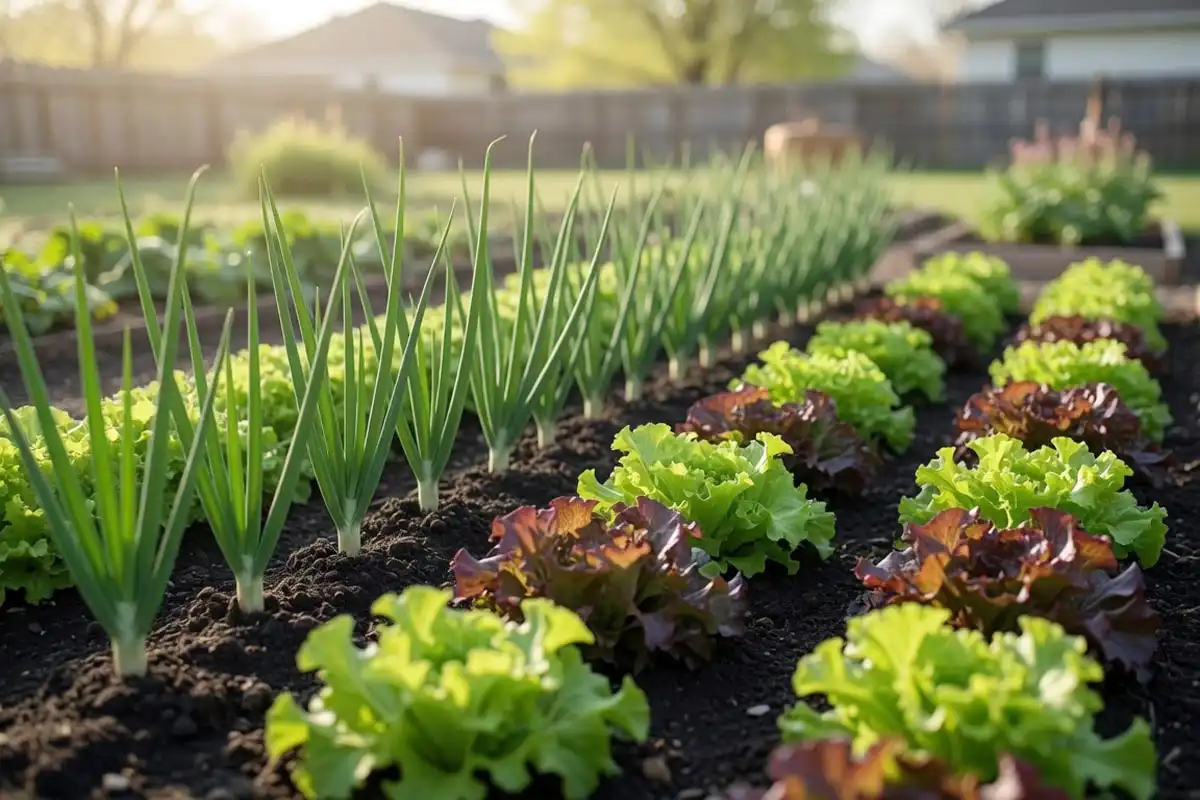
That layout keeps the onions in charge of the bed while the lettuce works the gaps. Because lettuce comes off early, the onions get the space back right when they start to bulb.
Spacing and Bed Layout
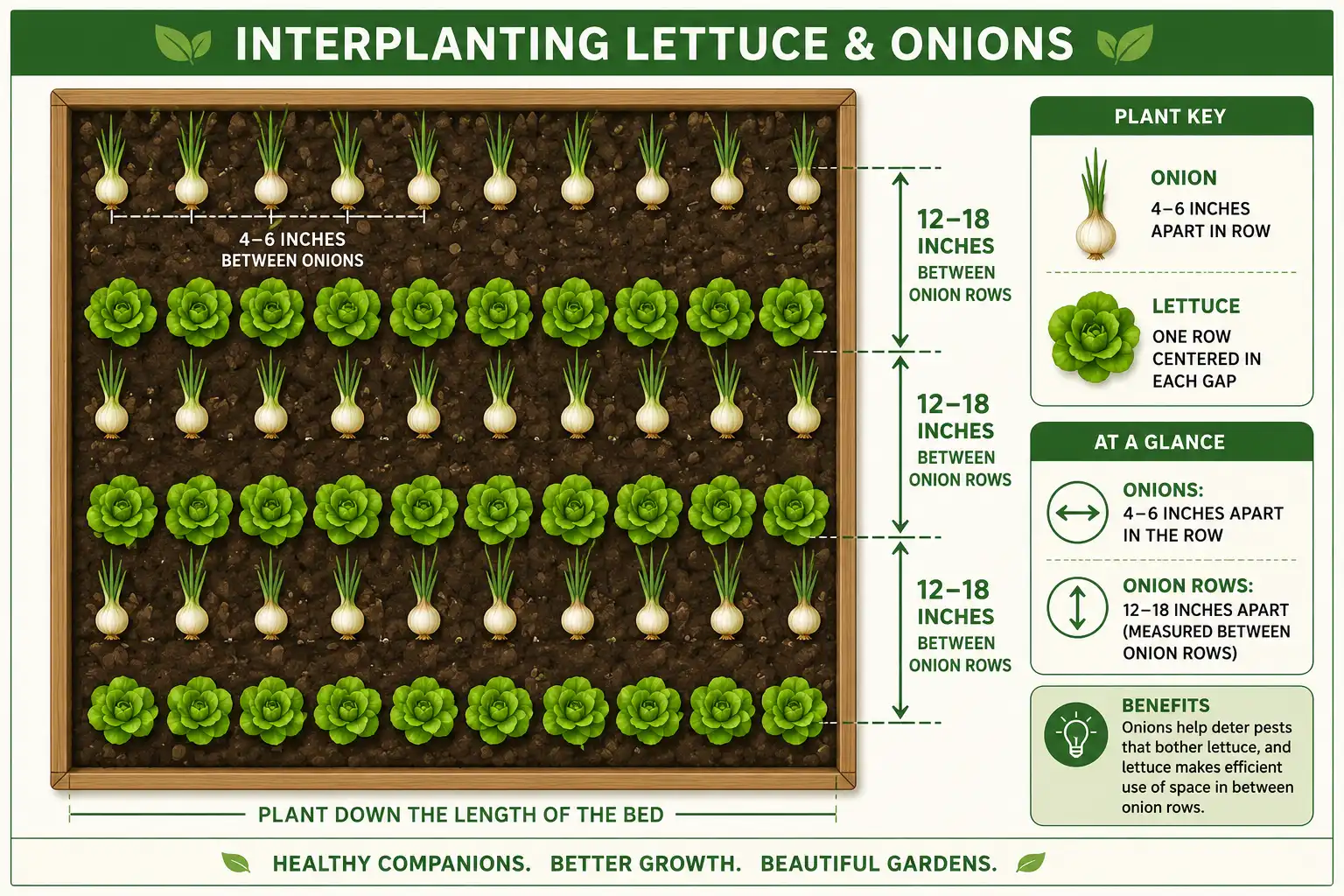
Space onion rows 12 to 18 inches apart, with onions set 4 to 6 inches apart in the row. Then run a single lettuce row down the center of each gap. Leaf lettuce can sit 6 to 8 inches apart. Head lettuce wants 10 to 12 inches. Keep a little breathing room between the lettuce and the onions. If you jam them together, both crops fight for water and feed, and neither does its best. For exact numbers by lettuce type, our guide on spacing lettuce in rows and beds breaks it all down.
When to Plant Them in the Garden
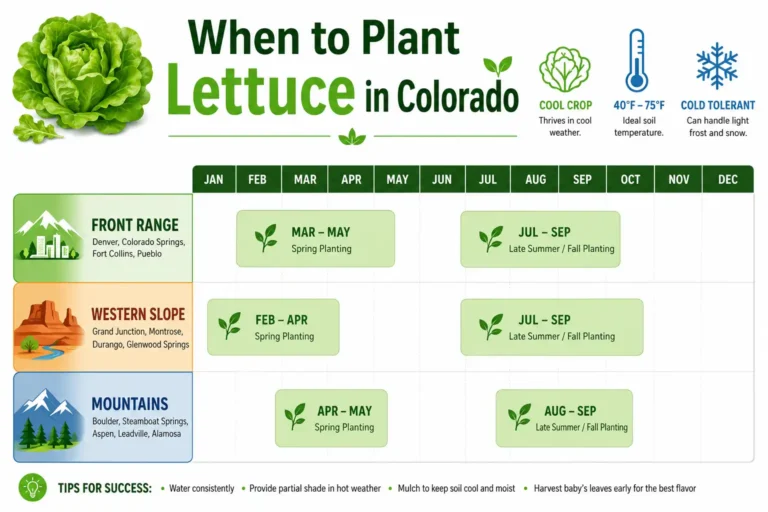
In USDA zone 6a, both crops go in early, as soon as the soil can be worked in spring.
Onions need a long season, so they lead off. Set transplants or sets in March, sometimes early April, once the soil holds in the low 40s°F. Long-day and intermediate-day onions suit Kansas and the wider Great Plains. K-State Research and Extension lists onion sets and transplants among the first things to plant in the spring garden. Lettuce goes in at the same time. Direct-sow seed or drop in transplants the moment the bed is ready. Both crops also make a strong fall planting, and start a second round of lettuce in late summer for crisp cool-weather heads. For raising seedlings, see how to handle starting onions from seed before the season starts.
Will Interplanting Shrink Your Onions?
It can, slightly, because lettuce and onions do compete below ground for water and nutrients.
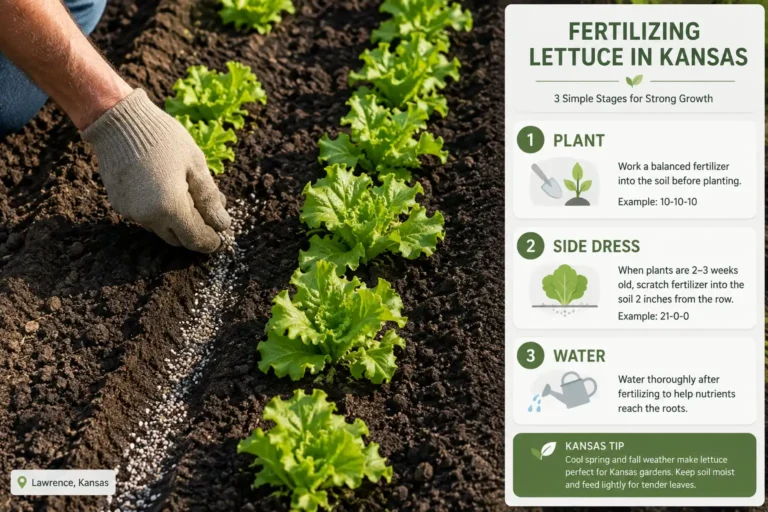
A greenhouse study from Brock University grew onions and lettuce together and measured the result. Onion dry weight dropped when the two crops competed at the roots, compared with onions grown on their own. Field trials show the same pattern. Each individual onion often runs a touch smaller in a mixed bed than in a solid stand of onions. But total output per bed still climbs, which circles back to that Land Equivalent Ratio. You trade a bit of onion size for a whole extra crop of lettuce. The fix is simple. Feed the bed a little more, water it steadily, and never crowd the plants. Give the onions room to finish bulbing once the lettuce clears out.
Mistakes That Cost You the Pairing
Most failures trace back to crowding, thirst, or the wrong neighbor.
Crowding starves the bed. Too many plants per square foot leaves onions small and turns lettuce bitter and quick to bolt. Water matters just as much. Both crops want steady moisture, about an inch a week, and onions have shallow roots that dry out fast. Let the bed go dry and you get tough onions and bolting lettuce. So check how much water lettuce wants each week, and hold that line. The wrong neighbor can sink the whole plan, too. Keep beans and peas away from onions, since onions stunt legumes. Heat is the last trap. Lettuce bolts when summer bears down. Onions throw too little shade to help, so plan your lettuce for spring and fall, not the heart of July.
Bottom Line
Onions go in rows first, then every gap gets filled with lettuce. The lettuce smothers weeds and comes off the bed early, and the onions finish the season with room to bulb. Two crops, less weeding, more food per square foot. Keep it watered, keep it fed, and do not crowd. That is the whole system, and it has earned a permanent spot in the spring beds.