Best Fertilizer for Onions in 2026: Top 10 Grades Ranked
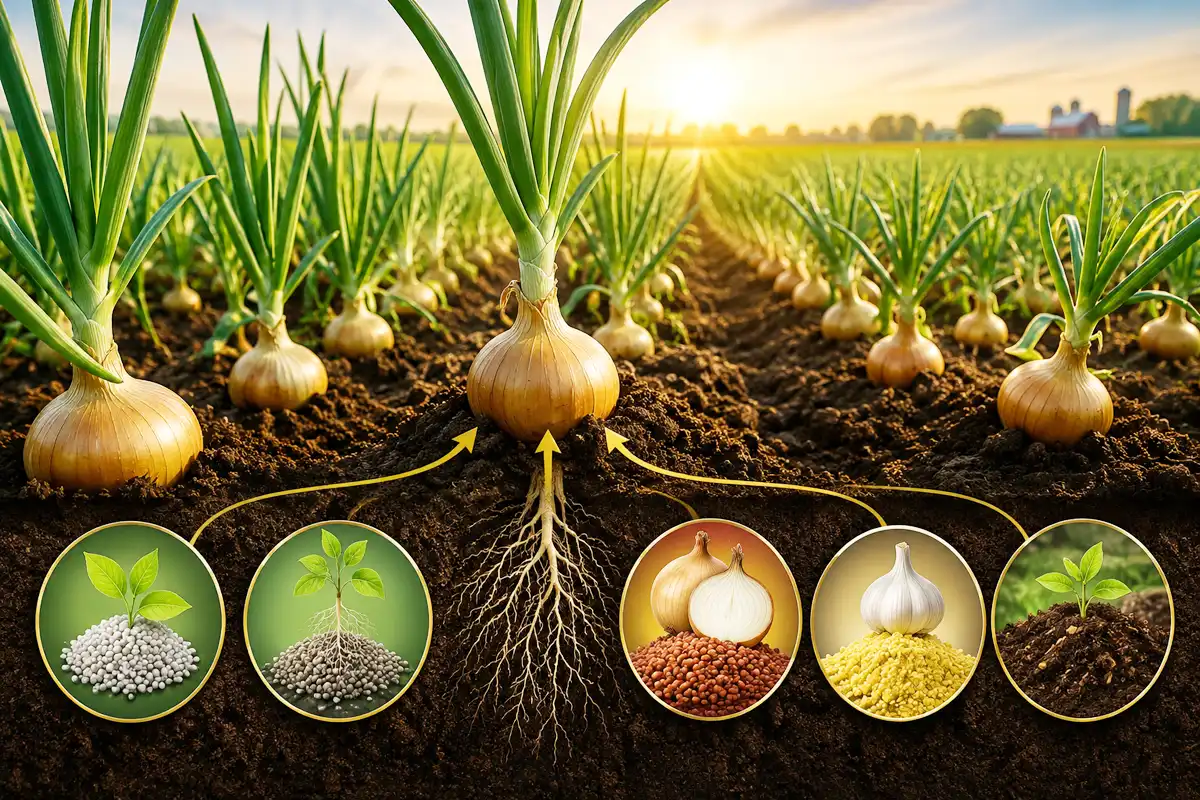
Onions need 120 to 150 pounds of nitrogen per acre each season. Yet 90% of their roots sit in the top 7 inches, so that band empties fast. That is why the best fertilizer for onions has to match each stage. Otherwise you get small bulbs and thick necks.
The best fertilizer for onions is Hi-Yield Ammonium Sulfate, supplying 21% nitrogen plus 24% sulfur. For an organic onion fertilizer, Jobe’s Organics 4-4-4 adds 8% calcium. Down To Earth Blood Meal greens tops within a week.
Best Fertilizer for Onions at a Glance
- Best Overall: Hi-Yield Ammonium Sulfate
- Best for Alkaline Soil: The Grow Co Ammonium Sulfate
- Best Balanced Pre-Plant: Southern Ag All Purpose
- Best Organic Pre-Plant: Jobe’s Organics All Purpose
- Gentlest Organic Option: Espoma Organic Garden-Tone
- Fastest Organic Nitrogen: Down To Earth Blood Meal
- Best Slow Release Organic Nitrogen: Down To Earth Feather Meal
- Best for Bulb Fill: Down To Earth Langbeinite
- Best Water Soluble: Jack’s Classic All Purpose
- Best Quick Correction: Miracle-Gro Water Soluble All Purpose
Also see: Fertilizers for Potato Plants
How to Choose the Best Fertilizer for Onions
Four things decide which bag earns your money. Your soil test numbers, the first figure on the label, the sulfur content, and the physical form. Work through them in that order and the choice narrows fast. Skipping step one wastes the most cash.
Start With a Soil Test, Not a Bag
Test before you buy. Allium cepa performs best at pH 6.0 to 6.8. The nitrate-N figure on your report also changes the rate before you pick a grade. Pull 6-inch cores from 10 to 15 spots across the bed. Mix them in a clean bucket, then mail that composite sample to your county extension office. Use the lab at K-State Research and Extension. A mail-in soil testing kit covers the seasons when to want a faster answer. UC Davis guidance puts every ppm of soil nitrate-N at 2 to 4 lb N per acre. So a 20 ppm reading takes 40 to 80 lb N straight off your season plan. Below 6.0, work in lime. Above 7.0, elemental sulfur pulls it back down.
Read the First Number on the Bag
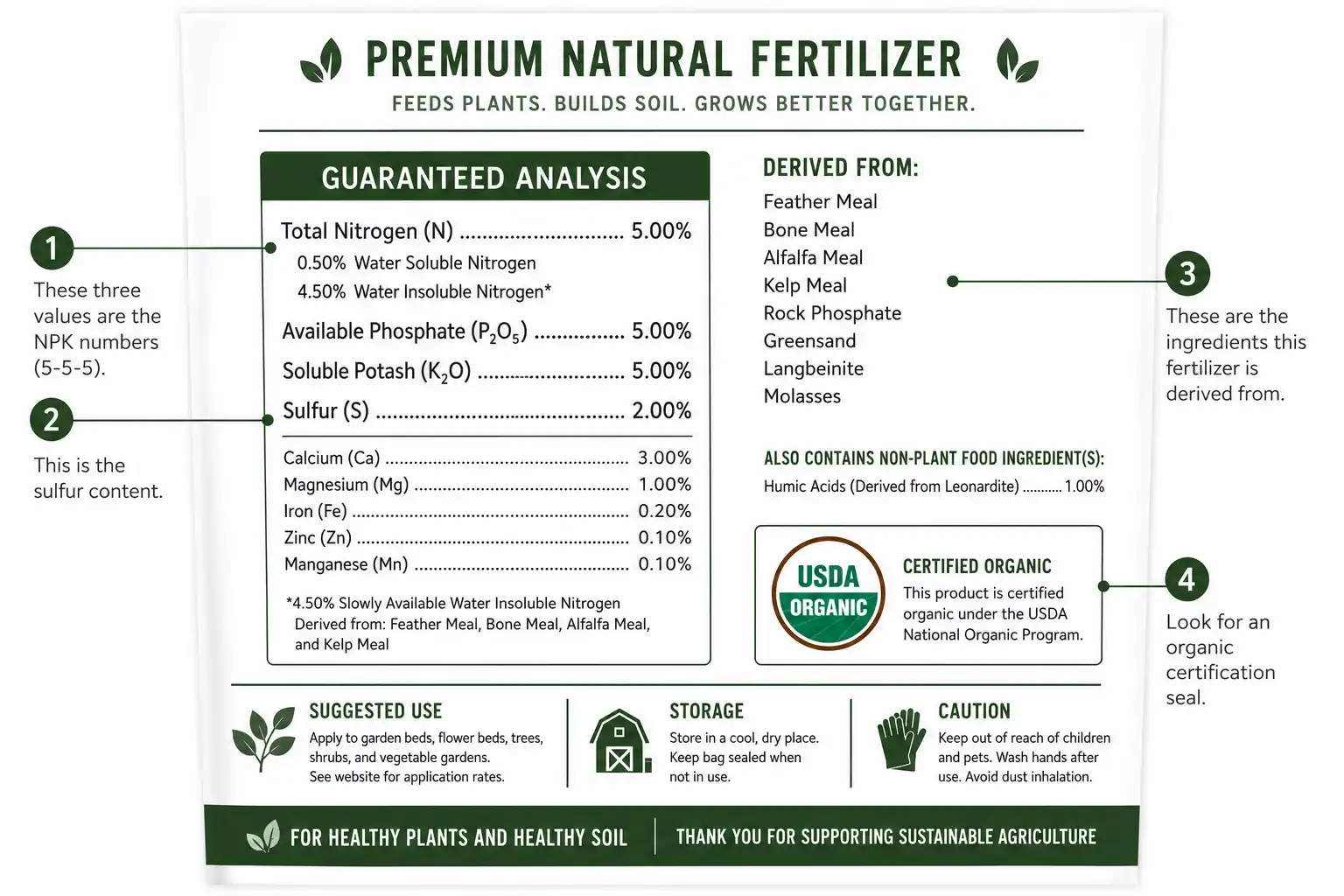
Nitrogen drives leaf count, and every leaf becomes a bulb ring. That makes the first number the one that matters most before bulbing. Here is what each figure in an onion fertilizer NPK grade actually does for the crop. Nitrogen builds tops and stacks leaves, which sets your leaf count ceiling. Phosphorus pushes early roots in cool spring ground, because a shallow root system cannot chase immobile phosphate. Potassium handles scale development and storability, so it earns its keep late. If the label math still feels fuzzy, our walkthrough of NPK basics for crops covers the arithmetic. Ten leaves means ten rings. That ceiling locks in before the first bulb ever swells.
Sulfur Is the Nutrient Most Onion Fertilizers Skip
Onions pull heavy sulfur, and sulfur drives onion pungency through the alliin pathway. So a 21-0-0 ammonium sulfate carrying 24% sulfur does two jobs in one pass. Shortfalls turn up first on sandy soil with low organic matter, where sulfate leaches past the roots every spring. Where a test confirms a real deficit, plan 20 to 30 lb S per acre. Go up to 40 lb on the sandiest ground. NC State Extension wants nutrients like this worked into the bed before planting. The root zone stays shallow all season. Sulfate of potash and langbeinite, sold as K-Mag, both add sulfur with no nitrogen attached. Growing sweet bulbs instead? Keep sulfur lean, because pungency climbs right along with it.
Granular, Water Soluble, or Liquid
Use granular for row side dress work. Water soluble suits transplant starter and quick correction. Liquid handles fertigation through a drip line. Granular costs the least per pound of nitrogen and stays put, but it does nothing until you water it in. A soluble feed reaches the root zone within a day. It also washes out fast, so repeat every 10 to 14 days. Liquid through drip lands nitrogen exactly where those shallow roots sit, which suits sandy ground. On a garden scale, a hose end sprayer handles the same job. Skip foliar feed for nitrogen, because onion leaves are waxy and upright and take up very little.
Onions grow in tight rows where a thrown pattern lands right on the leaves, so choosing a fertilizer spreader by row width saves you a lot of burned tips.
The 10 Best Fertilizers for Onions: Reviews
These are ranked for four things. The guaranteed analysis, whether sulfur is in the bag, how the release curve lines up with onion stages, and what long-term owners report. Every rate below comes off the product label. Own rows run on ammonium sulfate over a 10-10-10 base, so treat the organic picks as label and extension analysis rather than the field notes.
1. Hi-Yield Ammonium Sulfate 21-0-0
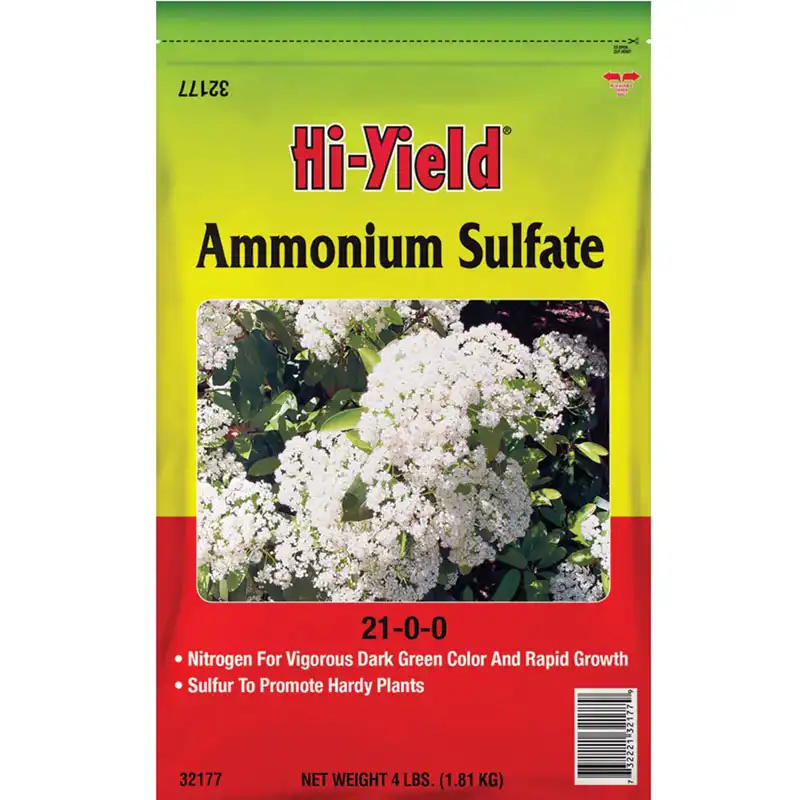
Hi-Yield is the garden line from VPG Fertilome, and this bag holds straight ammonium sulfate. Nothing else. You get 21% nitrogen plus roughly 24% sulfate sulfur, the exact pairing onions want from week three to bulb initiation. Growers feeding alliums report darker tops inside a week.
Specifications:
- Analysis: 21-0-0 with sulfate sulfur
- Form: granular, spreader friendly
- Vegetable rate: half pound per 100 sq ft
- Water in right after spreading
Best for: side-dressing onion rows every 2 to 3 weeks.
2. The Grow Co Ammonium Sulfate 21-0-0
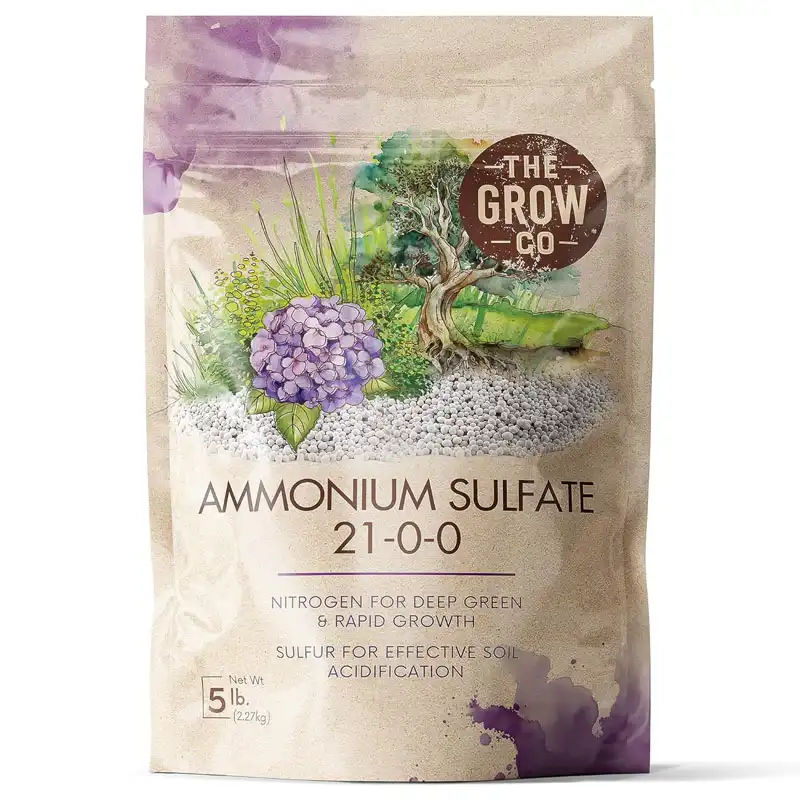
Same chemistry, but The Grow Co prints the full guarantee on the bag: 21% nitrogen and 24% sulfur. That matters above pH 7.0, because the sulfate drops pH while it feeds. Onions lose zinc and manganese uptake on high-pH ground, so one bag handles both jobs.
Specifications:
- Analysis: 21-0-0 with 24% sulfur
- Form: soluble granules
- Garden rate: 2.5 cups per 100 sq ft
- Store sealed, keep it dry
Best for: onion beds on alkaline Great Plains ground.
3. Jobe’s Organics All Purpose Fertilizer 4-4-4
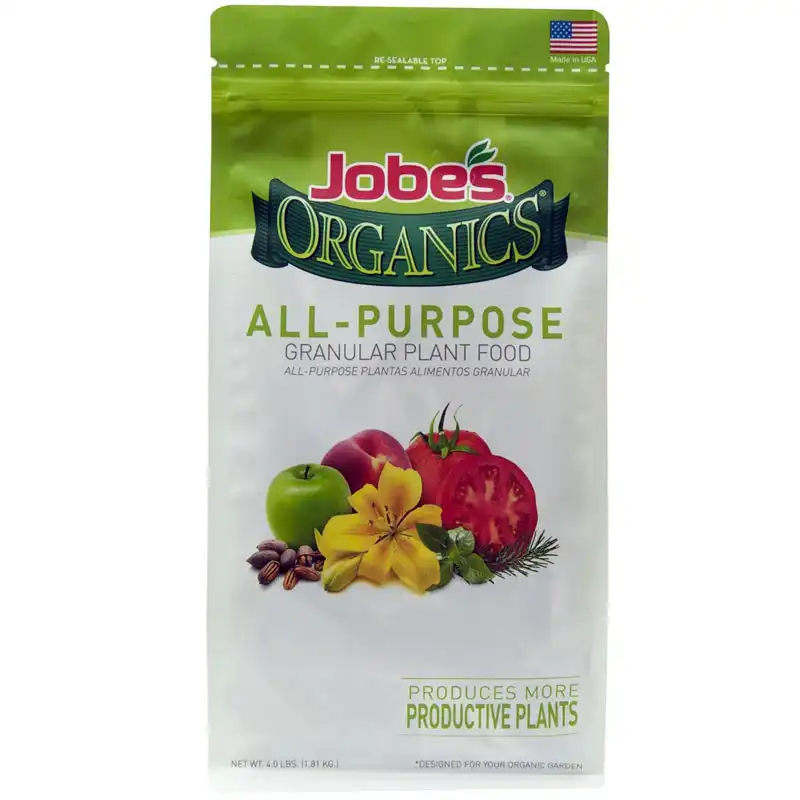
Jobe’s blends feather meal, bone meal, processed poultry manure, and sulfate of potash, then adds billions of archaea to speed breakdown. It is OMRI listed and made in Kentucky. That 8% calcium is the part most gardeners overlook, since calcium firms outer scales. Work it in at bed prep.
Specifications:
- Analysis: 4-4-4 plus 8% calcium
- Form: granules, resealable bag
- Frequency: every 2 to 3 weeks
- Handle outdoors, the dust travels
Best for: organic bed prep before onions go in.
4. Down to Earth Blood Meal Fertilizer 12-0-0
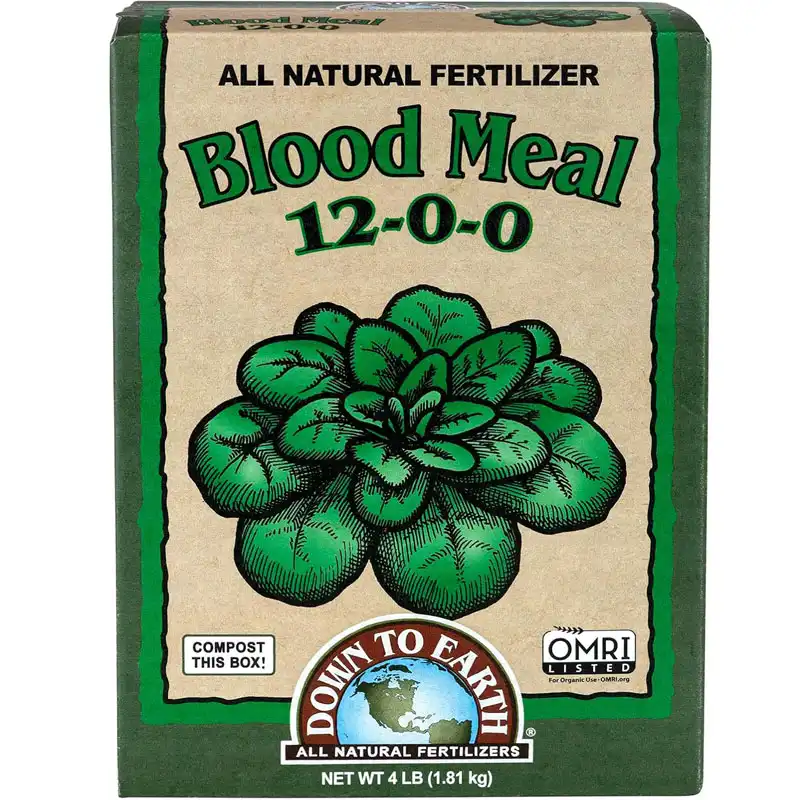
Down To Earth has milled single-ingredient amendments in Eugene, Oregon since 1977. This is pure dried blood meal at 12-0-0, OMRI listed, with no filler. It is the quickest organic nitrogen you can side-dress on onions. Rabbits and deer also skip treated rows, which helps near timber.
Specifications:
- Analysis: 12-0-0, single ingredient
- Form: fine powder
- Rate: 2 to 4 lb per 100 sq ft
- Activates over 2 to 4 weeks
Best for: organic growers who need nitrogen now.
5. Down To Earth Organic Feather Meal Fertilizer 12-0-0
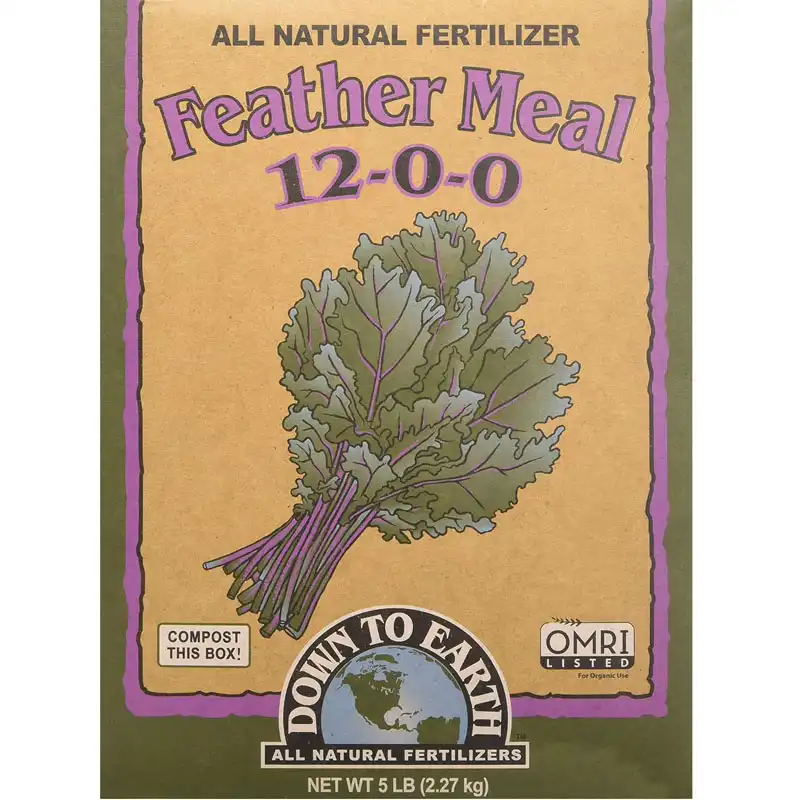
Same analysis as blood meal, very different behavior. Feather meal comes from ground and hydrolyzed poultry feathers, so nitrogen releases across six to eight weeks instead of two. That steady curve suits long-season onions. Incorporate it two to three weeks ahead of planting and it carries leaf building.
Specifications:
- Analysis: 12-0-0, slow release
- Form: powder, soil incorporated
- Rate: 2 to 4 lb per 100 sq ft
- Incorporate 2 to 3 weeks early
Best for: pre-plant nitrogen on organic onion ground.
6. Southern Ag All Purpose 10-10-10
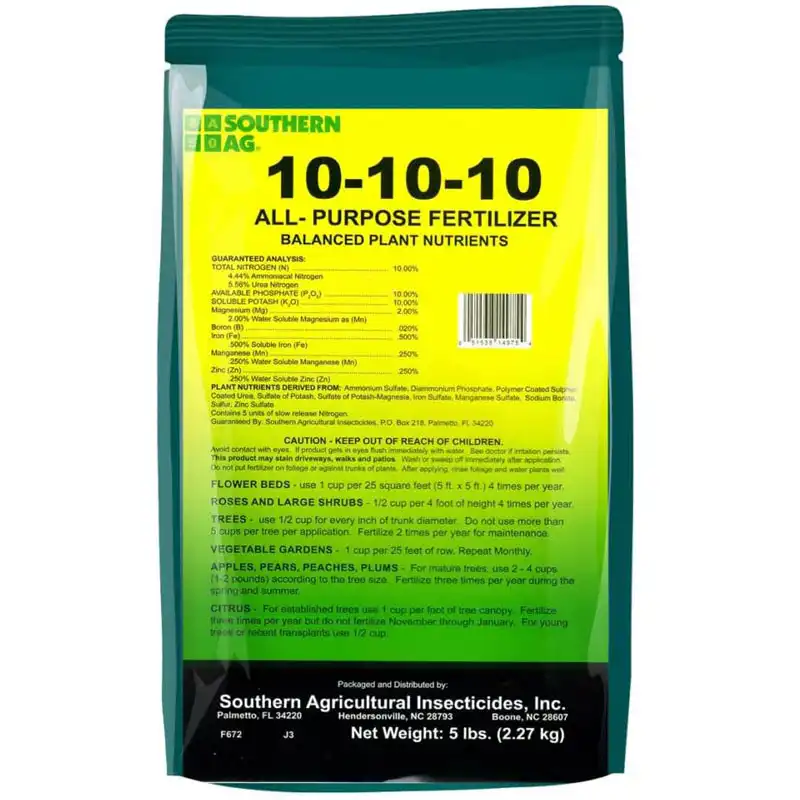
A homogenous 10-10-10 carrying magnesium, boron, iron, manganese, and zinc through every granule. Homogenous matters here. Blended products separate in the bag and leave hungry stripes down the bed. This is the grade to work into the top 2 inches before onions go in.
Specifications:
- Analysis: 10-10-10 plus trace elements
- Form: uniform granular
- Vegetable rate: 1 cup per 25 feet
- Broadcast evenly, then water in
Best for: bed prep when a test reads low on phosphate and potash.
7. Jack’s Classic All Purpose 20-20-20
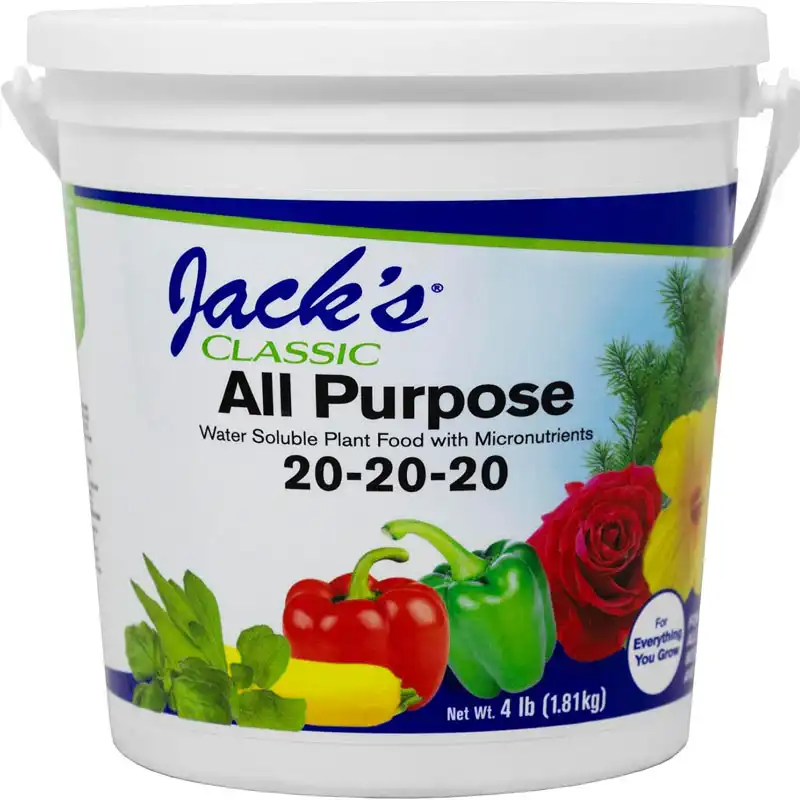
Jack’s Classic has come out of Allentown, Pennsylvania for over 75 years, and greenhouse growers still lean on it. The powder dissolves clean and carries boron, copper, chelated iron, manganese, zinc, and molybdenum. One spoon per gallon. For onions, use it as a transplant starter and on containers at quarter strength.
Specifications:
- Analysis: 20-20-20 with micronutrients
- Form: water soluble powder
- Mixing: one spoon per gallon
- Frequency: weekly during the season
Best for: transplant starter, container onions, and feeding through a hose end sprayer.
8. Down To Earth Langbeinite 0-0-22
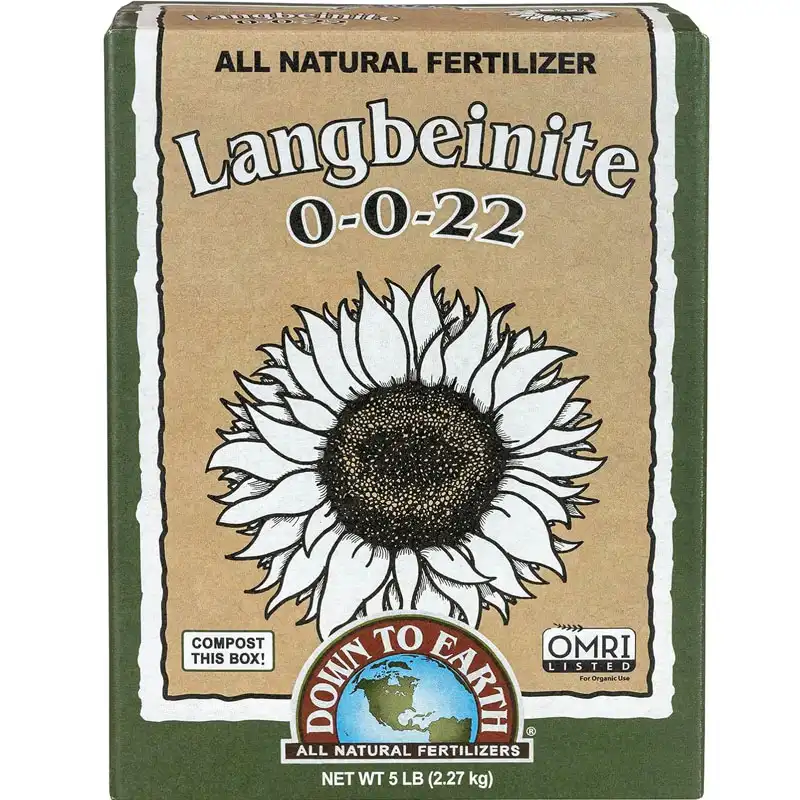
Mined langbeinite, chemically K2Mg2(SO4)3, gives 22% potash, 22% sulfur, and 11% magnesium in the sulfate form roots take up directly. Zero nitrogen. That makes it the safest amendment once bulbs swell. Chlorine stays under 3%, so salt-sensitive Allium cepa tolerates it far better than muriate of potash.
Specifications:
- Analysis: 0-0-22 plus 22% S, 11% Mg
- Form: mined granules, OMRI listed
- Soil effect: full in 2 to 3 weeks
- Shelf life: 5 years kept dry
Best for: bulb fill and fixing magnesium shortage.
9. Espoma Organic Garden-Tone 3-4-4
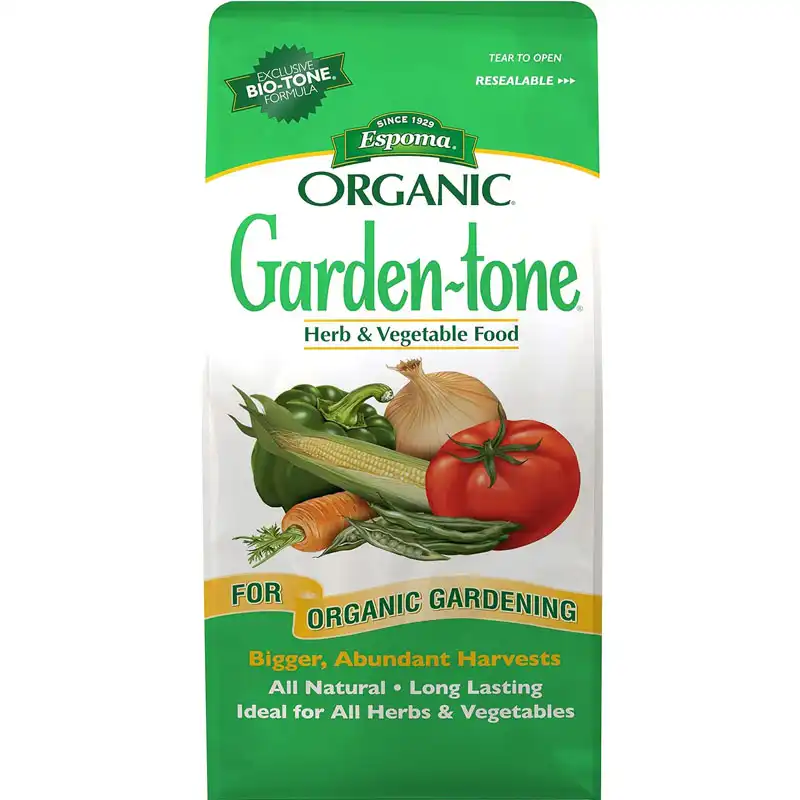
Espoma has made natural organics since 1929, and Garden-Tone carries their Bio-tone microbe blend plus 5% calcium. It is a registered Organic Input Material. The low analysis is deliberate, so it feeds steadily without pushing soft growth. Gardeners report strong results on onions, carrots, lettuce, and kale.
Specifications:
- Analysis: 3-4-4 plus 5% calcium
- Form: granular, ready to apply
- Frequency: monthly through the season
- Apply along rows, then water
Best for: raised beds and worm-friendly organic ground.
10. Miracle-Gro Water Soluble All Purpose 24-8-16
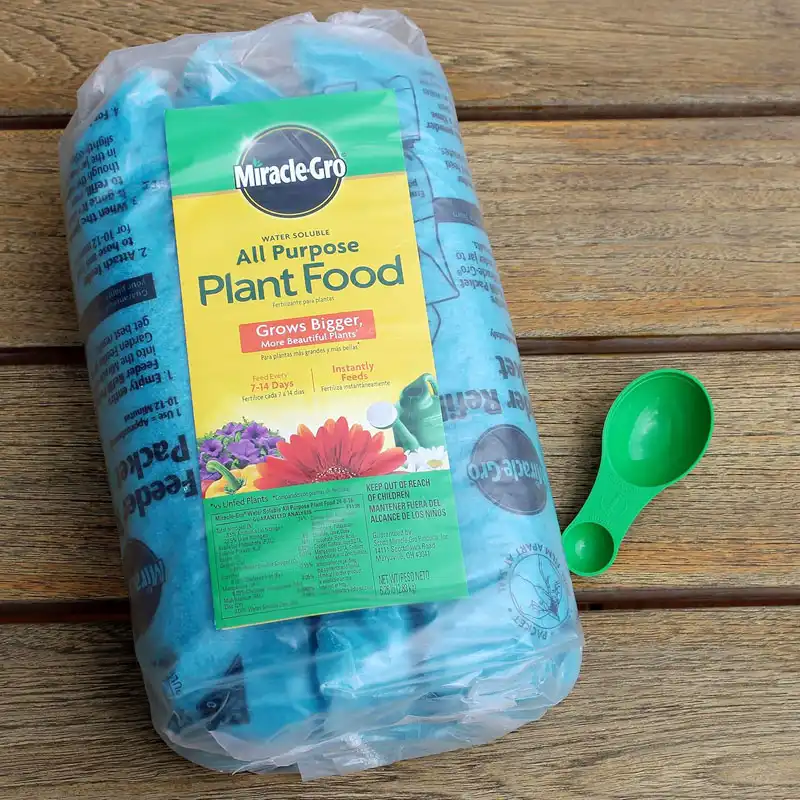
Scotts makes this in Marysville, Ohio, and it is the fastest correction on the list. The powder dissolves instantly and carries chelated iron, which helps when high pH ties iron up. Outdoor mixing runs 1.5 tablespoons per 1.5 gallons. Reach for it to catch a deficiency, not as your main program.
Specifications:
- Analysis: 24-8-16 with six micronutrients
- Form: water soluble powder
- Outdoor mix: 1.5 tbsp per 1.5 gallons
- Stays stable for years when dry
Best for: rescuing pale onions between granular feeds.
Comparison of the Best Fertilizer for Onions
| Product | Analysis | Type | Best onion stage |
|---|---|---|---|
| Hi-Yield Ammonium Sulfate | 21-0-0 plus sulfate sulfur | Granular, synthetic | Vegetative side dress |
| The Grow Co Ammonium Sulfate | 21-0-0 plus 24% S | Granular, synthetic | Vegetative on alkaline ground |
| Southern Ag All Purpose | 10-10-10 plus trace elements | Granular, synthetic | Pre-plant bed prep |
| Jobe’s Organics All Purpose | 4-4-4 plus 8% Ca | Granular, OMRI | Pre-plant, organic beds |
| Espoma Organic Garden-Tone | 3-4-4 plus 5% Ca | Granular, OMRI | Monthly organic feed |
| Down To Earth Blood Meal | 12-0-0 | Powder, OMRI | Organic side dress |
| Down To Earth Feather Meal | 12-0-0 slow release | Powder, OMRI | Pre-plant nitrogen |
| Down To Earth Langbeinite | 0-0-22 plus 22% S, 11% Mg | Granular, OMRI | Bulb fill |
| Jack’s Classic All Purpose | 20-20-20 plus micronutrients | Water soluble | Transplant starter, containers |
| Miracle-Gro All Purpose | 24-8-16 plus micronutrients | Water soluble | Quick nitrogen correction |
What NPK Ratio Do Onions Need at Each Growth Stage?
The right fertilizer for onions changes three times in one season. Phosphorus forward at planting, nitrogen heavy through leaf building, then potassium forward once bulbs swell.
| Stage | Grade to use | Why it works |
|---|---|---|
| Pre-plant, at bed prep | 10-20-10 or 10-10-10 | Phosphorus does not move through soil, and cool ground slows uptake. Band it where the first roots will find it. |
| Vegetative, emergence to seventh leaf | 21-0-0 or 20-10-10 | Each new leaf turns into another ring, so leaf count sets the ceiling on bulb size. |
| Bulb fill, initiation to tops falling | 5-10-10 or 0-0-22 | Potassium thickens scales and holds storage quality without pushing soft new growth. |
Pre-plant is your only real window for phosphorus placement. A 10-20-10 puts phosphate inside the shallow root zone before the soil warms. That is why Dixondale Farms blends this exact grade for onions. Plain 10-10-10 works fine when your test already shows adequate phosphate. Want phosphate without any nitrogen? Triple superphosphate at 0-46-0 does it cleanly.
Vegetative growth is where the crop gets made. Nitrogen builds tops before bulbing starts, and onions are heavy feeders through this whole stretch. Straight 21-0-0 is the cleanest tool here. Pick 20-10-10 instead if your test still reads low on phosphate or potash. Urea at 46-0-0 costs the least per pound of nitrogen. It still needs incorporating, and heavy rates burn seedlings in cold soil.
Bulb fill wants potassium without nitrogen. A light 5-10-10 finish covers most beds. Langbeinite at 0-0-22 brings potassium, magnesium, and sulfur with zero nitrogen, which makes it the safest late option. Calcium nitrate at 15-0-0 belongs in fertigation earlier in the season, never after initiation.
When to Fertilize Onions
When to fertilize onions comes down to four moments. Bed prep, three weeks after planting, every 2 to 3 weeks after that, then a hard stop at bulb initiation. Here is the schedule in USDA hardiness zone 6a.
- Bed prep, 7 to 10 days before planting. Work 1 to 1.5 lb of 10-10-10 per 100 sq ft into the top 2 inches. That runs about 45 to 65 lb of nitrogen per acre, right at the preplant share. Rake level, then let a rain settle it before plants go in.
- At planting. Nothing extra. Fresh granular against a new root ball burns, and the crop has almost no root surface to feed with yet.
- Three weeks after transplant. Side-dress a half cup per 10-foot row of 21-0-0. Keep granules 2 to 3 inches off the plants, then water it in the same day.
- Every 2 to 3 weeks after that. Repeat the same half cup of 21-0-0 down the row. Four rounds is typical for a spring crop here.
- At bulb initiation. Stop cold. No more nitrogen from any source, including compost tea and fish emulsion.
One caution on these numbers. Row-foot rates and per-acre rates do not convert cleanly. A banded strip covers far less ground than a broadcast acre, so use whichever scale matches how you apply.
Onion sets already carry stored food, so wait four weeks before the first side dress. Direct-seeded rows want that first feed at the two-leaf stage, not on a calendar date. Anyone starting onions from seed indoors should feed flats at quarter strength until the third true leaf. Bare-root plants from a nursery follow the three-week rule above. The clock resets when you transplant onions mid season.
Day length runs this schedule, not the calendar. Short-day onions such as Texas Early Grano and the Vidalia types bulb at 10 to 12 hours. Their feeding window closes early. Long-day onions like Walla Walla and Red Zeppelin hold off until 14 to 16 hours. That buys two extra rounds of nitrogen. Intermediate-day onions land between the two.
Running organic? Swap the 21-0-0 for blood meal at 12-0-0, which releases over roughly two weeks. Feather meal at 12-0-0 feeds slower across six to eight weeks. Check the label for an OMRI listing if you sell certified.
How to Side Dress Onions Without Burning the Roots
Band the granular in a shallow furrow midway between rows, then water it in. Six steps, start to finish.
- Mark the middle. With rows 18 inches apart, your band goes 9 inches out from each row.
- Open a shallow furrow. Scratch a furrow 2 to 3 inches deep with a hoe corner. Any deeper cuts feeder roots.
- Drop the granular in. A half cup of 21-0-0 per 10 feet of row. Spread it along the bottom, never in a pile.
- Cover and firm. Pull soil back over the band. Banding under soil cuts volatilization losses compared with a surface broadcast.
- Water in. Half an inch of water moves nitrogen into the shallow root zone within a day.
- Check clearance. Keep every granule 2 to 3 inches off the stems. Salt against a wet leaf base causes fertilizer burn within hours.
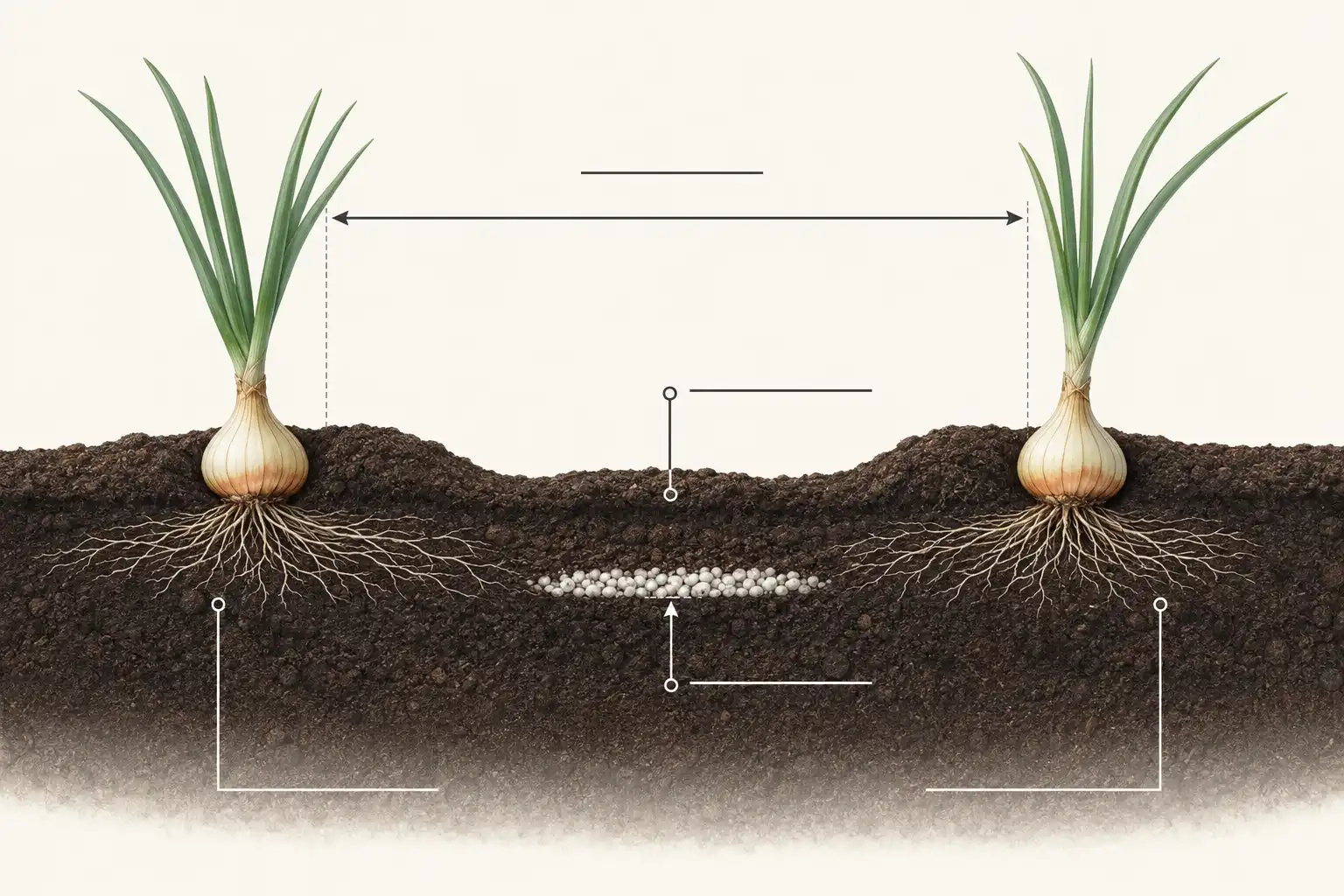
Nine inches looks too far from the plant. It is not. Onion roots run wide and shallow instead of deep. They spread well past the leaf canopy, yet they stay in that top 7 inches. They reach the band within a few days of watering. Placing granular any closer buys nothing and risks scorch, especially in July heat.
When to Stop Fertilizing Onions
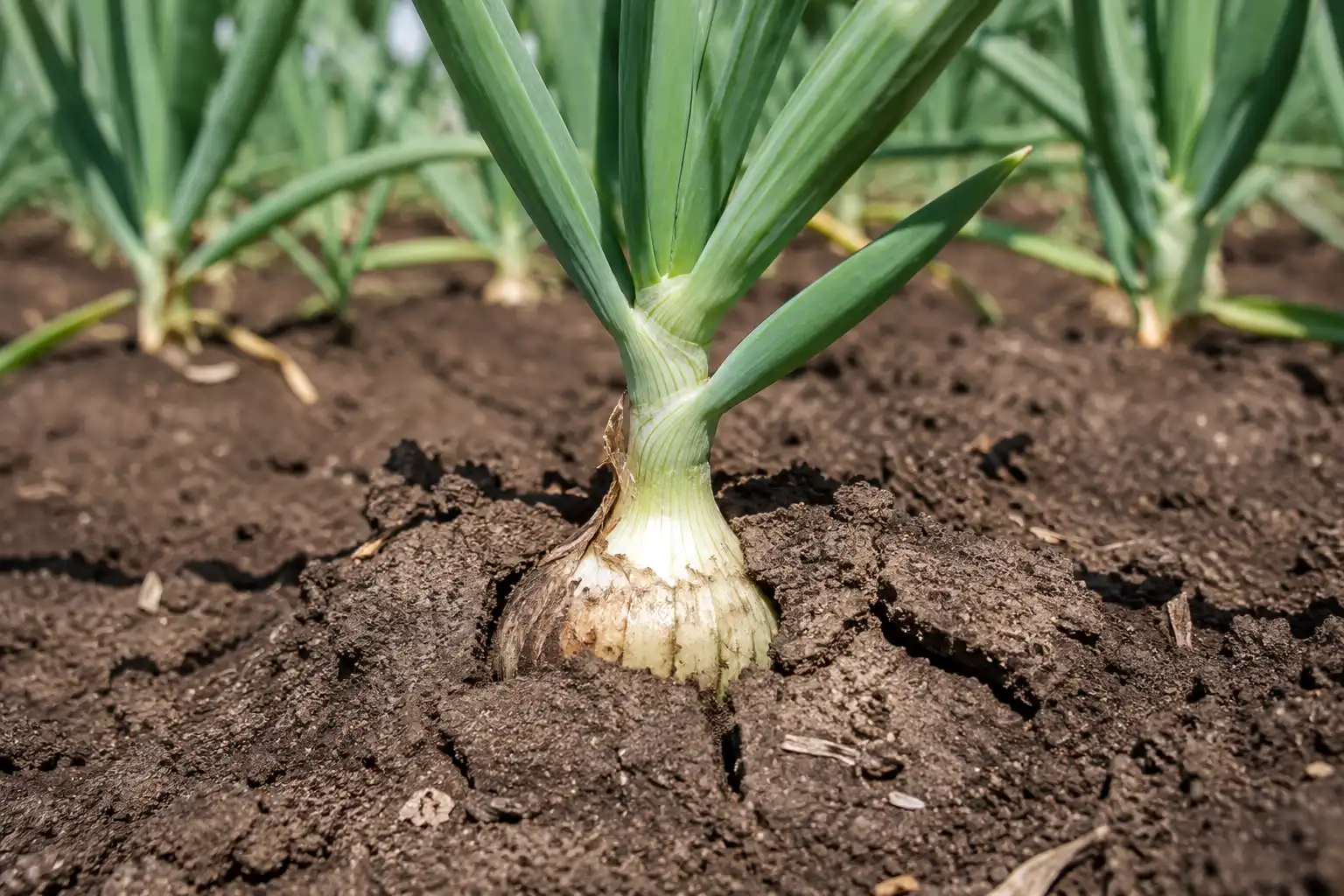
Stop fertilizing onions at bulb initiation. Day length triggers it, not the calendar, and the seventh leaf is your visible cue. Three signs show up together. The plant quits pushing new leaves. You feel a soft neck just above the bulb. Then the soil cracks around the swelling stem. That is your cutoff, roughly 4 to 5 weeks ahead of harvest.
Push nitrogen past that point and the plant reverses course. Excess late nitrogen causes thick necks and poor storage. The crop swings back into leaf mode instead of finishing bulbs. A thick neck holds water. It refuses to dry down during curing, which invites storage rot and early sprouting in the bin. NC State Extension points growers to harvest once 50% to 80% of tops have fallen over. A late feed pushes that signal back by weeks.
Onion Fertilizer Rates Per Acre for Field Growers
A workable onion fertilizer rate per acre runs 120 to 150 lb N per acre for the season. That matches NC State Extension guidance. Put 30% to 40% down preplant, then split the balance across the growing season.
Rate trials support staying near the low end. The University of Georgia Vidalia Onion Research center ran a two-year nitrogen trial in 2023 and 2024. They compared 80, 100, and 120 lb N per acre at three planting densities. The 100 to 120 lb rates produced the best dry weight yield in high-density plantings. Even 80 lb still covered basic nutrient uptake. Dixondale Farms works from a total program of 160-80-140 lb per acre, minus whatever your soil test already credits back.
Timing beats the total, though. UC Davis uptake work shows onions absorb under 20% of season nitrogen before the three-leaf stage. After that, uptake climbs to 1.5 to 3.5 lb N per acre per day. That is the whole case for split application or fertigation over one heavy preplant shot. USDA and NRCS nutrient planning builds around rate, timing, placement, and source. A split satisfies all four while protecting bulb yield. Growers in the Columbia Basin often push totals near 160 lb, counting preplant nitrate. Pacific Northwest trials showed yield falling off above that mark.
Best Fertilizer for Onions in Containers and Raised Beds
The best fertilizer for onions in containers is a slow or controlled release granular at planting. Follow it with a half strength water soluble every two weeks. Pots leach hard, so a field schedule starves them.
Give each group of three plants a pot at least 10 inches deep and 10 inches across. A soilless mix of peat and perlite holds very little cation exchange capacity. That means leaching carries nitrate out the drain holes with every watering. Field soil keeps a reserve on hand for you, while peat and perlite keep almost none.
Espoma Organic Garden-Tone makes a safe base at planting and will not burn a young transplant. At 3% nitrogen it cannot carry the crop alone, so Jack’s Classic 20-20-20 does the nitrogen work between rounds. Quarter strength is plenty, near a quarter teaspoon per gallon.
A raised bed sits between pot and field. Feed it on the field schedule, then add one extra round if your mix runs above 30% compost.
Onion Nutrient Problems and How to Fix Them
Read the leaves before you read the label. Onion symptoms point to specific fixes, and guessing burns a whole season.
| What you see | What it means | What to do |
|---|---|---|
| Older leaves yellowing from the tip back | Nitrogen deficiency | Side dress 21-0-0 at a half cup per 10-foot row now, then water in |
| Pale new center growth while older leaves stay green | Iron lockup at high pH | Check pH. Above 7.0, work in elemental sulfur and spray an iron chelate as a stopgap |
| Heavy tops, small bulbs, fat necks | Too much nitrogen, too late | Cut nitrogen completely and finish with 0-0-22 |
| Split bulbs or doubles | Uneven moisture plus a nitrogen surge | Even out irrigation. Never follow a dry spell with a heavy feed |
| Interveinal chlorosis on mid-age leaves | Magnesium shortage | Apply langbeinite, or Epsom salt at 1 tbsp per gallon as a drench |
| Twisted, streaked new leaves with stunted tops | Zinc shortage, often from phosphate buildup | Spray a chelated zinc, and stop adding phosphate |
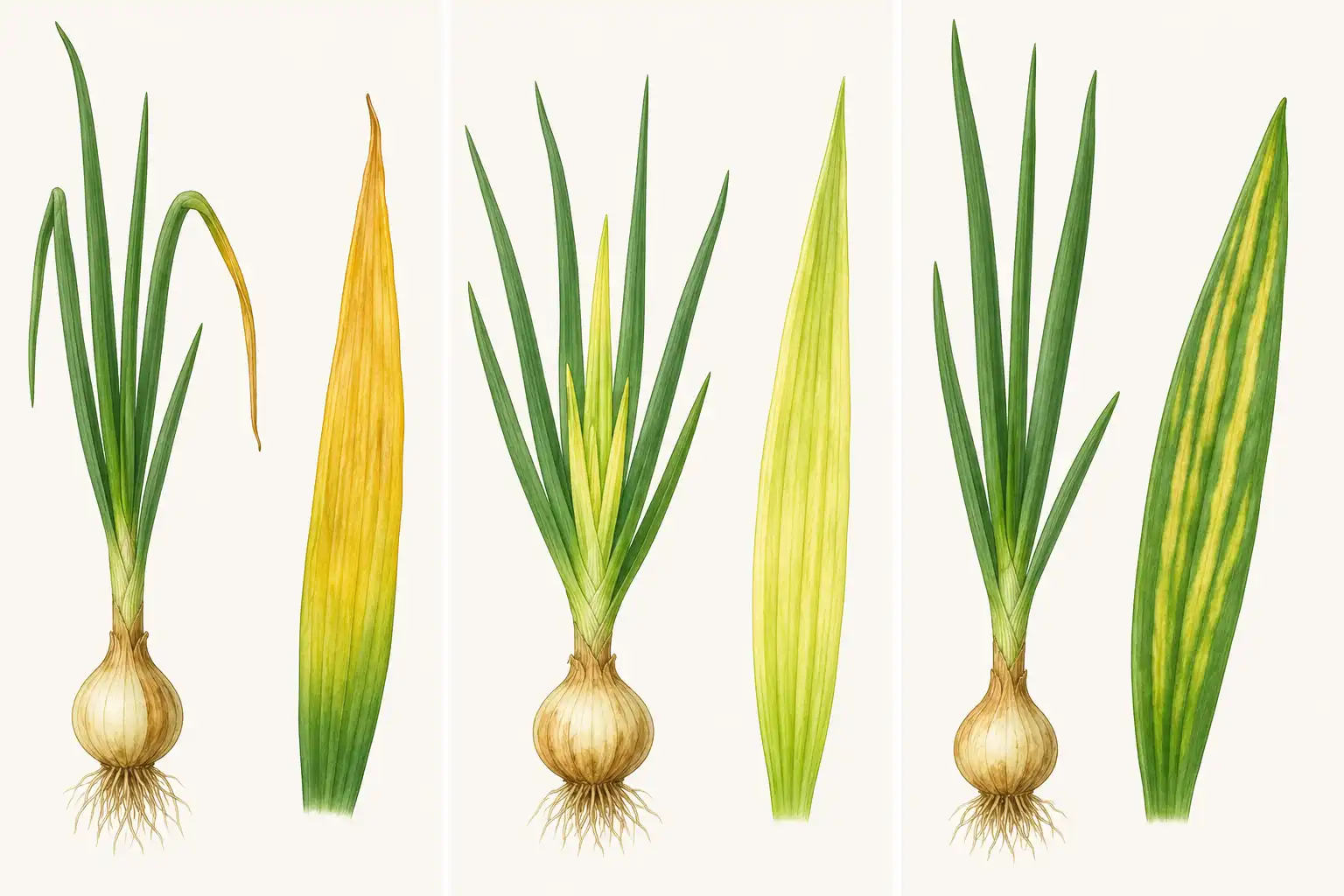
Nitrogen shortage is the most common of these, and it corrects fastest. Color returns within a week of a side dress. Iron lockup fools people, because the plant looks hungry while the soil holds plenty of iron. High pH simply ties it up, and the same trap catches manganese and zinc. Our notes on micronutrient shortages in crops help sort those apart.
Split bulbs almost always trace to water rather than fertilizer. Two dry weeks followed by heavy irrigation and a side dress will crack bulbs wide open.
When symptoms conflict, run a tissue test on the tallest leaf from 20 to 30 plants. A tissue test reports what the plant actually took up, which no soil test can tell you.
Fertilizer Mistakes That Cost You Bulb Size
- Feeding nitrogen past bulb initiation. That is over fertilizing at the worst possible moment. Quit the day the neck softens.
- Skipping the soil test and stacking phosphate. Repeat 10-10-10 rounds create phosphorus buildup that ties up zinc. Test first, then buy.
- Broadcasting granular across wet foliage. Salt sticks to damp leaf bases and causes foliage burn overnight. Band it in a furrow instead.
- Using fresh manure. Fresh manure releases nitrogen on its own timeline and often keeps feeding right through bulb fill. Compost it a full season first.
- Buying a chloride grade with no sulfur. Muriate of potash dumps salt on a salt-sensitive crop, and a plain 10-10-10 does nothing for flavor. Choose sulfate forms like ammonium sulfate or langbeinite.
FAQs on Onions Fertilizer
What is the best fertilizer for onions?
Is 10-10-10 good for onions?
What is the best fertilizer for garlic and onions?
How often should I fertilize onions?
Is ammonium sulfate or urea better for onions?
Is blood meal good for onions?
Can too much nitrogen ruin onions?
Is Epsom salt good for onions?
Is compost enough to grow big onions?
Final Words on Onion Fertilizers
For most growers the best fertilizer for onions is straight ammonium sulfate at 21-0-0. Side dress every 2 to 3 weeks, starting three weeks after planting. Jobe’s Organics All Purpose handles the same work on a certified organic bed, turned in at bed prep.
One rule beats every product choice. Push nitrogen hard until bulb initiation, then quit cold. Across the Great Plains that usually means an early June cutoff for spring-planted rows. Onion fertilizer timing sets your bulb size. The bag only sets your cost.