Best Fertilizer Spreader in 2026: 8 Machines Compared
Streaked strips and burned patches trace back to how the granular fertilizer went down, not the bag. A wrong gate setting wastes urea and costs yield. So the best fertilizer spreader for your ground matters more than the label. Below are the picks by acreage, judged on even coverage.
The best fertilizer spreader is the Earthway 2150. Its enclosed gearbox and 13-inch pneumatic tires hold a steady spread pattern on rough ground. For acreage, run the Agri-Fab 45-0463 pull behind. For beds, pick the Scotts EdgeGuard Mini.
Top Fertilizer Spreader Picks at a Glance
- Best Overall: Earthway 2150 Commercial Broadcast Spreader
- Best Built for Salt and Lime: Brinly P20-500BHDF Push Spreader
- Best for Beds and Small Plots: Scotts Turf Builder EdgeGuard Mini
- Best for Half an Acre to Two Acres: Agri-Fab 45-0463 Pull Behind Broadcast Spreader
- Best for Precise Placement: Agri-Fab 45-0288 Tow-Behind Drop Spreader
- Best for Food Plots: Buyers Products ATVS100 ATV Broadcast Spreader
- Best for 10 Acres and Up: Farm Star 3-Point PTO Spreader
- Best Budget Spot Tool: Chapin 25 lb Handheld Seed and Fertilizer Spreader
The 8 Best Fertilizer Spreaders: Reviews
Reviews run in the order we would recommend them, grouped by the job they do best. Skip to the type that matches your acreage.
1. Earthway 2150 Commercial Broadcast Fertilizer Spreader
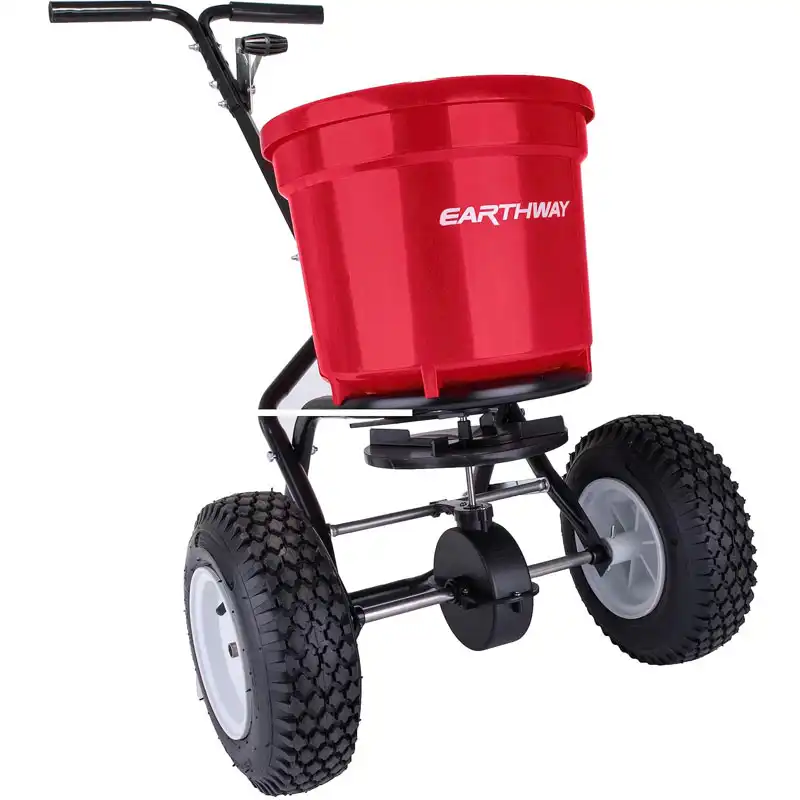
EarthWay Products has built spreaders in Bristol, Indiana since 1965, and the 2150 is the walk-behind most. The frame is powder-coated tube steel. What sets it apart is the patented Even-Spread 3-hole drop system, which feathers the pattern edge instead of cutting it off hard. That is what kills striping. Side-spread control shuts one side down, keeping product out of ditches. Best for garden ground and small plots, especially if you rotate urea, pelletized lime, and rock salt.
Specifications
- 50 lb rustproof poly hopper
- Fully sealed enclosed gearbox
- Stainless steel gate linkage
- Lifetime technical support included
2. Brinly P20-500BHDF Push Spreader
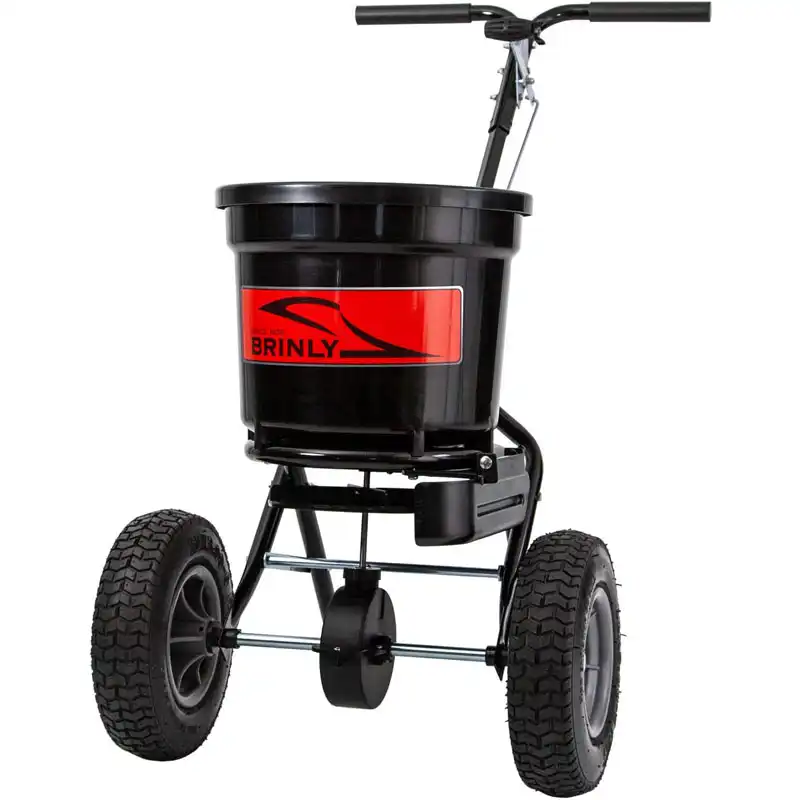
Brinly-Hardy has been making implements since 1839 and builds this one in Jeffersonville, Indiana. Corrosion resistance is the draw here. The shaft, agitator, and hardware are stainless steel, and the enclosed gearbox is rust-resistant. So this is what it helps to pick for rock salt and ice melt over anything with painted internals. A hopper screen breaks clumps, and the on/off runs on a solid rod rather than a cable. Best for heavy granular work up to half an acre.
Specifications
- Stainless steel shaft and agitator
- Fully enclosed rust-resistant gearbox
- 12-inch pneumatic turf-tread tires
- Clear rain cover included
3. Scotts Turf Builder EdgeGuard Mini Broadcast Spreader
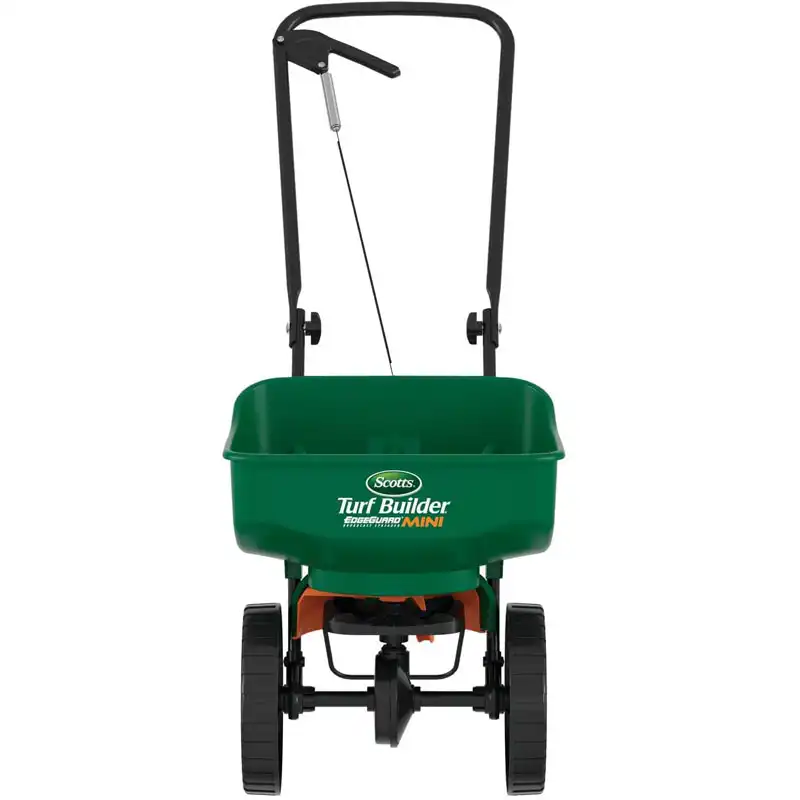
The Scotts Company ships this one pre-calibrated, no assembly needed. Snap the wheels on and go. The rate dial runs 1 through 14, and Scotts prints matching numbers on their own bags, so it is the easiest unit here to set. EdgeGuard closes the right side of the pattern, keeping product off driveways and beds. A curved hopper with a dual-bladed agitator keeps light material moving. Best for raised beds, borders, and lawn areas under 5,000 sq ft.
Specifications
- Covers up to 5,000 sq ft
- Curved hopper, dual-bladed agitator
- Numbered rate dial, 1 to 14
- Fold-down handle for storage
4. Agri-Fab 45-0463 Pull Behind Broadcast Spreader for Seed, Fertilizer
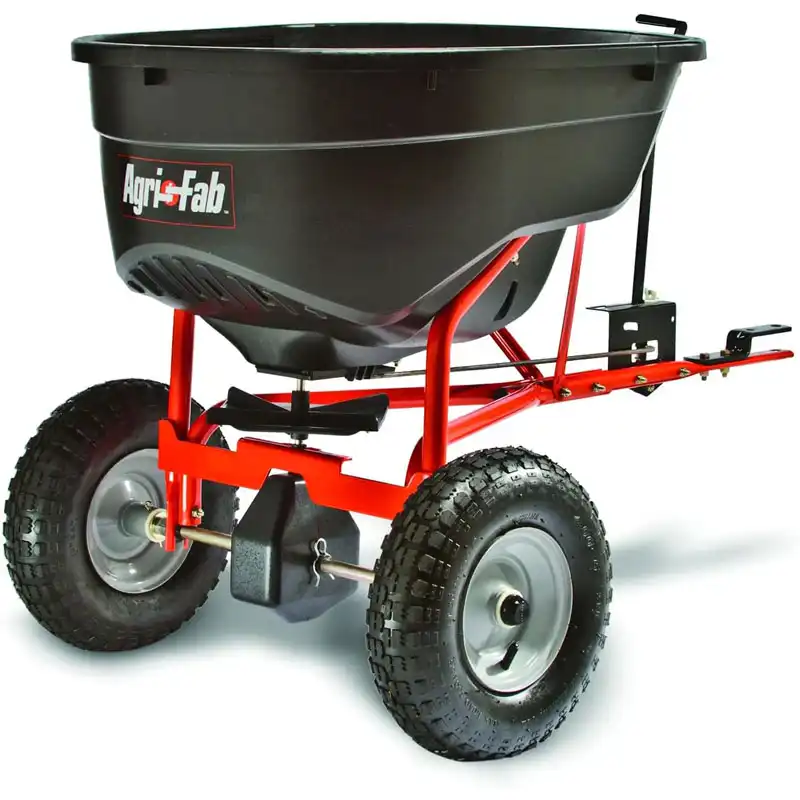
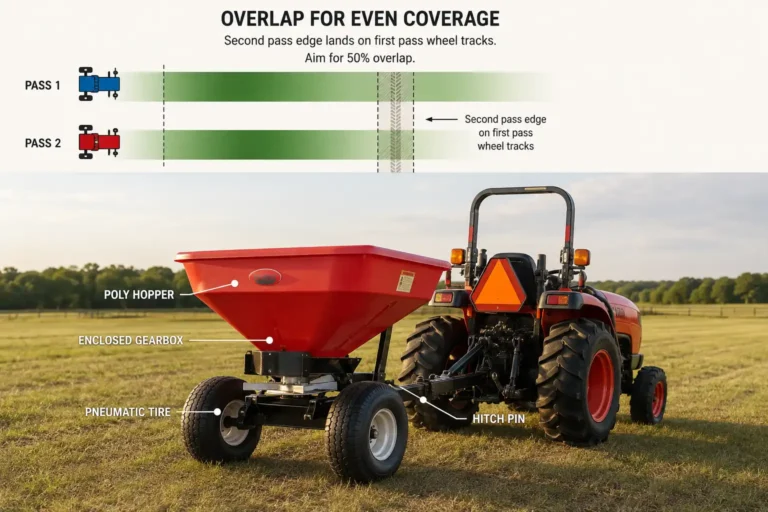
Agri-Fab builds this in Sullivan, Illinois, and it is the step up once pushing stops making sense. The 130-pound hopper covers about 25,000 sq ft per fill at a 10 to 12 foot spread pattern. The universal hitch fits most garden tractors. Flow control is a steel rod you reach from the seat, the whole point of going tow-behind. On a zero-turn, though, that rod sits awkwardly, and owners rig extensions to reach it. Best for half an acre through two acres.
Specifications
- 1-inch welded steel tubing frame
- Enclosed removable gearbox
- 13 by 4 inch pneumatic tires
- Three-year limited warranty
5. Agri-Fab Tow Behind Lawn and Garden Drop Spreader
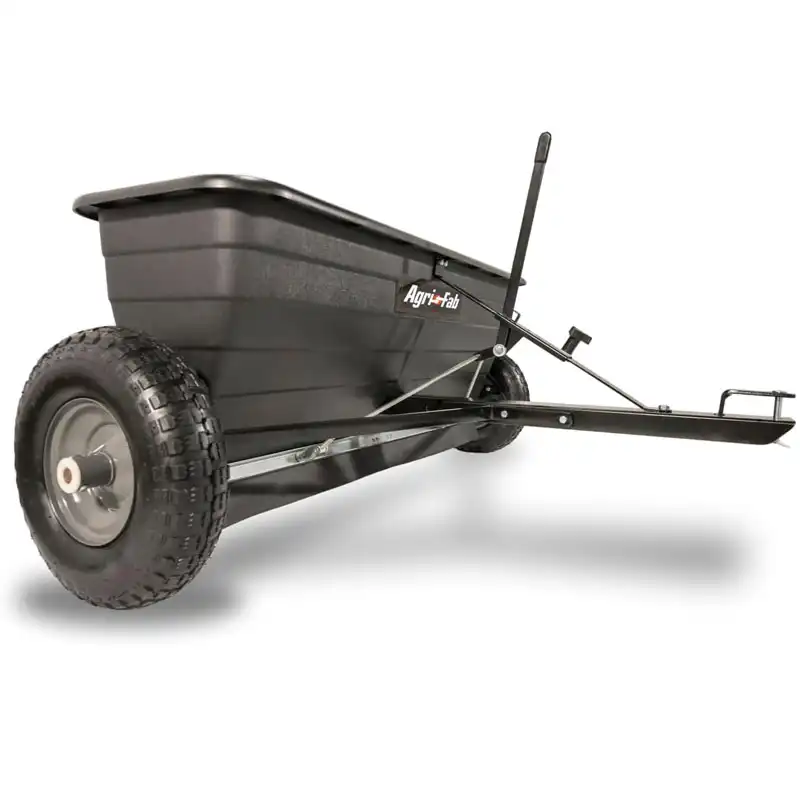
Material falls straight down across a 42-inch band, so nothing throws sideways at all. That makes it the right tool near ponds, ditches, and beds, where one stray granule ends up in the water. The 175-pound poly hopper covers close to an acre per fill, and a galvanized steel agitator keeps flow moving. Rate is set with separate left and right screws, which is the weak spot, since matching them takes patience. Best for seeding and fertilizer where placement beats speed.
Specifications
- 175 lb rustproof poly hopper
- 42-inch controlled drop width
- Galvanized steel agitator
- 12 by 3.5 inch pneumatic tires
6. Buyers Products ATVS100 ATV Broadcast Spreader
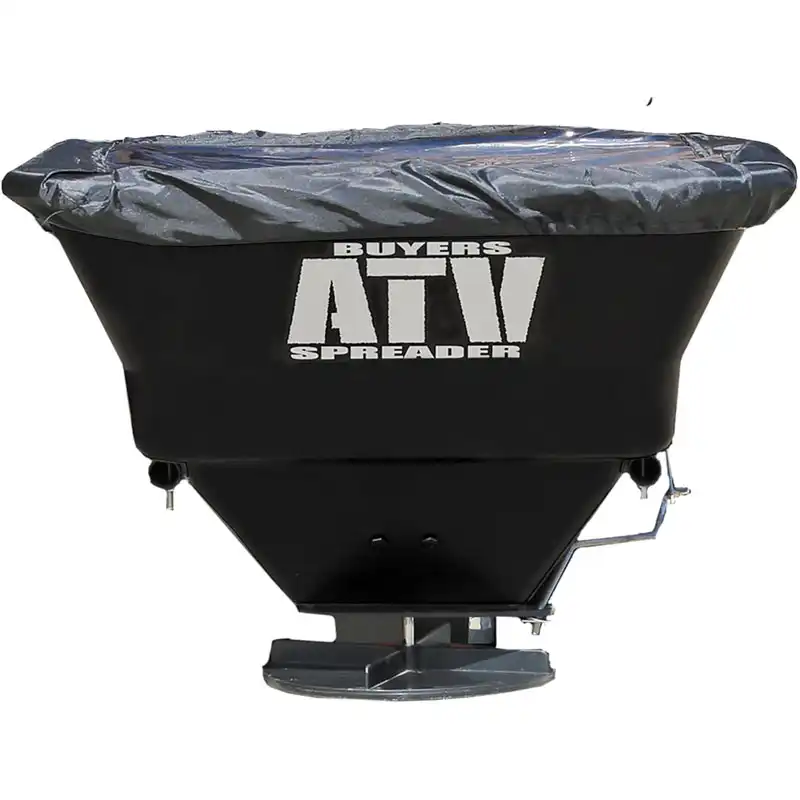
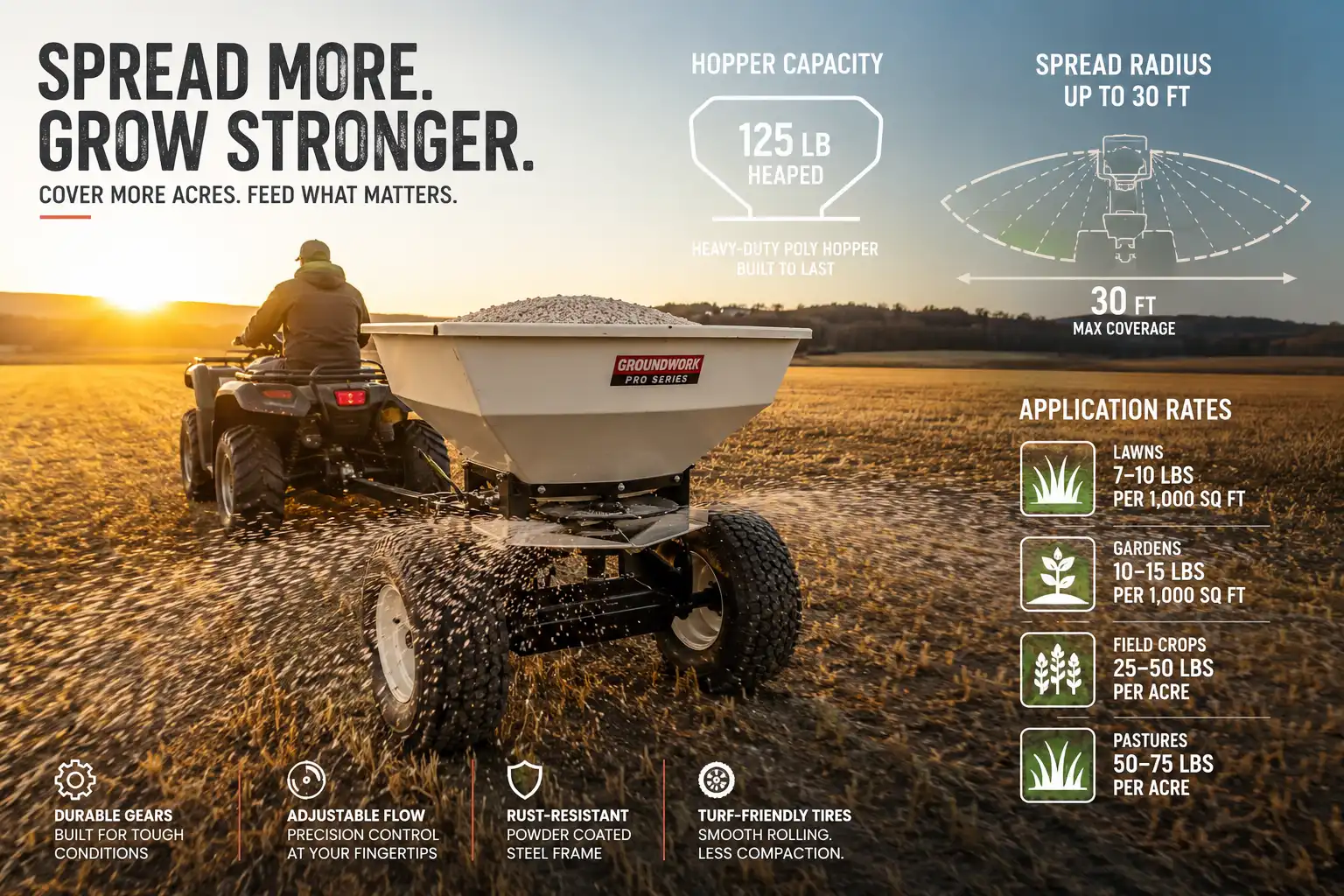
Buyers Products makes this rack-mount 12V unit, and the motor is the reason to buy it. The impeller runs off ATV power, so rate holds steady when a tire slips or you crawl through a wet spot. Ground-drive units lose rate right there. An inline switch on the cord shuts it off from the seat. Rated width is 30 feet, but plan on well under that. The outer edge of the pattern lands too thin to count. Best for food plot and pasture work.
Specifications
- 100 lb polyethylene hopper
- Enclosed 12V drive motor
- Manual feed gate regulator
- Limited lifetime warranty
7. Farm Star 3-Point PTO Spreader
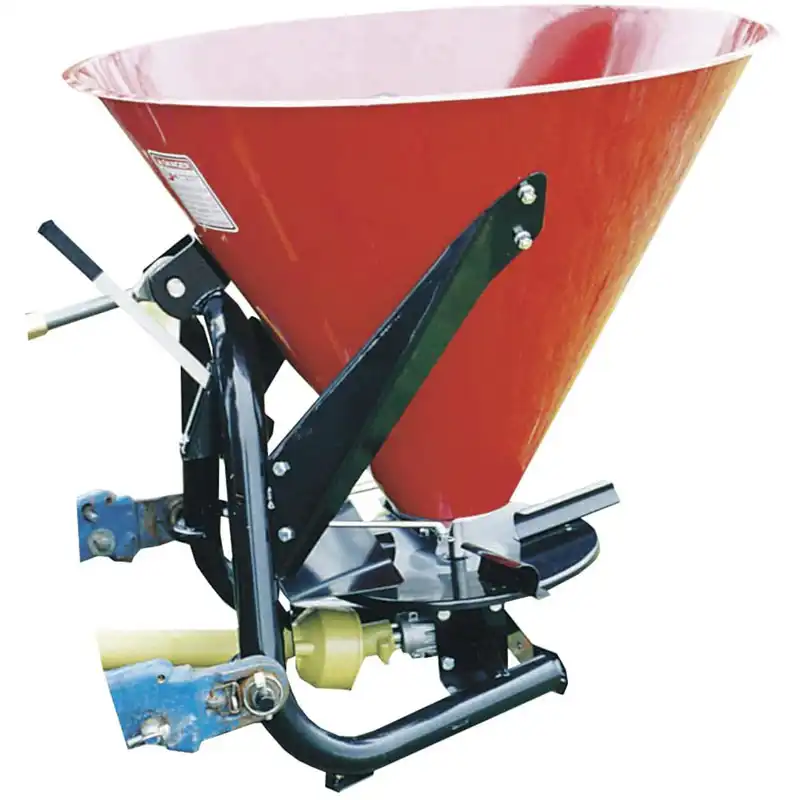
Farm Star builds this Category 1 three-point hitch unit, and the steel cone hopper holds 500 pounds. The power take-off driveline comes attached, so the spinner holds its speed no matter how fast you drive. Adjustable spinner fins set the width, and owners report 15 to 40 feet. Add the optional agitator if you spread pelletized lime, because damp lime bridges over the gate.
Specifications
- 500 lb steel cone hopper
- Enclosed industrial-grade gearbox
- Category 1 three-point mount
- Optional agitator, part 420758
8. Chapin 25 lb Handheld Seed and Fertilizer Spreader
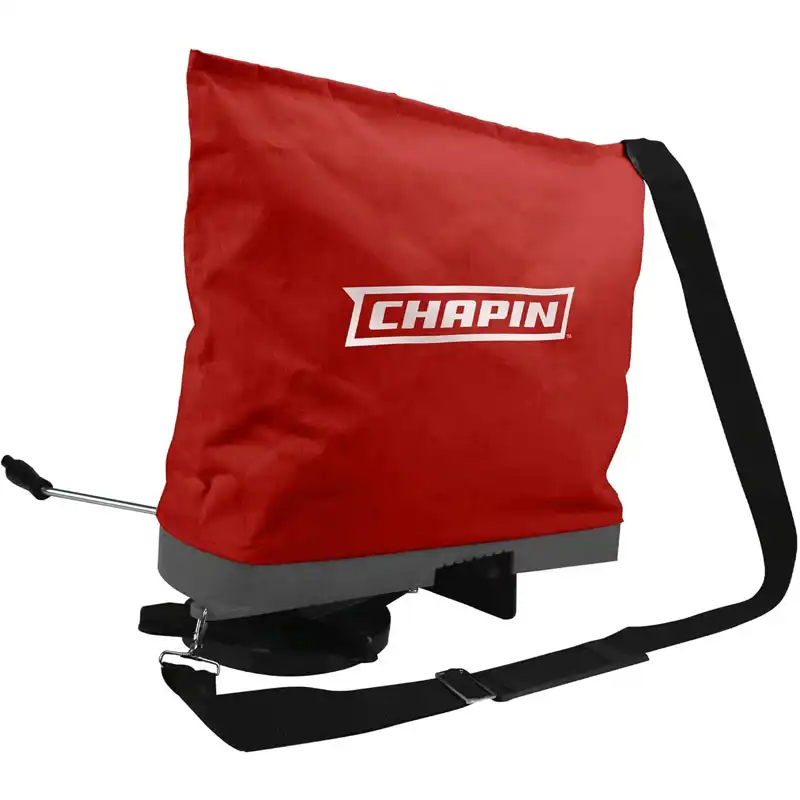
Chapin International designs this bag seeds spreader in Batavia, New York. A hand crank throws 5 to 18 feet depending on crank speed. An application chart is printed on the bottom. Best use is cover crop seed, clover, and grass seed in spots a wheel will not reach. Read the label first, though. Chapin says keep salt, sand, pelletized lime, and lime powder out of it, and owners report gears stripping early. Treat it as an occasional seed tool.
Specifications
- Enclosed, weather-protected gear system
- Adjustable gate with printed chart
- Stationary rear baffle
- Two-year limited warranty
Fertilizer Spreader Comparison Chart
| Model | Type | Capacity | Rated spread width | Warranty |
|---|---|---|---|---|
| Earthway 2150 | Push broadcast | 50 lb | 40 ft | Lifetime tech support |
| Brinly P20-500BHDF | Push broadcast | 50 lb | 8 ft | 1 year |
| Scotts EdgeGuard Mini | Push broadcast | 5,000 sq ft | 5-8 ft | 1 year |
| Agri-Fab 45-0463 | Tow-behind broadcast | 130 lb | 10 to 12 ft | 3 years |
| Agri-Fab 45-0288 | Tow-behind drop | 175 lb | 42 in | 3 years |
| Buyers ATVS100 | ATV 12V broadcast | 100 lb | Up to 30 ft | Limited lifetime |
| Farm Star 420700 | Three-point PTO | 500 lb | 15 to 40 ft | Limited |
| Chapin 84700A | Handheld bag | 25 lb | 5 to 18 ft | 2 years |
Types of Fertilizer Spreaders and Which One Fits Your Ground
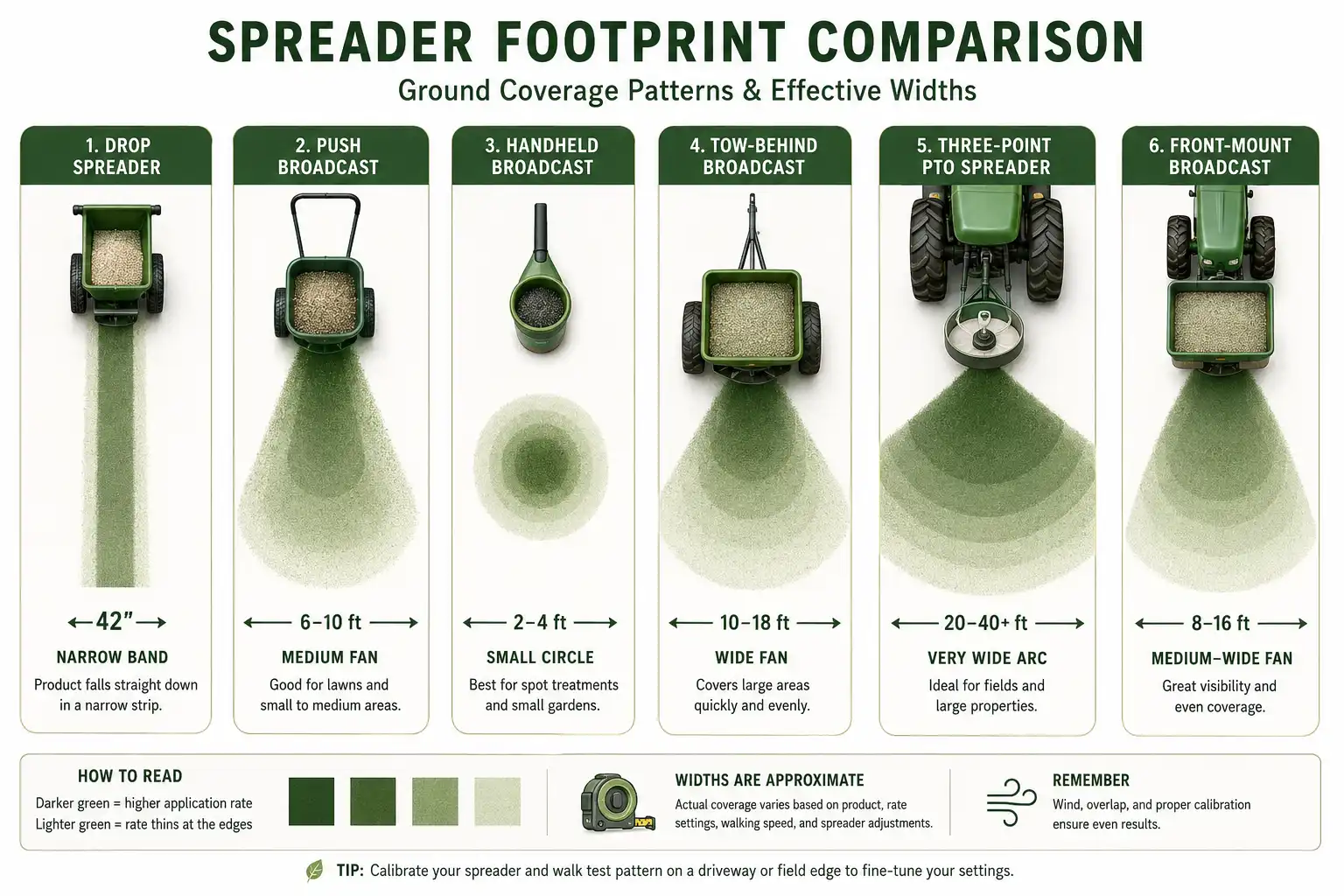
Six machine types cover almost every job, and picking the wrong one is the most common mistake. Match the type to your acreage first, then worry about brand. The best fertilizer spreader for a half-acre garden is the wrong tool for 40 acres of pasture.
Broadcast (Rotary) Spreaders
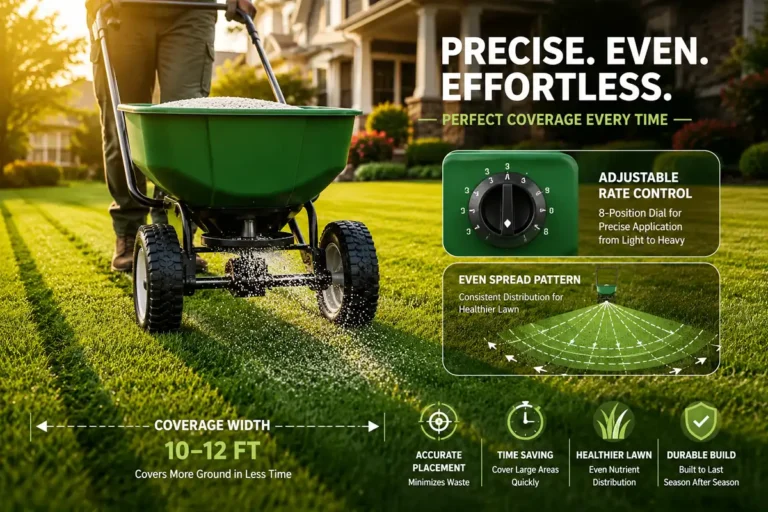
A spinning disc throws product 6 to 12 feet wide. That makes it the fastest walk-behind option, since it covers three or more times its own width per pass. The impeller does the work, so an even feed to the disc matters. Weak spots are tight corners and anything near flower beds. Use this when you have open ground and want to move.
Drop Spreaders
Product falls straight down between the wheels, so precision is the highest of any type. Nothing throws onto sidewalks, waterways, or beds. The tradeoff is speed, and any skipped overlap shows up as a green stripe two weeks later. These drop spreader picks cover the models that hold a clean edge. Use this when edges and precision beat coverage speed.
Handheld and Chest-Mount Spreaders
These hold 5 to 20 pounds and work as a spot tool. Gaps, small beds, and anything under 1,500 sq ft fit here. A chest-mount unit with a hand crank will cover a quarter acre if you are patient. Use this when the job is small or the ground is too rough to push a wheel.
Tow-Behind Spreaders
A tow-behind holds 130 pounds and up, hitches universally, and puts the flow lever within reach of the seat. That last part matters more than capacity, because you can shut the gate at the headland without stopping. Half an acre and larger is the sweet spot. The tow-behind broadcast options go deeper on hitch fit and hopper sizing.
ATV and UTV 12V Spreaders
These mount to a rack or receiver and run an electric impeller off the battery. Best use is food plot work, pasture overseeding, and hunting ground where a tractor will not go. Rate stays put because the motor spins at a set speed regardless of ground speed. Most throw a full 360 degrees, though, so expect product on the machine and on you.
Three-Point PTO Spreaders
A Category 1 three-point hitch unit driven off the power take-off is the step up nobody talks about. Hopper sizes run 350 to 1,000 pounds. Because the disc spins at PTO speed rather than ground speed, your rate does not drift when you slow for a turn. Real field capacity lands at 5 to 40 acres in an afternoon.
Look for a poly or stainless hopper, a mechanical agitator over the outlet, and a gate with numbered stops. The agitator matters most with pelletized lime, which bridges over an open outlet on damp mornings. Spread width runs 20 to 50 feet depending on disc speed and granule size. So set your tramlines off a pattern test, not the manual. Run the PTO at rated speed, usually 540 rpm. Dropping to 400 rpm narrows the swath width and stacks product under the tractor.
| Area to cover | Spreader type |
|---|---|
| Under 1,500 sq ft | Handheld |
| 1,500 sq ft to 1/4 acre | Chest-mount or small push |
| 1/4 to 1/2 acre | Walk-behind broadcast |
| 1/2 to 2 acres | Large push or tow-behind |
| 2 to 10 acres | Tow-behind or ATV 12V |
| 10 acres and up | Three-point PTO |
What to Look For in a Fertilizer Spreader
Eight things separate a spreader that holds rate from one that streaks. The last three are where most buying guides stop short.
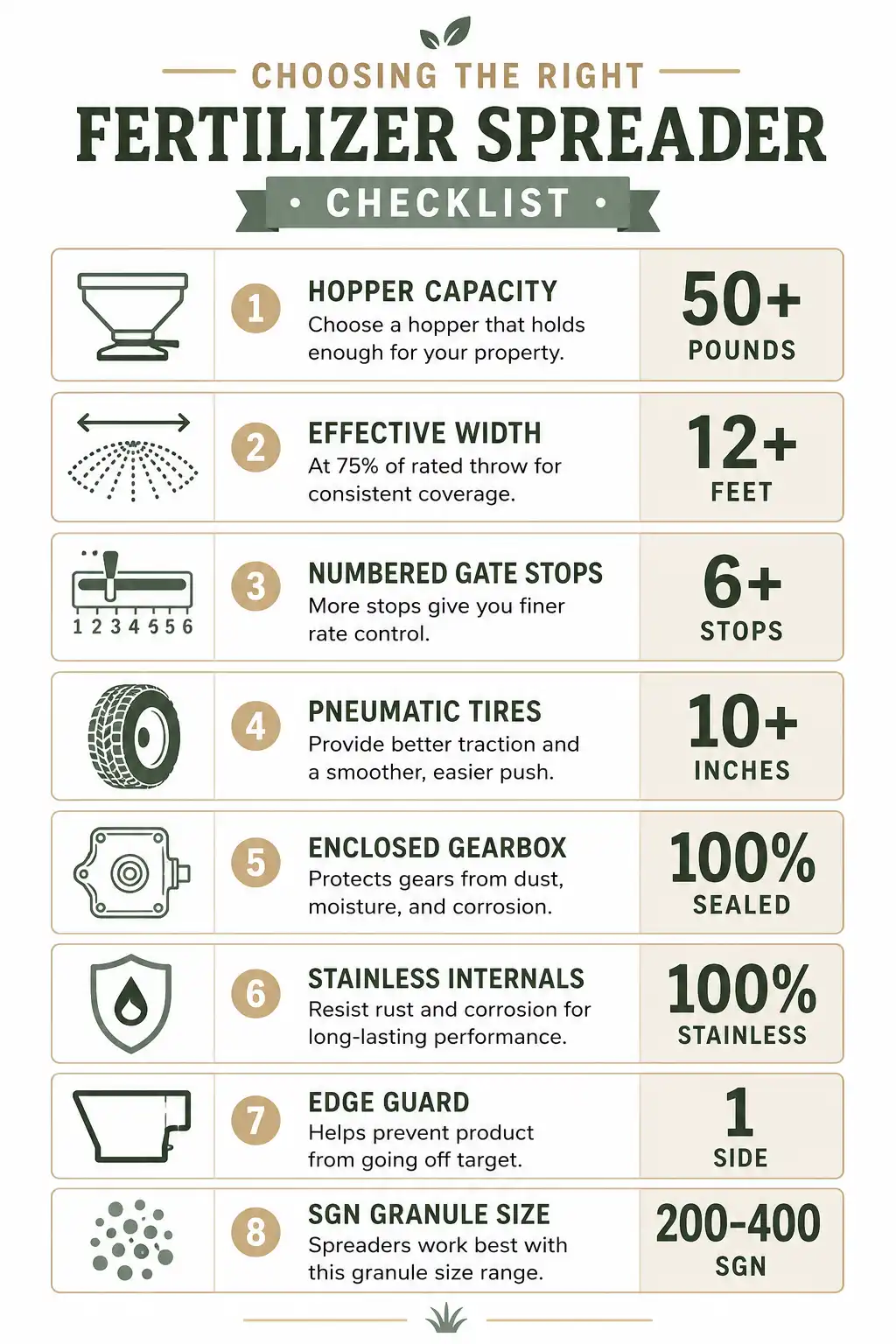
Hopper Capacity and Refill Timing
Match it to your area so you refill at the headland, not mid-pass. A 50-pound poly hopper covers roughly 15,000 sq ft at turf rates, about a third of an acre. At field rates near 200 pounds per acre, that same hopper covers a quarter acre. Stopping mid-pass to reload almost always leaves a heavy spot.
Rated vs Effective Spread Width
Rated width is total throw. Effective spread width is the band where the rate still carries. LSU AgCenter puts effective width at 70 to 85 percent of total throw on a good unit. On a poor one it drops under 20 percent. University of Kentucky uses 75 percent as a working rule. Only a pattern test gives you your number.
Flow Gate and Calibration Settings
Numbered stops repeat season to season. A sliding lever with no detents does not. Look for a gate that can be set to “7” next spring and trust. Watch the low end, though. Light material like grass seed often will not flow at all on the lowest stops, so run a mid-range gate and walk faster instead.
Pneumatic vs Hard Plastic Tires
Pneumatic tires roll over clods and hold traction. Hard plastic wheels skid, and on a ground-drive broadcast unit a skidding tire slows the disc while you keep walking. That drops the rate right where the ground is roughest.
Enclosed vs Open Gearbox
An enclosed gearbox keeps urea dust and lime out of the gears. Open gears pick up dust, grind, and seize by the second season. This single feature separates commercial units from box-store models.
Poly, Stainless, or Powder-Coated Steel
Poly will not rust, which is why nearly every good hopper uses it. Stainless steel frames cost more and last longest. Powder-coated steel works fine until a chip exposes bare metal. Then ammonium sulfate (21-0-0) or road salt eats that spot fast.
Edge Guard and Side Deflector
A side deflector or edge guard blocks the outboard third of the pattern. That keeps product out of ditches and off pavement. Placement is one of the four Rs in 4R Nutrient Stewardship. NRCS conservation practice 590 also warns against surface applying where runoff can carry nutrients off.
Granule Size (SGN) and Bulk Density
SGN is average granule diameter in millimeters times 100, so SGN 300 means 3 mm granules. Ohio State reports urea at 4.7 mm throwing 65 feet, while 1.7 mm urea reached only 33 feet. So one gate setting gives three different widths across straight 46-0-0 urea, pelletized lime, and a blended 10-10-10. Keep blend SGNs within 10 points or the load segregates. Bulk density matters too, since lime and DAP (18-46-0) run heavier per cubic foot than urea.
How to Calibrate a Fertilizer Spreader
Calibrating a fertilizer spreader takes about twenty minutes and pays for itself the first pass. Here is the extension method, not the bag-label shortcut.
- Get your target rate from the soil test. Write it down in pounds of product per 1,000 sq ft and per acre. A current soil test kit or a lab report from your extension office gives you the number. Skip this and everything after it is guesswork.
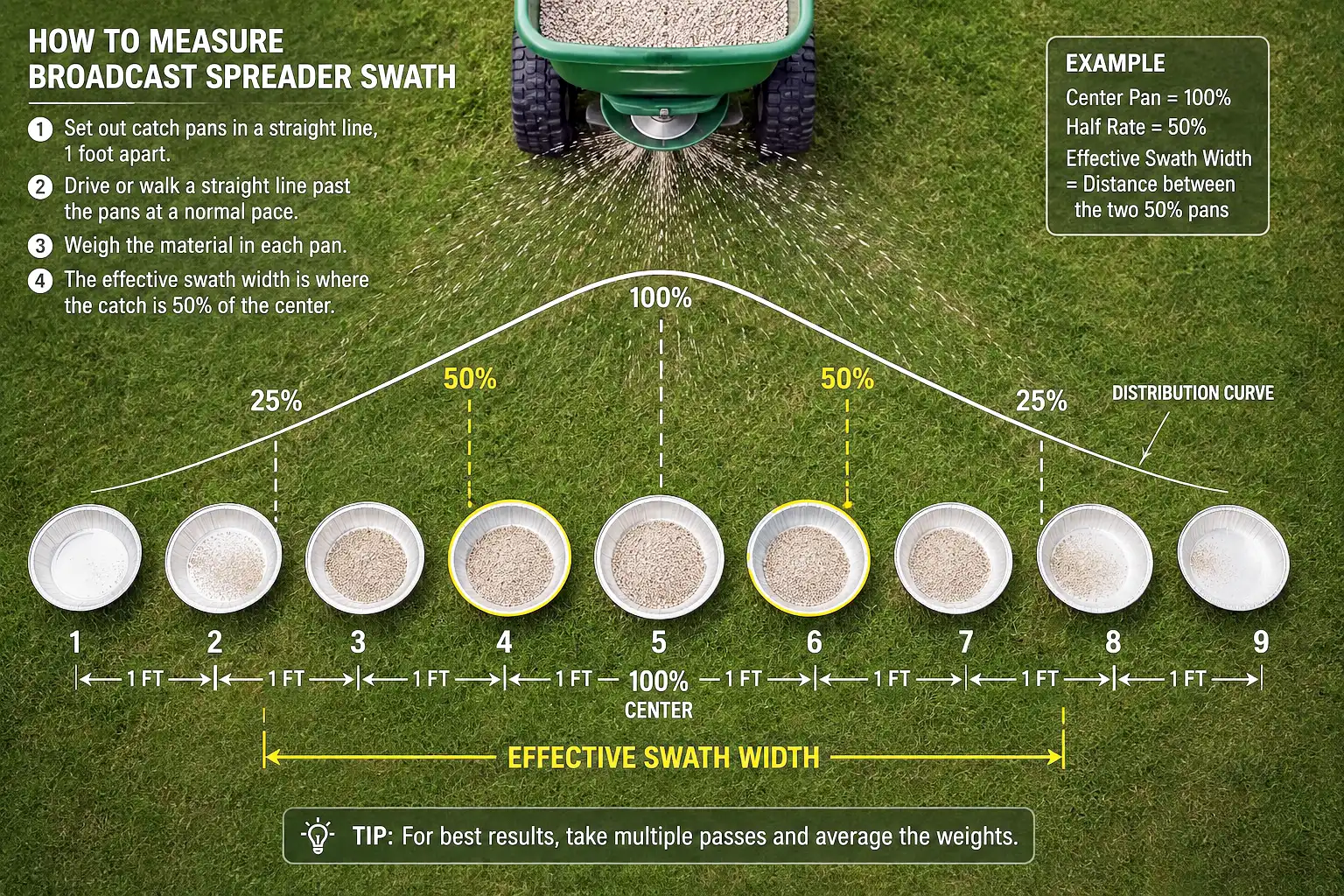
- Find effective swath width. Set shallow pans one foot apart in a line across the pattern, then make a pass over the center pan. Weigh each pan. Effective width is twice the distance from center to the pan holding half the center weight. UMass Extension and NC State Extension both use this exact half-weight rule.
- Mark a test strip that equals a known area. A 3-foot drop width needs 33 feet 4 inches to make 100 sq ft. A 12-foot effective width needs 83 feet 4 inches to make 1,000 sq ft.
- Set the gate to the label starting point. Load a weighed amount, close the gate first, then walk your normal working pace. Penn State Extension is blunt about this, since label spreader settings assume roughly 3 mph and your pace may differ.
- Catch and weigh what came out. Use a catch pan under the hopper, or run the pass on clean concrete and sweep it into a dustpan. NC State notes pans work well for swath width but poorly for rate. So weigh the hopper before and after to get the rate number.
- Do the math and check against target. UMass calls a spreader calibrated when output lands within plus or minus 5 percent of the goal weight. Outside that, move the gate one stop and run it again.
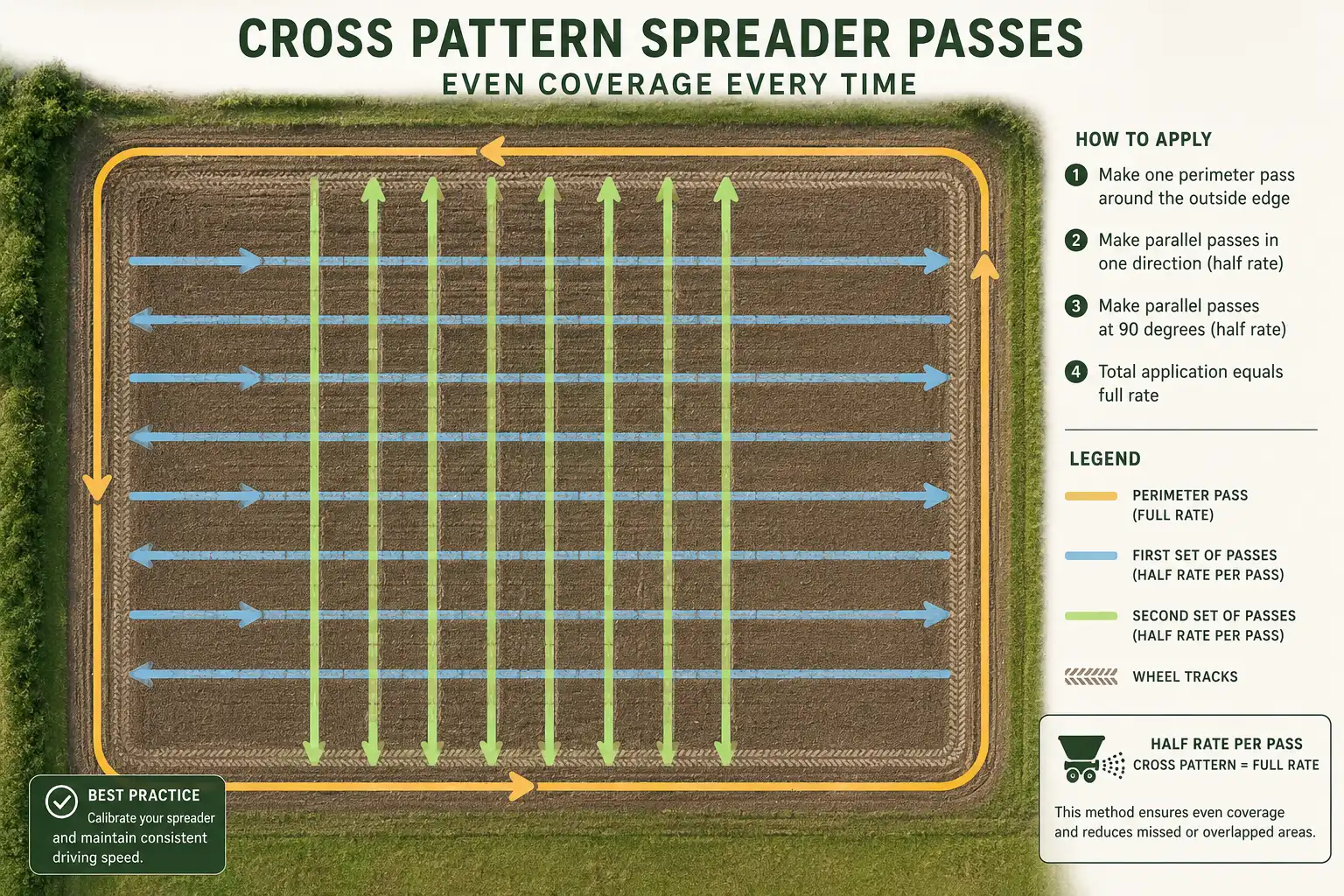
- Halve the rate before you cross-pass. Two passes at full rate double the dose, which is the most common calibration error. Set the gate for half, then cross at right angles.
Worked example. A rotary unit with a 12-foot effective width over a 60-foot strip covers 720 sq ft. At 4 pounds per 1,000 sq ft you should collect about 2.9 pounds. To calibrate in field terms, multiply the per-1,000 figure by 43.56 for lb per acre. That puts 4 pounds per 1,000 sq ft at about 174 pounds per acre.
Personal opinion. These procedures come from turf publications, because that is where the best documentation sits. The math and the pan work apply the same way to field crops, food plots, and garden beds.
How to Use a Fertilizer Spreader Without Streaks or Burn
Load half the rate and make two passes at right angles. That single habit prevents more streaking than any feature on the machine.
- Close the gate before you load. Every time.
- Load on a tarp or the driveway so spills are recoverable.
- Start walking before you open the gate, and close it before you turn.
- Overlap wheel track to wheel track on a broadcast unit. Go edge to edge on a drop unit.
- Run the perimeter pass first with the edge guard engaged, then fill the middle.
- Hold a steady pace, because rate climbs the moment you slow down.
What goes wrong most often:
- Spreading on wet foliage. Granules stick to leaves and cause fertilizer burn instead of feeding roots.
- Spreading right before heavy rain. A downpour moves granules off the field before they dissolve. Wait on a forecast showing a steady half inch, not a thunderstorm.
- Opening the gate while stopped. That dumps a pile you cannot spread back out.
- Broadcasting dry urea on hot bare ground with no incorporation. Penn State Extension reports up to a third of the nitrogen can leave as ammonia. Nitrogen volatilization starts within hours. You need half an inch of rain in one event, or tillage, to move it in. That risk peaks on no-till acres in the Great Plains. A quarter inch of scattered rain does more harm than none.
- Skipping the soil test. You cannot calibrate to a rate you never established.
Weather That Ruins a Spread Pattern
Wind and humidity move your rate more than any dial on the machine. Check both before you load.
Wind Limits for Granular Spreading
UGA Extension says stop spreading granular fertilizer and lime once wind passes 10 mph. Ohio State puts the practical ceiling at 15 mph. Side wind hurts more than a headwind, because it skews the pattern while your wheel tracks stay straight. Fine prills drift first, so urea and grass seed suffer before coarse lime does. Run the first pass with the wind, then cross at right angles.
Humidity and Damp Product
Granules that pick up moisture flow slower, so your rate drops at the same gate setting. A load that ran right at 7 a.m. can run light by mid afternoon on a muggy day. That is one more reason to weigh output instead of trusting the dial.
How Even Is Even Enough
ASABE S341.4 is the standard for measuring granular spreader uniformity. It scores patterns on coefficient of variation, and under 20 percent is acceptable for fertilizer. You will not compute CV out in the field. The pan test shows you the same thing, though. Pans that step down evenly from the center mean a usable pattern.
What Else a Fertilizer Spreader Can Apply
Most of these machines earn their keep four or five ways, not one. Here is what it handles:
- Granular fertilizer, which is the everyday job
- Pelletized lime and gypsum, to spread lime on a pH correction pass
- Grass seed and cover crop seed, which is why a seeds spreader and a fertilizer unit are often the same machine
- Granular pre-emergent herbicide, at half rate in two passes
- Granular insecticide for grub and armyworm control
- Ice melt and rock salt through the winter
- Screened compost, but only if the gate opens wide enough
Two cautions nobody prints on the box. Powdered lime, damp compost, and anything that bridges will pack solid in a small hopper. So stick to pelletized products unless the unit has an agitator. And rock salt eats unpainted steel faster than any fertilizer. Say you run cover crops on new ground and salt in January. Then buy stainless or poly, not painted steel.
Cleaning and Storing Your Spreader
Empty the hopper the same day you finish. Fertilizer draws moisture out of the air. Then wet residue rusts steel from the inside, where you cannot see it.
Then blow the gearbox, outlet holes, and gate slot out with compressed air. Wash the hopper and frame with soap and water. Dry it completely before it goes in the shed, because a damp hopper is worse than a dirty one. Last, put a few drops of oil on the gate linkage and the axle ends.
That linkage is the part that matters. A seized gate is the top reason a fertilizer spreader stops holding rate. Corrosion on the pivot is almost always why. Salt is harsher than fertilizer, so rinse after every single salt load, not just at the end of winter.
FAQs About Fertilizer Spreaders
What is the best fertilizer spreader?
How do you use a fertilizer spreader?
What spreader setting should I use?
Broadcast or drop spreader, which is better?
How do you clean a fertilizer spreader?
What size fertilizer spreader do I need for 5 acres?
Can you use a fertilizer spreader for grass seed and lime?
How do you spread fertilizer without a spreader?
When is the best time to apply granular fertilizer?
Bottom Lines about Fertilizer Spreader
For most operations the best fertilizer spreader is a commercial walk-behind with an enclosed gearbox and pneumatic tires. The Earthway 2150 suits garden ground. Past about two acres, a tow-behind is generally the better fit. Past ten, a three-point PTO unit stops being a luxury.
One habit beats every feature on this page. Calibrate once each spring against the actual product in the bag, not last year’s setting. Granule size changes between suppliers, and your gate does not know that.
Fair warning on scope. That section reflects aggregated owner reports rather than hands-on testing.