Micronutrient Deficiency in Plants: 5 High pH Traps and Easy Fixes

Micronutrient deficiency in plants is a nutrient shortage that disrupts growth, leaf color, flowering, and yield even when nitrogen, phosphorus, and potassium look fine. Plants need micronutrients in small amounts, but each one runs a high-impact job inside enzymes, chlorophyll formation, pollen, and cell walls. Deficiency shows up as patterned symptoms on new or old leaves, weak growing points, poor fruit set, or “off” color that fertilizer NPK does not fix. This guide covers the micronutrients, the field symptoms, the common causes, and practical correction steps.
What counts as a micronutrient, and why does it matter?
Micronutrients are essential mineral elements that plants use in small quantities to run key metabolic reactions. Commonly managed micronutrients include iron (Fe), zinc (Zn), manganese (Mn), copper (Cu), boron (B), molybdenum (Mo), chlorine (Cl), and nickel (Ni). Extension guides list these as micronutrients that can limit plant health and yield when unavailable in soil.
A micronutrient problem rarely looks like a simple “low level.” A soil can contain plenty of an element, but pH, moisture, temperature, compaction, and chemistry can lock it up so roots cannot take it in. Higher pH commonly reduces availability of boron, copper, iron, manganese, and zinc, while molybdenum behaves in the opposite direction.
Crop farming planting density matters because the right population balances sunlight capture with airflow and moisture use for your field conditions.
How do I tell micronutrient deficiency from disease, herbicide, or drought stress?
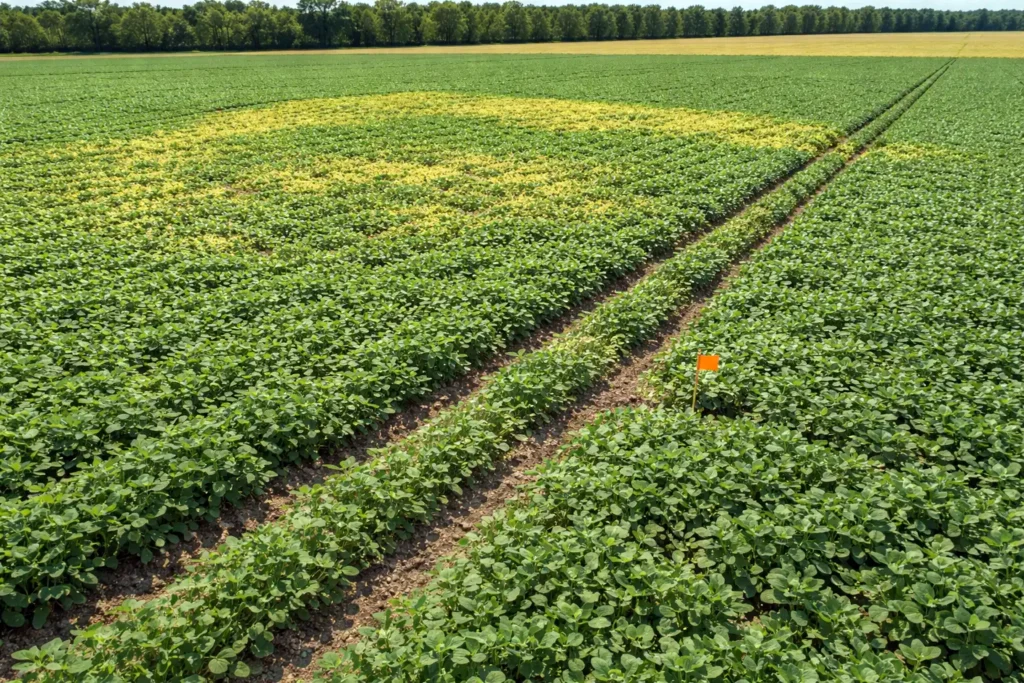
Micronutrient deficiency usually creates a repeatable pattern tied to leaf age, vein structure, and where symptoms start. A disease often produces spots, lesions, fuzzy growth, or a spreading patch pattern tied to infection. Herbicide injury often twists, straps, cups, or distorts leaves in a way that follows drift patterns or boom shutoffs. Drought stress often rolls leaves, dulls color, and reduces growth without the crisp interveinal chlorosis patterns you see with iron or manganese.
Start with three checks before you buy product:
- Pattern check: Is it on certain soil types, ridges, wet holes, or high pH areas?
- Leaf age check: Are new leaves worse than old leaves, or the opposite?
- Management check: Recent liming, heavy phosphorus, manure, or a new herbicide program can shift availability.
When symptoms overlap, use a soil test and a leaf tissue test to confirm. University extension notes that accurate diagnosis often depends on testing because different deficiencies can look similar in the field.
For anyone still unsure about the difference between organic and synthetic fertilizer, a quick read through these soil fertility basics helps match inputs to pH and uptake problems like micronutrient lockup.
Which leaves show symptoms first, and why does leaf age matter?
Leaf age matters because nutrient mobility inside the plant changes where symptoms appear.
- Low mobility micronutrients show first on new growth because the plant cannot move enough from old leaves. Iron and boron commonly behave this way in many crops.
- More mobile nutrients can show on older leaves first because the plant reallocates them to new growth when supply runs short.
This is not a perfect rule for every crop and every micronutrient form, so use it as a sorting tool, not a final diagnosis.
When you compare drip and sprinkler irrigation, use the practical notes in irrigation and water management to keep moisture steady so roots can take up micronutrients instead of showing stress symptoms.
What are the most common micronutrient deficiencies and their field symptoms?
Below is a practical “walk-the-field” symptom guide. Use it to narrow your guess, then confirm with testing when dollars or yield are on the line.
What does iron deficiency look like?
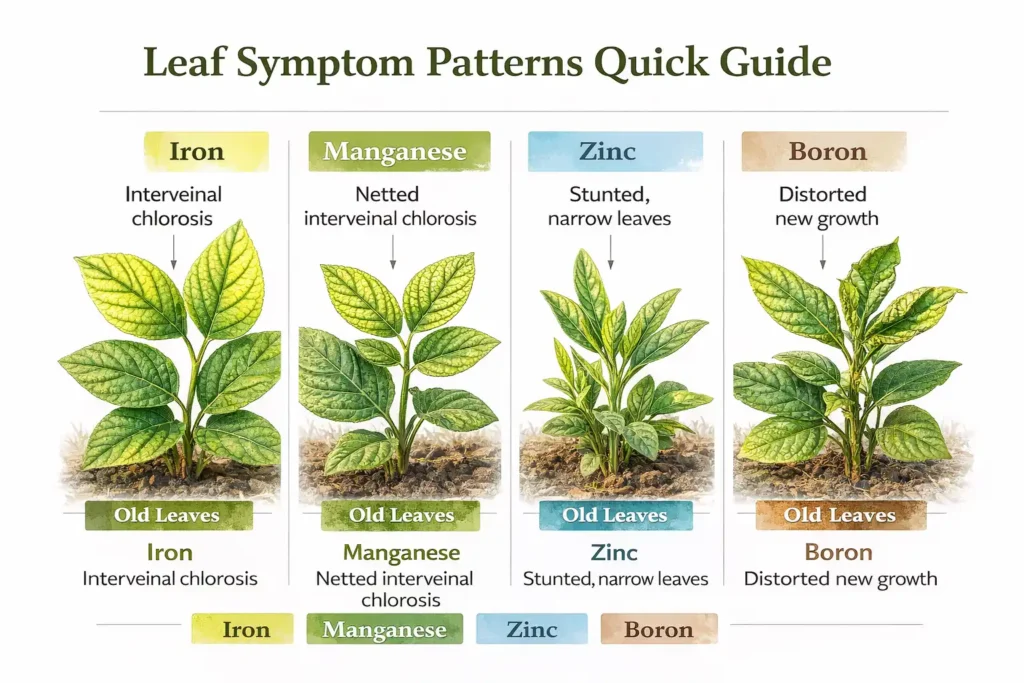
Iron deficiency shows as interveinal chlorosis on young leaves, where the veins stay greener than the tissue between them. It is common on high pH soils and in cool, wet conditions that slow root activity. Soil pH references note that micronutrient availability, including iron, drops as pH rises.
Fast confirmation tip: If the newest leaves are pale yellow with green veins, and older leaves stay greener, iron jumps to the top of the list.
What does zinc deficiency look like?
Zinc deficiency commonly reduces leaf expansion and shortens internodes, which makes plants look stunted or rosetted. Some crops show banding or striping on leaves. Zinc availability can fall sharply as soil pH rises, and university guidance highlights strong pH effects on zinc concentration in soil solution.
Where it shows up: Cold springs, high pH fields, and areas with high phosphorus history can increase zinc issues.
What does manganese deficiency look like?
Manganese deficiency often looks like interveinal chlorosis with a finer “netted” appearance than iron. It shows on younger to mid leaves depending on crop. Like zinc and copper, manganese availability declines as pH rises.
Field clue: You often see manganese deficiency on high pH knolls and in soils with low organic matter.
What does boron deficiency look like?
Boron deficiency hits growing points, cell walls, flowering, and fruit set. Symptoms often include brittle or thickened new leaves, poor pollination, cracked stems, and internal disorders like hollow stem in some vegetables. Michigan State Extension highlights hollow stem as a boron deficiency symptom in cole crops and stresses how small the “safe range” is between too little and too much.
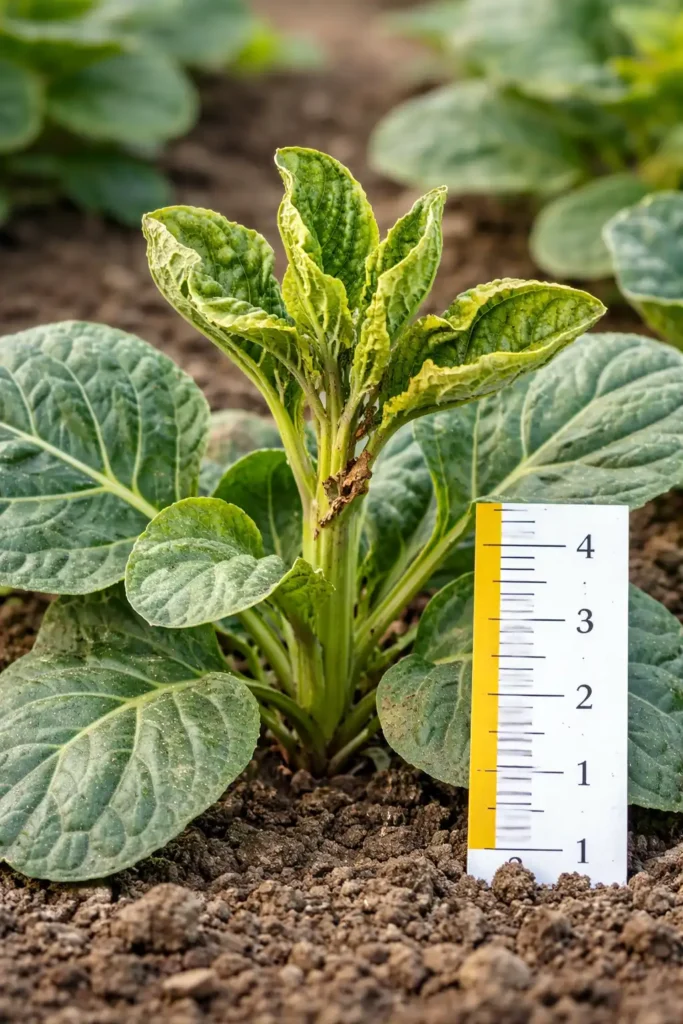
High-risk situations: Sandy soils, droughty periods, and crops with higher boron demand.
What does copper deficiency look like?
Copper deficiency can reduce vigor, create weak stems, and cause poor reproductive development in sensitive crops. Copper availability also declines at higher pH, which makes high pH ground a repeated theme for multiple micronutrients.
Watch-outs: Over-liming and organic soils can raise risk in certain regions.
What does molybdenum deficiency look like?
Molybdenum deficiency can mimic nitrogen deficiency because molybdenum supports nitrate metabolism. In some brassicas, it can cause “whiptail” type symptoms. Unlike most micronutrients, molybdenum availability tends to increase as pH rises, so low pH soils can be higher risk.
Field clue: If you have an acidic soil and brassica issues that do not respond as expected to nitrogen management, molybdenum belongs in the conversation.
What about chlorine and nickel?
Chlorine and nickel are essential in small amounts, but true deficiencies are less common under field conditions. Problems show up more often in unusual soils, highly leached sands, or specialty production systems. Treat these as “test to confirm” nutrients instead of guessing from visuals.
What causes micronutrient deficiency in plants?
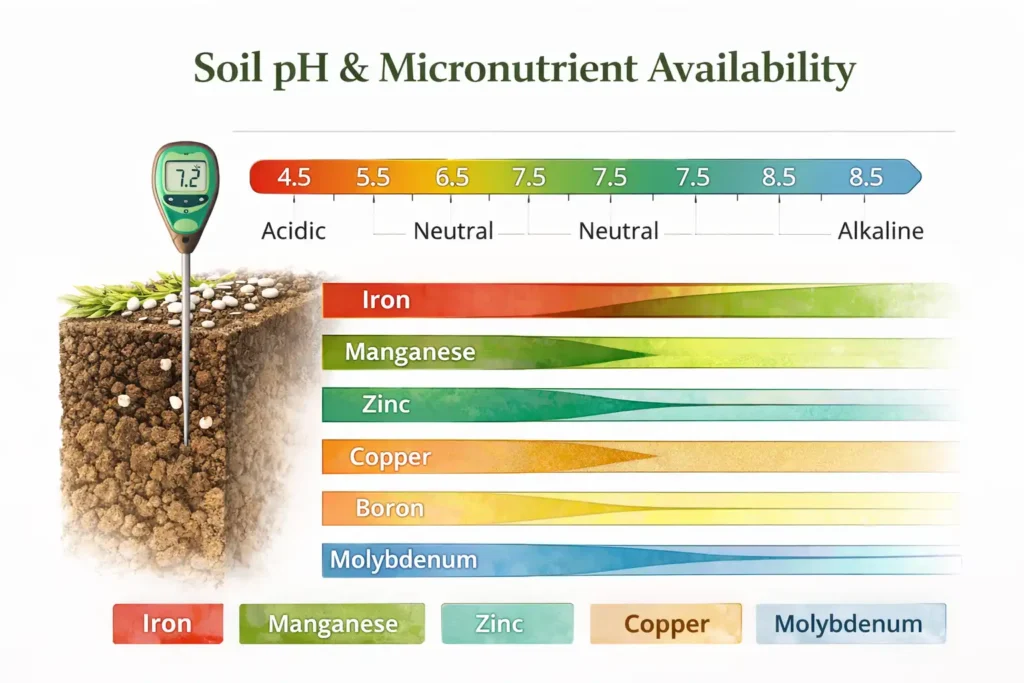
Micronutrient deficiency usually comes from availability problems, not a total absence in soil.
Does soil pH cause micronutrient deficiency?
Soil pH drives chemical form and solubility, which controls what roots can take up. West Virginia University Extension notes that higher pH can reduce availability of boron, copper, iron, manganese, and zinc. University of Maryland Extension also explains that most micronutrients decrease in availability as pH rises, with molybdenum as a key exception.
Farm decision: If a field runs high pH, plan micronutrients as part of your base fertility strategy, not as a rescue.
For pH and long-term nutrient planning, it helps to keep your core fertility program tight. The soil management and fertility basics section on CropFarming.org fits well as a refresher when you are building that plan. soil fertility practices
Can water management trigger micronutrient issues?
Yes. Dry soil limits mass flow and diffusion of nutrients to roots, while saturated soil limits oxygen, slows roots, and changes chemistry for iron and manganese. If your problem areas follow irrigation patterns or drought-prone ridges, water management belongs in the diagnosis.
The CropFarming.org guide on irrigation and water planning helps you match watering to root function, which supports steadier nutrient uptake.
Can macronutrients and amendments create micronutrient lockup?
Yes. Heavy liming can push pH up and reduce availability of several micronutrients. High phosphorus programs can aggravate zinc issues in some soils. Manure and organic matter can tie up copper and zinc in certain conditions while improving availability in others. This is why testing and field history matter more than a single symptom photo.
How do I diagnose micronutrient deficiency the right way?
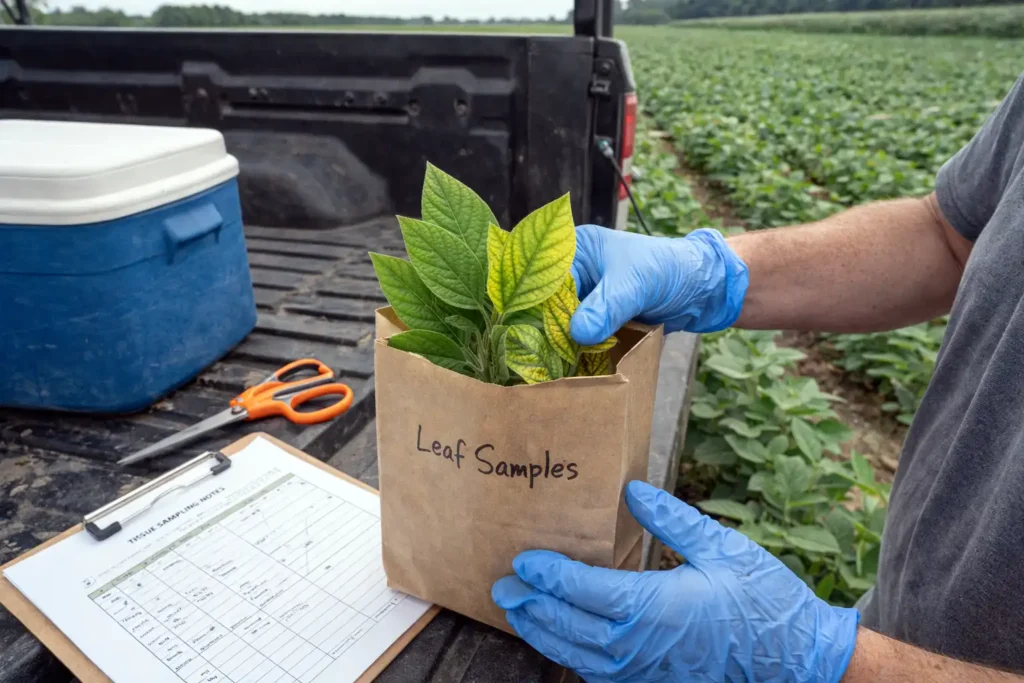
A good diagnosis uses field patterns, tests, and timing.
- Scout by soil zone. Compare knolls vs low areas, sandy vs heavier ground, and old manure bands vs clean ground.
- Pick the right tissue. Sample the correct plant part at the correct growth stage for your crop and lab standard.
- Pair tissue with soil. Soil tests explain availability drivers like pH, organic matter, and base saturation. Tissue tests confirm what the plant actually took up.
- Record the “why.” Note pH, recent lime, recent phosphorus, irrigation events, and weather swings.
If you are building your first testing routine, CropFarming.org’s soil testing and measuring tools section is a solid starting point for sampling gear and field workflows.
How do I fix micronutrient deficiency in plants?
Correction depends on speed needed, root conditions, and the cause of the shortage.
When does foliar feeding make sense?
Foliar feeding makes sense when roots cannot access nutrients fast enough because of pH, wet soils, cold soils, or short-term demand spikes. University of Florida IFAS notes that foliar application can avoid soil reactions that tie up micronutrients, and it discusses why chelated forms can improve uptake through the waxy leaf surface.

Practical rule: Use foliar for rapid correction and symptom relief, then fix the soil driver so you do not chase the same problem every season.
If you apply foliar micronutrients, use clean water, correct spray volume, and compatible tank mixes. A dependable sprayer setup matters as much as the product. CropFarming.org’s guide to sprayers and application gear helps you dial in nozzles, pressure, and coverage.
When does soil application make sense?
Soil application makes sense when you need a longer-lasting fix, especially for boron, zinc, and manganese in many field crops. Soil placement near the root zone improves uptake and reduces waste. In high pH soils, choose forms designed for that chemistry and focus on pH management as the foundation.
Do chelates help, and when are they worth the money?
Chelates help when a micronutrient ties up quickly in soil or when foliar uptake needs a form that moves into leaf tissue. University of Florida IFAS discusses chelated fertilizer behavior and highlights that chelated forms can improve effectiveness compared with non-chelated sources in certain situations.
Farm decision: Use chelates when your soil conditions repeatedly lock up micronutrients, and when tissue tests confirm a true shortage.
How do I correct the root cause so the problem stays fixed?
Long-term fixes target pH, root health, and soil structure.
- Adjust pH in the direction that improves availability for the micronutrient you lack, based on soil test recommendations.
- Reduce compaction to improve root exploration and oxygen.
- Keep soil moisture steady through irrigation scheduling and residue management.
- Build organic matter with consistent crop residue return and cover crops when they fit your system.
If you want a broader look at how inputs and management practices work together, our guide on what farmers use to help plants grow supports that whole-system view.
What safety steps matter when handling micronutrient products?
Micronutrient fertilizers still count as chemicals you mix, spray, and store. Protect your eyes, skin, and lungs during mixing and application. Use clean measuring tools and avoid breathing dusts from dry formulations. Follow label instructions for re-entry intervals and tank mix order.
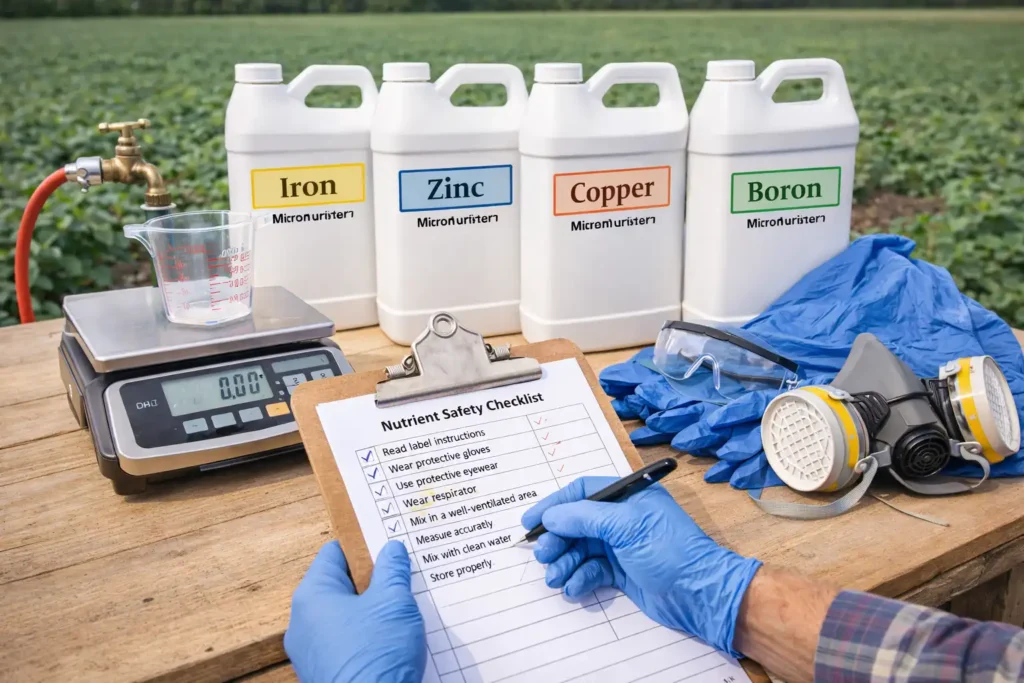
For practical protection basics, CropFarming.org’s farm PPE and safety gear page keeps the essentials in one place.
Which crops commonly show micronutrient deficiencies?
Any crop can show micronutrient deficiency when conditions limit uptake, but some are more sensitive in common systems:
- Brassicas often show boron-related disorders under low boron supply.
- High pH ground often pushes iron, zinc, and manganese issues across several crops.
If you want crop-specific scouting notes, the CropFarming.org crop guides section helps you match symptoms and timing to the crop you are growing.
What is the best “no-regrets” plan for micronutrients?
A no-regrets plan uses prevention, confirmation, and targeted correction.
- Build a soil test program that tracks pH and micronutrient trends by zone.
- Confirm symptoms with tissue testing before expensive rescue treatments.
- Use foliar feeds for quick correction when roots are limited, and soil strategies for season-long support.
- Record what worked by field, rate, form, and timing so next year’s plan starts ahead.
Conclusion
Micronutrient deficiency in plants is a solvable problem when you treat it like a system issue, not a single-product issue. Start with the symptom pattern and the leaf age, then confirm with soil and tissue tests. Correct fast with foliar nutrition when needed, and correct long-term by managing pH, moisture, and root health. When you match the right micronutrient form and timing to the real cause, plants recover quicker and yields hold steadier.