16-4-8 Fertilizer: Rates, Timing, and Best Picks for 2026
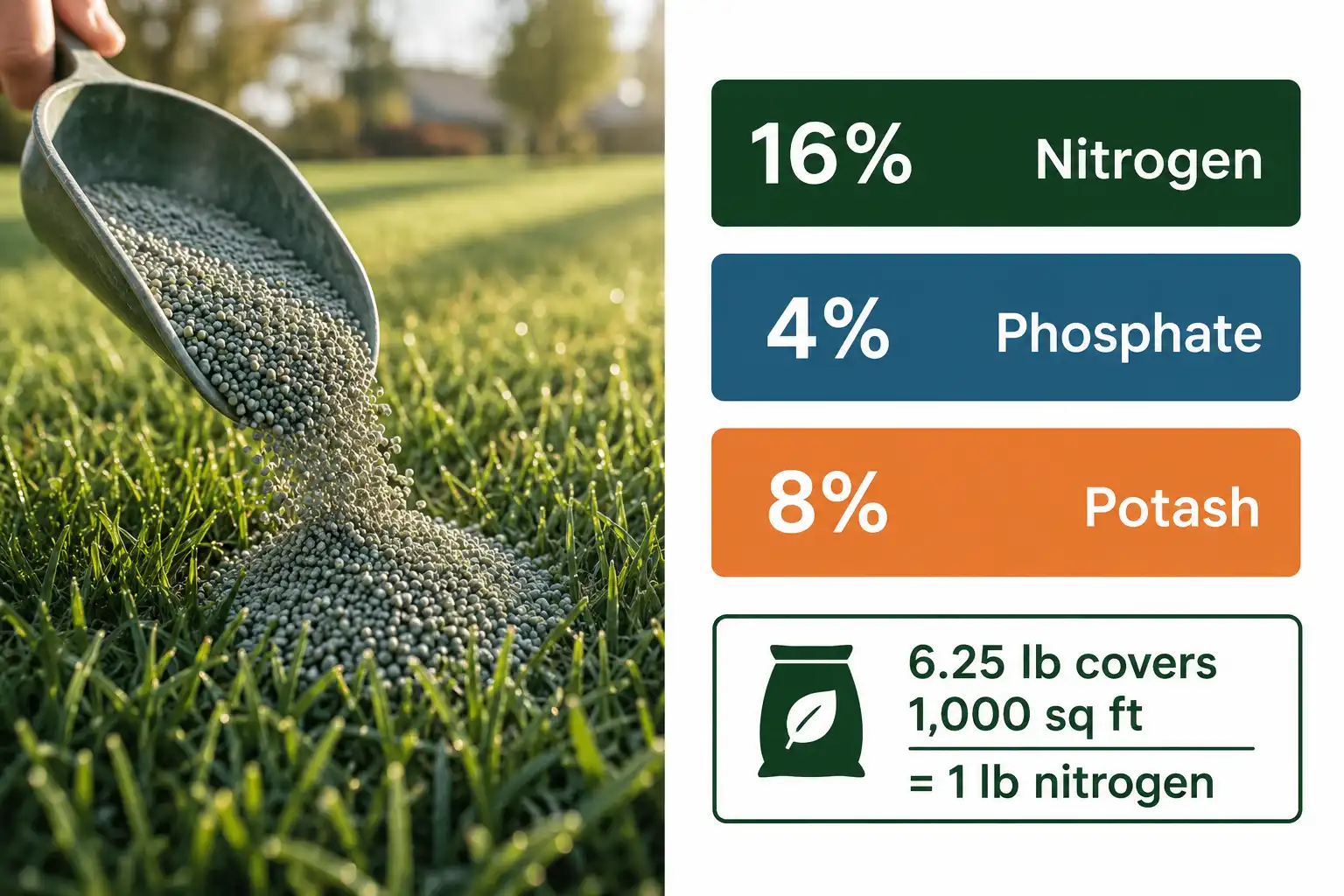
Most lawn and turf programs start with one set of numbers. 16-4-8 fertilizer carries four times more nitrogen than phosphate. That ratio matches what established grass actually pulls from the soil.
16-4-8 fertilizer is a turf grade supplying 16% nitrogen, 4% phosphate, and 8% potash. That 4-1-2 ratio feeds established lawns. Spread 6.25 pounds per 1,000 square feet to apply one pound of nitrogen.
What Is 16-4-8 Fertilizer?
16-4-8 fertilizer is a complete turf grade holding 16% nitrogen, 4% phosphate, and 8% potash by weight. Those three numbers print on every bag as the guaranteed analysis. The rest of the bag is carrier, filler, and minor elements.
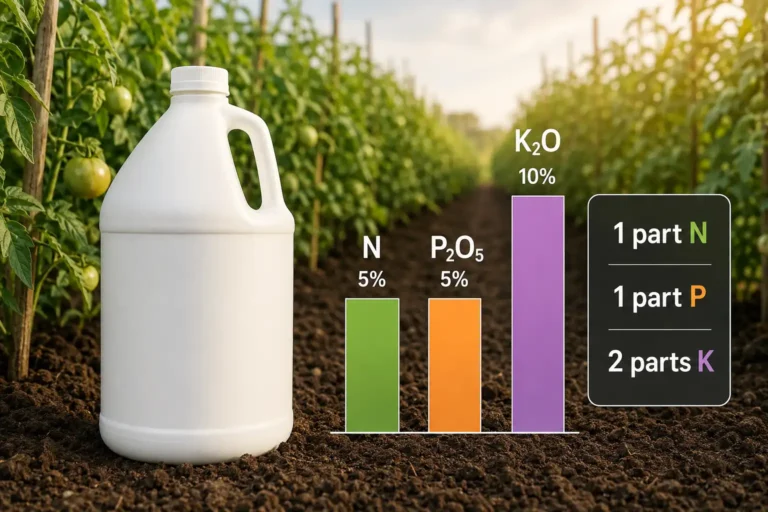
Divide the grade by four and you land on a 4-1-2 ratio. UF/IFAS and Clemson Cooperative Extension both name that ratio as the default choice. Reach for it when you have no soil test in hand. Rutgers and Nebraska Extension recommend the same 3-1-2 to 4-1-2 window.
| What the bag says | What it means | Inside a 50 lb bag |
|---|---|---|
| 16 | 16% total nitrogen (N) | 8.0 lb nitrogen |
| 4 | 4% available phosphate (P2O5) | 2.0 lb phosphate |
| 8 | 8% soluble potash (K2O) | 4.0 lb potash |
| Balance | Carrier, filler, micronutrients | 36 lb |
One detail trips up new buyers. The second and third numbers report phosphate and potash, not elemental phosphorus and potassium. Multiply phosphate by 0.44 for actual P. Multiply potash by 0.83 for actual K. So that 50-pound bag really carries about 0.9 pound of phosphorus and 3.3 pounds of potassium. This breakdown of NPK fertilizer basics walks through the same math for crop grades.
Read next: 5-1-1 Fish Emulsion Fertilizer
What Each Nutrient Actually Does
Nitrogen drives blade growth, tillering, and green color. Phosphate feeds root development and early establishment. Potash strengthens cell walls, which improves drought tolerance, cold hardiness, and disease resistance.
Grass burns through nitrogen faster than the other two. Therefore a grade weighted 4-to-1 toward N tracks the real demand curve of a mowed stand.
Check the Nitrogen Source, Not Just the Number
Two bags can both read 16-4-8 and behave nothing alike. Look at the fine print under the guaranteed analysis for “slowly available nitrogen” or “water insoluble nitrogen.”
By federal labeling rules, a product marketed as slow-release must hold at least one third of its nitrogen in slow-release form. Virginia Cooperative Extension treats 15% or more water insoluble nitrogen as a slowly available source. For steady 6 to 8 week feeding, look for 50% or better.
All-soluble 16-4-8 greens fast and quits fast. Blends with methylene urea, polymer coated urea, or sulfur coated urea stretch the response and cut burn risk.
What Is 16-4-8 Fertilizer Good For?
16-4-8 fertilizer is good for established lawns, sports turf, pastures, and any grass stand you want dense and green. It also suits leafy garden crops, sweet corn sidedress, and ornamental grasses. Established fruit plantings benefit as well.
The small phosphate share still earns its place. Even mature turf removes some phosphorus every season. However, most established lawns already test medium to high in P, which is exactly why the middle number stays low.
| Strong fit | Weak fit |
|---|---|
| Established cool-season and warm-season lawns | Root crops like carrots, beets, and potatoes |
| Athletic fields and high-traffic turf | Starter fertility for bare soil (needs more P) |
| Grass pasture and hay ground on small acreage | Blooming and fruiting stages that need potassium |
| Sweet corn, greens, and leafy vegetables | Legumes that fix their own nitrogen |
| Ornamental grasses and lawn overseeding | States that restrict phosphorus on established turf |
Is 16-4-8 Fertilizer Good for Lawns?
Yes, 16-4-8 fertilizer ranks among the best all-around choices for an established lawn. Clemson Cooperative Extension names this exact grade as the 4-1-2 example to reach for when no soil test is available. The nitrogen thickens the stand. Potash carries the turf through summer stress. Meanwhile the light phosphate feeds roots without loading the soil.
That said, the answer flips in two situations. If your soil test already reads high in phosphorus, skip the middle number and buy 16-0-8 or 24-0-6 instead. If you live in a state with turf phosphorus rules, the law may decide for you.
Which Grasses Respond Best
| Grass type | Season | Response to 16-4-8 |
|---|---|---|
| Tall fescue | Cool | Excellent, especially in fall |
| Kentucky bluegrass | Cool | Excellent, thickens by rhizome spread |
| Perennial ryegrass | Cool | Strong, fast color response |
| Bermudagrass | Warm | Excellent through summer heat |
| Zoysiagrass | Warm | Good at moderate rates |
| St. Augustinegrass | Warm | Good, watch summer county rules |
| Centipedegrass | Warm | Use half rate only |
| Buffalograss | Warm | Light rates only, gets weedy with excess N |
Buffalograss deserves a warning. K-State Research and Extension notes it needs less nitrogen than any lawn grass grown in Kansas. It also turns weedy when overfed. Cap it at 2 pounds of N per 1,000 square feet per season.
How Much 16-4-8 Fertilizer to Apply per 1,000 Square Feet
Spread 6.25 pounds of 16-4-8 fertilizer per 1,000 square feet to deliver one pound of actual nitrogen. The math is simple: divide 100 by the first number on the bag. Since 100 divided by 16 equals 6.25, that figure works for every 16-4-8 product on the shelf.
| Nitrogen goal per 1,000 sq ft | Pounds of 16-4-8 | When to use it |
|---|---|---|
| 0.5 lb N | 3.1 lb | Summer feeding on cool-season grass, centipede lawns |
| 0.75 lb N | 4.7 lb | Light maintenance, hot or dry stretches |
| 1.0 lb N | 6.25 lb | Standard maintenance feeding |
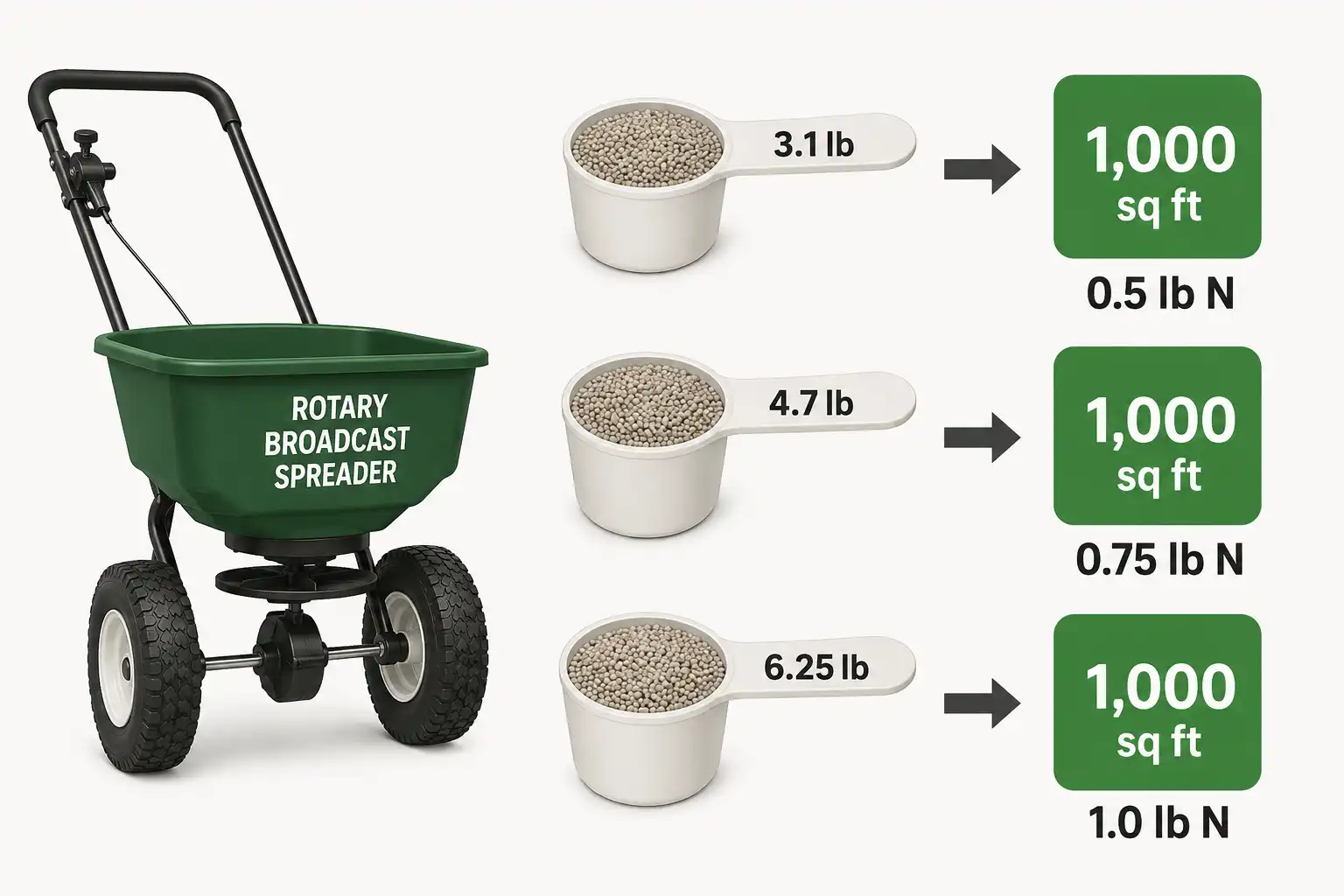
Scale that up and one acre takes about 272 pounds of product, which supplies roughly 43 pounds of nitrogen. Measure your actual turf area first, because most people overestimate by a wide margin. Then calibrate on a driveway or tarp before you touch the grass. Fine-particle products flow much faster than standard prills. A properly calibrated fertilizer spreader saves more money than any bag discount.
Annual Nitrogen Budget by Grass Type
One application is not a program. Set a yearly nitrogen budget, then split it across the growing season.
| Grass | Annual N (lb per 1,000 sq ft) | 16-4-8 per year (lb per 1,000 sq ft) |
|---|---|---|
| Tall fescue | 2 to 4 | 12.5 to 25 |
| Kentucky bluegrass | 2 to 4 | 12.5 to 25 |
| Perennial ryegrass | 2 to 4 | 12.5 to 25 |
| Bermudagrass | 3 to 5 | 19 to 31 |
| Zoysiagrass | 2 to 3 | 12.5 to 19 |
| St. Augustinegrass | 2 to 4 | 12.5 to 25 |
| Centipedegrass | 1 to 2 | 6 to 12.5 |
| Buffalograss | 1 to 2 | 6 to 12.5 |
Virginia Cooperative Extension caps quickly available nitrogen at 0.7 pound per 1,000 square feet in any active growing month. Consequently, a mostly soluble 16-4-8 should go down at the lighter rates rather than the full 6.25 pounds.
When to Apply 16-4-8 Through the Season
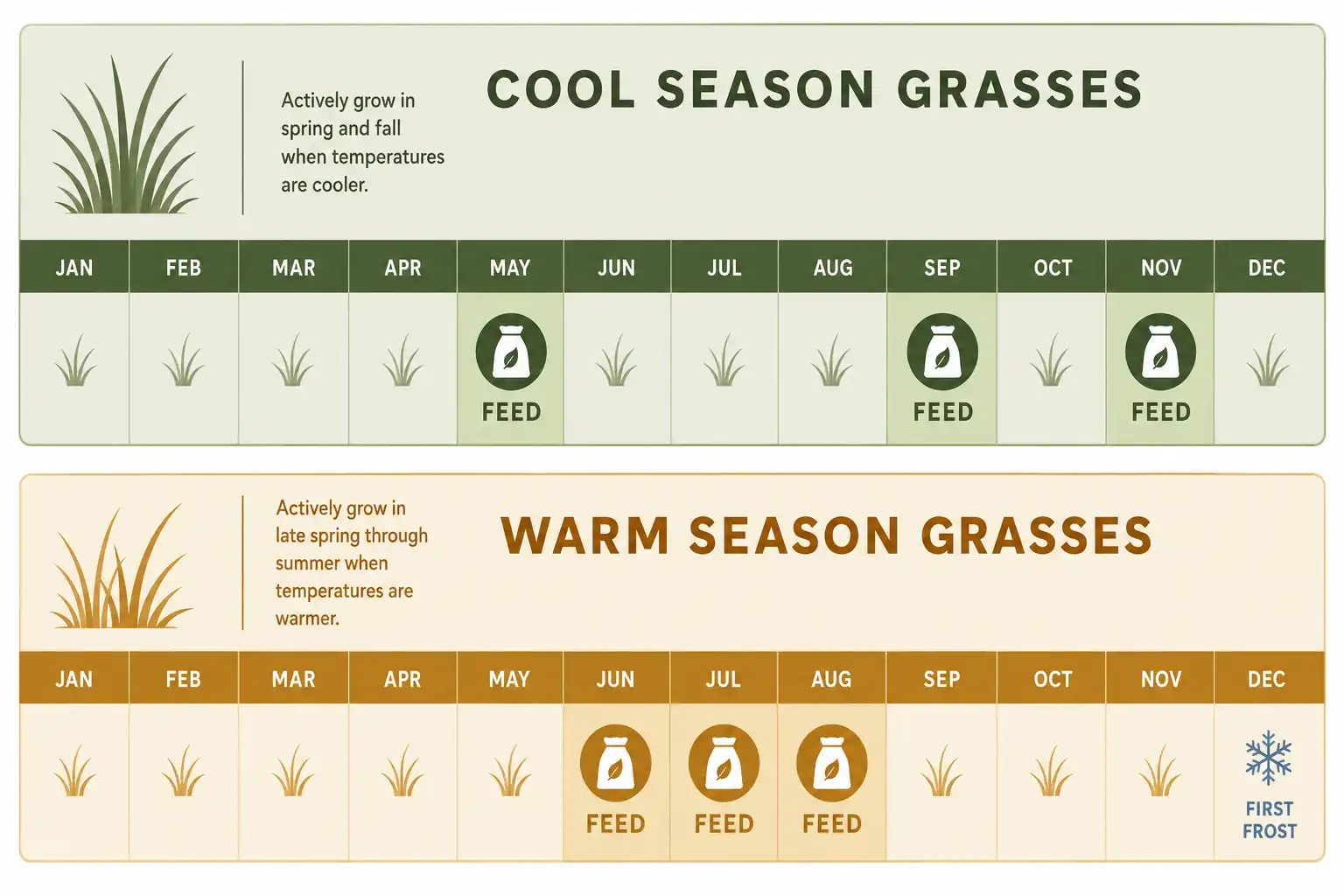
Timing beats rate. Cool-season and warm-season grasses peak at opposite ends of the calendar. So the same bag goes down in different months depending on your grass.
Cool-Season Lawns (Fescue, Bluegrass, Ryegrass)
September is the single most important feeding of the year. K-State Research and Extension recommends 1 to 1.5 pounds of nitrogen per 1,000 square feet. These grasses tiller and spread hardest in fall. November comes second and keeps color late while setting up an early spring green-up.
Skip the heavy March feeding. Early spring nitrogen forces top growth at the expense of roots, and it multiplies mowing and disease pressure. Instead, wait until top growth slows in May, then apply a light slow-release rate.
Warm-Season Lawns (Bermuda, Zoysia, Buffalo, St. Augustine)
June is the starting gun in Kansas. These grasses respond once soil temperatures climb and the turf greens up fully. After that, feed on 6 to 8 week intervals through midsummer.
Stop nitrogen roughly 30 days ahead of your average first frost. Late feeding pushes tender growth into cold weather and raises winterkill risk.
| Month | Cool-season | Warm-season |
|---|---|---|
| March to April | Skip or very light | None |
| May | Light rate, slow-release | None until green-up |
| June | None | Full rate |
| July to August | None (heat stress) | Half to full rate |
| September | Heaviest feeding | Final feeding in warm zones |
| November | Second feeding, quick-release | None |
Granular or Liquid 16-4-8: Which One Feeds More
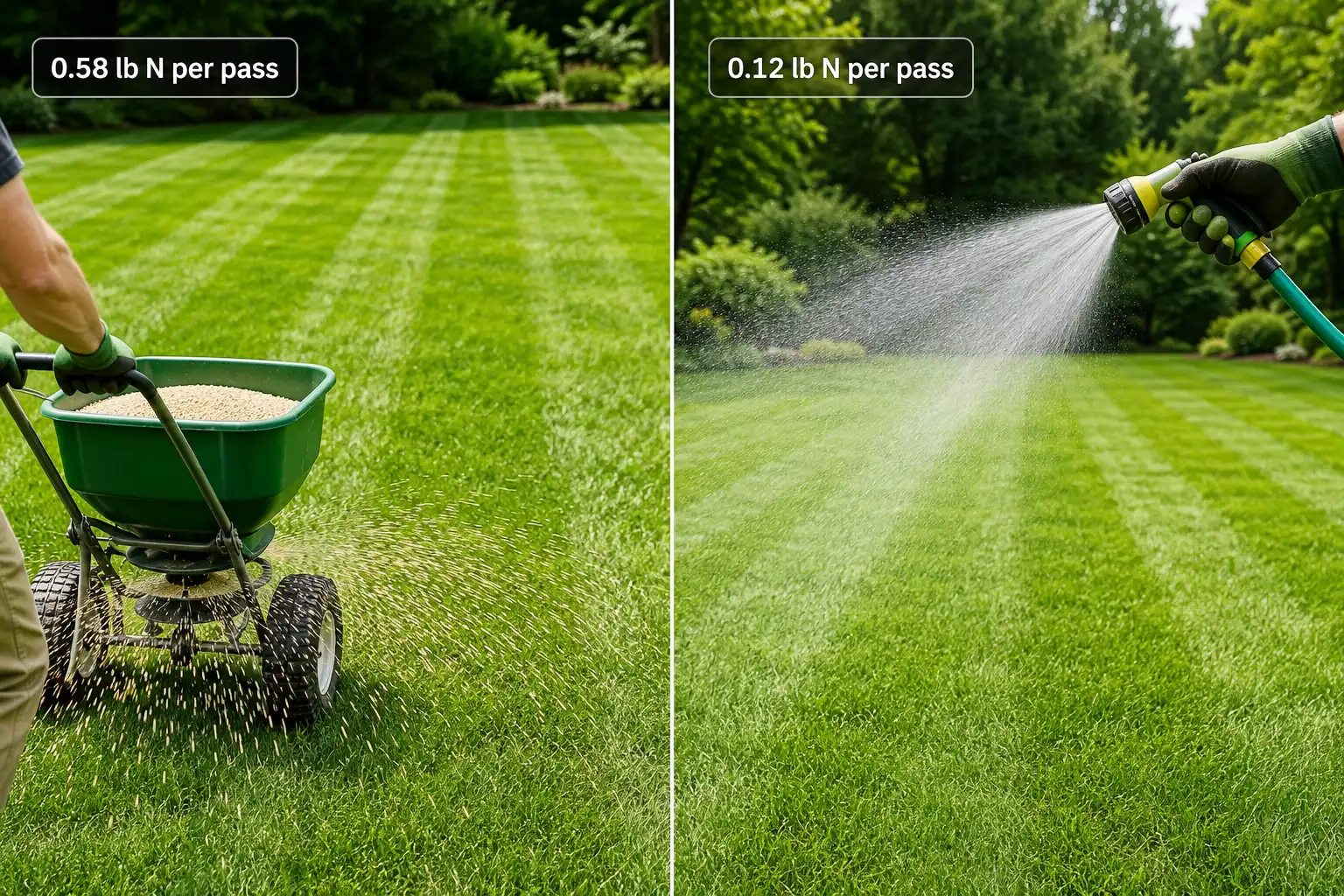
Granular 16-4-8 delivers far more nitrogen per application than liquid 16-4-8, and the gap is bigger than most buyers expect. Run the numbers and the difference becomes obvious.
A fine-particle granular product spread at 3.6 pounds per 1,000 square feet puts down about 0.58 pound of nitrogen. A gallon of liquid 16-4-8 weighs roughly 10 pounds. So the whole jug carries about 1.6 pounds of nitrogen. Spread that across the labeled 12,800 to 16,000 square feet. The result lands near 0.10 to 0.13 pound of nitrogen per 1,000 square feet.
In other words, one liquid pass supplies about a tenth of the nitrogen in a standard granular feeding. Liquid still greens up faster, because leaf tissue absorbs part of the nutrient directly. Yet the color fades sooner, which is why labels call for reapplication every 3 to 4 weeks.
| Factor | Granular 16-4-8 | Liquid 16-4-8 |
|---|---|---|
| Nitrogen per pass | 0.5 to 1.0 lb per 1,000 sq ft | 0.10 to 0.13 lb per 1,000 sq ft |
| Visible color | 6 to 14 days | 3 to 7 days |
| Feeding window | 6 to 8 weeks | 2 to 4 weeks |
| Equipment | Broadcast or drop spreader | Hose-end or pump sprayer |
| Best role | Season-long backbone | Fast color correction |
Approach in zone 6a is simple. Granular carries the program, and liquid handles touch-ups before company comes or after a rough stretch of heat. If you go the liquid route, buy a quality hose end sprayer for fertilizer. It beats the throwaway cap that ships on most bottles.
Where 16-4-8 Is Restricted or a Poor Choice
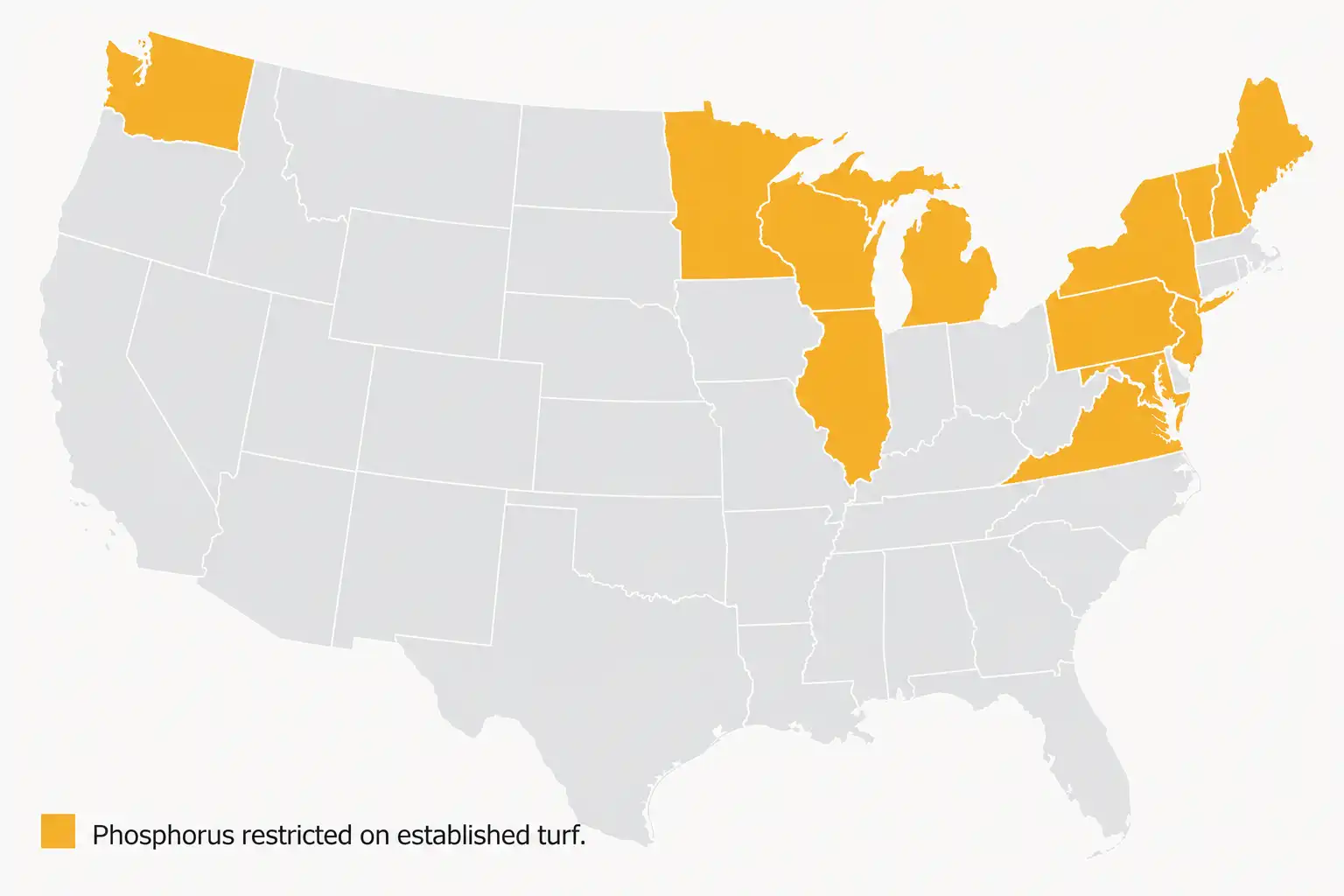
16-4-8 contains phosphorus, so several states restrict it on established lawns. Product labels commonly name Maryland, Michigan, New Jersey, New York, and Virginia. Minnesota, Washington, Wisconsin, Pennsylvania, New Hampshire, Vermont, Maine, and Illinois carry turf phosphorus rules as well.
The restrictions target runoff into waterways like the Chesapeake Bay and the Great Lakes. Most laws share the same three exceptions:
- A soil test from a recognized lab shows a phosphorus need, usually within the past three years.
- You are establishing a new lawn from seed or sod.
- You are repairing bare or damaged turf areas.
Blackout dates stack on top of that. Maryland blocks homeowner nitrogen and phosphorus from November 16 through March 1. Pennsylvania runs December 15 through March 1. New York opens April 1. Several Florida counties ban nitrogen and phosphorus from June 1 through September 30. Check your state department of agriculture before you buy, because these dates shift.
Kansas has no statewide turf phosphorus ban, so 16-4-8 stays legal. Even so, soil testing before loading the spreader is still the recommended step. A basic soil testing kit or a county extension sample settles the question. You learn whether that 4% phosphate does anything at all.
Where phosphorus is off the table, three grades cover the same job:
- 16-0-8 or 24-0-6: identical nitrogen behavior, zero phosphate
- 32-0-4: high nitrogen for lawns already strong in P and K
- 15-0-15 blends: heavy potassium for coastal, sandy, or centipede lawns
4 Best 16-4-8 Fertilizer Products Worth Buying
These four were selected because they cover the two forms and three budget tiers. Coverage figures come from label rates, not marketing maximums, so plan your bag count from measured square footage.
| Product | Form | Size | Label coverage | Best for |
|---|---|---|---|---|
| The Andersons PGF Complete 16-4-8 | Granular | 40 lb | About 10,000 to 11,000 sq ft | Overall performance |
| PROXIO 16-4-8 with Humates | Granular | 40 lb | Up to 11,000 sq ft | Value on large lawns |
| LawnStar 16-4-8 Liquid | Liquid concentrate | 1 gal | Up to 16,000 sq ft | Sprayer users, mixing control |
| Simple Lawn Solutions Advanced 16-4-8 | Ready-to-spray | 32 oz | 3,200 sq ft | Small lawns, no equipment |
1. The Andersons PGF Complete 16-4-8 with Humic DG
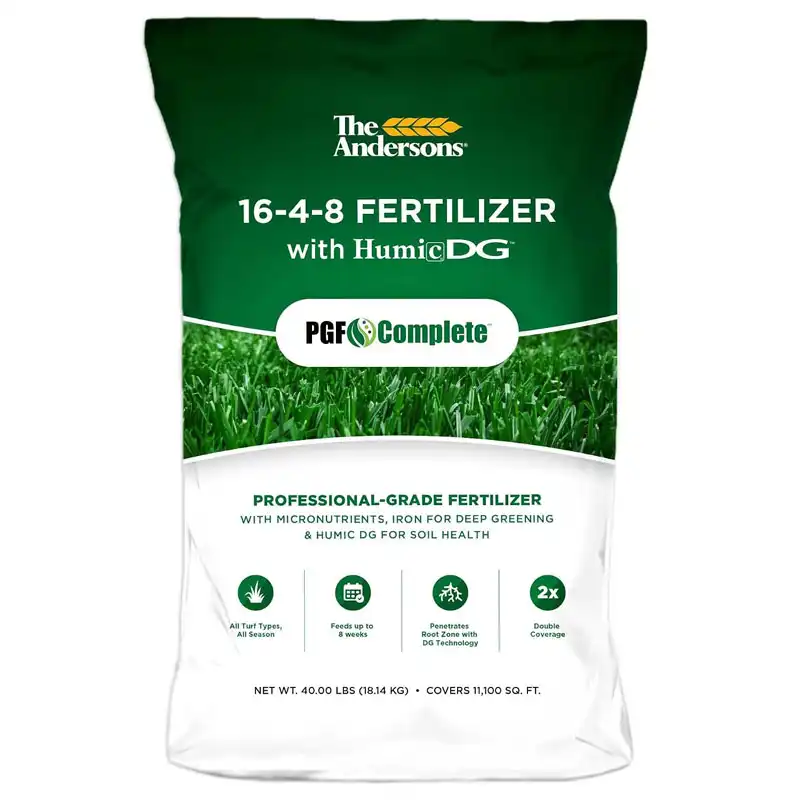
This is the same DG-technology formula that shows up on golf courses and sports turf. Particle size is the reason it works so well. Granules run far smaller than standard prills. So you get roughly twice the particles per square foot and a smoother spread pattern. Nitrogen comes in quick and slow forms. Color shows in 6 to 14 days, then holds for up to 8 weeks. Iron, micronutrients, and 7% Humic DG round it out. Drop to the low rate for summer feeding on cool-season grass and on centipede.
Specs: 40 lb bag | 16-4-8 with iron, micronutrients, 7% Humic DG | Label rate near 3.6 lb per 1,000 sq ft | Reapply every 6 to 8 weeks
2. PROXIO Lawn Fertilizer 16-4-8 with Humates
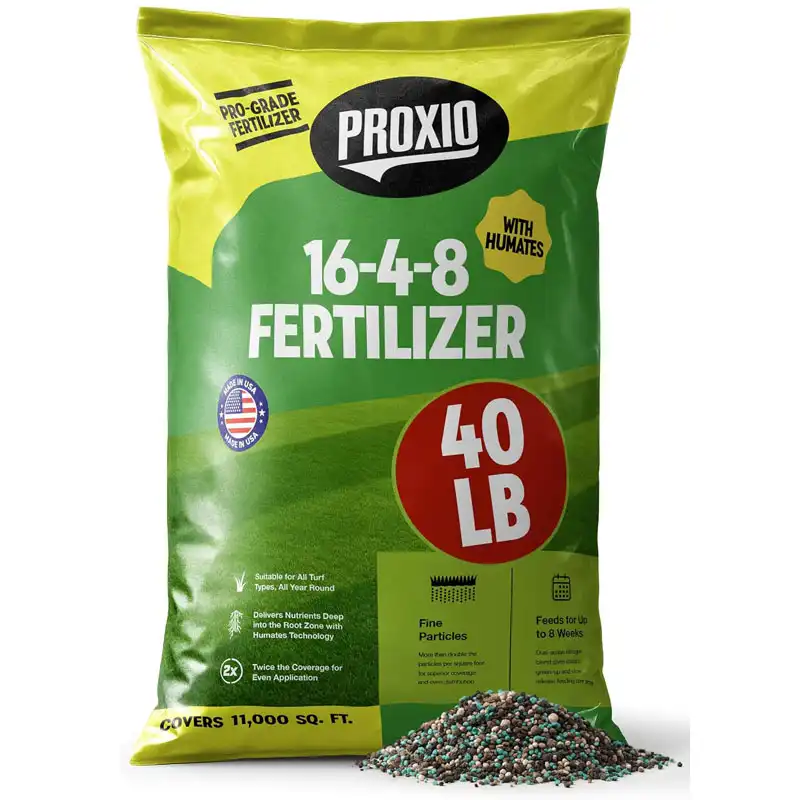
PROXIO copies the premium playbook at a friendlier price. You still get ultra-fine granules, dual-release nitrogen, added iron, and humic plus fulvic acid for soil biology. One 40-pound bag covers up to 11,000 square feet and feeds for as long as 8 weeks. PROXIO makes it in the USA, and it spreads well through rotary equipment. Two cautions apply. Bags occasionally arrive damp and clumped from storage, so break them up and dry them before loading. Owners of Scotts drop spreaders also report flow problems from the small pellet size.
Specs: 40 lb bag | 16-4-8 with iron, micronutrients, humates | Covers up to 11,000 sq ft | Rotary spreader recommended
3. LawnStar Balanced 16-4-8 Liquid Fertilizer
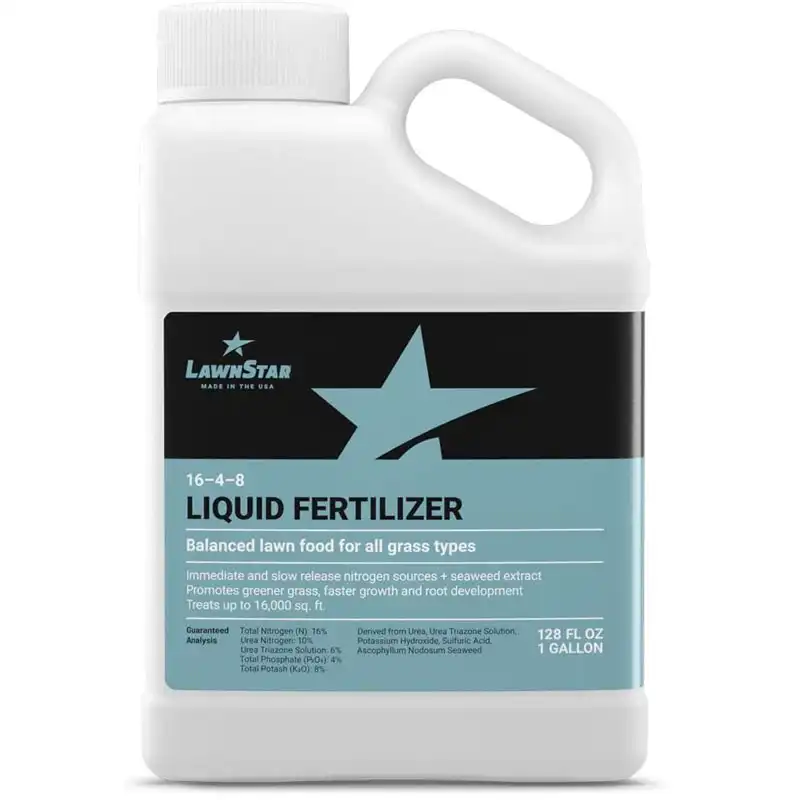
A gallon of LawnStar treats up to 16,000 square feet. That makes it the most economical liquid here for a mid-sized yard. Roughly two thirds of the nitrogen releases immediately and one third releases slowly. So color shows inside a week while the feeding stretches out. Seaweed extract adds biostimulants that support root development and stress tolerance. You mix it about 1 part to 10 parts water and run it through any hose-end or pump-up sprayer. Straining through fine mesh first is worth the trouble, since sediment sometimes clogs nozzles.
Specs: 128 fl oz concentrate | 16-4-8 with seaweed extract | Treats up to 16,000 sq ft | Mix roughly 1:10 with water
4. Simple Lawn Solutions Advanced 16-4-8
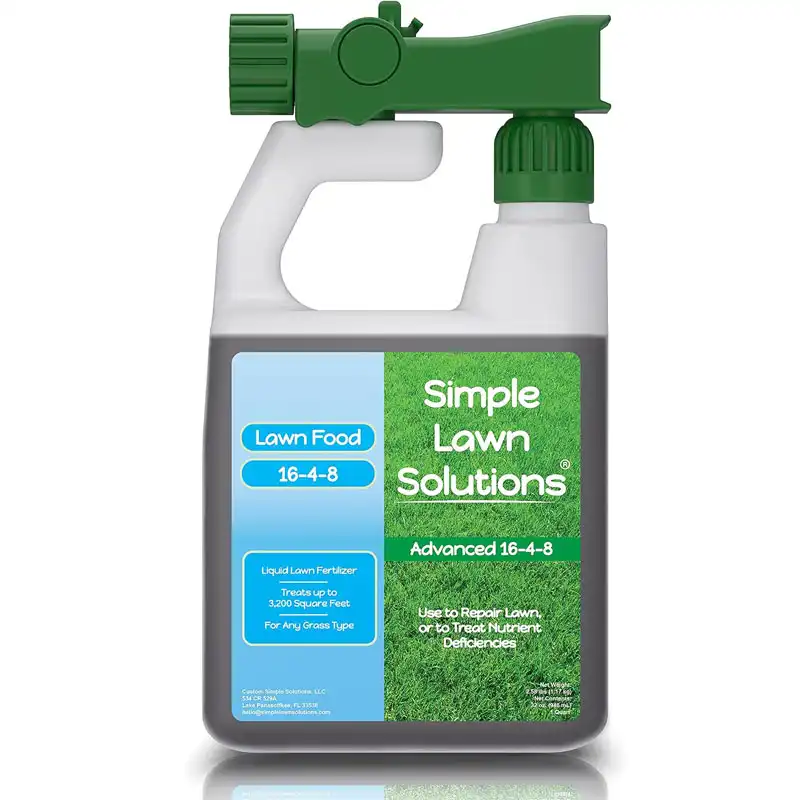
This one skips equipment entirely. The 32-ounce bottle screws onto a garden hose, and a dial on the cap meters the concentrate as you walk. Coverage runs 3,200 square feet per bottle, so it fits small and mid-sized lawns better than acreage. Seaweed and fish emulsion supply organic matter alongside the macronutrients, and the formula is safe on Bermuda, zoysia, St. Augustine, centipede, fescue, and bluegrass. Spray in early morning or evening below 80°F. Overlap your passes deliberately, because the clear solution leaves no visible track on the grass.
Specs: 32 fl oz ready-to-use | 16-4-8 with seaweed and fish | Covers 3,200 sq ft | Reapply every 3 to 4 weeks
How to Apply 16-4-8 Without Burning the Grass
Fertilizer burn comes from salt, not from the grade itself. Follow these steps and the risk drops close to zero.
- Mow first, then wait. Cut the lawn a day ahead so the canopy is open and the blades are dry.
- Apply to dry foliage. Wet blades hold granules against leaf tissue, which is where scorch starts.
- Calibrate the spreader. Run a test pass on pavement. Never carry over a setting from a different product, since fine particles flow much faster.
- Split the rate in half. Apply half in one direction, then the other half at 90 degrees. Skips and stripes disappear.
- Water it in immediately. Put down about 0.2 to 0.25 inch of irrigation or catch a rain within 24 hours.
- Sweep the hard surfaces. Blow granules off driveways, sidewalks, and streets back onto turf so nothing reaches a storm drain.
- Leave the clippings. Skip the bagger for at least one mowing afterward. Clippings return nitrogen and never cause thatch.
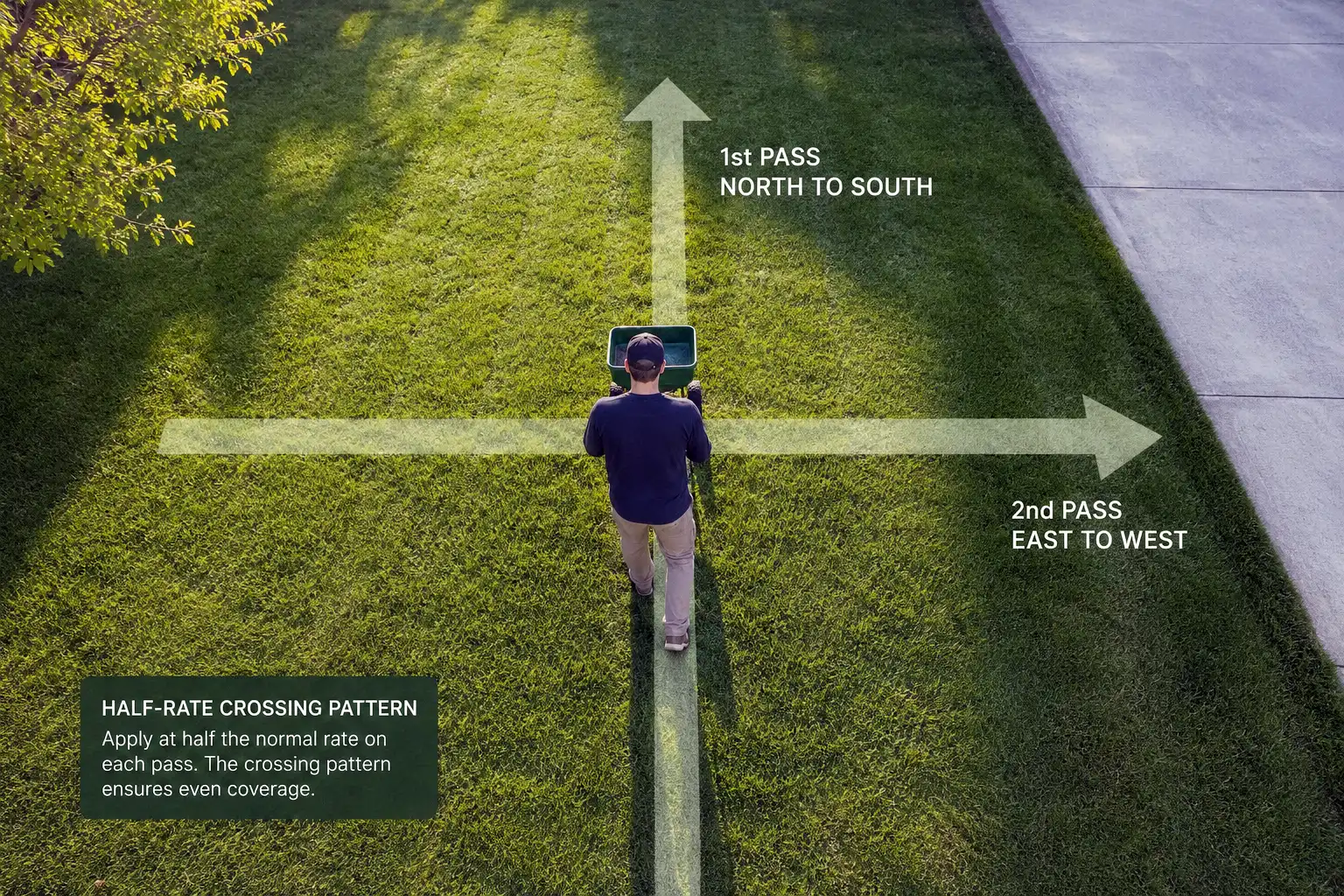
Watch the weather too. Soil temperature between 55°F and 60°F signals active root uptake. Meanwhile, sustained air above 85°F raises burn risk on cool-season grass. Skip the pass entirely when heavy rain is forecast.
16-4-8 Compared With Other Fertilizer Grades
Every grade solves a different problem. Here is where 16-4-8 sits against the bags next to it on the shelf.
| Grade | Ratio | Lb per 1,000 sq ft for 1 lb N | Best use |
|---|---|---|---|
| 16-4-8 | 4-1-2 | 6.25 | Established lawn maintenance |
| 12-4-8 | 3-1-2 | 8.3 | Same job, gentler nitrogen load |
| 10-10-10 | 1-1-1 | 10.0 | General garden feeding |
| 16-16-16 | 1-1-1 | 6.25 | Gardens and new plantings |
| 46-0-0 (urea) | Nitrogen only | 2.2 | Cheapest nitrogen at field scale |
| 15-0-15 | 1-0-1 | 6.7 | Coastal, sandy, or centipede turf |
| 24-0-6 | 4-0-1 | 4.2 | Lawns in phosphorus-restricted states |
Balanced grades like 10-10-10 and 16-16-16 are fine in a garden bed. On a mature lawn, though, they waste phosphorus and force you to spread more product for the same nitrogen.
Can You Use 16-4-8 on Crops and Pastures?
Yes, 16-4-8 works well on gardens and small acreage, but it stops making economic sense past a few acres. The reason is cost per unit of nitrogen, not agronomy.
Covering one acre at the standard turf rate takes roughly 272 pounds of 16-4-8. That supplies about 43 pounds of nitrogen. Sweet corn alone can use 150 pounds of nitrogen per acre or more. Matching that would take close to 940 pounds of product. At that scale, growers reach for urea at 46-0-0 instead. Then they apply phosphate and potash separately from a soil test.
For a home garden or a small hay patch, though, 16-4-8 does a fine job as a nitrogen-forward feed. It works especially well as a sidedress on sweet corn at the 18 to 24 inch stage. Lettuce, spinach, chard, and other leafy crops respond too.
One hard rule: never use a weed and feed version of 16-4-8 anywhere near food plants. Those products carry herbicides that will damage or kill vegetables. Read the full label, not just the three numbers on the front.
FAQs About 16-4-8 Fertilizer
Can I use 16-4-8 fertilizer on a new lawn?
How long does 16-4-8 take to green up grass?
Will 16-4-8 burn my lawn?
How often should I apply 16-4-8?
Is 16-4-8 the same as 12-4-8?
Can I put 16-4-8 on my vegetable garden?
Does 16-4-8 fertilizer kill weeds?
Bottom Lines
Keep 16-4-8 around because it answers the most common turf question without a soil test in hand. Measure the area, spread 6.25 pounds per 1,000 square feet, then water it in. Repeat on a 6 to 8 week schedule during active growth.
Time it right and the rate matters less. A September application supports fescue, a June application supports bermuda, and a November pass supports early spring green-up. Check your state phosphorus rules before the first bag. Then soil test every three years, so you know whether that middle number still earns its spot.