Fish Emulsion Fertilizer 5-1-1: Rates, Timing, and Top Picks
Pale leaves and stalled growth mean your crop ran short on nitrogen. Bagged granules take days to move into the root zone. Reach for fish emulsion fertilizer 5-1-1, a liquid feed that works fast.
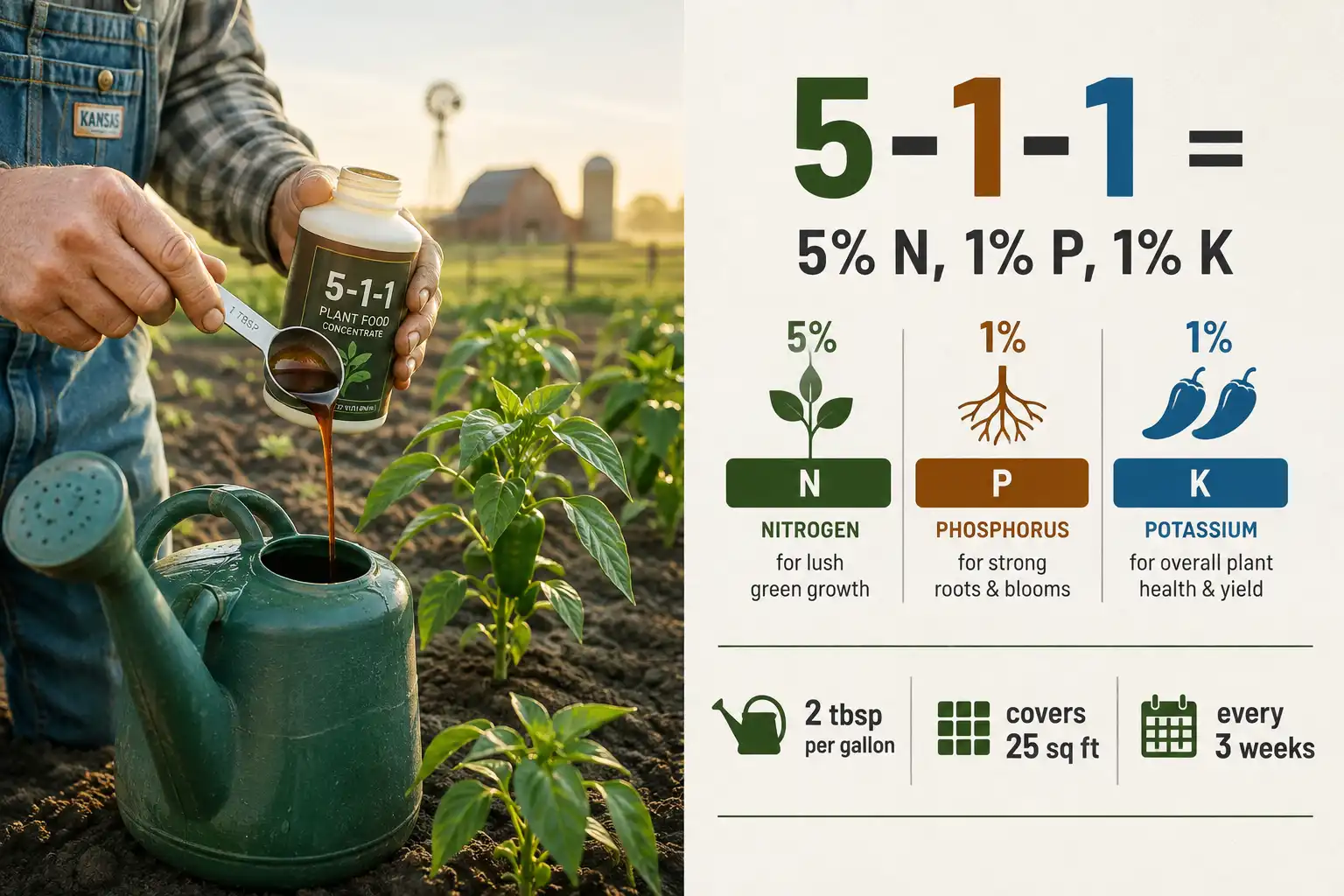
Fish emulsion fertilizer 5-1-1 supplies 5% nitrogen, 1% phosphate, and 1% potash. Mix 2 tablespoons per gallon of water for vegetables. Then drench 25 square feet of soil every three weeks through the growing season.
What Is 5-1-1 Fish Emulsion Fertilizer?
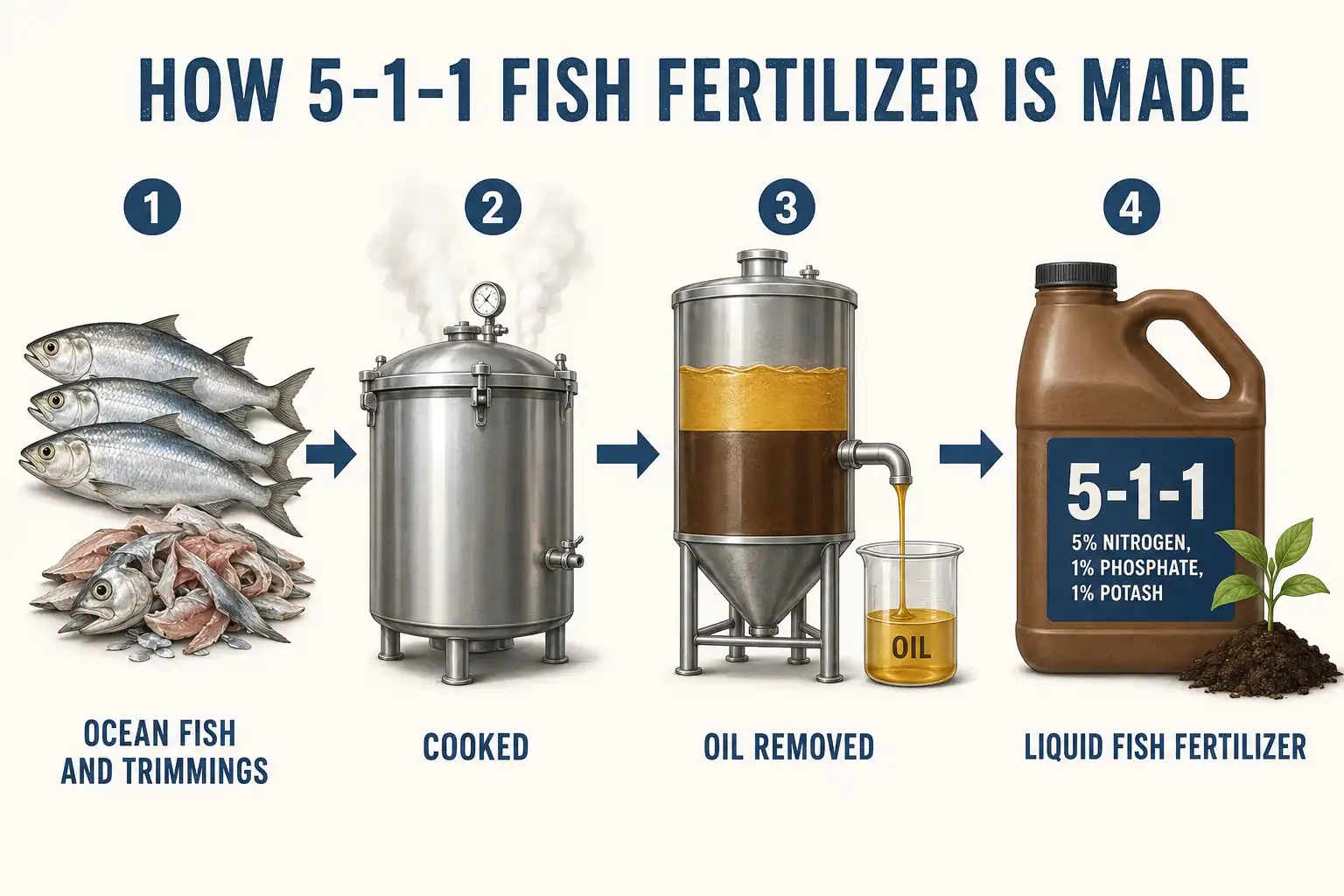
5-1-1 fish emulsion fertilizer is a liquid nitrogen feed made from fish solubles. Those solubles are the protein-rich liquid left over from commercial fish processing. Processors cook menhaden and other ocean fish. Next they pull the oil out for other markets. Then they concentrate what remains into a thick brown syrup.
That syrup carries nitrogen in a form roots pick up quickly. It also carries organic matter that feeds soil microbes. Nutrients sit at low concentration here. So the product will not scorch tender tissue the way a salt fertilizer can.
Keep a jug on the shelf near Topeka. It earns its spot in spring, when soil is still cold and granular nitrogen sits idle.
What Do the Numbers 5-1-1 Mean?
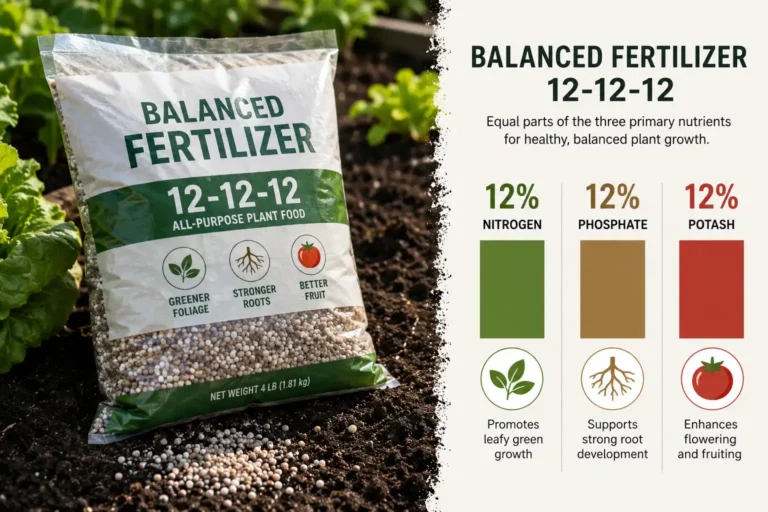
They are the guaranteed analysis: 5% total nitrogen, 1% available phosphate, and 1% soluble potash by weight. Every fertilizer sold in the United States carries these three figures in that order. Our guide on reading NPK on crop fertilizer covers that math in full.
The nitrogen splits three ways on the label:
| Nitrogen form | Percentage | How fast it releases |
|---|---|---|
| Ammoniacal nitrogen | 0.50% | Immediate |
| Other water soluble nitrogen | 3.75% | Days |
| Water insoluble nitrogen | 0.75% | Slow, microbe driven |
That 3.75% water soluble fraction does the heavy lifting. It moves with irrigation water and reaches roots within a day or two. The 0.75% insoluble portion holds back and feeds later as soil microbes break it down.
Most brands stabilize the concentrate with sulfuric acid and phosphoric acid. That is where the single point of phosphate comes from, not from fish bone.
How Much Nitrogen Does It Actually Deliver?
Less than most growers assume. One quart of concentrate weighs about 2.45 pounds, so a full gallon runs near 9.8 pounds. At 5%, that gallon holds roughly 0.49 pounds of actual nitrogen.
Run the numbers on one feeding:
| Measure | Amount |
|---|---|
| Concentrate per gallon of water (vegetables) | 2 tablespoons (1 fl oz) |
| Actual nitrogen in that mix | 0.0038 lb |
| Area covered | 25 sq ft |
| Nitrogen delivered per 1,000 sq ft | About 0.15 lb |
| Seven feedings across a season | About 1.05 lb per 1,000 sq ft |
Most garden soils want 1 to 2 pounds of nitrogen per 1,000 square feet per season. So a full-label program of 5 1 1 fish emulsion fertilizer lands at the low end of that range. Light feeders do fine on it alone. Sweet corn and other heavy feeders need a second nitrogen source.
The potash picture is worse. At 1%, seven feedings deliver about 0.2 pounds of potash per 1,000 square feet. That is close to nothing. Treat this product as a nitrogen tool, not a complete program. Pull a home soil test kit before you decide what else the ground needs.
How to Use Fish Emulsion Fertilizer 5-1-1
Dilute the concentrate in water, then apply it as a soil drench around the base of the plant. Never pour it on straight. Follow these steps:
- Shake the jug hard for 15 seconds. Solids settle during storage, so an unshaken pour gives you thin liquid off the top.
- Measure into an empty container first. Put the concentrate in the watering can, then add water. Mixing in that order keeps the syrup from sticking to the bottom.
- Match the rate to the crop. Use the table below rather than guessing.
- Fill with lukewarm water and stir. Cold water thickens the concentrate and leaves streaks.
- Drench the soil around the root zone. Stay off the crown and keep the solution away from stems.
- Water lightly afterward. A quick rinse moves nitrogen into the root zone and cuts the odor on the surface.
- Use the batch the same day. Labels warn against storing mixed solution, because it ferments and smells far worse.
What Are the Mixing Rates by Plant Type?
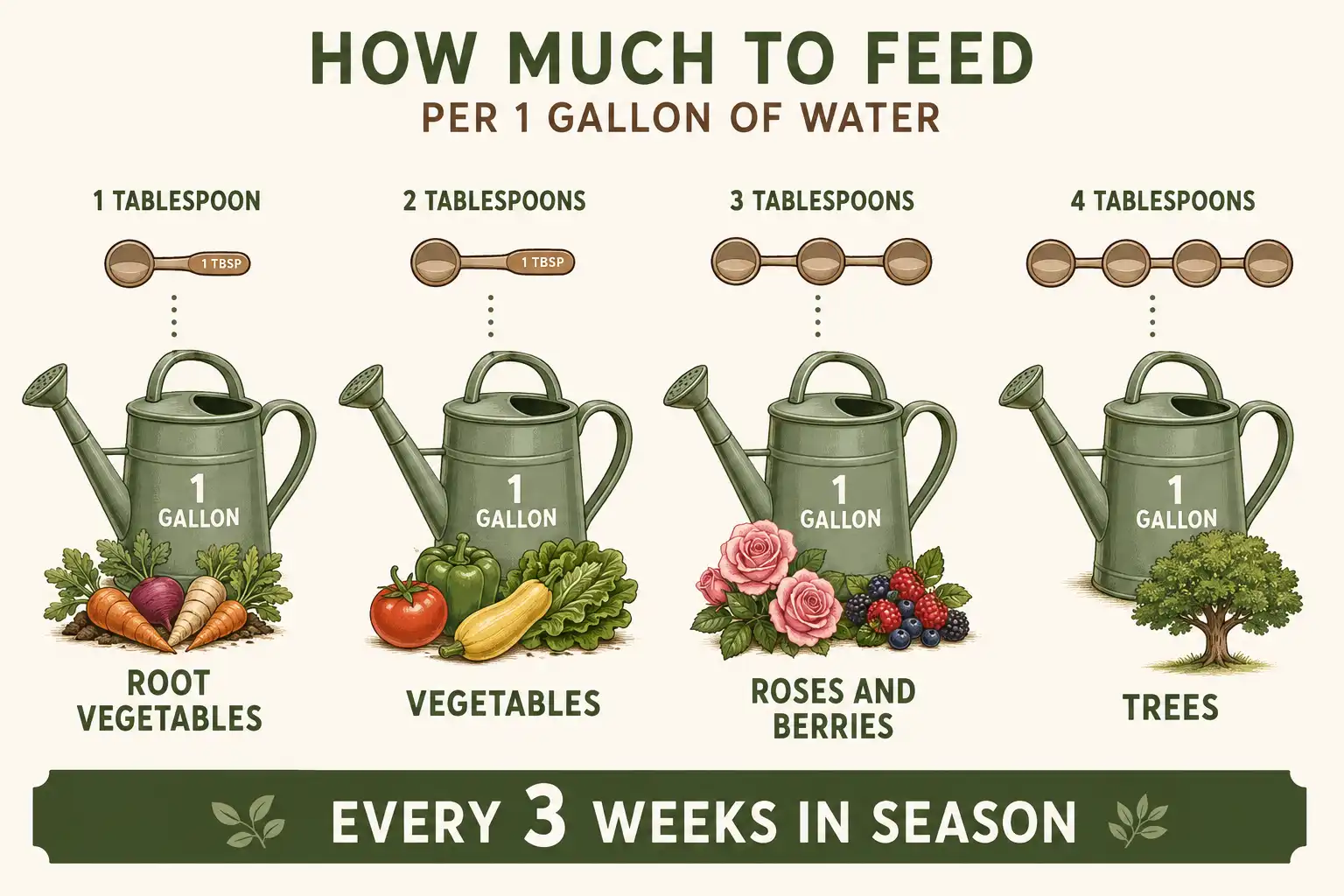
Rates change with the crop, and the differences matter. Root crops get a third of what tomatoes get, because extra nitrogen pushes tops instead of roots.
| Plant type | Rate per gallon of water | Coverage |
|---|---|---|
| Vegetables, bedding plants, bulbs, annuals | 2 tablespoons | 25 sq ft |
| Perennials, roses, vines, berries | 3 tablespoons | 25 sq ft |
| Shrubs | 3 tablespoons | Per 2 ft of plant height |
| Root vegetables (carrots, beets, radishes) | 1 tablespoon | 25 sq ft |
| Outdoor container plants | 1 tablespoon | 1 cu ft of soil |
| Trees | 4 tablespoons | 25 sq ft |
| Large indoor plants | 2 teaspoons per quart | Pot surface |
| Transplants and seedlings | 1 teaspoon | 25 sq ft |
Should You Use It as a Drench or a Foliar Spray?
Use a soil drench for regular feeding and save foliar spray for quick correction. Drenching puts nitrogen where roots can hold it, so the response lasts longer.
Foliar spray works when leaves have already gone pale and you want color back in a few days. Cut the rate in half, strain the solution through cheesecloth, and spray to the point of runoff. Spray early morning or evening only. Never spray in full sun above 85°F, because the leaf tissue can scorch.
Screens clog fast on fish products, so rinse your equipment right after. For larger plots, a hose end sprayer built for liquid feed beats hauling watering cans across the field.
How Often Should You Apply It?
Every three weeks during active growth is the standard label interval. Some brands print monthly instead. Either schedule works, so follow the jug in your hand.
Start about two weeks after transplanting, once roots have taken hold. Then stop feeding roughly four weeks before your last harvest on fruiting crops. Late nitrogen pushes leaves when the plant should be filling fruit. Our notes on fish fertilizer timing on tomatoes break down that schedule crop by crop.
How Much 5-1-1 Fish Emulsion Fertilizer for Peppers?
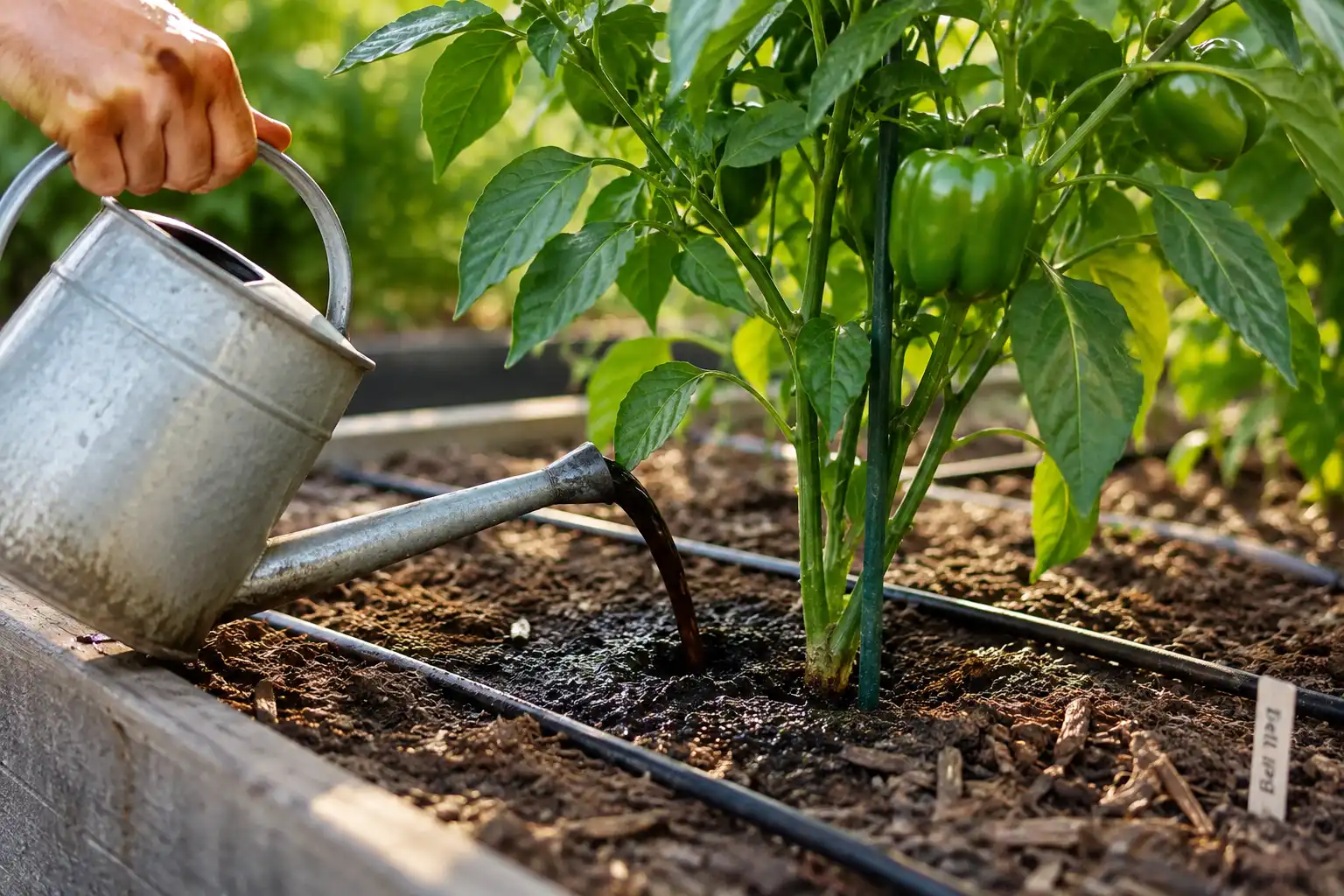
Mix 2 tablespoons per gallon of water, then apply about 2 cups of that solution per plant. One gallon covers 25 square feet, which works out to six or seven pepper plants at standard 18-inch spacing. Repeat every three weeks.
Timing matters more than volume with peppers. Here is the schedule:
- At transplant: Water in with a weak solution, 1 teaspoon per gallon. This settles the soil around the roots.
- Two to three weeks after transplant: First full feeding at 2 tablespoons per gallon.
- Through early vegetative growth: Continue every three weeks while the plant builds frame.
- Once the first fruit sets: Cut back or stop. Switch to a potassium source.
That last step is where most growers slip. Michigan State University Extension warns against heavy nitrogen before fruit set. Too much can trigger flower drop. It also leaves plants soft and brittle. University of Illinois Extension takes a narrower view. Its 2025 write-up says research does not fully support overfertilization as the cause of poor fruit set. That source points to pollination instead.
Both sides agree on the practical part: extra nitrogen buys you nothing after fruit set. A 5-1-1 grade gives peppers almost no potassium, and peppers pull potassium hard while fruit fills. So feed nitrogen early, then move to a higher potassium product once the first peppers size up.
Which Crops Respond Best to a 5-1-1 Grade?
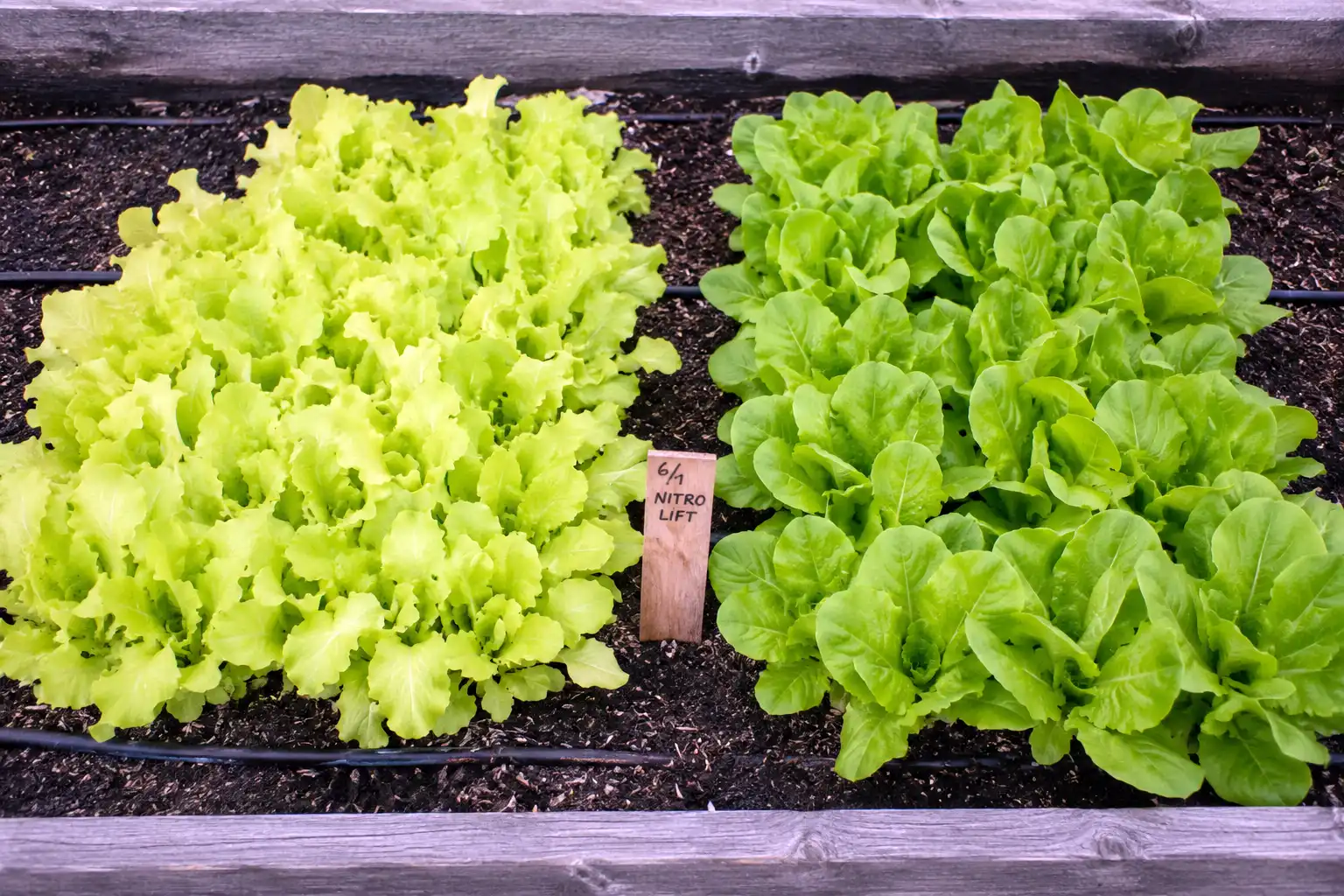
Leafy crops respond best, because the whole harvest is the part nitrogen builds. Lettuce, spinach, chard, kale, and brassicas all show color and size gains within a week or two of a feeding.
Strong fit:
- Lettuce and salad greens
- Spinach, chard, and kale
- Sweet corn during early vegetative growth
- Transplants recovering from setting out
- Container plants that leach nutrients with every watering
Weak fit:
- Carrots, beets, and radishes at full rate (cut to 1 tablespoon or skip)
- Peppers and tomatoes after fruit set
- Beans, peas, and soybeans, which fix their own nitrogen
- Any crop where a soil test already shows high nitrate
For salad beds, applying it every two weeks at the vegetable rate is the typical approach. That schedule anchors the approach to fertilizing lettuce through the season. Cut-and-come-again beds pull nitrogen hard after each harvest, so steady liquid feeding beats one heavy dose.
Does Fish Emulsion Burn Plants?
Not at label rates. Nutrient concentration is low here. The salt index also sits well under urea or ammonium sulfate. So the “won’t burn” claim on the jug holds up in the field.
That said, the concentrate is acidic and the label carries a caution about eye and skin contact. Never apply it undiluted. Overapplying at three or four times the label rate can still stress seedlings. Soluble salts cause that, not nitrogen burn.
How Do You Cut the Fish Smell?
The odor peaks during mixing and fades within 24 hours after application. It never goes away completely, so plan around it instead of fighting it.
- Apply in the evening. Cooler air holds the smell down, and overnight watering carries it into the soil.
- Water the soil surface afterward. A quick rinse pushes residue below the top inch.
- Mix outdoors, upwind. Most of the smell comes from the open jug, not the diluted mix.
- Skip indoor use. Even deodorized versions linger in a closed room for days.
- Rinse spills off concrete right away. Dried residue attracts ants and holds odor for weeks.
- Watch for animals the first night. Raccoons, cats, and dogs dig at fresh applications. Watering it in solves most of that.
Some products include a wintergreen deodorizer. It softens the edge, though growers still report a strong smell on day one.
Fish Emulsion vs Fish Hydrolysate: What Is the Difference?
Processing temperature separates them. Emulsion is heat processed. That step drives off the oils for other markets. What remains is a nitrogen-heavy liquid, usually 5-1-1. Hydrolysate is cold processed with enzymes, which keeps the oils, bones, and proteins in the bottle.
| Factor | Fish emulsion | Fish hydrolysate |
|---|---|---|
| Processing | Heat and acid stabilized | Cold enzymatic |
| Typical grade | 5-1-1 | 2-4-1 or 2-3-2 |
| Nitrogen | Higher, faster acting | Lower, slower |
| Calcium and phosphorus | Minimal | Higher from bone |
| Oils retained | No | Yes |
| Cost per gallon | Lower | Higher |
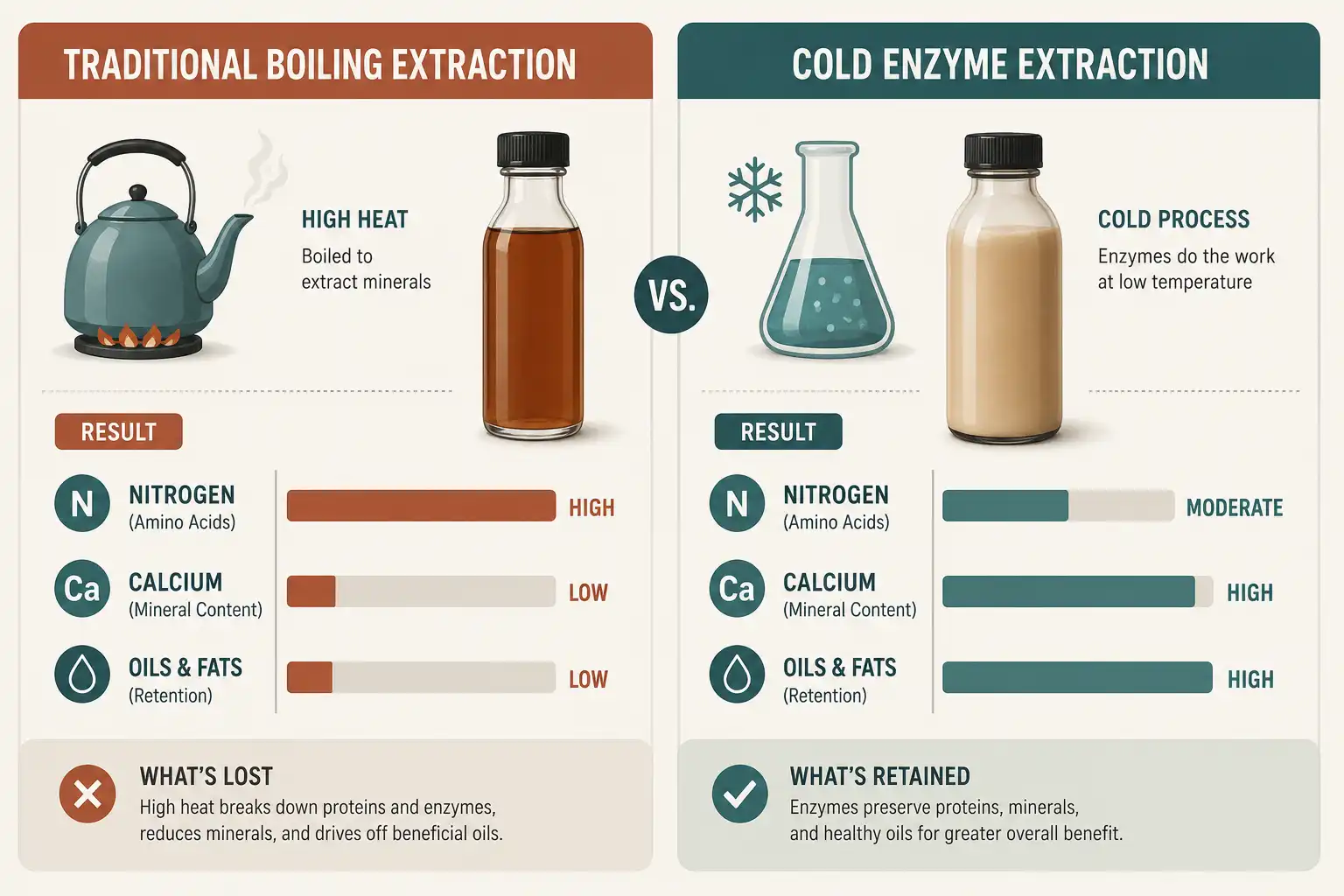
Pick emulsion when you need nitrogen now. Pick hydrolysate when you are feeding soil biology over years rather than pushing a crop this month. Claims that heat processing ruins the product are oversold. Soil microbes break down both forms before roots use much of either.
How Should You Store It?
Store the sealed jug in a cool, dark place away from heat and freezing. Kept that way, concentrate holds potency for one to two years.
Shake before every use, since separation is normal. Never store diluted solution, because it ferments in a closed container and can build pressure. An old jug that smells sharper than usual and pours thin has likely lost strength. Replace it rather than guess at a higher rate.
4 Best Fish Emulsion Fertilizer 5-1-1 Products
All four run the same guaranteed analysis. Three also come out of the same brand family. So the real differences are size, certification, and tree rates.
1. Alaska Fish Fertilizer OMRI Listed 5-1-1
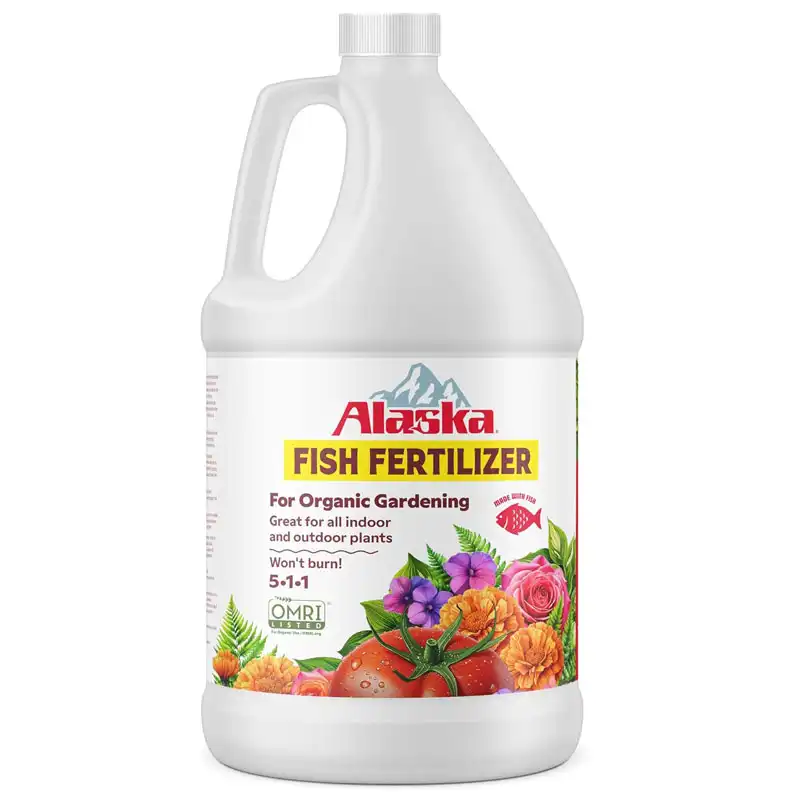
This is the jug by the hose. The 115-ounce size mixes about 115 gallons of solution at the vegetable rate. One bottle carries a good-sized plot through a season. OMRI listing matters if you sell at a farmers market or certify acres. Growers consistently report darker leaf color inside a week on tomatoes, roses, and containers. Caps and seals draw the most complaints, so inspect the bottle on arrival.
Specs:
- NPK: 5-1-1 (5% N, 1% P2O5, 1% K2O)
- Volume: 115 fluid ounces (8.8 lb)
- Rate: 2 tablespoons per gallon for vegetables
- Frequency: every three weeks in season
2. Alaska Fish Emulsion Fertilizer 5-1-1 Concentrate
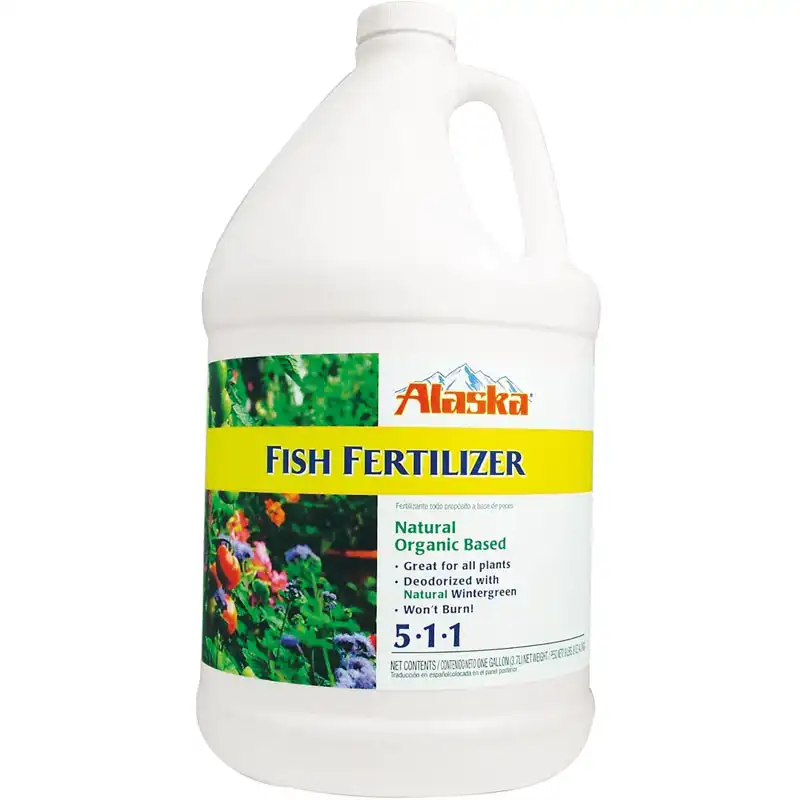
Same formula, bigger jug. One gallon mixes roughly 128 gallons of diluted solution at the vegetable rate. That outlasts most home gardens. The listing notes a natural wintergreen deodorizer, though growers still describe a sharp smell on the first day. Shake it hard, because a gallon of alaska fish emulsion fertilizer 5-1-1 settles heavier than the smaller sizes. Users report strong results on vegetables, roses, azaleas, and citrus.
Specs:
- NPK: 5-1-1
- Volume: 1 gallon (3.7 liters)
- Derived from: fish solubles and phosphoric acid
- Rate: 1 to 2 tablespoons per gallon
3. Lilly Miller Alaska Fish Fertilizer 5-1-1 Concentrate
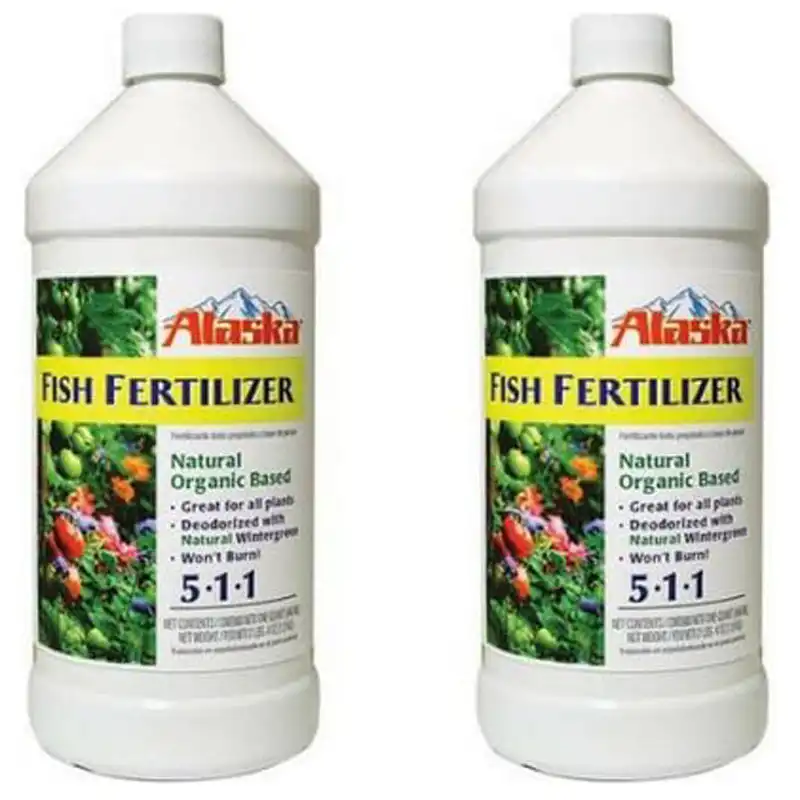
Lilly Miller and Alaska come out of the same house, so the analysis matches exactly. The quart is the size best suited to anyone starting out. It mixes about 32 gallons of solution at the vegetable rate, enough to cover roughly 800 square feet per pass. Growers report heavy tomato and pepper sets, plus houseplant bottles that last a full year. Wear gloves, since the label warns about eye and skin contact.
Specs:
- NPK: 5-1-1
- Volume: 1 quart (946 mL)
- Net weight: about 2.45 pounds
- Rate: 2 tablespoons per gallon for vegetables
4. Fertilome Fish Emulsion Fertilizer 5-1-1
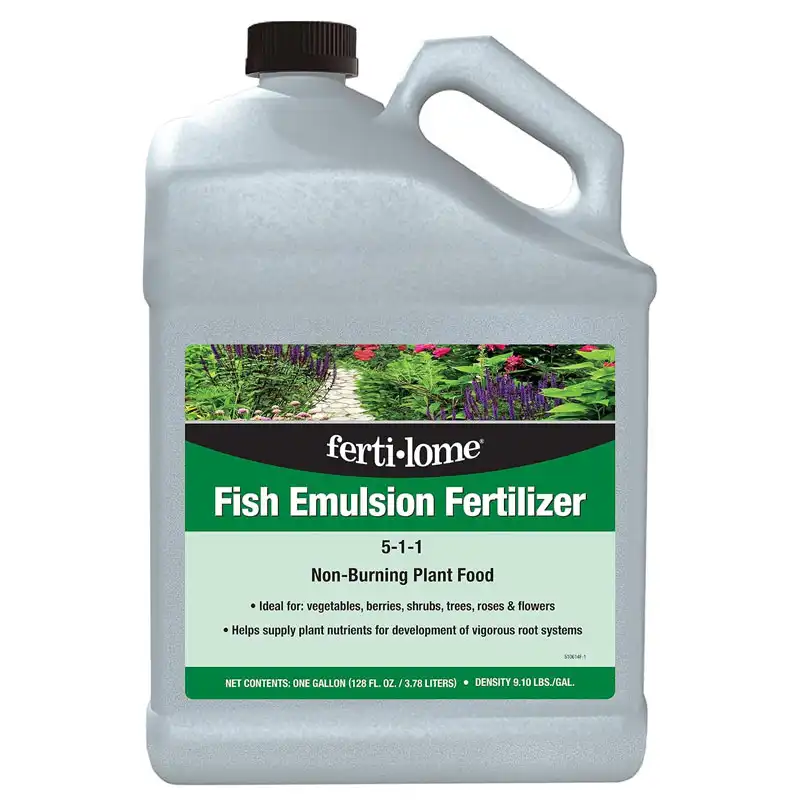
Fertilome runs the same analysis but carries no OMRI listing, so skip it if certification matters to you. The label splits plant and tree rates clearly. Trees get 4 tablespoons per gallon while plants get 1 to 2. Feeding runs monthly rather than every three weeks. Growers report deep green foliage and strong root response, especially on roses and patio plants. Odor complaints run highest among these four.
Specs:
- NPK: 5-1-1 (5% N, 1% P2O5, 1% K2O)
- Volume: 1 gallon (128 fl oz)
- Derived from: fish solubles
- Rate: 1 to 2 tbsp for plants, 4 tbsp for trees
5-1-1 Fish Emulsion Fertilizers Comparison
| Product | Size | OMRI listed | Deodorized | Best use |
|---|---|---|---|---|
| Alaska Fish Fertilizer 5-1-1 | 115 fl oz | Yes | No | Working garden, certified plots |
| Alaska Fish Emulsion Concentrate | 1 gallon | Yes | Wintergreen | Largest plots, best value |
| Lilly Miller Alaska 5-1-1 | 1 quart | Yes | No | Containers, small beds |
| Fertilome Fish Emulsion 5-1-1 | 1 gallon | No | No | Trees, shrubs, orchards |
How Do You Pick the Right One?
Match the container to your square footage, then check certification. A quart covers about 800 square feet per pass at the vegetable rate. A gallon covers roughly 3,200 square feet per pass.
Buy OMRI listed if you sell produce as organic or want the paperwork. Skip it if you garden for your own table, since the formula is the same either way. Still weighing liquid against dry? Our rundown of organic fertilizer choices for vegetables sets the two side by side.
FAQs on 5-1-1 Fish Emulsion Fertilizer
Can I use fish emulsion fertilizer 5-1-1 on seedlings?
Does 5-1-1 fish emulsion fertilizer expire?
Can I spray it on leaves during hot weather?
Will it attract animals to my garden?
Is fish emulsion safe around pets?
Can I use a 5-1-1 grade on my lawn?
Does it lower soil pH?
Can I mix it with other fertilizers?
How long before I see results?
What to Keep on Hand for This
A 5-1-1 grade earns its keep as a fast nitrogen tool, not a full fertility program. Use it on lettuce beds and on transplants recovering from a rough set. Peppers get it until the first fruit sizes. After that, switching to potassium and letting the plant fill out is the next step.
Run the math before you buy. One gallon holds about half a pound of actual nitrogen. Treat it as a supplement to your soil test. Get the rate right, water it in, apply it in the evening, and the smell will be gone by morning.