How to Grow Zucchini in Raised Beds: Spacing, Soil, and Care
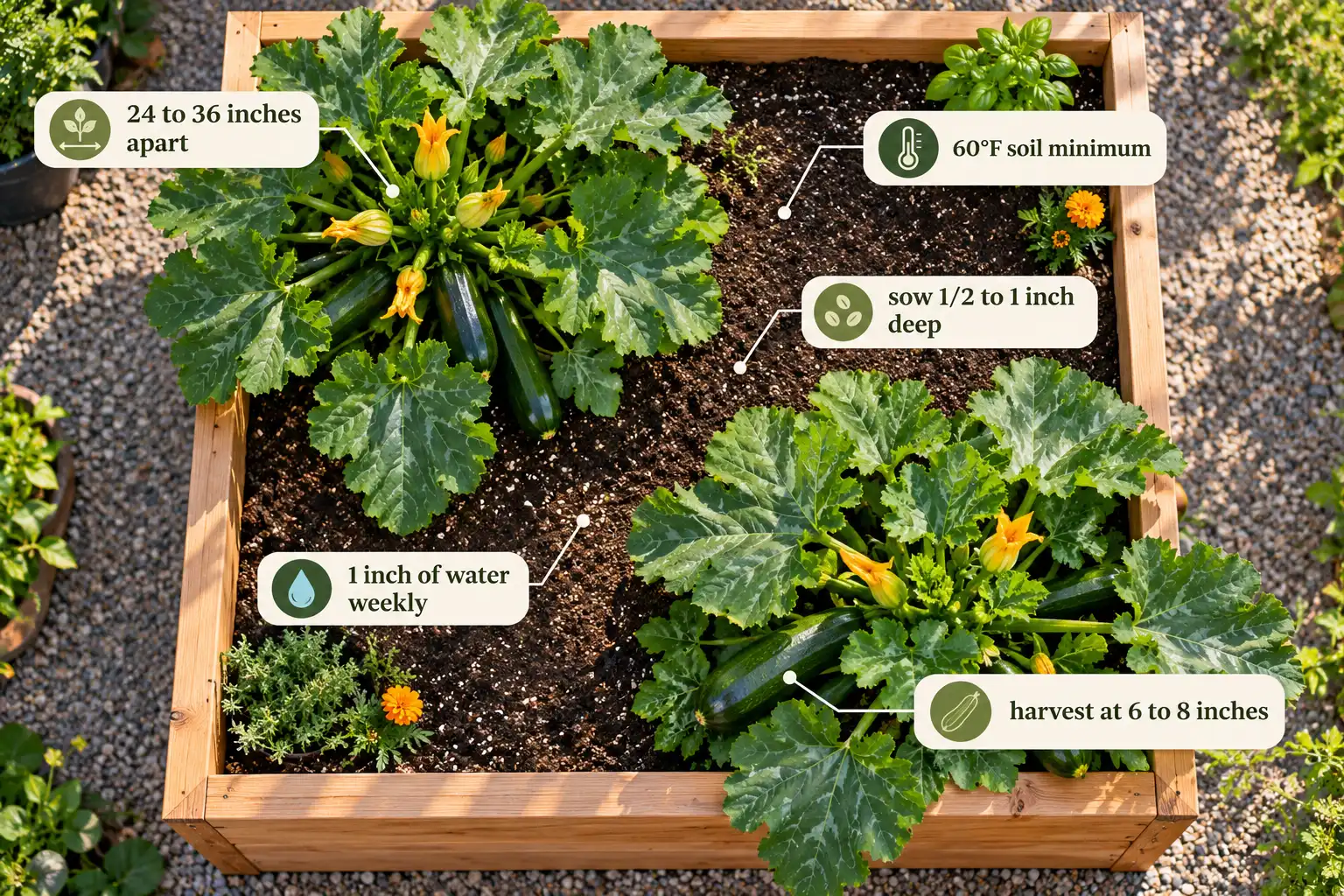
Zucchini produces heavily in a raised bed, but a single plant spreads about 3 feet and drinks hard. Learning how to grow zucchini in raised beds comes down to warm soil, generous spacing, steady water, and early pest control.
To grow zucchini in raised beds, sow seed 1/2 to 1 inch deep once soil reaches 60°F. Space plants 24 to 36 inches apart, water 1 inch weekly, and harvest fruit at 6 to 8 inches long.
Can Zucchini Grow in a Raised Garden Bed?
Yes. Zucchini (Cucurbita pepo) grows very well in a raised garden bed, because the crop needs warm, well-drained soil. University of Minnesota Extension notes that raised beds give vine crops the drainage they need. Raised-bed soil also warms faster in spring. That matters, since squash seed does not germinate in cold ground.
Water is the tradeoff. Raised beds behave like large containers, so they dry out faster than in-ground plots. In fact, UMN Extension points out that the taller the bed, the more often you need to water.
Clemson Cooperative Extension also recommends raised beds for squash, listing better drainage as one defense against blossom-end rot. However, it makes one regional exception and advises against raised squash beds in South Carolina’s sandy Central region. On very sandy ground, keep the bed low and add compost to hold moisture.
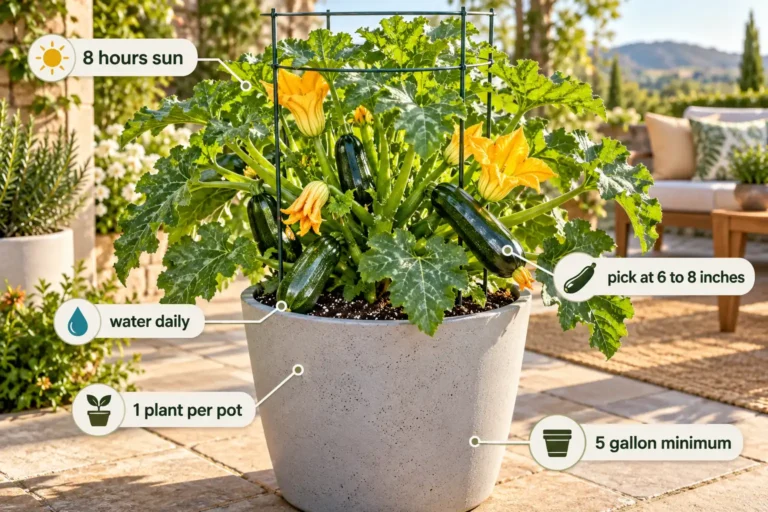
Also know: Grow Zucchini in Containers
How to Grow Zucchini in Raised Beds: Bed Depth and Soil
Bed Size, Depth, and Sun
Build the bed 8 to 12 inches deep over open ground. Zucchini sends down a long taproot plus branching surface roots, according to UMN Extension. Those roots benefit from reaching the native soil below. So before filling, loosen that ground with a broadfork or shovel. Also skip any solid liner under the bed, since UMN warns that a barrier is likely to stunt root growth.
On a patio or driveway, build taller. UMN Extension suggests raising beds 1 to 2 feet on pavement to reduce heat. Keep the bed about 4 feet wide so you reach the center from either side without stepping on the soil.
Finally, pick the sunniest spot you have. UMN Extension recommends at least 6 to 8 hours of direct sun daily for full-sun crops in raised beds.
Soil Mix and pH
Fill the bed with one-half to two-thirds topsoil and one-third to one-half plant-based compost. That is the blend UMN Extension recommends, ideally built on loam or sandy loam topsoil. Avoid bagged potting soil, because it dries out too quickly in a bed. More compost is not always better, either. Pure compost dries fast and repels water once it gets too dry.
Target a soil pH of 6.0 to 6.5. Both UMN Extension and Clemson Cooperative Extension cite this slightly acidic range for squash. A lab soil test confirms your pH, phosphorus, and potassium before you add fertilizer or lime. After that, UMN suggests retesting raised beds every 2 to 3 years.
Choosing a Zucchini Variety for Raised Beds
Choose a bush zucchini, not a vining type. UMN Extension notes that bush types fit far more easily into small gardens. For home gardens, Clemson Cooperative Extension recommends Black Beauty, Eight Ball, Elite, Embassy, Senator, and Spineless Beauty. Four options suit tight raised beds especially well.
| Variety | Type | Fruit | Raised-Bed Advantage |
|---|---|---|---|
| Black Beauty | Open-pollinated, introduced in the 1920s | Dark green, cylindrical | Classic standard; give it full spacing |
| Eight Ball | Hybrid, 1999 All-America Selections winner | Round, dark green | Compact plant spreads about 3 feet |
| Spineless Beauty | Hybrid | Medium green, cylindrical | Open habit and spineless leaf stems for easy picking |
| Spineless Perfection | Hybrid | Glossy medium green, 7 to 8 inches | Intermediate resistance to powdery mildew and two mosaic viruses |
Iowa State University Extension’s review of the 1999 All-America Selections winners describes Eight Ball’s compact habit and its spread of about 3 feet. For the two Spineless types, seed company spec sheets list an open plant habit with spineless petioles. That saves your forearms in a crowded bed. Disease resistance matters too, because close planting raises powdery mildew pressure.
Zucchini Spacing in Raised Beds
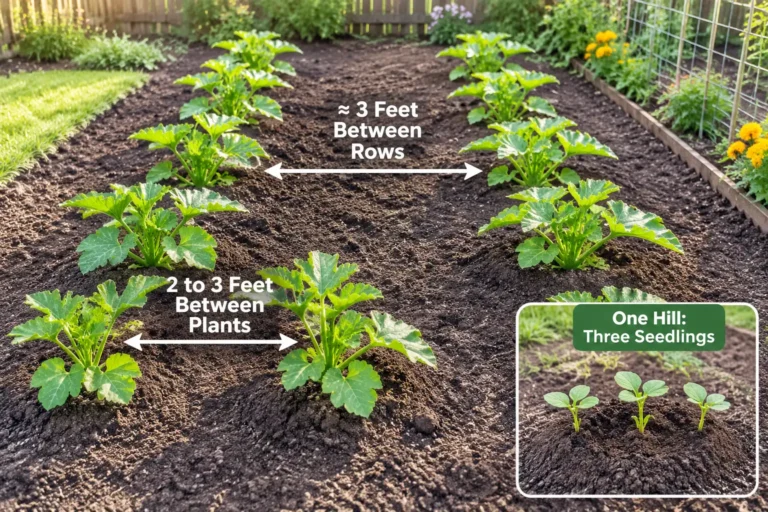
Space bush zucchini 24 to 36 inches apart in a raised bed. A raised bed has no walking rows, so each plant needs its full circle of space in every direction.
Extension spacing guidance supports that range:
- UMN Extension plants bush types in hills only 2 to 3 feet apart.
- Clemson Cooperative Extension thins seedlings to 12 to 15 inches, but in rows set 3 feet apart.
- NC State Extension’s square foot gardening guide lists summer squash and zucchini at 18 to 24 inches.
The 18-inch end of that range works only for plants trained up a stake. Unsupported, even a compact variety like Eight Ball spreads about 3 feet wide. Crowded plants shade each other and trap humid air in the canopy. They also hide fruit until it turns into a baseball bat.
How Many Zucchini Plants in a 4×4 Raised Bed?
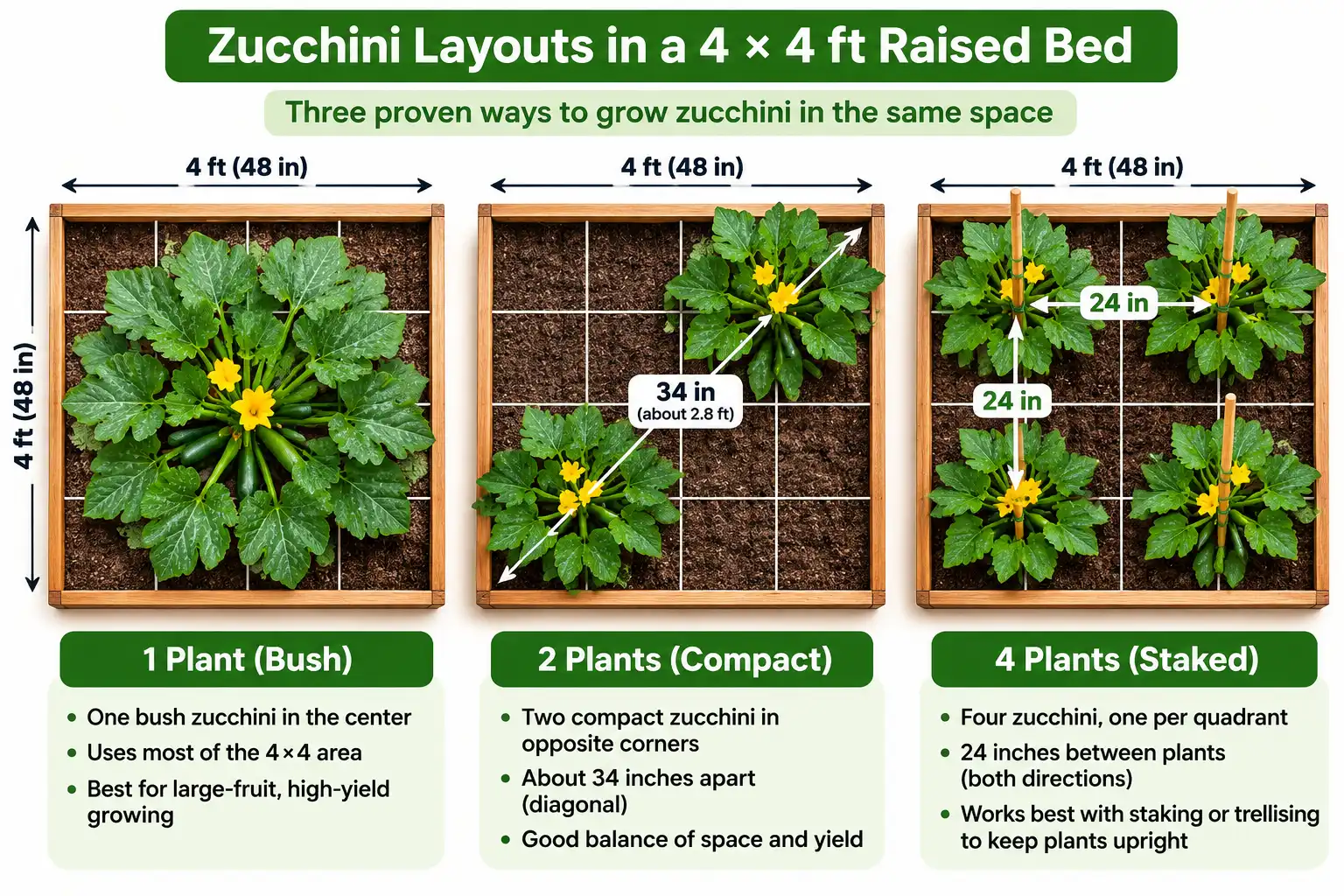
A 4×4 raised bed holds one or two bush zucchini plants grown on the ground, or up to four plants staked upright. The Square Foot Gardening method, popularized by Mel Bartholomew, gives one bush summer squash a 3 by 3 foot block. That leaves a 4×4 bed room for a single sprawling plant plus low crops along one edge.
| Growing Style | Plant Spacing | Space per Plant | Plants in a 4×4 Bed |
|---|---|---|---|
| Full-size bush, sprawling | 36 inches | About 9 sq ft | 1 |
| Compact bush, such as Eight Ball | 24 to 30 inches | 4 to 6 sq ft | 2 |
| Staked upright | 18 to 24 inches | 2 to 4 sq ft | Up to 4 |
For two plants, set them in opposite corners, about 1 foot in from each side. That diagonal places them roughly 34 inches apart. For four staked plants, center one plant in each 2 by 2 foot quadrant. A 4×8 bed simply doubles each count.
Growing Zucchini Upright on a Stake
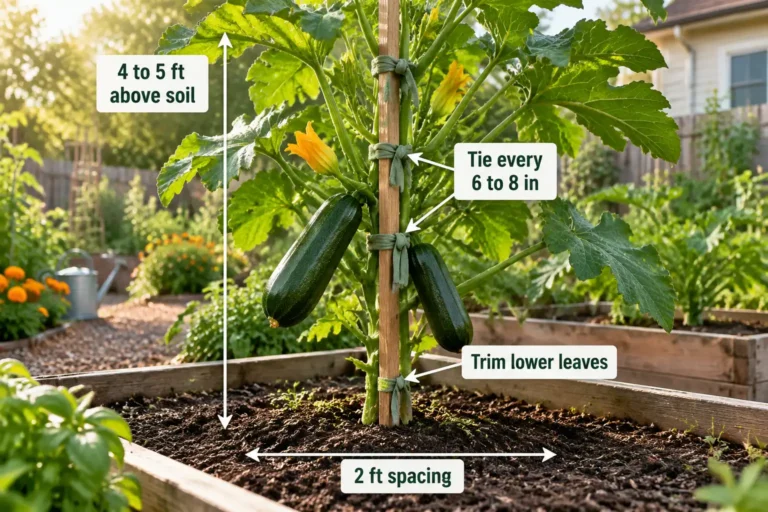
Staking turns a 3-foot sprawl into a narrow column. Drive a sturdy stake 4 to 5 feet tall beside each planting spot at seeding time, before roots spread. Then tie the main stem to the stake with soft ties every 8 to 12 inches as it grows. Remove old, yellowing leaves below the lowest fruit to open airflow around the stem. Upright plants also dry out faster, so check moisture more often. UMN Extension notes that trellised squash needs watering more frequently.
When to Plant Zucchini in a Raised Bed
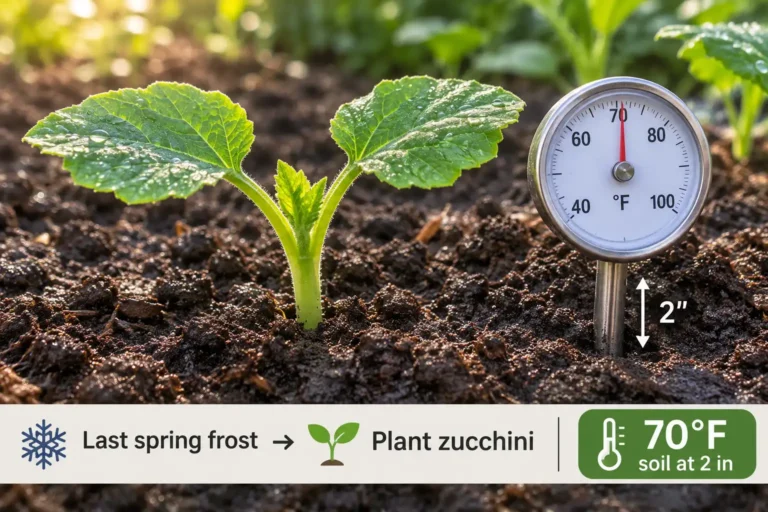
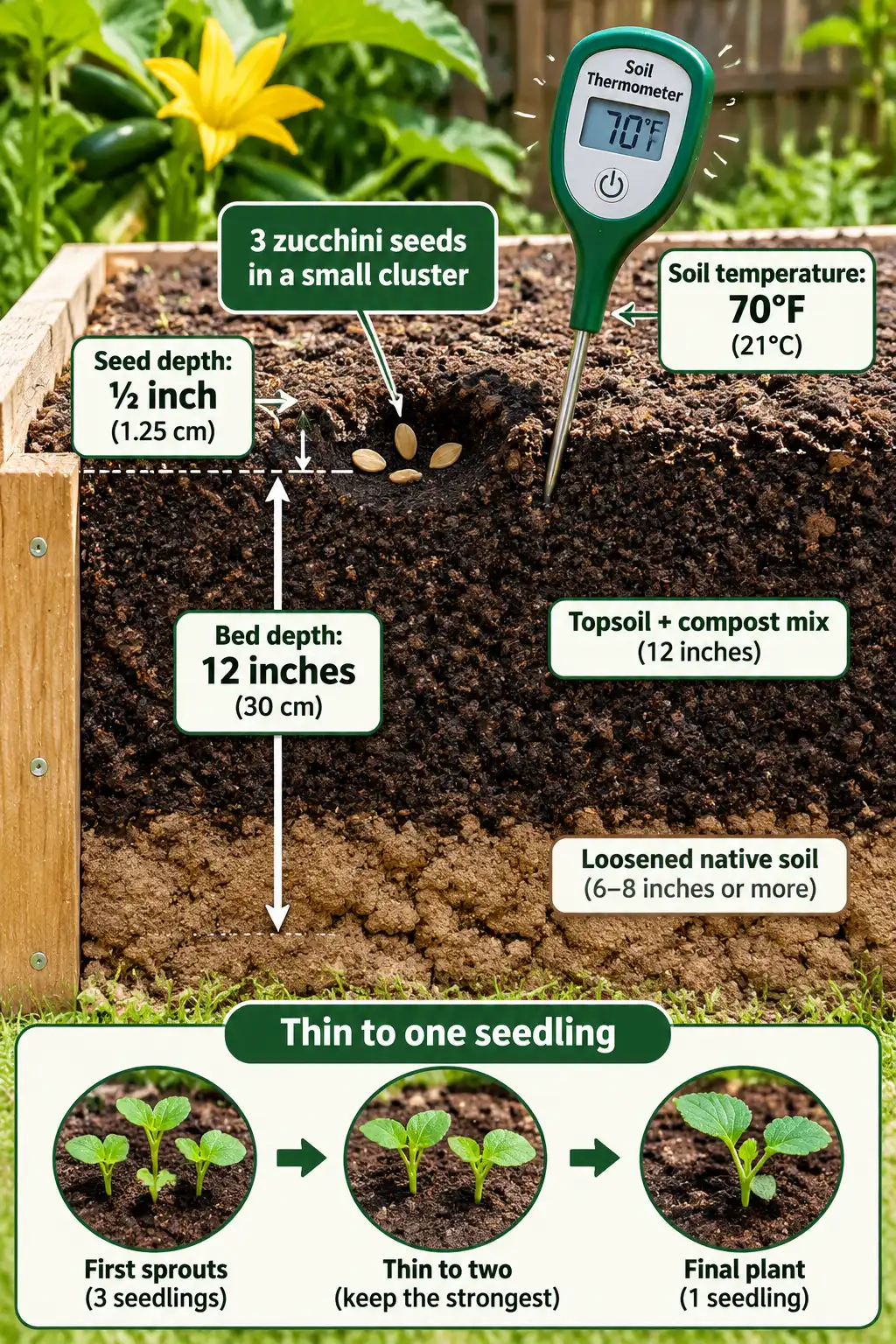
Plant zucchini after your last spring frost, once soil reaches at least 60°F at a 4-inch depth. That is the minimum Clemson Cooperative Extension sets. UMN Extension uses a warmer target of 70°F at 2 inches for reliable germination. Check the bed in early morning with a probe-style soil thermometer, since soil is coolest then. Raised beds reach these readings sooner than the surrounding ground.
Timing shifts by region. In Minnesota, the window usually opens in late May, or early June in the north, according to UMN Extension. In South Carolina, Clemson lists spring planting from March 15 in the Coastal Plain and April 15 in the Piedmont. Clemson also lists fall plantings from mid-July through August.
Earlier is better where pests build up. Clemson advises planting early, because squash vine borers and pickleworms get worse later in the season. For a steadier harvest, sow part of the bed first and the rest three weeks later, as UMN Extension suggests.
How to Plant Zucchini in a Raised Bed
Direct seeding works best. UMN Extension notes that squash transplants often struggle after root damage or cold soil. Before sowing, mix in fertilizer based on your soil test. Without test results, Clemson recommends a pre-plant 5-10-10 blend at 3 pounds per 100 square feet. That works out to about 8 ounces for a 4×4 bed or 1 pound for a 4×8 bed.
Then follow these steps:
- Water the bed a day ahead so the soil is evenly moist.
- Mark each planting spot using the spacing table above.
- Sow 2 to 3 seeds per spot, about 1/2 inch deep. Go closer to 1 inch in a light mix that dries fast at the surface.
- Firm the soil gently and water with a soft spray.
- Thin to the strongest seedling at the 1 to 2 true-leaf stage, as Clemson advises. Snip extras at soil level instead of pulling them.
- For transplants, set young plants at their original depth without breaking the root ball.
Watering and Feeding Zucchini in Raised Beds
How Much Water Zucchini Needs
Give zucchini about 1 inch of water per week from rain or irrigation, per UMN Extension. Raised beds often need more, because they dry out faster than garden soil. Each time, water deeply enough to wet the top 6 inches, as Clemson recommends. Light, frequent sprinkles keep roots shallow.
Water in the morning and aim at the soil, not the leaves. A timer-controlled drip kit or soaker hose keeps foliage dry and moisture even. Steady moisture matters most during fruit set and fruit development, according to Clemson.
Once soil temperature passes 75°F, spread 2 to 3 inches of straw or shredded leaves. UMN Extension warns that organic mulch applied earlier slows soil warming. After that point, mulch holds moisture and helps prevent blossom-end rot, Clemson notes.
How to Fertilize Zucchini in a Raised Bed
Side-dress once, as plants begin to spread and before vines run. Clemson recommends calcium nitrate (15.5-0-0) at 2 pounds per 100 feet of row. In a raised bed, that equals roughly 2 tablespoons per 4 feet of planted row. Scatter it in a ring around each plant, scratch it in lightly, and water.
Go easy on nitrogen, though. Clemson warns that too much nitrogen pushes vine growth and cuts fruit production. Similarly, beds built with plenty of compost often need little extra fertilizer, according to UMN Extension. Heavy yearly compost also builds up phosphorus and salts, so let your soil test guide the rate.
Pollination: Why Zucchini Flowers Fall Off Without Fruit
The first flowers fall off because they are male. UMN Extension explains that zucchini opens male flowers first, on thin stems. Female flowers follow, each with a small swollen ovary at its base that looks like a tiny zucchini. Bees then carry pollen from male to female flowers. Cold, rainy, or cloudy weather slows bees and reduces fruit set.
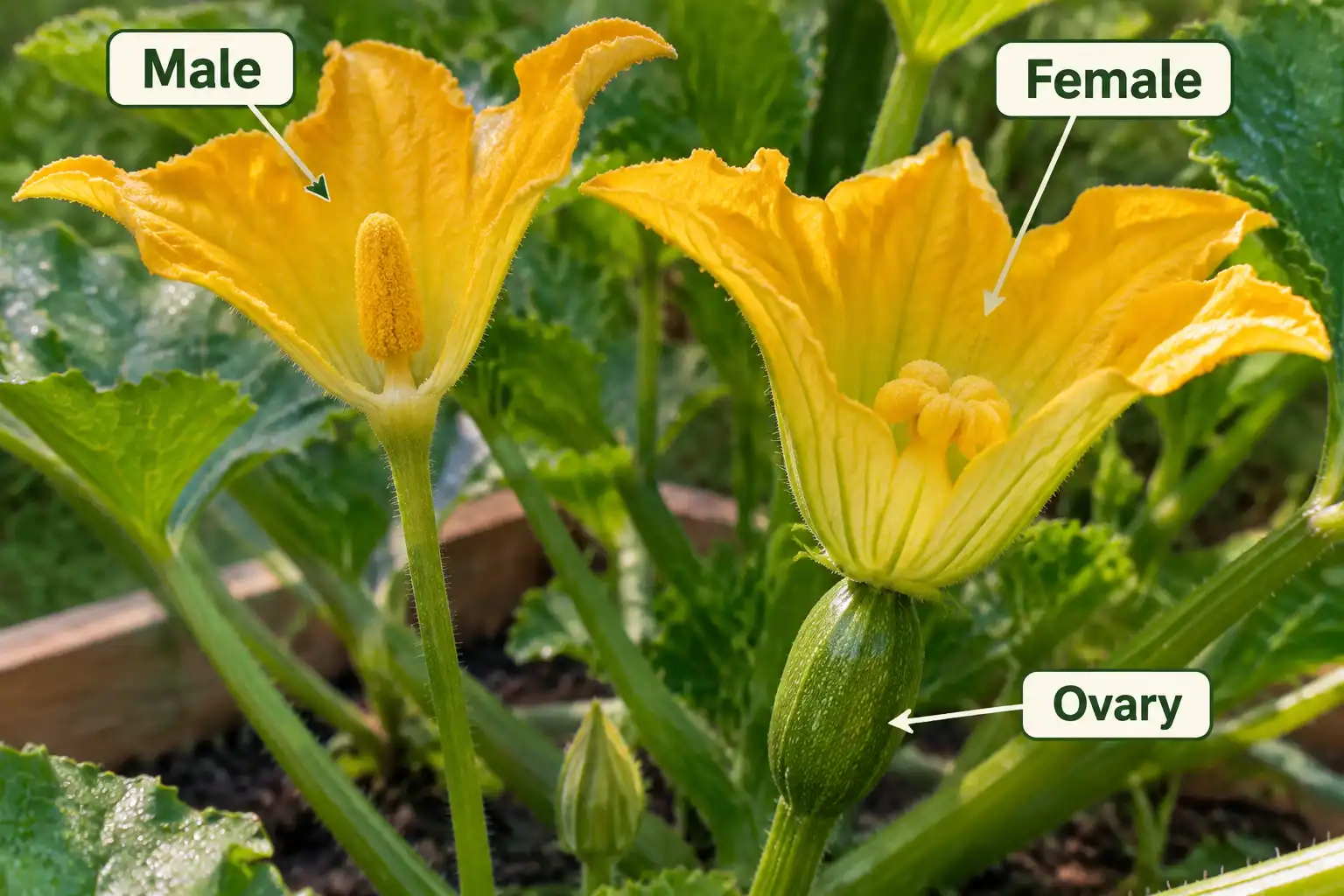
Hand pollinate when young fruit keeps shriveling from the tip. UF/IFAS Extension advises pollinating in the morning, because squash flowers close by evening. First, pick an open male flower and peel back its petals. Next, brush its pollen-coated center against the stigma inside a female flower.
To draw more bees, grow flowering herbs near the bed. Also hold any insecticide sprays until late evening, when bees are less active, as Clemson advises.
Pests and Diseases in Raised Beds
Squash Vine Borer
Squash vine borer is the most serious pest of raised-bed zucchini. Its larvae tunnel into the crown, and the whole plant wilts, according to UMN Extension. UGA Extension notes that the borers overwinter in the soil where squash grew the previous season. As a result, replanting zucchini in the same bed keeps the pest right under your crop.
Start by rotating crop families between beds each year. UMN Extension recommends keeping a plant family out of the same bed for 3 to 4 years. Then add these defenses:
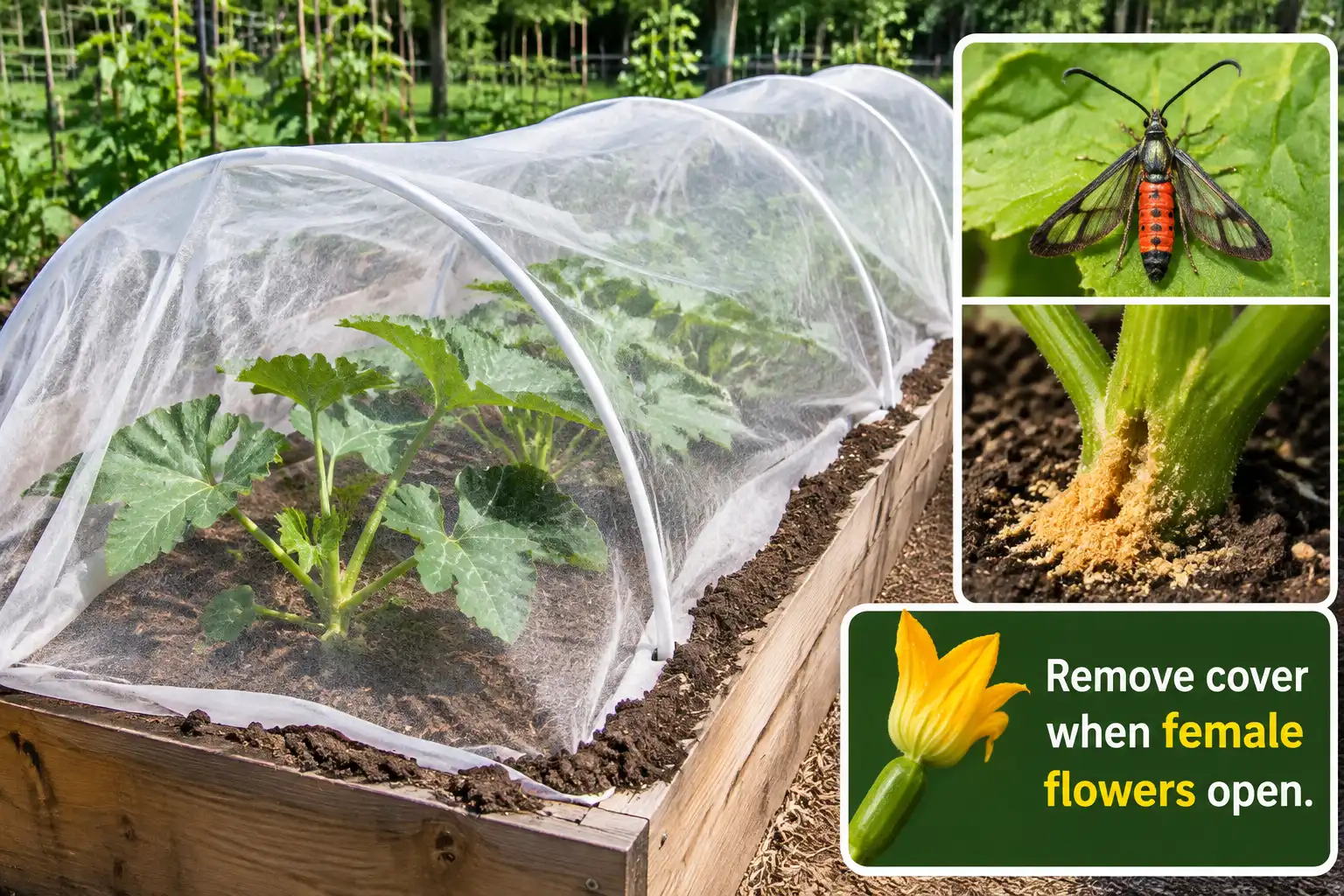
- Cover young plants with floating row cover on hoops until the first female flowers open. UGA Extension recommends removing it then so bees reach the blooms.
- Use row cover only in a bed that did not grow squash last year. Otherwise, moths emerging from the soil end up trapped under the fabric.
- Watch for sawdust-like frass at the stem base and sudden midday wilting.
- If you find a borer, slit the stem lengthwise from the entry hole, remove the larva, and mound moist soil over the cut. UGA notes this encourages new roots to form.
Squash Bugs, Cucumber Beetles, and Powdery Mildew
Squash bugs feed in groups and leave leaves ragged, per UMN Extension. Clemson notes that they lay egg clusters between leaf veins in a V pattern. Check leaf undersides twice a week and crush egg clusters on sight.
Striped and spotted cucumber beetles chew leaves, flowers, stems, and fruit. The same row cover used for borers keeps them off young plants. Aphids matter too, because Clemson notes they spread viruses to squash.
Powdery mildew shows up as white, powdery spots on leaves and vines. To slow it, keep foliage dry, respect spacing, and choose resistant varieties such as Spineless Perfection.
Troubleshooting Zucchini Problems in Raised Beds
Most raised-bed zucchini failures trace back to a short list of causes.
| Problem | Likely Cause | Fix |
|---|---|---|
| Seeds never come up | Soil below 60°F, so seed rotted | Resow once soil reaches 60 to 70°F |
| Early flowers drop with no fruit | First flowers are male | Wait for female flowers to open |
| Small fruit shrivels from the tip | Poor pollination | Hand pollinate in the morning |
| Dark, dry rot at the blossom end | Blossom-end rot from poor calcium uptake | Water evenly, mulch 2 to 3 inches, cut nitrogen |
| Plant collapses suddenly | Squash vine borer in the stem | Slit the stem, remove the larva, bury the cut |
| White powder on leaves | Powdery mildew | Water soil only, improve airflow, grow resistant types |
| Ragged leaves, gray bugs underneath | Squash bugs | Crush V-shaped egg clusters, use row cover early |
| Fewer new fruit forming | Oversized fruit left on the plant | Pick every 1 to 2 days |
| Bland flavor | Dark, cloudy weather or disease | Check for disease and confirm 6 to 8 hours of sun |
When and How to Harvest Zucchini
Zucchini is ready about 55 days after planting, according to Clemson Cooperative Extension. Harvest when fruit reaches 6 to 8 inches long and the skin looks glossy. Clemson sets 7 to 8 inches as the quality target and notes that smaller fruit is even more tender. In warm weather, check plants daily or every other day.
Cut each fruit with a knife or pruners, leaving a short stem. Avoid twisting or tugging, because squash vines send out roots at the joints. UMN Extension warns that disturbing the vine breaks those roots. Also skip harvesting while leaves are wet, to avoid spreading disease.
Remove oversized fruit even if you plan to compost it. Large zucchini left on the vine lowers plant yield, per UMN. Male blossoms are edible, too. Pick them the day they open, since UMN notes this does not reduce fruit yield.
Frequently Asked Questions
Do zucchini plants need a trellis in a raised bed?
No, bush zucchini grows well without support. Still, one sturdy stake per plant keeps stems upright, improves airflow against powdery mildew, and lets you fit up to four plants in a 4×4 bed.
Can you plant zucchini and tomatoes in the same raised bed?
Yes, in a bed 4 by 8 feet or larger. Give zucchini a 3-foot circle at one end and keep staked tomatoes at the other, since growing tomatoes with zucchini works best when neither crop shades the other.
Should you plant zucchini in the same raised bed every year?
No, rotate zucchini to a different bed each season. Squash vine borers overwinter in the soil where squash grew, so a 3 to 4 year break from squash disrupts both pests and soilborne disease.
Can zucchini grow in a partly shaded raised bed?
Zucchini survives partial shade, but it produces noticeably less fruit. Give the bed at least 6 to 8 hours of direct sun daily, the range UMN Extension recommends for full-sun crops grown in raised beds.
Can you use potting soil in a raised bed for zucchini?
No, potting soil dries out too quickly to work well in a raised bed. UMN Extension recommends a blend of one-half to two-thirds topsoil, with plant-based compost making up the rest.
What to Check Before You Plant
Confirm three things before seed goes in: soil at 60°F or warmer, a topsoil and compost mix at pH 6.0 to 6.5, and 24 to 36 inches for each bush plant. After planting, the routine stays simple. Water deeply each week, side-dress once, and pick every day or two. Next season, move zucchini to a different bed to break the vine borer cycle.