How Far Apart to Plant Zucchini: 2 to 3 Feet for Most Gardens
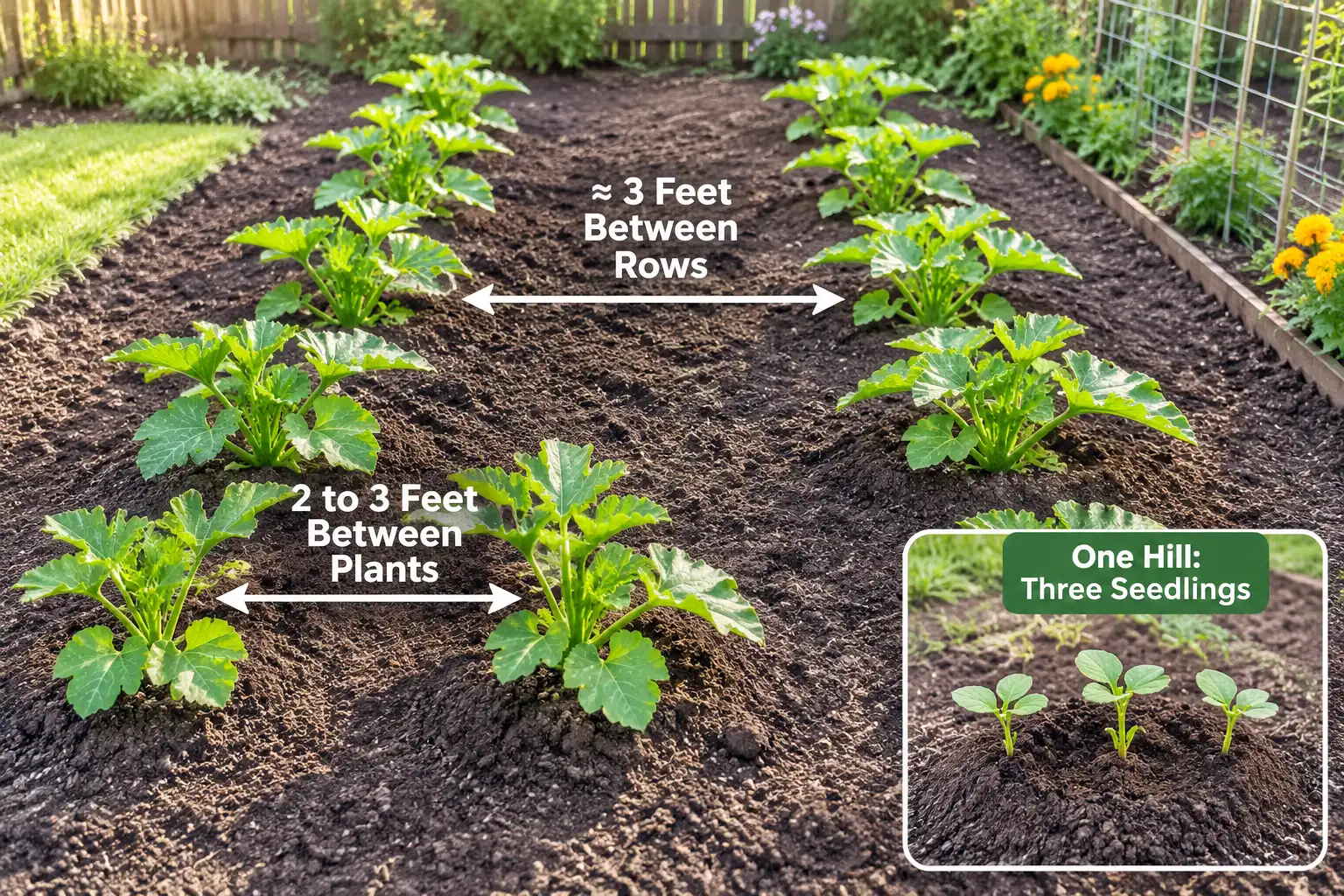
Zucchini starts as a small seedling but fills a wide patch by midsummer. Knowing how far apart to plant zucchini sets how many plants fit in a bed. It also controls airflow through the leaves and your access at harvest.
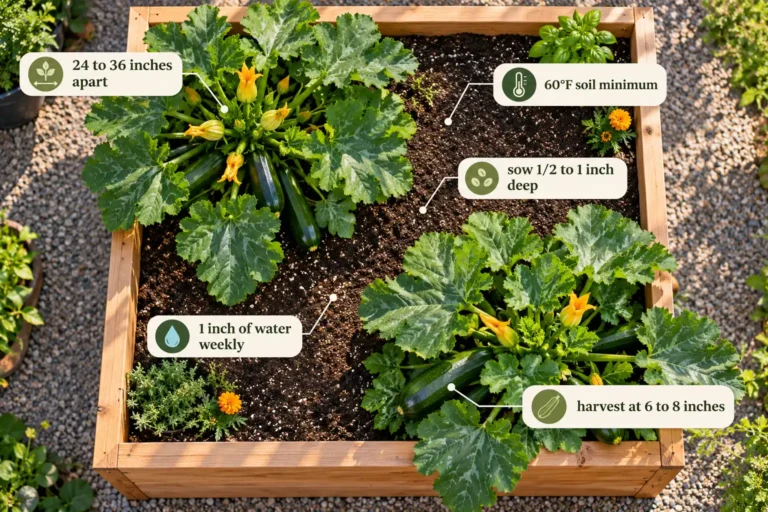
Space bush zucchini 2 to 3 feet apart in rows about 3 feet apart. That gap is the standard answer to how far apart to plant zucchini in most gardens. Vining types need 5 to 6 feet between hills.
Zucchini Plant Spacing by Layout
Zucchini spacing changes with your layout and the plant’s growth habit. The ranges below come from extension guides in Florida, South Carolina, Minnesota and North Carolina.
| Layout | Between Plants or Hills | Between Rows | Source |
|---|---|---|---|
| Single rows, bush type | 12 to 24 inches | 36 inches | UF/IFAS |
| Seeded rows, thinned | 12 to 15 inches | 3 feet | Clemson Extension |
| Close rows or hills, bush type | 2 to 3 feet | 2 to 3 feet | UMN Extension |
| Hills | 3 to 4 feet | 4 to 6 feet | Clemson Extension |
| Hills, vining type | 5 to 6 feet | 5 to 6 feet | UMN Extension |
| Trellis or square foot grid | 18 to 24 inches | 1 plant per 2 sq ft | NC State Extension |
Southern guides run tighter in the row. For example, University of Florida IFAS (UF/IFAS) and Clemson Cooperative Extension allow as little as 12 inches between plants. By contrast, University of Minnesota Extension (UMN) gives bush types 2 to 3 feet between rows or hills. So choose the tight end only when you can water at the soil line and harvest often.
How Much Space Does Zucchini Need?
A bush zucchini needs about 4 to 9 square feet of ground at maturity. Vining types need far more, roughly 25 to 36 square feet per hill.
Those numbers come straight from extension spacing. UMN Extension sets bush types 2 to 3 feet apart each way, or 4 to 9 square feet. For vining types, it allows 5 to 6 feet between hills. UF/IFAS, however, packs bush plants tighter. Its Florida guide lists 5 to 10 plants per 10 feet of row, in rows 36 inches apart. That works out to about 3 to 6 square feet per plant.
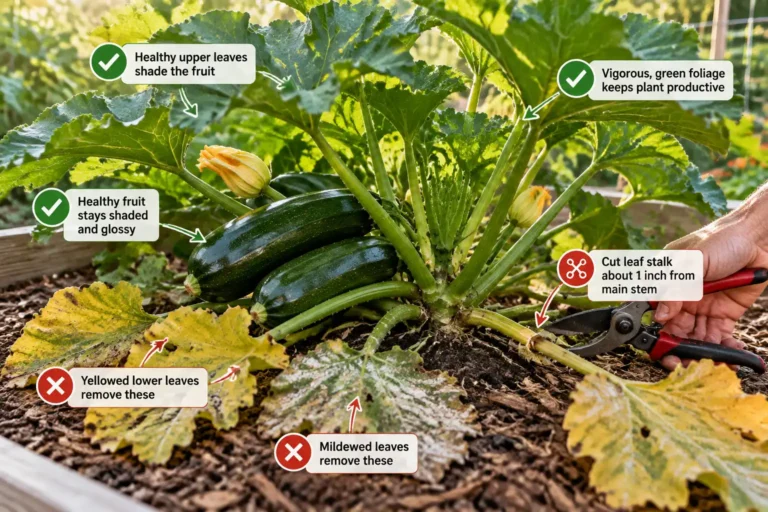
Room matters because crowding costs yield. According to UMN Extension, cucurbits that sit too close compete for light and nutrients. As a result, shaded leaves photosynthesize less and growth slows. Crowding also traps humid air. Oregon State University Extension notes that wider spacing and pruning improve air circulation, which helps limit powdery mildew.
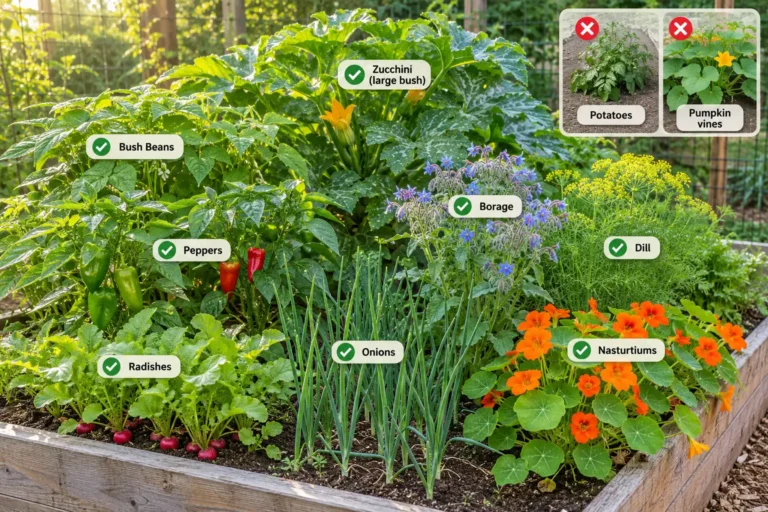
Growth habit sets your number. Most summer squash grows as a bush, per UF/IFAS, though UMN notes that some varieties form long vines. So read the seed packet for “bush” or “vining” before you mark the bed. Shared beds follow the same rule. Give zucchini its full footprint when pairing it with tomatoes so neither crop shades the other.
How Far Apart to Plant Zucchini in Rows
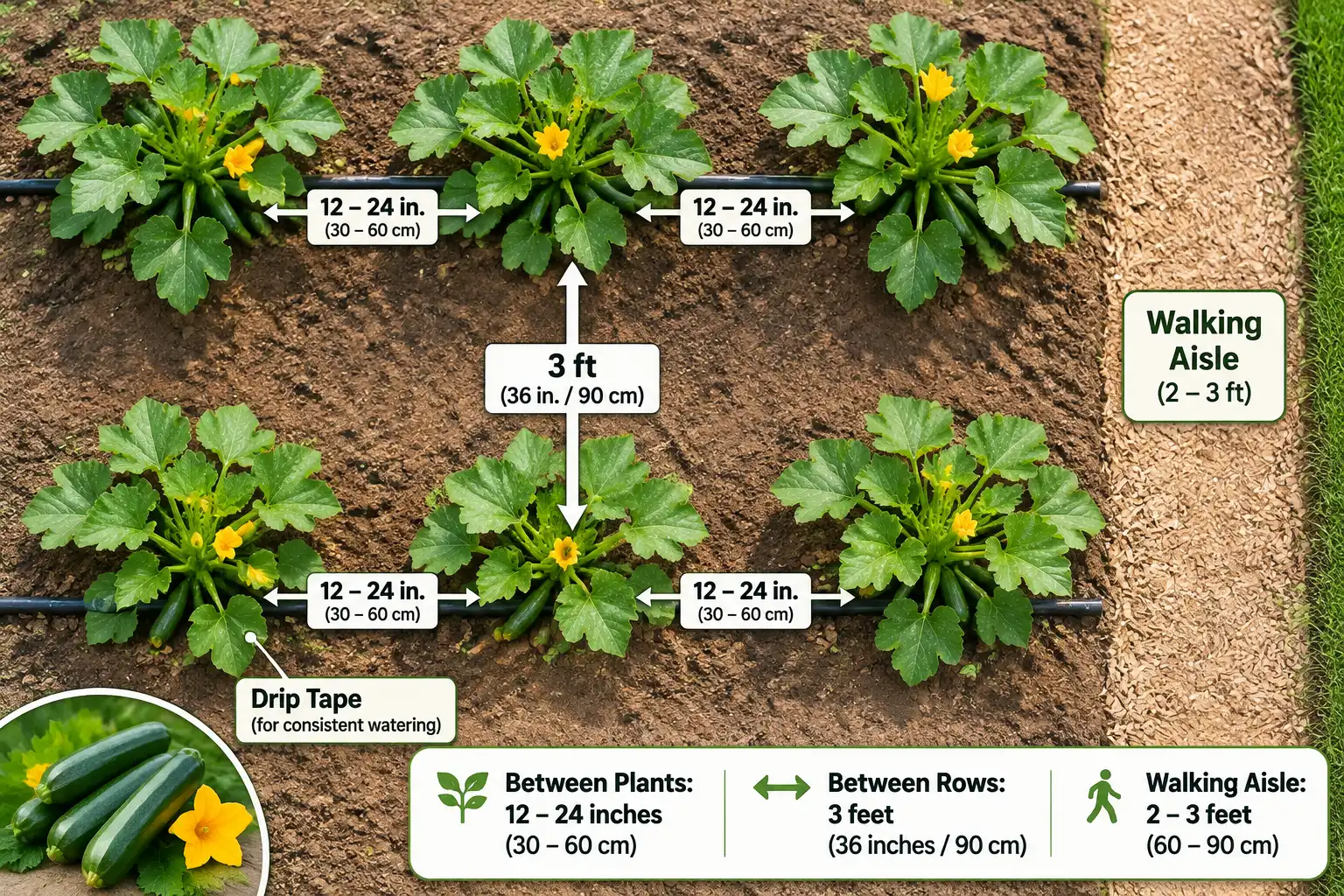
Plant zucchini 12 to 24 inches apart in the row, with at least 3 feet between rows. UF/IFAS uses those numbers for Florida gardens. It also notes you can shrink or skip row spacing in beds, as long as plant spacing holds.
Clemson Cooperative Extension starts with direct seeding. First, it recommends sowing seed 1/2 inch deep and 4 to 6 inches apart in 3-foot rows. Then thin seedlings to 12 to 15 inches at the one to two true leaf stage. For transplants, Clemson recommends 15 inches between plants at planting.
Row length sets your plant count. A 100-foot row holds 100 plants at 12 inches, about 67 at 18 inches and 50 at 24 inches.
Wider rows earn their space at harvest, though. UMN Extension explains that squash vines root from their joints, so jostling the vines can break those roots. A walkable aisle lets you pick without that damage. Tight rows also dry slowly after rain. For that reason, UMN advises drip or soaker hose and no sprinklers on squash. That makes drip lines a better fit than overhead spray in close rows.
How to Plant Zucchini in Hills
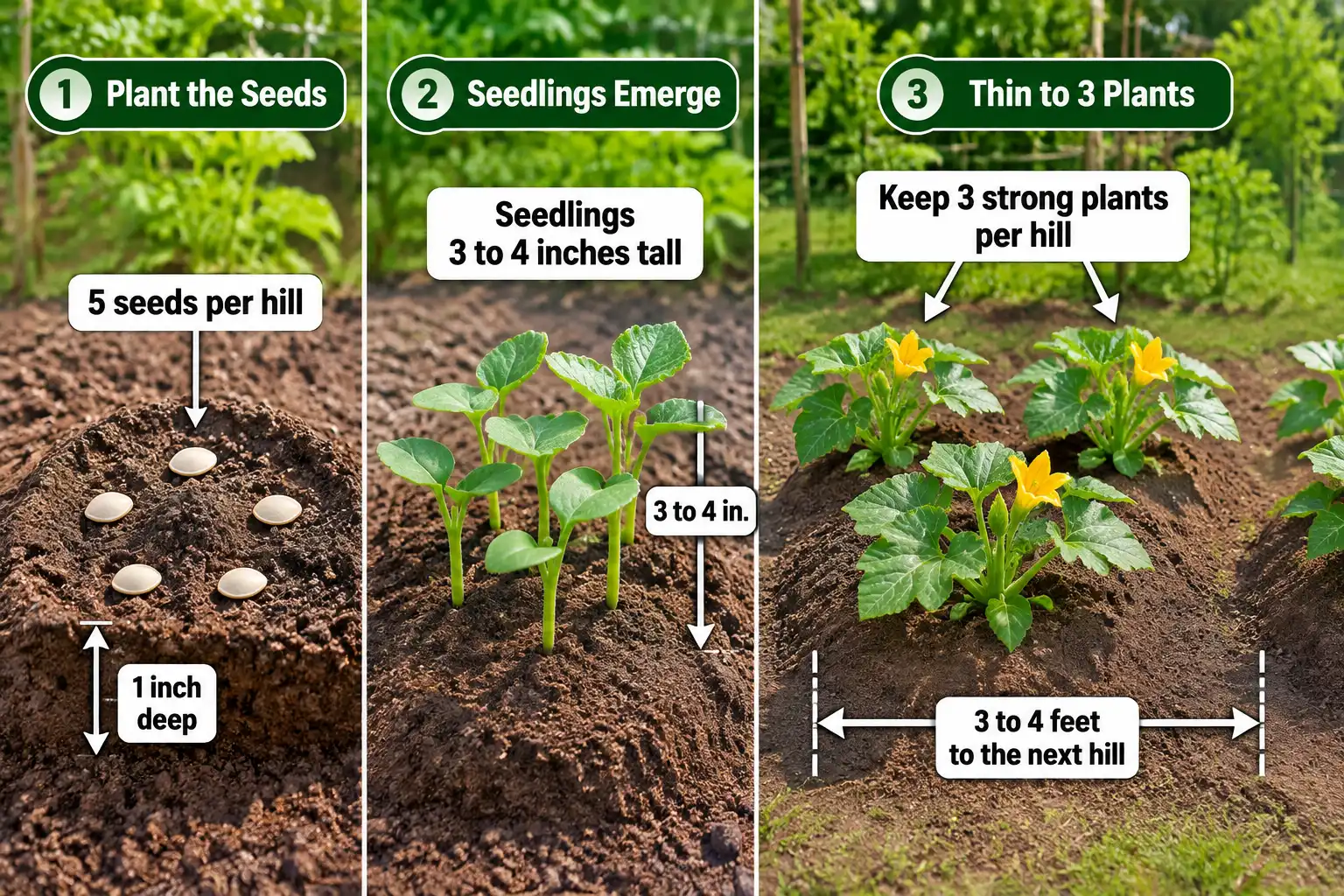
A hill is a tight cluster of three or four seeds in one spot, according to UMN Extension. It does not have to be a mound. Still, a low raised hill drains faster in wet spring soil.
Hill spacing depends on growth habit. Clemson Cooperative Extension sets hills 3 to 4 feet apart in rows 4 to 6 feet apart. Each hill gets two or three seeds. Texas A&M AgriLife Extension allows 18 to 48 inches between hills, on rows 3 to 8 feet apart. It also notes that vining types need more room than bush types. For true vining varieties, UMN allows 5 to 6 feet between hills.
Seed counts differ too. Texas A&M sows five or six seeds about 1 inch deep per hill. Then it thins each hill to three plants once seedlings reach 3 to 4 inches tall.
Timing matters as much as spacing. UMN Extension recommends sowing after the last frost, once soil reaches 70°F at a 2-inch depth. In most of Minnesota, that falls in late May. Clemson, by contrast, sets a lower bar of 60°F at 4 inches for South Carolina. Check the reading with a probe soil thermometer before you sow.
Step-by-Step Hill Planting
- Mark hill centers. Space them 3 to 4 feet apart for bush zucchini and 5 to 6 feet apart for vining types.
- Feed each hill. Work 2 to 3 tablespoons of fertilizer into a 2-by-2-foot area, 3 to 4 inches deep.
- Sow the seed. Plant five or six seeds 1/2 to 1 inch deep, a few inches apart.
- Water right away. Soak the hill after sowing so the seeds sit in moist soil.
- Thin early. Once seedlings reach 3 to 4 inches tall, snip the extras at the soil line.
- Keep the strongest. Leave up to three plants per hill, and fewer at the tight end of the spacing range.
Snipping beats pulling because it leaves the roots of the keepers undisturbed. For the feeding step, Texas A&M AgriLife names a balanced 10-10-10 blend as its example fertilizer for squash.
How Many Zucchini Plants per Square Foot?
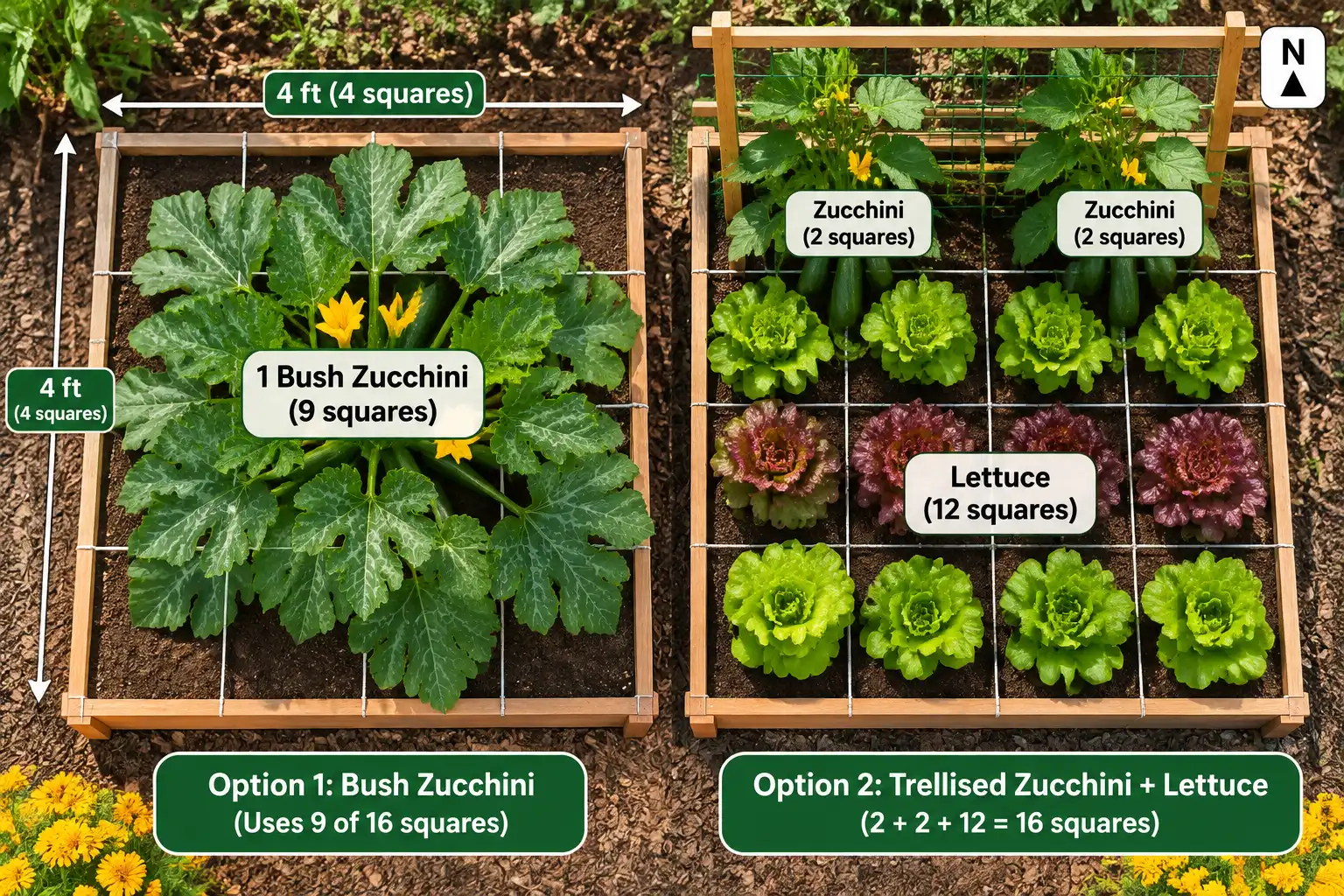
Zucchini needs more than one square foot, so the count is a fraction. Plan on 1 plant per 2 square feet on a trellis and 1 plant per 9 square feet when it sprawls.
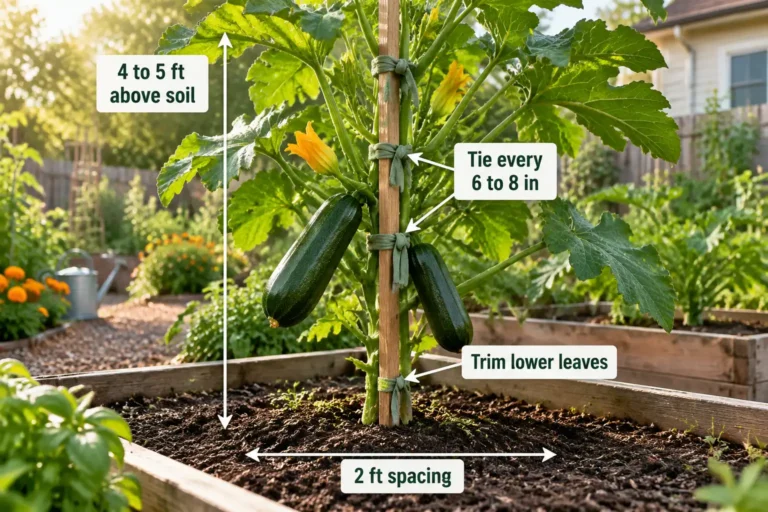
NC State Extension’s square foot gardening guide groups summer squash and zucchini at 18 to 24 inches between plants. That equals 1 plant per 2 square feet, a tight rate that suits plants trained upward. A bush zucchini left to sprawl, however, needs a 3-by-3 block of squares. That matches UMN’s bush spacing of up to 3 feet.
| Growing Style | Squares per Plant | Plants per Square Foot |
|---|---|---|
| Trellised or staked | 2 | 0.5 |
| Bush on a 2-foot grid | 4 | 0.25 |
| Sprawling bush | 9 | 0.11 |
In a standard 4-by-4 bed, one sprawling plant takes 9 of the 16 squares. Two trellised plants along the north edge, on the other hand, use only 4 squares. That leaves the rest of the bed for low crops, and the trellis casts its shade away from them.
Spacing Zucchini on a Trellis or in Containers
On a Trellis or Stake
Set trellised zucchini 18 to 24 inches apart along the support, which matches NC State Extension’s square foot range. Next, tie the main stem loosely as it grows. Upright plants hold their leaves off the soil, so air moves through the canopy more freely. Expect to water more often, though. UMN Extension notes that trellised plants may need water more frequently.
In Containers
Grow one zucchini per container. Ramsey County Master Gardeners, working with University of Minnesota Extension, list a 5-gallon pot as the minimum for squash. Bigger pots hold more water, and that matters because container soil dries out fast. For that reason, check moisture every day, as those Master Gardeners advise.
Signs Your Zucchini Plants Are Too Close

Crowded zucchini shows the problem through mildew, hidden fruit and damaged vines. Match the symptom to its fix below.
| Symptom | Likely Cause | Fix |
|---|---|---|
| White powdery spots spreading leaf to leaf | Still, humid air in a dense canopy | Remove the worst leaves; widen spacing next season |
| Oversized fruit found late | Leaves hide fruit in packed rows | Check plants daily and pick overgrown fruit |
| Pale, stretched growth | Plants competing for light | Thin to final spacing at one to two true leaves |
| Broken vines after picking | No room to step between plants | Leave a walkable aisle between rows |
| Leaves stay wet into evening | Slow drying in tight rows | Water at the soil line in the morning |
UMN Extension warns that leaving oversized fruit on the vine lowers yield. Clemson Extension recommends morning watering so leaves dry before dark. For extra margin, Oregon State University Extension names Payroll and Sebring as zucchini varieties with better powdery mildew resistance.
Wide gaps cause trouble too. Bare soil grows weeds until the leaves close over it. UMN Extension recommends shallow hoeing until vines spread between rows. It also advises waiting for 75°F soil before adding straw or compost, since organic mulch slows warming. After that point, mulching between rows helps hold down weeds in the open gaps.
Frequently Asked Questions
Can you plant two zucchini plants in one hole?
Yes, as long as you treat the spot as a hill and widen the spacing around it. Texas A&M AgriLife Extension thins hills to three plants, so allow 3 to 4 feet before the next hill.
Do zucchini and yellow squash need different spacing?
No, both are summer squash (Cucurbita pepo) and share the same spacing rules. Keep bush plants of either type 2 to 3 feet apart, and plan them as one block.
Can zucchini grow 12 inches apart?
Yes, compact bush types can grow 12 inches apart in single rows. Clemson Cooperative Extension thins seedlings to 12 to 15 inches in 3-foot rows, so plan frequent harvests and dry foliage.
How deep should you plant zucchini seeds?
Sow zucchini seeds 1/2 to 1 inch deep once the soil has warmed after frost. UMN and Clemson Extension use 1/2 inch, while Texas A&M AgriLife goes about 1 inch deep.
Putting This Into Practice
Start with the growth habit printed on the seed packet. Bush zucchini fits 2 to 3 feet apart in 3-foot rows, or 12 to 24 inches in tighter Southern rows. Vining types need hills 5 to 6 feet apart. A trellis cuts the footprint to about 2 square feet per plant. After that, thin early, water at the soil and pick often, so the space you planned keeps producing.