How to Calculate Water Needs for Crops: 6 Water-Smart Habits

Calculating water needs for crops starts with one goal: replace the water a crop uses through evapotranspiration, without overfilling the root zone. You calculate that need by tracking weather-driven water loss, adjusting for the crop growth stage, subtracting effective rainfall, then dividing by irrigation efficiency to match what your system delivers. This guide walks through the full process, from field measurements to unit conversions, so you can set run times with confidence and avoid yield loss from drought stress or waterlogging.
If you want broader irrigation context, see the irrigation and water management on crop farming. For soil storage and infiltration basics, refer to soil fertility fundamentals.
What does “crop water need” mean?
Crop water need means the amount of water a crop removes from the field each day through evaporation from soil and transpiration from leaves. Agronomists express that loss as crop evapotranspiration (ETc). ETc changes with weather, canopy size, wind, humidity, and growth stage.
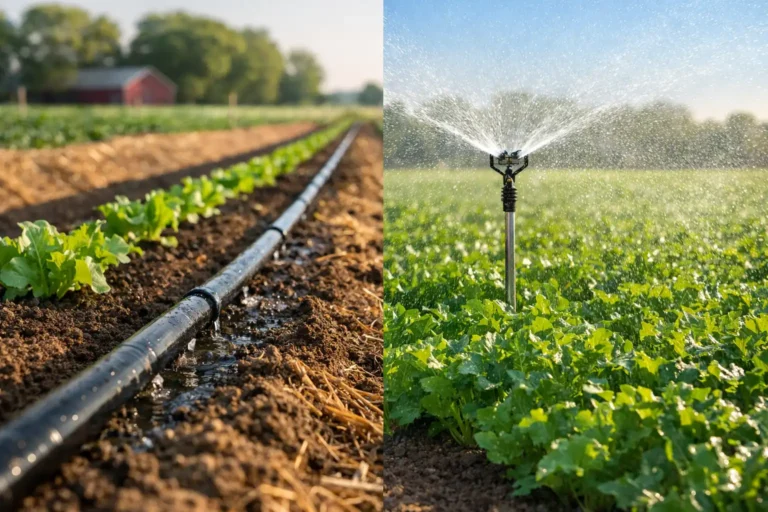
Before you add run times, it helps to compare drip and sprinkler irrigation so your efficiency assumption matches what your system really delivers in the field.
Which numbers do you actually calculate?
A farmer calculates four numbers to turn “water need” into an irrigation plan.
- Daily ETc (how much the crop uses)
- Effective rainfall (how much rain stays available in the root zone)
- Net irrigation requirement (what irrigation needs to replace)
- Gross irrigation requirement (what your system needs to apply after losses)
Those numbers keep the work factual and repeatable.
What field information do you need before you start?
You need inputs that describe the crop, the soil, and the irrigation system.
- Crop type and growth stage (for crop coefficient, Kc)
- Rooting depth you manage (effective root zone)
- Soil texture and water-holding behavior (how fast it infiltrates, how much it stores)
- Irrigation method and expected efficiency (drip, sprinkler, furrow, pivot)
- A weather source for reference ET (ETo) or local ET data
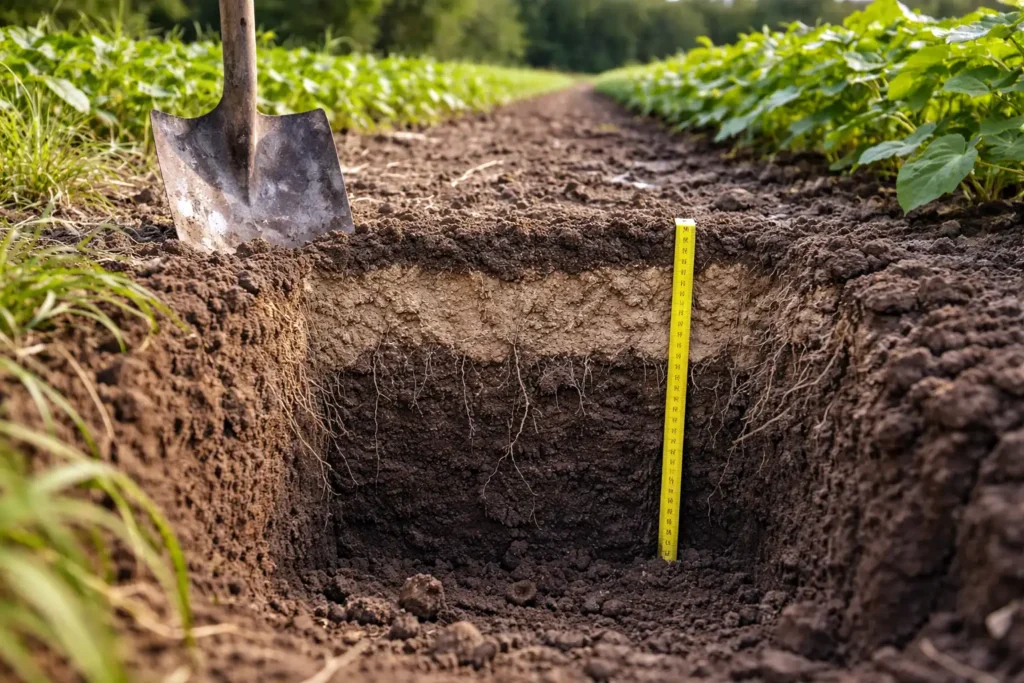
A soil probe, shovel, or auger verifies rooting depth and wetting depth after a run. Tools that help with measuring and testing fit well under soil testing and measuring tools.
If growth looks uneven even when your ET math is solid, double-check your NPK fertilizer ratio for crops because nutrient stress can mimic water stress and throw off your scheduling decisions.
How do you calculate ETc from weather data?
ETc equals reference ET (ETo) multiplied by the crop coefficient (Kc).
ETc = ETo × Kc
ETo comes from weather stations, extension services, or irrigation scheduling networks. Kc comes from published tables that match your crop and growth stage. Kc rises as canopy closes and drops as the crop matures or senesces.
How do you account for rainfall the right way?
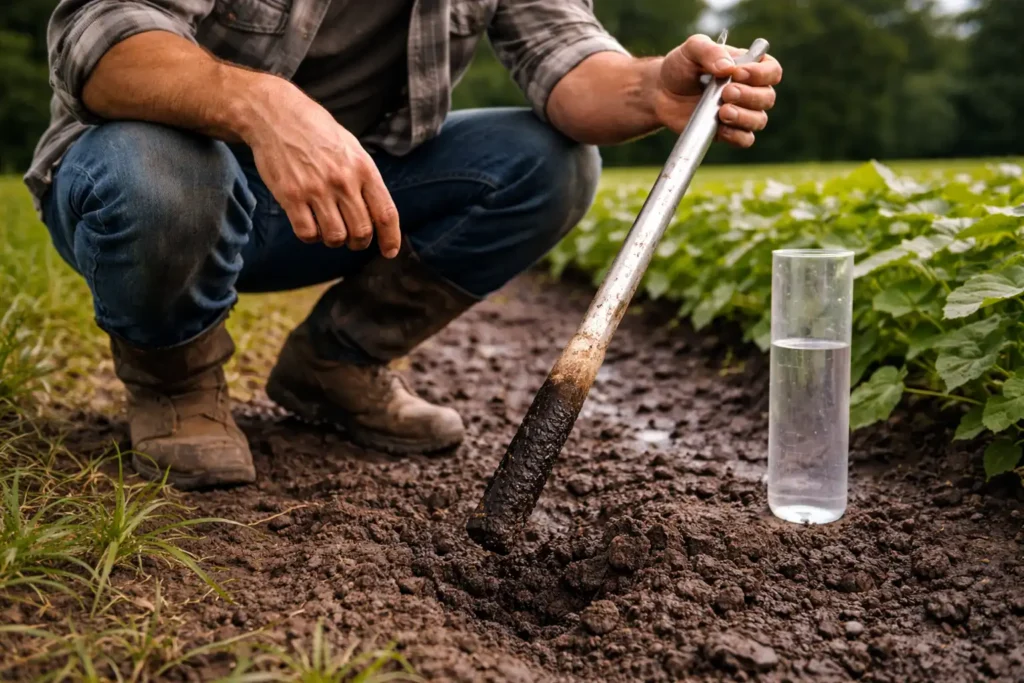
Effective rainfall counts only the portion of rain that stays in the crop root zone and remains available. Heavy rain can run off, pond, or leach below roots. Light rain can evaporate before it soaks in when the topsoil stays hot and windy.
A practical approach uses two checks:
- Infiltration check: Does the rain soak in where you farm, or does it run off?
- Root-zone check: Does the wetting depth match your effective root zone?
If your soil crusts or seals, effective rainfall drops even when the gauge shows a good total.
How do you calculate net and gross irrigation requirement?
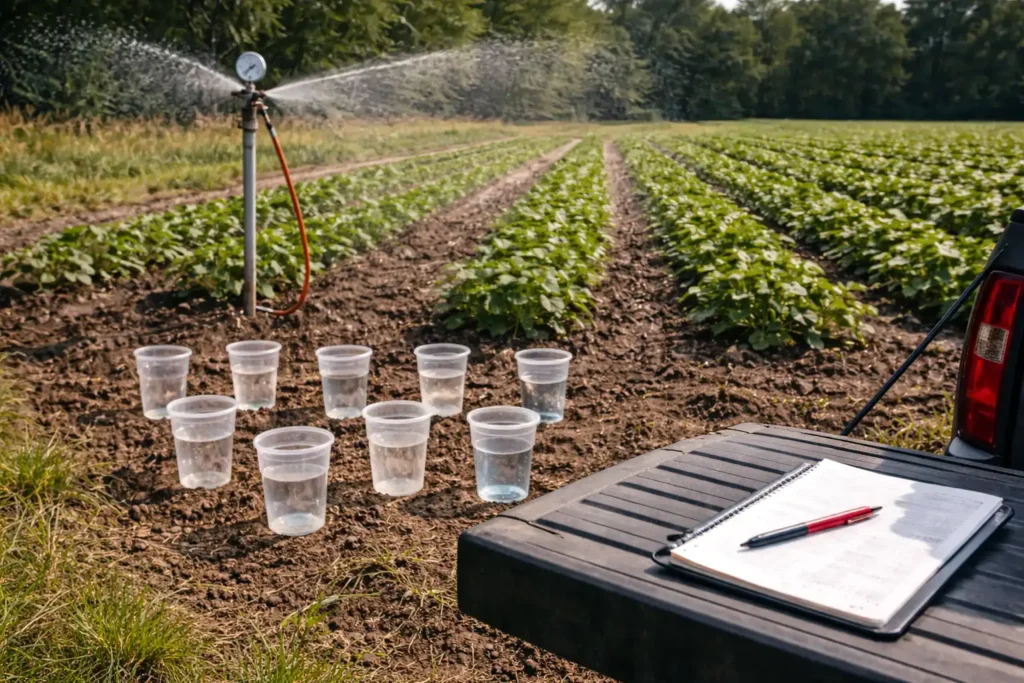
Net irrigation requirement is the water you need to replace in the root zone.
Net irrigation requirement = ETc − effective rainfall ± planned soil water change
Gross irrigation requirement adjusts net need for system losses.
Gross irrigation requirement = Net irrigation requirement ÷ irrigation efficiency
Efficiency depends on method, pressure control, uniformity, wind drift, evaporation, runoff, and deep percolation. The goal is not a perfect label number. The goal is a realistic factor you update by checking actual wetting and crop response.
What is the step-by-step method you can run every week?
This workflow turns weather and crop stage into inches or millimeters to apply.
- Pick a scheduling period. Use daily calculations for sandy soils and hot weather. Use 3 to 7 days for heavier soils and stable conditions.
- Get ETo for each day in the period. Use a consistent local source.
- Choose Kc for your crop stage. Match stage to your field, not the calendar.
- Calculate daily ETc and sum it. ETc = ETo × Kc.
- Subtract effective rainfall for the same days. Use field checks after meaningful storms.
- Decide allowable depletion for your soil and crop. Keep a buffer during flowering and fruit fill.
- Compute net irrigation requirement. Replace what the crop used beyond rainfall and available storage.
- Convert net depth to gross depth using efficiency. Gross = Net ÷ Efficiency.
- Convert gross depth to run time. Use system flow and irrigated area.
- Verify with a probe after irrigation. Wetting depth and uniformity confirm your assumptions.
Keep each step tied to what you can measure in the field.
How do you convert “depth of water” into gallons, liters, and run time?
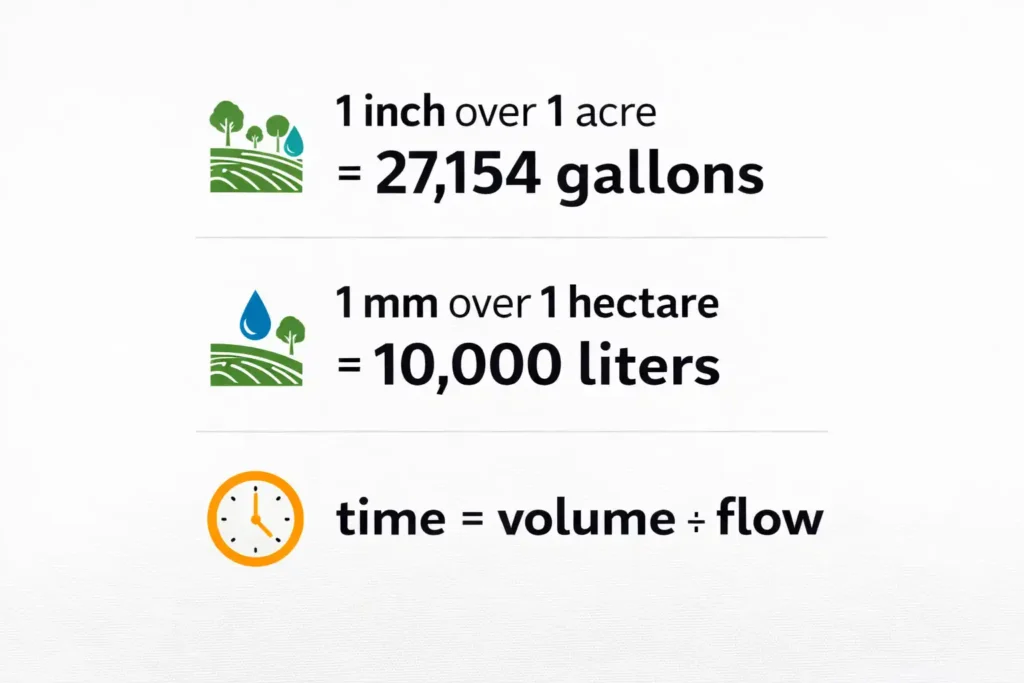
Depth is the cleanest way to think about crop water. Then you convert depth to volume for your pump and system.
Useful conversions
- 1 inch over 1 acre = 27,154 gallons (constant geometry)
- 1 acre-inch = 102.8 cubic meters
- 1 mm over 1 hectare = 10 cubic meters = 10,000 liters
Run time idea
- Volume applied = flow rate × time
- Depth applied = volume ÷ area
If you manage multiple blocks, write the area and flow for each block on a field card so you do not guess during a busy week.
What does a worked example look like?
Example numbers below show the math, not a universal recommendation.
- Field: 20 acres under a sprinkler system
- Weekly crop water use estimate (sum of ETc): 1.40 inches
- Effective rainfall that week: 0.30 inches
- Net irrigation requirement: 1.40 − 0.30 = 1.10 inches
- Assumed efficiency: 0.75
- Gross depth to apply: 1.10 ÷ 0.75 = 1.47 inches
Convert depth to volume:
- Acre-inches = 20 acres × 1.47 inches = 29.4 acre-inches
- Gallons = 29.4 × 27,154 = 798,328 gallons (rounded)
If your system delivers 900 gallons per minute to that set, then run time equals 798,328 ÷ 900 = 887 minutes, which is about 14.8 hours. Split sets when infiltration limits or runoff risk show up.
How do soil type and rooting depth change the plan?
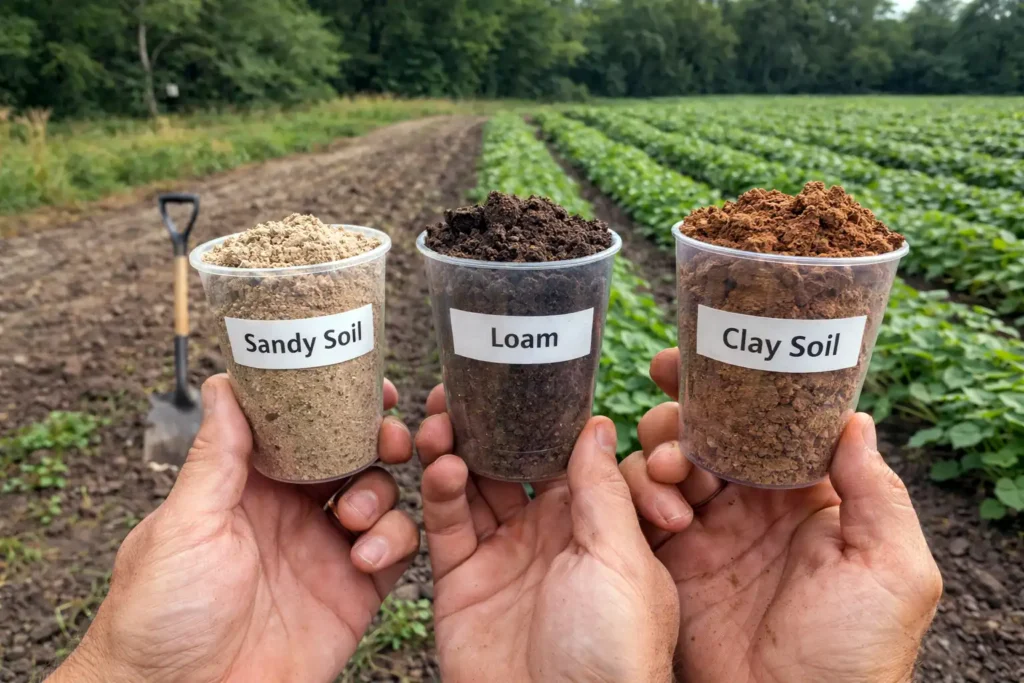
Soil controls storage and intake rate. Rooting depth controls how much of that storage your crop can use.
- Sandy soils store less plant-available water per foot, so they need smaller, more frequent irrigations.
- Clay soils store more water but accept water slower, so they need longer soak times and careful runoff control.
- Shallow roots shrink the “reservoir,” even if the soil could store more deeper down.
A probe check after irrigation tells you whether water stays in the root zone or leaks below it. That check improves your efficiency assumption faster than any spreadsheet.
How do you adjust for growth stage without guessing?
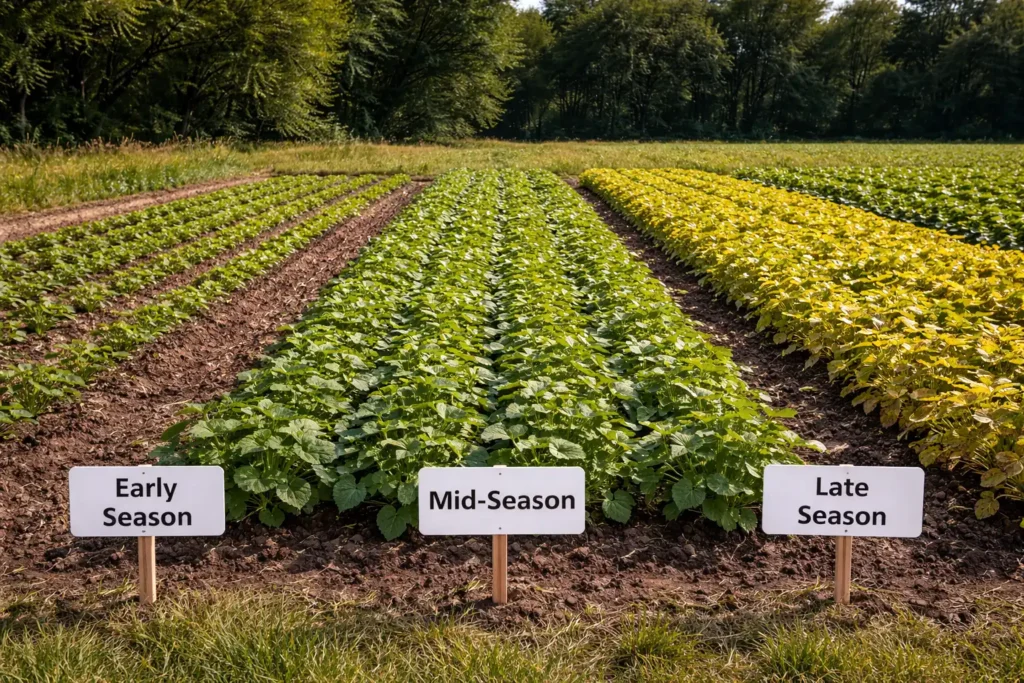
Growth stage drives Kc and drought sensitivity.
- Early season: small canopy, lower water use, shallow roots
- Mid-season: full canopy, peak water use, higher yield risk from stress
- Late season: declining canopy, water use drops, stress timing still matters for quality
Use field observations like canopy cover, plant height, and leaf area changes to select the stage, then apply the matching Kc table from a trusted extension source.
What tools make irrigation scheduling more accurate?
Tools improve measurement, which improves decisions.
- Rain gauge placed in an open area
- Soil probe or auger for wetting depth
- Catch cans for sprinkler uniformity checks
- Pressure gauge and flow meter for system output
- Soil moisture sensors when you manage high-value crops or variable soils
When you work around pumps, rotating shafts, electricity, and pressurized lines, use proper protection. A quick refresher on farm safety and PPE supports safe checks in the field.
What are the most common calculation mistakes?
These mistakes create overwatering, underwatering, or both in the same field.
- Using rainfall total instead of effective rainfall
- Using the wrong Kc stage for the actual canopy
- Ignoring irrigation non-uniformity across the set
- Scheduling by calendar instead of soil water depletion
- Converting area units wrong when turning inches into gallons
- Running too fast for the soil intake rate and losing water to runoff
A short probe check after a run catches most of these before yield takes a hit.
How do you know your calculated water need matches the real field?
Your field confirms the math through plant signals and soil moisture.
Healthy scheduling shows up as steady growth, normal leaf color, and consistent soil moisture within the effective root zone. Poor scheduling shows up as midday leaf rolling that persists into evening, uneven vigor across the set, standing water, or roots that stay shallow because the surface stays wet. Use calculations to set the plan, then use field checks to tune it.