What to Plant With Zucchini: 12 Companions and 5 to Avoid
Zucchini grows best beside crops that attract bees, draw pests away, or fill space without crowding it. Choosing what to plant with zucchini also means knowing which crops to avoid and how much room each needs.
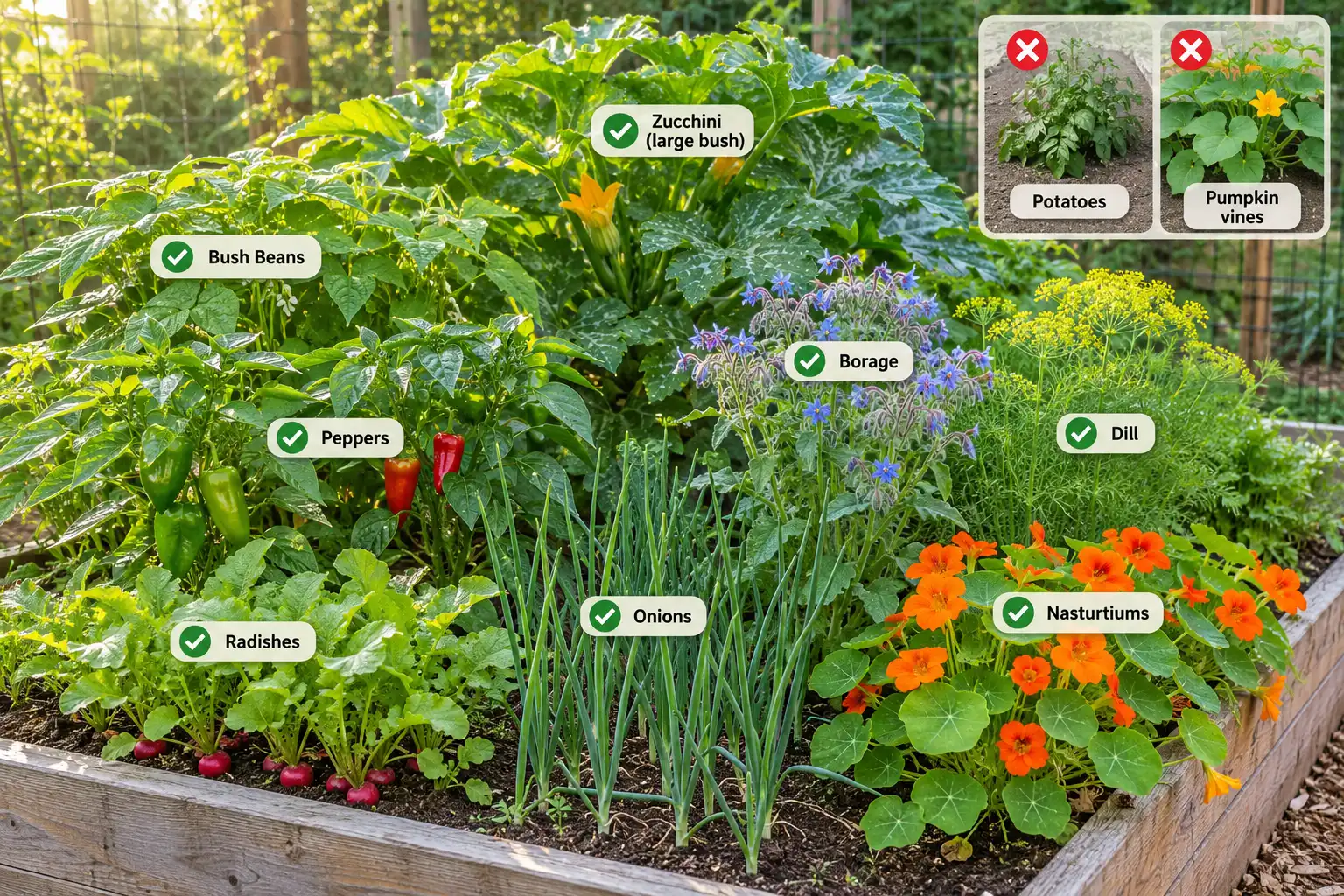
Plant zucchini with beans, corn, peppers, radishes, onions, and bee flowers such as borage and dill. These crops answer what to plant with zucchini because they feed pollinators, cover soil, or use separate space. Keep potatoes and pumpkins elsewhere.
What to Plant With Zucchini: Companion Chart
The best zucchini companion plants either stay out of its way or add something it lacks.
| Companion | Main job | Placement |
|---|---|---|
| Bush beans | Covers soil; adds nitrogen as residue breaks down | 24 in. from the crown |
| Pole beans | Grows up, not out | North side, on a trellis or corn |
| Corn | Anchors a Three Sisters planting | Mound center |
| Peppers | Shares few squash pests | South side, 30 in. away |
| Radishes | Done in 4 weeks, before zucchini spreads | Between young plants |
| Lettuce and spinach | Finishes by early summer | Same bed, 4 to 6 weeks earlier |
| Onions and garlic | Takes little room | Bed edges |
| Borage | Draws bumblebees and honey bees | Bed ends, 2 to 3 ft away |
| Dill and sweet alyssum | Feeds hoverflies and parasitic wasps | Edges or corners |
| Nasturtiums and marigolds | Feeds bees and beneficial insects | Border rows |
| Sunflowers | Draws pollinators | North side only |
| Blue Hubbard squash | Lures squash bugs and cucumber beetles | Perimeter, outside the bed |
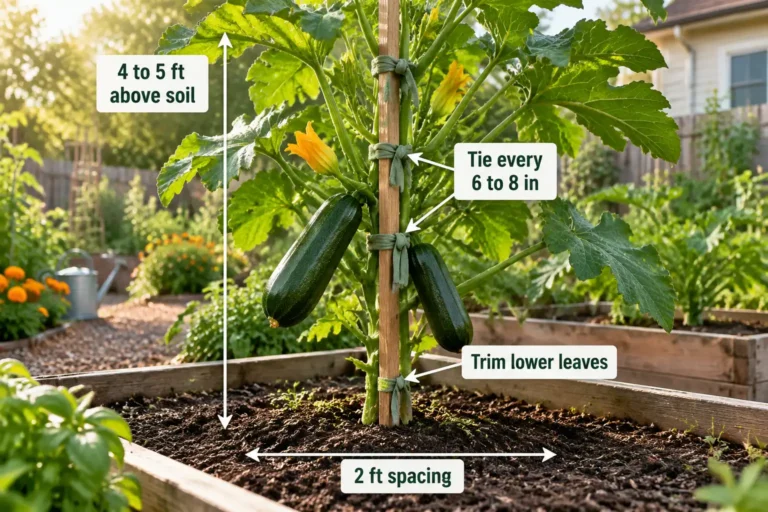
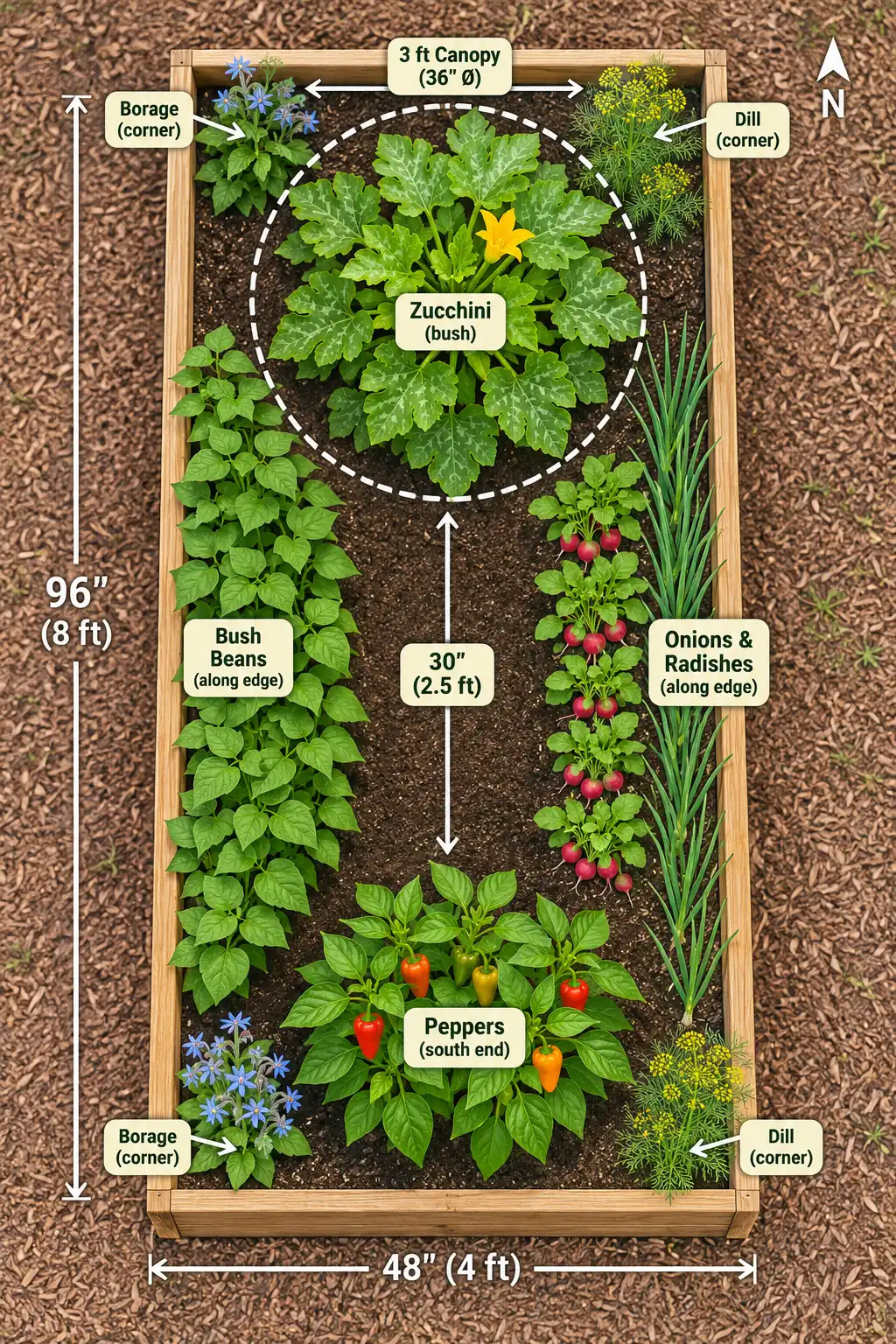
In a 4×8 bed, set one bush zucchini at the north end and lower crops at the south end, so every companion stays in sun. The same rule works for zucchini in a raised bed of any size.
How Companion Plants Help Zucchini
Companion plants help zucchini in three ways: pollination, pest control, and better use of space.
First, zucchini depends on insects for fruit. University of Minnesota Extension explains that squash plants carry separate male and female flowers, and bees move pollen between them. When bees are scarce or weather turns cold and cloudy, fruit set drops. So flowering neighbors that keep bees nearby pay off at harvest.
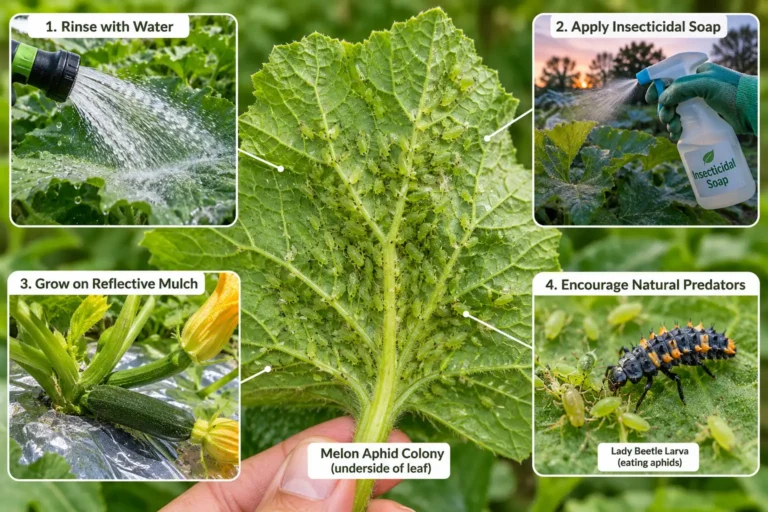
Second, zucchini draws a dedicated pest group. The same guide names its main pests: striped and spotted cucumber beetles, squash bugs, and squash vine borers. Flowers that feed hoverflies and parasitic wasps add natural enemies. Meanwhile, a trap crop pulls pests to a spot you control.
Third, a bush zucchini spreads 3 to 4 feet wide by midsummer. Quick crops use that ground in spring, and upright crops use the edges all season. Poor neighbors, on the other hand, compete for the same root zone and light.
Can You Plant Zucchini and Cucumbers Together?
Yes, zucchini and cucumbers grow well together when you give them room and stay ahead of shared pests. They do not cross-pollinate. Iowa State University Extension explains that only cucurbits of the same species cross. Zucchini is Cucurbita pepo, while cucumber is Cucumis sativus, a different genus. Even a same-species cross never changes the current season’s fruit.
The real risk is shared trouble. Clemson Cooperative Extension notes that cucumber beetles feed on squash and cucumbers alike, and they also transmit bacterial wilt. Both crops host powdery mildew too. UMN Extension reports that it favors humid canopies at 68 to 81°F. Good airflow through proper spacing helps hold it back.
To grow them side by side:
- Trellis cucumbers on the north side so they never shade zucchini.
- Keep 3 to 4 feet between the zucchini crown and the cucumber row.
- Water at the soil line with drip or soaker hose.
- Cover young plants with row cover, then remove it at first bloom.
Penn State Extension gives the same row cover window: from planting until bloom, so bees reach the flowers. Wider zucchini spacing also keeps both canopies drier through late summer.
Can You Plant Zucchini and Peppers Together?
Yes, zucchini and peppers make easy neighbors. Peppers belong to the nightshade family, so they share few pests with squash. Squash bugs and squash vine borers stick to cucurbits and leave peppers alone.
Shade is the main conflict. Peppers need full sun to flower and set fruit, and zucchini leaves often reach a foot across. So plant peppers on the south side of the bed, about 30 inches from the zucchini crown. In tight beds, choose a compact bush zucchini over a vining type.
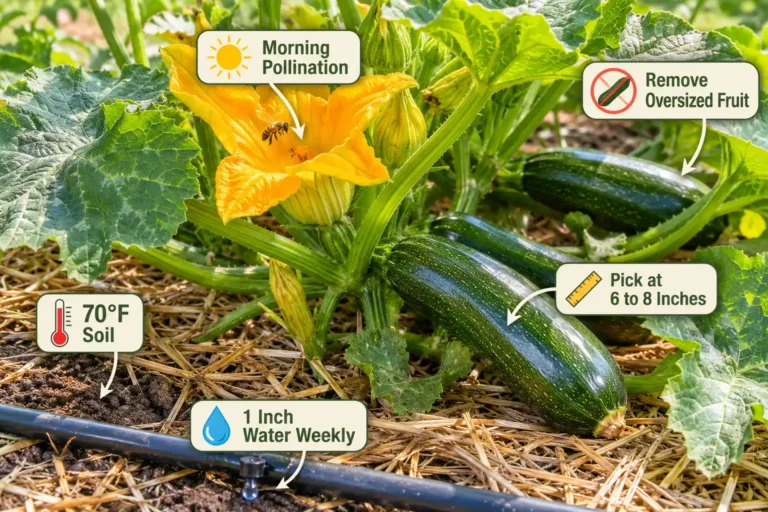
Water needs line up well. UMN Extension recommends about 1 inch of water per week for squash, applied to the soil rather than the leaves. Peppers do well on the same schedule, so one drip line serves both crops.
By midsummer, check for old zucchini leaves leaning over the peppers. Pruning zucchini leaves that have yellowed or shade neighbors lets light back in and improves airflow.
Can You Plant Zucchini and Beans Together?
Yes, beans rank among the most reliable zucchini partners. Bush beans stay low and cover bare soil at the bed edge. Pole beans climb, so they use vertical space zucchini never reaches.
However, the nitrogen benefit works differently than most charts suggest. UGA Extension explains that nitrogen held in legume plants does not reach other crops until that plant material decomposes. In other words, living beans feed themselves first. Zucchini gains most at season’s end, when you chop spent beans and leave them as mulch. Keep feeding zucchini as usual while both crops grow.
Use these spacing and timing rules:
- Sow bush beans 3 to 4 inches apart in a row about 24 inches from the zucchini crown.
- Train pole beans up a trellis on the north side, or up corn in a Three Sisters mound.
- Sow beans once soil reaches 60°F.
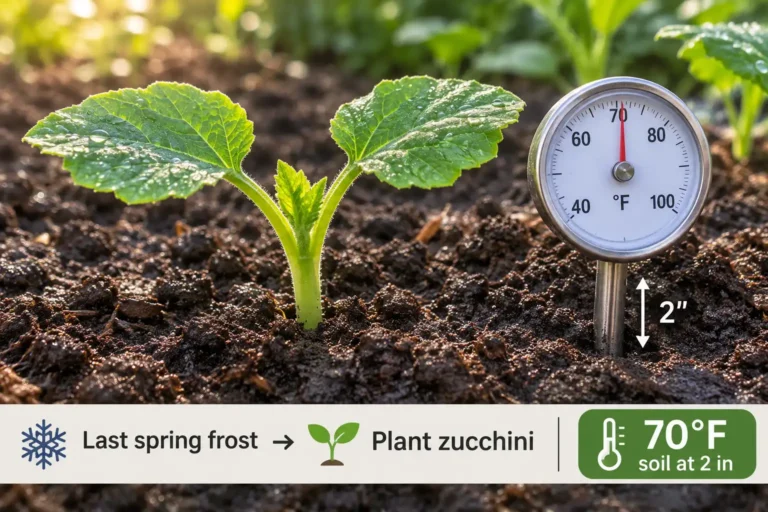
- Plant zucchini once soil hits at least 70°F at 2 inches deep, per UMN Extension.
Other Vegetables That Grow Well With Zucchini
These crops pair well because they use different space or finish at a different time.
Corn
Corn gives pole beans a living trellis in the Three Sisters system below. Set zucchini on the south side of corn, since tall stalks cast shade to the north.
Radishes, Lettuce, and Spinach
These cool-season crops finish before zucchini fills in. Radishes mature in about 4 weeks, so sow them between zucchini hills at planting. Lettuce and spinach go in 4 to 6 weeks earlier and come out as squash leaves spread.
Onions and Garlic
Onions and garlic fill narrow strips along bed edges. Fall-planted garlic comes out in early summer, right as zucchini starts to sprawl.
Tomatoes
Tomatoes work beside zucchini only with generous room, because both crops grow large. Stake or cage tomatoes on the north side and keep 3 feet between plants. Upright staking stops tomatoes and zucchini from tangling in a shared bed.
Herbs and Flowers to Plant With Zucchini
Flowers help zucchini most by keeping pollinators and beneficial insects close.
- Borage: blooms for months and draws bumblebees and honey bees. Give it 2 to 3 feet, since it sprawls.
- Dill, cilantro, and sweet alyssum: tiny flowers feed hoverflies and parasitic wasps, which attack aphids and caterpillars.
- Marigolds and nasturtiums: often sold as squash bug repellents. Treat them as pollinator flowers rather than a pest barrier. Nasturtiums also attract aphids, so keep them a few feet from zucchini.
- Sunflowers: pull in bees from across the yard. Plant them on the north side, where their shade falls away from the bed.
Timing matters as much as variety. UMN Extension notes that the first flush of zucchini fruit often sets poorly until bees find the planting. Flowers that open before or with the first squash blossoms shorten that gap.
How to Plant a Three Sisters Bed With Zucchini
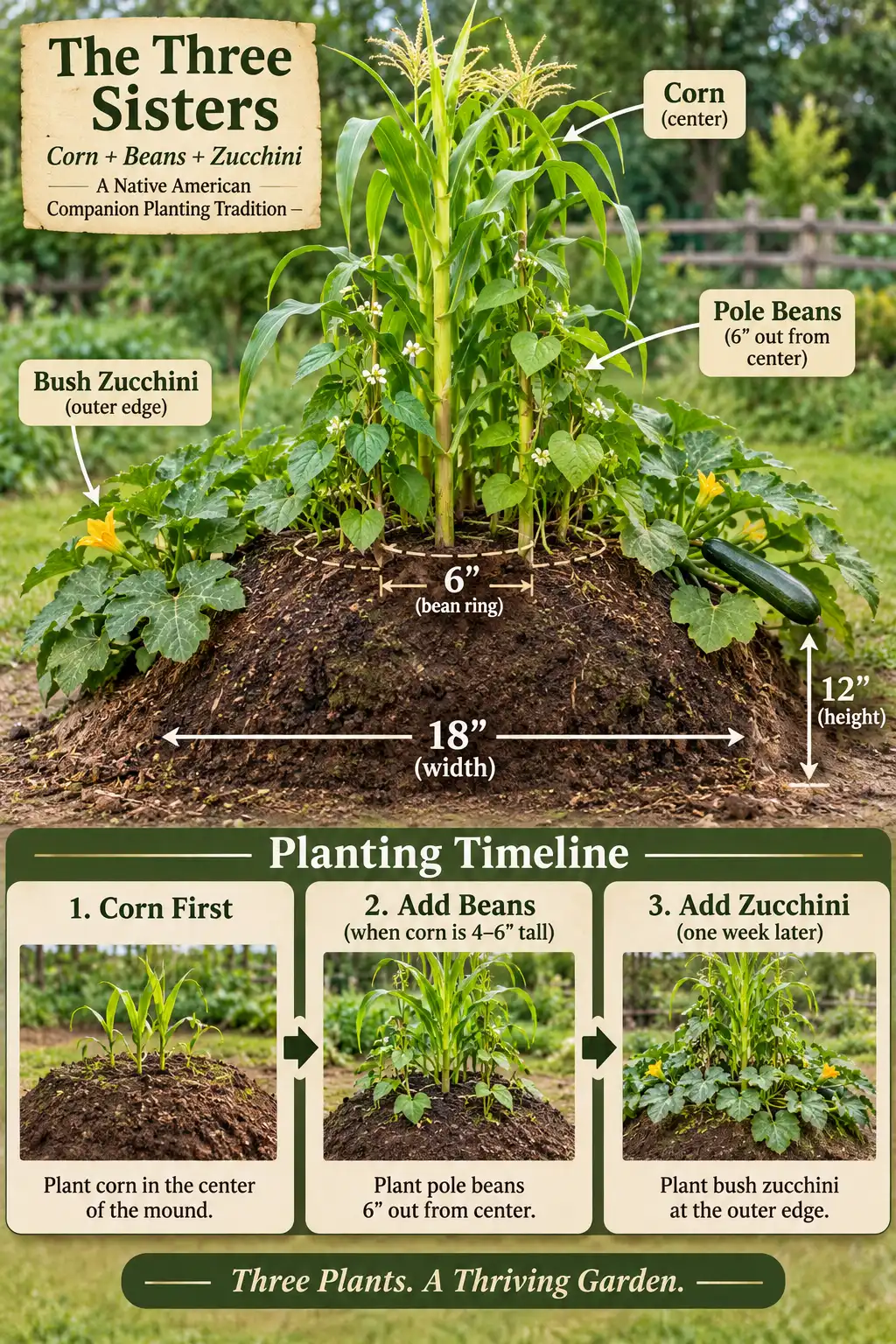
The Three Sisters combines corn, pole beans, and squash in one mound. Corn supports the beans, bean residue returns nitrogen, and squash leaves shade the soil against weeds. Bush zucchini suits small gardens here because it spreads less than traditional vining squash.
Follow this sequence:
- Build mounds about 12 inches high and 18 inches across, 5 feet apart.
- Plant 4 to 6 corn seeds in the center of each mound, 1 inch deep.
- Once corn stands 4 to 6 inches tall, sow 4 pole beans in a ring 6 inches out.
- About a week later, once soil reaches 70°F, sow 2 or 3 zucchini seeds on the outer edge.
- Thin to one zucchini per mound after the first true leaves open.
Choose a tall, sturdy corn variety, because vigorous pole beans pull down short sweet corn by late summer. Without the zucchini, the same timing works for growing corn and pole beans as a pair.
Use Blue Hubbard Squash as a Trap Crop
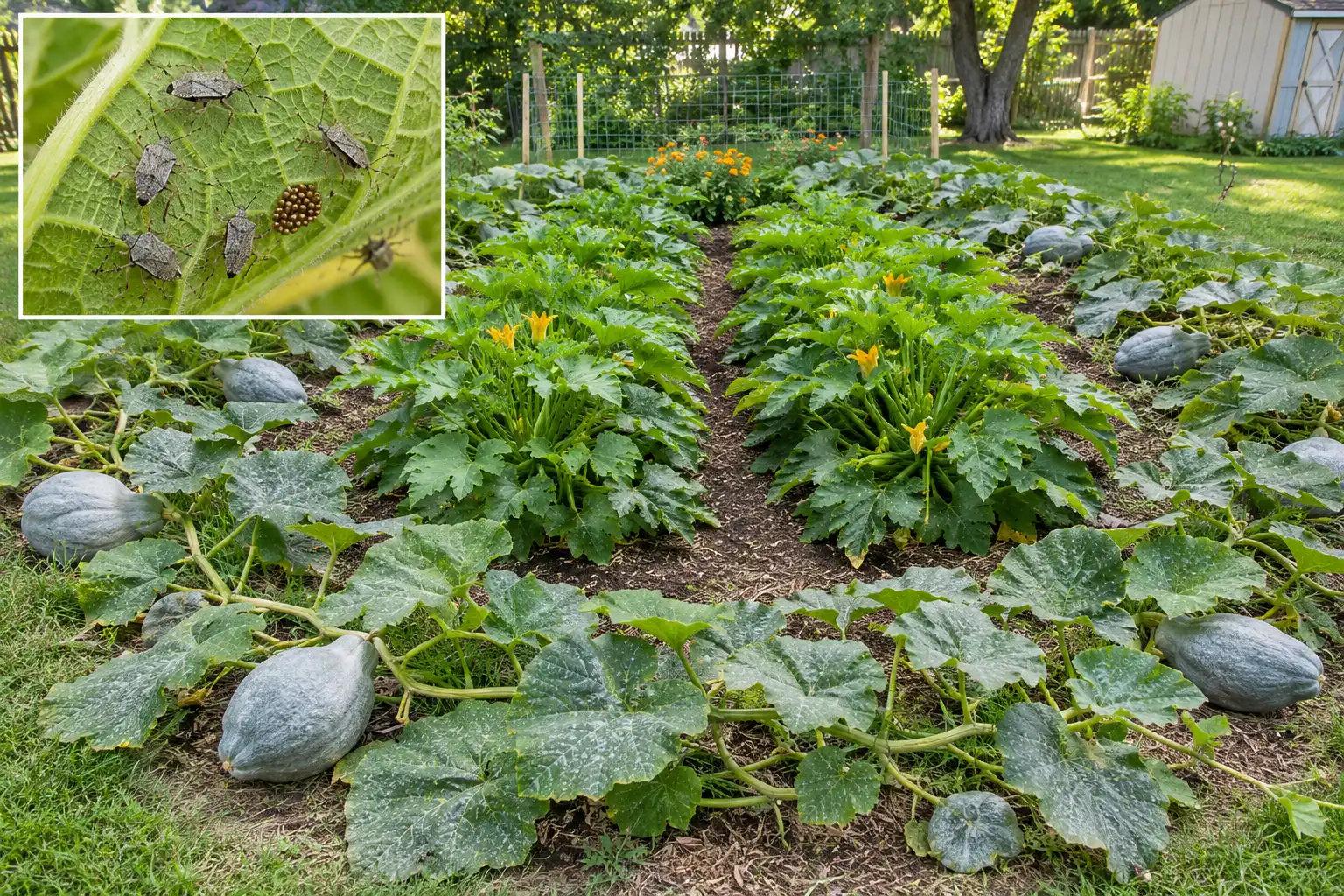
A trap crop is a plant that pests prefer over your main crop. For zucchini, Blue Hubbard squash fills that role best. UF/IFAS Extension describes a University of Missouri and USDA ARS study on this. In it, cucumber beetles and squash bugs favored Blue Hubbard and buttercup squash over zucchini. Clemson Cooperative Extension adds that Hubbard types take heavier squash bug damage and are highly susceptible to squash vine borers.
That pull only helps when you manage the trap:
- Plant Blue Hubbard in a ring or in end rows around the zucchini, never inside the bed.
- Sow it 1 to 2 weeks before zucchini so it is bigger when pests arrive.
- Check trap plants every few days, crush bronze egg clusters, and hand-pick adults.
- Pull and bag heavily infested trap plants before pests move on.
Blue Hubbard belongs to Cucurbita maxima, so it does not cross with zucchini, according to Iowa State’s species chart. Treat the trap crop as one part of integrated pest management, alongside row covers and fall cleanup.
What Not to Plant Near Zucchini
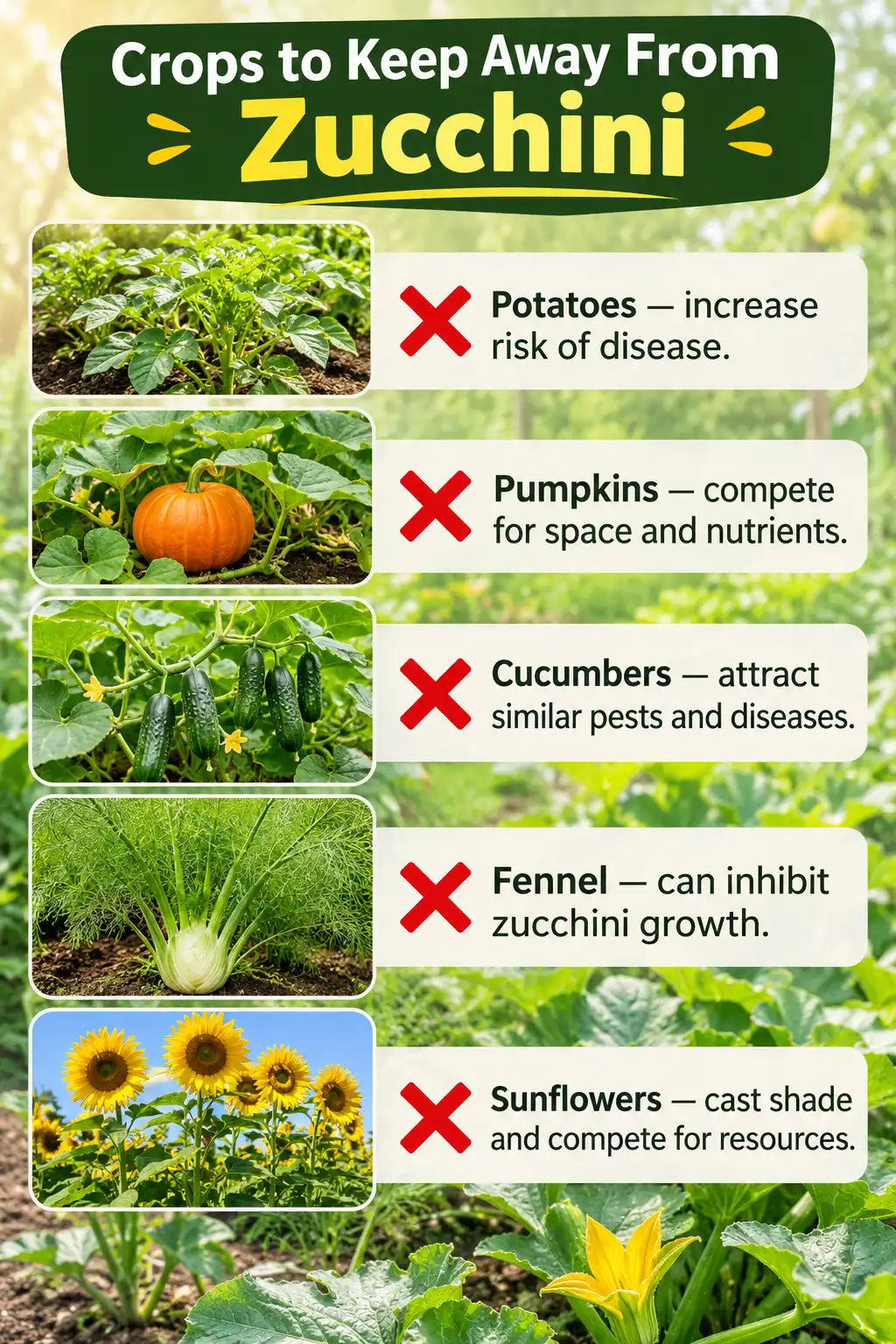
Keep a crop away from zucchini when it competes for root space, shares its worst pests, or shades it.
| Crop | Problem near zucchini | Better approach |
|---|---|---|
| Potatoes | Hilling and digging break zucchini roots; both feed heavily | Grow in a separate bed |
| Pumpkins and winter squash | Share every squash pest; vines overrun zucchini | Separate bed; rotate yearly |
| Crowded cucumbers and melons | Shared beetles, bacterial wilt, and powdery mildew | Trellis; 3 to 4 feet of space |
| Fennel | Widely listed as a poor neighbor for most vegetables | Give it its own corner |
| Tall crops on the south side | Shade cuts flowering and fruit set | Move them to the north side |
Potatoes cause the most direct conflict. UMN Extension notes that squash vines root at their joints, and disturbing the vines breaks those new roots. Hilling and digging potatoes does exactly that.
Pumpkins raise a seed issue as well. Pumpkins, acorn squash, and zucchini all belong to Cucurbita pepo, so they cross freely. That cross only matters if you save seed, since it never changes this year’s fruit.
Troubleshooting Zucchini Companion Beds
Most companion bed problems trace back to shade, crowding, or a shared pest. Match the symptom to the fix.
| Symptom | Likely cause | Fix |
|---|---|---|
| Peppers or beans stretch and set little fruit | Shade from the zucchini canopy | Move them south; trim old zucchini leaves |
| Zucchini flowers drop with no fruit | Early male flowers or too few bees | Add bee flowers; remove row covers at bloom |
| White powder on squash and cucumber leaves | Powdery mildew in a crowded canopy | Widen spacing; water soil, not leaves |
| Sudden wilt with sawdust-like frass at the stem base | Squash vine borer | Bury vine nodes with soil; rotate next year |
| Bronze egg clusters under leaves | Squash bugs | Crush eggs; clear plant debris after harvest |
| Vines wilt with no borer hole at the base | Bacterial wilt from cucumber beetles | Control beetles early; pull infected plants |
Vine borers rarely spare any squash. Penn State Extension notes they attack summer squash, winter squash, gourds, and pumpkins. Butternut and green striped cushaw are the exceptions. In borer-heavy areas, those two make safer neighbors than pumpkins.
FAQs about Zucchini Companion Plants
Can you plant zucchini and pumpkins together?
Yes, but only with plenty of room, since both vines sprawl and share every major squash pest. They also cross-pollinate, which matters only if you plan to save seed for next year.
Do marigolds keep squash bugs away from zucchini?
Marigolds are not a reliable squash bug barrier, though they do add flowers for pollinators and beneficial insects. For squash bugs, a Blue Hubbard trap crop and regular egg checks work better.
How far apart should companion plants be from zucchini?
Keep most companions 24 to 36 inches from the zucchini crown, since bush plants spread 3 to 4 feet. Quick crops like radishes go closer because you harvest them before the leaves spread.
Can you plant zucchini and watermelon together?
Yes, zucchini and watermelon grow fine together with enough space, and they cannot cross-pollinate because they are different species. Both attract cucumber beetles, so scout young plants every few days.
What should you plant after zucchini?
Follow zucchini with a crop from another family, such as garlic, beans, or a fall cover crop. Skip squash, cucumbers, and melons in that spot for at least two years to break pest cycles.
Putting This Into Practice
Deciding what to plant with zucchini starts with layout, not seed. Put zucchini where it gets full sun, then place peppers, beans, and quick crops so its leaves never cover them. Add a few bee flowers nearby. If squash bugs hit hard last season, ring the patch with Blue Hubbard. Keep potatoes and pumpkins in another bed, and give cucumbers a trellis and 3 feet of room.