How Often to Water Zucchini: 1 Inch a Week, More in Heat
Watering decides how much zucchini you harvest. The plants carry broad leaves and fast-growing fruit, and both depend on steady soil moisture. Here is how often to water zucchini, plus how to adjust for heat, soil type, containers, and drip lines.
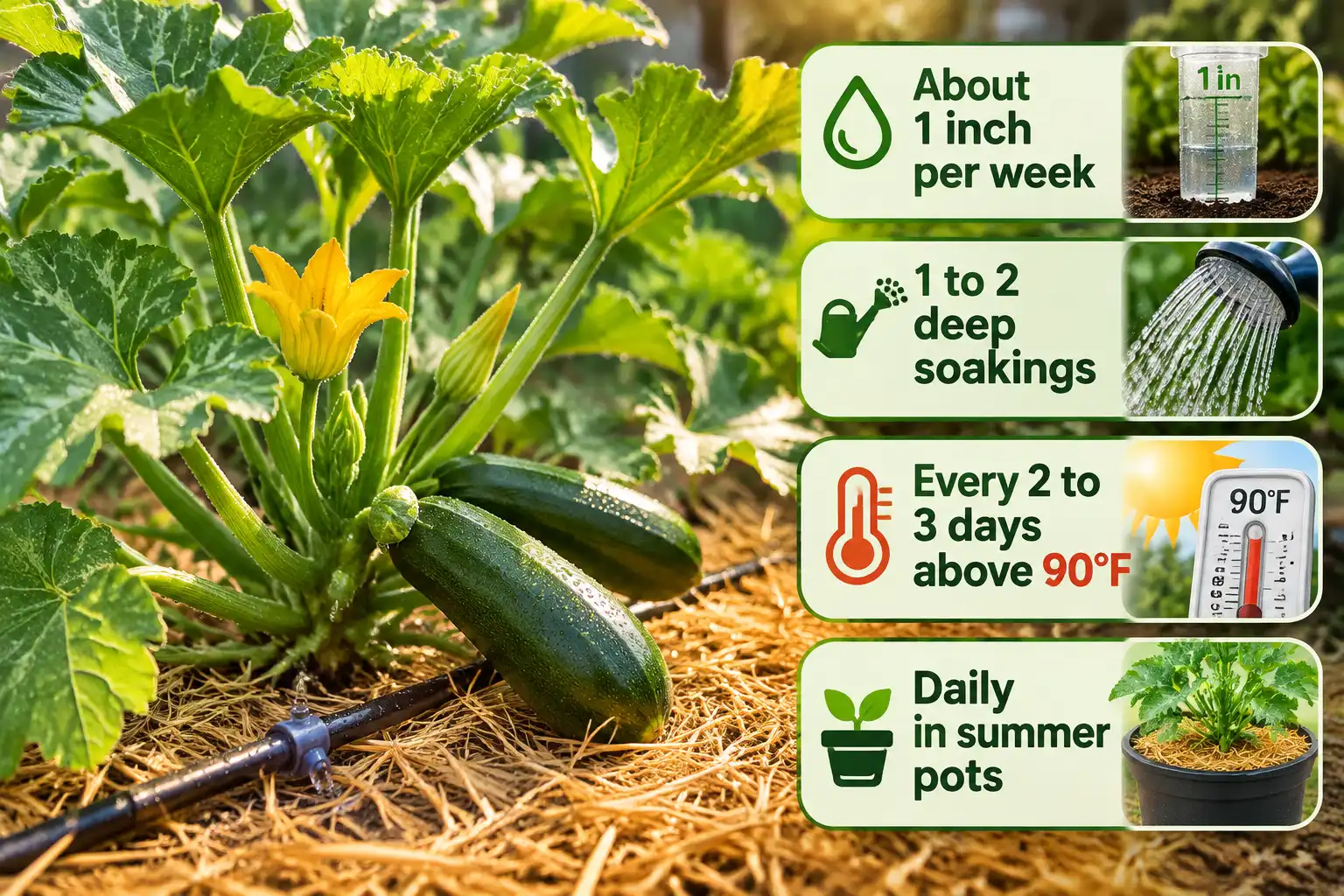
Water zucchini deeply once or twice a week so plants get about 1 inch of water, rain included. During heat above 90°F or in sandy soil, water every 2 to 3 days. Water container zucchini daily in summer.
How Much Water Does Zucchini Need per Week?
Zucchini needs about 1 inch of water per week from rain and irrigation combined. University of Minnesota Extension gives that baseline for vine crops and calls squash heavy water feeders. Iowa State University Extension sets a slightly wider target of 1 to 1½ inches for most vegetables. Meanwhile, UF/IFAS Extension goes up to 2 inches, depending on season and soil type.
So treat 1 inch as the midsummer baseline. Zucchini (Cucurbita pepo) in full fruit, hot weather, or sandy soil needs more.
How Many Gallons Does One Zucchini Plant Need?
A mature zucchini plant in the ground needs roughly 6 gallons of water per week. Clemson Cooperative Extension converts 1 inch of water to about 6 gallons per square yard. NC State Extension spaces summer squash 3 to 4 feet apart, so each plant covers at least a square yard. Wider zucchini spacing gives each plant more ground, so it needs slightly more water. In practice, split the 6 gallons into two soakings of about 3 gallons each.
Weekly Water Needs by Growth Stage
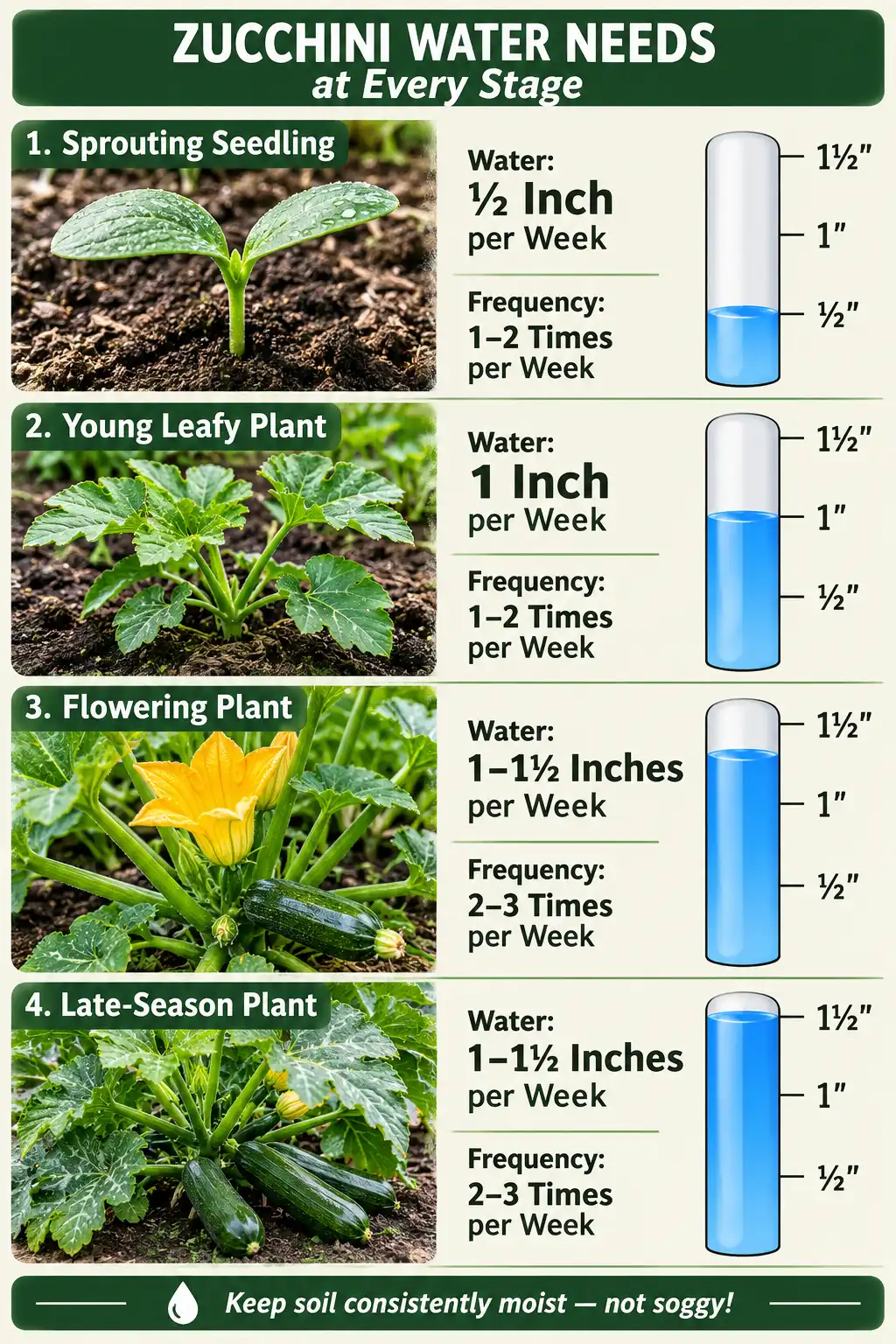
Water demand climbs as the plant grows. UF/IFAS Extension advises light, frequent watering for young plants and deeper, less frequent watering as they mature. Both UC ANR and Clemson Extension name flowering and fruit development as the critical stage for squash. A dry spell during that window costs you fruit.
| Growth stage | Water per week | How often | Goal |
|---|---|---|---|
| Seed to emergence (5 to 10 days) | Light, top inch only | Every 1 to 2 days | Even sprouting |
| Young plants before flowering | About 1 inch | 1 to 2 deep soakings | Deep roots |
| Flowering and fruiting | 1 to 1½ inches | 2 soakings, or every 2 to 3 days in heat | Steady fruit growth |
| Late season, cooler nights | Less than midsummer | After a soil check | Avoid soggy soil |
Learn more: Prune Zucchini Plants
How Weather and Soil Change Watering Frequency
Heat, wind, and soil texture decide how fast the root zone dries out. That is why a fixed calendar schedule often misses. Sandy soil drains fast, and UF/IFAS Extension notes that just ½ inch of water moistens sand about 6 inches deep. So sandy beds need smaller, more frequent waterings. Clay holds water longer, so water it less often and more slowly to avoid runoff.
| Condition | Typical frequency | Amount each time |
|---|---|---|
| Mild weather (70s to mid 80s °F), loam soil | Once or twice a week | ½ to 1 inch |
| Hot weather (90°F and up) | Every 2 to 3 days | About ½ inch |
| Sandy soil | Every 2 to 3 days | About ½ inch |
| Clay soil | Once a week | 1 inch, applied slowly |
| Raised beds in summer | Every 2 to 3 days | ½ to ¾ inch |
| Containers in summer | Daily, sometimes twice | Until water drains out |
| After 1 inch or more of rain | Skip watering | Recheck in 3 to 4 days |
Use the table as a starting point. Then confirm with a soil check before each watering.
Regional Differences
In the Upper Midwest and Northeast, the 1-inch baseline usually holds, and summer rain covers part of it. Along the Gulf Coast and in Florida, sandy soils favor short, frequent waterings. By contrast, the hot, dry Southwest and California’s Central Valley push plants toward the 2-inch end of the UF/IFAS range. Wherever you grow, keep a rain gauge by the bed, as Clemson Extension recommends. Then irrigate only the shortfall.
How to Water Zucchini Plants
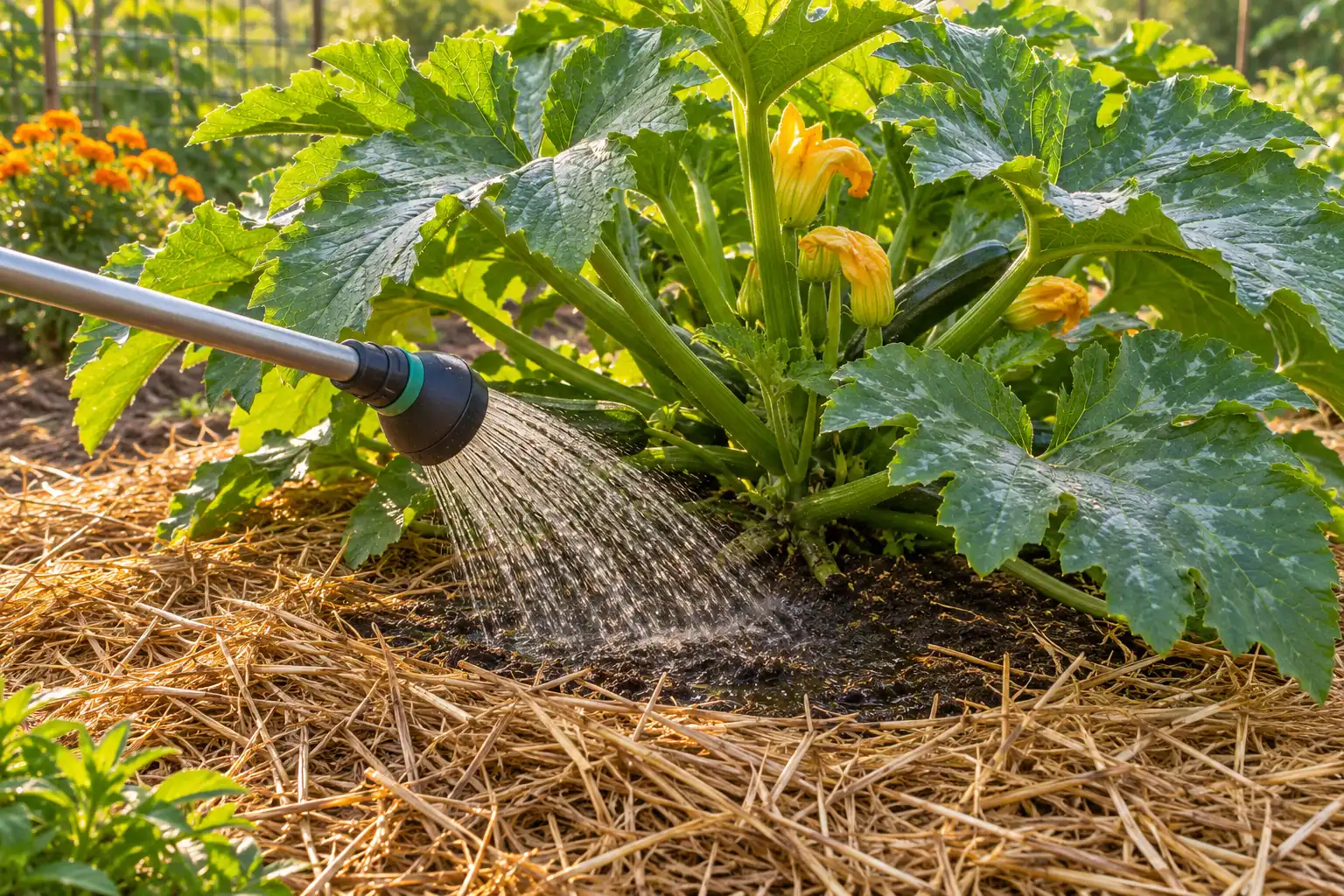
Water zucchini slowly at the base of the plant, early in the morning, until the soil is moist 6 to 8 inches deep. Follow these five steps.
1. Check the Soil First
Push a finger 1 inch into the soil beside the plant. UF/IFAS Extension advises watering when the top ½ inch to 1 inch begins to dry. If it still feels damp, wait a day and check again. For larger beds, a soil moisture meter gives a faster reading at root depth.
2. Soak the Root Zone Deeply
Deep, slow watering builds deep roots. Clemson Extension notes that 1 inch of water wets the root zone 6 to 8 inches down. It also classes summer squash as moderately deep-rooted. Likewise, University of Minnesota Extension advises soaking the soil thoroughly every time. Light daily sprinkles, by contrast, keep roots near the surface, where heat dries them first.
3. Keep Water Off the Leaves
Aim water at the soil, not the foliage. NC State Extension recommends soaking below the leaves to help prevent powdery mildew. UF/IFAS Extension also calls drip lines ideal for squash, because wet leaves invite fungal problems.
4. Water Early in the Morning
Morning watering gives leaves time to dry and cuts evaporation. Iowa State University Extension names 5 to 9 a.m. as the best window. In contrast, evening watering with a sprinkler leaves foliage wet overnight and raises disease risk.
5. Mulch to Hold Moisture
Spread 2 to 3 inches of straw or shredded leaves around the plant once the soil warms. According to Iowa State University Extension, mulch conserves soil moisture, prevents surface crusting, and may reduce disease. Keep it an inch or two away from the stem.
Drip Irrigation for Zucchini
Drip irrigation is the most efficient way to water zucchini. Clemson Extension rates drip as the most efficient irrigation method available. It puts water at the roots and keeps leaves dry, which matters for a crop prone to powdery mildew.
A timer adds consistency, so plants get the same amount even when you are away. For a small bed, a drip kit with a built-in timer takes little setup. Alternatively, a soaker hose laid under mulch works as a simpler, low-cost option.
How to Set Up Drip Lines for Zucchini
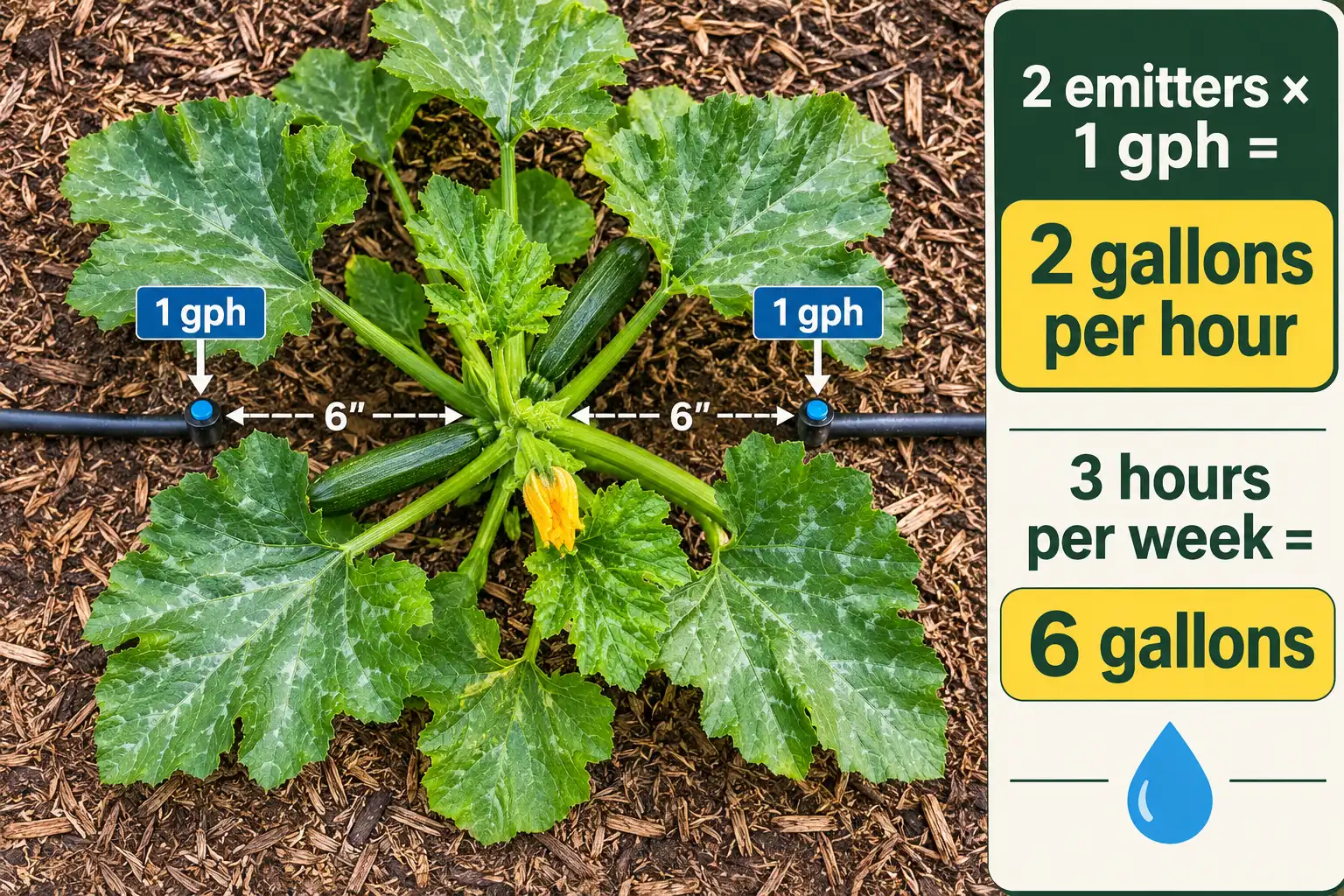
Give each plant at least two emitters, placed on opposite sides of the stem about 6 inches out. As the plant spreads, add an emitter or move them toward the outer root zone. Iowa State University Extension notes that emitters usually come in ½, 1, or 2 gallons per hour (gph). For zucchini, 1 gph emitters keep run times practical.
How Long to Run Drip for Zucchini
Divide the weekly gallons by the combined emitter flow. For example, 6 gallons with two 1 gph emitters takes 3 hours of run time each week. Split that into two 90-minute runs or three 60-minute runs.
| Emitters per plant | Combined flow | Weekly run time for 6 gallons | Sample schedule |
|---|---|---|---|
| 2 × ½ gph | 1 gph | 6 hours | 2 hours, 3 times a week |
| 2 × 1 gph | 2 gph | 3 hours | 90 minutes, twice a week |
| 2 × 2 gph | 4 gph | 1½ hours | 45 minutes, twice a week |
Drip wets a narrower area than rain, so treat these numbers as a starting point. After the first run, dig beside an emitter. If the soil is dry 6 inches down, lengthen the run. If it is soggy, shorten it.
Can You Overwater Zucchini?
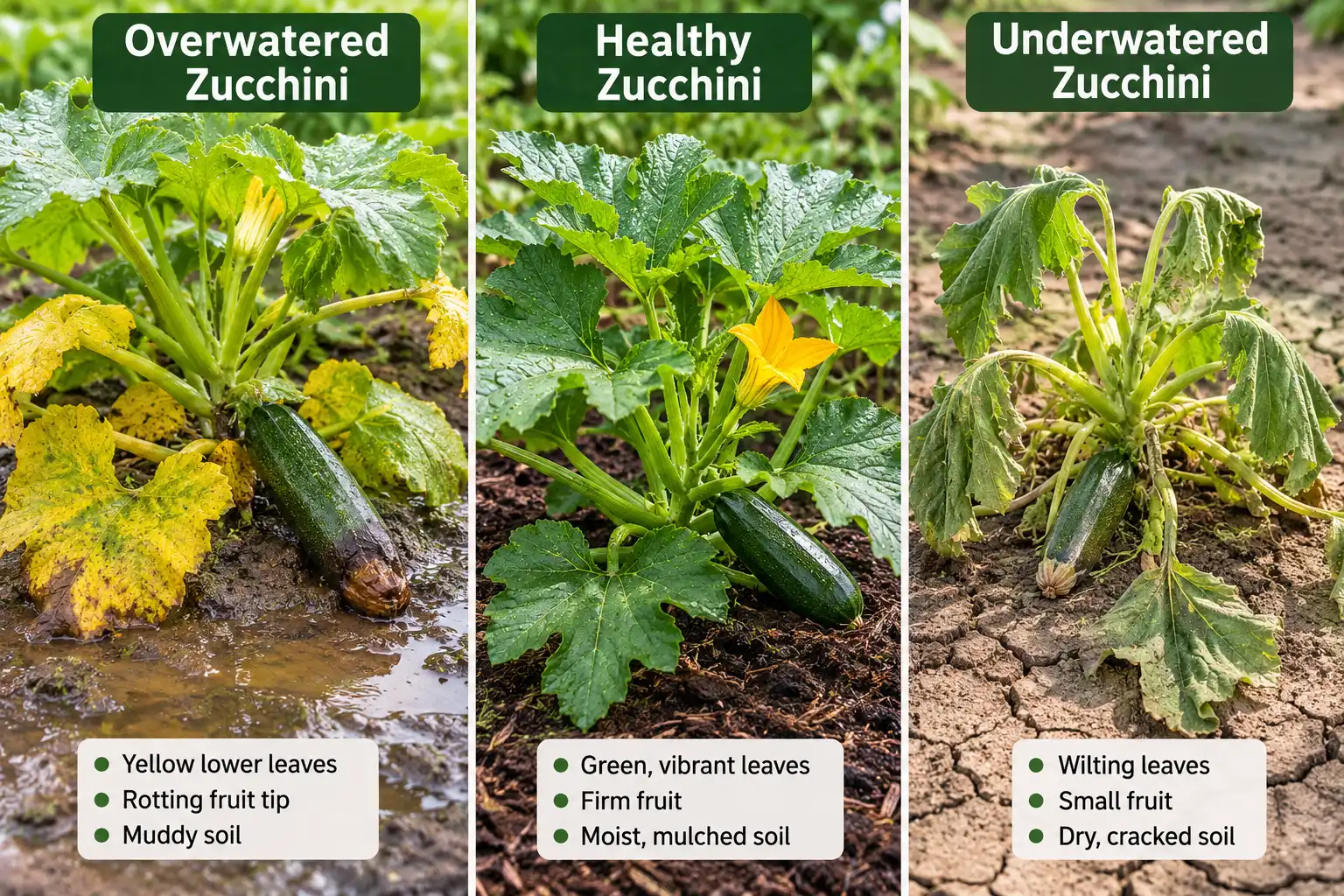
Yes. Zucchini uses a lot of water, but soggy soil starves its roots of oxygen. UC ANR notes that vine crops, summer squash included, often get overwatered in home gardens. NC State Extension adds that wet soil can trigger blossom end rot in squash.
Watch for these signs of too much water:
- Lower leaves turn yellow while the soil stays wet
- Leaves wilt even though the soil is damp
- The stem turns soft or dark at the soil line
- Fruit rots at the blossom end
- Green algae or a sour smell appears on the soil surface
To fix it, stop watering until the top 1 to 2 inches dry out. Next, work compost into heavy soil to improve drainage. NC State Extension also notes that raised beds and containers reduce blossom end rot in heavy clay.
Overwatered vs Underwatered Zucchini
| Sign | Overwatered | Underwatered |
|---|---|---|
| Soil at 1 inch deep | Wet or muddy | Dry and crumbly |
| Leaves | Yellow, starting low on the plant | Dull, drooping, crisp edges |
| Wilting | At any time of day | Still wilted the next morning |
| Fruit | Soft rot at the blossom end | Blossom end rot, small fruit |
| Stem base | Soft or dark | Firm |
Both problems can cause blossom end rot. So the soil check, not the fruit, tells you which one you have.
Troubleshooting Zucchini Watering Problems
Leaves Wilt Every Afternoon
Afternoon wilting is usually normal. UC ANR Master Gardeners explain that a zucchini leaf stem works like a straw. In afternoon heat, it cannot move water to the big leaves fast enough. Healthy plants recover overnight, so check them in the morning before you water. If a plant stays wilted in moist soil, inspect the stem base for squash vine borers. University of Minnesota Extension notes this pest can wilt the entire plant.
Fruit Turns Brown at the Tip
A brown, sunken tip on young fruit is blossom end rot. According to NC State Extension, drought, wet soil, low soil pH, and excess nitrogen can all trigger it. Even soil moisture is the most important fix. Also, pick off damaged fruit so the plant puts its energy into new ones.
White Powder Appears on the Leaves
White, powdery patches point to powdery mildew, a common late-summer squash disease. Switch to watering at the base in the morning to keep leaves dry and humidity low. Then remove a few crowded older leaves to improve airflow.
Watering Zucchini in Containers and Raised Beds
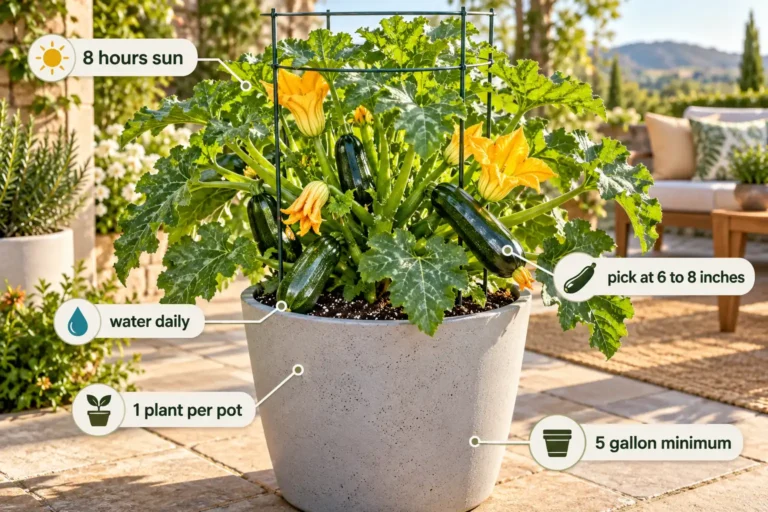
Container zucchini needs water far more often than plants in the ground. UC ANR notes that containers dry out quickly and may need daily watering in warm weather. It also advises checking them at least twice a day. Water until it drains from the bottom holes, then let the top inch dry before the next round.
Pot size matters too. For zucchini grown in pots, UC ANR suggests a container about 24 inches wide and 16 to 18 inches deep. A bigger pot holds more water, so it dries more slowly on hot days.
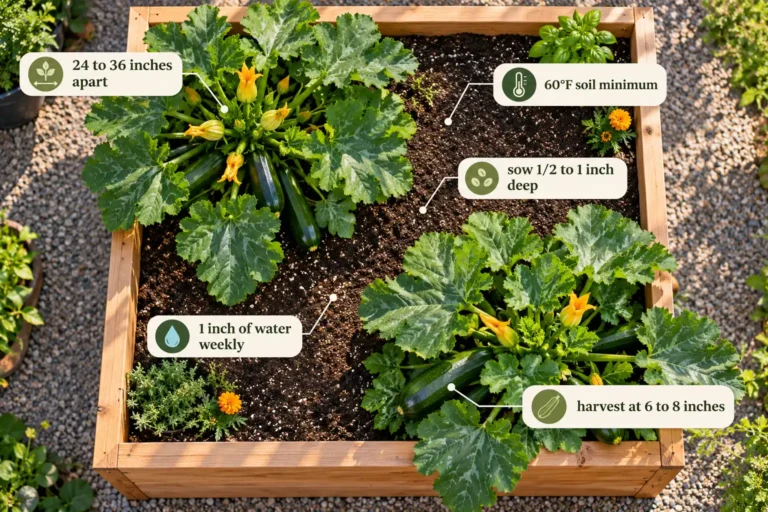
Raised beds drain and warm faster than in-ground soil. As a result, they often need water every 2 to 3 days in summer. Drip lines on a timer suit zucchini in raised beds, since every run delivers the same amount.
FAQs on Water Zucchini Right
Should you water zucchini every day?
No, daily watering keeps the root zone of garden zucchini too wet. Instead, water deeply once or twice a week, or every 2 to 3 days during hot spells above 90°F.
Is it better to water zucchini in the morning or evening?
Morning is the better time to water zucchini, especially with a hose or sprinkler. Water between 5 and 9 a.m., as Iowa State Extension advises, so leaves dry before disease can spread.
How many gallons of water does a zucchini plant need per week?
A mature zucchini plant needs about 6 gallons of water per week. That figure comes from Clemson Extension, which converts 1 inch of water to roughly 6 gallons per square yard of garden.
Does rain count toward zucchini’s weekly water?
Yes, rain counts toward the 1-inch weekly target for zucchini. Keep a rain gauge near the bed, as Clemson Extension suggests, and water only enough to make up the difference.
Do zucchini plants need more water when fruiting?
Yes, flowering and fruiting is the most water-sensitive stage for zucchini. Both UC ANR and Clemson Extension flag it as critical, so aim for 1 to 1½ inches per week.
How do you know when zucchini needs water?
Check the soil, not the leaves, because afternoon drooping is normal on hot days. Water when the top inch feels dry or when leaves stay wilted into the next morning.
Putting This Into Practice
Start with 1 inch of water per week, delivered in one or two deep morning soakings at the base. Then let the soil set the schedule. Water when the top inch dries, and water more often in heat, sand, and containers. A drip line on a timer makes that consistency easy. Steady moisture works best alongside wide spacing, full sun, and frequent picking, the other basics of growing zucchini for a long harvest.