How to Grow Eggplant From Seed: Timing, Heat, and Transplants
Eggplant is often one of the slowest crops to get going indoors, compared to other transplants. Heat drives everything it does. Learning how to grow eggplant from seed comes down to three things. Sow early enough, hold the mix warm, and wait for warm nights before setting plants out.
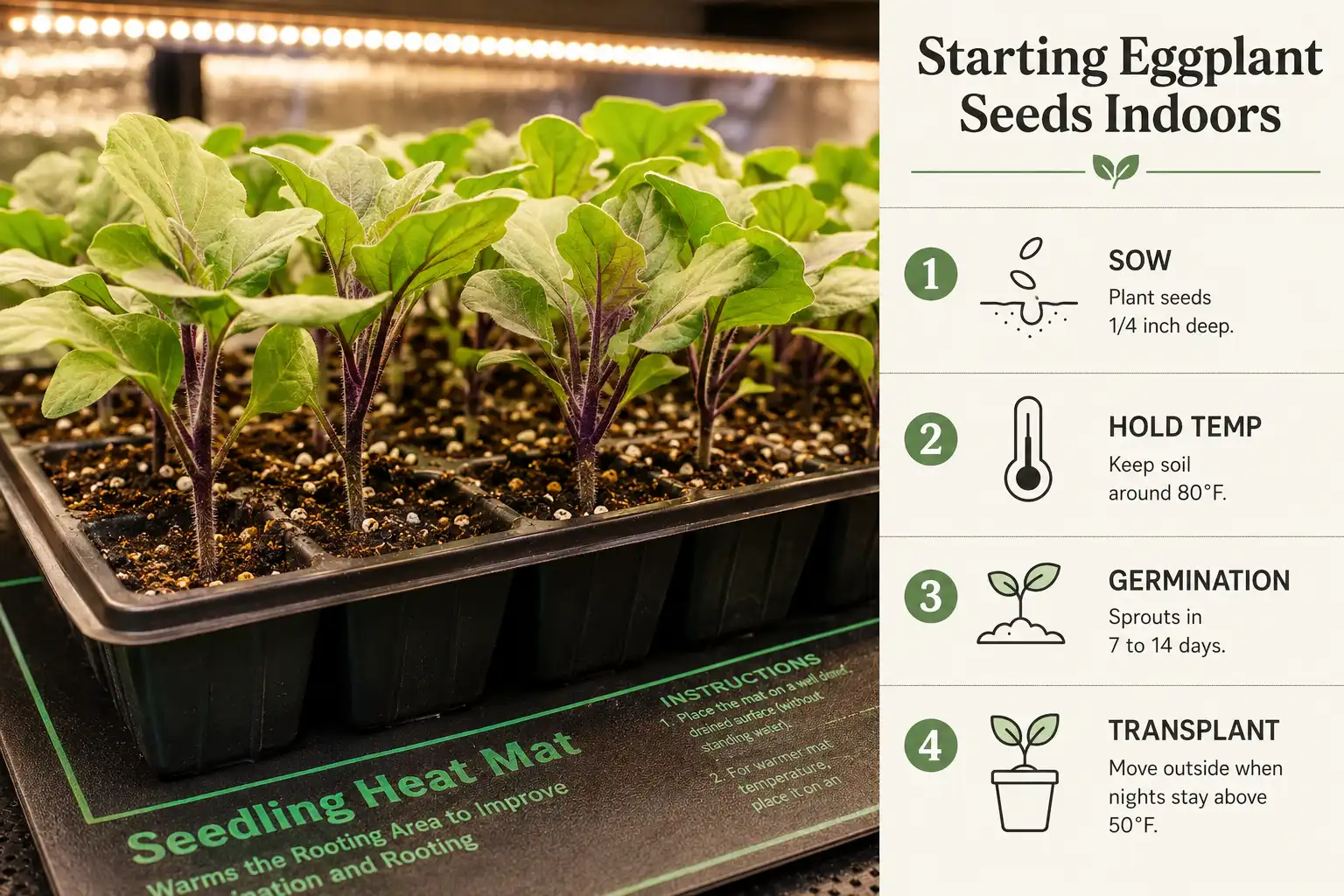
To grow eggplant from seed, sow 1/4 inch deep about 8 weeks before transplanting. Hold the mix at 75°F to 85°F until sprouts show. Then set hardened plants out only after nights stay above 50°F.
Why Eggplant Has to Start Indoors
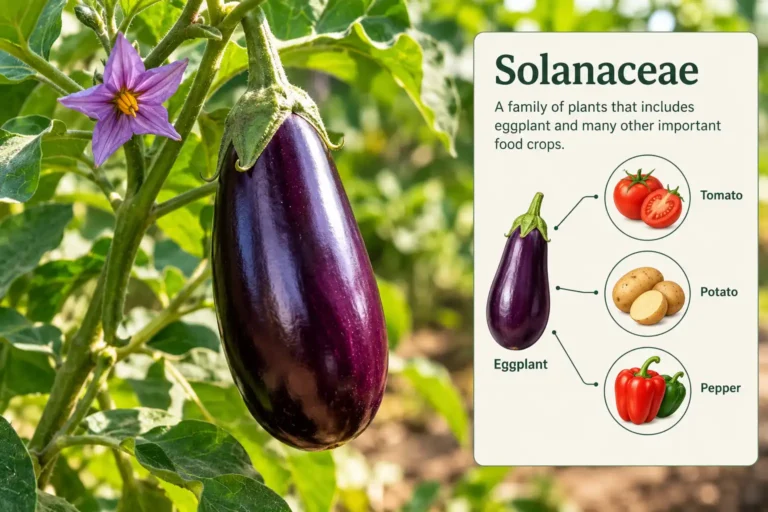
Eggplant seed will not germinate in cool soil, so an indoor start is the only reliable path across most of the country. Eggplant (Solanum melongena) sits in the Solanaceae family alongside tomatoes, peppers, and potatoes. Even so, it handles cold worse than any of them. Growth stalls below 60°F and cold injury sets in near 55°F.
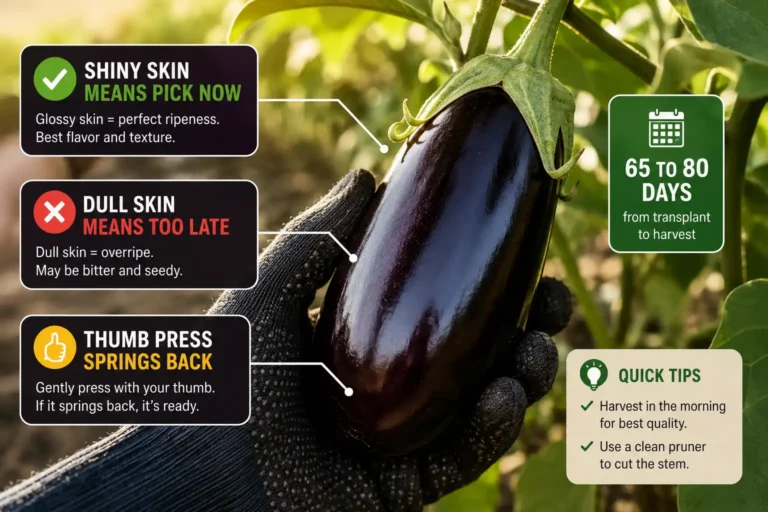
Direct sowing works only where summers run long and hot, like south Texas, Florida, and the Gulf Coast. Everywhere else the field simply never warms up in time. Soil does not hit 65°F until the second week of May. A full-season globe type needs 80 more days after that. Without a head start indoors, first frost arrives before the fruit does.
Learn more: When to Plant Eggplant Seeds
When to Start Eggplant Seeds Indoors
Start eggplant seeds about 8 weeks before your target transplant date, not 8 weeks before your frost date. That difference matters, because eggplant goes out 2 to 3 weeks after your average last frost. Counting from the wrong anchor leaves you with root-bound plants sitting under lights for a month.
The table below works back from average last frost by USDA hardiness zone.
| USDA zone | Average last frost | Sow indoors | Transplant outside |
|---|---|---|---|
| 4 | May 15 to May 30 | April 10 to April 25 | June 5 to June 20 |
| 5 | May 1 to May 15 | March 27 to April 10 | May 22 to June 5 |
| 6 | April 15 to April 30 | March 11 to March 26 | May 6 to May 21 |
| 7 | April 1 to April 15 | February 25 to March 11 | April 22 to May 6 |
| 8 | March 15 to March 30 | February 8 to February 23 | April 5 to April 20 |
| 9 | February 15 to February 28 | January 11 to January 25 | March 8 to March 21 |
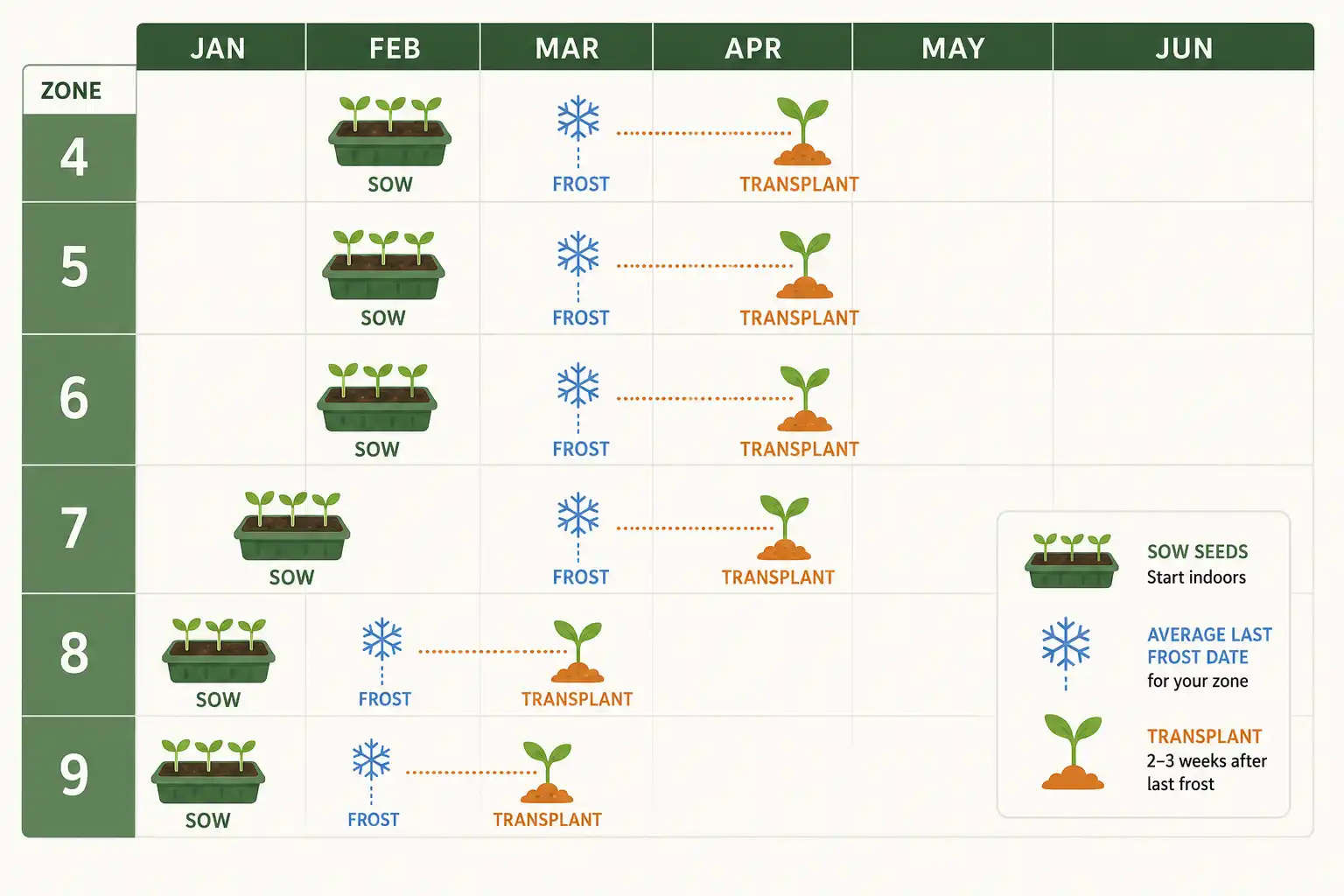
Two adjustments matter. First, if you are growing an 80-day globe variety in zone 5 or colder, stretch the indoor start to 10 weeks. Second, gardeners in zones 9 through 11 can run a second sowing in June for a fall crop.
What You Need Before You Sow
Gather five things and the rest is routine. Eggplant fails from cold mix and soggy mix more than anything else, so supplies here are about heat and drainage.
- Sterile soilless germination mix. Peat or fine pine bark blended with perlite or vermiculite. Skip garden soil, which compacts and carries pathogens.
- Clean cells or small pots. Reused trays need a 10 minute soak in a 1:9 bleach and water solution first.
- A seedling heat mat. This is one item that’s hard to skip when starting seed indoors.
- Bottom-watering tray and a clear dome. A basic seed starting tray and dome setup covers both.
- Overhead light. A shop window will not do it.
Keep a soil thermometer pushed into the mix rather than trusting the mat’s dial. Mat thermostats read the surface they sit on, not the root zone, and the gap runs 5°F to 8°F on the bench.
Also learn: Companion Plants for Eggplant
How to Sow Eggplant Seeds Step by Step
Sow 1/4 inch deep into pre-moistened mix, then hold bottom heat at 80°F until sprouts break the surface. Here is the exact sequence every March.
- Moisten the mix first. Wet it in a bucket until it clumps but sheds no water when squeezed. Dry mix repels water once it is in the cell.
- Fill and settle cells. Tap the tray on the bench. Do not pack it down with your thumb.
- Drop 2 seeds per cell. Eggplant germination runs uneven, so this is cheap insurance. Thin to the strongest seedling later.
- Cover 1/4 inch. Sift dry mix over the seed and mist the surface.
- Label by variety. Slender Asian types and globe types hit transplant size on different weeks.
- Set on the heat mat at 80°F to 85°F. Cover with the dome.
- Check moisture daily. Heat mats dry the mix fast, so mist rather than flood.
- Pull the dome and the mat once half the cells sprout. Extra heat past emergence stretches stems.
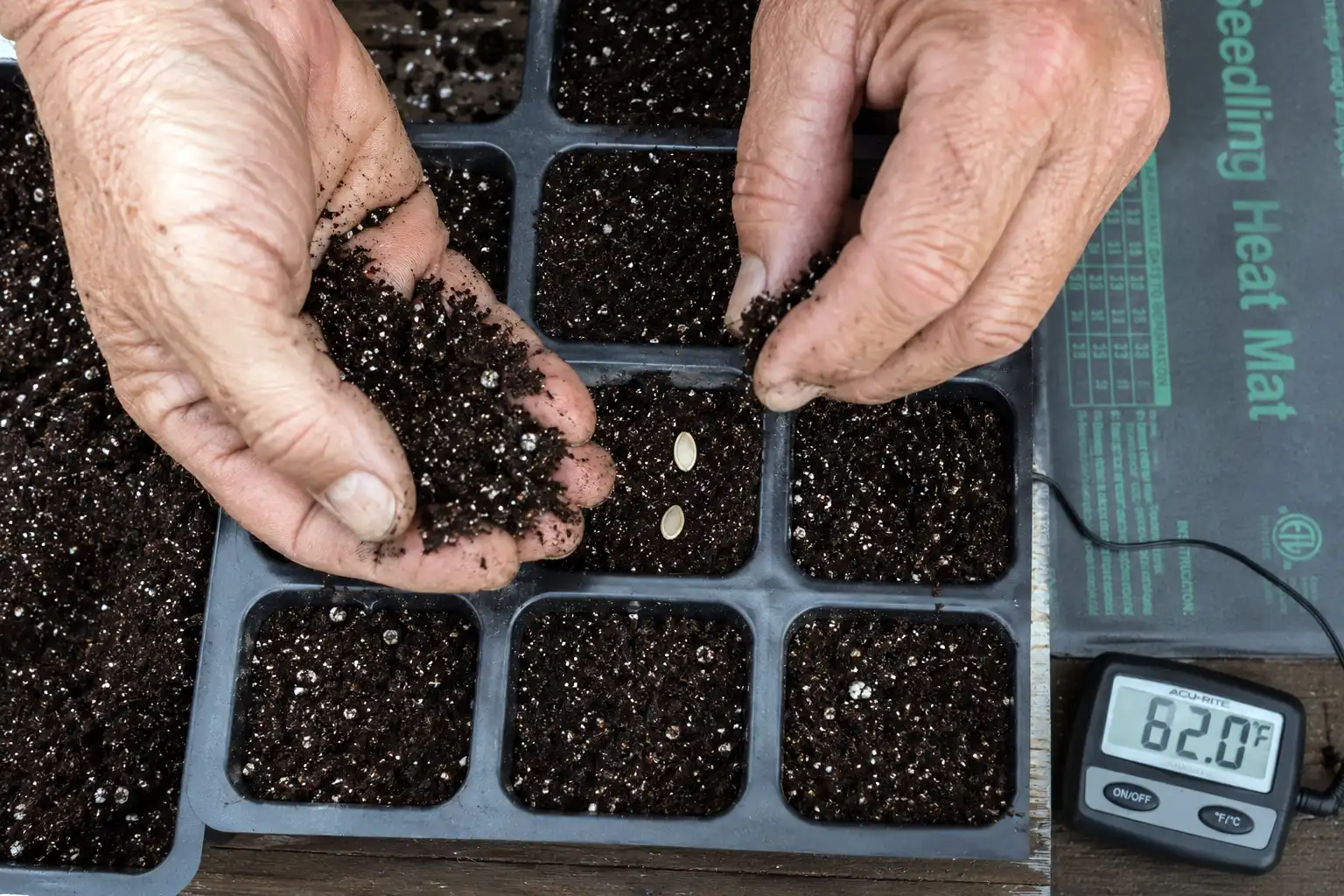
Once seedlings are up, drop the mix target to about 70°F. Warm still beats cool at every stage, but germination heat and growing heat are not the same number.
How Long Do Eggplant Seeds Take to Germinate?
Eggplant seeds sprout in 7 to 14 days when the mix holds 75°F to 85°F. Speed tracks temperature closely. At 80°F see the first hooks on day 8. Drop the mix to 65°F and emergence stretches past three weeks, while many seeds rot before they ever sprout.
| Mix temperature | Days to emergence | What to expect |
|---|---|---|
| 60°F or below | 21+ days or none | Heavy seed rot |
| 65°F to 70°F | 14 to 21 days | Slow, patchy stand |
| 75°F to 85°F | 7 to 14 days | Even, full stand |
| 90°F or above | 6 to 10 days | Fast but leggy sprouts |
Seed age matters too. Eggplant seed stays viable 4 to 5 years when stored cool and dry, though germination percentage slides after year three. If you are opening a packet from 2022 or earlier, sow three seeds per cell instead of two.
How to Care for Eggplant Seedlings Under Lights
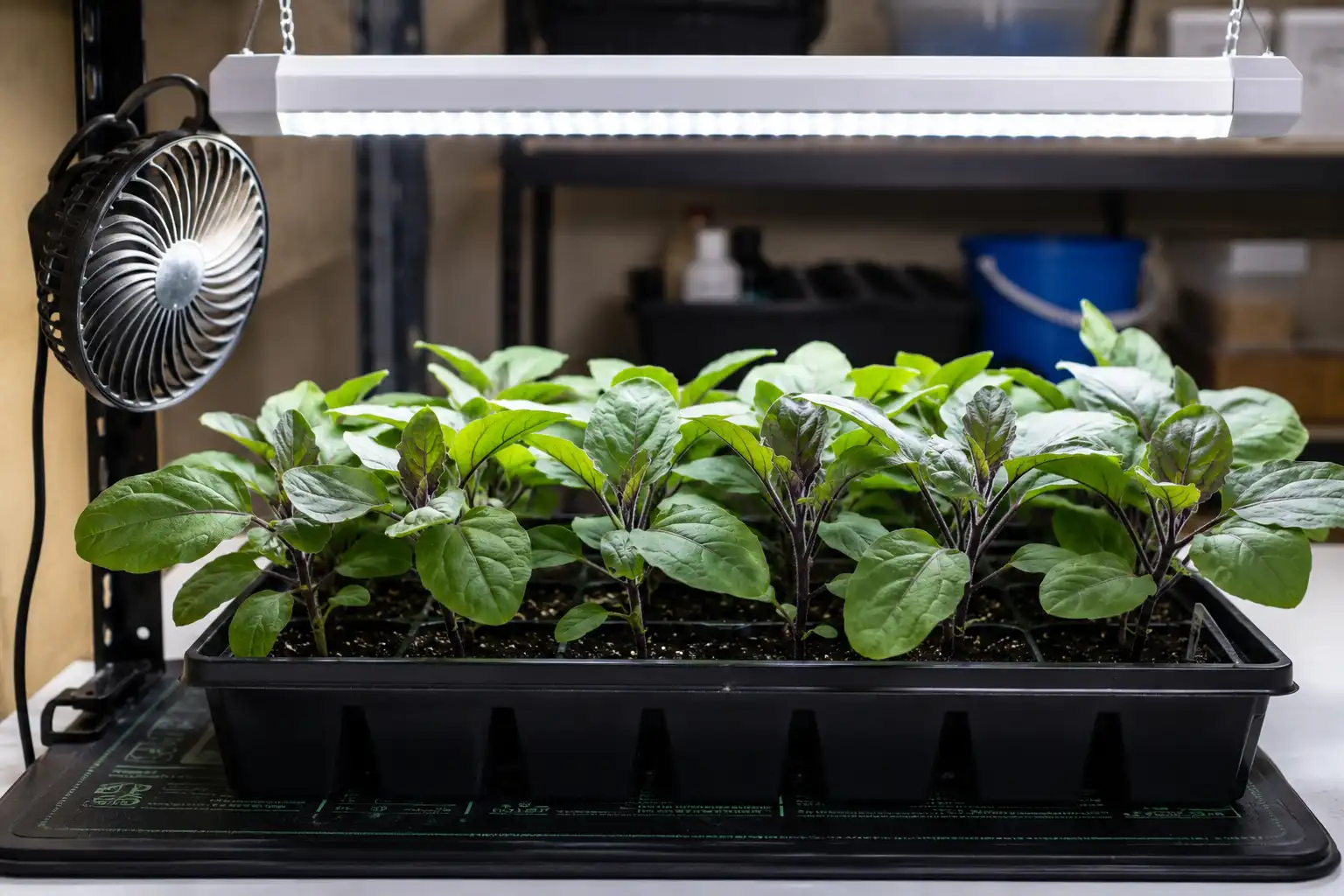
Get light on eggplant seedlings the day they emerge, and keep it close. Weak, stretched stems almost always trace back to light that sits too far away or runs too few hours.
- Distance: 2 to 3 inches above the leaves. Raise the fixture as plants grow.
- Duration: 14 to 16 hours daily on a timer.
- Air temperature: 70°F days, no lower than 65°F nights.
- Airflow: A small fan on low builds stem caliper and dries the surface.
A shelf of grow lights sized for a seedling bench beats any windowsill. March light in the Great Plains runs both short and flat. Water from the bottom and let the surface dry between drinks. That single habit prevents most damping off in the flat, which hits eggplant hard because the mix stays warm and humid.
If seedlings do stretch, do not bury the stem the way you would with a tomato. Eggplant will not root along a buried stem. Fix the light instead and stake the seedling if it leans.
When and How to Pot Up Eggplant Seedlings
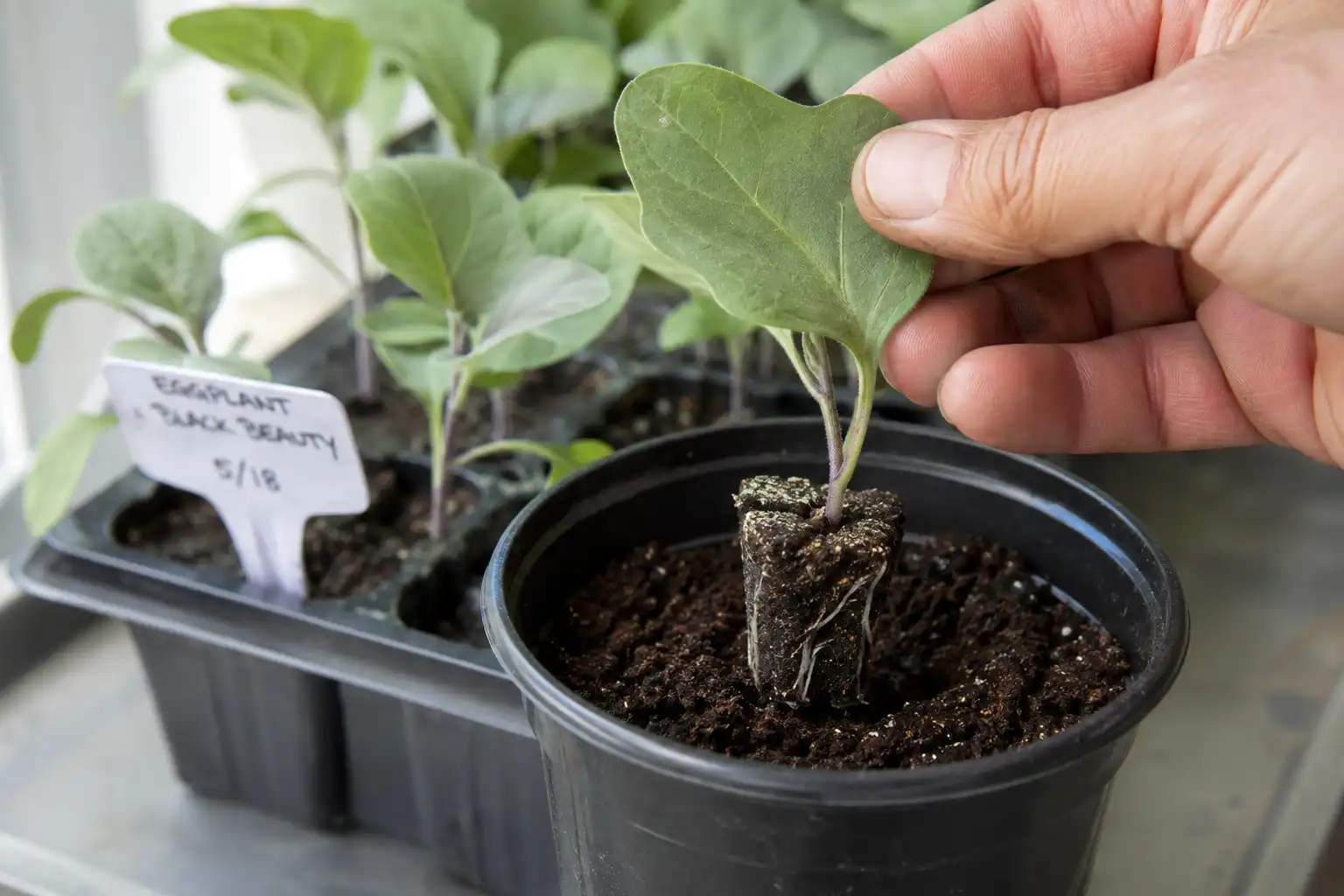
Pot up once the first true leaves open, usually 2 to 3 weeks after germination. Eggplant resents crowding, and a plant held in a small cell for eight weeks will flower early and set poorly.
Move each seedling into a 3 or 4 inch pot. Handle it by a leaf, never the stem, since a crushed stem never recovers. Set it at the same depth it grew before. Water it in and return it to bottom heat until day temperatures on your bench sit in the 70s.
Open flats need thinning too. Space seedlings 2 to 3 inches apart once true leaves appear. Crowded flats produce leaning plants no matter how good your light is.
Watch for early flowers. Eggplant often tries to bloom indoors around week six. Pinch every flower cluster off until the plant is in the ground, because fruit set indoors robs the roots you actually need.
How to Feed Eggplant Seedlings
Start feeding once the second set of true leaves opens, and keep the rate low. Germination mixes carry almost no fertility, so seedlings run out of nitrogen around week three or four.
Use a soluble fertilizer or fish emulsion at one quarter to one half the label rate for mature plants. Apply every 7 to 10 days. Full-strength doses burn seedling roots fast.
Two signals tell you where you stand. Pale lower leaves mean the mix ran empty, so feed. Dark, floppy, oversized leaves mean too much nitrogen, so back off. Excess nitrogen builds bushy plants that set one small crop and then quit. Field growers make the same mistake. If your seed-starting mix already contains slow-release fertilizer, hold off entirely until week five.
How to Harden Off Eggplant Seedlings
Harden eggplant over 7 to 10 days, starting with one hour in filtered shade. Skipping this step costs 30% to 50% of the plant’s early vigor, and eggplant recovers from transplant shock slower than tomatoes do.
- Days 1 to 3: One to three hours in full shade with wind protection. No direct sun.
- Days 4 to 6: Add morning sun, up to four or five hours outside.
- Days 7 to 10: Most of the day outside, including afternoon sun.
- Throughout: Cut water volume gradually and let bench temperatures drift toward 60°F.
Bring plants in any night the forecast dips below 55°F. The same principles used for hardening off field transplants apply here. Eggplant just needs the gentler end of every range. A finished transplant stands 5 to 8 inches tall. Its stem runs about as thick as a pencil, with leaves spaced close together.
When to Transplant Eggplant Into the Garden
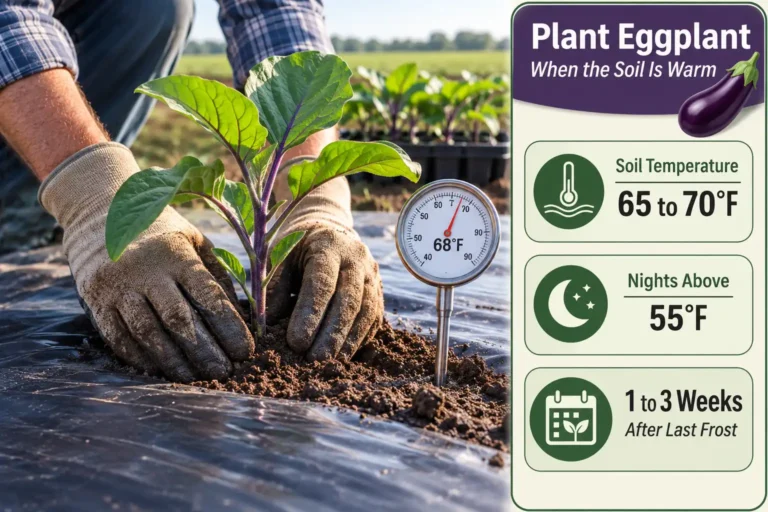
Transplant eggplant 2 to 3 weeks after your last frost. Wait for overnight lows above 50°F and soil at 4 inches reading 65°F. Frost date alone is not the trigger. Cold soil is what stalls these plants, sometimes permanently.
Three numbers to check before transplanting:
- Soil temperature at 4 inches: 65°F minimum, 70°F preferred.
- Overnight lows: Above 50°F for five nights running.
- Daytime highs: Averaging 70°F or better.
Warm the ground ahead of time if you are pushing the calendar. Black plastic mulch laid 2 to 3 weeks ahead adds 5°F to 8°F at root depth. Raised beds also warm faster than flat ground. Hold organic mulch back until the soil reaches 75°F, since straw and grass clippings insulate cold soil and keep it cold.
Transplant late in the afternoon or on a calm, overcast day. Water each plant in, and pour a cup of half-strength starter solution around the root ball. K-State Research and Extension and University of Minnesota Extension both flag the 50°F night threshold. A late cold snap can kill a full flat of transplants overnight, which is why monitoring temperature closely during hardening off matters.
How to Space and Support Eggplant Transplants
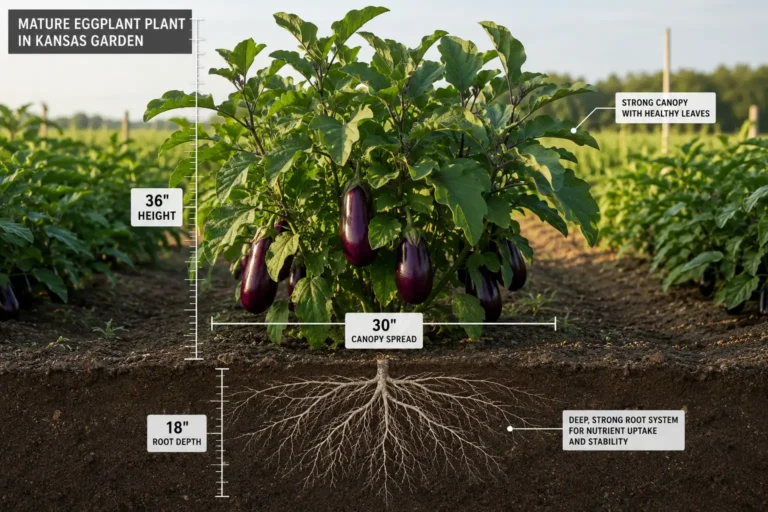
Space eggplant 18 to 24 inches apart in rows 30 to 36 inches apart. Tighter spacing cuts airflow and raises disease pressure, particularly Verticillium wilt.
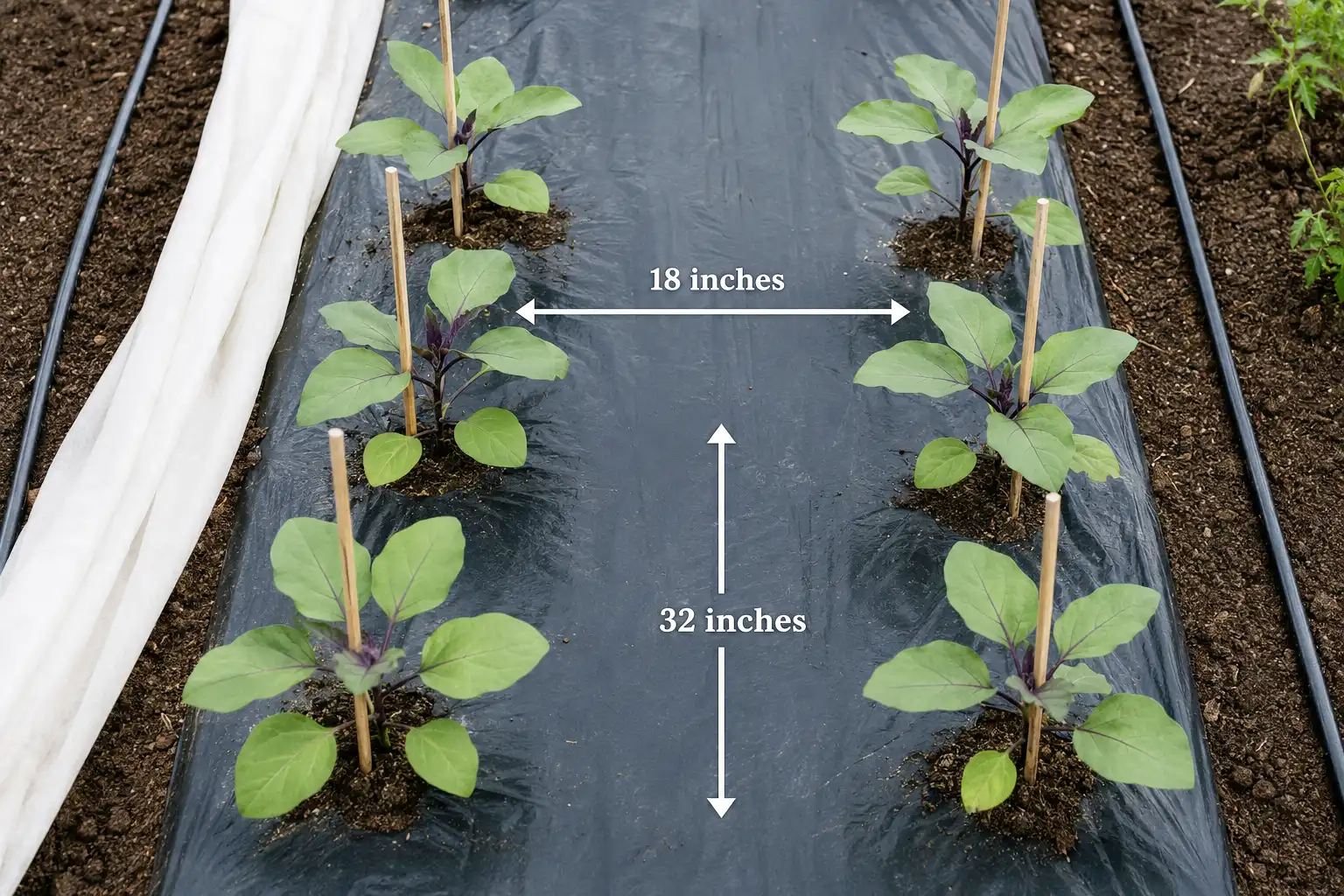
Set a 36 inch stake at planting rather than later. Globe types like Black Beauty and Rosa Bianca carry two-pound fruit and snap at the main stem once loaded. Tie loosely every 8 to 10 inches as the plant climbs.
Cover new transplants with lightweight row fabric the same day they go in. Flea beetles find young eggplant within days. They shotgun the leaves with small round holes. That stunts plants during the exact three weeks they need to establish. Colorado potato beetles work the same crop. Pull the cover once plants touch the fabric or the first blossoms open, so pollinators can reach the flowers.
Rotation matters more than most people expect. Keep eggplant off ground that grew tomatoes, potatoes, peppers, or tomatillos for the past three to four years. If bed space is tight, planting eggplant near tomatoes is workable. Still, it concentrates the same pests and soilborne diseases in one spot.
Best Eggplant Varieties to Grow From Seed
Pick by days to maturity first, then by fruit shape. Days below count from transplant, not from sowing, so add your 8 week indoor start to get the real total.
| Variety | Type | Days from transplant | Best fit |
|---|---|---|---|
| Fairy Tale | Mini striped | 50 to 65 | Containers, zones 4 to 6 |
| Orient Express | Japanese slender | 58 | Cool nights, short seasons |
| Millionaire | Japanese hybrid | 55 to 65 | Flavor, heavy repeat set |
| Hansel | Mini cluster | 55 to 70 | Baby fruit, patio pots |
| Ichiban | Japanese slender | 61 to 70 | Dependable all-purpose slicer |
| Black Beauty | Standard globe | 73 to 85 | Long hot summers, zone 6+ |
| Rosa Bianca | Italian heirloom | 75 to 88 | Mild flesh, zone 7+ |
| Listada de Gandia | Italian striped heirloom | 80 to 85 | Hot summers, zone 7+ |
Season length decides this for you. If your frost-free window runs under 100 days, the Japanese slender types are the only ones that finish reliably. Own bench carries Orient Express for early fruit and Black Beauty for the August flush. Topeka gives me roughly 180 frost-free days in a normal year.
Grow open-pollinated types like Black Beauty, Rosa Bianca, and Listada de Gandia if you plan to save seed. Hybrids such as Ichiban and Millionaire will not come back true.
Common Problems When You Grow Eggplant From Seed
Nearly every failure below traces back to temperature, light, or water. Match the symptom to the cause and the fix is quick.
| Symptom | Likely cause | Fix |
|---|---|---|
| Seeds never sprout | Mix below 65°F | Add bottom heat, hold 80°F to 85°F |
| Patchy, slow emergence | Old seed or dry surface | Sow 3 per cell, mist daily under a dome |
| Stems collapse at soil line | Damping off | Bottom water, add airflow, thin crowding |
| Tall pale stretched stems | Light too far or too brief | Drop lights to 2 inches, run 16 hours |
| Purple leaves, stalled growth | Room below 65°F | Warm the bench, feed half strength |
| Pale lower leaves in week four | Mix fertility used up | Pot up and feed every 7 to 10 days |
| Flowers forming indoors | Root bound, held too long | Pinch flowers, move to a larger pot |
| Plants sit still after transplant | Soil under 65°F | Wait for warmth, use black plastic mulch |
| Small round holes in new leaves | Flea beetles | Row fabric on the day of transplanting |
| Wilting one branch at a time | Verticillium wilt | Rotate out of nightshades 4 years |
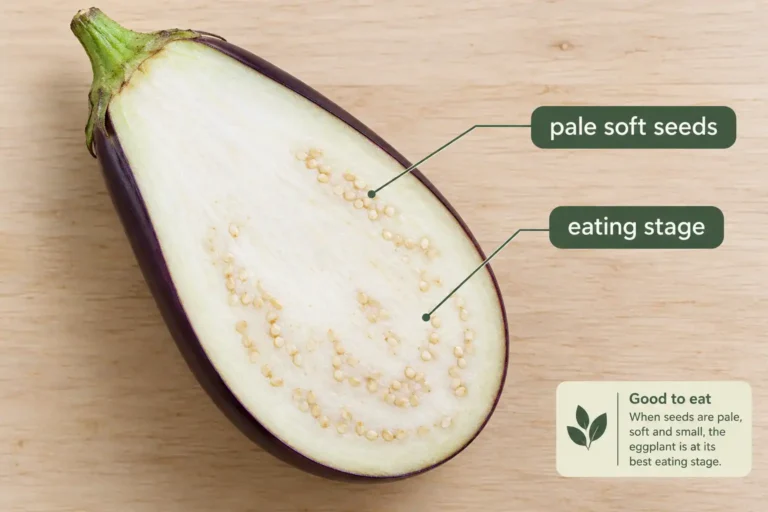
One more note on bitterness, since it starts at the seed stage. Bitter fruit comes from harvesting late, not from variety alone. Choose a variety your season can actually finish, and you avoid the rushed, over-mature fruit that turns sharp.
Final Thoughts on Growing Eggplant From Seed
Eggplant rewards patience at both ends. Sow around March 15 in Topeka and hold the mix at 80°F until sprouts show. Run lights two inches off the leaves for eight weeks. Plants go out around May 15, never sooner, always over black plastic with row fabric on top. Get the heat right and the rest of the season takes care of itself.