What Do Eggplant Leaves Look Like? Size, Shape, and Texture
Leaf shape is the fastest way to identify a young eggplant in the field. So what do eggplant leaves look like? They are big, lobed, and covered in fine hairs. Reading them also tells you when pests or disease have moved in.
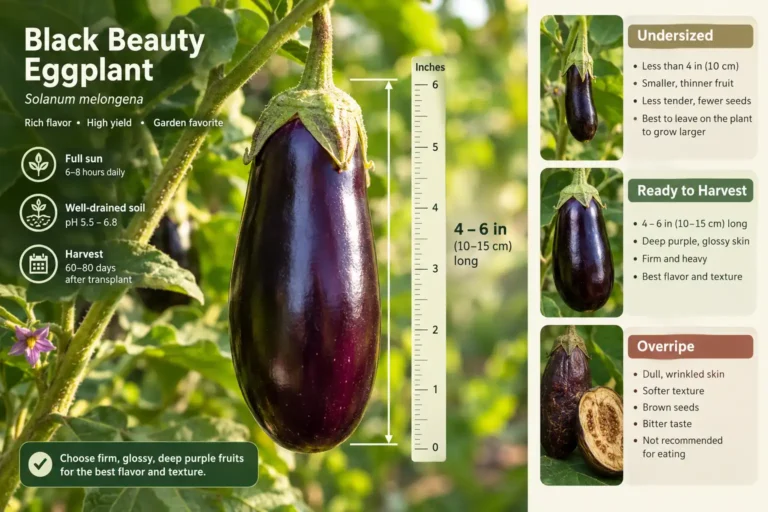
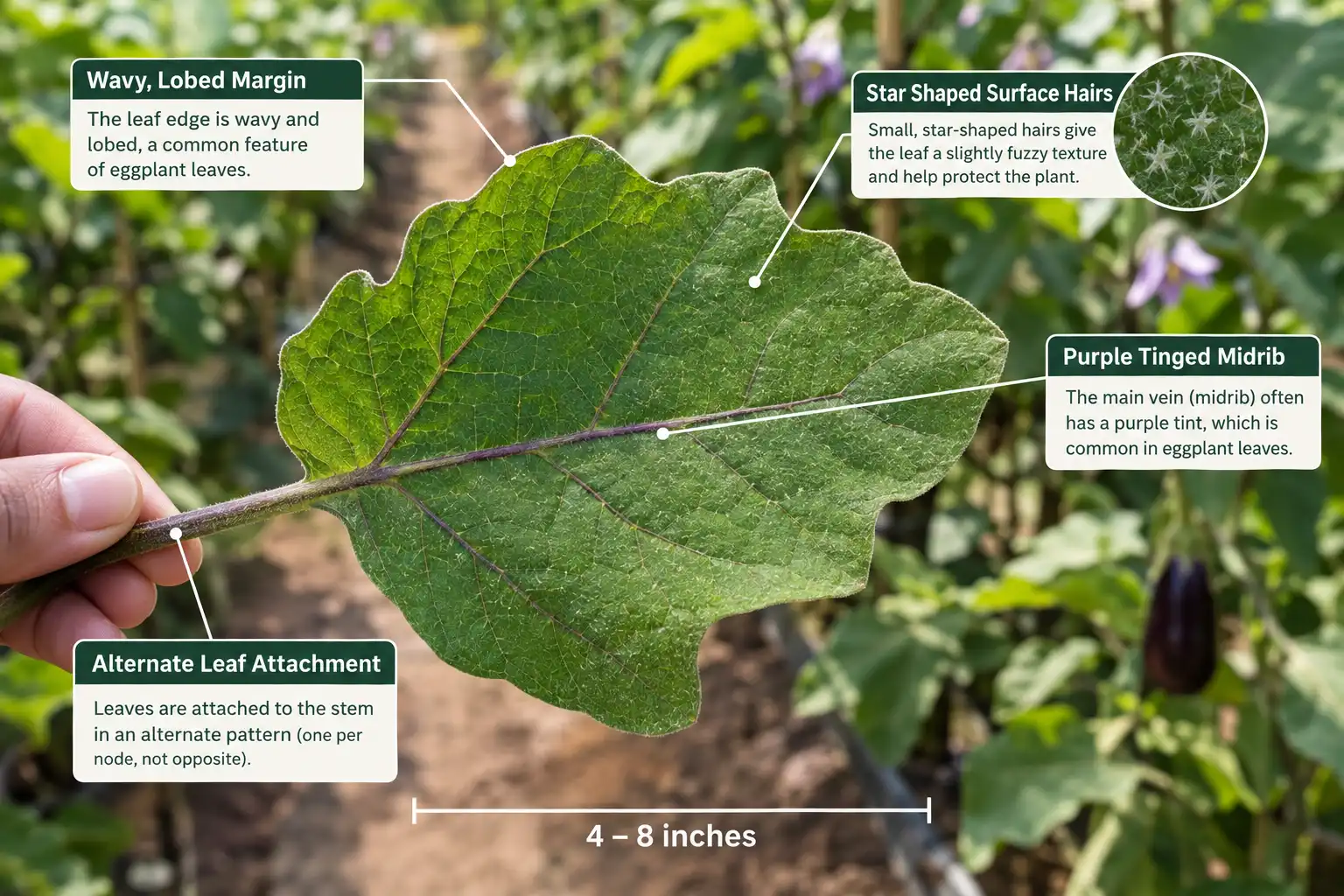
Eggplant leaves are large, simple, and alternate, running 4 to 8 inches long with wavy lobed edges. Star shaped hairs coat both sides, giving a gray green, felt like surface. Some cultivars carry small prickles.
What Do Eggplant Leaves Look Like Up Close?
Eggplant leaves are large single blades with wavy lobed edges and a dull, fuzzy surface. Each leaf stays whole. It never splits into separate leaflets the way a tomato leaf does.
Leaves attach alternately along the stem, so they stagger side to side instead of sitting in pairs. Most mature blades run 4 to 8 inches long and 2 to 4 inches wide. Stout leaf stalks hold them away from the stem.
Margins carry shallow, rounded lobes with wavy edges. There are no sharp saw teeth anywhere on the blade. The leaf base is often uneven, with one side starting lower than the other. Tips run pointed to blunt.
Texture settles the identification. According to NC State Extension, eggplant leaves and stems carry star shaped hairs and sometimes prickles. Those branched hairs scatter light, so healthy foliage reads gray green rather than glossy green. Run a finger across the surface and it feels like felt, not wax.
Undersides look paler, with raised veins standing out clearly. Prickles show up on the midrib and leaf stalk in older heirlooms and many Asian types. Most modern hybrids carry few or none. For the whole plant those leaves sit on, see how to recognize an eggplant plant at each stage.
| Leaf feature | What you see |
|---|---|
| Size | 4 to 8 inches long, 2 to 4 inches wide |
| Arrangement | Alternate, one blade per node |
| Blade type | Simple, never divided into leaflets |
| Margin | Shallow wavy lobes, no teeth |
| Surface | Star shaped hairs both sides, felt texture |
| Color | Gray green above, paler beneath |
| Leaf stalk | Stout, sometimes prickly |
How Do Eggplant Leaves Change From Seedling to Harvest?
Leaf shape shifts three times during the season, and each stage looks different enough to fool a grower.
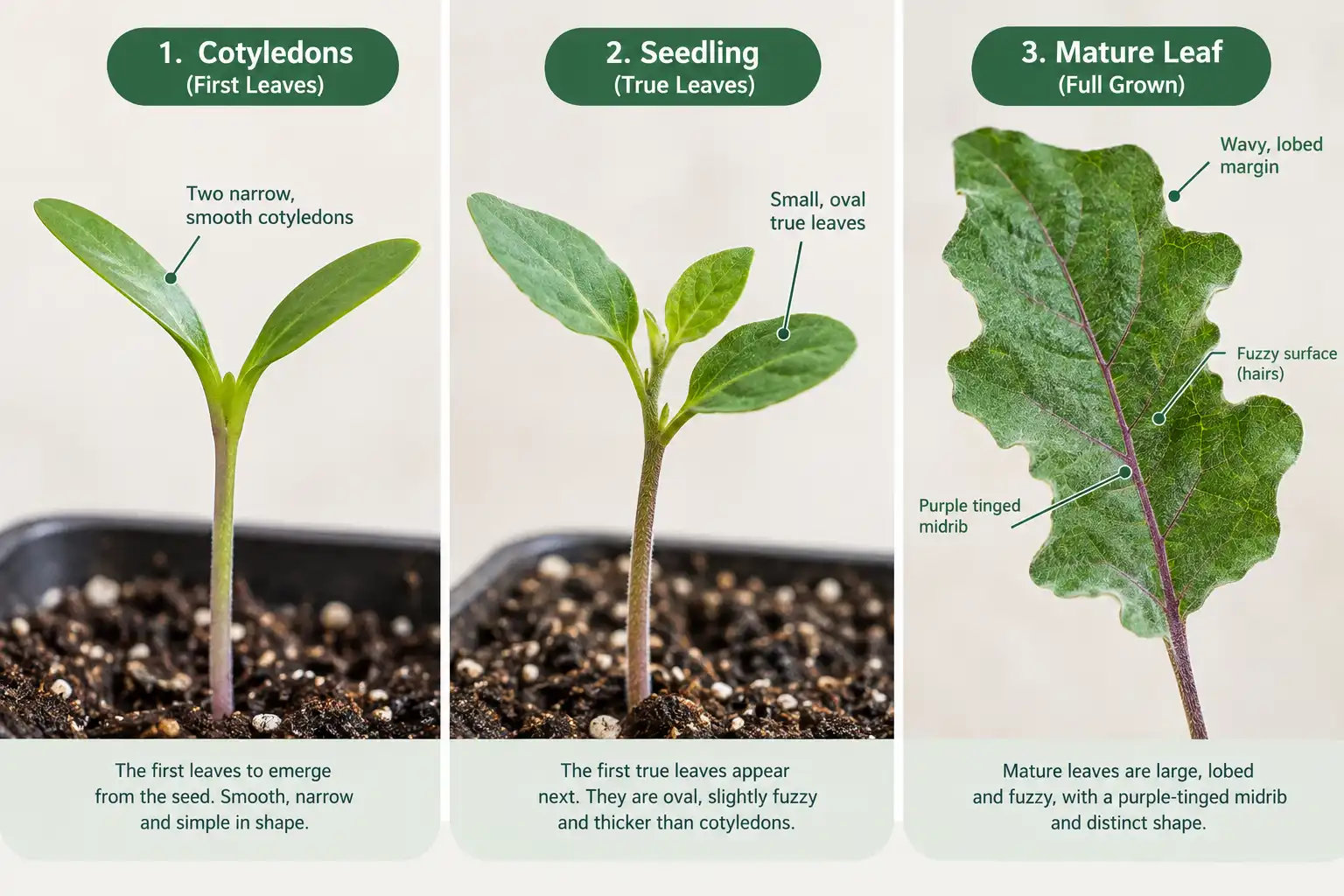
Seed leaves come first. Those two cotyledons are narrow, smooth, and slightly pointed. They carry no hairs and no lobes, so they give no clue about the species.
The first true leaves arrive next. They are small ovals with light hair cover and nearly straight edges. At this point eggplant, pepper, and tomato seedlings all look much alike.
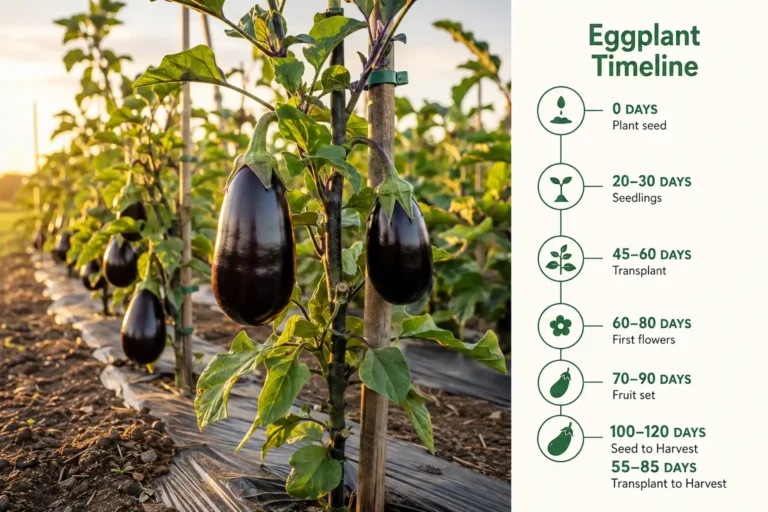
By the third or fourth true leaf, the wavy lobed margin shows up plainly. Hair cover thickens. Blades widen fast. A transplant ready for the field carries four to six true leaves on a thick stem. If you are starting eggplant from seed indoors, that leaf count beats plant height as a readiness signal.
Mature leaves reach full size once flowering starts. Lower leaves then yellow and drop through the season. That pattern is normal aging, not disease.
| Growth stage | Leaf appearance |
|---|---|
| Cotyledon | Two narrow, smooth, hairless blades |
| True leaves 1 to 2 | Small ovals, light hairs, nearly smooth edges |
| True leaves 3 to 6 | Wavy lobes appear, hair cover thickens |
| Flowering onward | Full 4 to 8 inch blades, dense canopy |
Do Eggplant Leaves Look Different Between Varieties?
Yes, but the differences are far smaller than fruit differences. Blade shape holds steady across cultivars. Color and prickles are what change.
Purple fruited types such as Black Beauty and Ichiban often show purple pigment in the midrib, leaf stalk, and stem. That color comes from anthocyanin, the same pigment class behind the dark fruit skin. Purple veining on these plants is normal rather than a stress signal.
White and green fruited cultivars behave differently. Casper and Applegreen usually show little or no purple in the veins.
Prickle load also varies. Some heirlooms and Asian types carry small spines on the midrib and leaf stalk. Many modern hybrids are nearly smooth. Blade size tracks vigor too, so leaf area follows how large eggplant plants grow in a given setting.
How Do You Tell Eggplant Leaves From Other Nightshade Leaves?
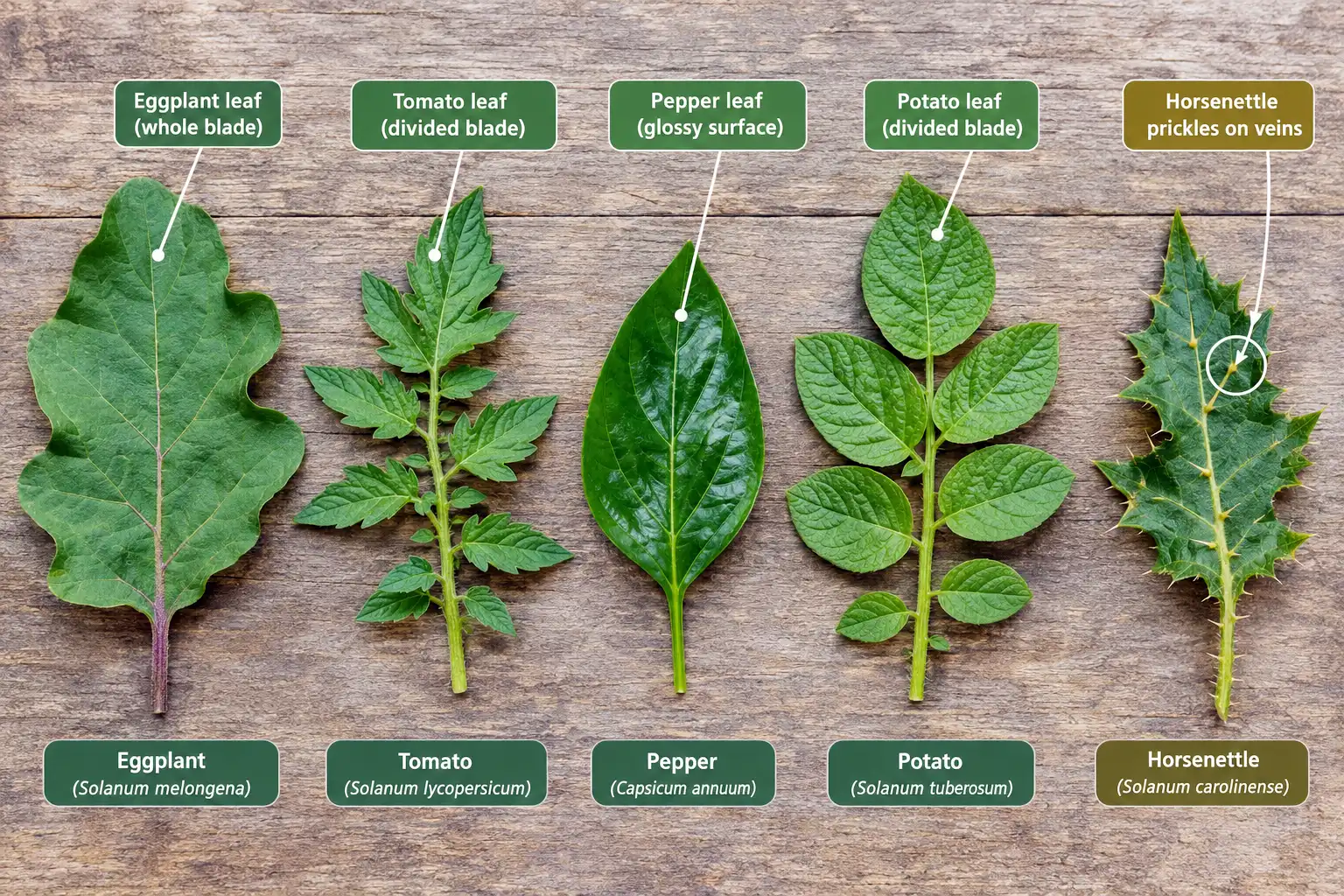
Check whether the blade is whole or divided, then check the hairs. Eggplant shares the nightshade family with tomato, pepper, and potato, so growers mix up the seedlings often.
| Plant | Leaf shape | Surface | Quick tell |
|---|---|---|---|
| Eggplant | Simple, wavy lobes | Star hairs, felt texture, gray green | Big whole blade, fuzzy |
| Tomato | Compound, toothed leaflets | Sticky hairs, strong scent | Divided leaf, tomato smell |
| Pepper | Simple, smooth edges | Hairless, glossy | Shiny and pointed |
| Potato | Compound, leaflets of two sizes | Lightly hairy | Divided, uneven leaflet sizes |
| Horsenettle | Simple, shallow lobes | Star hairs both sides | Sharp prickles on veins |
Horsenettle is the one that fools people. Michigan State University Extension describes its leaves as egg shaped and lobed, 2 to 5 inches long. Sharp prickles stud the veins, midveins, and leaf stalks. Star shaped hairs cover both surfaces, just as they do on eggplant. So a volunteer plant with that outline and heavy spines is almost certainly a weed, not a stray crop plant.
What Do Holes in Eggplant Leaves Mean?
Hole size and shape point straight to the cause. Foliage shows trouble well before fruit does.
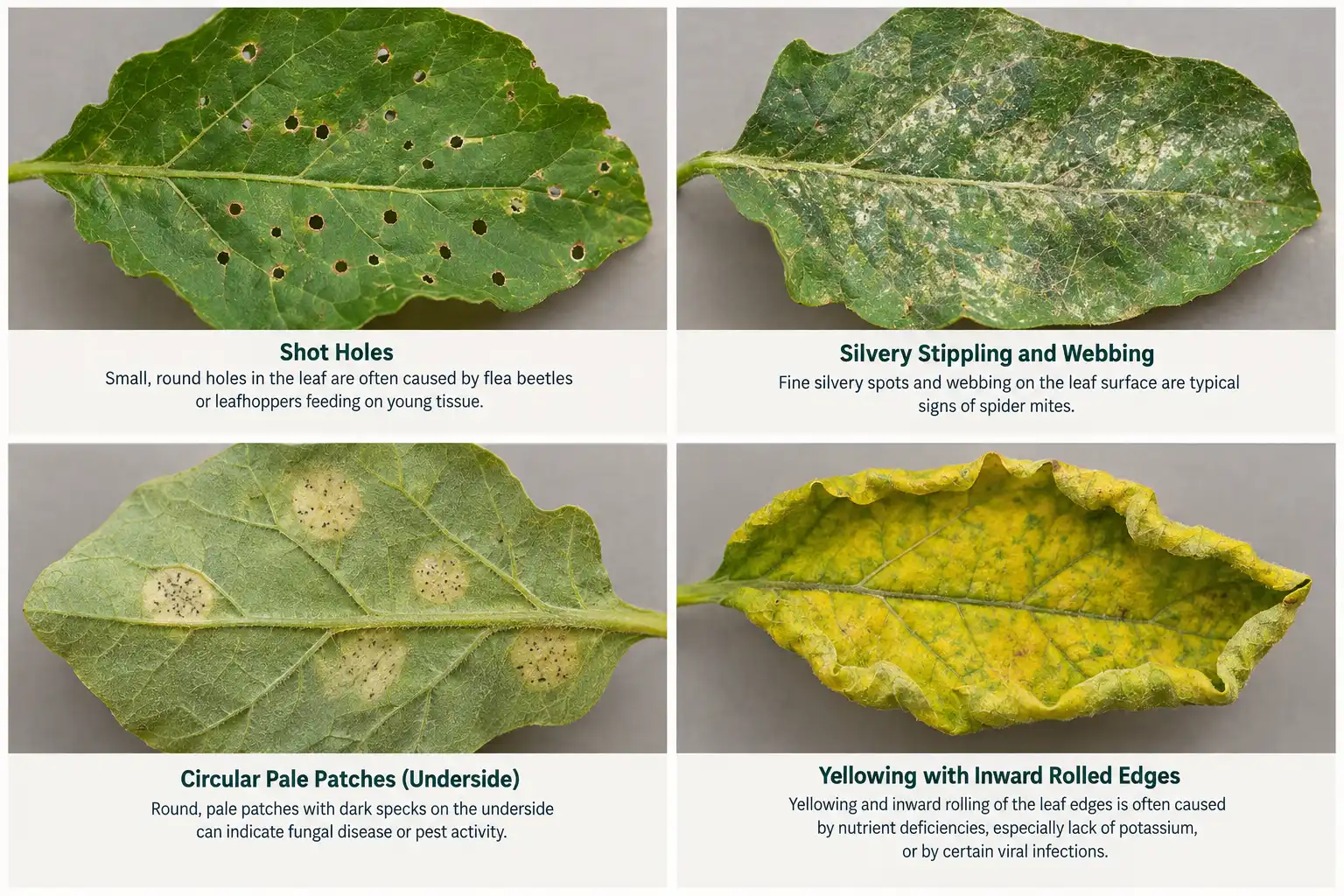
Small round holes come from flea beetles. Clemson Cooperative Extension reports that eggplant is a favored host of several flea beetle species. They chew small shot like holes in the blade. Damage matters most while plants are small. Once plants size up, they tolerate a fair amount of feeding.
Large ragged holes and stripped branches point to Colorado potato beetle. Clemson notes that both larvae and adults feed on eggplant foliage. Populations build fast enough to strip a plant.
Holes that started as spots signal disease instead. The Pacific Northwest Plant Disease Management Handbook describes Cercospora leaf spot as small pale spots on eggplant. Those spots turn gray to brown, then dry and crack until the center drops out. Older leaves show it first. That sequence separates it from flea beetle feeding, which leaves clean holes with no surrounding spot.
Why Do Eggplant Leaves Turn Yellow, Pale, or Bronze?
Color loss means feeding damage, vascular disease, or a nutrient shortage, and the pattern tells you which.
Pale silvery stippling means two spotted spider mites. NC State Extension reports that infested foliage first shows silvery or pale yellow stipples. Leaves then bronze and dry up. Silken webs appear on the undersides.
Eggplant lace bugs create similar upper surface discoloration. NC State Extension describes roughly circular discolored patches on the tops of infested leaves, with colonies feeding underneath. Dark varnish like excrement spots on the underside separate lace bugs from mites.
Yellowing with drooping and inward rolling edges suggests Verticillium wilt. UC Integrated Pest Management reports yellowing and drooping foliage on infected plants. Leaf edges roll inward, and severe cases brown out. Slice the lower stem lengthwise and look for brown streaking inside. Rotation planning helps here, because this pathogen and other soilborne crop diseases survive in soil for years.
Even yellowing between the veins on older, lower leaves usually points elsewhere. University of Georgia Extension links that pattern to magnesium shortage, most common on light sandy soils.
| What you see | Likely cause |
|---|---|
| Small round shot holes | Flea beetles |
| Large ragged holes | Colorado potato beetle |
| Gray brown spots that drop out | Cercospora leaf spot |
| Silvery stippling with webbing | Two spotted spider mites |
| Circular pale patches, dark specks below | Eggplant lace bug |
| Yellowing, drooping, rolled edges | Verticillium wilt |
| Interveinal yellowing, lower leaves | Magnesium shortage |
FAQs on Eggplant leaf appearance and characteristics
Are eggplant leaves poisonous?
Why are my eggplant leaves turning purple?
How many leaves should an eggplant transplant have?
Do eggplant leaves have thorns?
Why are the lower eggplant leaves yellow and dropping?
What the Leaves Tell You in the Field
Three traits confirm eggplant every time. Look for one whole blade per stalk, shallow wavy lobes, and star shaped hairs. Those hairs leave the surface gray green and felt like. Mature blades run 4 to 8 inches long.
After that, read the leaves for problems. Clean round holes mean flea beetles. Spots that fall out mean Cercospora. Stippling with webbing means mites. Yellowing with rolled edges and brown stem streaking means Verticillium. Check the underside every time, because most pests work there first.