How Long Does Eggplant Take to Grow? Full Timeline by Stage
Eggplant runs on a longer clock than most warm season crops in the garden. How long does eggplant take to grow depends on whether you count from seed or from transplant. Here is the full timeline, stage by stage, with the temperatures that control it.
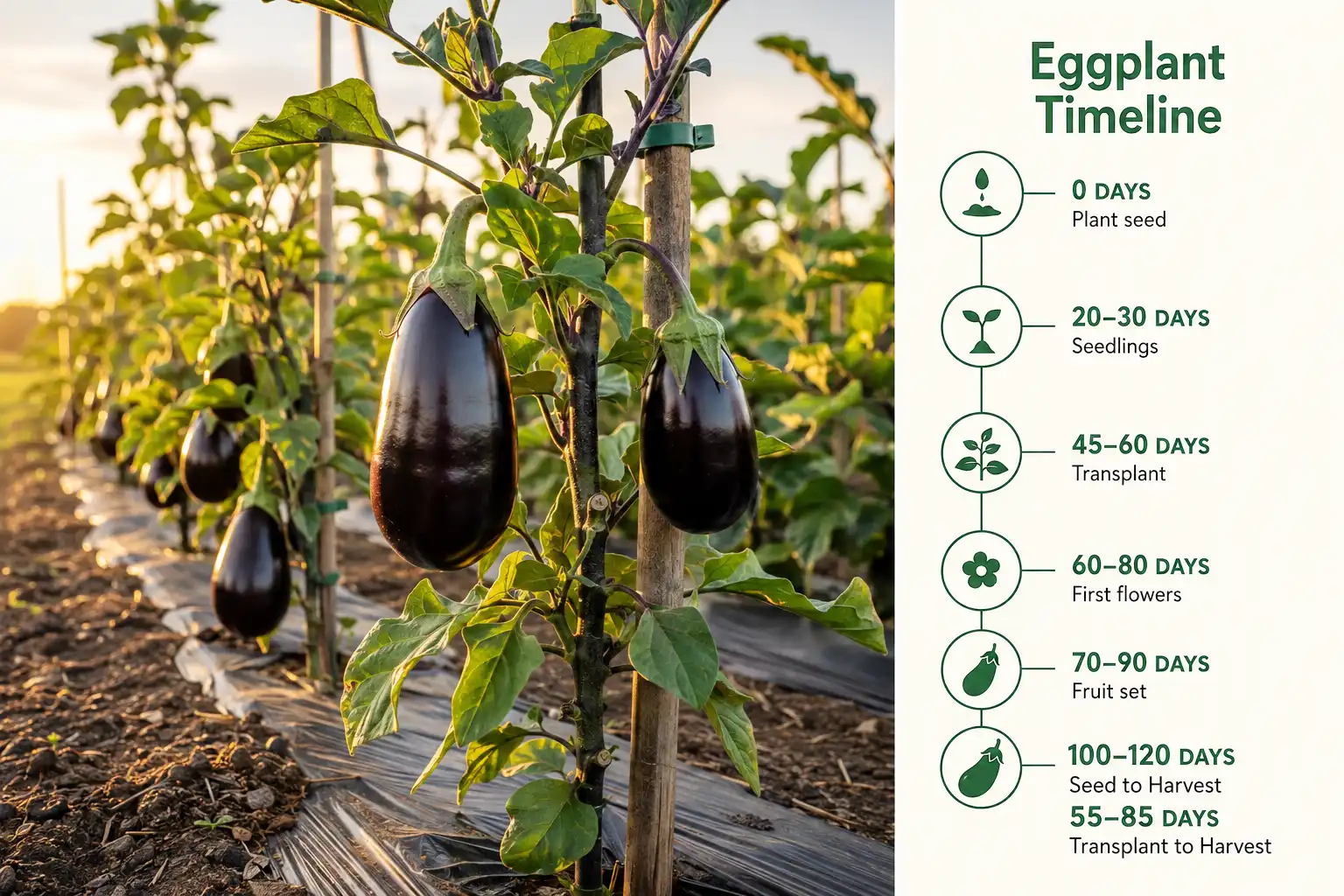
Eggplant takes 100 to 120 days from seed to first harvest. From transplant, most varieties need 55 to 85 days. So how long does eggplant take to grow comes down to variety choice and summer heat.
How Long Does Eggplant Take to Grow From Seed to Harvest?
Plan on 100 to 120 days from sowing to your first picked fruit. Virginia Cooperative Extension stretches that range to 150 days for slow varieties in cool seasons.
Here is how those days break down.
| Phase | Time it takes | Running total from sowing |
|---|---|---|
| Sowing to emergence | 5 to 14 days | 5 to 14 days |
| Emergence to transplant size | 6 to 10 weeks | 47 to 84 days |
| Hardening off | 7 to 10 days | 54 to 94 days |
| Transplant to first open flower | 35 to 55 days | 89 to 149 days |
| Flower to picked fruit | 10 to 40 days | 100 to 150 days |
Hardening off usually overlaps the last week indoors, so subtract a few days there.
The number printed on your seed packet is not the seed to harvest figure. Seed catalogs count days to maturity from the day the transplant goes in the ground. That single detail trips up more first year growers than anything else. A packet marked 75 days means 75 days after transplanting, not 75 days after sowing.
That is why eggplant needs planning about five months ahead of your target harvest date.
Learn more: Grow Eggplant in Containers
How Long Do Eggplant Seeds Take to Germinate?
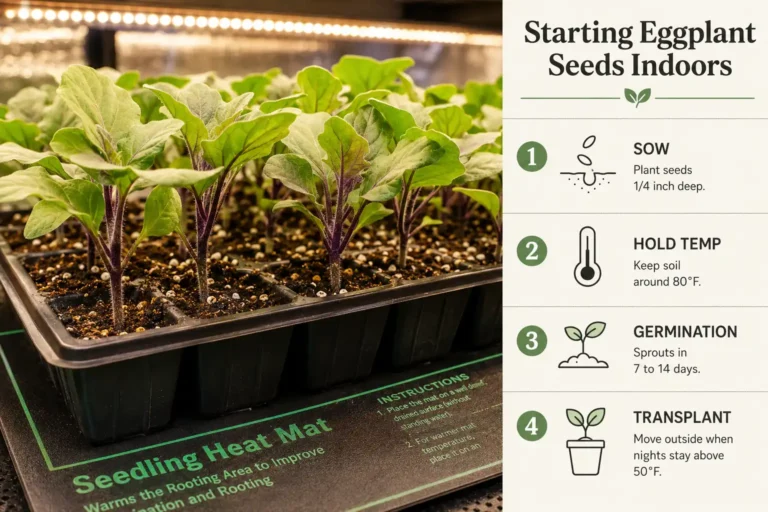
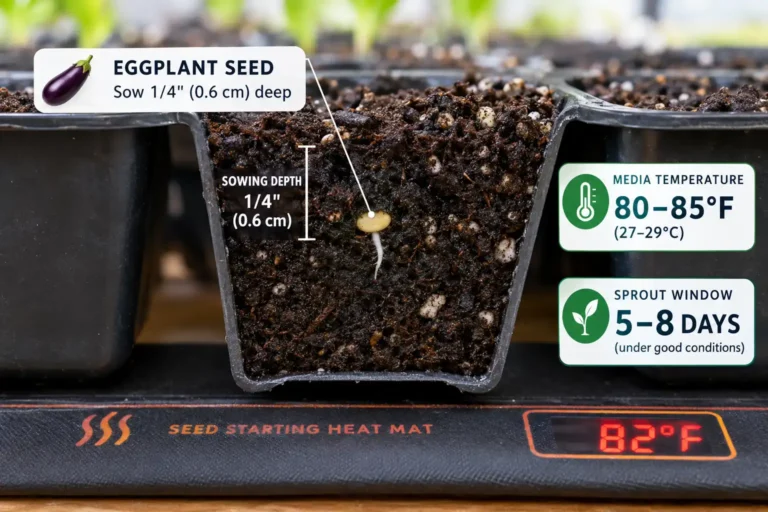
Eggplant seeds sprout in 5 to 14 days when the mix holds 80 to 90°F. Drop that to 70°F and germination slows badly. Below 68°F it usually stops.
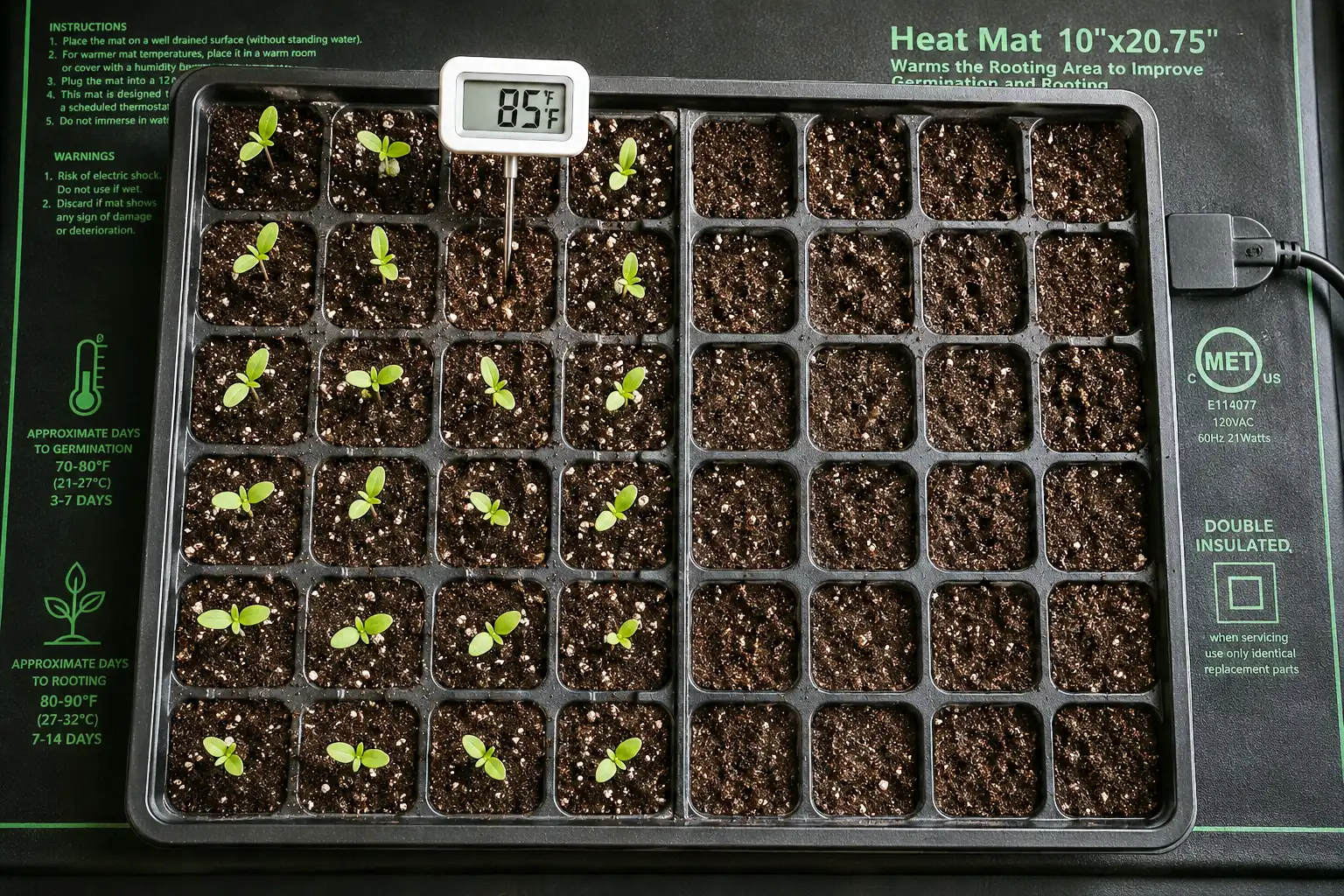
Eggplant is fussier here than tomato or pepper. Room temperature alone will not do it. The tray needs bottom heat, because potting mix on a table sits several degrees cooler than the air around it.
Three things stretch germination past two weeks:
- Cool mix. Anything under 75°F adds days.
- Old seed. Eggplant loses vigor faster than most vegetables. By year three, germination can fall near half.
- Uneven moisture. One dry-out during imbibition halts the process.
Test old packets on a damp paper towel before you commit tray space. Ten seeds tell you what you have in about a week.
How Long Before Eggplant Seedlings Are Ready to Transplant?
Give seedlings 6 to 10 weeks indoors after emergence. Utah State University Extension puts it at 8 to 10 weeks, while Johnny’s and Clemson run closer to 6 to 8. Both work, but the longer schedule fits northern gardens with short summers.
Grow the seedlings at 65 to 75°F once they sprout. That is cooler than germination on purpose, since heat plus dim light produces stretched, weak plants.
Watch for these readiness signs instead of counting days:
- Three to four true leaves past the cotyledons
- Stem thick enough to stand without leaning
- Roots holding the plug together when lifted
- No open flowers yet
A blooming transplant sets back after planting and yields less. Pinch those buds off before the plant goes out.
Two things reliably cost you weeks here. Weak light produces leggy plants that never firm up, so keep grow lights running over the tray close and long. A cold, wet mix invites stem collapse at the soil line, which can empty a flat overnight.
Our walkthrough on starting eggplant from seed indoors covers sowing depth, potting up, and light timing.
When Does the Clock Actually Start Outdoors?
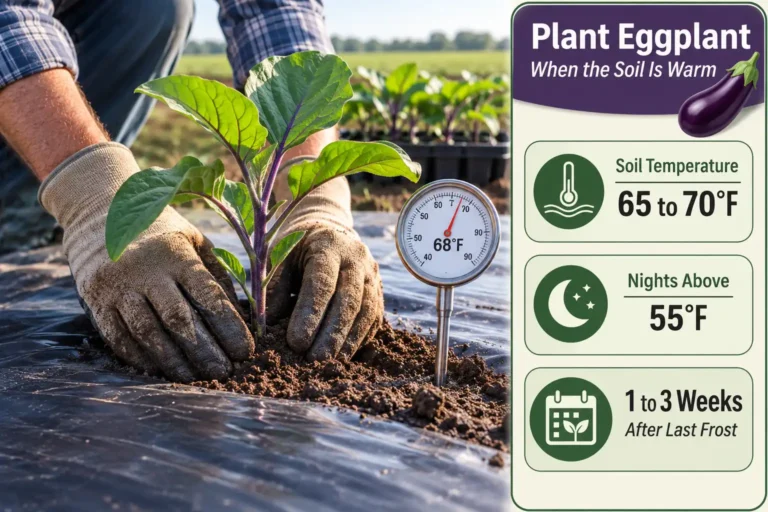
The clock starts when soil at 4 inches deep holds 65°F and night lows stay above 60°F. Not on your last frost date.
This matters more for eggplant than almost any other garden crop. Set a transplant into 58°F soil and it does not simply grow slower. It stalls, sits, and often never catches the plant set out two weeks later into warm ground.
| Soil or air temperature | What happens to the plant |
|---|---|
| Below 55°F | Cold damage, poor recovery |
| Below 60°F | Growth stalls, roots idle |
| 65°F soil, 60°F nights | Safe transplant window |
| 70 to 85°F days | Best growth and fruit set |
| Above 90°F days | Pollen viability falls, flowers drop |
| Above 95°F days | Fruit abortion |
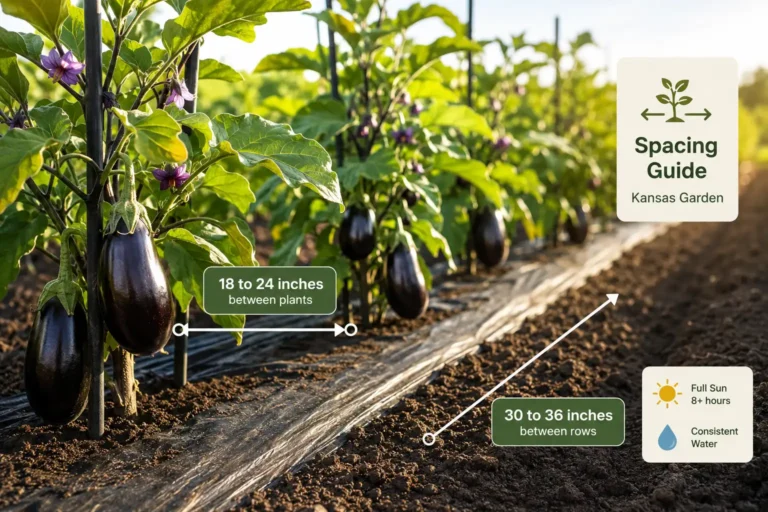
In zone 6a near Topeka, that means mid to late May. Set eggplant about two weeks after tomatoes. Pushing earlier has never paid off.
Take a soil temperature reading with a thermometer at midmorning for three straight days before you commit. One warm afternoon means nothing. For region by region dates, our rundown on the eggplant planting window breaks it down by zone.
Black plastic mulch buys real time. It warms the top few inches by 5 to 10°F and can move the transplant date up by about ten days.
How Many Days From Transplant to First Harvest by Variety?
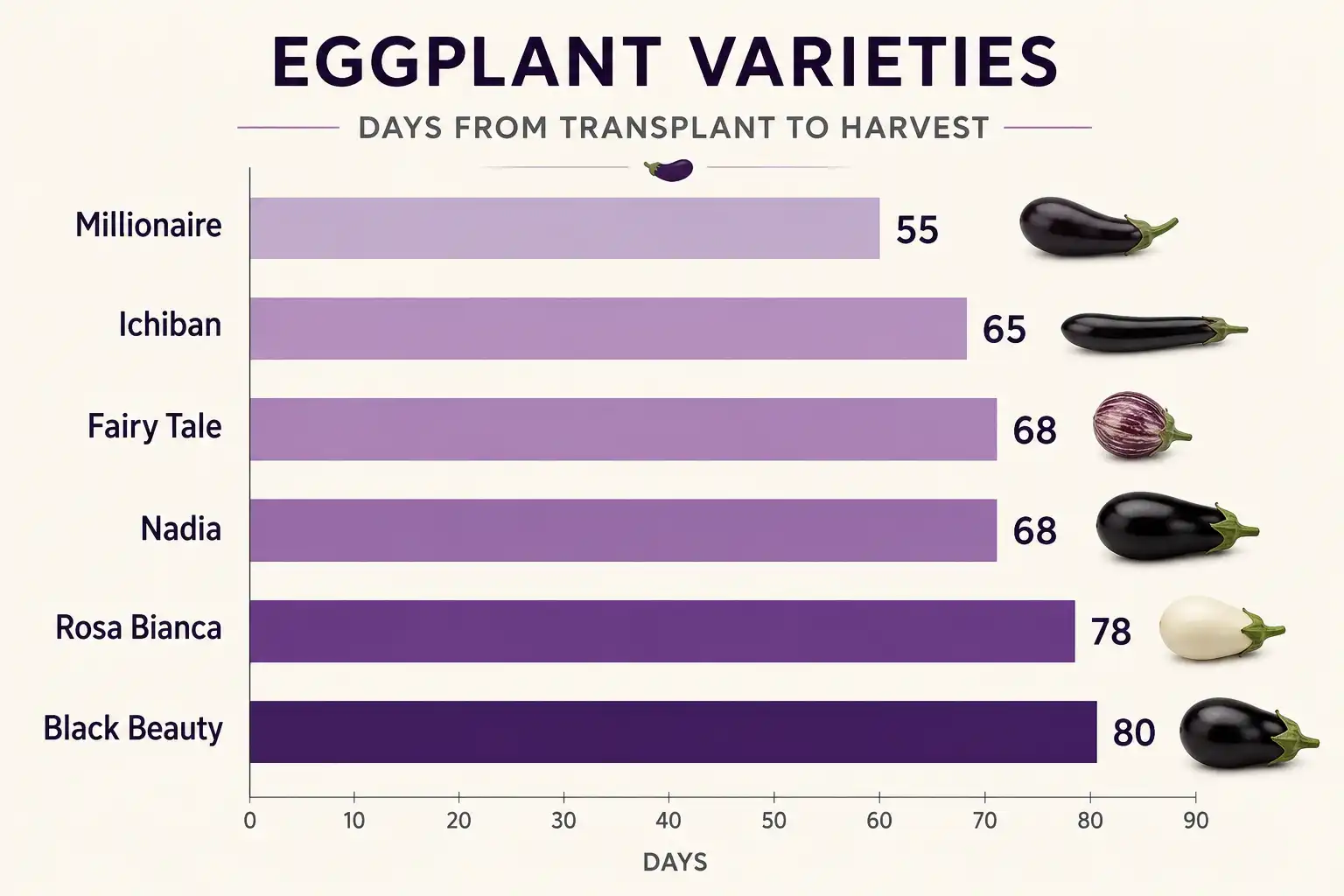
Most eggplant varieties need 55 to 85 days from transplant. Small fruited Asian types finish fastest. Large Italian globes take the longest.
| Variety | Type | Days from transplant |
|---|---|---|
| Millionaire | Japanese, slender | 50 to 55 |
| Easter Egg | Small white ornamental | 52 to 55 |
| Dusky | Italian, early | 60 to 63 |
| Calliope | Small striped | 60 to 64 |
| Ichiban | Japanese, slender | 60 to 70 |
| Little Fingers | Asian, clustered | 65 to 68 |
| Fairy Tale | Mini striped | 65 to 70 |
| Nadia | Italian standard | 65 to 70 |
| Rosa Bianca | Italian heirloom | 75 to 80 |
| Ghostbuster | White standard | 75 to 80 |
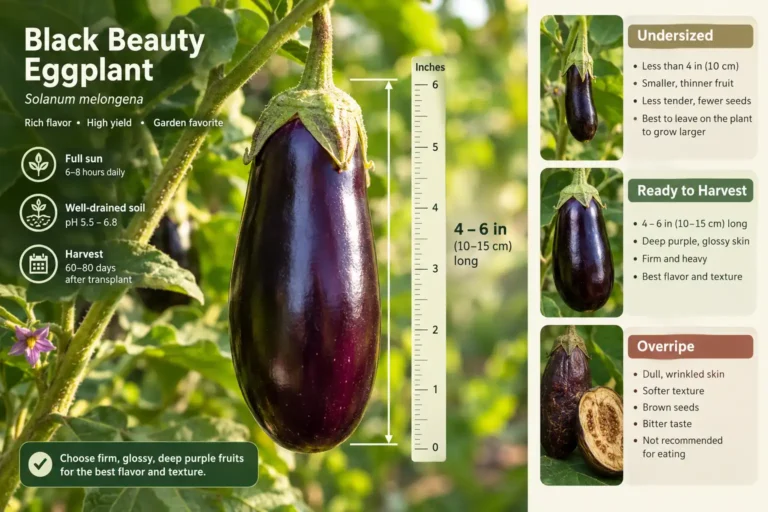
| Black Beauty | Italian standard | 75 to 85 |
Black Beauty sells in nearly every garden center, yet it is the slowest common choice. In zone 5 or a cool zone 6, it often runs out of warm days before it fills a second flush.
Count your frost free days first, then pick. Subtract 14 days as a buffer for the midsummer heat pause. That pause is not optional in most of the country.
For short seasons, Ichiban and Fairy Tale are the safe picks. Both set fruit in the first flowering wave and still leave room for a second round.
What Happens During Each Growth Stage?
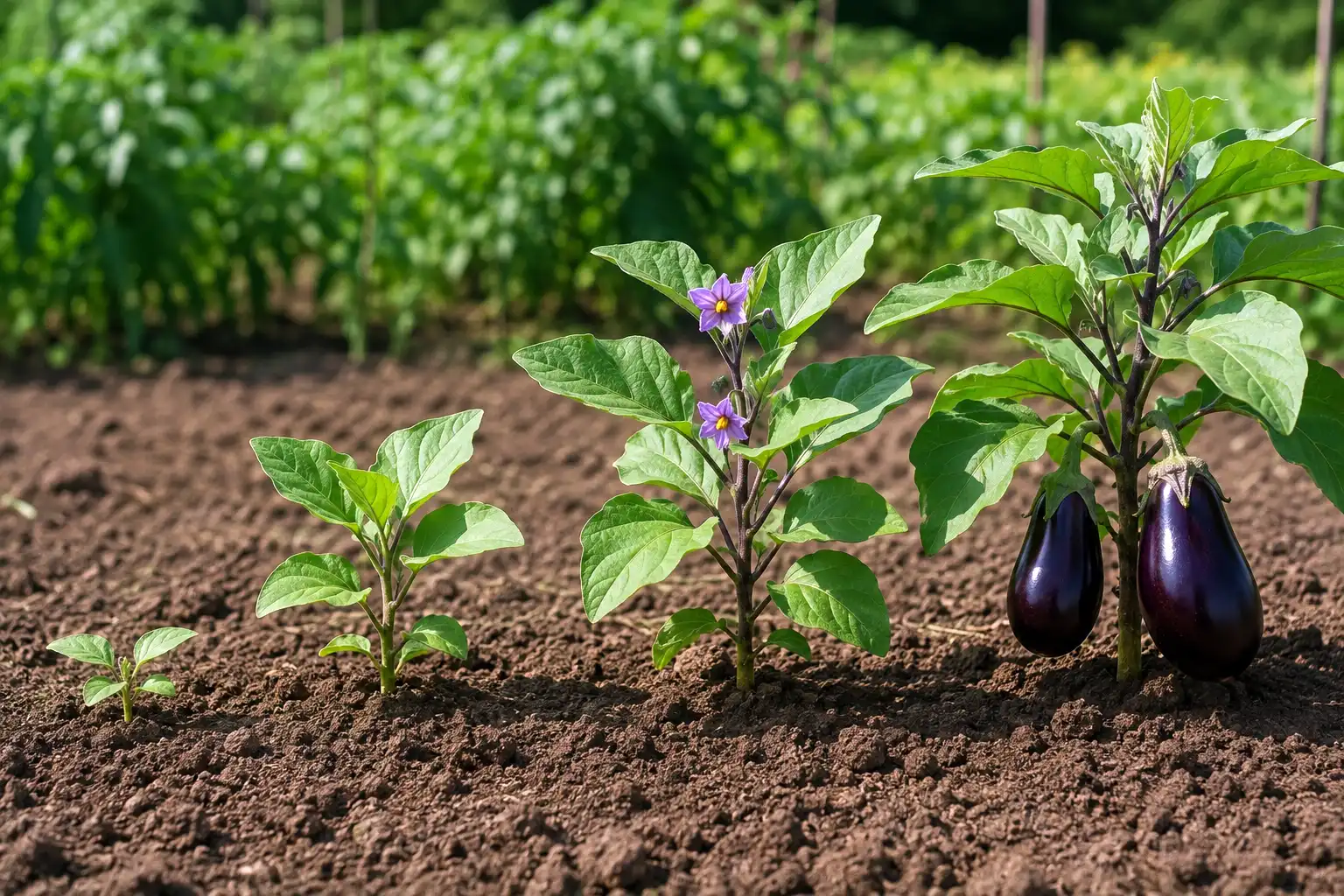
Eggplant moves through six stages, and each one has a fairly predictable length once soil stays warm.
Germination, 5 to 14 days. The seed leaves open. No true leaves yet, and the plant still feeds off the seed.
Seedling, 3 to 5 weeks. True leaves appear 7 to 14 days after emergence. Growth looks slow because the root system is doing the work.
Vegetative growth, 3 to 5 weeks after transplant. The plant doubles in size and sets its branch framework. Nitrogen matters most here.
Flowering, starting 35 to 55 days after transplant. Purple star shaped blooms open in waves. Each flower stays open two to three days.
Fruit set and fill, 10 to 40 days per fruit. Cell division runs the first week. Expansion runs weeks two and three. Most fruit hits picking size at day 14 to 21.
Harvest, 6 to 10 weeks long. Once picking starts, it continues until frost, provided you keep up with it.
The vegetative stage is where growers lose time without noticing. A plant that sits in cool soil for two weeks does not just delay harvest by two weeks. It delays flowering, and flowering has to finish before the heat pause hits.
How Long From Flower to Picked Fruit?
Count 10 to 40 days from open flower to picked fruit, according to UC Davis postharvest research. In practice, most standard varieties in warm weather land at 14 to 21 days.
That spread is wide because temperature drives it. Fruit fills fast at 80°F and crawls at 65°F. Slender Japanese types also finish sooner than heavy globes, simply because there is less fruit to fill.
Pick by appearance, not the calendar:
- Skin is glossy, not dull. Dull skin means overripe.
- Thumbnail press leaves a dent. If the flesh springs back, wait.
- Seeds are still pale and soft when you cut one open.
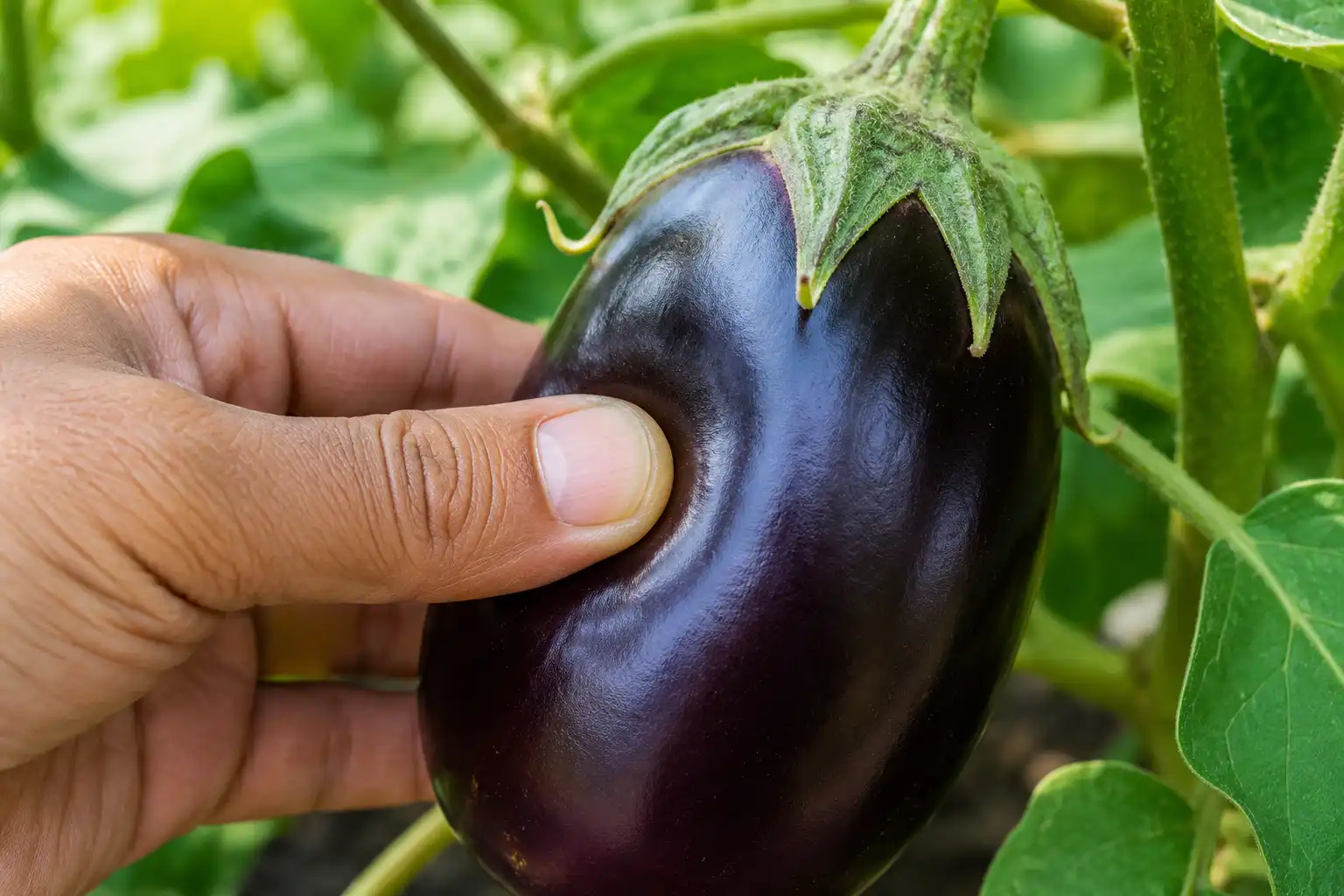
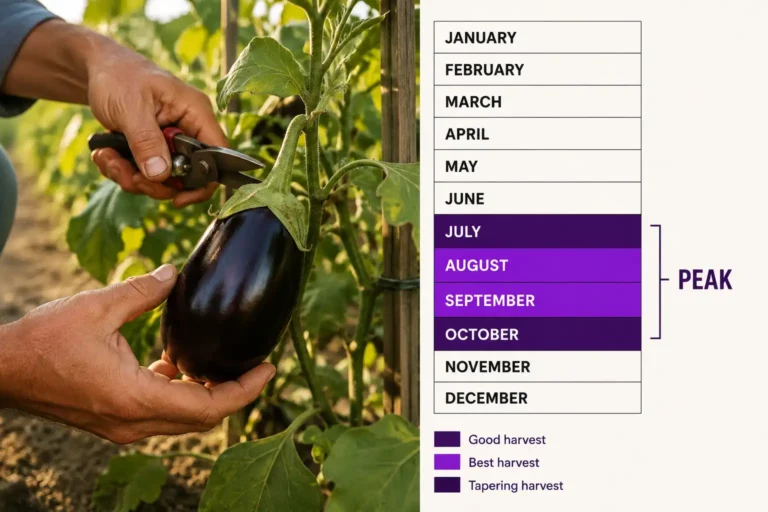
Cut the stem with pruners rather than pulling. Eggplant stems are woody and will tear the branch.
Leaving mature fruit on the plant slows or stops new flower formation. University of Missouri Extension flags that as a common yield loss. So pick once or twice a week all season. The same harvest timing cues apply across most fruiting crops.
Why Does Eggplant Stop Growing in Midsummer?
Eggplant pauses because pollen goes sterile above 90°F. The plant keeps flowering, but the blooms dry up and drop within a day or two without setting fruit.
UC ANR production guidance ties fruit abortion to daytime highs near or above 95°F. Nights below about 61°F cause deformed pollen at the other end of the range. Both conditions show up in a normal Kansas July.
Growers misread this every year. Dropping flowers in July usually means heat, not disease and not a nutrient problem. The plant is waiting.
Add 10 to 14 days to your expected timeline for that pause. When highs settle back under 90°F in late August, fruit set resumes. The plant then delivers its heaviest flush of the year. Best pickings around Topeka land in September, not July.
Three things shorten the pause:
- 30 percent shade cloth from late morning through midafternoon
- Deep, even irrigation so heat stress does not stack on drought stress
- Straw or plastic mulch to steady soil temperature at the root zone
Skip the shade cloth if your highs rarely clear 92°F. It costs you light you actually need.
Can You Speed Up the Eggplant Timeline?
You can cut two to three weeks off the calendar with four moves. But you cannot rush the fruit fill itself.
- Pick a faster variety. Switching from Black Beauty to Ichiban saves 15 days outright.
- Lay black plastic two weeks before planting. Warm soil at transplant is worth about 10 days.
- Use row cover for the first three weeks. It holds 5 to 8°F at night and blocks flea beetles, which stunt young plants badly.
- Set out stocky 8 week transplants. A leggy 12 week plant fruits later than a compact 8 week one.
Direct seeding is the one shortcut that backfires. Eggplant sown in the field wastes 6 to 8 weeks of the warm season, and it only works in the deep South. Our comparison of sowing seed straight into the row against transplanting explains where the line falls.
Skip anything promising faster fruit through heavy nitrogen. Excess nitrogen builds leaves and delays flowering, which pushes harvest later instead of earlier.
How Long Does an Eggplant Plant Keep Producing?
A healthy plant produces for 6 to 10 weeks once harvest starts, ending at the first hard frost. Expect 4 to 6 large fruits from a standard variety, or 15 to 20 from a slender Asian type.
Eggplant is a tender perennial grown as an annual across the US. Frost ends it. In zones 9 through 11 with protection, plants can carry over and fruit again.
Keep production going with steady picking and a nitrogen sidedress of 30 to 50 pounds per acre after the first fruits set. Growers in the field scale that to about a tablespoon of 34-0-0 per plant in the garden.
If your season runs long, cut plants back by a third after the summer pause. They rebuild and set a fall crop.
Key Dates to Carry Into Your Planting Calendar
Work backward from frost, not forward from the seed packet. Take your average first fall frost date. Subtract the variety days to maturity, then 14 more for the heat pause. That gives your latest safe transplant date. Subtract 8 more weeks to find your sowing date.
For me in zone 6a, that means sowing in mid March and transplanting around May 20. Picking runs from late July into October. The change that gained me the most was simple. Match variety days to maturity against your local frost free window, rather than buying whatever the garden center stocked.