How Many Bushels of Soybeans Per Acre? (2026 Yield Guide)
Knowing how many bushels of soybeans per acre you can expect helps you set goals, plan storage, and price the crop. That number swings hard by region, weather, and management.
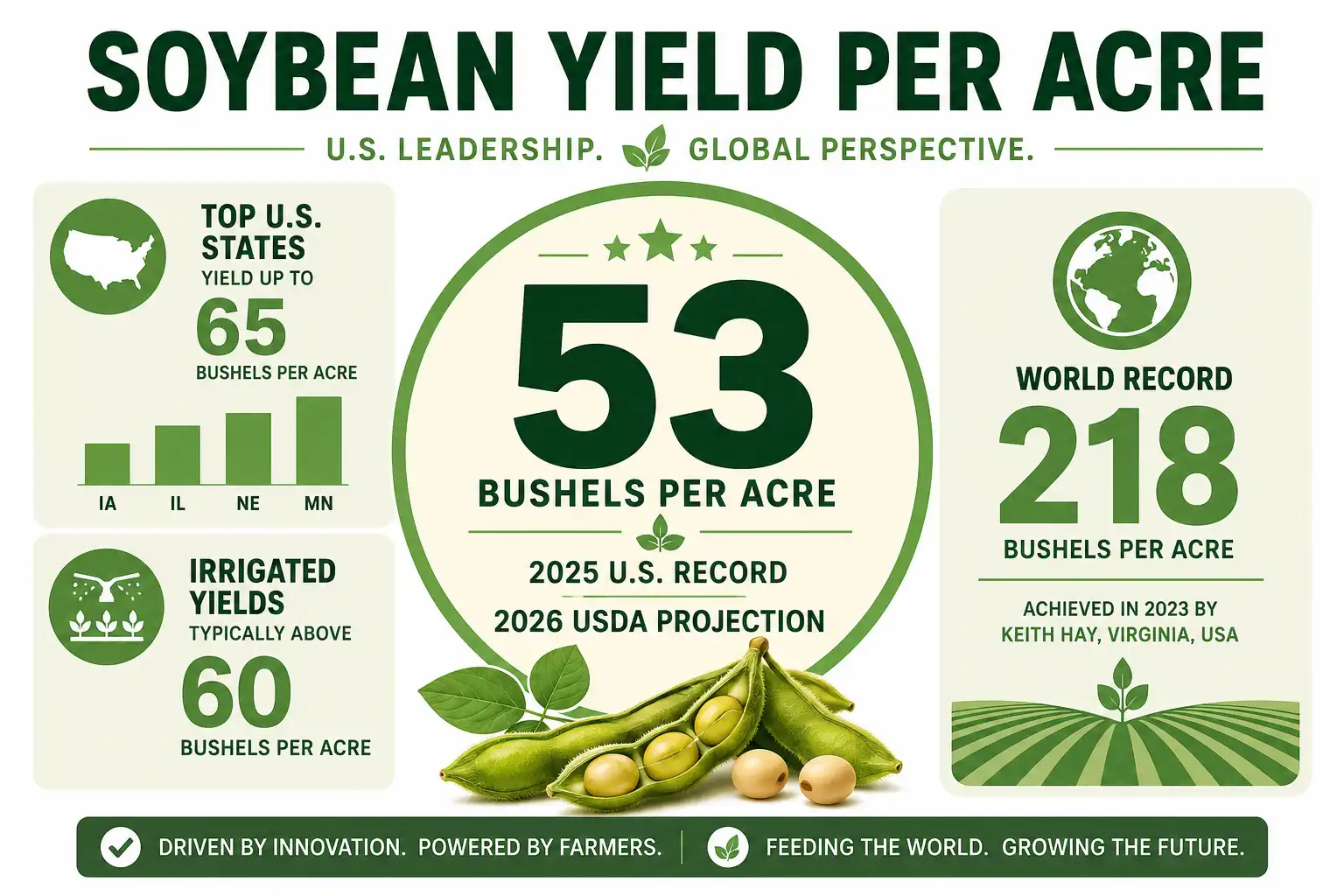
The U.S. soybean average set a record 53 bushels per acre in 2025, and USDA projects the same trend yield for the 2026 crop now in the ground. Most fields run 45 to 65, depending on rainfall and soil.
What Is the Average Soybean Yield Per Acre?
The national average sits right around 50 to 53 bushels per acre. The most recent harvest, in 2025, set a record at 53 bushels per acre, the highest the U.S. has ever produced.
Soybeans weigh 60 pounds to the bushel. So a 53-bushel field puts about 3,180 pounds of beans on every acre. That average has crept up for years thanks to better genetics and tighter field management.
Here is how recent U.S. averages stack up. The 2025 record of 53 bushels sits above 50.7 in 2024, 50.6 in 2023, 49.5 in a dry 2022, and 51.4 in 2021. The trend is steady: average yields keep climbing about half a bushel a year.
What Is the 2026 Soybean Yield Outlook?
USDA projects another 53-bushel average for the 2026 crop now in the ground. The May 2026 forecast puts the new crop near 4.45 billion bushels on about 84 to 85 million planted acres. If summer weather holds, that would rank as the second-largest soybean crop on record, behind only 2021. Keep in mind it is a trend-yield estimate, so the real 2026 number lands after harvest this fall.
How Many Bushels of Soybeans Per Acre by State?
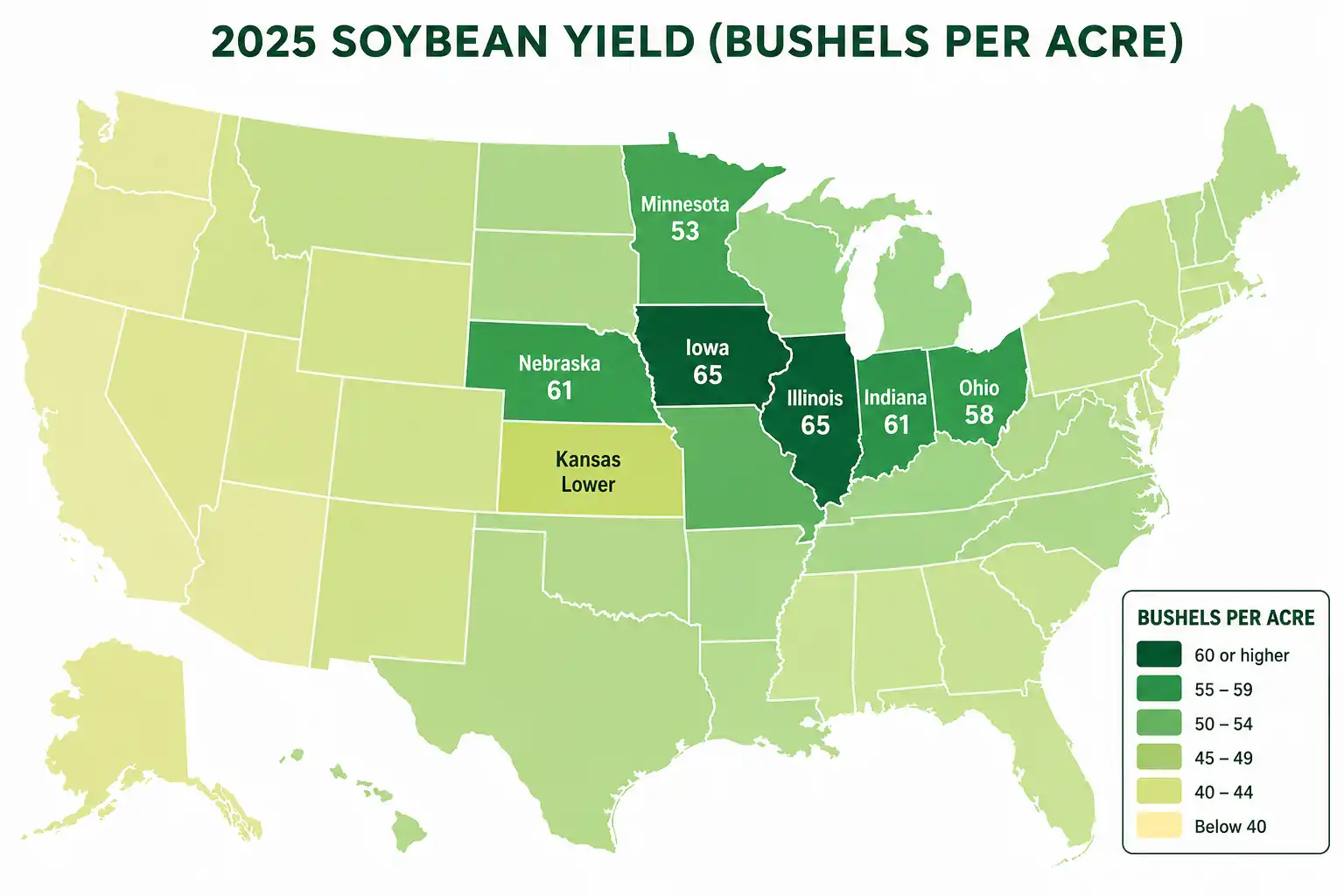
Yields vary a lot by state, and the Corn Belt leads the pack. In 2025, Iowa and Illinois both averaged about 65 bushels per acre, the highest in the country.
Indiana and Nebraska ran near 61 bushels. Ohio came in around 58. Minnesota averaged 53. These states get steady summer rain and deep, fertile ground, so their floor sits higher than most.
In Kansas, the picture changes fast. Drought knocked 2024 state average down to just 35 bushels per acre across 4.4 million harvested acres. The 2025 season was kinder, with more rain and yields back above the five-year mark. That swing shows how much water drives the final number on the Great Plains.
What Is a Good Soybean Yield Per Acre?
A good soybean yield depends on your ground and your water. On solid dryland fields, 50 to 60 bushels per acre is a strong result. Under irrigation, 60 to 70 is very good.
Top growers go well past that. In the Kansas Soybean Yield Contest, winning entries have averaged about 77 bushels per acre, with several no-till and irrigated fields topping 90. K-State Research and Extension trials show 80 to 90 bushels is reachable with good genetics and 100,000 to 120,000 plants per acre.
Set your target against your own field history, not a contest plot. If your beans usually make 45, aim for 50 next season. Small, steady gains beat chasing one big number, and they add up year after year.
What Is the Highest Soybean Yield Ever Recorded?
The world record is 218.2856 bushels per acre, set by Georgia farmer Alex Harrell in 2024.
Harrell broke his own 2023 record of 206.8 bushels. Both crops grew under center pivot irrigation on a small contest plot. He planted Pioneer P49Z02E at 110,000 seeds per acre on 30-inch rows in late March, then managed nutrients and disease hard all season. Those record beans averaged close to 3.1 seeds per pod.
That total runs more than four times the national average. Nobody farms a whole operation at 218 bushels. Still, it shows the ceiling, and it proves the plant can do far more than we usually ask of it.
How Do You Estimate Soybean Yield Before Harvest?
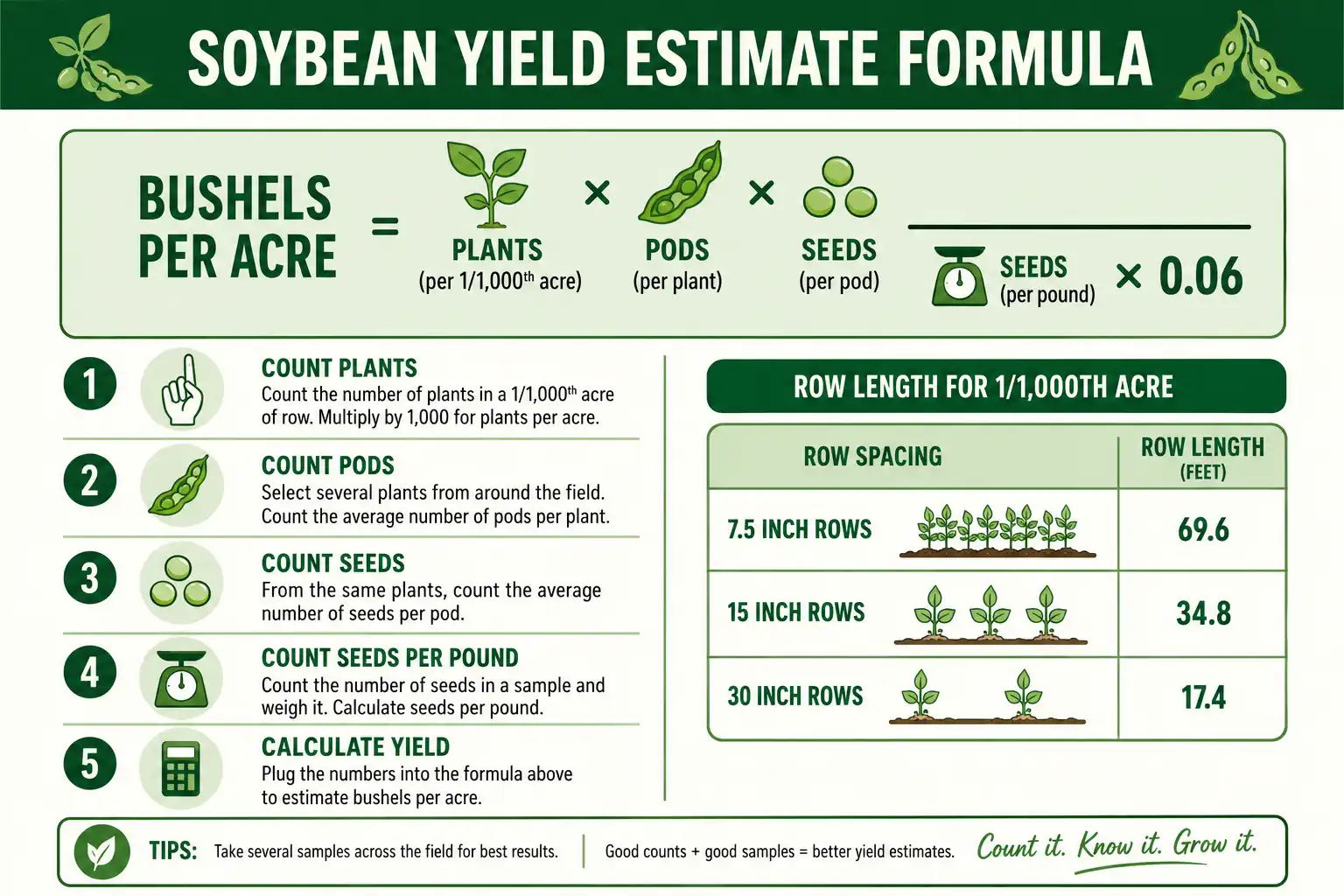
Estimate soybean yield with the pod-count method and one simple formula:
Bushels per acre = (plants in 1/1,000th acre x pods per plant x seeds per pod) ÷ (seeds per pound x 0.06)
You need four numbers: plants per acre, pods per plant, seeds per pod, and seeds per pound (seed size). Here is how to gather each one.
First, count pod-bearing plants in 1/1,000th of an acre. The row length you measure depends on your spacing. In 30-inch rows, count 17 feet 5 inches of row. In 15-inch rows, count 34 feet 10 inches. In 7.5-inch rows, count 69 feet 8 inches. Do this in 10 spots across the field, then average them.
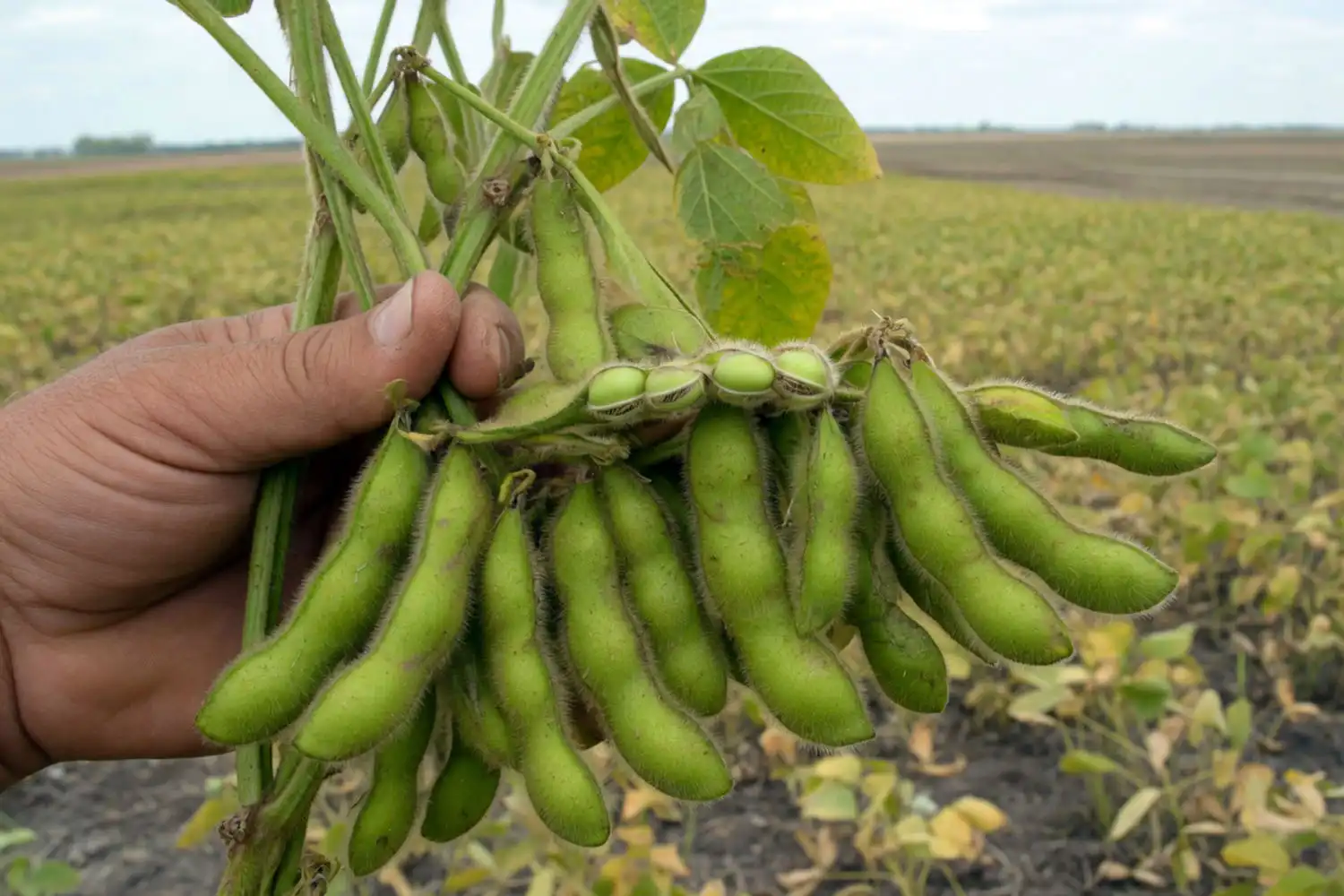
Next, pull 10 random plants and count the pods on each. Average that for pods per plant. Then count the seeds inside 10 random pods. Healthy beans average 2.5 seeds per pod, so drop to 2.0 if the crop ran through stress.
For seed size, use 3,000 seeds per pound in a normal year. Use 3,500 if late-season stress shrank the beans, or 2,500 for big, well-filled seed.
Say you count 120 plants in 1/1,000th acre, 30 pods per plant, 2.5 seeds per pod, and 3,000 seeds per pound. The math runs 120 x 30 x 2.5 = 9,000, divided by (3,000 x 0.06 = 180), which equals 50 bushels per acre.
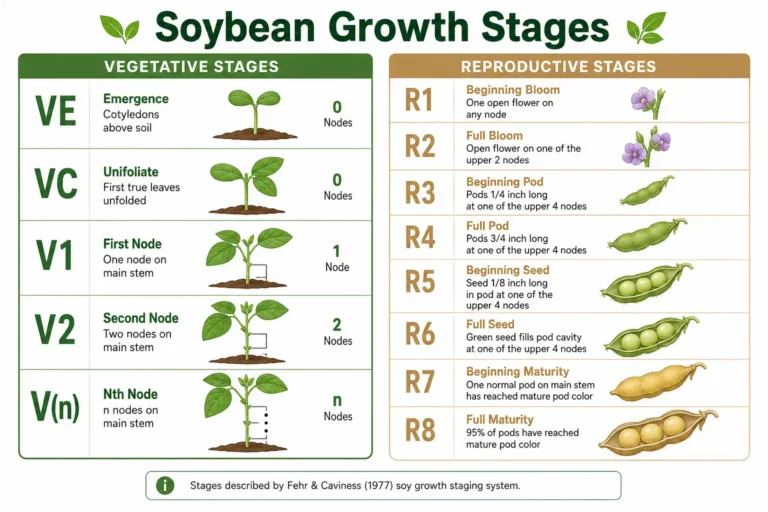
These counts get more accurate late in the season. Wait until R6 (full seed) or R7 (beginning maturity) for the cleanest read. Staging your beans correctly makes the estimate far more reliable.
What Affects How Many Bushels Per Acre You Get?
Weather and management decide most of your final yield. Bushels per acre come from the whole season working together, so managing a soybean crop start to finish matters far more than any single pass across the field.
Does Planting Date Change Soybean Yield?
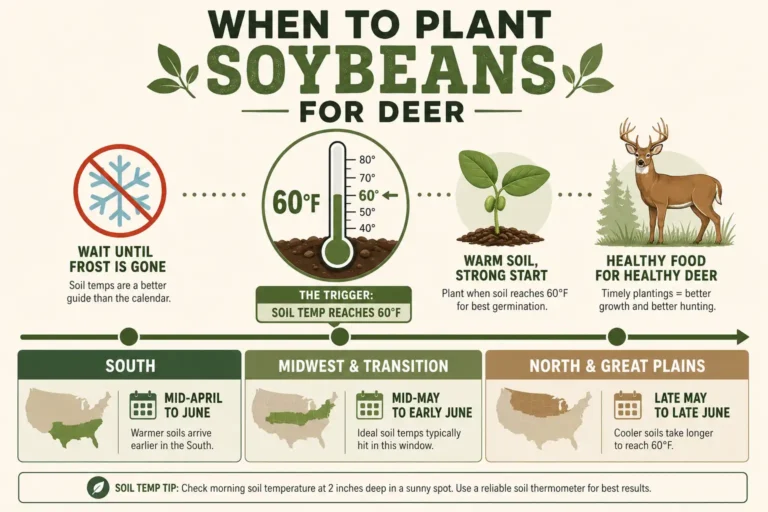
Yes, planting date is one of the biggest levers you control, and early planting almost always beats late. Beans planted from mid-April to mid-May catch more daylight and build more nodes before they flower. NCSU data shows early-planted fields running well ahead of July plantings, sometimes by 30 bushels or more. Getting your beans planted on time pays better than almost any input you can buy.
Do Narrow Rows Boost Yield?
Narrow rows often add bushels, especially in the north and on later plantings. Rows of 15 inches or less close the canopy faster. That captures more sunlight, shades out weeds, and holds soil moisture. NDSU found 14-inch rows closed canopy about 35 days sooner than 28-inch rows. On dry ground, wider rows sometimes hold up better, so match your spacing to your rainfall.
How Much Does Water Matter?
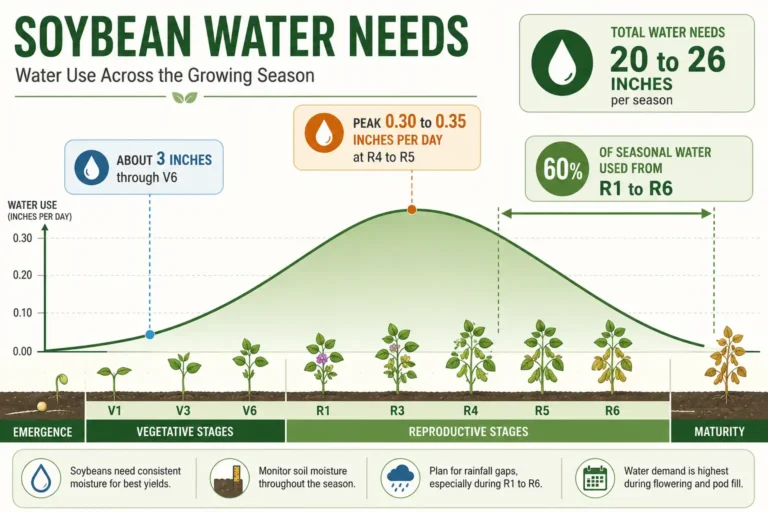
Water matters more than any single input on most fields. Soybeans set seed in August, and they need steady moisture through pod fill. A dry August shrinks seed size and drops yield fast. That is why Kansas irrigated beans have historically averaged 59 bushels while dryland fields managed 42. Knowing the water a bean crop needs at each stage protects the back half of the season.
What Else Limits Yield?
Soil fertility, variety choice, and pests fill out the rest. Keep soil pH near 6.0 to 6.8 and hold phosphorus and potassium in the optimum range, since soybeans respond more to steady soil fertility than to a rescue application. Pick a variety and maturity group suited to your area. Watch for sudden death syndrome, frogeye leaf spot, white mold, and spider mites, because any one of them can cost double-digit bushels.
How Can You Increase Soybean Yield Per Acre?
Start with the basics done right, then add extras only where they pay. A few steady changes do more for pushing your yields higher than chasing any single product.
Plant early into warm, fit soil. Use a variety bred for your region and a maturity group that fills its full season. Lock in the right seeding rate, generally around 100,000 to 140,000 seeds per acre on most ground. Narrow your rows if you farm in the north or plant late. Keep fertility and pH in range. Scout weekly for disease and bugs, and spray fungicide only when a susceptible variety and an early planting date justify it. Time your irrigation to protect pod fill.
None of this works alone. The fields that beat the county average usually nail their timing first and their inputs second.
Final Verdict
In Kansas, soybean yields ride on rain more than anything else. In a good year, dryland beans in the region make 50 to 55 bushels per acre. A dry August can shave a third off that in a hurry. So planting early, keeping fertility steady, and guarding the crop through pod fill are the key moves. Hit those marks and the bushels follow. Know your own field’s average, set a target a few bushels above it, and build from there.