When Is Corn in Season in Florida: 5 Signs of Peak Sweet Corn
Florida ships sweet corn while northern fields sit frozen, so the state keeps its own calendar. Exactly when is corn in season in Florida depends on which of three production regions grew the ears. Harvest months, peak volume, and store checks follow below.
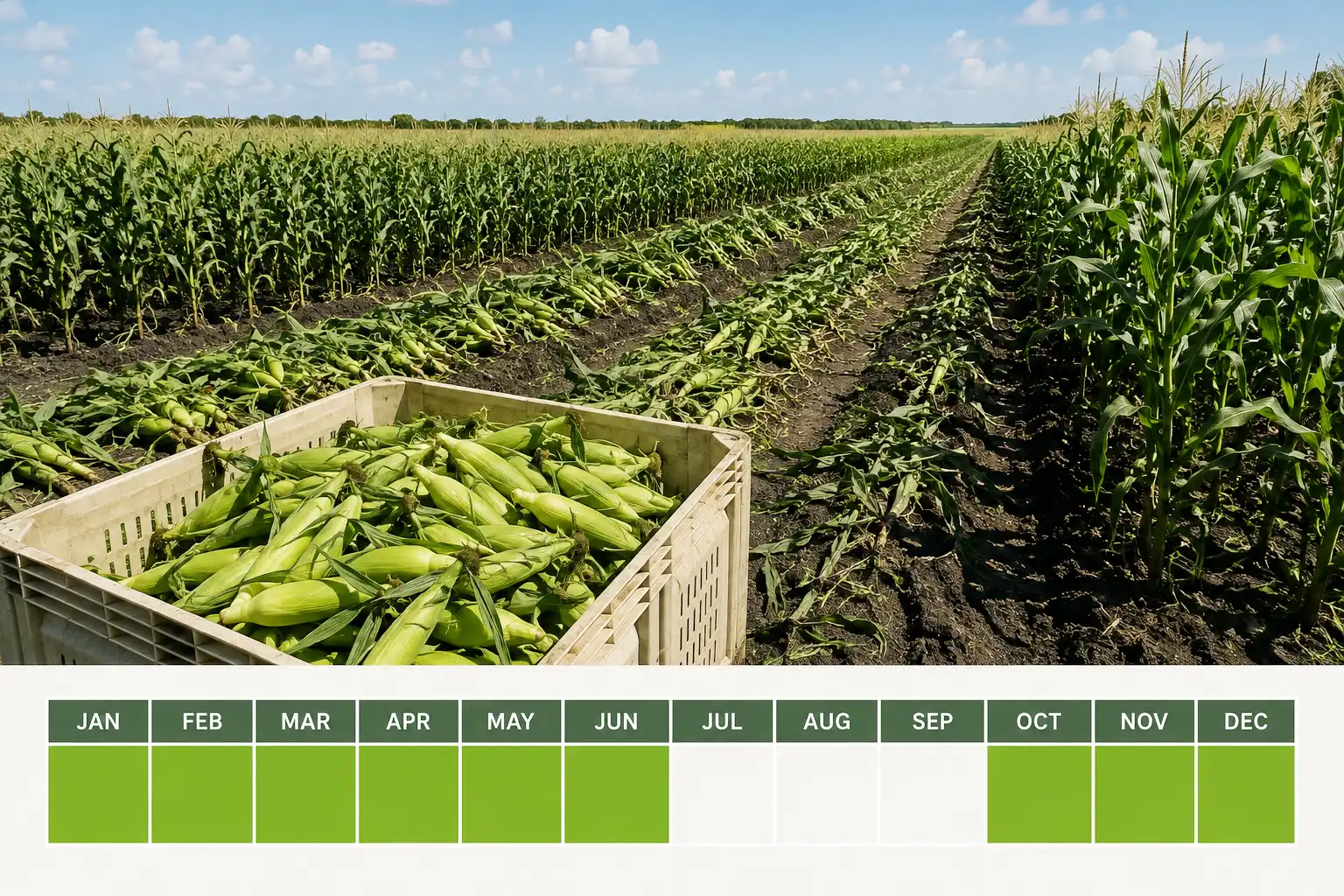
Corn is in season in Florida from October through June. South Florida carries the fall and winter market. Central and north Florida add volume from March into June. Fields rest July through September, when Georgia supplies the East Coast.
When Is Corn in Season in Florida by Month
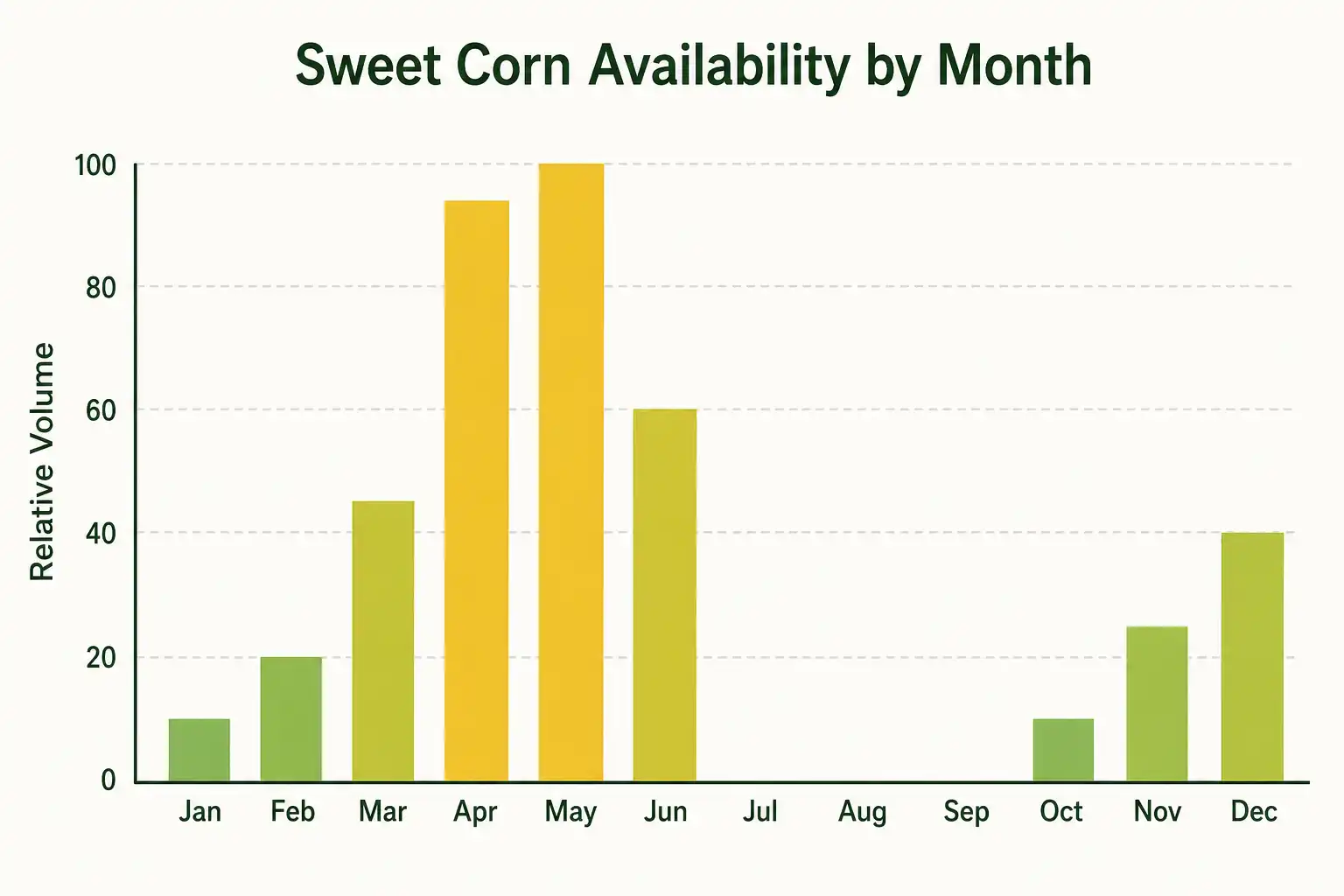
Florida sweet corn reaches stores from October through June. The Florida Department of Agriculture and Consumer Services and UF/IFAS Extension both give that nine month window. Volume stays thin at the two edges. Spring carries the bulk.
| Month | What happens in the fields | Region driving supply | Volume |
|---|---|---|---|
| October | First ears come off early south Florida plantings | South | Light |
| November | The East Coast fresh market shifts to Florida | South | Building |
| December | Steady cutting across the Everglades Agricultural Area | South | Moderate |
| January | Miami-Dade harvest opens | South | Moderate |
| February | Winter plantings mature on schedule | South | Moderate |
| March | Central Florida fields join in | South and central | Heavy |
| April | All three regions overlap | Statewide | Peak |
| May | Last big south Florida cuttings, north Florida starts | Statewide | Peak |
| June | Tail end from central and north Florida | Central and north | Falling |
| July to September | Fields rest | None | None |
According to UF/IFAS Extension, Florida is the main fresh market supplier for the East Coast from November through May. That leaves October and June as real but light months. West Coast shoppers see a different pattern. California ships on its own schedule, so the California corn season barely overlaps with Florida’s.
Which Regions Set the Florida Corn Calendar
Three regions split the season, and each one plants on a different schedule. UF/IFAS Extension publishes the commercial windows in Chapter 17 of the Vegetable Production Handbook of Florida.
| Region | UF/IFAS planting window | Resulting harvest window |
|---|---|---|
| South Florida | September to March | November to June |
| Central Florida | January to April | April to July |
| North Florida | February to April | May to July |
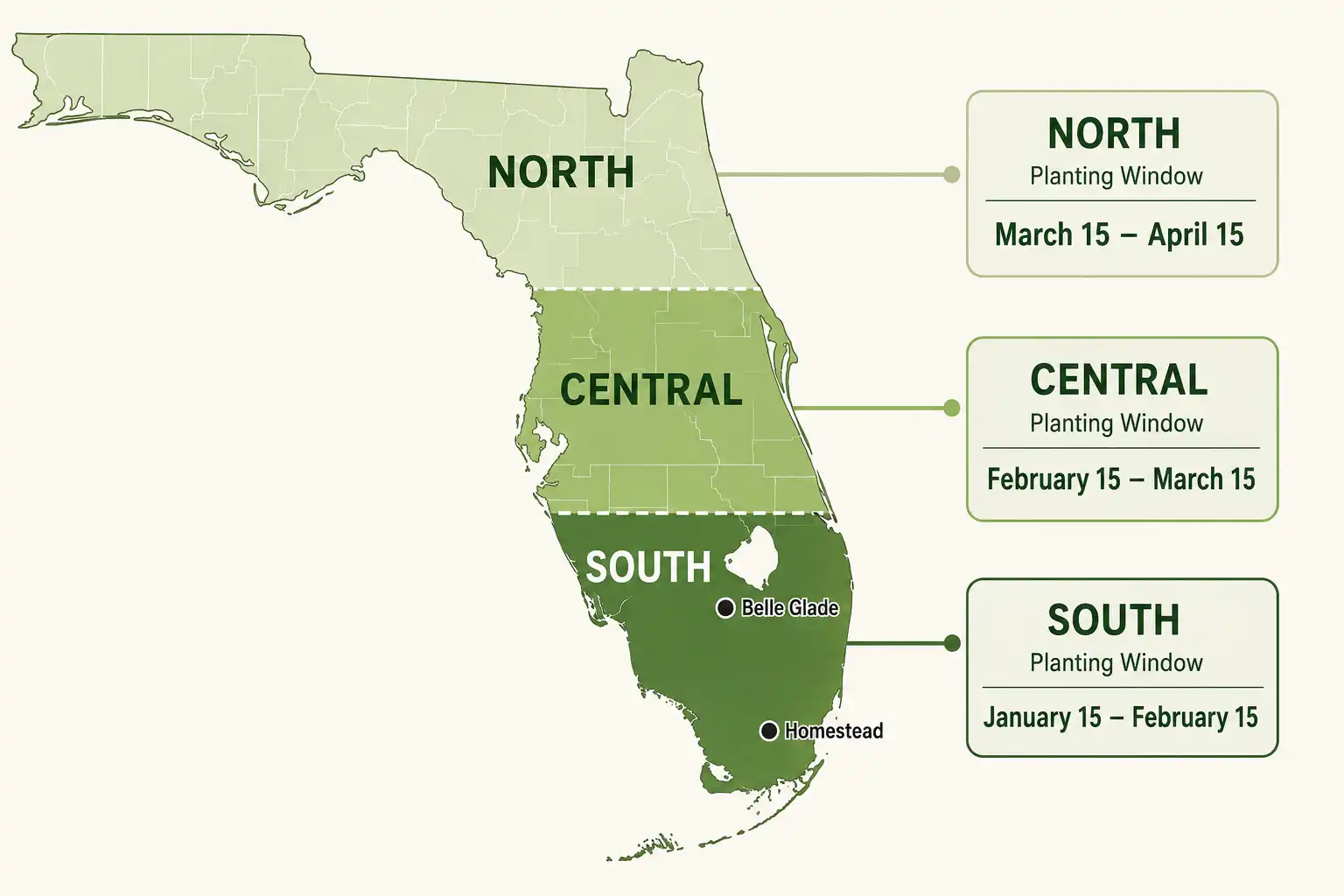
The harvest column is arithmetic, not a published figure. It adds the 64 to 90 day maturity range from the same handbook to each planting window.
South Florida
South Florida runs the longest window and the most acres. The 2022 USDA Census of Agriculture put Palm Beach County at 36,429 acres of sweet corn. That is 63.5 percent of the state total. Most of that ground sits in the Everglades Agricultural Area around Belle Glade. Deep muck soils there hold water well through the dry season.
Miami-Dade County works a tighter schedule. UF/IFAS Extension reports planting there from early October into January, with harvest from January through April. Growers use gravelly and marl soils, plus sandy ground west of Kendall. Primetime, Summersweet 9730, and Sunvolt are the main cultivars.
Central Florida
Central Florida plants January through April. Its ears land after the south Florida spring rush is already underway. UF/IFAS Extension in Hillsborough County lists 60 to 95 days to harvest for home plantings there. So a January seeding and an April seeding both reach the market inside one season.
North Florida
North Florida plants latest, from February through April. Spring warms later in the Panhandle and along the Georgia line, so harvest lands in May and June. The UF/IFAS Baker County spring guide lists 80 to 100 days to harvest there. That runs longer than the state range, because early plantings sit in cooler soil.
Why Florida Corn Stops for the Summer
Heat and rain end the season, not a drop in demand. UF/IFAS Extension reports that rising heat and rainfall cut profitability from late May into late July. Georgia then takes over East Coast supply.
The yield penalty is measurable. USDA ARS research published in 2022 found a clear temperature ceiling. Growing season temperatures above 86 degrees Fahrenheit hurt sweet corn yield. Each extra degree day above that mark during flowering cut yields 0.5 percent in irrigated fields. Rainfed fields lost 2 percent.
Summer also stacks up pest pressure. UF/IFAS Extension lists fall armyworm, corn earworm, corn silk flies, and chinch bugs as pests to manage. Warm wet weather favors all of them.
How Long Florida Sweet Corn Takes From Seed to Harvest
Florida sweet corn takes 64 to 90 days from seed to harvest, according to UF/IFAS Extension. Cultivar choice drives most of that spread. Soil temperature drives the rest.
The same handbook gives the commercial planting numbers.
- Seeding depth: 1.0 to 1.5 inches
- Row spacing: 28 to 36 inches
- Plant spacing in the row: 6 to 8 inches
- Seed: 6 to 15 pounds per acre
- Plant population: 24,000 to 32,000 plants per acre
Because the window is short, growers watch the ears rather than the calendar. The same checks work in a backyard plot. Knowing when sweet corn is ready beats the day count on the seed packet.
How to Spot Peak Season Florida Corn at the Store
Five checks separate fresh ears from tired ones. Work through them in order.
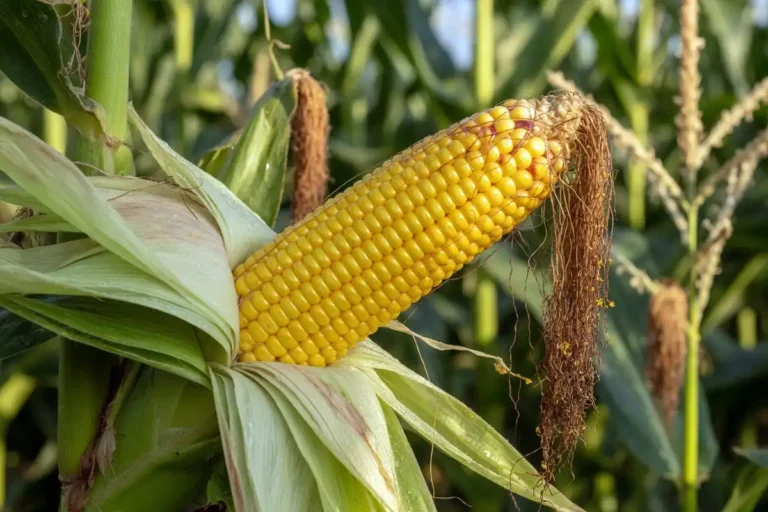
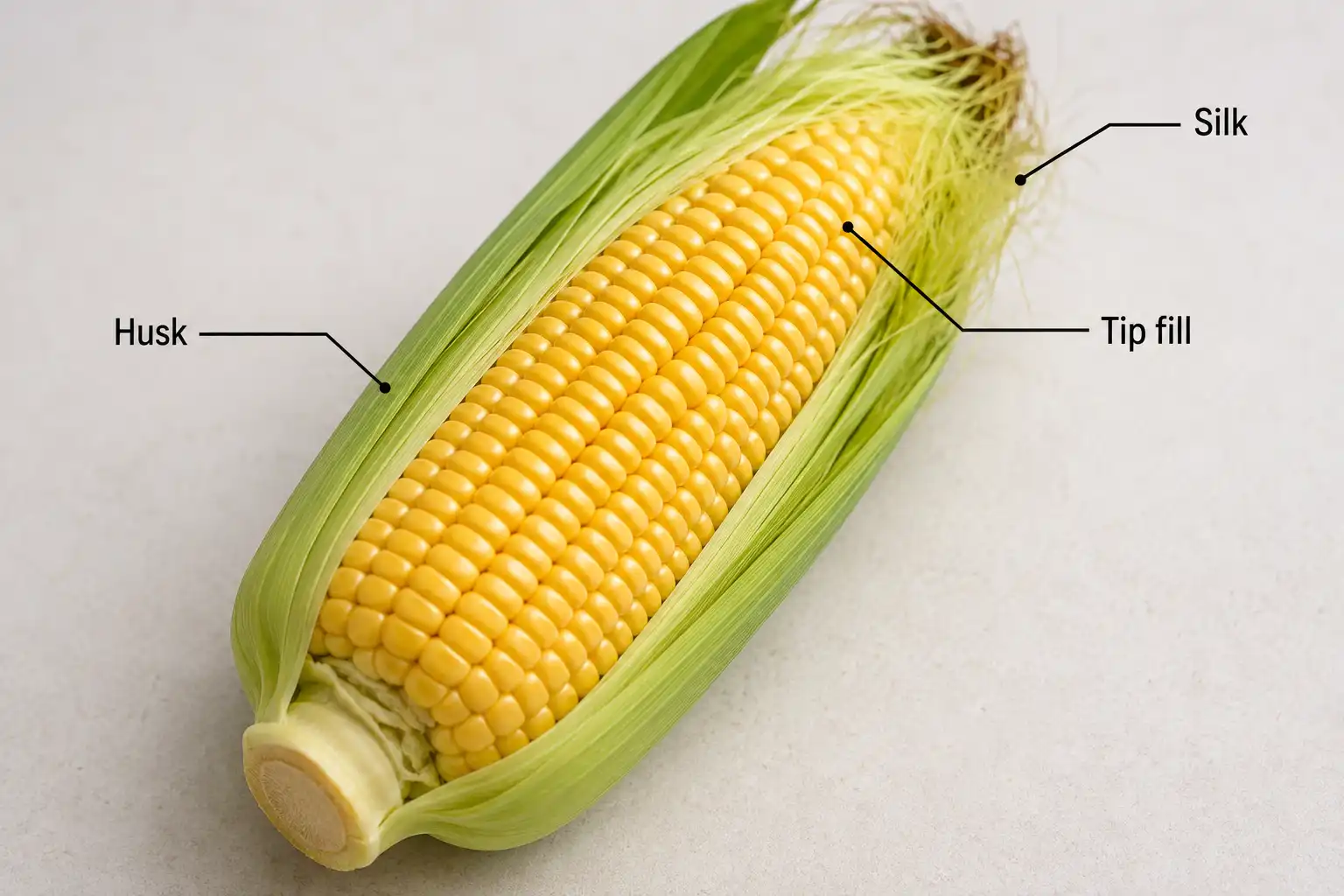
- Husks tight and bright green, with no yellow or dry edges
- Silk moist and golden at the tip, never brown and brittle
- Kernels plump to the tip when you feel through the husk
- Stem end freshly cut and pale, not dried and gray
- Clean sweet smell, with no sour or fermented note
Genetics matter as much as freshness. UF/IFAS Extension groups sweet corn by the genes that control sweetness. Those genes also set how long an ear holds quality.
| Sweet corn type | Sweetness genes | Storage life |
|---|---|---|
| Sugary (su) | Full sugary | 1 to 3 days |
| Sugary enhanced (se) | Sugary plus sugary enhancer | 3 to 5 days |
| Synergistic | Sugary plus half shrunken-2 | 3 to 5 days |
| Supersweet (sh2) | Full shrunken-2, no sugary | 5 to 10 days |
| Improved supersweet | Half sugary plus full shrunken-2 | 5 to 10 days |
Nearly all shipped Florida corn is a shrunken-2 supersweet type. UF/IFAS Extension lists Primetime and Seminole Gold among the yellow supersweets. Obsession and Seminole Sweet lead the bicolors, and Coronado is a common white. So an ear bought in March can still taste sweet after several days in transit.
How to Keep Florida Sweet Corn Sweet at Home
Cold is the only thing that slows sugar loss. Oregon State University Extension puts numbers on it. At 85 degrees Fahrenheit, up to 60 percent of the sugars can turn to starch in a single day. At 32 degrees, the figure drops to 6 percent. Loss also runs about four times as fast at 50 degrees as at 32 degrees.
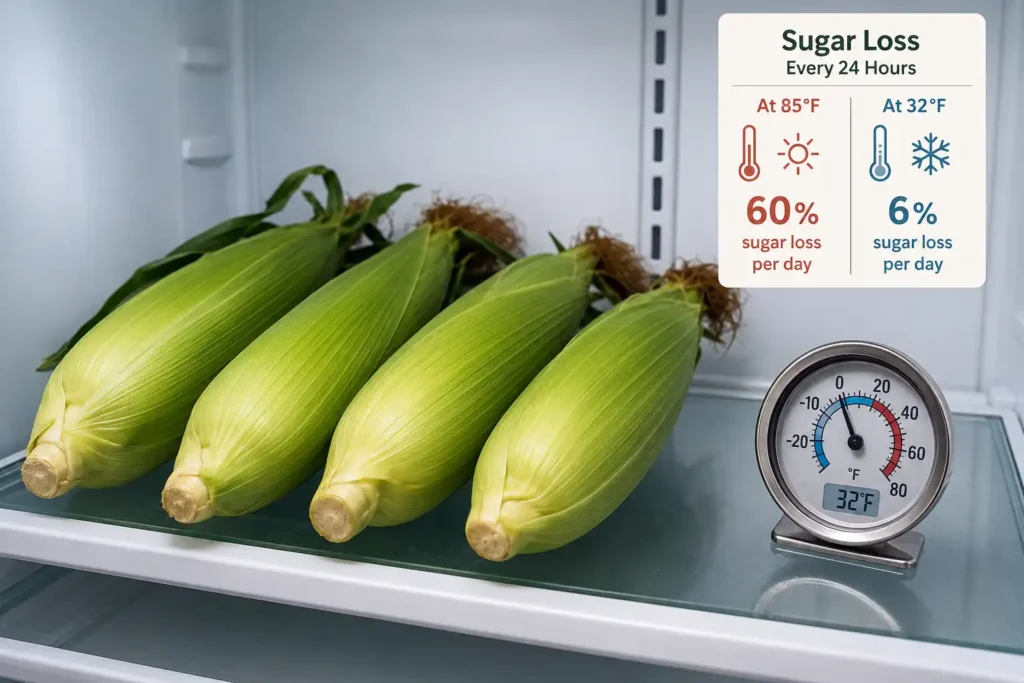
Practical handling follows from those numbers.
- Refrigerate within the hour, at 32 to 34 degrees Fahrenheit
- Leave the husks on, since they slow moisture loss and kernel denting
- Keep humidity high, near 95 to 98 percent, which package ice helps with
- Plan to eat or freeze within a few days rather than a week
NC State Extension notes a hard limit. Even under good conditions, sweet corn holds quality for only 5 to 8 days. After that, freezing beats waiting. The National Center for Home Food Preservation calls for a 4 minute water blanch on whole kernel corn. Cut the kernels afterward at about two thirds of their depth. Ears frozen on the cob need longer. Blanch small ears 7 minutes, medium ears 9 minutes, and large ears 11 minutes. Pressure canning sweet corn is the other route for a big haul. The same rules for cooling produce after harvest apply to any crop that loses sugar fast.
When Florida Home Gardeners Should Plant Sweet Corn
Match the commercial window for your region and the timing takes care of itself. UF/IFAS Extension puts north Florida at February through April. Central Florida runs January through April, and south Florida runs September through March. Working backward from those dates, a March seeding in central Florida ripens around mid June.
Scout the whorl for fall armyworm from the fourth leaf stage onward. UF/IFAS Extension flags it as a primary caterpillar pest on Florida sweet corn. Block planting also matters more than most gardeners expect, because sweet corn is wind pollinated and short rows fill poorly. For the full picture on soil, spacing, and cultivar choice, see the guide on growing corn in Florida.
FAQs About Florida Corn Season
Is Florida sweet corn available all year?
What months bring the most Florida sweet corn?
Does Florida grow field corn as well?
How can you tell store corn came from Florida?
Why does shipped Florida corn still taste sweet?
What to Watch on the Florida Corn Calendar
Buy Florida sweet corn between October and June. Aim for April and May, when all three regions ship at once. Check husk, silk, and kernel fill before you trust the label. Then chill the ears fast, because sugar loss starts the moment they leave the field. Growers should plant to their own region’s window rather than the statewide range.