How Much Potassium Does Corn Require Per Acre? (2026 Guide)
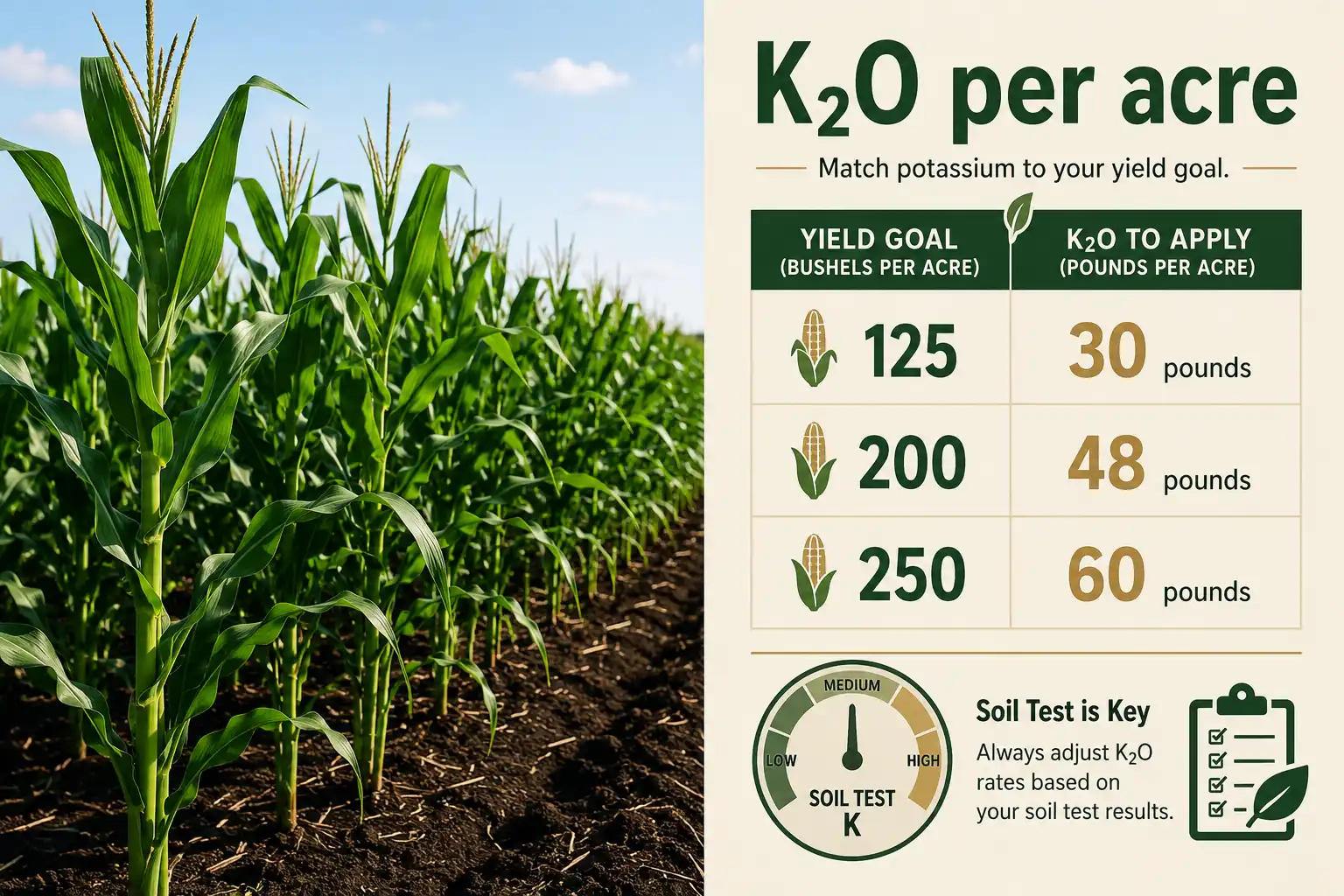
Potassium drives grain fill and stalk strength in corn, yet many farmers underapply it. How much potassium does corn require per acre comes down to two numbers: what the grain removes and what your soil already supplies.
Corn requires roughly 40 to 55 lb of potassium (K2O) per acre for a 200-bushel crop, based on grain removal of about 0.20 to 0.27 lb K2O per bushel. Your soil test K level sets the exact rate.
How Much Potassium Does Corn Require Per Acre?
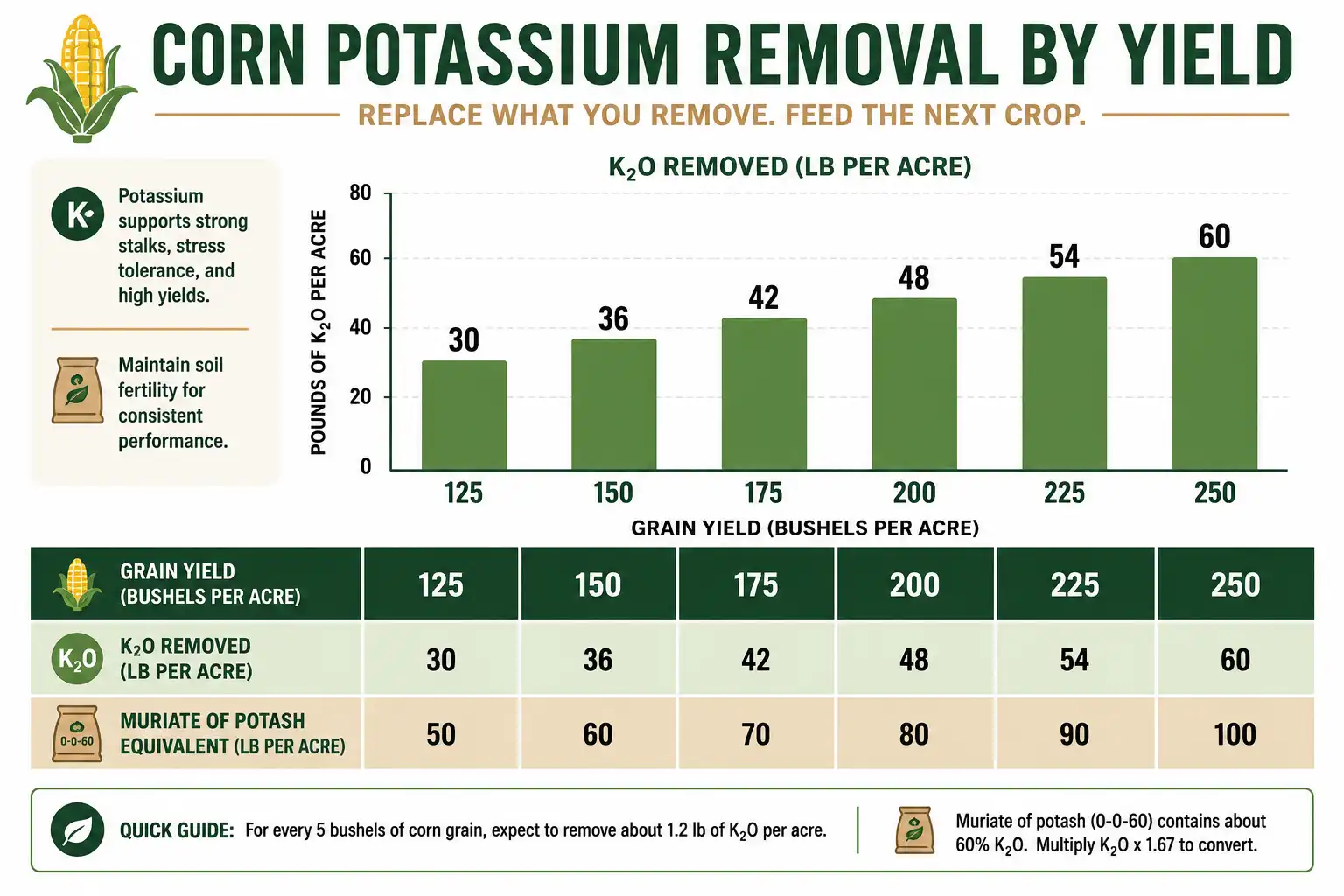
Corn removes about 0.20 to 0.27 lb of K2O per bushel of grain. On these fields, 0.24 lb per bushel is used as a working figure. That puts a 200-bushel crop near 48 lb of K2O per acre leaving the field in the grain.
The word “require” trips up a lot of growers, though. Corn takes up far more potassium than it removes. A high-yielding crop can pull 150 to 200 lb of K2O per acre into the whole plant during the season. Most of that stays in the leaves and stalks. When you harvest grain only, the stover breaks down and returns its potassium to the soil.
So the number that matters for your fertilizer bill is grain removal, not total uptake. Match your rate to corn yields per acre, then adjust for what your soil already holds.
| Grain yield (bu/acre) | K2O removed (lb/acre) | Muriate of potash (0-0-60) equivalent |
|---|---|---|
| 125 | 30 | 50 lb |
| 150 | 36 | 60 lb |
| 175 | 42 | 70 lb |
| 200 | 48 | 80 lb |
| 225 | 54 | 90 lb |
| 250 | 60 | 100 lb |
Values use 0.24 lb K2O per bushel. At the low end (0.20) subtract about 15 percent. At the high end (0.27) add about 12 percent.
Also know: How Much Nitrogen Does Corn Need Per Acre (2026 Rate Guide)
How Does Your Soil Test Change the Potassium Rate?
Your soil test decides whether you build, maintain, or cut back. Removal tells you the baseline. The soil test tells you whether the bank account is full or empty.
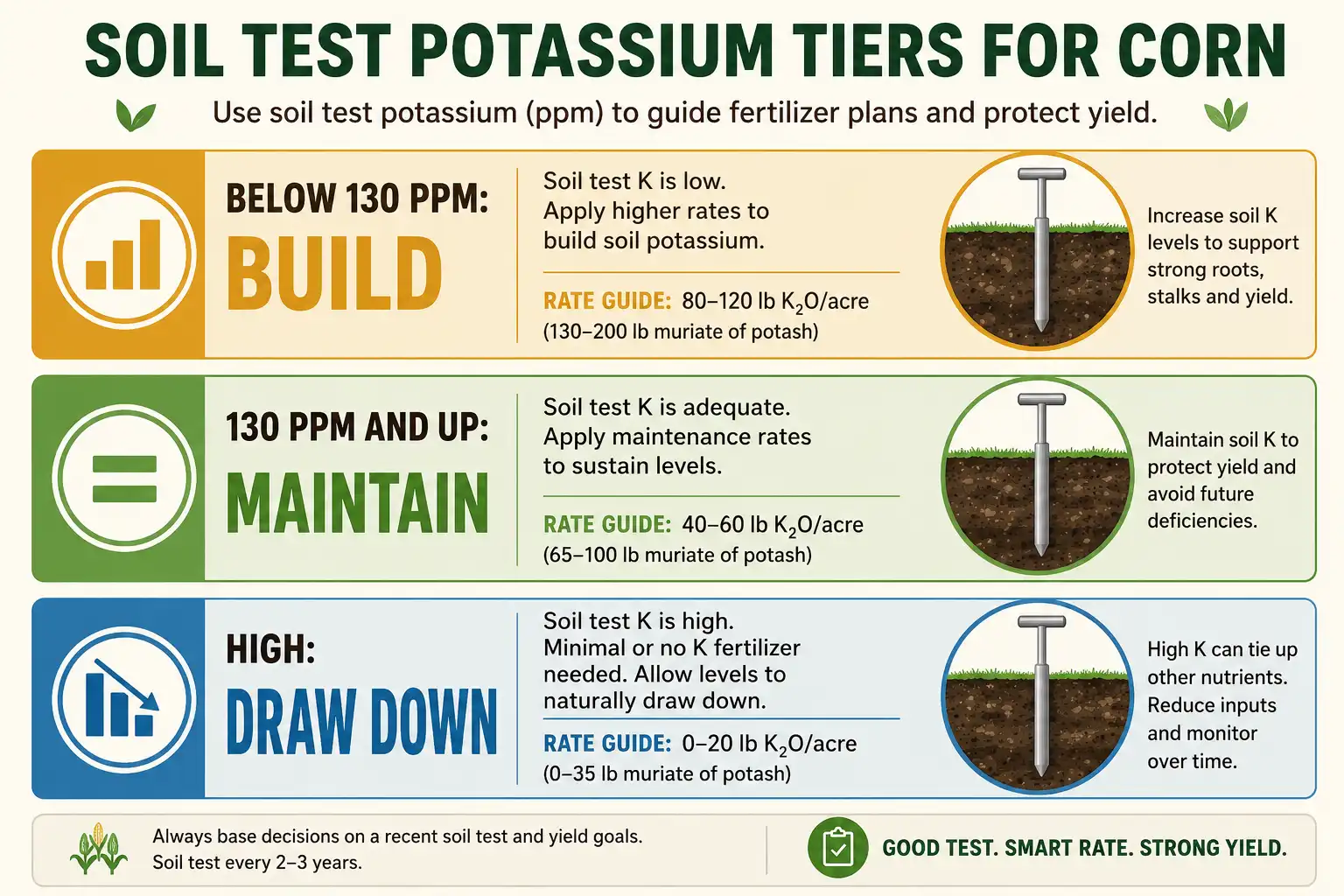
In Kansas, K-State Research and Extension uses about 130 ppm of exchangeable potassium as the line. Below 130 ppm, corn often responds to added K, so you feed removal plus extra to build the level. Above 130 ppm, the soil supplies most of the crop’s need, and a starter dose covers the rest. Other states set the bar a little differently. The Tri-State recommendations (Ohio, Indiana, Michigan) use a 120 ppm critical level with a 170 ppm maintenance limit. Missouri targets 280 lb per acre, near 140 ppm.
Three tiers guide the rate:
- Below critical (build): apply grain removal plus enough to raise the test. It takes roughly 4 lb of K2O to lift the soil test 1 lb per acre.
- Maintenance range: apply what the crop removes, plus about 20 lb of K2O to cover fixation and leaching losses.
- Above the maintenance limit (drawdown): apply part of removal or none, and let the soil test drift down.
Everything starts with a current number. Pull regular soil testing every two to three years. For fields being built up, it helps to use a good soil test kit or a full lab panel. If your report reads in lb per acre, divide by 2 to get ppm at an 8-inch sampling depth. Guessing here wastes money in both directions.
Read more: What Is the Average Corn Yield Per Acre in Nebraska? (2026 Data)
How Much Potassium Does Corn Silage Remove Per Acre?
Corn silage removes far more potassium than grain, because you haul off the whole plant. K-State figures about 8.7 lb of K2O per ton of silage. A 20-ton crop carries away roughly 174 lb of K2O per acre. That is three to four times the grain-only removal on the same field.
Silage ground drops in soil test potassium fast. If you cut silage year after year, plan to replace that potassium or watch stalk quality slide. Base the rate on your corn silage tonnage, not a grain estimate, or you will fall behind.
When and How Should You Apply Potassium to Corn?
Apply potassium before or at planting, since corn takes up most of its K between the V6 stage and silking. Uptake ramps up fast about four to six weeks after emergence, then finishes soon after tasseling. The soil needs the potassium in place before that surge.
Timing is flexible on soils that hold potassium well. Fall or spring broadcast both work on medium and heavy Kansas soils, because K binds to clay and stays put. Sandy, low-CEC (cation exchange capacity) ground is different. There, spring application and banding cut leaching risk.
Placement matters most when the soil test sits near the critical level. A band of potash near the row feeds the crop more efficiently than a broadcast pass. No-till and strip-till fields benefit from banding too, since surface-applied K can stratify in the top inch. If you run a starter, you can fold potassium into a 19-19-19 fertilizer program or a similar blend, as long as you respect seed-safety limits on N plus K2O in direct seed contact.
What Are the Best Potassium Sources for Corn?
Muriate of potash (0-0-60) is the standard potassium source for corn. It carries 60 percent K2O, costs less per unit than any other option, and spreads easily. The chloride it contains is a plant micronutrient, and corn handles it without trouble. That is why most Corn Belt and Great Plains growers reach for it.
Sulfate of potash (0-0-50) is the chloride-free option. It adds sulfur, which helps on sandy, low-sulfur ground, but it runs 40 to 50 percent more per unit of K. Corn rarely needs it. Potassium-magnesium sulfate (0-0-22) is worth a look when your soil is short on magnesium and sulfur too.
To turn a recommendation into product, divide the K2O rate by the analysis. A 48 lb K2O rate needs about 80 lb of muriate of potash (48 divided by 0.60). Manure and compost also supply potassium, so if you run livestock, credit those pounds first. Our rundown on organic and chemical fertilizer sources covers how to balance the two.
How Do You Spot Potassium Deficiency in Corn?
Potassium deficiency shows as yellowing and scorching along the outer edges of the lower leaves. The firing starts at the leaf tip and runs down the margin toward the base, while the midrib stays green. Because potassium is mobile, the plant robs older leaves to feed new growth, so the bottom of the plant fires first.
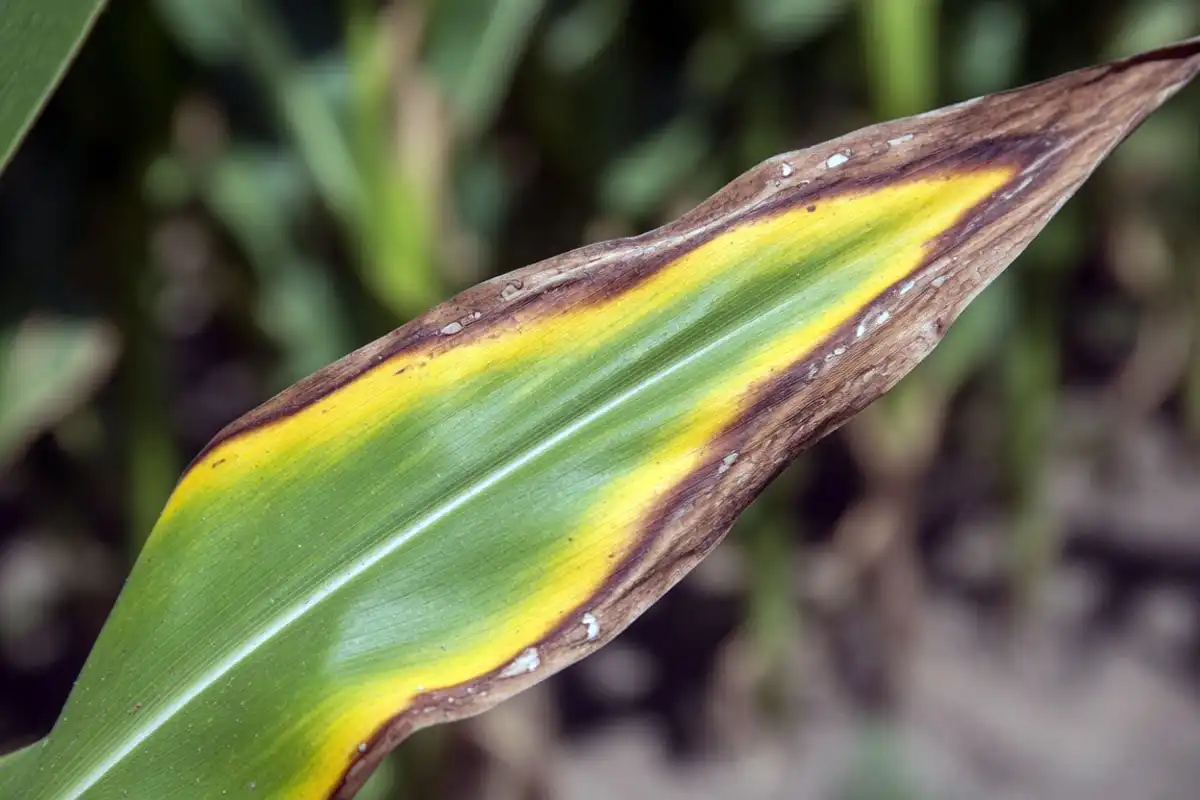
Do not confuse it with nitrogen deficiency. Nitrogen yellows down the midrib in a V shape from the tip. Potassium hits the leaf margins instead. Symptoms usually appear around V6 to V8, once demand climbs.
Dry weather can fake a shortage. Potassium moves to the roots by diffusion, so a dry topsoil slows uptake even when the soil test reads fine. Those plants often green up after a rain. A true deficiency, though, keeps spreading up the plant and leads to weak stalks and lodging by fall. When leaf symptoms and a low soil test line up, the field needs potassium, not patience.
Setting Your Corn Potassium Rate This Season
Start with your soil test, not a bag rate. If potassium reads below 130 ppm, feed removal plus a build increment. If it reads high, a starter band usually covers a grain crop. Silage ground always needs more, because the whole plant leaves the field. Match the pounds to your yield, pick the cheapest form your crop tolerates, and get it on before the V6 surge. Do that, and potassium stops being the weak link in your corn.