How Much Corn Can You Grow Per Acre? (2026 Yield Guide)
Corn yield swings hard from field to field. Soil, water, and hybrid all move the number. The honest answer to how much corn you can grow per acre starts with your water. This guide covers 2026 benchmarks, dryland and irrigated ranges, and how to estimate your crop.
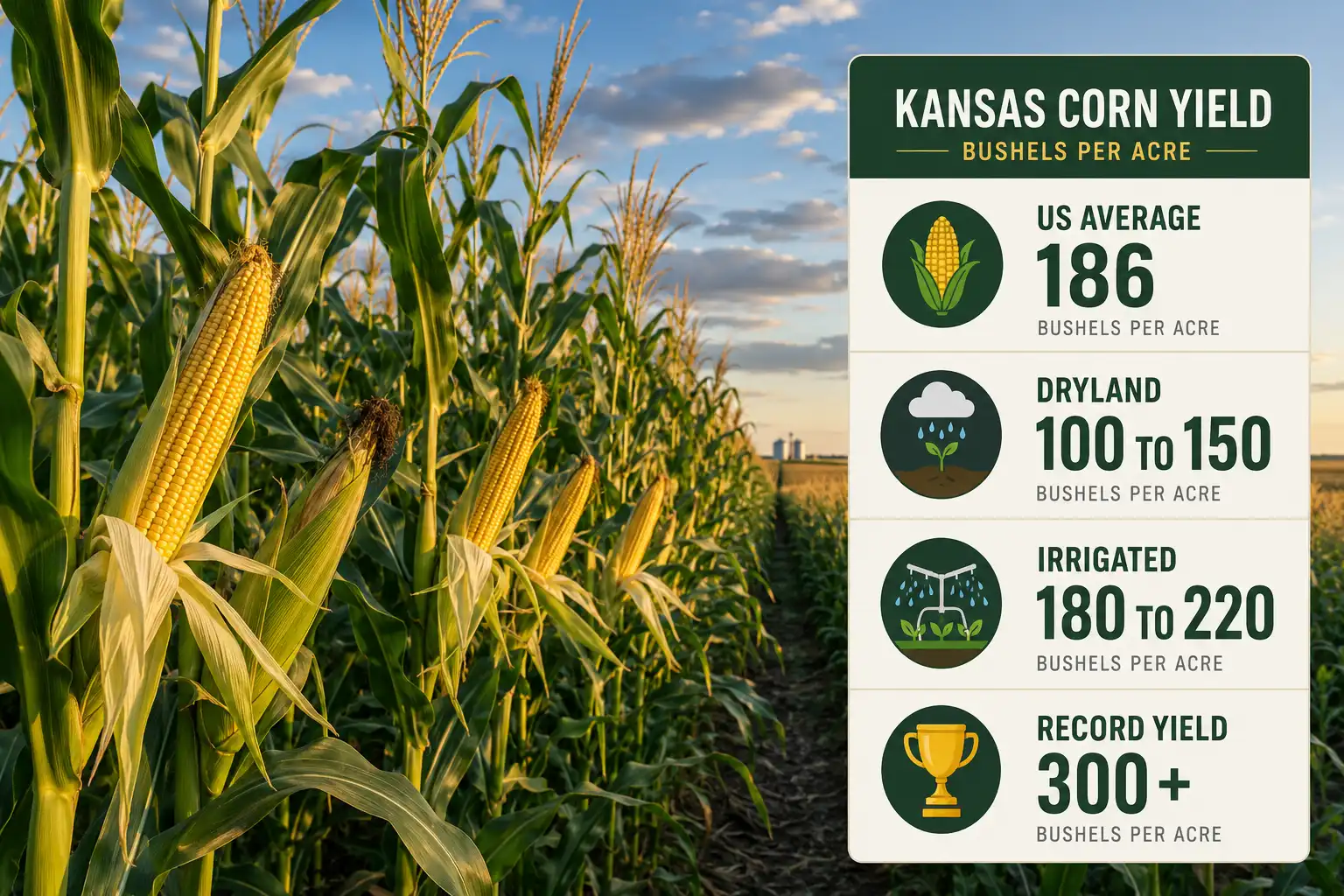
Corn yields run 150 to 200 bushels per acre on most US ground. In 2025, the national average set a record 186.5 bushels. How much corn you can grow per acre depends mostly on your water, hybrid, and stand.
How Much Corn Can You Grow Per Acre?
Most US corn grows between 150 and 200 bushels per acre. In 2025, the national average reached a record 186.5 bushels per acre, according to USDA NASS. That beat the 179.3 average from 2024. That figure blends every acre, from irrigated ground in Nebraska to dryland fields in Kansas.
Averages hide a wide spread, though. One farm can range from 90 bushels on a droughty hillside to 240 on deep bottom ground. So the real answer depends on your soil, your rainfall, and your management.
Here is the rough picture across the country:
- Below-average ground: under 130 bushels per acre
- Typical fields: 150 to 190 bushels per acre
- Strong irrigated or Corn Belt fields: 200 to 240 bushels per acre
- Contest and record fields: 300 bushels and up
Shelled corn weighs 56 pounds per bushel at 15.5% moisture. That standard for what a bushel of corn weighs sits behind every yield number you read.
What Yield Should You Expect From Dryland vs Irrigated Corn?
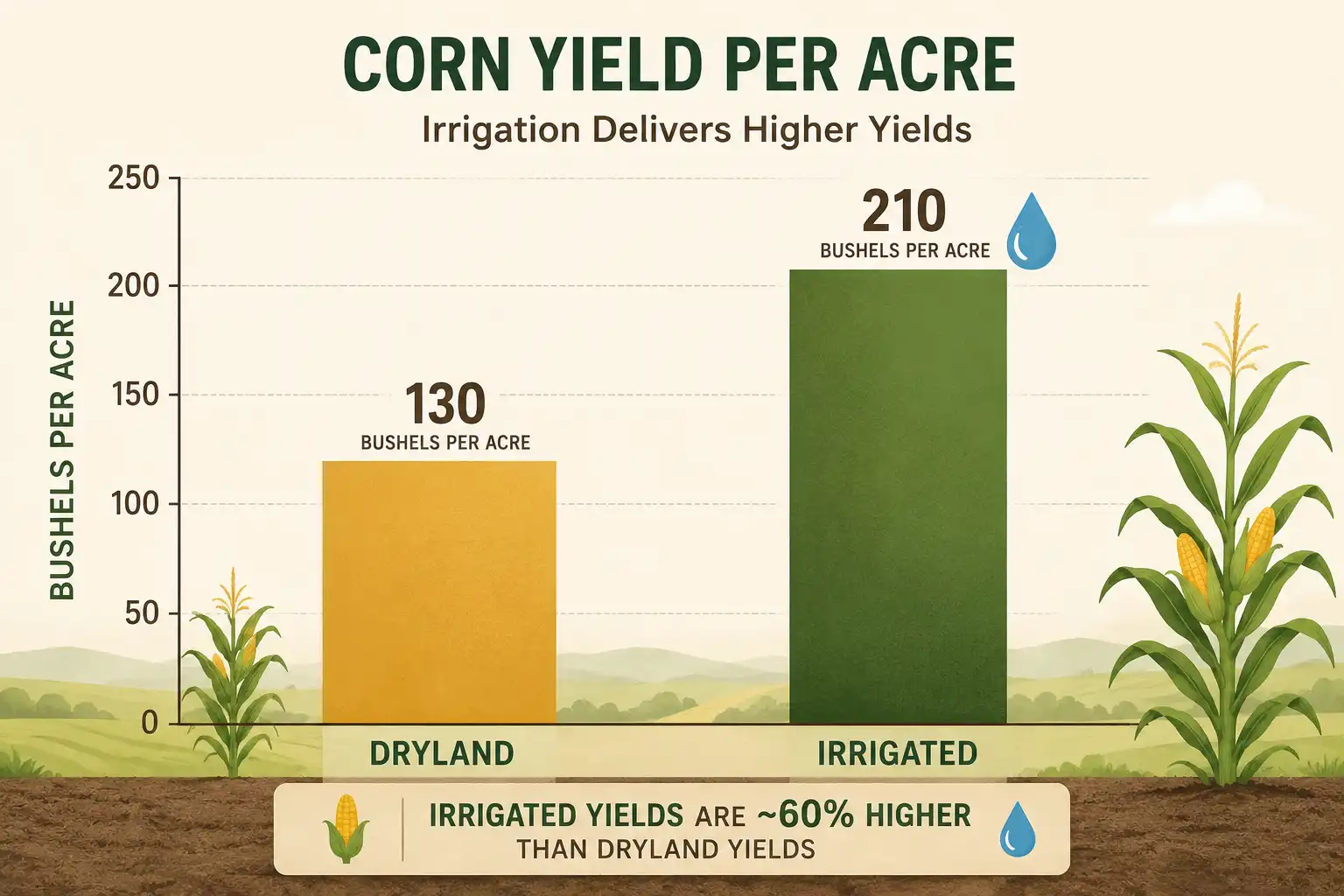
Irrigated corn usually yields 60 to 120 bushels per acre more than dryland corn. Dryland corn runs 100 to 150 bushels in a normal year. Irrigated fields in the same county push 180 to 220 bushels, because water never runs short at pollination.
K-State Research and Extension sorts Kansas corn into four productivity tiers:
- Low: under 100 bushels per acre
- Medium: 100 to 150 bushels per acre
- High: 150 to 180 bushels per acre
- Very high: 190 to 210 bushels per acre
Rainfall decides which tier you land in. Corn in Kansas uses about 23 inches of water across the season. Miss that mark during July, and yield falls fast. This is why farmers say rain makes grain. In 2025, drought finally eased across the Great Plains, and Kansas set a state-record corn crop as a result.
How Do You Estimate Corn Yield Before Harvest?
You estimate corn yield by counting ears and kernels, then dividing by a kernel-weight factor. The Yield Component Method works from the milk stage (R3) onward. It gets you within about 20 bushels of your final number.
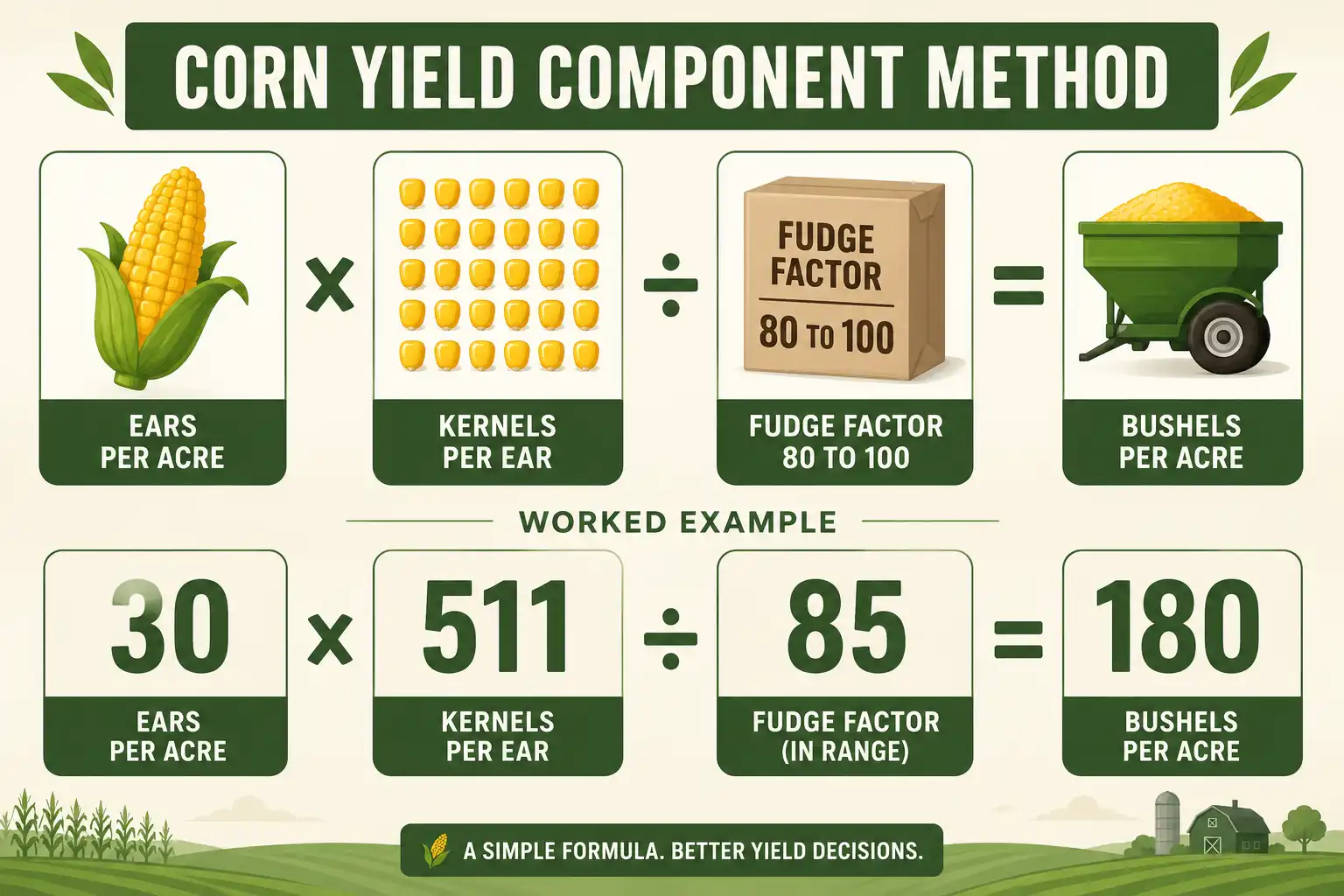
Here is the method, straight from university agronomists:
- Mark off 1/1,000 of an acre. In 30-inch rows, that is 17 feet 5 inches of row. In 20-inch rows, use 26 feet 2 inches.
- Count every harvestable ear in that length. Skip the nubbins.
- Pick every fifth ear. Count the kernel rows, then the kernels per row. Multiply the two for kernels per ear.
- Average the kernels per ear across your sampled ears.
- Multiply ears by average kernels per ear. Then divide by a fudge factor.
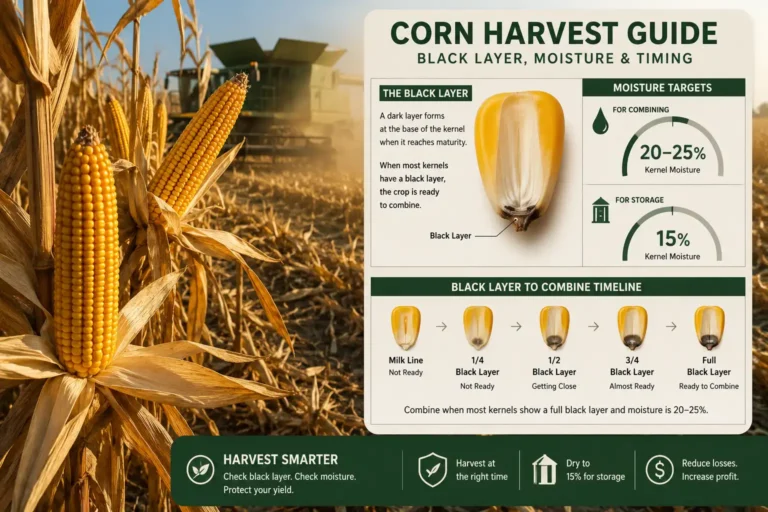
The fudge factor stands in for kernel weight. You cannot measure that until black layer. Use 80 for excellent grain fill, 90 for average, and 100 for stressed, small kernels. Many agronomists now use 75, 85, and 95 for modern hybrids.
Here is a worked example. Say you count 30 ears and average 511 kernels per ear:
- 30 x 511 = 15,330
- 15,330 divided by 85 = 180 bushels per acre
Sample at least five spots in the field. The more uniform your stand, the fewer checks you need. Your ear count ties back to ears each stalk carries, and your kernel math depends on kernels on a full cob.
What Determines How Much Corn You Grow Per Acre?
Water, plant population, hybrid, and fertility determine most of your corn yield. Weather at pollination sets the ceiling, and everything else fine-tunes the result. Here are the levers that move your bushels the most.
Water and Rainfall
Water is the single biggest driver of corn yield in most fields. Corn needs the most moisture from tasseling through grain fill. A dry spell during silking can cut yield 40 to 60 bushels per acre in a matter of days. Dryland growers plant for the rain they expect, while irrigated growers remove that limit.
Plant Population
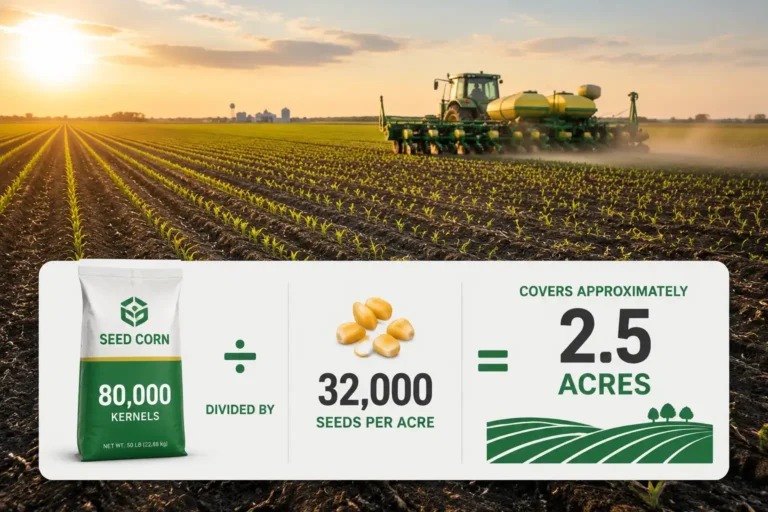
Plant population sets how many ears you harvest per acre. Irrigated corn often runs 30,000 to 36,000 plants per acre. Dryland corn in dry country drops to 16,000 to 24,000, so plants do not fight over limited water. Match the seeding rate for corn to your soil and moisture, not to your neighbor’s.
Hybrid and Maturity
Your hybrid sets the genetic yield potential and the heat units it needs. Full-season hybrids catch more sunlight and yield more, if your frost-free window allows. So farmers match hybrid maturity to local growing degree units. Pick a number too long for your area, and the crop will not finish before frost.
Soil Fertility and Nitrogen
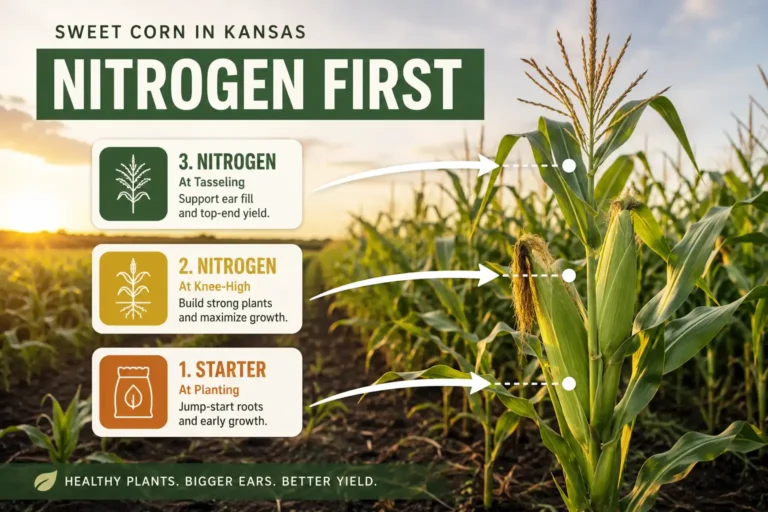
Nitrogen drives corn yield more than any other nutrient. Corn takes up half or more of its nitrogen in June and July. A soil test tells you what to add, so you do not overspend or come up short. Getting your corn fertilizer rate right protects both yield and your budget.
Pests, Disease, and Late-Season Stress
Stalk rots and mites quietly shave yield every year. Fusarium stalk rot is the most common problem in Kansas, and it hits hardest in hot, dry stretches. Spider mites feed during drought and cost you kernels. So scout often, because early action beats a rescue spray.
What Are the Highest Corn Yields on Record?
The all-time contest record now stands above 620 bushels per acre. Virginia farmer David Hula set that mark in 2023. He won the 2025 National Corn Growers Association contest with 572 bushels per acre. Those yields come from perfect soil, full irrigation, and intense management. Most farmers will never chase those numbers, and they do not need to.
The irrigated winner in Haskell County hit 349 bushels per acre. The dryland winner in Pottawatomie County reached 320 bushels per acre. Statewide, contest entries averaged about 252 bushels per acre.
These fields prove what corn can do with ideal conditions. They also show the gap between a state average near 130 and a contest yield above 300. That gap is water, genetics, and day-to-day decisions stacked up over a season.
How Can You Raise Corn Yield on Your Own Ground?
You raise corn yield by fixing your weakest limiting factor first. On dryland ground, that is almost always water, so moisture-saving practices are the focus. On better ground, fertility and stand quality matter more.
Here is where the effort should go:
- Plant on time to use the full season and cooler pollination weather.
- Set a plant population that matches your rainfall or irrigation.
- Test soil and feed nitrogen to the crop’s real need.
- Pick a hybrid proven in your area, not just a flashy yield number.
- Scout for stalk rot and mites before they cost you kernels.
None of these are secrets. The same steps that raise crop yield apply to corn, soybeans, and wheat alike. Small gains stack up. Two more bushels here and five there add real money by harvest.
Bottom Lines
On dryland fields, the target is 130 to 160 bushels per acre. Anything higher is a good year. Your target depends on your water, soil, and season. Use the Yield Component Method to check fields in late summer. Then compare that to your county average, and you will know if the crop is doing its job. Corn rewards steady management more than any single trick.