How Much 19-19-19 Fertilizer per Acre for Corn: The Rate Math
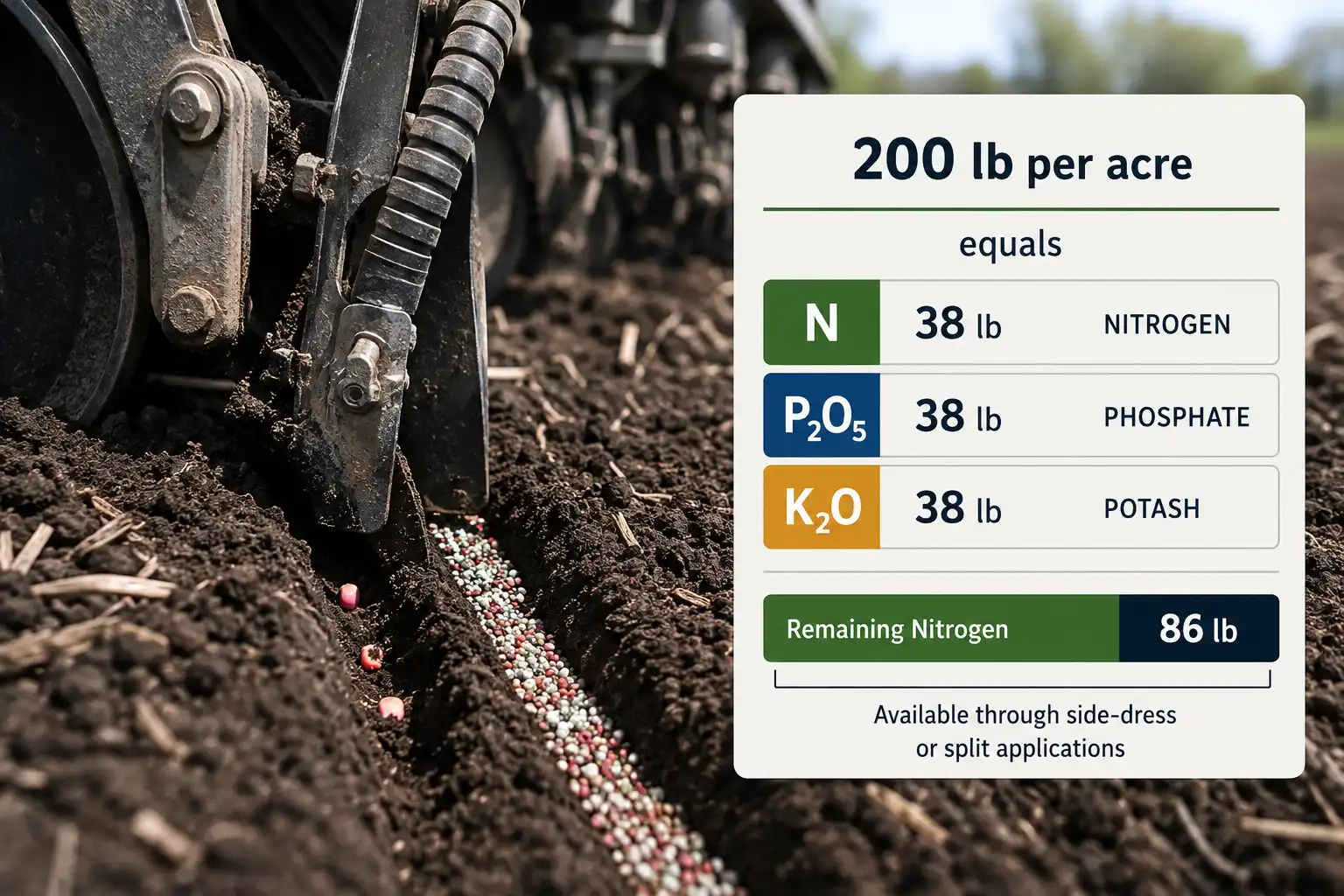
Triple 19 spreads easily and gets over-bought just as easily. A wrong rate wastes phosphate and potash and still leaves corn short on nitrogen. So how much 19-19-19 fertilizer per acre for corn depends on placement, soil test level, and your nitrogen plan.
Band 105 to 210 pounds of 19-19-19 fertilizer per acre for corn as a starter. Or broadcast 200 to 320 pounds where soil test P and K need maintenance. Then add 80 to 140 pounds of separate nitrogen.
What Is 19-19-19 Fertilizer?
19-19-19 is a balanced granular blend that contains 19% nitrogen, 19% phosphate (P2O5), and 19% potash (K2O). Farmers also call it triple-19. Every 100 pounds of product delivers 19 pounds of each nutrient, which keeps the math easy on the back of a notebook.
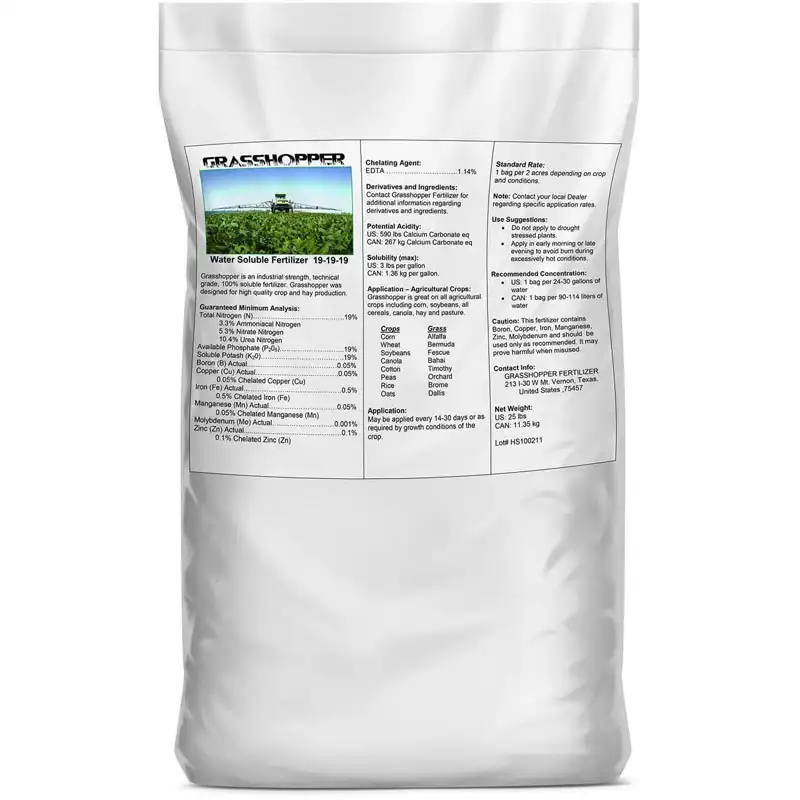
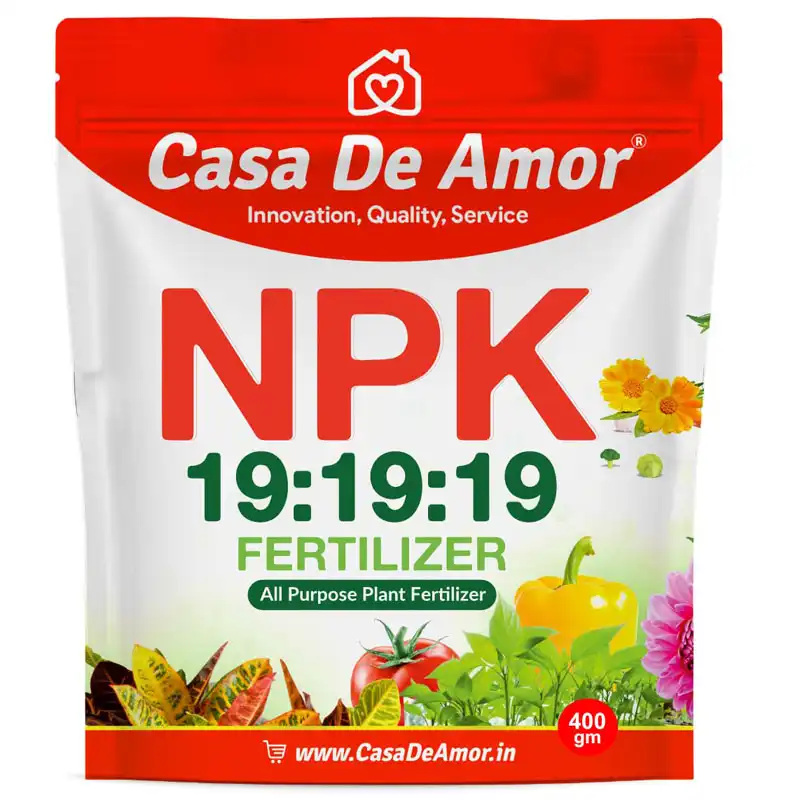
Example of 19 19 19 Fertilizers:

What 100 Pounds of Triple 19 Delivers
Every 100 pounds of 19-19-19 supplies 19 pounds each of nitrogen, phosphate (P2O5), and potash (K2O). So multiply the product rate by 0.19 to get pounds of each nutrient. That one number drives every decision below.
| Rate of 19-19-19 | N | P2O5 | K2O | N plus K2O |
|---|---|---|---|---|
| 100 lb/acre | 19 lb | 19 lb | 19 lb | 38 lb |
| 150 lb/acre | 29 lb | 29 lb | 29 lb | 57 lb |
| 200 lb/acre | 38 lb | 38 lb | 38 lb | 76 lb |
| 250 lb/acre | 48 lb | 48 lb | 48 lb | 95 lb |
| 300 lb/acre | 57 lb | 57 lb | 57 lb | 114 lb |
| 400 lb/acre | 76 lb | 76 lb | 76 lb | 152 lb |
That last column matters most at planting. Nitrogen and potash together carry the salt load that injures corn seed and young roots. Purdue Extension caps N plus K2O at 100 pounds per acre in a standard 2 by 2 band. So triple 19 hits that ceiling near 263 pounds of product.
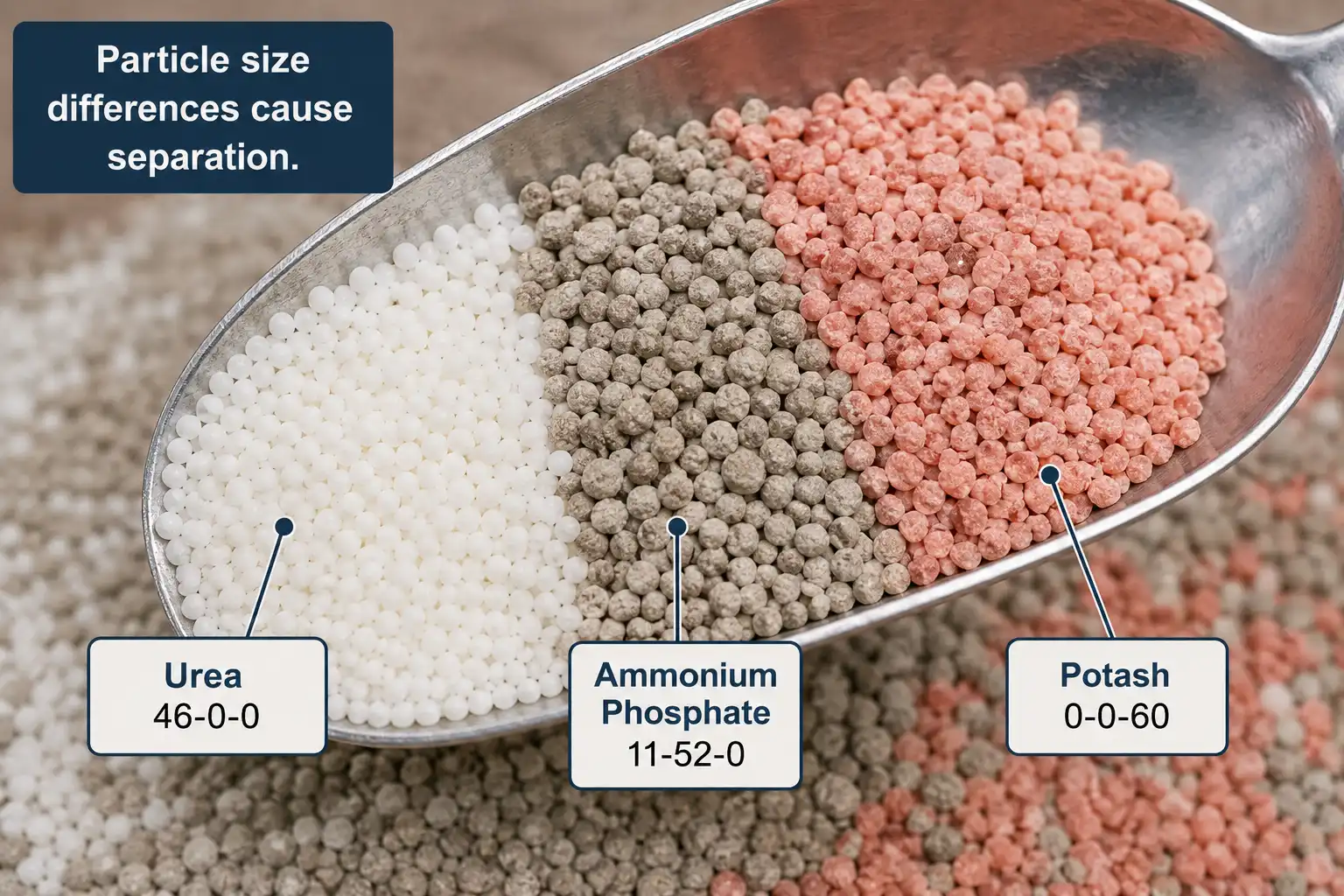
The grade also arrives in two forms. Some products come as one homogeneous granule. Bulk triple 19 is often a physical blend instead: urea, an ammonium phosphate, and muriate of potash. University of Minnesota Extension notes urea blends readily with 11-52-0 or 18-46-0. But urea granules weigh less than potash, so spinner spreaders throw them a shorter distance. That gap shows up later as wavy or streaky growth. Anyone comparing grades should check what a triple 19 blend contains. Then confirm spread width with a pan test.
How Much 19-19-19 Fertilizer per Acre for Corn?
Use 105 to 210 pounds per acre in a starter band. Broadcast rates run 200 to 320 pounds per acre as the phosphate and potash base. Both ranges assume soil test P and K sit at or below the maintenance range. Neither range covers the crop’s nitrogen demand.
The banded figure follows starter guidance from Purdue Extension. That guidance puts 2 by 2 rates at 20 to 40 pounds per acre of each nutrient. At 19 percent, that becomes 105 to 210 pounds of product.
The broadcast figure follows removal. K-State Research and Extension measures corn grain removal per bushel. The figures are 0.9 pound of N, 0.33 pound of P2O5, and 0.26 pound of K2O. So a 180 bushel crop pulls about 59 pounds of phosphate and 47 pounds of potash off the field.
| Yield goal | P2O5 removed | K2O removed | 19-19-19 to match P2O5 |
|---|---|---|---|
| 120 bu/acre | 40 lb | 31 lb | 210 lb/acre |
| 150 bu/acre | 50 lb | 39 lb | 260 lb/acre |
| 180 bu/acre | 59 lb | 47 lb | 315 lb/acre |
| 200 bu/acre | 66 lb | 52 lb | 345 lb/acre |
Those rates replace what the grain hauls away. They are not a recommendation for every field. The soil test still comes first.
Why Triple 19 Cannot Carry the Nitrogen
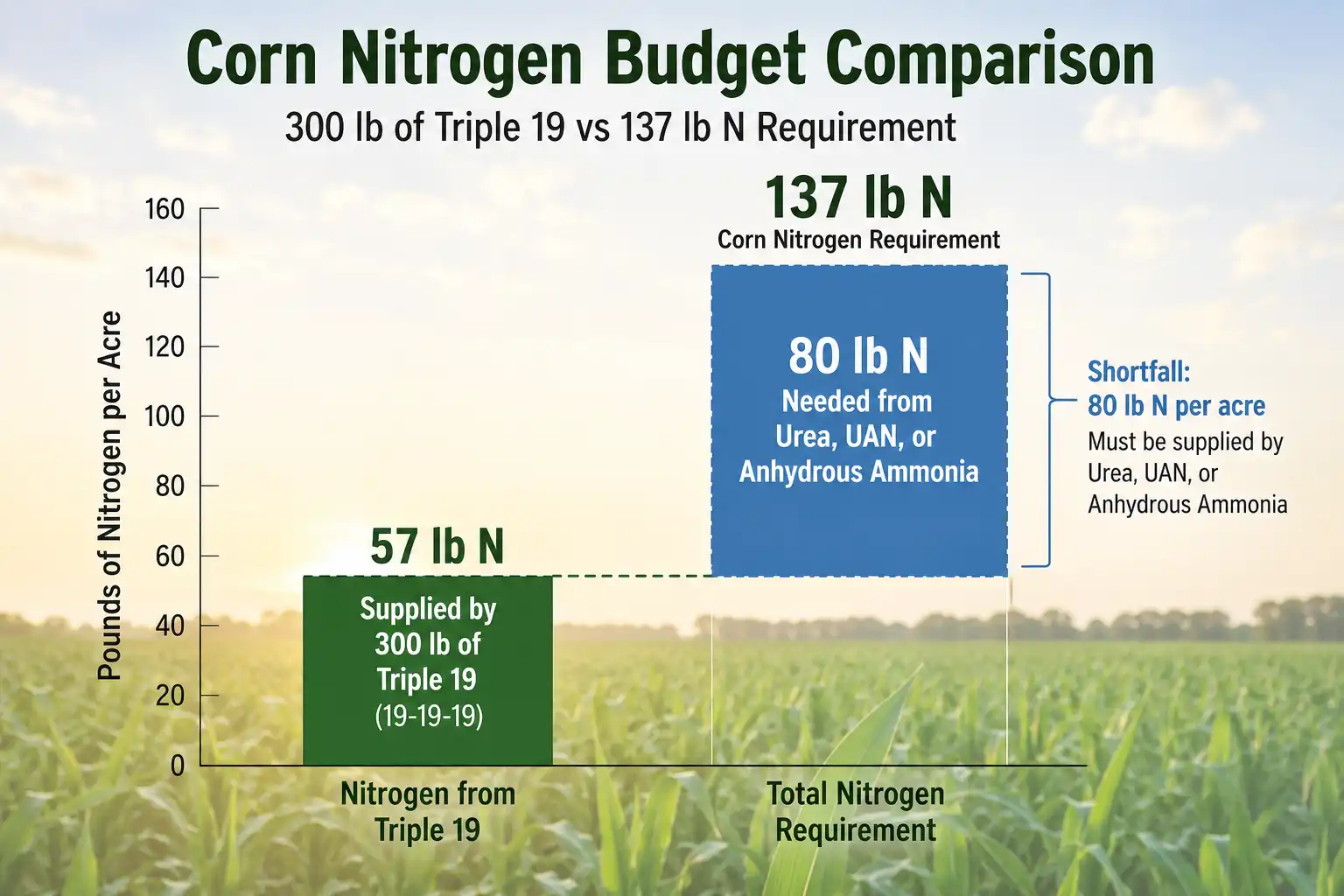
No sensible rate of 19-19-19 covers a corn nitrogen program. Iowa State University Extension uses a maximum return to nitrogen (MRTN) approach. At common price ratios, Iowa rates land near 137 pounds of N per acre for corn following soybean. Corn following corn runs near 180 pounds. Reaching 137 pounds of N from triple 19 alone would take 721 pounds of product per acre.
That pass would also drop 137 pounds of phosphate and 137 pounds of potash. Against a 180 bushel crop, that is more than twice the phosphate removed. It is nearly three times the potash. Corn after corn at 180 pounds of N would need 947 pounds of product. That runs close to half a ton per acre.
Iowa State also notes a shift in method. Corn Belt soil fertility specialists moved away from the old yield goal approach. Seven states now share the MRTN calculator. So set the nitrogen budget first. Then decide how much of it the starter can carry. More detail on that budget sits in this breakdown of the nitrogen a corn crop needs.
How to Set the Rate from a Soil Test
Start with a soil test, because phosphate and potash rates hinge on it. These five steps get you to a product rate.
- Pull a representative sample and read the P and K values in ppm.
- Compare each value to your state’s maintenance range.
- If both sit above the maintenance limit, apply no phosphate or potash at all.
- If both sit in the maintenance range, target crop removal for P2O5 and removal plus 20 pounds for K2O.
- Divide the phosphate target by 0.19 to get pounds of 19-19-19 per acre.
Ohio State University Extension frames step 4 that way under the Tri-State Fertilizer Recommendations. Once soil tests reach the maintenance limit, further phosphate and potash stop paying. K-State Research and Extension adds a sharper cutoff for starter phosphate. Above about 30 ppm soil test P, an economic response is rare. Cold, wet, early planted fields are the main exception.
Step 3 is where triple 19 often becomes the wrong product. A field testing high in both nutrients needs nitrogen only. Buying a balanced grade there pays for two nutrients the crop cannot use. Correct soil testing steps for a field cost far less than one wasted pass.
Placement Limits That Cap the Rate
Placement sets a hard ceiling that soil test math cannot override.
In the seed furrow: skip it. University of Minnesota Extension is blunt here. Urea and urea based fertilizer should never sit in direct seed contact with corn. K-State Research and Extension agrees. It rules out in-furrow placement when the N source is urea or UAN, whatever the rate. Urea converts to ammonia, and that ammonia is toxic to seedlings. Since most triple 19 carries urea nitrogen, the furrow is closed to it.
In a 2 by 2 band: this is the safe home for triple 19. Purdue Extension limits fertilizer within one inch of the seed to 20 pounds of N plus K2O. A standard 2 by 2 band takes up to 100 pounds. K-State recommends 2 to 3 inches beside and below the seed, or a 2 by 0 surface band. Practically, 105 to 185 pounds of product keeps you inside the tighter limits. Purdue also notes a practical ceiling. Rates near 100 pounds of N plus K2O in a 2 by 2 rarely pay, and they slow refills.
Broadcast before planting: spread and incorporate 2 to 3 inches deep, 7 to 14 days ahead of planting. Skip frozen or saturated ground, since surface phosphate moves with runoff.
Fall application deserves caution. University of Minnesota Extension advises against fall UAN. Rapid nitrification and high loss potential drive that call. A balanced grade broadcast in fall carries the same risk on its nitrogen share.
Where the Rest of the Nitrogen Comes From
Cover the gap with a straight nitrogen source, not more balanced product. Say a 200 pound base supplies 38 pounds of N. If the budget calls for 140, then 102 pounds still has to reach the crop.
| Source | Analysis | Product for 100 lb N | Notes |
|---|---|---|---|
| Urea | 46-0-0 | 217 lb | Incorporate or use an NBPT inhibitor |
| UAN | 32-0-0 | 28 gallons | 11.06 lb per gallon, 3.5 lb N per gallon |
| UAN | 28-0-0 | 33 gallons | Lower salt out temperature |
| Anhydrous ammonia | 82-0-0 | 122 lb | Inject, watch root pruning |
Mississippi State University Extension puts 32 percent UAN at 11.06 pounds per gallon. That figure gives the gallon math above. The same source warns that surface applied urea and UAN both lose nitrogen to volatilization. NBPT urease inhibitors only slow that loss. Rain or irrigation still has to move the nitrogen into the soil. So band, inject, or incorporate whenever the equipment allows. Rates and handling sit in this guide to urea in the 46-0-0 grade.
Application Timing by Growth Stage
| Timing | What goes on | Why then |
|---|---|---|
| 7 to 14 days before planting | Broadcast 19-19-19, incorporate | Gets P and K into the root zone |
| At planting | 2 by 2 band, 105 to 185 lb/acre | Early P access, low injury risk |
| V4 to V6 | Sidedress the nitrogen balance | Uptake climbs sharply after V6 |
| V6 to V10 | Drop nozzles or injected N only | Granules on leaves burn tissue |
| After V10 | Pre-tassel N through drops | Last practical window |
Corn pulls most of its nitrogen between V6 and silking. So the sidedress pass matters more for final yield than the starter pass. A stage by stage plan for fertilizing corn through the season lines up each pass with uptake.
Triple 19 Against Other Corn Grades
| Grade | Analysis | Rate for 50 lb P2O5 | Best fit on corn |
|---|---|---|---|
| Triple 19 | 19-19-19 | 263 lb | Starter or base where P and K both test low |
| Triple 10 | 10-10-10 | 500 lb | Same balance, nearly double the rate |
| MAP | 11-52-0 | 96 lb | Phosphate base, safer near seed than DAP |
| DAP | 18-46-0 | 109 lb | Phosphate base where potash tests high |
| Urea | 46-0-0 | Not a P source | Bulk nitrogen, preplant or sidedress |
| Muriate of potash | 0-0-60 | Not a P source | Potash only, on low testing K fields |
Triple 19 wins on convenience and one pass simplicity. Straight materials win on cost per pound of nutrient. They also win on fields where only one nutrient runs short. Fields testing low in potash but adequate in phosphate are common. Looking at the potassium a corn crop pulls each year shows why potash alone often fits better.
What Goes Wrong at the Wrong Rate
Thin stands in the row. Too much N plus K2O landed near the seed. Check the band offset, then cut the rate below the published salt limit.
Streaky or wavy growth across the pass. A blended grade separated in the spreader, or the spread width missed. Run a pan test and match the pattern to the boom width.
Yellow corn at V8 after a heavy base pass. Even 300 pounds of triple 19 supplies only 57 pounds of N. That leaves 80 or more pounds short when uptake peaks.
Soil test P climbing year over year. Applications ran above removal. Ohio State research found that over fertilization does not reliably build soil test P and K. So the extra product either leaves the field or ties up.
Nitrogen missing after a surface urea pass. Volatilization took it. Incorporate, band, or add an NBPT product, then count on rainfall to finish the job.
FAQs about 19-19-19 Fertilizer Per Acre for Corn
Can 19-19-19 be the only fertilizer for corn?
How many pounds of 19-19-19 supply 50 pounds of nitrogen?
Can you put 19-19-19 in the seed furrow?
Is 19-19-19 worth using on high testing soils?
Does 19-19-19 work for sweet corn plots?
Key Points to Carry Into the Field
Set the nitrogen budget first, then let the soil test set the phosphate and potash rate. Band 105 to 185 pounds of triple 19 per acre at planting. Or broadcast 200 to 320 pounds where both nutrients test low. Keep N plus K2O inside the published salt limits. Then plan a sidedress pass for the 80 to 140 pounds of nitrogen the balanced grade cannot supply.