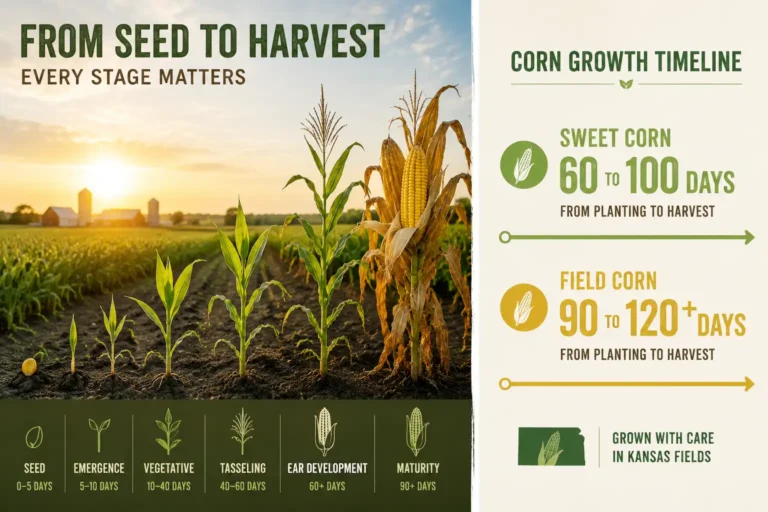
How Much Nitrogen Does Corn Need Per Acre (2026 Rate Guide)
Nitrogen is the nutrient that decides your corn yield, and it is also one of your biggest input costs. So the amount of nitrogen corn needs per acre is worth getting right.
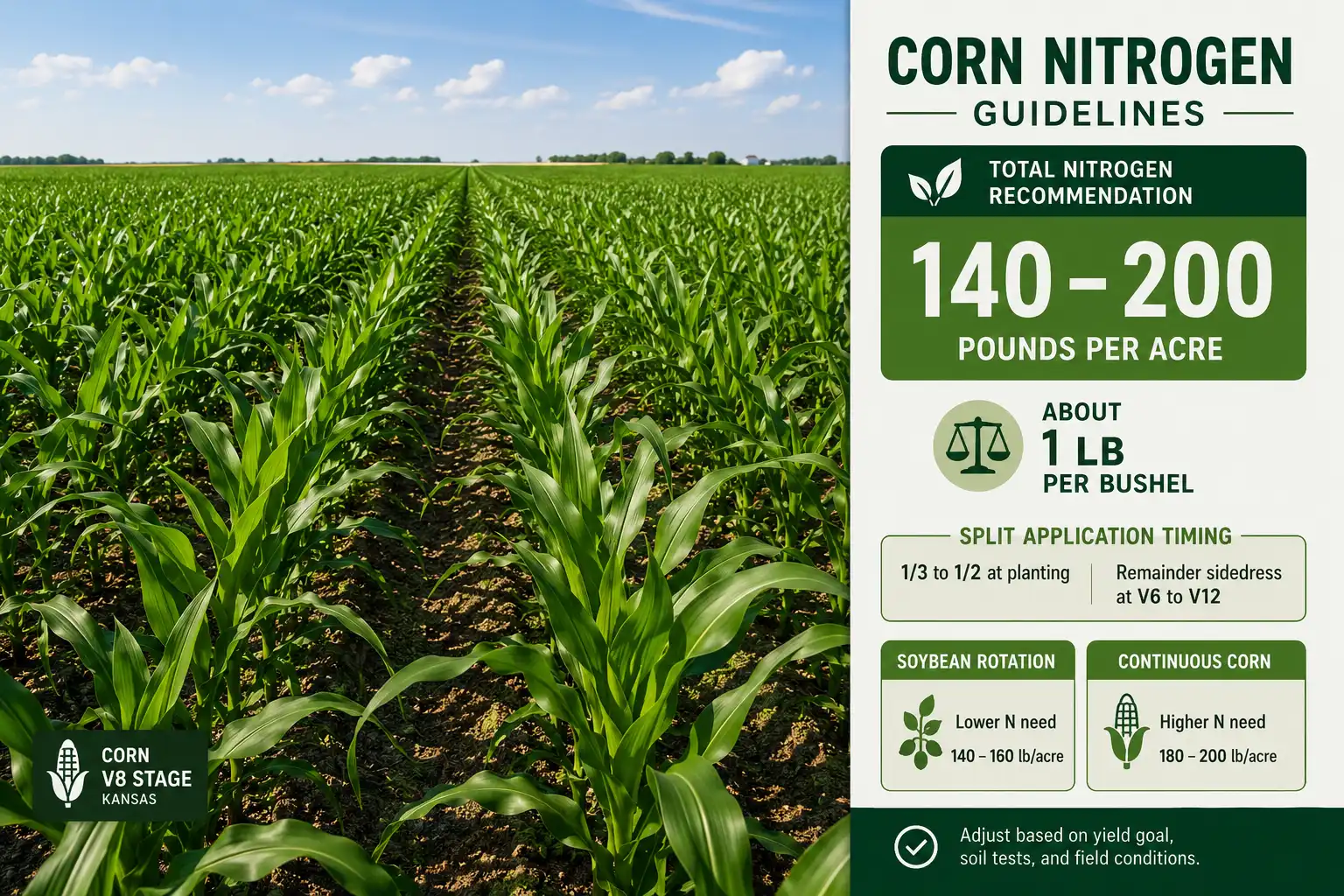
Corn usually needs 140 to 200 pounds of actual nitrogen per acre, or roughly 1 pound per bushel of your yield goal. Corn following soybeans needs less, and continuous corn needs more, so match the rate to your rotation.
How Much Nitrogen Does Corn Need Per Acre?
Most grain corn needs 140 to 200 pounds of actual nitrogen per acre. A good working number is about 1 pound of nitrogen for every bushel you expect to harvest.
That per-bushel rule reflects how much nitrogen the corn plant pulls from the ground. A 180 bushel crop takes up close to 180 pounds of nitrogen across the whole plant. You do not apply all of that as fertilizer, though. Your soil supplies part of it through organic matter, and some of any fertilizer you spread gets lost first.
The right number depends on three things. First, your yield goal sets the ceiling. You can only fertilize for the yield your ground will give. So set a realistic target for how much corn you can grow. Second, your rotation moves the rate up or down. Third, your soil and weather decide how much of it stays put.
| Situation | Typical nitrogen to apply (lb/acre) |
|---|---|
| Corn after soybeans, 150 to 180 bu | 120 to 160 |
| Continuous corn, 150 to 180 bu | 170 to 200 |
| Irrigated high yield corn, 200+ bu | 200 to 250 |
| Dryland corn in a dry region | 100 to 160 |
These are starting ranges, not hard rules. K-State caps its recommendation at 230 pounds for dryland corn and 300 pounds for irrigated corn.
How Do You Calculate the Right Nitrogen Rate for Corn?
Two methods dominate. In the Great Plains, most of us use the yield goal method. Across the Corn Belt, growers use the MRTN approach.
The Yield Goal Method
The yield goal method starts with your target yield and subtracts the nitrogen your soil already provides. K-State Research and Extension keeps it simple with one factor.
Multiply your yield goal by 1.6 to get the total nitrogen the crop needs. Then subtract what the soil gives you. Good soil testing does most of that work, because it shows the nitrate already in your profile.
Common credits to subtract:
- About 20 pounds of nitrogen per acre for each 1 percent of soil organic matter.
- Any nitrate a profile soil test finds in the root zone.
- Credits for manure or a previous legume crop like soybeans.
Here is how it runs on a Kansas field. Say the yield goal is 180 bushels.
- 180 times 1.6 = 288 pounds total nitrogen.
- Soil at 2.5 percent organic matter supplies about 50 pounds.
- A profile nitrate test shows another 30 pounds.
- Corn following soybeans earns roughly a 40 pound credit.
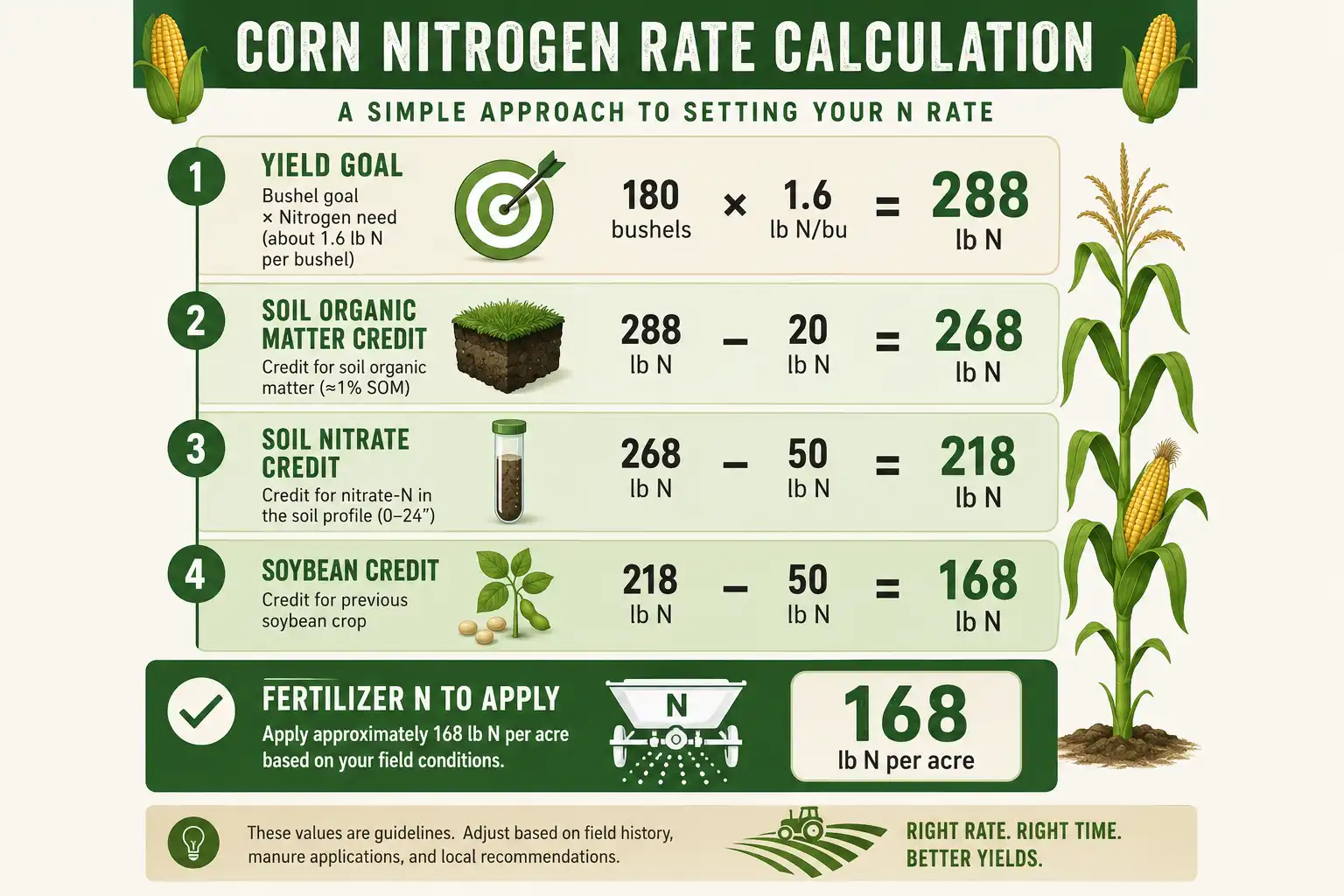
That leaves about 168 pounds of fertilizer nitrogen to apply. A small starter of around 30 pounds early also helps young plants get moving.
The MRTN Method
The MRTN method skips the math. It points you to the rate that returns the most profit, not the most yield.
MRTN stands for maximum return to nitrogen. Iowa State University built it from hundreds of field trials across Iowa, Illinois, Indiana, Michigan, Minnesota, Ohio, and Wisconsin. You plug in your nitrogen price and corn price, and the calculator gives a rate.
In Iowa, corn after soybeans usually lands near 130 pounds of nitrogen per acre. Continuous corn runs closer to 180 to 190 pounds.
One warning: the MRTN rate already includes your rotation. Do not subtract a separate soybean credit on top of it, or you will short the crop. That double subtraction is a common and costly mistake.
How Does Crop Rotation Change Your Nitrogen Rate?
Corn after soybeans needs less nitrogen than corn after corn. The gap is usually 30 to 50 pounds per acre.
Growing a soybean crop the year before leaves the ground in better shape for corn. The rotation frees up nitrogen and cuts residue problems that tie nitrogen up in continuous corn.
Continuous corn needs more nitrogen for two reasons. Heavy corn residue holds nitrogen as it breaks down. That nitrogen is not free for the next crop right away. So plan on the higher end of your range when corn follows corn.
Manure changes the math too. A good manure application can supply 50 to 150 pounds of nitrogen per acre. So test it and count that nitrogen before you buy fertilizer.
When Should You Apply Nitrogen to Corn?
Split your nitrogen. Put a little down at planting. Then apply the bulk as a sidedress around V6, when corn starts pulling nitrogen fast.
Corn uses very little nitrogen in the first month. Uptake then climbs sharply from about the V6 stage through tasseling. Matching your nitrogen to that curve keeps it in the root zone when the crop wants it.
A common split looks like this:
- A starter band at planting, around 20 to 30 pounds, to push early growth.
- The main sidedress between V6 and V8, carrying most of the rate.
- On sandy or irrigated ground, a third pass later to cover heavy uptake.
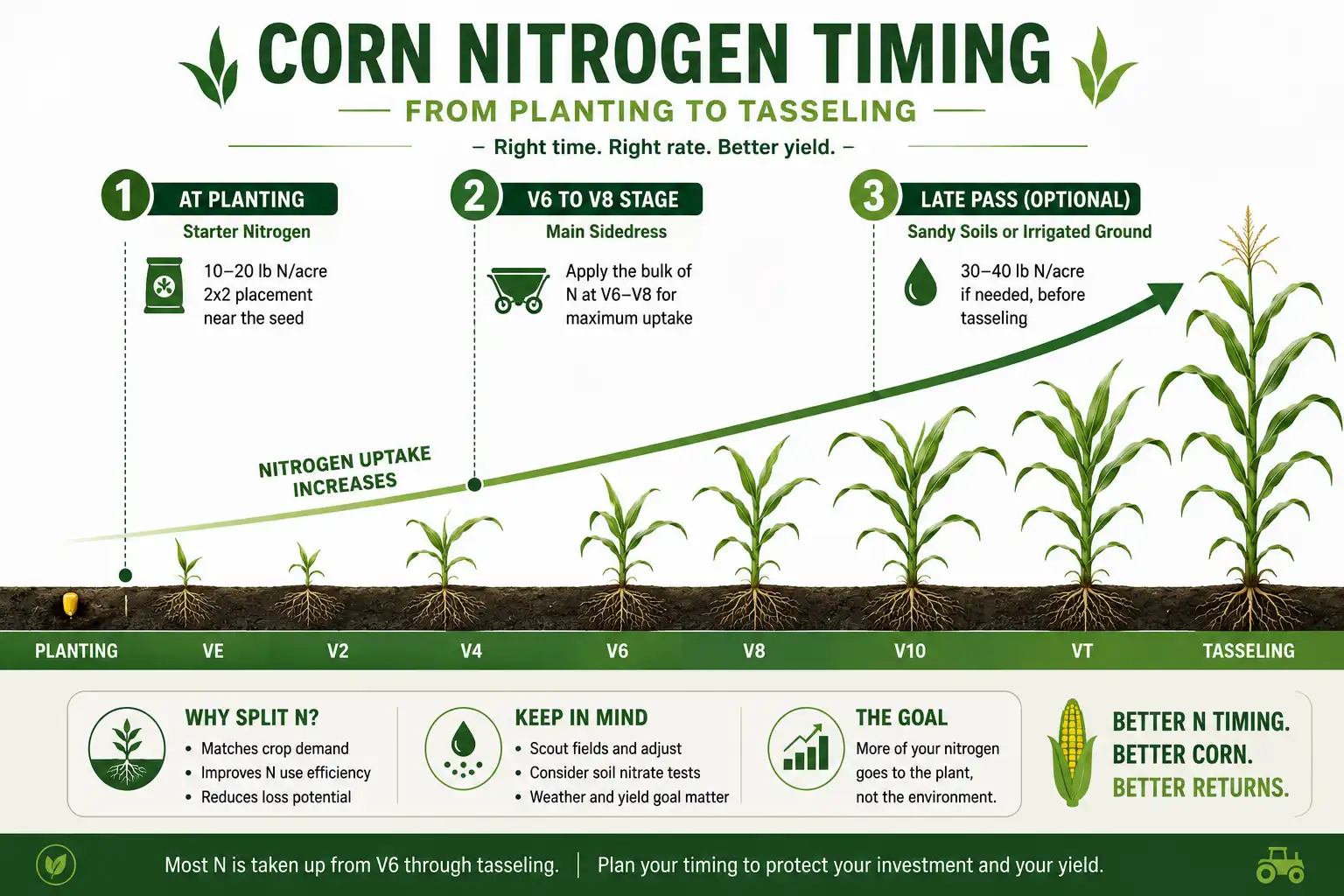
Split timing also cuts loss. Nitrogen sitting in wet spring soil can leach or gas off before the crop ever sees it. Applying closer to peak demand protects both the crop and your investment.
Keep starter fertilizer off the seed. On 30 inch rows, hold nitrogen plus potassium under 8 pounds in direct seed contact. Never place urea or UAN in the furrow. Both can burn young seedlings.
Which Nitrogen Source Is Best for Corn?
Anhydrous ammonia, UAN, and urea all grow good corn. The best choice depends on your equipment, your timing, and your loss risk.
Anhydrous ammonia carries 82 percent nitrogen and usually costs the least per pound. You inject it into the soil, so it fits pre-plant and sidedress passes. It needs the right gear and careful handling.
UAN solution runs 28 or 32 percent nitrogen. It is liquid, so it flows through a sprayer and works well for sidedressing. Many growers who ask about liquid fertilizer rates for corn lean on UAN for its flexibility.
Urea is dry and carries 46 percent nitrogen. It spreads easily, but it can gas off as ammonia if it sits on the surface too long. Work it in, water it in, or use a urease inhibitor to hold it.
For a balanced start, some growers band a little 19-19-19 fertilizer near the row. Then they follow with a straight nitrogen source for the main rate.
A nitrogen stabilizer pays off when you apply early or on wet ground. It slows the change to forms that leach or gas off, which stretches your nitrogen further.
How Do Soil and Weather Change Nitrogen Needs?
Wet soil steals nitrogen. Leaching and denitrification can pull 30 to 50 pounds per acre out of reach after heavy spring rain.
Sandy soils and irrigated fields lose nitrogen fastest, so they reward split applications and stabilizers. Heavy clay holds nitrogen better, but it can lose it to denitrification when it stays saturated.
Soil organic matter works in your favor. Every 1 percent of organic matter releases roughly 20 pounds of nitrogen per acre over a corn season. Higher organic matter ground simply needs less fertilizer.
Plant population matters here too. A thicker stand and a higher yield goal both raise nitrogen demand. So heavier corn plant populations need proportionally more nitrogen.
After a wet stretch, scout for pale, hungry corn. A rescue application of 30 to 50 pounds can save the crop if you catch a shortage early.
How Do You Know If Corn Needs More Nitrogen?
Yellowing lower leaves are the classic sign. The yellowing starts at the leaf tip and runs down the midrib in a clear V shape.
Corn moves nitrogen from old leaves to new growth when it runs short, so the bottom leaves fade first. Stalks turn thin and pale, and yield potential drops fast if you ignore it.
Do not guess from color alone. Two tools confirm a shortage:
- A pre-sidedress nitrate test, or PSNT, checks soil nitrate when corn is 6 to 12 inches tall.
- A tissue test or a crop sensor reads the plant directly and flags a shortage before you can see it.
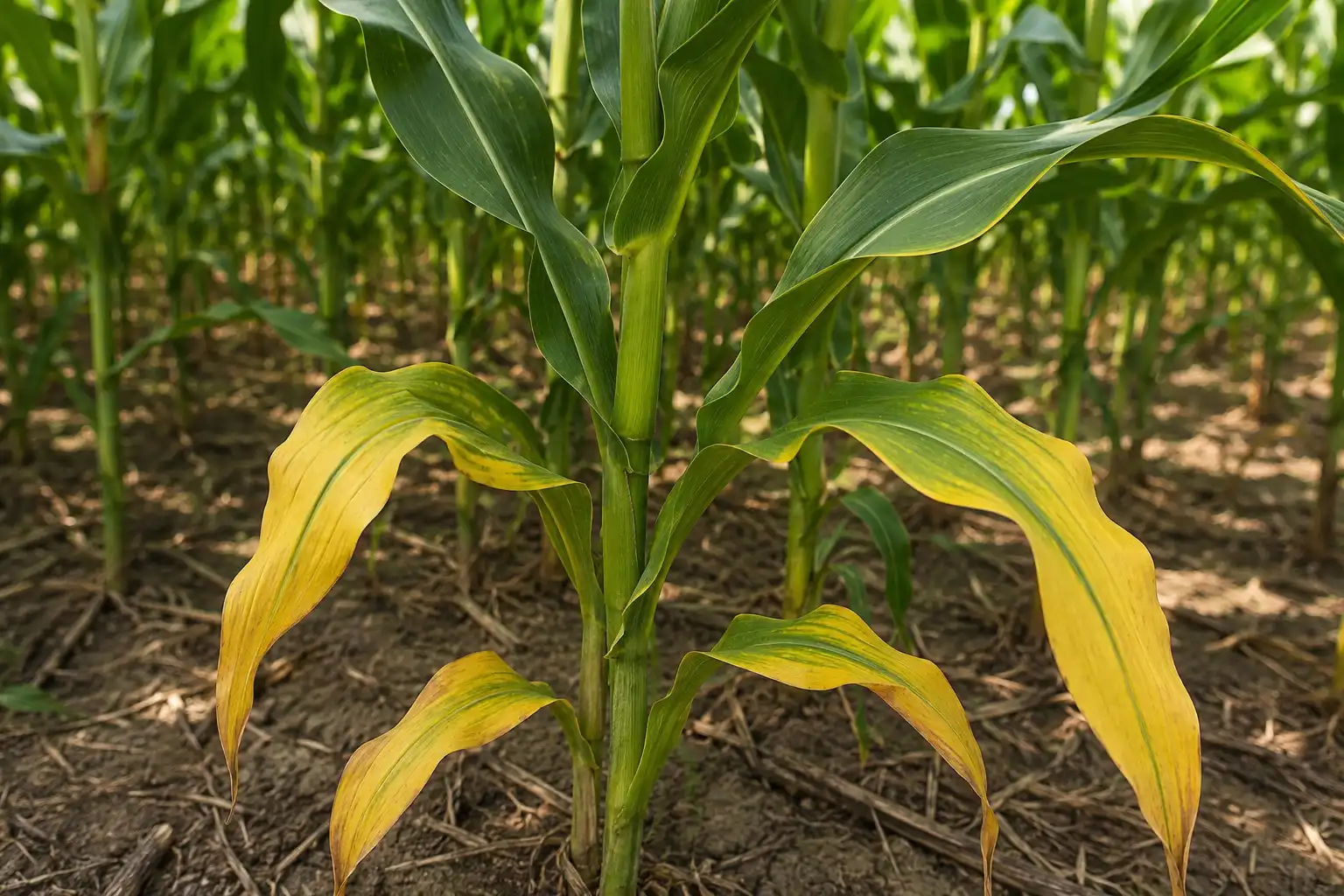
Catching a deficiency by V8 still leaves time for a rescue sidedress. Wait until tasseling and you have already lost those bushels.
How to Set a Nitrogen Rate in Kansas
A realistic yield goal is the starting point, then what the soil test and rotation give for free is subtracted. On dryland corn after soybeans, that usually lands between 130 and 160 pounds of nitrogen per acre. Split it, watch the weather, and keep some in reserve for a rescue pass if spring turns wet. Match the rate to your field, not to a bag label, and your nitrogen will earn its keep.