What Is the Average Corn Yield Per Acre in Nebraska? (2026 Data)
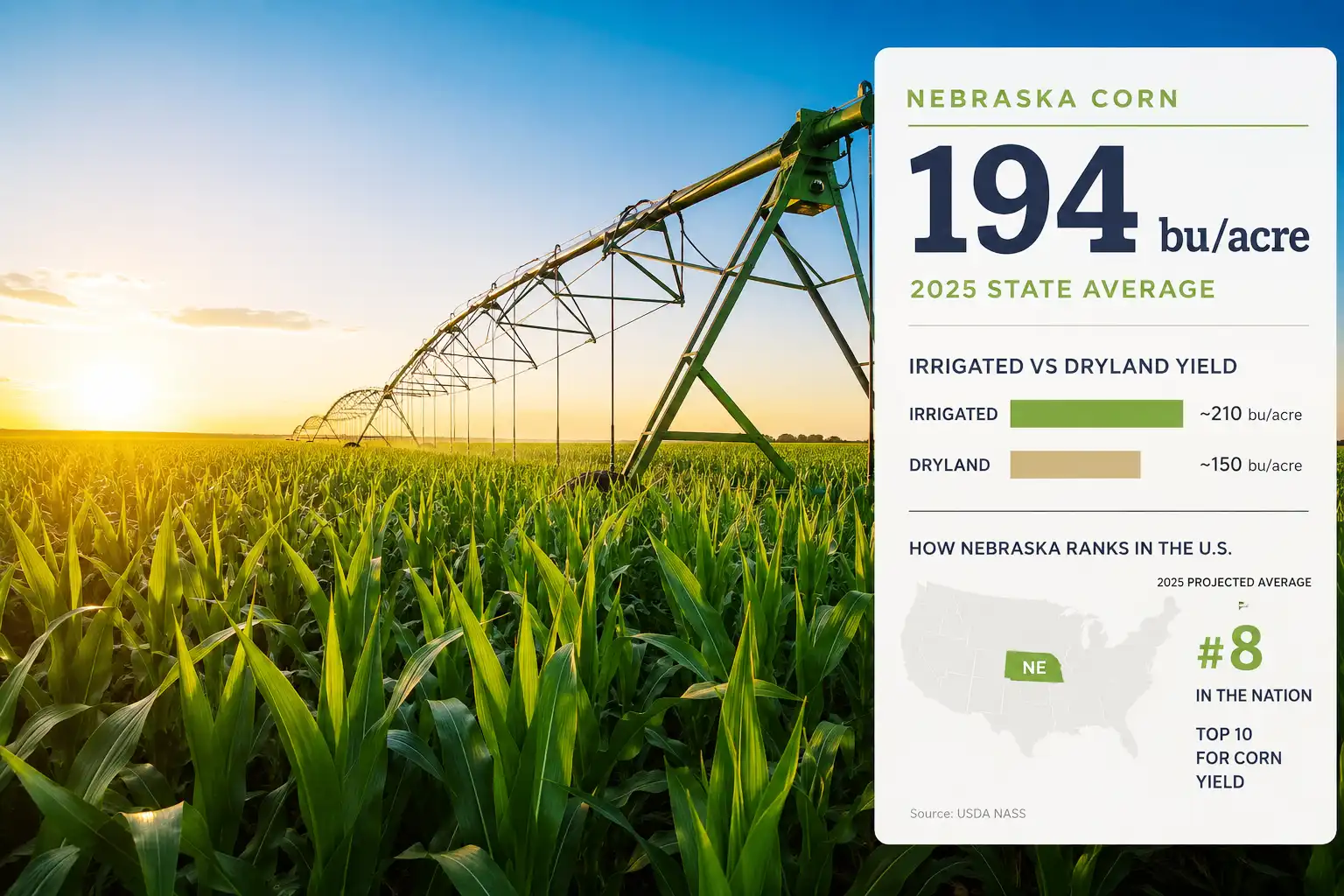
Nebraska sits near the top of the country for corn production, and irrigation is the main reason why. That edge shows up plainly in the numbers. The average corn yield per acre in Nebraska hit 194 bushels in 2025, well above the national mark.
Nebraska’s average corn yield was 194 bushels per acre in 2025, tying the state record first set in 2021. That beat the US average of about 186 bushels. Heavy irrigation from the Ogallala Aquifer keeps Nebraska yields consistently high.
What Is the Average Corn Yield Per Acre in Nebraska Right Now?
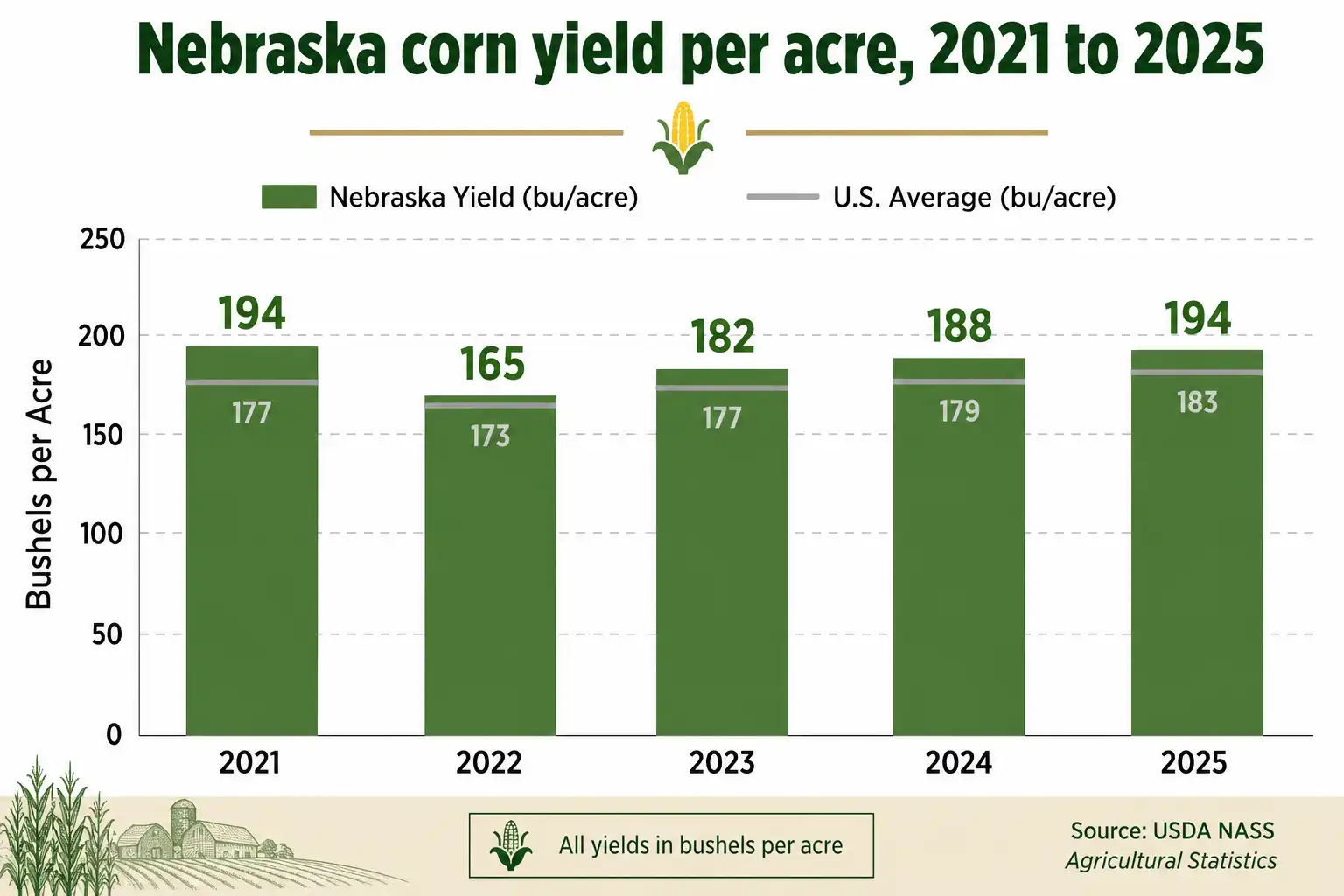
Nebraska averaged 194 bushels of corn per acre in 2025. That figure matched the state record first set in 2021. USDA’s National Agricultural Statistics Service put total grain production at 2.02 billion bushels. That came from about 10.45 million harvested acres. The year before, in 2024, the state averaged 188 bushels. So the trend stayed strong even after the 2022 drought pulled the average down to 165.
Here is how the last five crop years compare with the national number.
| Crop year | Nebraska average (bu/acre) | US average (bu/acre) |
|---|---|---|
| 2021 | 194 (record) | 176.7 |
| 2022 | 165 (drought) | 173.4 |
| 2023 | 182 | 177.3 |
| 2024 | 188 | 179.3 |
| 2025 | 194 (record tie) | 186.0 |
The pattern is clear. Nebraska usually runs several bushels ahead of the US average. Only a severe drought like 2022 knocks it below trend. That gap traces back to irrigation. It shapes much of what an acre of corn can produce on any field.
Why Are Nebraska’s Corn Yields So High?
Water is the short answer. Nebraska is the number one irrigated state in the country, and it holds more irrigated corn acres than anywhere else. About 70 to 74 percent of the state’s corn is irrigated, mostly through center pivot systems. That steady water supply removes the biggest yield limiter on the Great Plains. That limiter is summer moisture stress at the wrong time.
Most of that water comes from the Ogallala Aquifer, a huge groundwater store beneath the High Plains. It supplies a large share of all irrigation groundwater used in US agriculture. When a July dry spell hits during pollination, an irrigator keeps the crop fed. Dryland corn a mile away starts to struggle.
Soil helps too. Deep, fertile loess soils across eastern and central Nebraska hold moisture and feed a heavy crop. Add a strong corn-soybean rotation, and yields climb further. University of Nebraska research shows a clear rotation boost. Corn after soybeans yields roughly 10 to 15 bushels more per acre than corn on corn. Getting your fertilizer rate right on that rotation matters, because the soybean year cuts nitrogen needs the next season.
Nebraska ranks third in total corn production, behind only Iowa and Illinois. The state also feeds much of its own crop. It leads the nation in cattle on feed and ranks second in ethanol output. That in-state demand keeps corn acres high and gives farmers a reason to push for every bushel.
Irrigated vs Dryland Corn Yields in Nebraska
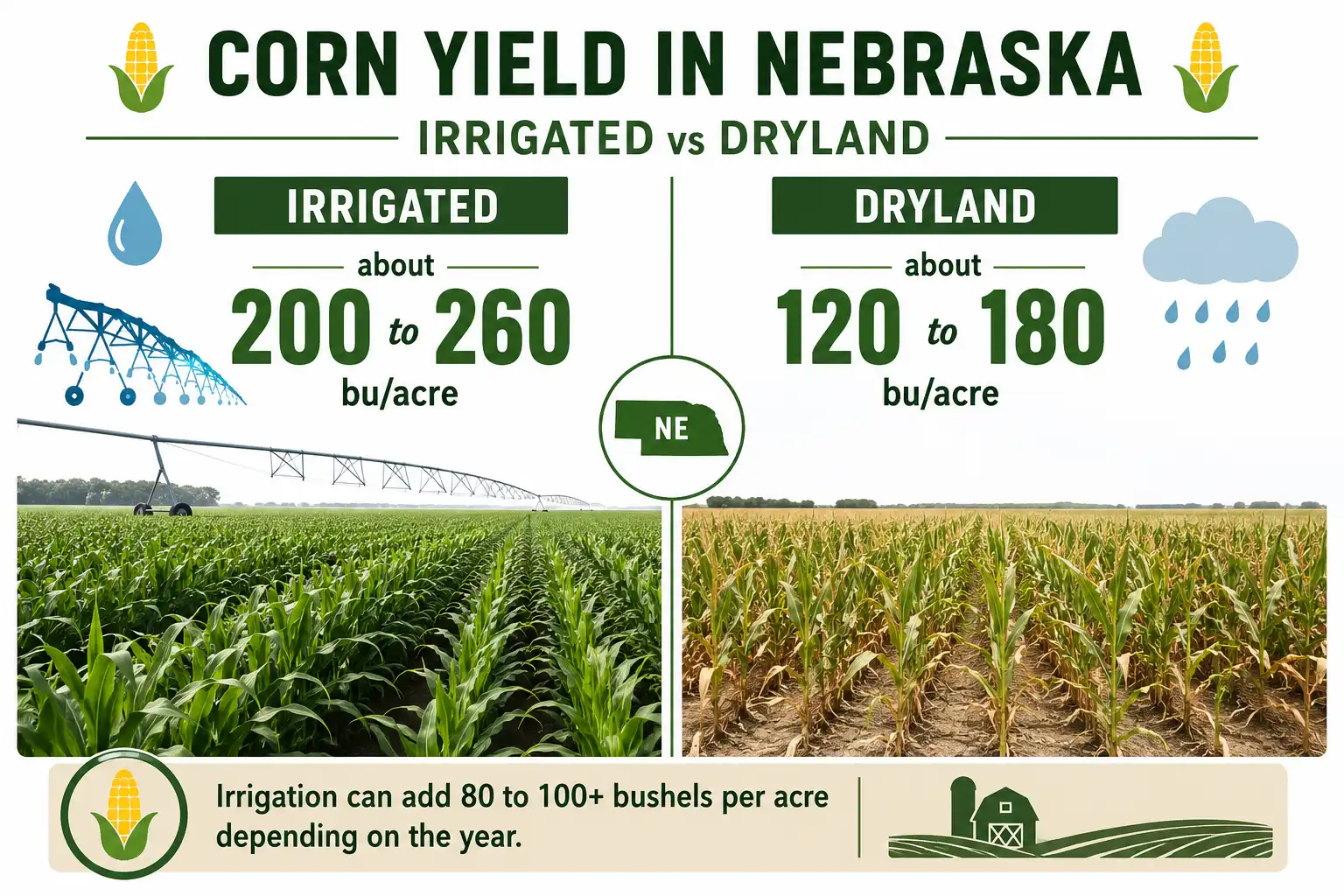
Irrigated corn in Nebraska yields far more than dryland corn, often by 50 to 80 bushels per acre. The University of Nebraska has put the illustrative split near 200 bushels for irrigated ground. Non-irrigated ground runs closer to 147 bushels. On strong central Nebraska fields, irrigated yields of 220 to 260 bushels are realistic in a good year.
One honest caveat belongs here. USDA NASS stopped reporting separate irrigated and non-irrigated yield estimates back in 2019. So there is no current official state average broken out by practice. The numbers above come from University of Nebraska extension work and on-farm research. They are not a fresh NASS practice split. Treat them as solid benchmarks rather than an exact current statewide figure.
What Does Irrigated Corn Yield in Nebraska?
Irrigated corn commonly yields 200 to 260 bushels per acre in Nebraska during a normal season. On-farm research trials in eastern and south central Nebraska recorded irrigated yields from 206 to 251 bushels. At the optimum seeding rate, they averaged about 224 bushels. The pivot takes weather luck mostly out of the equation. As long as the well keeps up and pollination goes clean, these fields deliver year after year.
What Does Dryland Corn Yield in Nebraska?
Dryland corn yield in Nebraska swings hard with rainfall, often landing between 120 and 180 bushels per acre. A wet year in eastern Nebraska can push a dryland field near 180. A dry year can drop it to 120 or lower. In the 2022 drought, some western dryland fields came in at just a handful of bushels per acre. That swing is why eastern growers lean on crop insurance and conservative budgets. Picking the right plant population per acre also protects dryland fields. A lighter stand handles moisture stress better than a thick one.
How Does Nebraska Compare to the National Average?
Nebraska usually yields several bushels above the US average, and 2025 followed that script. The state hit 194 bushels while the country averaged a record 186 bushels. Over the past five years, Nebraska has topped the national number every season except 2022, when drought cut deep. The reason ties back to irrigation, because so much of the national average comes from fully rainfed ground.
Nebraska trails Iowa and Illinois in total production, yet it stands among the highest-yielding states in most years. Its statewide average also carries a lot of dryland acres. So the irrigated fields alone run much higher than the headline number suggests. Want to raise your own crop yields toward those top-end figures? The levers are the same ones Nebraska irrigators pull: water timing, plant population, and hybrid choice.
Which Nebraska Counties Have the Highest Corn Yields?
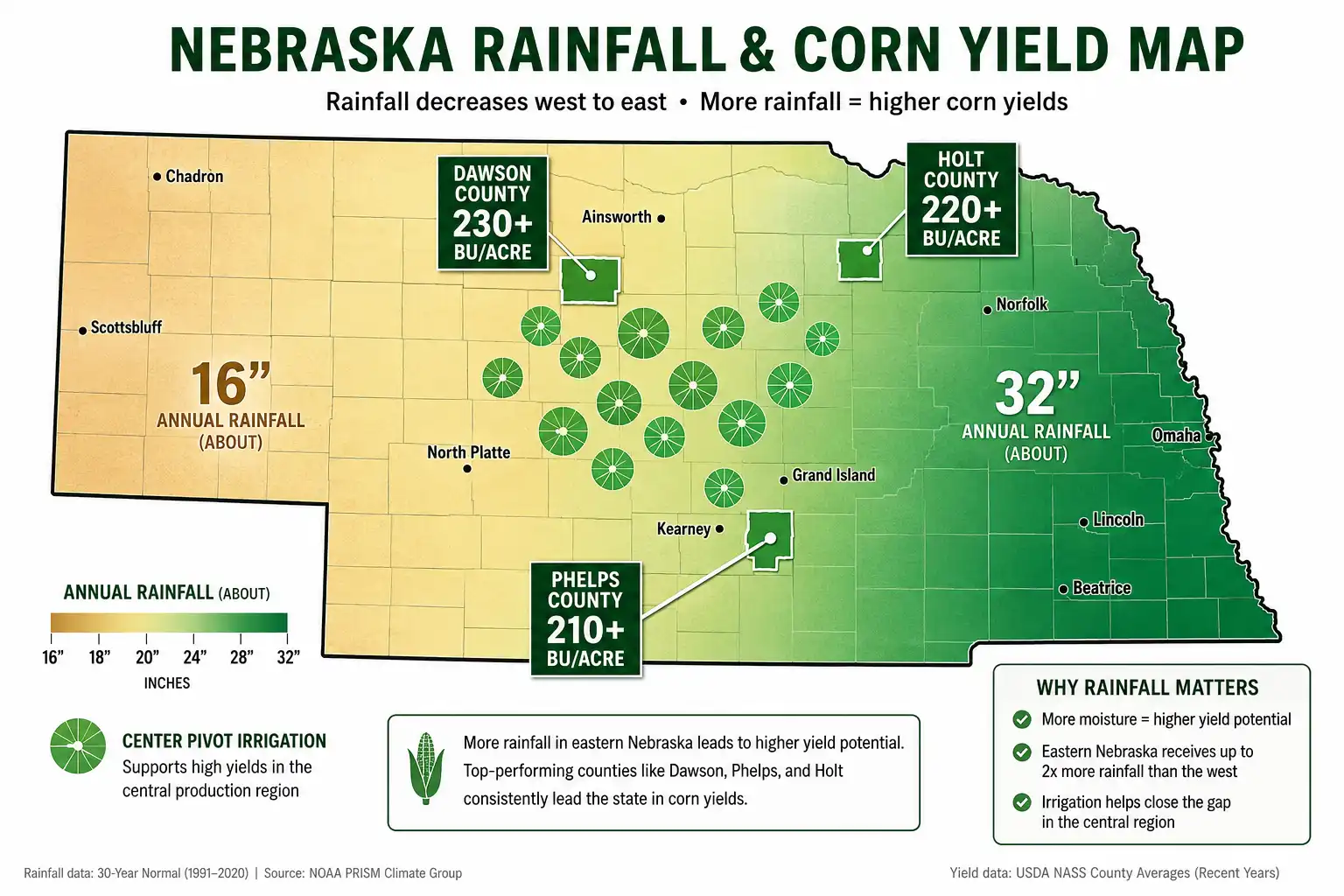
The top corn counties in Nebraska cluster where irrigation and good soil meet, mostly in central and south central Nebraska. In the 2023 county data, Dawson County led the state at 234.5 bushels per acre. Rock County followed at 232.3, then Phelps County at 227.2. Wheeler County hit 225.6 and Holt County 223.7. Sixteen Nebraska counties topped 200 bushels that year.
Phelps County stays near the top nationally most seasons. Private yield models have pegged it among the highest-yielding corn counties in the entire US. These are heavy irrigation counties along the Platte corridor. NASS still publishes county estimates. Since 2019, though, those figures no longer split irrigated from dryland. So a county number blends both systems.
Rainfall drives the east to west pattern. Southeast Nebraska gets around 32 inches a year. That drops by roughly 10 inches halfway across the state. The west sees just 16 to 18 inches. So eastern counties grow more dryland corn. Central and western counties rely on the pivot to hit their high yields.
What Affects Corn Yield on a Nebraska Field?
Water at pollination matters most, followed by planting date, hybrid maturity, plant population, and nitrogen. Corn is most sensitive to stress during that 10-day pollination window in July. A missed irrigation then costs more than any other timing. Get that right, and the rest of the season has room to work.
Planting date comes next. University of Nebraska work shows delays past May 10 cost measurable yield. Figure roughly half a bushel to a full bushel per acre per day. The drag speeds up after that. Most Nebraska corn goes in from late April through mid-May for that reason. Hybrid choice follows the calendar. Growers run 100 to 115 day hybrids in central Nebraska, and shorter-season types in the northwest.
The rest is blocking and tackling. Match your plant population to the field’s water supply. Keep nitrogen in step with the yield goal. Watch growing degree days through the season. If you want a read on where a field is headed before the combine rolls, you can estimate your corn yield before harvest with an ear count and a simple formula. Weather still writes the final chapter, but sound management sets the ceiling.
Bottom Line for Nebraska Corn Ground
Nebraska averages among the highest corn yields in the country. In 2025 it proved that again at 194 bushels per acre. Irrigation from the Ogallala Aquifer, deep loess soils, and a tight corn-soybean rotation do the heavy lifting. Together they carry the state above the national average nearly every year. If you farm irrigated ground here, 200 plus bushels is a fair target in a normal season. On dryland, plan for a wider swing and manage the risk accordingly.