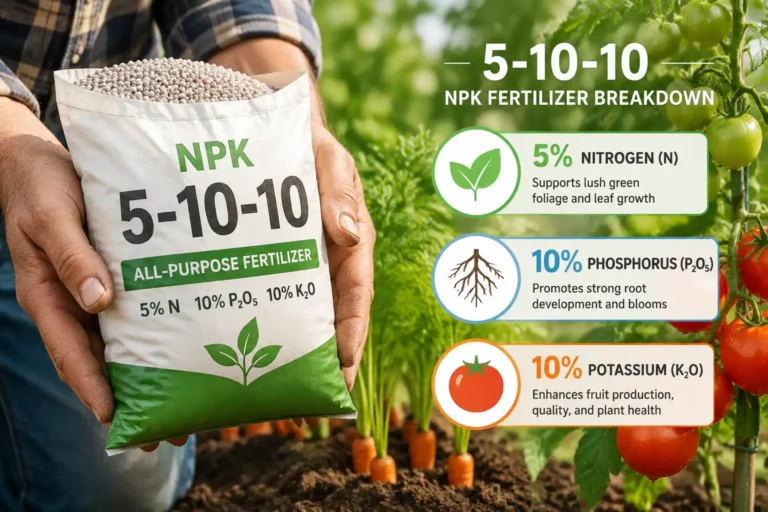
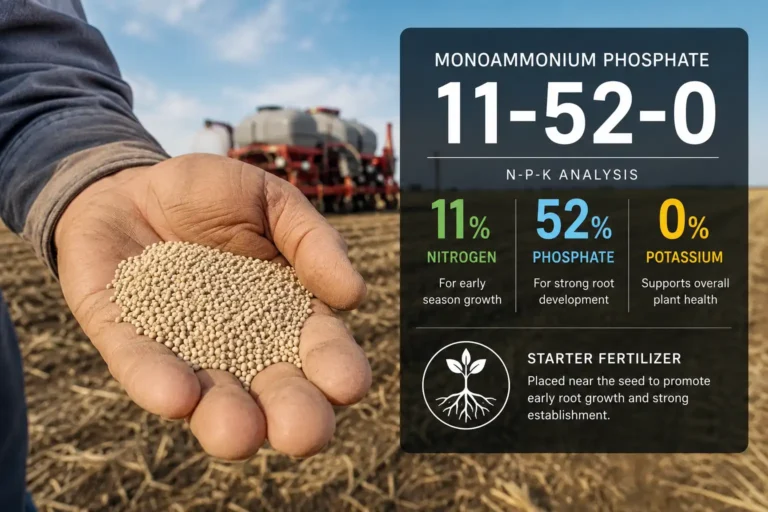
5 5 10 Fertilizer: What It Feeds and How to Use It Right
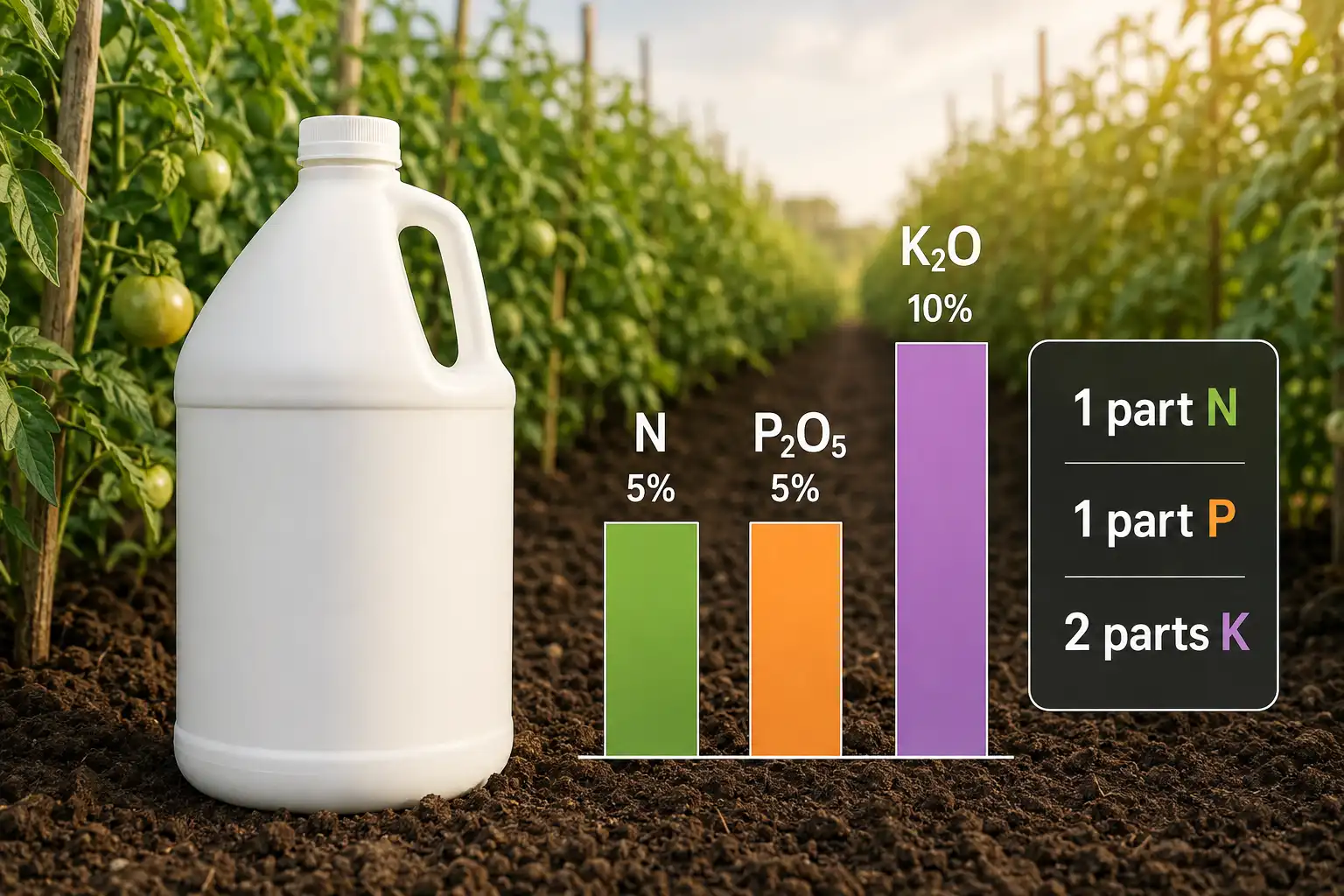
A 5-5-10 fertilizer carries twice as much potassium as nitrogen. That ratio suits fruiting crops, root crops, and any field running short on potash. This works well as an in-season top-up rather than as a primary potassium source.
5-5-10 fertilizer supplies 5% nitrogen, 5% phosphate, and 10% potash, so potassium leads. Apply it to tomatoes, potatoes, and grapes at fruit set. Pick is NutraTender 5-5-10 Foliar Fertilizer, which adds six micronutrients.
What Is 5-5-10 Fertilizer?
5-5-10 fertilizer guarantees 5% nitrogen, 5% available phosphate, and 10% soluble potash by weight. Those three numbers always run in that order on a US label. So a bigger third number tells you the product is built around potassium.
The rest of the container is carrier. In a liquid concentrate, that carrier is mostly water. In a granular blend, it is filler plus whatever secondary nutrients the maker adds.
State fertilizer laws follow AAPFCO labeling rules. Because of that, the guaranteed analysis on the jug is a legal minimum, not a marketing claim. You can trust the three numbers.
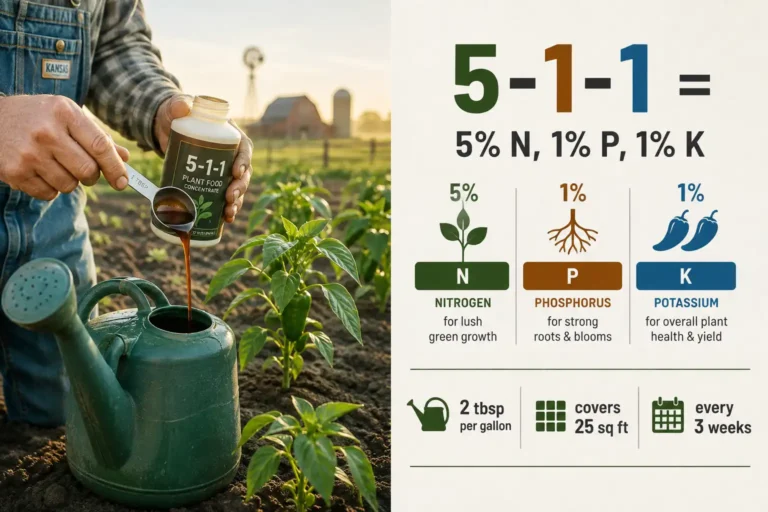
Know more: 5-1-1 Fish Emulsion Fertilizer Guide
What the Three Numbers Actually Guarantee
The numbers report nutrients in oxide form, not elemental form. Nitrogen appears as N. Phosphorus appears as P2O5, and potassium appears as K2O. So you need two conversions before you compare products fairly.
- Multiply P2O5 by 0.44 to get elemental phosphorus
- Multiply K2O by 0.83 to get elemental potassium
Run that math on 5-5-10 and you get 5% N, 2.2% P, and 8.3% K. Either way the ratio stays close to 1 part nitrogen, 1 part phosphate, 2 parts potash.
One label note deserves attention before moving on. Some 5-5-10 products advertise a “balanced formula.” That wording is wrong. Balanced means equal numbers, like 10-10-10. A 5-5-10 grade is deliberately potassium forward, and that is exactly why you would buy it.
How Much Nutrient Is Actually in a Gallon
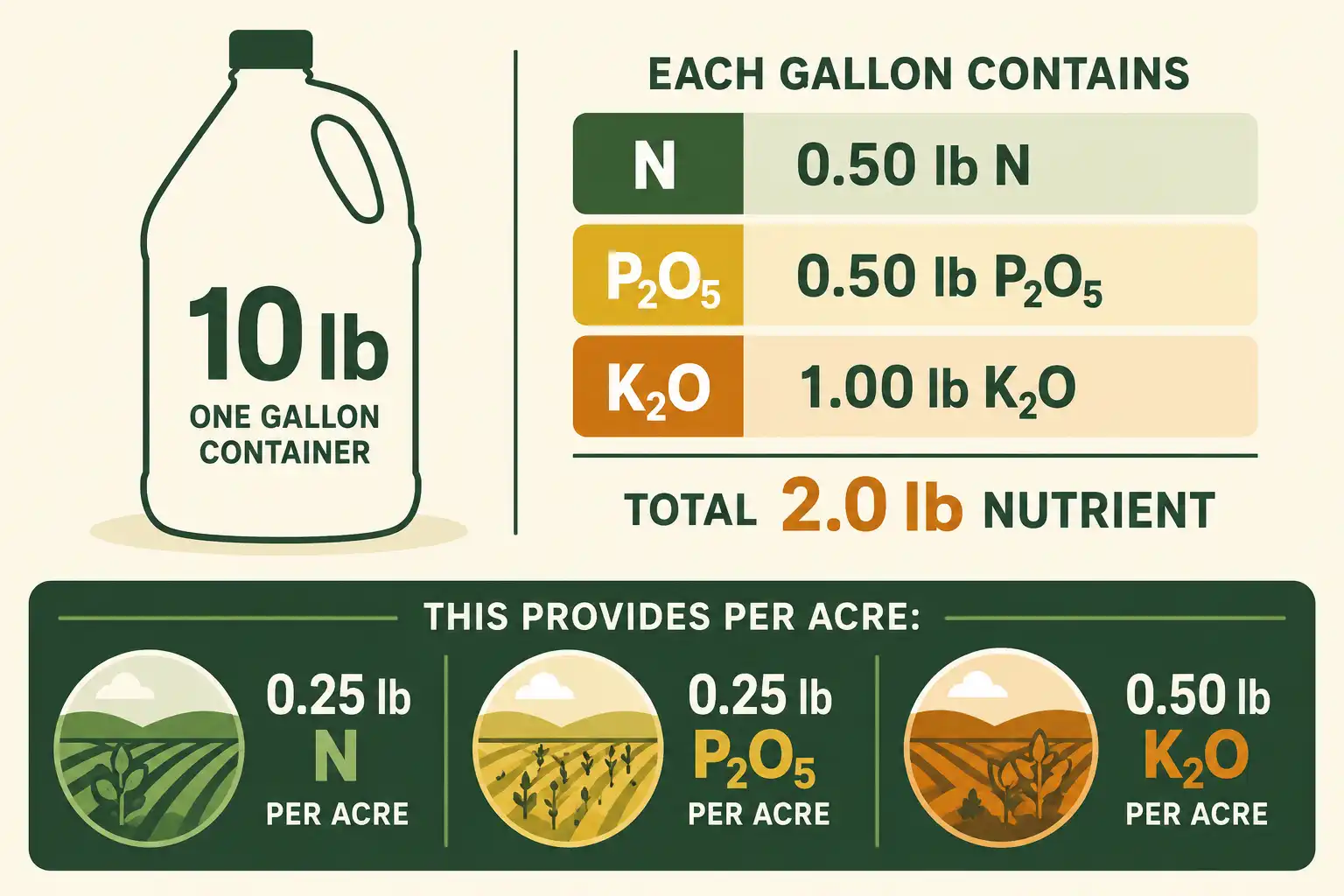
A gallon of liquid 5-5-10 weighing 10 pounds holds 2 pounds of total nutrient. That is the number that matters, and most buyers never work it out.
| Nutrient | Per gallon | Per acre at 2 acres per gallon |
|---|---|---|
| Nitrogen (N) | 0.50 lb | 0.25 lb |
| Phosphate (P2O5) | 0.50 lb | 0.25 lb |
| Potash (K2O) | 1.00 lb | 0.50 lb |
| Elemental phosphorus | 0.22 lb | 0.11 lb |
| Elemental potassium | 0.83 lb | 0.42 lb |
Keep that half pound of K2O per acre in mind. It shapes every decision further down.
What Is 5-5-10 Fertilizer Used For?
5-5-10 fertilizer supports fruit set, tuber bulking, and crop quality, since potassium drives all three. It works as a light in-season feed rather than a foundation fertilizer.
Potassium does specific jobs inside the plant. It regulates stomata, so water use tightens up during dry stretches. It also moves sugars from leaves into fruit and tubers. Plus it firms cell walls, which shows up as better shipping quality and fewer soft spots.
That is why a potassium forward grade earns its place at particular moments. Nitrogen builds the canopy early. Once flowering starts, though, extra nitrogen just grows more leaves. Potassium is what fills the fruit.
The 5% nitrogen still matters. It keeps foliage working during heavy fruit load without pushing rank growth. In practice, that small nitrogen share is a feature of the grade, not a shortfall.
Around Topeka it helps to use this ratio most in late July and early August. Heat is up, the crop is carrying fruit, and demand peaks. Meanwhile a dry August in the Great Plains slows root uptake right when the plant needs potassium most.
Where 5-5-10 Does Not Belong
Skip 5-5-10 on young transplants and on any crop still building leaf area. Early growth wants nitrogen and phosphorus, so a starter grade fits better there.
Also skip it on established lawns. Turf needs roughly 1 pound of nitrogen per 1,000 square feet per feeding. A quarter pound of nitrogen per acre does not come close.
Which Crops Respond Best to a 5-5-10 Ratio?
Heavy potassium feeders respond best, so tomatoes, potatoes, grapes, peppers, and squash top the list. These crops pull more potassium than nitrogen out of the field.
| Crop and yield | K2O removed per acre | Where 5-5-10 fits |
|---|---|---|
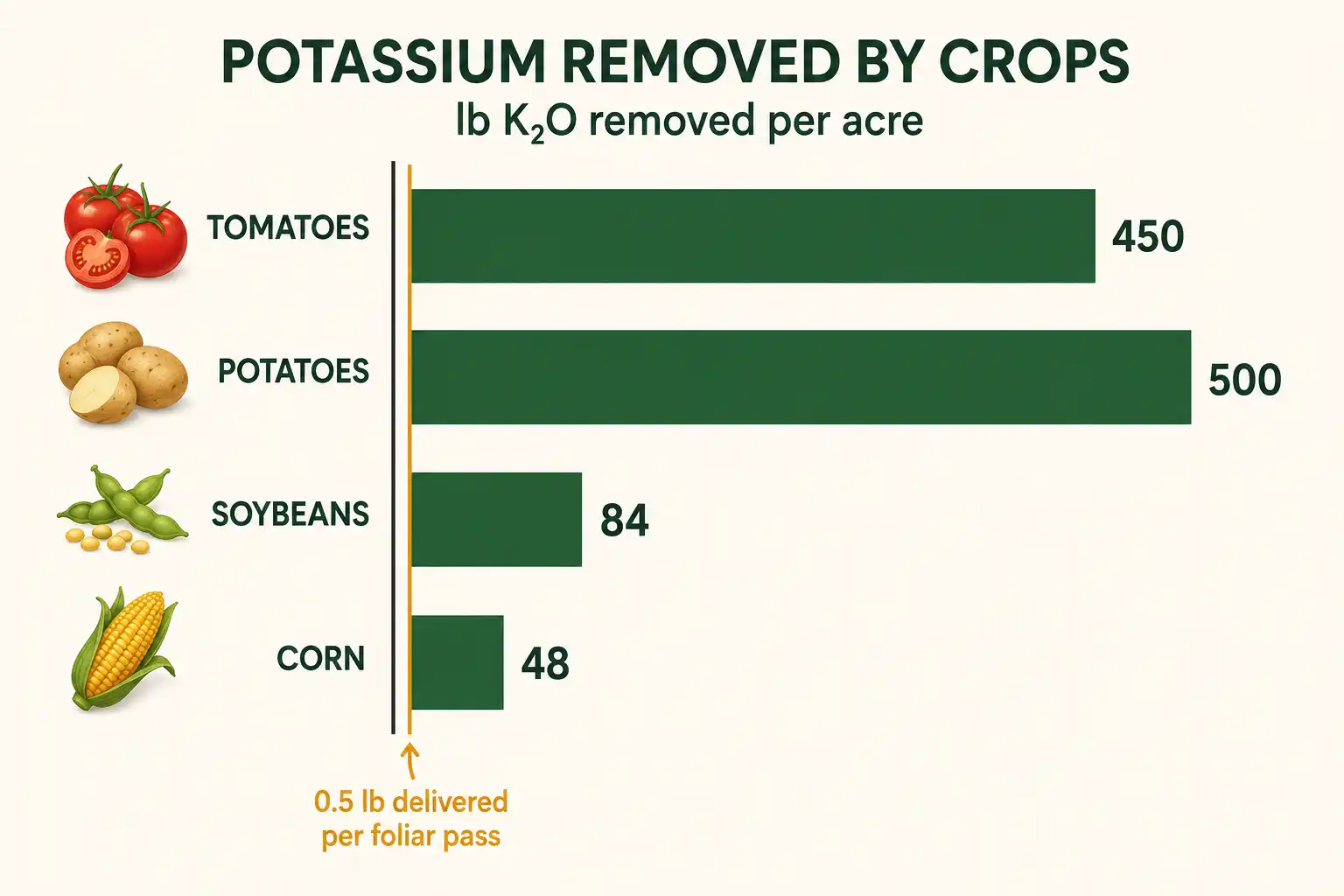
| Tomatoes, 40 tons | Over 450 lb | First fruit set through peak picking |
| Potatoes, 450 cwt | About 500 lb | Tuber bulking after row closure |
| Soybeans, 60 bu | 69 to 84 lb | Pod fill, R3 through R5 |
| Corn, 200 bu | 40 to 54 lb | Rarely pays, use soil applied potash |
| Grapes | Moderate, quality driven | Veraison through harvest |
| Peppers and squash | Moderate to high | Continuous fruit set |
Those removal figures come from land grant work at Michigan State and Illinois Extension. Notice how far they run above what any foliar pass delivers. Still, timing a small dose at the right stage can lift quality even when total supply is adequate.
Tomatoes are the clearest fit. If you want the full-season plan, our walkthrough on fertilizing tomatoes covers the soil applied side that has to come first.
Corn is the weakest fit. A 200 bushel crop removes roughly 48 pounds of K2O, and a foliar pass supplies half a pound. So fix corn potassium in the soil instead.
When Should You Apply 5-5-10 Fertilizer?
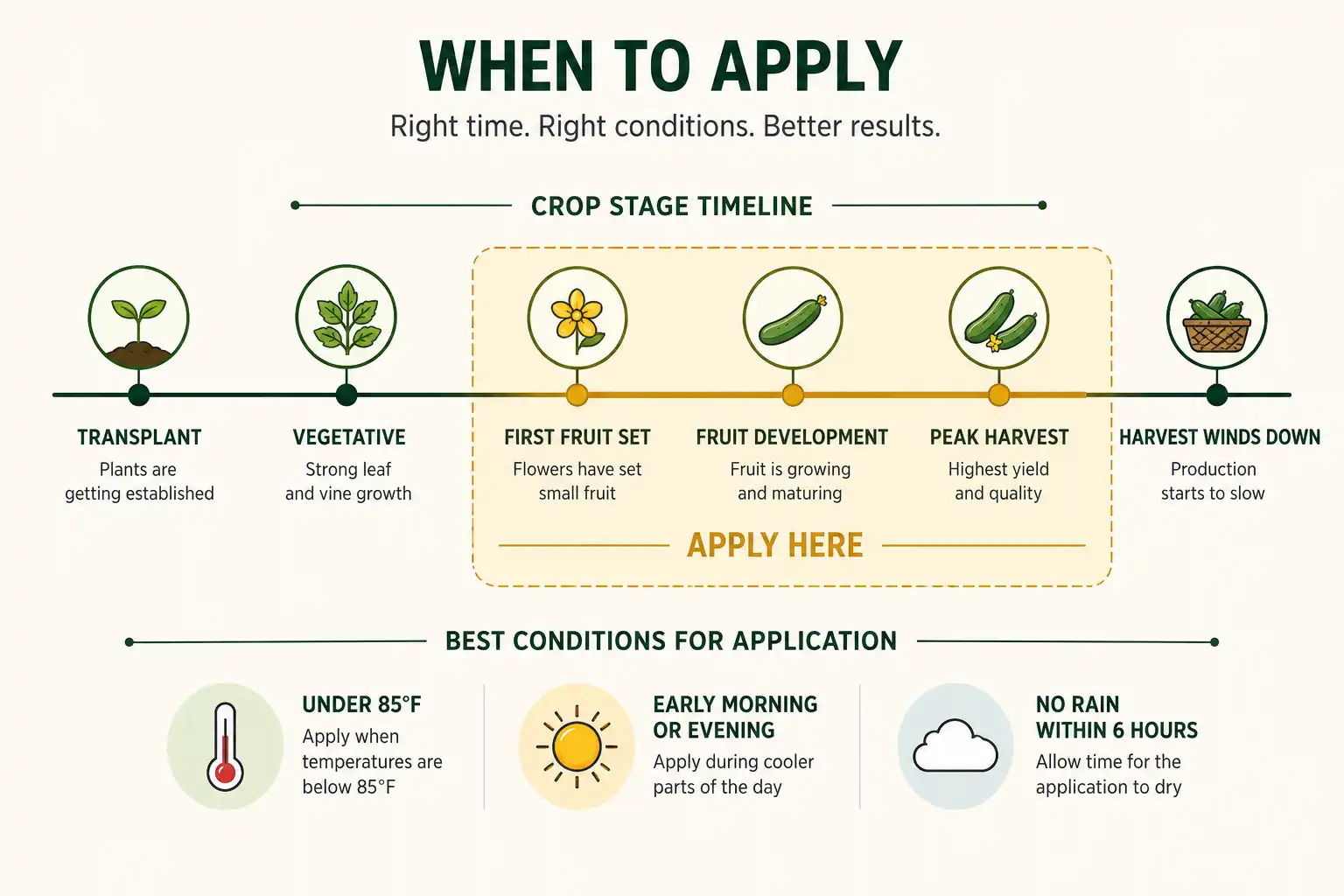
Apply 5-5-10 once reproductive growth starts, because that is when potassium demand climbs fastest. For most vegetables, that means first flower or first fruit set.
Growth stage beats calendar date every time. Here is the timing.
- Tomatoes and peppers: first application at first fruit set, then every 10 to 14 days through peak harvest
- Potatoes: start after row closure as tubers begin sizing, then repeat twice
- Soybeans: R3 to R5 only, and only where tissue tests show potassium slipping
- Grapes: one pass at veraison as berries begin to color
- Squash and cucumbers: every two weeks once vines start setting fruit
Weather sets the window inside that plan. Spray early morning or the last two hours of daylight. University of Minnesota Extension advises against foliar potassium above 90°F.
Humidity works in your favor here. Nutrients only move into the leaf while the droplet stays wet. Once it dries, uptake stops, so a humid evening buys you hours instead of minutes.
Also watch the radar. Rain within about six hours washes the pass off before it does anything.
How to Apply 5-5-10 Fertilizer
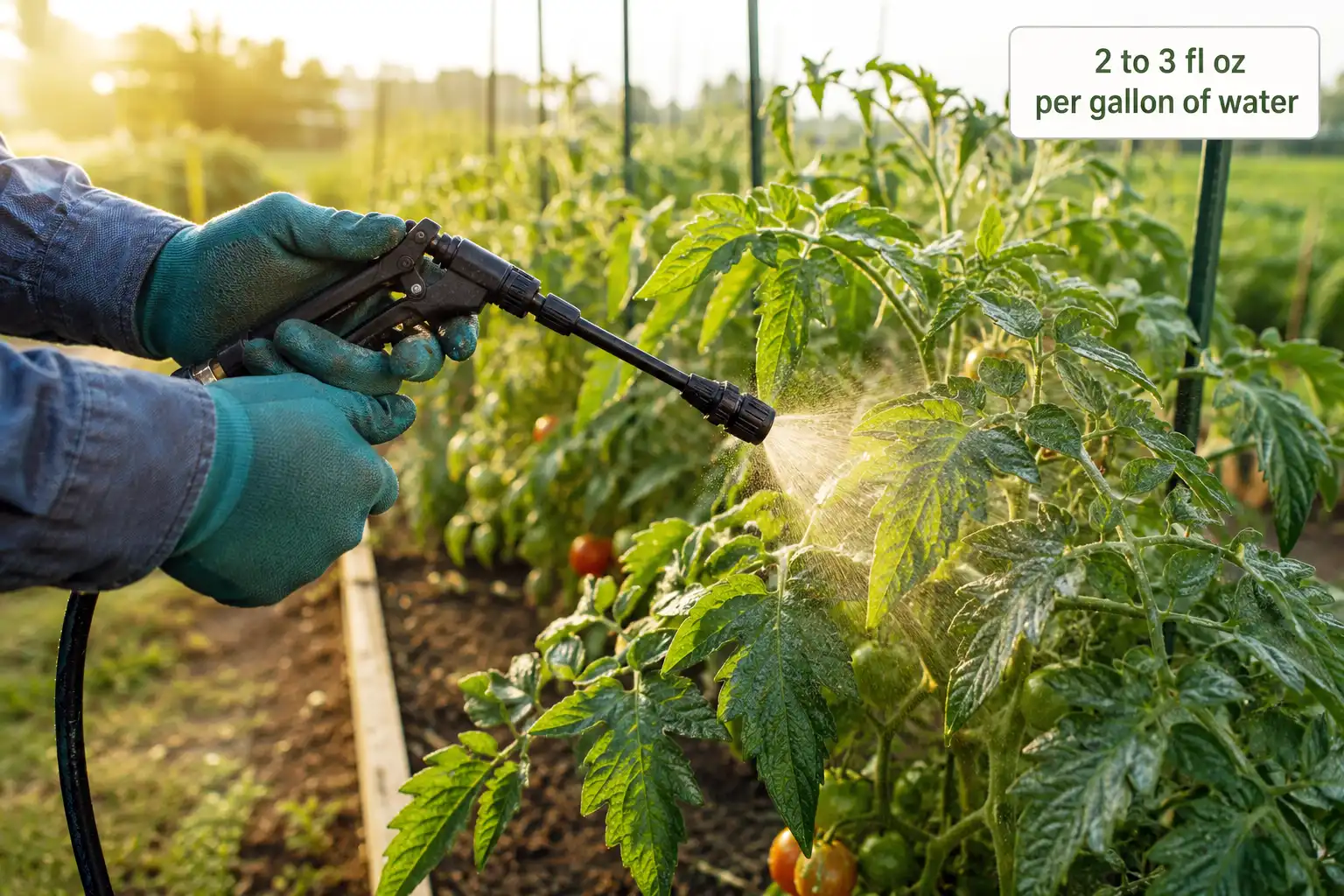
Dilute the concentrate, then spray until leaves are evenly wet without dripping. Most liquid 5-5-10 labels call for 2 to 3 fluid ounces per gallon of water.
That dilution is worth checking, because it tells you a lot. At 2 ounces per gallon, the finished spray runs about 0.37% total nutrient. That sits comfortably below the level where salt burn starts on tender foliage.
Garden and Container Rates
Mix 2 fluid ounces per gallon of water for beds and containers, then step up to 3 ounces for mature, heavy-bearing plants. One gallon of concentrate makes 43 to 64 gallons of finished spray, so a single jug lasts a home garden several seasons.
Cover both leaf surfaces. Stomata concentrate on the underside, yet most people only spray the top. A fine mist covers more surface than a coarse stream, so dial your nozzle down.
For bed-scale work a pump sprayer is plenty. Once you get past a quarter acre, though, a battery backpack sprayer holds pressure steady and gives you far more even coverage.
Field and Row Crop Rates
Apply 0.5 gallon of concentrate per acre in 21 to 32 gallons of water. That works out to one gallon covering two acres, which matches typical label coverage.
Carrier volume is the part people get wrong. Foliar nutrition depends on coverage, not on concentration. So push your water volume toward 30 gallons per acre rather than cutting it to save time.
Two or three passes at 10 to 14 day intervals fit most crops. Beyond that you are spending money without adding uptake.
Fertigation and Drip
Run the same dilution through drip lines during peak demand. Inject into a running system, then flush the lines afterward. Otherwise salts sit in the emitters and plug them.
Drip delivery reaches roots instead of leaves, which lifts the useful rate considerably. So fertigation is the better choice when you actually need nutrient volume rather than a quick top-up.
Does Foliar 5-5-10 Replace a Soil Potassium Program?
No, foliar 5-5-10 cannot replace soil applied potassium, because leaves absorb only small amounts per pass. Treat it as a supplement layered on top of soil fertility.
The arithmetic settles this quickly. A foliar pass delivers half a pound of K2O per acre. A 200 bushel corn crop removes roughly 48 pounds. So one pass covers about 1% of what the crop pulls out.
Extension research backs that up. Iowa State reported 47 Midwest corn trials with foliar micronutrients and mixes that showed no yield increase. Across 63 soybean trials, only one showed a significant gain.
Cost tells the same story. Muriate of potash ran near $494 per ton retail in mid 2026, which pencils out to about $0.41 per pound of K2O. That same half pound costs roughly 21 cents dry, against about $21 per acre through a foliar jug.
None of that makes 5-5-10 a bad product. It makes it the wrong tool for bulk nutrition. You buy timing and convenience, not tonnage.
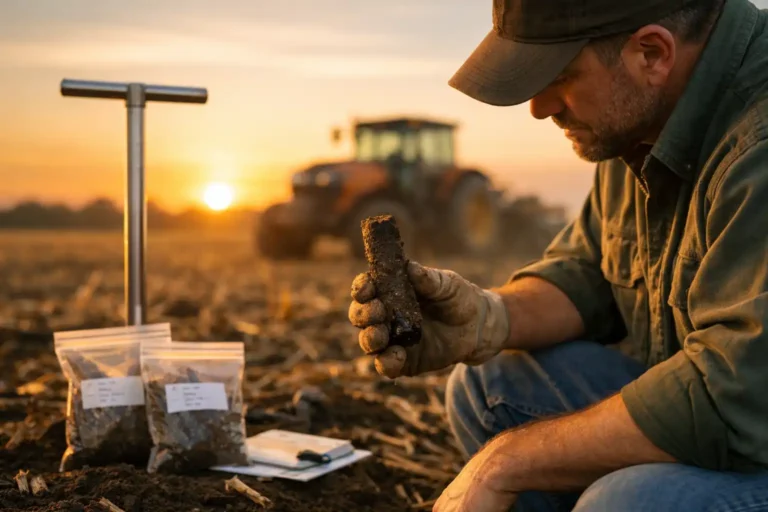
So build the base first. Pull samples and run soil testing every two or three years. K-State Research and Extension sets the critical soil test potassium level near 130 ppm for major Kansas crops. Anything below that needs dry material to correct it.
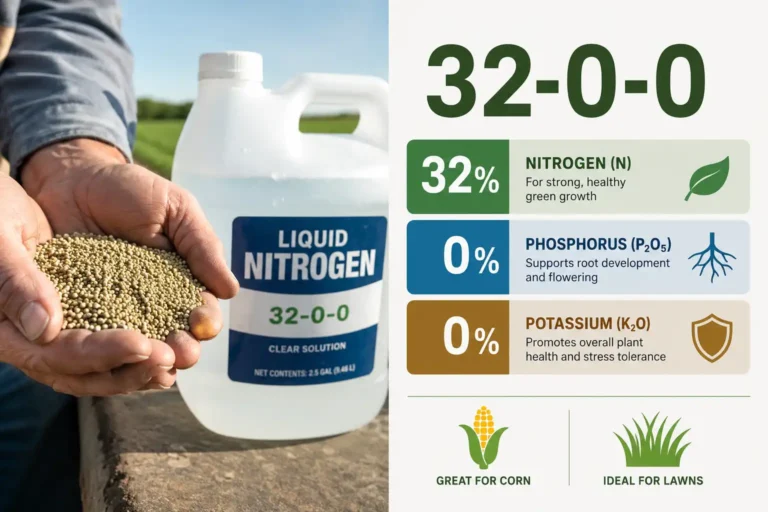
For that correction, 0-0-60 potash is the cheapest source per pound of nutrient you can buy. Broadcast it ahead of the crop, then use 5-5-10 for in-season fine tuning.
The Micronutrient Angle Is the Real Advantage
Micronutrients are where foliar feeding genuinely outperforms soil application. Iron, manganese, and zinc often sit locked up in high pH soils even after you apply them. Leaf delivery bypasses that problem.
A 5-5-10 carrying boron, copper, iron, manganese, molybdenum, and zinc gives you a maintenance dose alongside the potassium. Just keep expectations honest. At label dilution, iron and boron land near 18 ppm in the spray, which is well under a corrective rate.
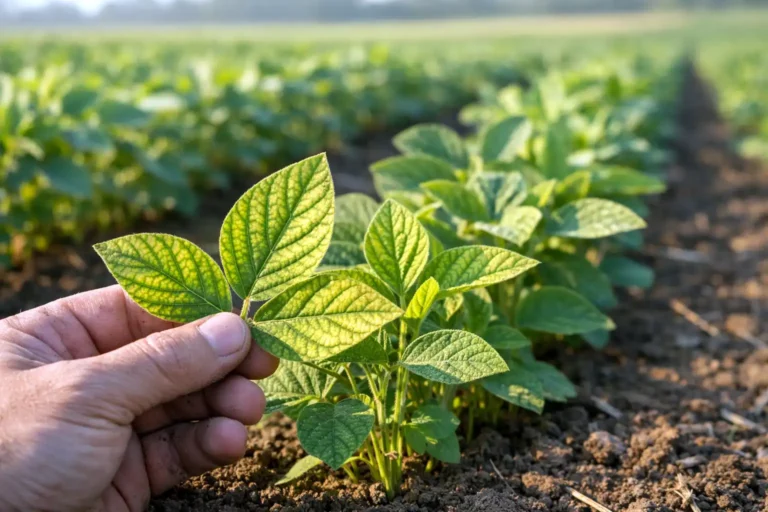
That means the micro package prevents drift toward shortage rather than fixing an existing one. If you see clear micronutrient deficiency symptoms, you need a targeted single-nutrient product at a proper rate.
Best 5-5-10 Fertilizer
The best 5-5-10 fertilizer is NutraTender 5-5-10 Foliar Fertilizer. It pairs the potassium forward ratio with a full six-element micronutrient package. It is a liquid concentrate built for spraying, not a granular blend.
NutraTender 5-5-10 Foliar Fertilizer
This mixes well for backpack sprayer application on staked tomatoes and short potato rows. The mixing math is straightforward, which is not true of every product on the market. One gallon at 2 to 3 ounces per gallon of water yields 43 to 64 gallons of spray. That lines up with the 2 acre coverage claim at a sensible 21 to 32 gallons per acre. It goes into solution clean and sprays without clogging a fine nozzle.
The micronutrient list stands out as a notable feature. Boron, copper, iron, manganese, molybdenum, and zinc all carry a guaranteed percentage, not a vague “with micros” line. Owner reports note firmer fruit and less shoulder cracking on tomatoes through August heat. Just understand what you are buying. This is an in-season supplement at roughly $21 per acre per pass, so it fits high-value ground rather than row crop acres..
Specifications:
- Analysis: 5-5-10 plus B, Cu, Fe, Mn, Mo, Zn
- Form: liquid concentrate, 1 gallon, 10 pounds
- Mix rate: 2 to 3 fl oz per gallon of water
- Supplies 0.50 lb N, 0.50 lb P2O5, 1.00 lb K2O
What to Check on Any 5-5-10 Label Before You Buy
Read the “derived from” line first, since the nutrient source changes how the product behaves. Potassium nitrate adds nitrogen you did not count on. Potassium chloride can scorch leaves on chloride-sensitive crops like potatoes and tobacco.
Then work through the rest.
- Chelation: look for EDTA or EDDHA on iron, manganese, and zinc, because chelated forms stay available in hard, alkaline water
- Net weight: you need pounds per gallon to convert percentages into actual nutrient
- Coverage claim: divide container volume by the mixing rate and check that the acre figure holds up
- Boron percentage: boron has a narrow safe range, so watch it on beans and cucurbits
- Surfactant: if none is included, add a non-ionic wetting agent for waxy foliage
- OMRI listing: required if you sell certified organic, and most liquid 5-5-10 products do not carry it
5-5-10 vs Other Common Grades
5-5-10 differs from other grades by putting potassium ahead of nitrogen at a low total analysis. That makes it a finishing fertilizer rather than a foundation one.
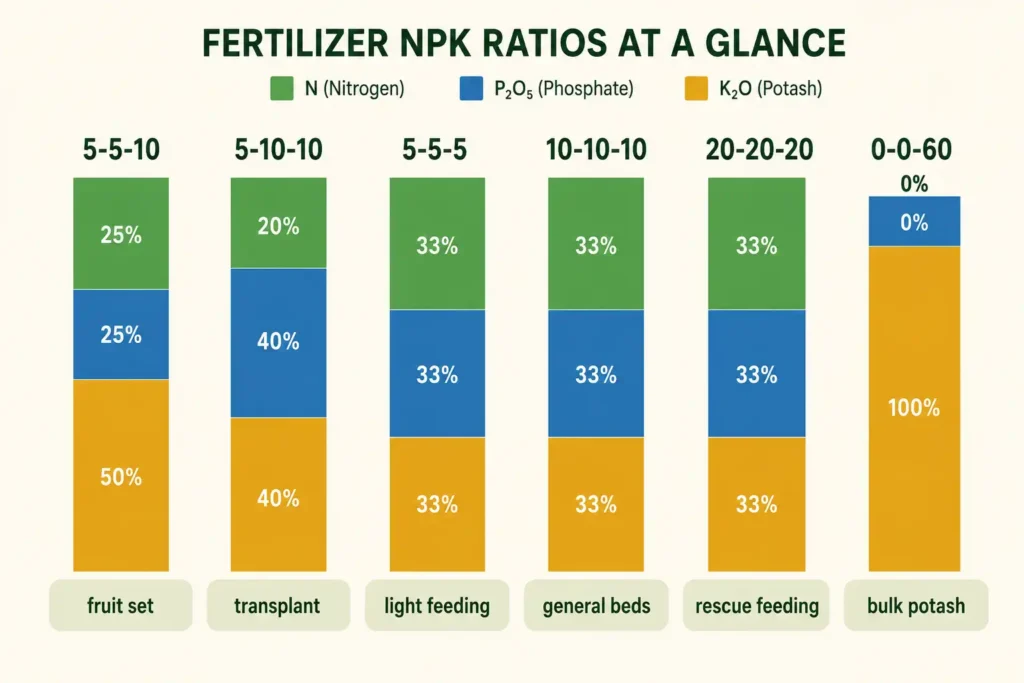
| Grade | Ratio | Where it fits | Watch for |
|---|---|---|---|
| 5-5-10 | 1:1:2 | Fruit set, tuber bulking, quality finish | Low total nutrient per gallon |
| 5-10-10 | 1:2:2 | Transplanting and early root growth | Phosphate builds up over years |
| 5-5-5 | 1:1:1 | Light general garden feeding | Too little potash for heavy feeders |
| 10-10-10 | 1:1:1 | Broad garden and bed feeding | Nitrogen can favor leaves over fruit |
| 20-20-20 | 1:1:1 | Water soluble rescue feeding | High salt load, easy to overapply |
| 0-0-60 | 0:0:1 | Bulk soil potassium correction | Chloride load, supplies no N or P |
The comparison people ask about most is 5-5-10 against 5-10-10. Those two are not interchangeable. A 5-10-10 leans on phosphate for root establishment, so it belongs at transplant. Continue applying it all summer and you slowly build excess soil phosphorus, which then interferes with zinc and iron uptake.
If you want a stronger soluble option for a struggling crop, a 20-20-20 blend delivers far more nutrient per gallon. Just watch the salt index, since it burns much more easily than 5-5-10.
Mixing, Tank Compatibility, and Storage
Jar test any tank mix before it goes in the sprayer, because foliar fertilizer and pesticides do not always play well together. Mix a small sample at field strength, then let it stand 30 minutes.
Follow the W-A-L-E-S order that University of Arkansas Extension publishes: wettable powders, agitate, liquid flowables, emulsifiable concentrates, then surfactants. Add one product at a time, and agitate between each.
Check the jar for sludge, curdling, separated layers, or crystals. Any of those means the mix fails, so keep the products in separate passes.
Fungicide tank mixes deserve extra care. Some foliar fertilizers combined with fungicides injure leaves, which defeats the point of the fungicide pass. Test that combination on a few plants first.
Storage is simple but easy to neglect.
- Store above freezing, since cold pushes salts out of solution and they may not fully redissolve
- Keep the container sealed and out of direct sun
- Shake before every use, especially after cold weather
- Never store diluted spray solution, because it separates and loses stability
FAQs About 5-5-10 Fertilizer
Is 5-5-10 fertilizer organic?
Can 5-5-10 fertilizer burn plants?
How often should you apply 5-5-10?
Is 5-5-10 the same as 5-10-10?
Does 5-5-10 work as a starter fertilizer?
How long does a gallon of 5-5-10 last?
Where 5-5-10 Fits in a Fertility Program
Follow this order of operations. Soil test first, then correct any potassium shortfall with dry material broadcast ahead of the crop. After that, 5-5-10 becomes a timing tool for the weeks when fruit is filling and heat is limiting root uptake.
On tomatoes, potatoes, and grapes, that timing pays. On corn and soybean acres, foliar potassium is usually less effective, so soil applied potash is often the better investment.
Buy 5-5-10 for what it does well. It delivers a small, well-timed potassium and micronutrient dose to high-value crops during their hardest weeks. Ask it to carry your whole potassium program and it will disappoint you.