0 0 60 Fertilizer: Uses, Rates, and Best Bagged Picks
Potassium runs short in more fields than most growers expect. 0-0-60 fertilizer fills that gap faster and cheaper than any other dry source. It carries no nitrogen and no phosphate. Below is what the grade does, who should use it, and who should skip it.
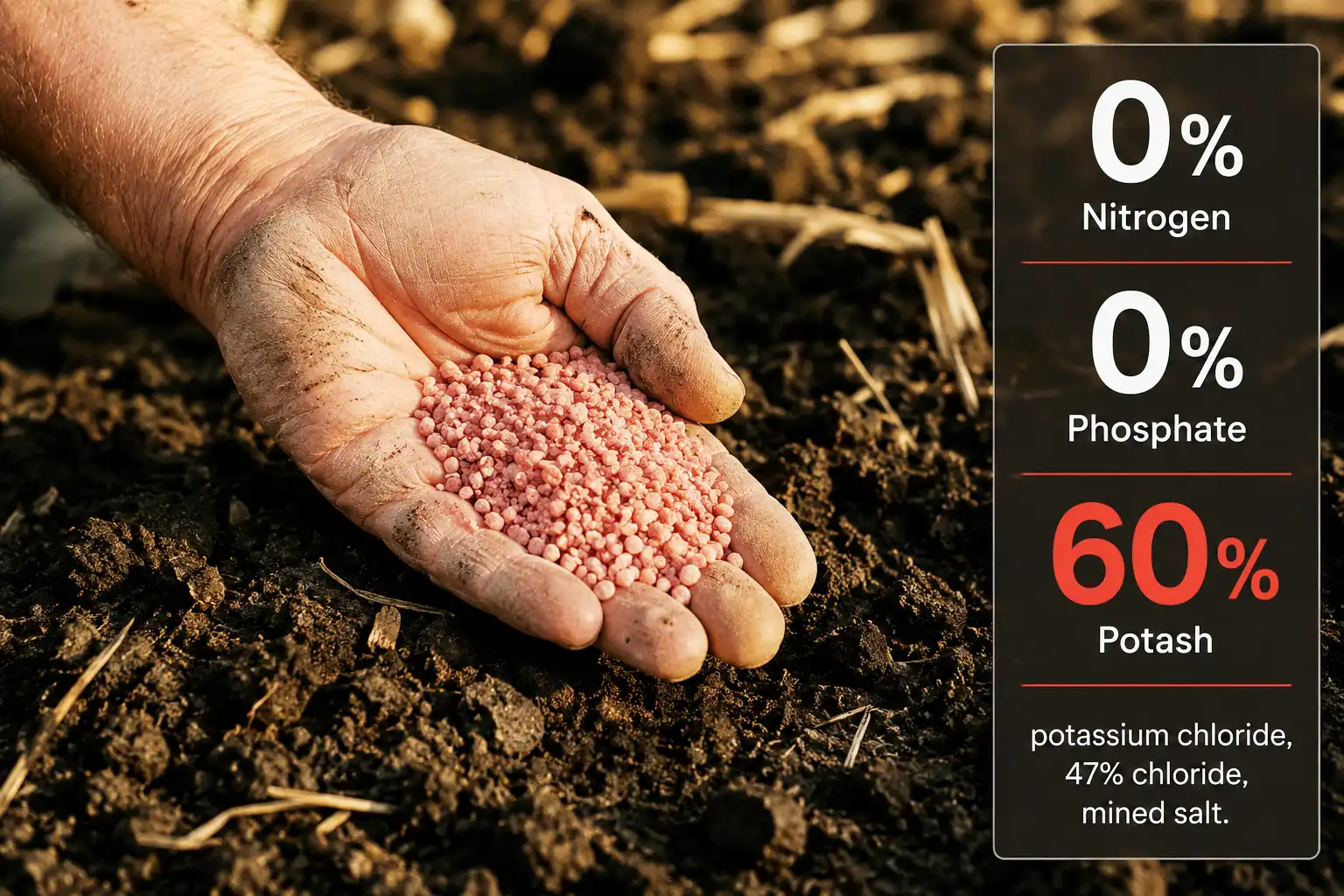
0-0-60 fertilizer is muriate of potash, a mined potassium chloride salt supplying 60 percent K2O and roughly 47 percent chloride. Apply it by soil test, broadcast ahead of planting, and keep it off chloride sensitive crops.
What Is 0-0-60 Fertilizer?
0-0-60 fertilizer is potassium chloride, sold as muriate of potash or simply potash. Miners pull it from ancient seabed deposits as the mineral sylvite. Then processors clean and granulate it. The finished product carries no nitrogen and no phosphate, so every pound of it works on one nutrient only.
Also See: 4-4-4 Fertilizer Guide
Here is the typical analysis of a standard granular grade:
| Component | Typical value |
|---|---|
| Potash (K2O) | 60 to 62 percent |
| Elemental potassium (K) | About 50 percent |
| Chloride (Cl) | About 47 percent |
| Sodium chloride | Around 2.5 percent |
| Salt index | 116 |
| Color | White, pink, or red |
| Water solubility | Fully soluble |
That salt index number matters more than most growers realize. Sulfate of potash sits at 46 on the same scale. So muriate of potash carries more than twice the salting effect per unit. That figure is worth keeping in mind when setting a rate near a seed row.
Color throws people off too. Potash ranges from white to pink to brick red depending on the extraction site and the refining route. Red potash is not lower quality. It simply carries trace iron oxide from the ore.
What Do the Three Numbers Mean?
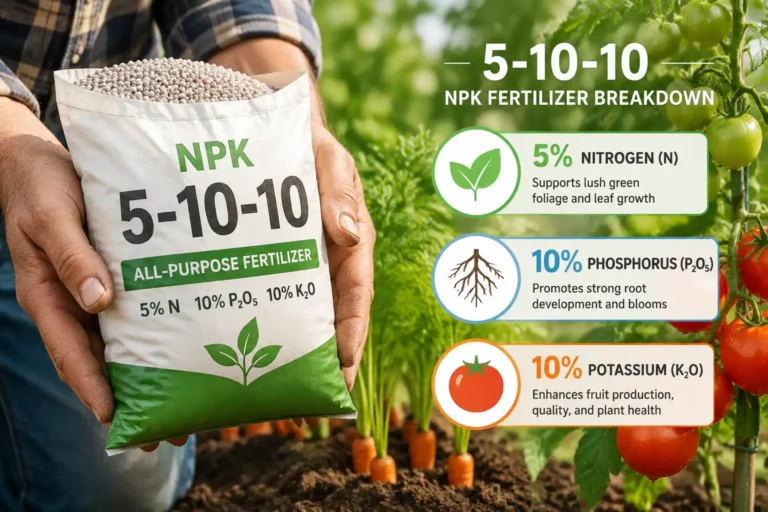
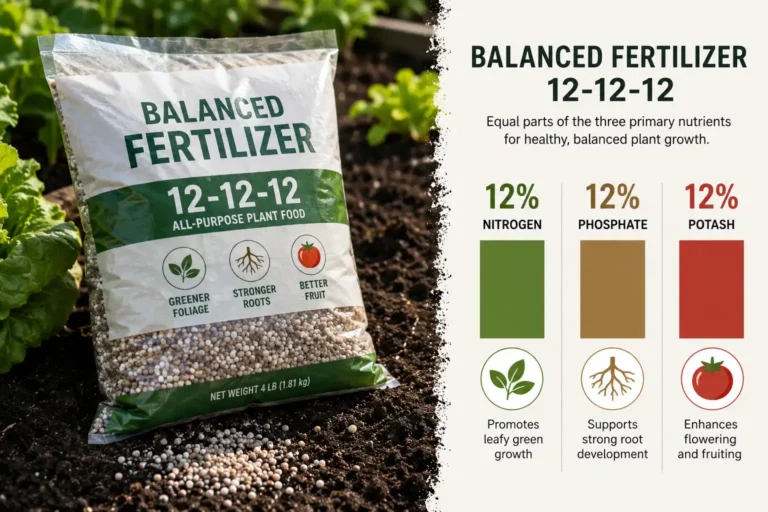
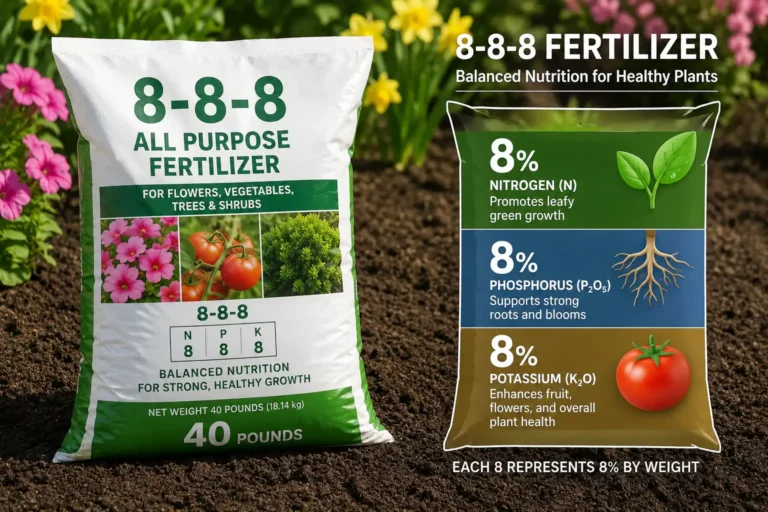
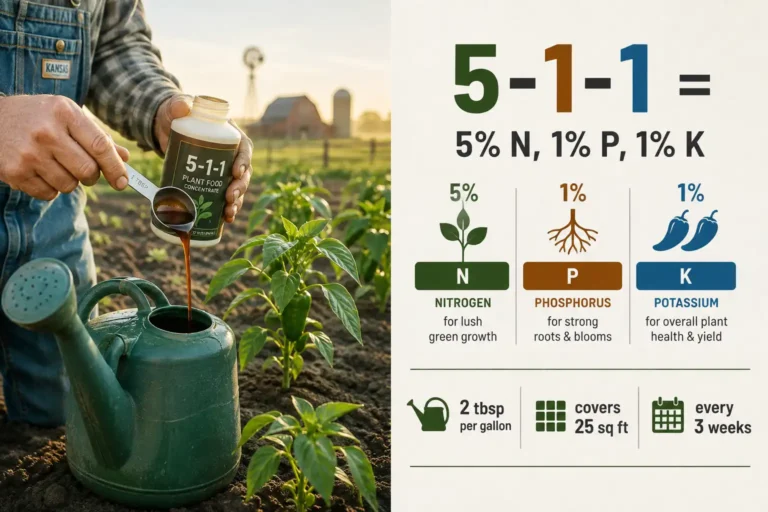
The three numbers give the guaranteed analysis by weight: nitrogen, phosphate, and potash, always in that order. So 0-0-60 means zero nitrogen, zero phosphate, and 60 percent potash. A 50 pound bag therefore holds 30 pounds of actual K2O.
One detail trips up a lot of people. That third number reports K2O, not elemental potassium. To convert, multiply K2O by 0.83. So 60 pounds of K2O equals about 50 pounds of true potassium. Soil test labs report potassium as ppm K, while fertilizer recommendations come back as pounds of K2O per acre. Keep the two units separate and the math stays clean. If the labeling system still feels murky, this breakdown of what NPK ratios mean for crop nutrition walks through it.
Is 0-0-60 the Same as Muriate of Potash?
Yes. 0-0-60 and muriate of potash describe the same product. “Muriate” is an old word for chloride, so muriate of potash simply means potassium chloride. You will also see it labeled MOP, KCl, potash, or red potash. All four names point at one bag.
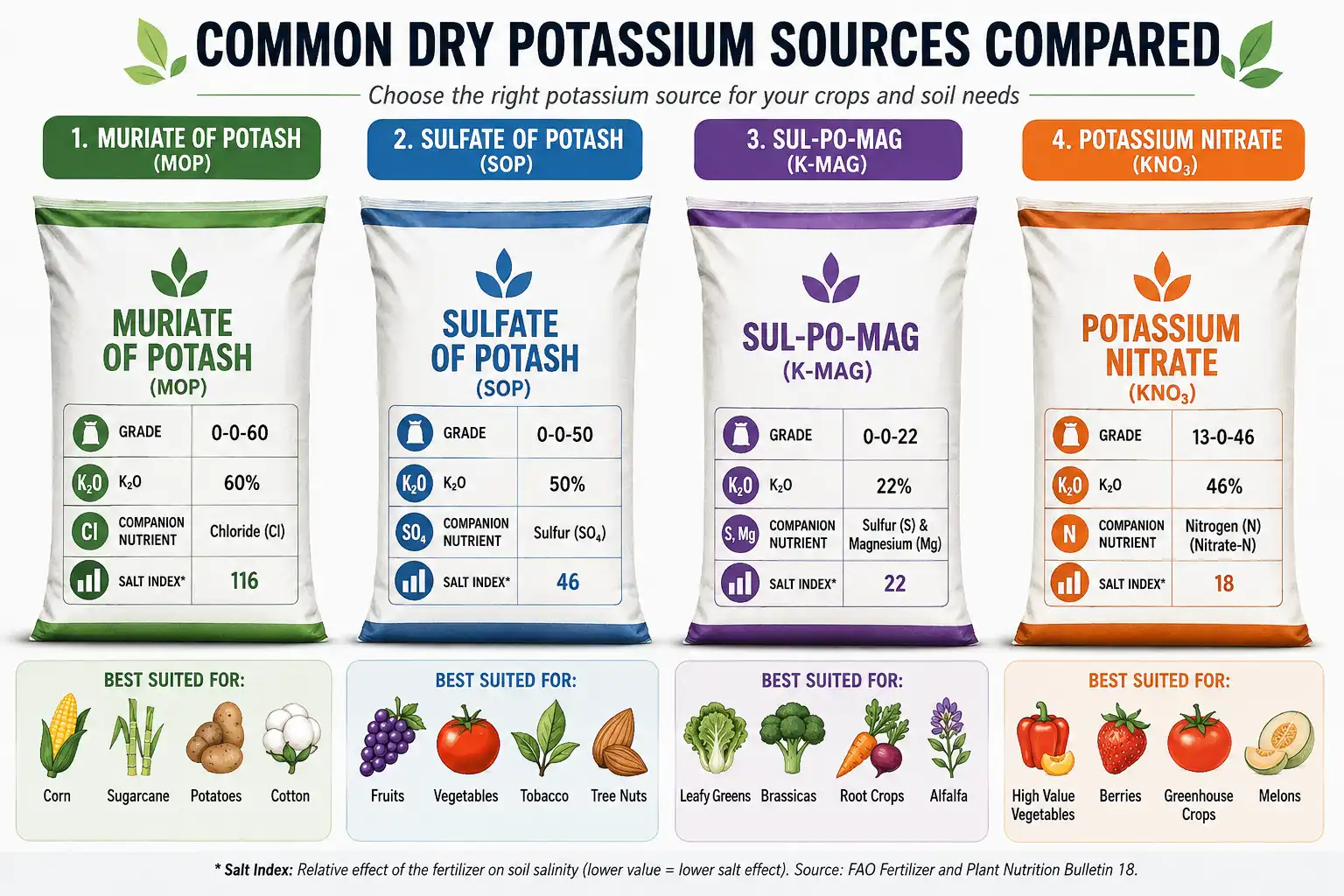
Some sellers list 0-0-62 instead. That grade is the same salt, just refined to a slightly higher purity. Treat the two as interchangeable and adjust your rate by a couple of percent.
What Is 0-0-60 Fertilizer Used For?
0-0-60 fertilizer corrects potassium shortages in crops that tolerate chloride. Corn, wheat, grain sorghum, alfalfa, cotton, and grass hay all handle it well. It also serves as the potassium leg in most blended dry fertilizer. So your local plant likely mixes it into any blend carrying a third number.
Potassium itself does specific jobs inside the plant. It regulates the stomata that open and close on leaf surfaces. Because of that, potassium controls how a crop manages water during heat. It also activates dozens of enzyme reactions, moves sugars from leaves to grain, and thickens cell walls. Stalk strength depends on it, which is why potassium short corn lodges late in the season.
| Crop or use | Typical fit for 0-0-60 |
|---|---|
| Corn | Excellent, and corn responds strongly to K |
| Wheat and barley | Excellent, plus a chloride benefit in many soils |
| Grain sorghum | Excellent, chloride helps suppress stalk rot |
| Soybeans | Good, but watch rate and timing near planting |
| Alfalfa and grass hay | Excellent, hay removes very large amounts of K |
| Cotton | Good |
| Lawns and pasture | Good, water in after spreading |
| Potatoes | Poor, use a sulfate source instead |
| Tobacco, berries, grapes | Poor, chloride hurts quality |
In northeast Kansas the chloride side actually earns its keep. K-State Research and Extension has documented wheat responses to chloride across the state. Odds of a response run higher in northeast and central Kansas than out west. Chloride fertilization suppresses several fungal diseases in wheat, including tan spot, leaf rust, and stripe rust. It also helps against stalk rot in sorghum and corn. K-State recommends chloride when a 24 inch profile test comes back under 6 ppm. So a potash application often pays twice.
Which Crops Should Not Get 0-0-60?
Chloride sensitive crops should not get 0-0-60. Potatoes top that list. Work from University of Minnesota and Oregon State shows potassium chloride lowers tuber specific gravity. Sulfate of potash holds it higher. Lower specific gravity means wetter, starchier tubers, longer fry times, and more storage shrink. Growers feeding the processing market avoid it for exactly that reason.
Other crops to keep off the list:
- Tobacco, where chloride downgrades leaf quality and burn
- Strawberries and raspberries, where chloride can cut sugar content
- Grapes, where chloride affects wine quality
- Tomatoes and peppers, where flavor and quality suffer
- Citrus and acid loving ornamentals, where leaf burn risk climbs
For any of these, buy sulfate of potash at 0-0-50 instead. It costs more per pound of K2O, but it carries under 1 percent chloride and adds 17 percent sulfur. For a potato crop, our guide to fertilizing potatoes through the season covers the sulfate route in detail.
One caution on timing rather than avoidance. University of California work tested fall applied potassium chloride. Chloride leached below the root zone before the potato crop went in. So fall timing softens the problem where a grower has no other option.
How Do You Know Your Field Needs Potash?
A soil test tells you, and nothing else does reliably. Visual symptoms show up late, usually after yield has already slipped. So test first, then decide.
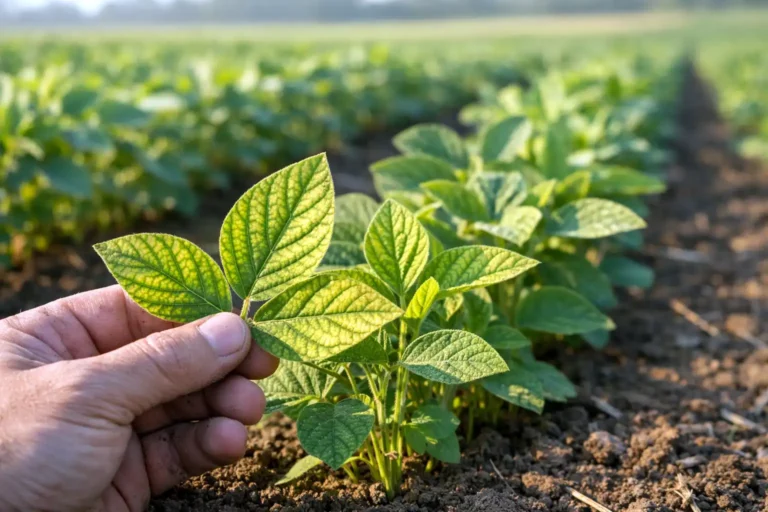
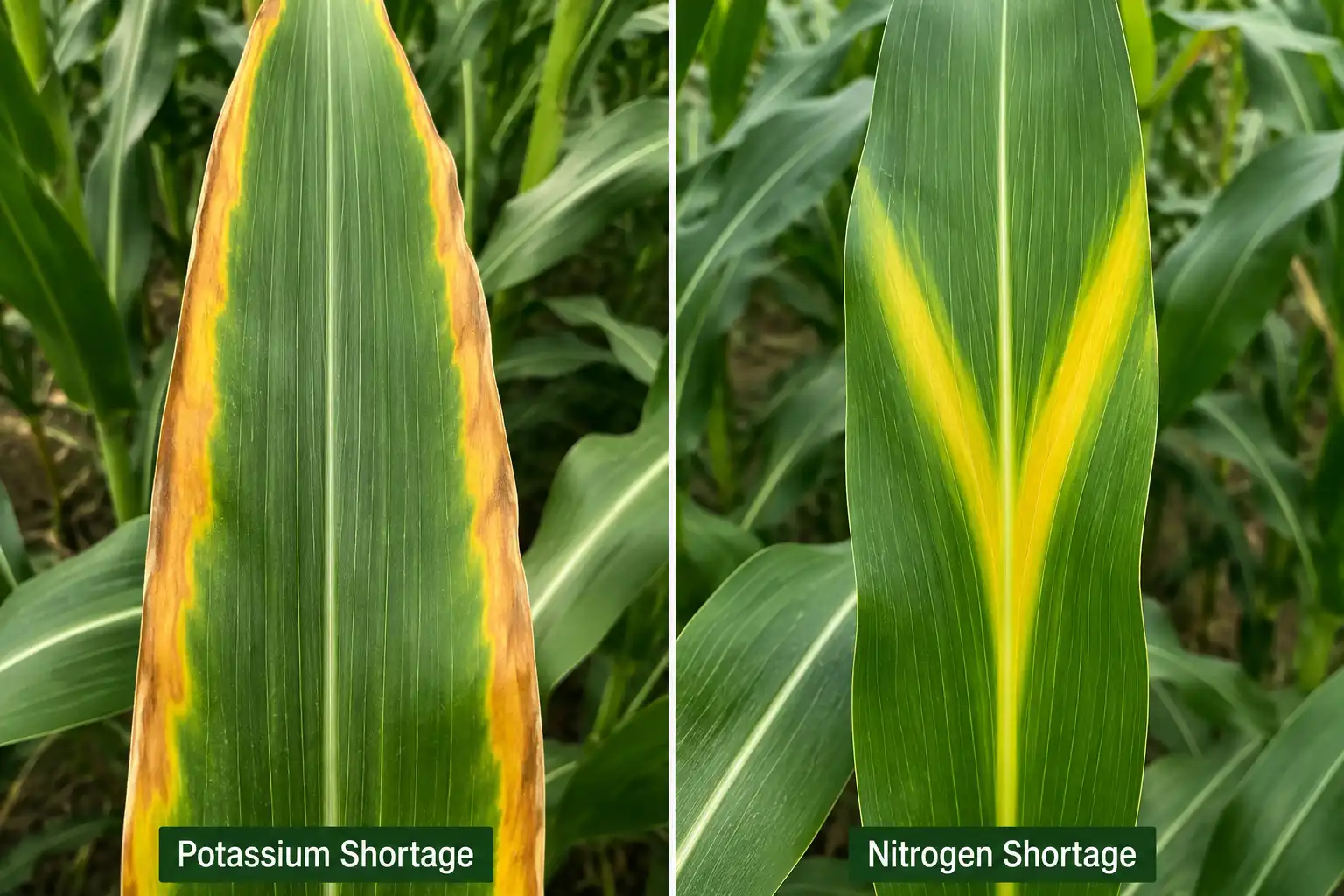
Still, learning the symptoms helps you catch trouble. Potassium moves easily inside the plant. It pulls out of older tissue and travels to new growth. That means deficiency always shows on the bottom leaves first.
| Nutrient | Where it shows | Pattern on the leaf |
|---|---|---|
| Potassium | Lower, older leaves | Yellowing along the outer margins, starting at the tip and running down the edges |
| Nitrogen | Lower, older leaves | Yellow V shape running from the tip down the midrib |
Iowa State Extension makes that difference the key diagnostic. Potassium burns the edges. Nitrogen runs the middle. Once you see it that way, you rarely confuse the two again.
In corn, symptoms usually appear between V6 and tasseling. Severe cases kill the lower leaves, delay silking, shrink ear size, and weaken stalks enough to cause lodging. In soybeans, symptoms can start as early as V3 in the lower canopy. Then they climb into the upper canopy during pod fill. NC State Extension notes that symptomatic soybean patches also look stunted and slow.
One warning worth repeating. Dry weather alone causes these symptoms even on soils testing adequate. Potassium reaches roots by diffusion through soil water. When topsoil dries out, that movement nearly stops. Compaction, sidewall smear, and nematode damage do the same thing by limiting root reach. So pull samples from both a good area and a bad area before you buy anything.
Reading a Soil Test for Potassium
Most labs report exchangeable potassium as ppm K. K-State sets the critical level at 130 ppm for major Kansas crops. Below that number, potash pays. Above it, K-State suggests only a starter containing K. Iowa, Illinois, and the Tri-State guidelines land in a similar range. Still, each state calibrates differently, so use the lab serving your region.
Sample depth matters as much as the number. Potassium stratifies badly under no-till, piling up in the top two inches while the six inch average looks fine. So pull a consistent zero to six inch core. Then pull it the same month every year. A reliable soil test kit for small farm use handles garden ground fine. Field acres deserve a lab test with real calibration behind it.
How Much 0-0-60 Fertilizer Do You Need Per Acre?
Divide the pounds of K2O your soil test calls for by 0.60. That single step converts a recommendation into a bag rate. So a 60 pound K2O recommendation needs 100 pounds of 0-0-60 fertilizer per acre.
Work an actual example. K-State publishes a sufficiency equation for corn:
- K2O rate = 73 + (yield goal x 0.21) + (soil test K x -0.565) + (yield goal x soil test K x -0.0016)
Run it for 180 bushel corn on ground testing 60 ppm K:
- 73 + (180 x 0.21) = 110.8
- 110.8 minus (60 x 0.565) = 76.9
- 76.9 minus (180 x 60 x 0.0016) = 59.6 pounds K2O per acre
- 59.6 divided by 0.60 = 99 pounds of 0-0-60 per acre
Push soil test K to 100 ppm instead. The same equation drops the rate to 43 pounds of product. That is the whole argument for testing before buying. NDSU caps corn potash recommendations at 120 pounds K2O per acre, because their trials showed higher rates actually cut yield. For a deeper look at rate setting, see the numbers on potassium that corn pulls from each acre.
Replacement Math for a Corn and Soybean Rotation
Replacement math keeps soil test levels from sliding year after year. Grain hauls potassium off the field, and you either replace it or watch the test number fall.
| Crop | K2O removed per bushel | Example yield | K2O removed per acre |
|---|---|---|---|
| Corn | 0.27 lb | 180 bu | 48.6 lb |
| Soybeans | 1.40 lb | 60 bu | 84.0 lb |
| Wheat | 0.37 lb | 70 bu | 25.9 lb |
One corn and soybean rotation removes roughly 133 pounds of K2O. That means about 220 pounds of 0-0-60 fertilizer every two years. Soybeans surprise people here. They remove far more potassium per bushel than corn does, so the bean year drives most of the drawdown.
Newer grain surveys from Illinois and Ohio show slightly lower removal per bushel than the older book values, on the order of 10 to 15 percent less. Modern hybrids simply move nutrients more efficiently. So if your soil tests keep climbing on a straight replacement program, trim the rate rather than adding more.
Hay ground is the opposite story. Baling removes the whole plant, not just grain, so alfalfa and grass hay pull enormous amounts of potassium off each acre. Those fields need the heaviest potash program on the farm.
Rates for Gardens, Raised Beds, and Lawns
Small plot rates run far lighter than most bag labels suggest. Use these as starting points, then adjust to your soil test:
| Setting | 0-0-60 rate | Notes |
|---|---|---|
| Garden soil testing low in K | 2 to 4 lb per 1,000 sq ft | Work into the top 4 to 6 inches |
| Garden maintenance | 0.5 to 1 lb per 1,000 sq ft | Only if the test says medium or higher |
| Established lawn | About 1.7 lb per 1,000 sq ft | Delivers 1 lb of K2O, water in fully |
| Raised beds | Skip unless tested | Compost heavy beds often run high in K |
That 2 to 4 pound garden rate delivers 1.2 to 2.4 pounds of K2O per 1,000 square feet. Split it if your soil is sandy, since potassium leaches on coarse ground. Never dump a handful around a single plant. The salt burns roots at close range.
How to Apply 0-0-60 Fertilizer
Broadcast it, then work it in. Potassium barely moves in most soils, so surface applied potash sits where it lands until tillage or rain carries it down. Here is the sequence:
- Pull a soil test and get a real K2O recommendation before buying anything.
- Convert the recommendation to product by dividing by 0.60.
- Calibrate the spreader with a known weight over a measured strip. Potash is dense, around 80 pounds per cubic foot, so a setting made for urea throws it wrong.
- Broadcast in two passes at half rate each, running the second pass at a right angle to the first. That cleans up streaking better than any other trick.
- Incorporate 4 to 6 inches with tillage, or let winter freeze and thaw plus rainfall move it down under no-till.
- Water it in on lawns and gardens with at least a quarter inch. That dissolves the granules and pulls salt away from crowns and roots.
A well calibrated spreader for dry fertilizer does more for your uniformity than any product choice. Streaked potash shows up in the crop by midseason, and by then you cannot fix it.
Skip foliar application entirely. The chloride load and salt index make 0-0-60 a poor choice for spraying on leaves. If you want foliar potassium, buy a low salt fluid product formulated for it.
Keeping Potash Away From the Seed
Potash burns seed at very low rates, so keep it out of the furrow. Extension guidelines across the Corn Belt limit total nitrogen plus K2O in direct seed contact to roughly 5 to 10 pounds per acre, with the low end on sandy ground and the high end on clay. K-State puts the corn threshold at 6 to 8 pounds of N plus K2O on 30 inch rows. Cross that line and you lose stand.
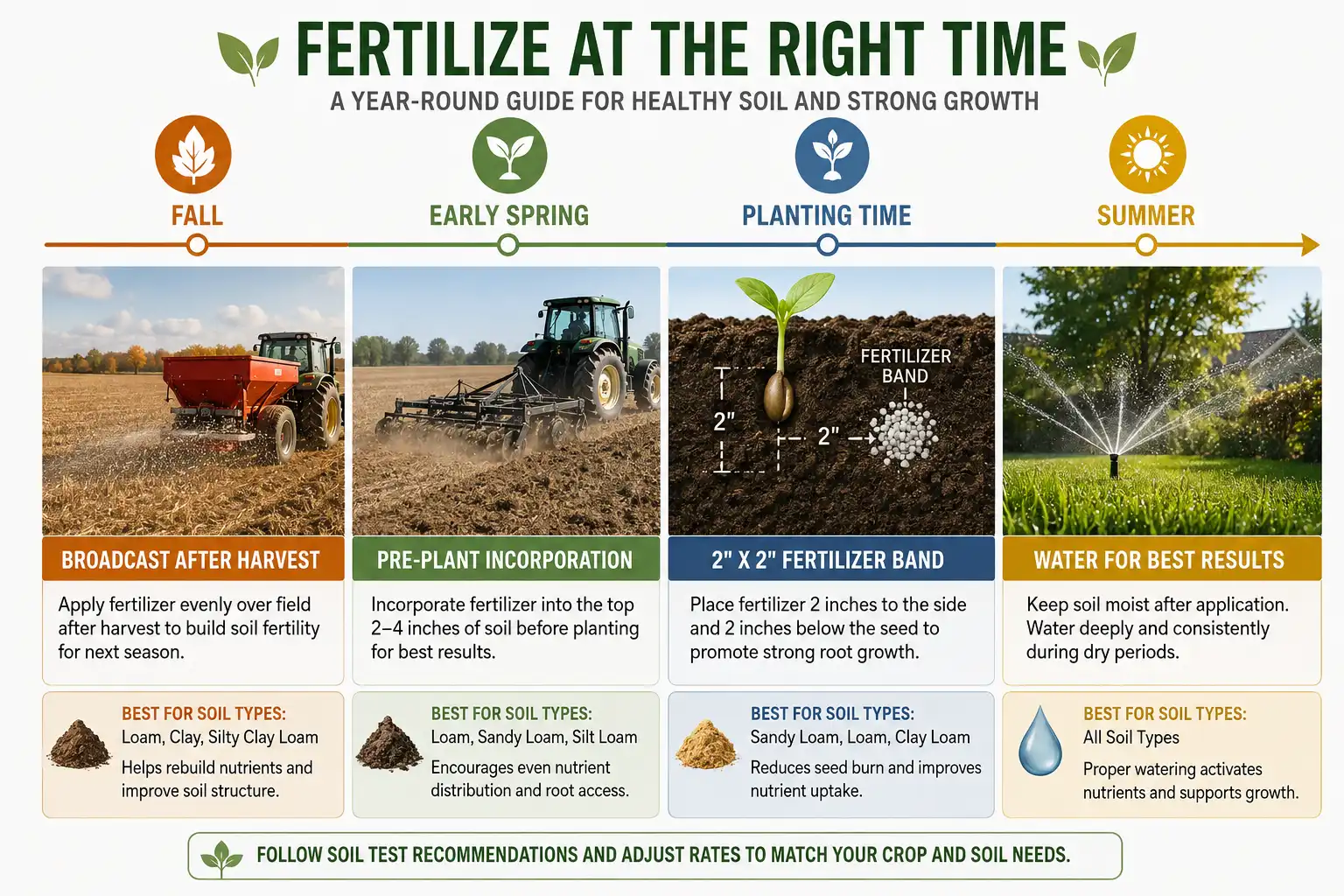
The 2 by 2 band solves this. Placing fertilizer 2 inches to the side and 2 inches below the seed gives roots access without direct salt contact. NDSU still caps banded nitrogen at 50 pounds per acre in that position. Most agronomists cap total banded N plus K2O near 100 pounds per acre.
Soybeans need one extra step. Purdue and University of Minnesota both advise against applying potash within two weeks of planting on silt loam or heavier soils. You want an inch or two of rain to move chloride out of the seed zone first. Where soil tests read medium or higher, hold pre-plant potash ahead of beans near 100 pounds of product per acre.
When to Apply 0-0-60 Fertilizer
Fall and early spring both work, and fall is usually better. Potassium holds tight to clay and organic matter, so it does not leach away over winter on medium and heavy soils. Fall application also spreads the workload and lets freeze and thaw cycles carry granules into the root zone under no-till.
| Timing | Best fit | Watch out for |
|---|---|---|
| Fall after harvest | Medium and heavy soils, no-till, hay ground | Avoid frozen or snow covered ground |
| Early spring pre-plant | Sandy soils, spring tilled fields | Leave two weeks before planting soybeans |
| At planting, 2 by 2 band | Low testing fields needing starter K | Cap N plus K2O near 100 lb per acre |
| In-season side-dress | Sandy ground, irrigated fields | Potassium moves slowly, so results lag |
| Mid to late summer | Established lawns, perennial hay | Water in fully to avoid surface burn |
Sandy soils change the answer. Coarse ground with low cation exchange capacity does leach potassium, so split the rate there and lean toward spring. Never spread on frozen or snow covered fields either. Runoff carries the granules straight into the ditch, and you pay for fertilizer that never reaches a root.
For potatoes specifically, fall is the only timing worth considering, and only when sulfate of potash is out of reach. Fall placement gives winter moisture time to leach chloride below the root zone.
How Does 0-0-60 Compare to Other Potassium Sources?
0-0-60 delivers the most potassium per pound and the lowest cost per unit of K2O. Potassium chloride runs roughly 40 to 50 percent cheaper per pound of K2O than sulfate of potash. That price gap explains why it dominates row crop agriculture.
| Source | Grade | Companion nutrient | Salt index | Best fit |
|---|---|---|---|---|
| Muriate of potash | 0-0-60 | 47% chloride | 116 | Corn, wheat, sorghum, hay, lawns |
| Sulfate of potash | 0-0-50 | 17% sulfur | 46 | Potatoes, tobacco, grapes, berries |
| Sul-po-mag | 0-0-22 | 11% Mg, 22% S | Low | Sandy soils short on magnesium |
| Potassium nitrate | 13-0-44 | 13% nitrogen | Moderate | Fertigation and vegetables |
Read that table by what the crop needs besides potassium. Sulfur short ground favors sulfate of potash. Sandy ground low in magnesium favors sul-po-mag. Chloride tolerant field crops on adequate sulfur favor muriate every time, because you are paying for potassium and nothing else.
One more angle. If you also need nitrogen and phosphate, a blend usually beats separate passes. Your dealer builds those blends from urea, a phosphate source, and the same potash discussed here.
4 Best 0-0-60 Fertilizers for Small Acres and Gardens
Field scale growers buy potash by the ton from a local dealer, and that is always the cheapest route per pound. Bagged products make sense for gardens, lawns, high tunnels, and small plots. These four cover that range.
| Product | Bag size | Form | Best for |
|---|---|---|---|
| The Grow Co Muriate of Potash | 5 lb | Granular | Small gardens and spot feeding |
| Cz Garden Muriate of Potash | 10 lb | Granular | Resealable storage between seasons |
| Easy Peasy Muriate of Potash | 10 lb | Granular | Mixed indoor and outdoor use |
| CountryMax Potash Fertilizer | 50 lb | Granular | Larger plots, pasture, and lawns |
1. The Grow Co Muriate of Potash 0-0-60
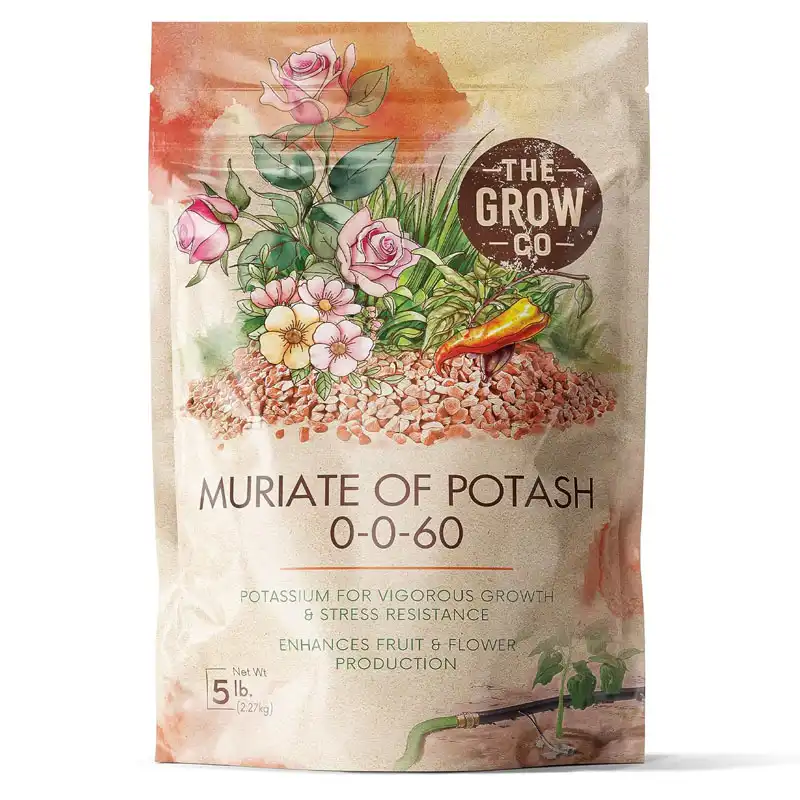
This is the bag best suited to a first-time gardener. The 5 pound size fits a single season on a modest plot, so nothing sits around absorbing moisture. Label guidance runs half a pound per 1,000 square feet worked into the top inch, plus a teaspoon near the drip line for individual plants. Read that half pound rate as maintenance, not correction. Low testing soil needs several times that. The crystal form dissolves after the first watering, which suits anyone mixing a liquid feed.
Specifications:
- Grade: 0-0-60
- Size: 5 lb
- Form: Granular crystals
- Coverage: About 1,000 sq ft per half pound
2. Cz Garden Muriate of Potash 0-0-60
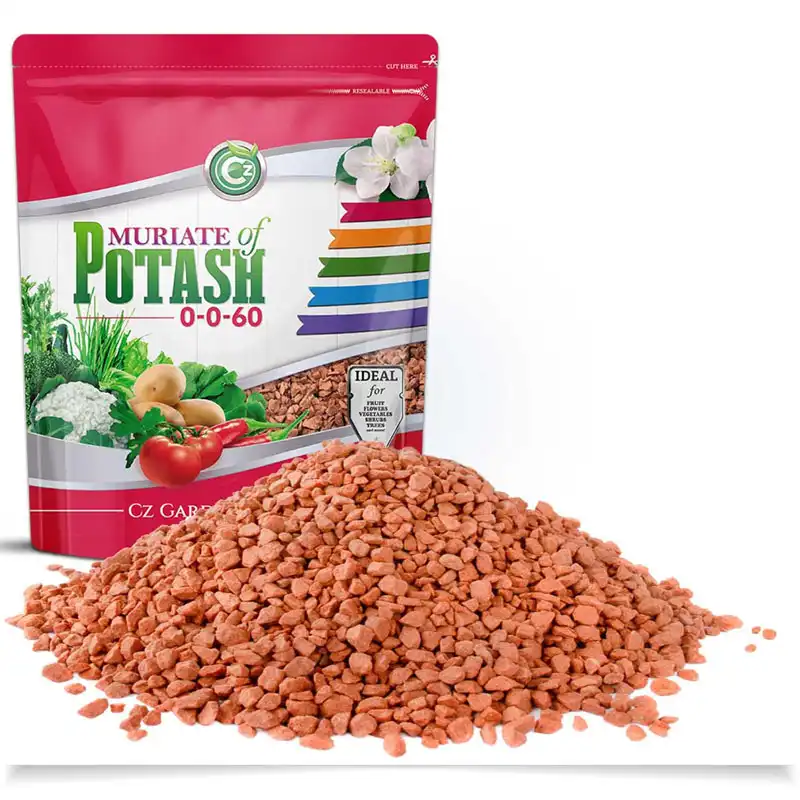
The resealable pouch is the real selling point here. Potash draws moisture and cakes into a brick in an open bag, so a heavy duty reseal earns its keep in a humid shed. Ten pounds covers a good sized garden with product left for next spring. Blending it with coarse sand before spreading, as the directions suggest, gives noticeably better distribution across roughly 2,000 square feet. One accuracy note worth flagging: the product description calls this a phosphate fertilizer, which is wrong. A 0-0-60 analysis contains zero phosphate. The grade itself is correct.
Specifications:
- Grade: 0-0-60
- Size: 10 lb
- Form: Granular
- Coverage: About 2,000 sq ft when sand blended
3. Easy Peasy All-Natural Muriate of Potash 0-0-60
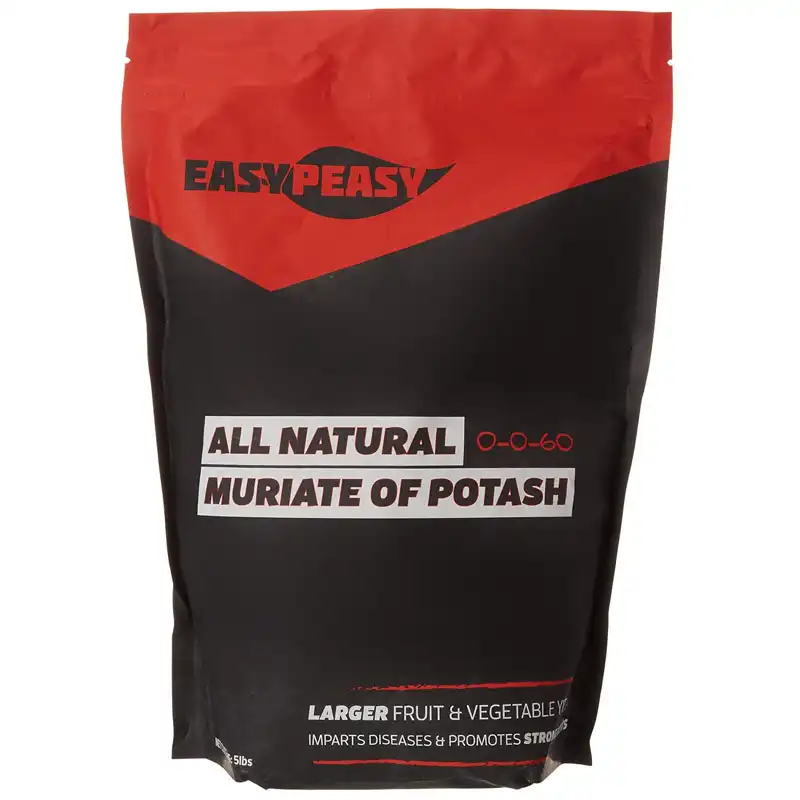
This one suits a grower running houseplants, raised beds, and a few fruit trees off the same bag. The liquid dilution guidance of one sixteenth teaspoon per two gallons is genuinely useful for potted plants, where dry granules are hard to meter. Granules work fine broadcast and watered in outdoors. Treat the “all natural” wording carefully though. Mined potassium chloride is not synthetic, but it is not automatically approved for certified organic ground either.
Specifications:
- Grade: 0-0-60
- Size: 10 lb listed
- Form: Granular
- Use: Indoor plants, gardens, lawns, trees
4. CountryMax Potash Fertilizer 0-0-60
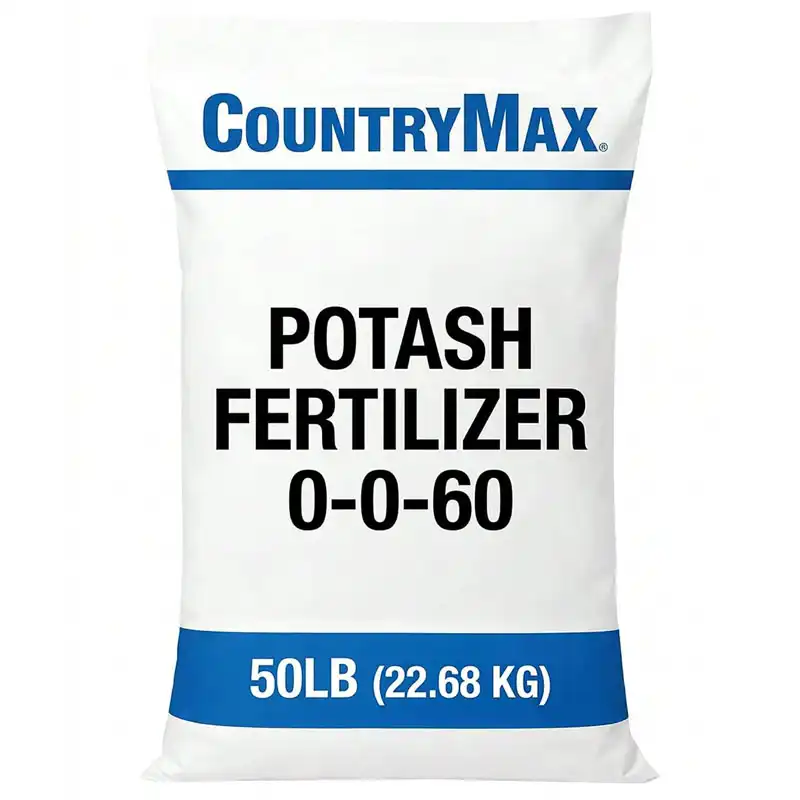
Fifty pounds is where bagged potash starts making economic sense. That single bag supplies 30 pounds of K2O, enough to cover roughly a quarter acre at a 120 pound per acre rate. It runs through a broadcast spreader well and suits pasture, orchard rows, hay ground, and large gardens. Skip the marketing line about weekly application. Potassium is not a weekly nutrient. Soil test, apply once or twice a season, and stop. Check the bag on arrival, since several buyers reported shipping damage.
Specifications:
- Grade: 0-0-60
- Size: 50 lb
- Form: Granular
- Supplies: 30 lb K2O per bag
What to Check Before You Buy a Bag of Potash
Check the guaranteed analysis first, then the bag size, then the chloride note. Marketing copy on potash bags gets loose, so the analysis panel is the only line that carries legal weight.
Run through this list:
- Confirm the grade reads 0-0-60 or 0-0-62. Anything lower is a blend, not straight potash.
- Match bag size to your acreage. Buying 5 pounds for a half acre wastes money badly.
- Check for a resealable closure if you cannot use the whole bag in one season.
- Ignore claims about weekly feeding. Potassium does not work that way.
- Verify the crop list. If your main crop is potatoes, berries, or grapes, buy sulfate of potash instead.
- Look at granule uniformity if you plan to spread it. Inconsistent granules segregate and streak.
Cost per pound of K2O beats sticker price every time. Divide the bag price by the pounds of K2O it holds, which is bag weight times 0.60. That single calculation usually flips the ranking.
Is 0-0-60 Fertilizer Allowed in Organic Production?
Only under a restriction, and several bags overstate this. The USDA National Organic Program lists potassium chloride at 7 CFR 205.602 as a nonsynthetic substance prohibited for organic crop production, unless it comes from a mined source and gets applied in a way that minimizes chloride buildup in the soil.
Read that carefully. Mined origin alone does not clear it. The application method has to limit chloride accumulation too, and your certifier makes that call. So a bag reading “all natural” or “ideal for organic gardening” is describing its mined origin, not a certification.
If you farm certified organic ground, talk to your certifier before you spread a single pound. Many organic growers reach for sulfate of potash, langbeinite, greensand, or compost instead. Our notes on chemical versus organic fertilizer choices compare those routes. Home gardeners with no certification face no legal restriction at all, though the chloride caution on sensitive crops still applies.
Common Mistakes With Potash
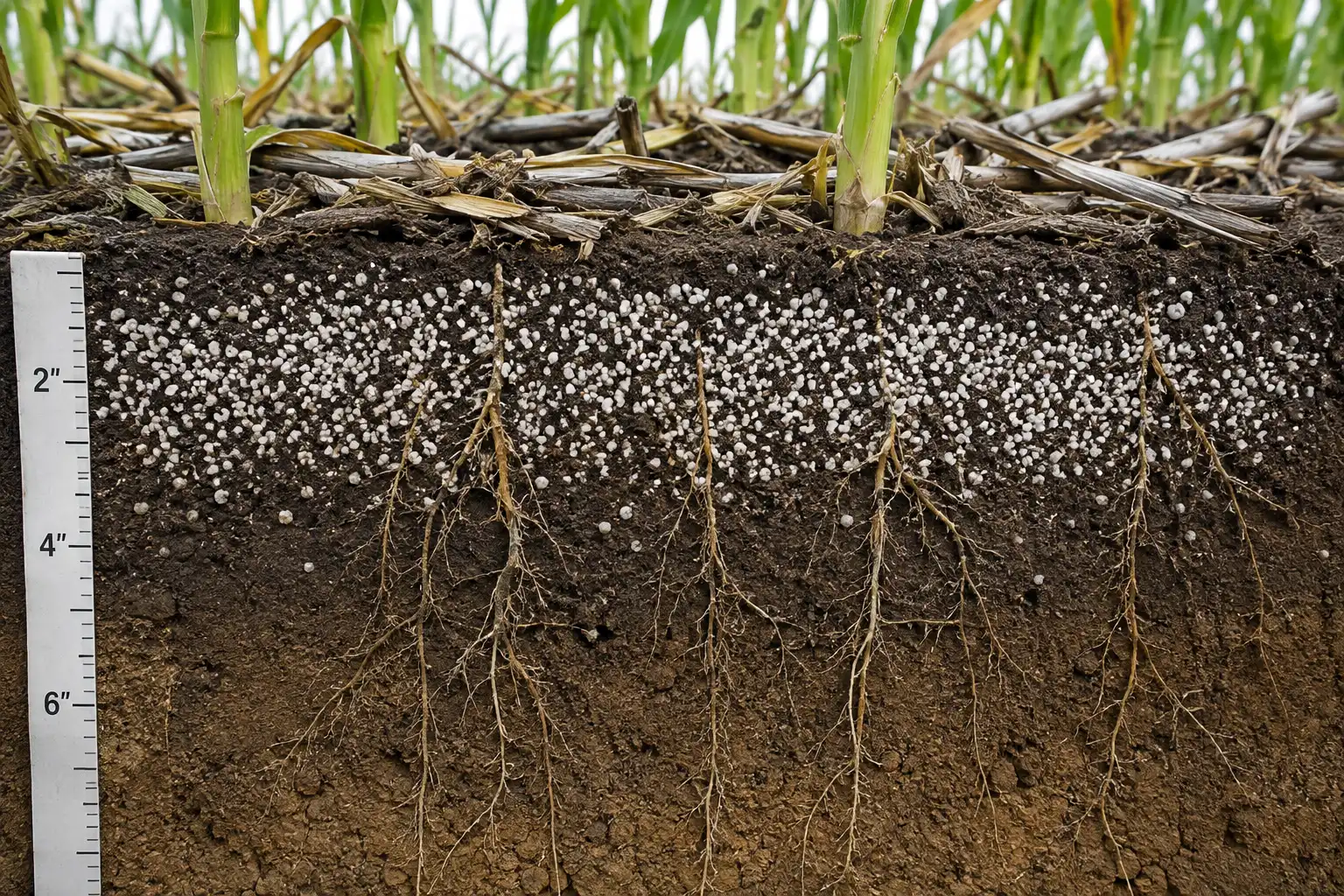
Most potash problems trace back to four habits. All four are easy to break.
Spreading without a soil test. Potassium is the nutrient growers most often over apply. Excess K competes with magnesium and calcium uptake, and on hay ground that pushes cattle toward grass tetany risk. Testing costs a fraction of a wasted application.
Ignoring stratification under no-till. Potassium piles up in the top two inches of long term no-till ground. A six inch sample averages that away and reads fine while roots below three inches find little. Sample consistently and consider a deeper split sample every few years.
Blaming the fertilizer for a moisture problem. Deficiency symptoms in a dry August usually mean the potassium is there but immobile. Adding more will not fix a diffusion problem. Check soil moisture and compaction first.
Putting potash in the furrow. Keep the total of nitrogen plus K2O in seed contact under 10 pounds per acre, or move it to a 2 by 2 band. Fixing a burned stand is not possible once emergence fails.
FAQs on 0-0-60 Fertilizer
How fast does 0-0-60 work?
Can I mix 0-0-60 with other fertilizers?
Will 0-0-60 burn my lawn?
Does potash lower soil pH?
Is red potash better than white?
Can I apply 0-0-60 every year?
Key Points to Carry Into the Field
Test before you buy, then divide the K2O recommendation by 0.60 to get your bag rate. Broadcast in fall on medium and heavy ground, keep it out of the seed furrow, and give soybeans two weeks between application and planting. Skip it entirely on potatoes, grapes, berries, and tobacco, where a sulfate source protects quality. For corn, wheat, sorghum, and hay ground in Kansas, 0-0-60 remains the cheapest potassium in the shed, and the chloride that comes with it often earns its own keep.