How to Start Zucchini Seeds Indoors: 3-Week Timing and Transplant Steps
Zucchini grows quickly and reacts badly when its roots get torn. So learning how to start zucchini seeds indoors comes down to two things: short timing and pots that go into the ground with the plant.
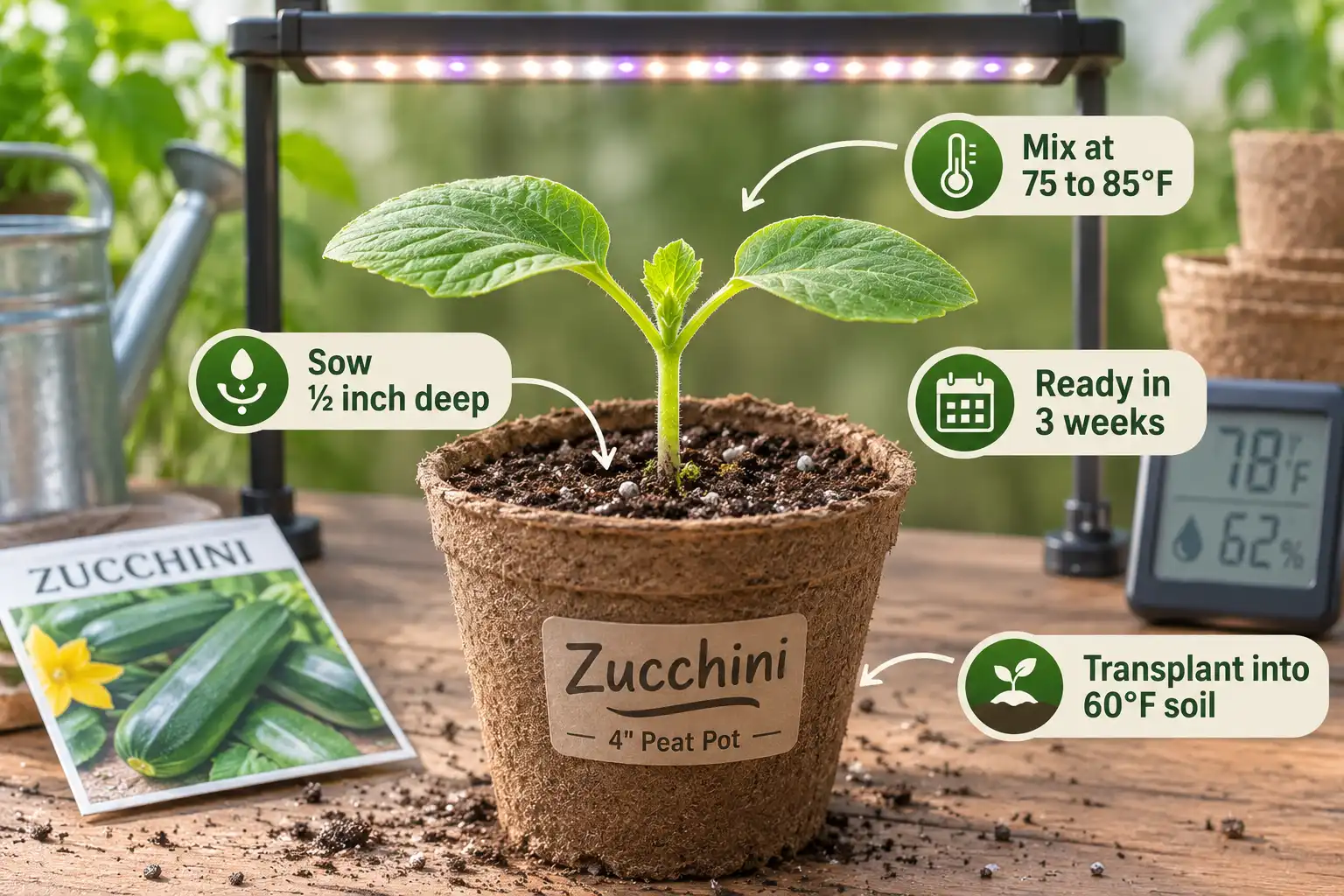
To start zucchini seeds indoors, sow 3 weeks before transplant day. Plant two seeds ½ inch deep per 3- to 4-inch biodegradable pot. Keep the mix at 75 to 85°F until sprouts appear. Transplant after frost into 60°F soil.
Should You Start Zucchini Indoors or Sow Direct?
Start zucchini indoors when your season is short, your spring soil warms slowly, or pests wipe out direct-sown seedlings. Otherwise, direct sowing is simpler.
University of Minnesota Extension prefers direct seeding for squash. Its reasoning is practical. Indoor-started squash often stalls from root damage at transplanting or from going into cold soil.
Still, indoor starts carry one real advantage. UMN Extension waits for 70°F soil at a 2-inch depth before direct sowing squash. Transplants, however, go out once soil reaches 60°F, according to Clemson Cooperative Extension. In a cold spring, that gap plus 3 weeks in the pot adds up to a meaningful head start.
| Factor | Start Indoors | Direct Sow |
|---|---|---|
| Best fit | Short seasons, cold springs, heavy pest pressure | Long, warm seasons |
| Soil temperature at planting | 60°F | 70°F |
| Head start | About 3 weeks, often more | None |
| Root damage risk | Low with biodegradable pots | None |
| Gear needed | Pots, mix, heat mat, grow light | Seed and a hoe |
Northern growers gain the most from an indoor start. In most of Minnesota, UMN Extension times squash sowing for late May, or early June in the north. By contrast, growers along the Gulf Coast and in the low deserts of the Southwest usually have enough warm weeks to sow direct. The tradeoffs of direct sowing versus transplanting follow the same pattern for most warm-season crops.
When to Start Zucchini Seeds Indoors
Start zucchini seeds indoors 3 weeks before your transplant date, and no more than 4. Purdue Extension notes that cucurbit seedlings need only 2 to 3 weeks to reach transplant size.
Set the transplant date first. Clemson Cooperative Extension advises waiting until frost danger has passed and soil reaches 60°F at a 4-inch depth. In most gardens, that lands 1 to 2 weeks after the average last frost date. Then count back 3 weeks to find your sowing day.
Starting earlier works against you. Zucchini roots circle a small pot fast, and root-bound plants stall after transplanting. A younger seedling settles in faster.
| Average Last Frost | Sow Indoors | Transplant Outdoors |
|---|---|---|
| March 15 | March 1 to 8 | March 22 to 29 |
| April 1 | March 18 to 25 | April 8 to 15 |
| April 15 | April 1 to 8 | April 22 to 29 |
| May 1 | April 17 to 24 | May 8 to 15 |
| May 15 | May 1 to 8 | May 22 to 29 |
| June 1 | May 18 to 25 | June 8 to 15 |
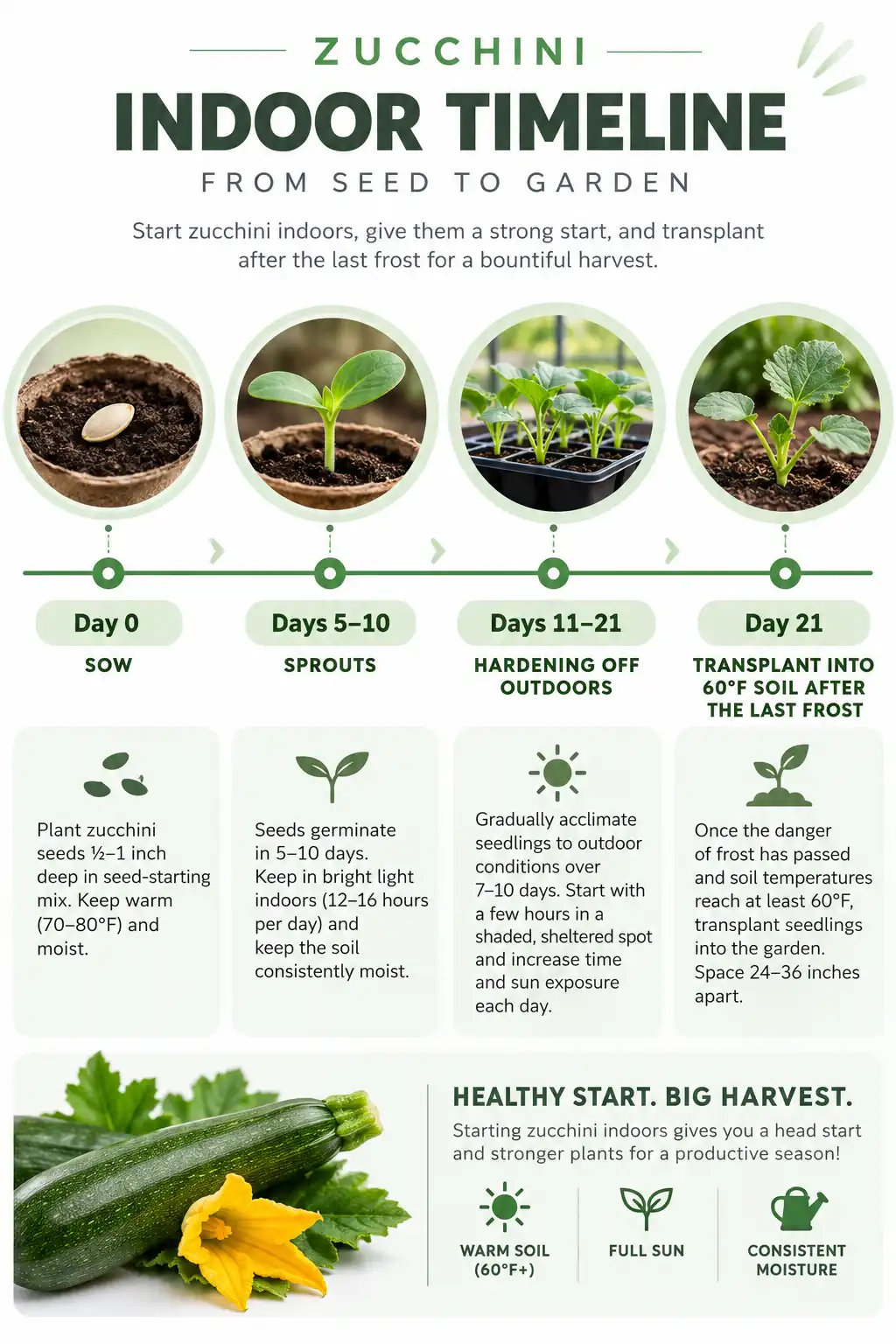
Treat the transplant column as a target, not a rule. A cold snap pushes planting back, so check the bed with a soil probe thermometer before you commit. When spring runs cool, sow at the later end of the window.
What You Need
Purdue Extension recommends individual peat pots or pellets over open flats, because each root ball moves intact. So choose containers that either go into the ground whole or release the root ball cleanly.
- 3- to 4-inch peat, coir, or paper pots, one per plant
- Sterile seed-starting mix
- Heat mat, ideally with a thermostat
- LED or fluorescent grow light on a timer
- Small fan
- Tray for bottom watering
Soil blocks work well too, since roots stop at the block’s edge instead of circling. Making soil blocks takes a hand press and a dense, moist mix. Skip egg cartons and small plug trays, because zucchini roots fill them fast.
Light deserves the most attention. A seedling grow light on a timer beats a windowsill in early spring, when daylight is weak and short.
How to Start Zucchini Seeds Indoors, Step by Step
1. Moisten the Mix First
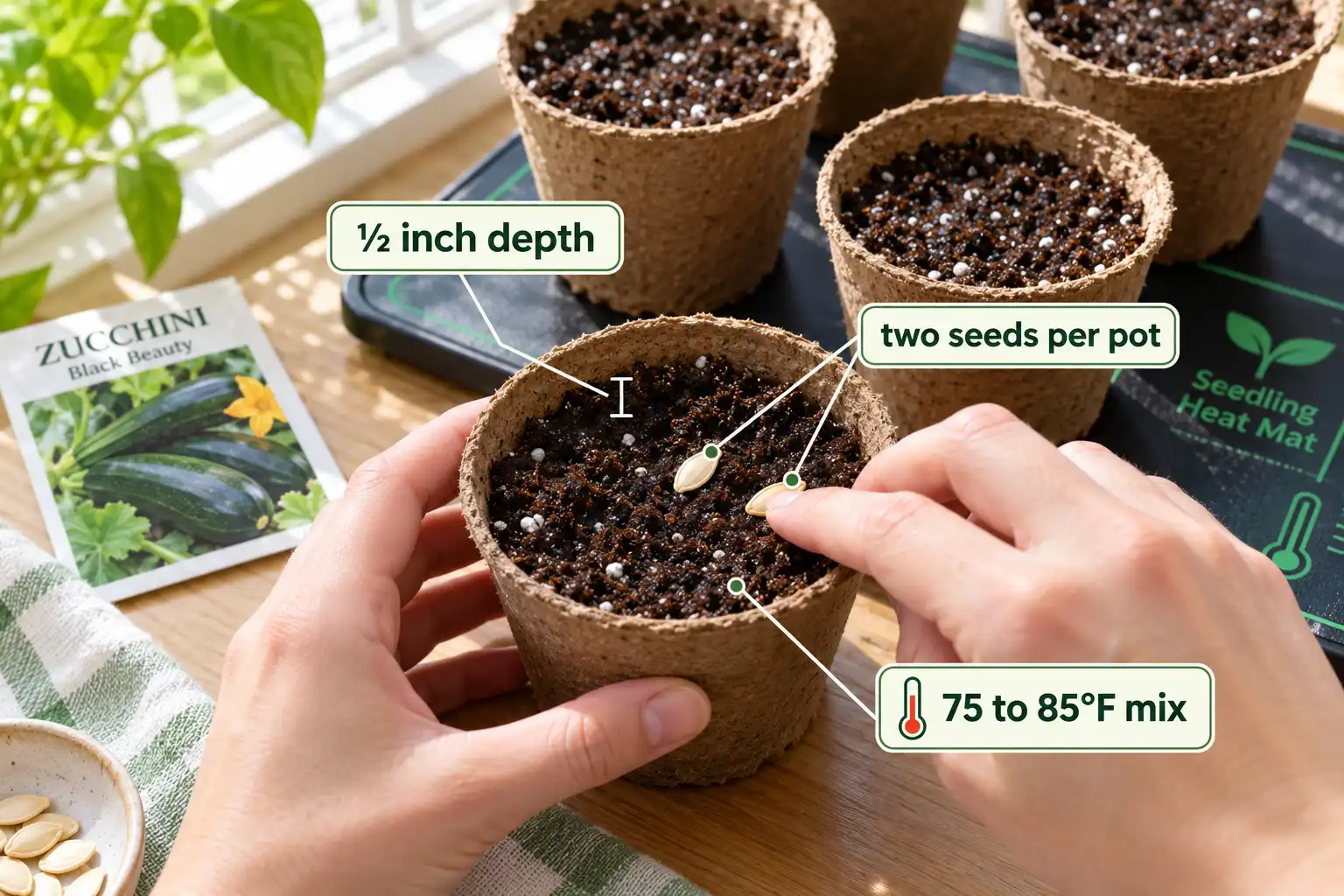
Wet the mix until it feels like a wrung-out sponge. Then fill each pot to ½ inch below the rim. Dry mix sheds water and leaves seeds in dry pockets.
2. Sow Two Seeds per Pot
Press two seeds ½ inch deep in each pot, then cover and firm the mix. Purdue Extension recommends two seeds per pot, thinned later to one strong plant.
3. Keep the Mix at 75 to 85°F
Set pots on a heat mat until sprouts appear. Oregon State University Extension lists 60°F as the minimum for squash germination, with an optimum range of 70 to 95°F. Water only when the surface starts to dry.
4. Move Sprouts Under Bright Light
Move pots under lights as soon as the first stem loop breaks the surface. Run lights 14 to 16 hours a day, 2 to 4 inches above the leaves. Then switch off the heat mat. Clemson notes that summer squash grows best at 65 to 75°F.
5. Thin to One Seedling
Once seedlings reach 2 inches tall, snip the weaker one at soil level. Pulling it tears the roots of the plant you keep.
6. Water From Below
Set pots in a tray of water for 10 to 15 minutes, then drain. Let the top ½ inch dry between waterings. Also run a small fan on low for a few hours daily. Moving air toughens stems and dries the surface.
How Long Does Zucchini Take to Germinate?
Zucchini seeds germinate in 5 to 10 days, according to NC State Extension. Warm mix pushes sprouting toward the fast end of that range. Cool mix slows it or stops it.
The emergence data Oregon State University Extension publishes doesn’t list squash. However, cucumber, a close cucurbit relative, shows the pattern clearly. Cucumber seedlings take 13 days to emerge at 59°F, 6 days at 68°F, and 4 days at 77°F. So every few degrees of warmth cuts days off the wait.
| Mix Temperature | What to Expect |
|---|---|
| Below 60°F | Little or no germination; high rot risk |
| 60 to 69°F | Slow, uneven sprouting |
| 70 to 95°F | Optimum range; fastest, most even emergence |
| Above 95°F | Germination declines; 100°F is the upper limit |
First, look for a pale, arched stem pushing through the mix. Next, two smooth, oval seed leaves (cotyledons) open. After that, the first true leaf appears, rougher and slightly lobed.
Why Are My Zucchini Seeds Not Germinating?
Cold, wet mix causes most zucchini germination failures. Below 60°F, squash seed sits idle in damp mix and often rots before it sprouts. So check temperature first, then moisture, depth, and seed quality.
| Cause | Sign | Fix |
|---|---|---|
| Mix below 60°F | No sprouts after 10 days; seed soft when dug up | Use a heat mat set to 75 to 85°F |
| Soggy mix | Sour smell, mushy seed, surface mold | Pre-moisten mix; water only when the surface dries |
| Mix dried out | Seed swelled, then shriveled | Cover pots with a clear dome; remove it at emergence |
| Planted too deep | Late or missing sprouts | Keep depth at ½ inch |
| Old seed | Low sprout rate from a full packet | Run a germination test before sowing |
| Seed saved from market zucchini | Thin, soft, pale seeds | Use packet seed; growers pick market fruit before seeds mature |
To test old seed, roll 10 seeds in a damp paper towel and seal it in a plastic bag. Keep it at 75 to 85°F and count sprouts after 7 days. For example, 6 sprouts means 60% germination, so sow three seeds per pot instead of two.
Fixing Leggy and Collapsing Seedlings
Leggy, pale, or collapsing seedlings point to light, water, or disease problems. Each one has a quick fix.
| Problem | Likely Cause | Fix |
|---|---|---|
| Tall, thin, leaning stems | Weak light or too much heat | Lower lights to 2 to 4 inches; turn off the heat mat |
| Stem pinched and collapsed at the soil line | Damping-off | Remove affected plants; water less; add airflow |
| Yellowing seed leaves | Overwatering | Let the top ½ inch dry between waterings |
| Roots circling the pot | Seedling held too long | Transplant now with the root ball intact |
Stem collapse at the soil line spreads fast through crowded pots. Clean pots, fresh mix, and careful watering stop most cases, and the guide to preventing damping-off in seedlings covers each habit in detail.
How to Harden Off Zucchini Seedlings
Harden off zucchini seedlings over 7 to 10 days, adding outdoor time and sun a little each day. University of Minnesota Extension suggests starting with a couple of hours in shade, then building up from there.
Also hold off on fertilizer. Nebraska Extension advises against feeding transplants before or during hardening off.
| Days | Time Outdoors | Exposure |
|---|---|---|
| 1 to 2 | 1 to 2 hours | Full shade, sheltered from wind |
| 3 to 4 | 3 to 4 hours | Morning sun, afternoon shade |
| 5 to 6 | 5 to 6 hours | Mostly sun, light breeze |
| 7 to 8 | All day | Full sun |
| 9 to 10 | Day and night | Full sun; nights above 50°F |
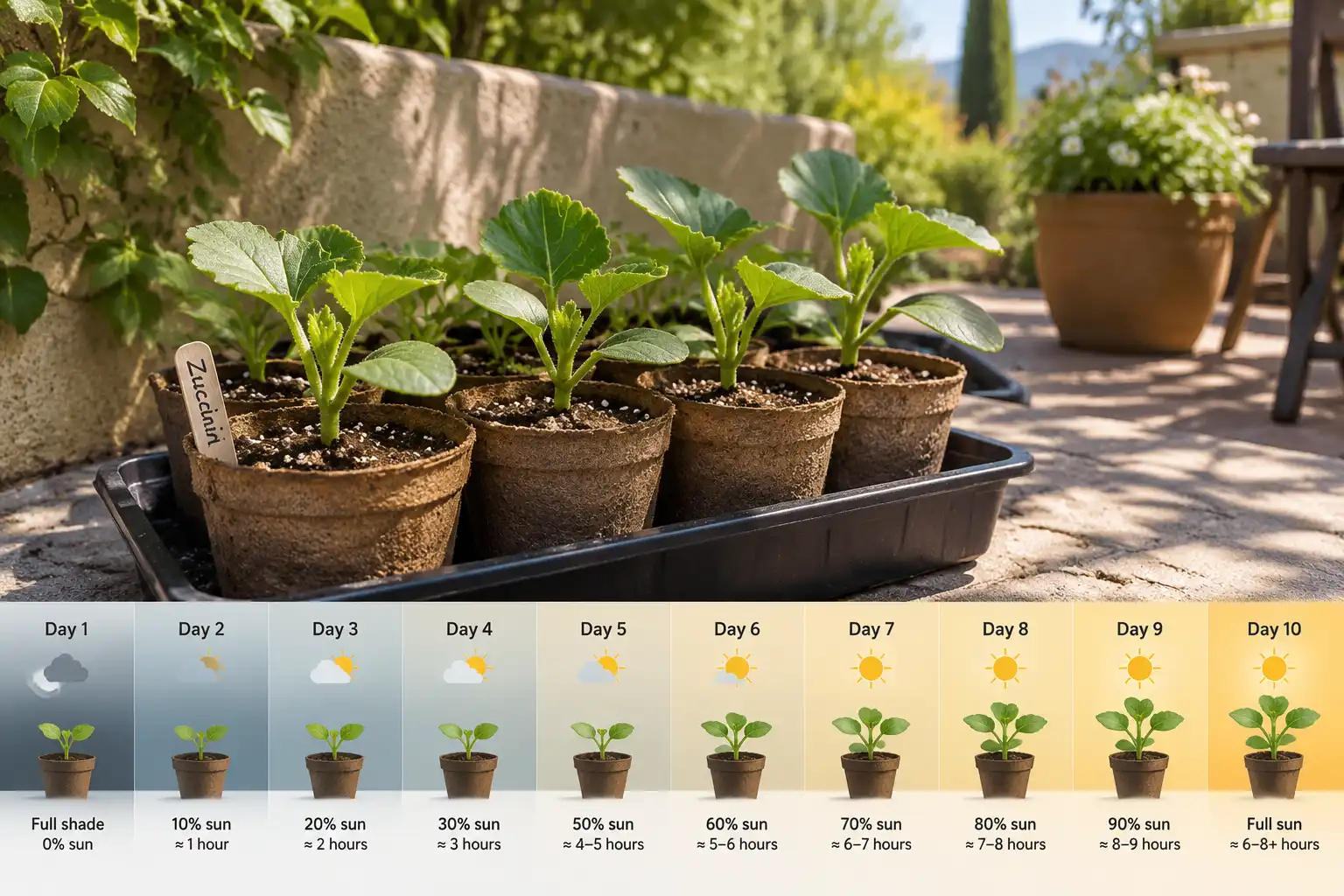
Bring seedlings inside on windy days and whenever nights drop below 50°F. Small pots dry out fast in sun and wind, so check moisture morning and evening. Mild midday wilting is normal early on. However, white or bleached leaf patches mean too much sun too soon, so step back a day.
Can You Transplant Zucchini?
Yes, zucchini handles transplanting well when its root ball stays intact. Damaged roots are the real problem. UMN Extension names transplant injury as a common reason indoor-started squash fails in the garden.
Your seedlings are ready when they show these signs:
- Two true leaves open, the stage Purdue Extension uses for cucurbit transplants
- 3 to 4 weeks since sowing
- Roots hold the mix together without circling the pot
- Frost has passed and soil reads 60°F at 4 inches
The same rules apply to nursery transplants. Purdue recommends stocky plants in individual pots, free of pests, disease, and yellow leaves. Pass on plants already flowering in small pots, since they tend to stall after planting.
How to Transplant Zucchini Seedlings
Transplant zucchini on an overcast day or in the late afternoon. Purdue Extension recommends late afternoon or early evening planting for cucurbits, which gives roots a cool night to settle.
- Water each pot thoroughly an hour before planting so the root ball holds together.
- Dig a hole slightly wider and deeper than the pot.
- Tear off the rim of peat or paper pots and slit the sides. Any exposed pot edge wicks water away from the roots.
- For plastic pots, squeeze the sides, tip the pot, and catch the root ball in your palm. Never pull the plant by its stem.
- Set the root ball level with the bed, with no pot edge above the soil.
- Firm the soil gently and water in with a weak fertilizer solution, which Nebraska Extension suggests to ease transplant shock.
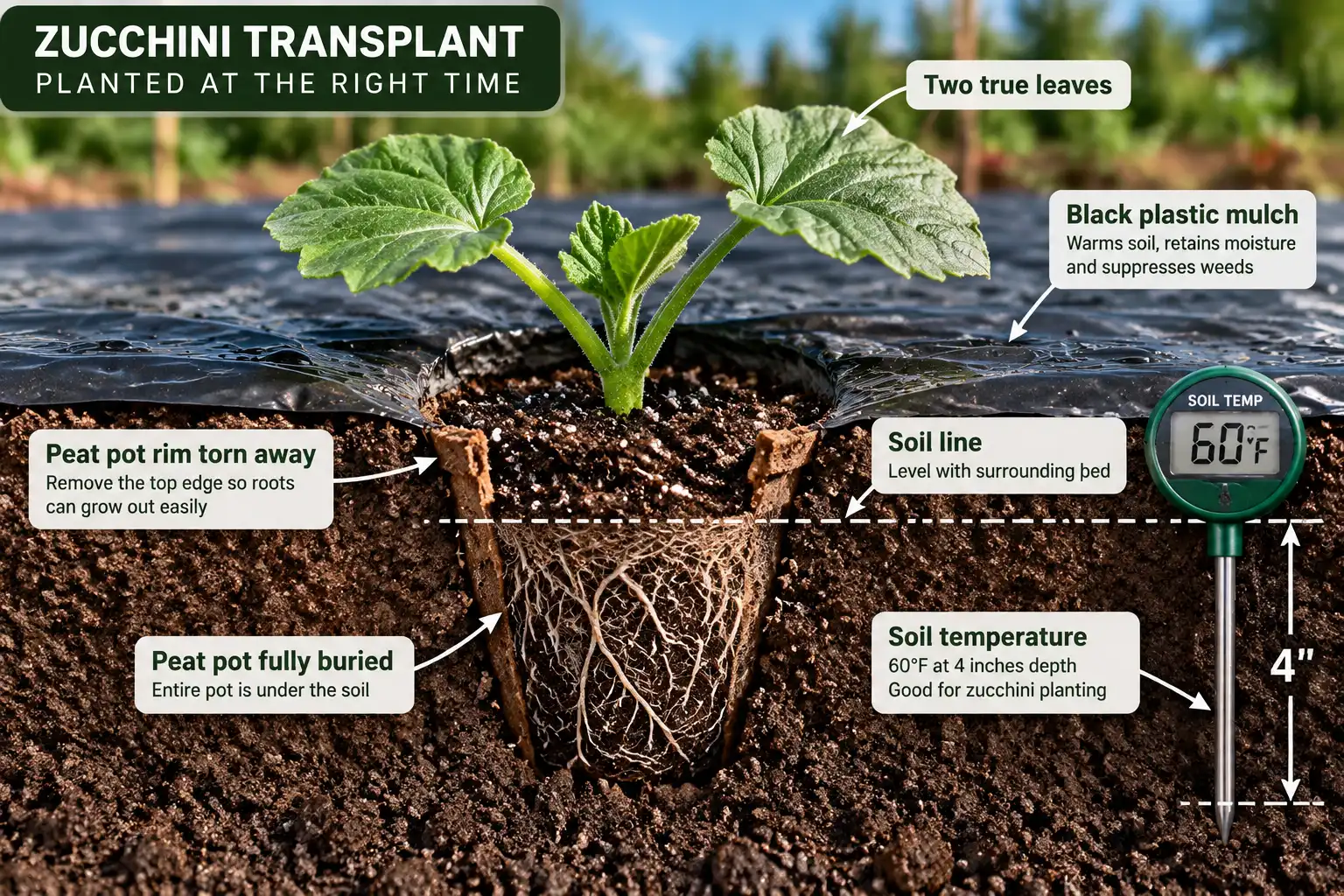
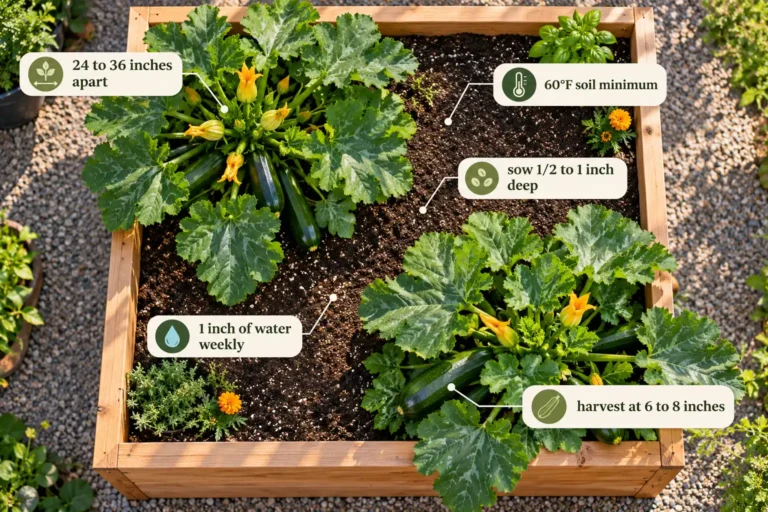
Give bush zucchini 2 to 3 feet between hills or rows, per UMN Extension. Black plastic mulch warms the soil for earlier planting, and floating row covers protect plants on cool nights. However, remove row covers once flowers open, because bees need access to pollinate. Plan extra room when pairing zucchini with tomatoes in one bed, since both spread fast.
Frequently Asked Questions
Should You Soak Zucchini Seeds Before Planting?
Soaking is optional for zucchini, and a few hours in room-temperature water is the most it needs. Warm mix at 75 to 85°F speeds germination far more than any soak, while long soaks invite rot.
Do Zucchini Seeds Need Light to Germinate?
No, zucchini seeds germinate in darkness under ½ inch of mix. Light matters the moment sprouts break the surface, because a few days in dim light leaves stems stretched and weak.
Can You Start Zucchini Seeds in a Sunny Window?
A sunny window works only as a backup for zucchini seedlings. Spring window light is too weak and too short, so seedlings lean and stretch unless a grow light runs 14 to 16 hours daily.
How Big Should Zucchini Seedlings Be Before Transplanting?
Transplant zucchini seedlings once they show two true leaves, usually 3 to 4 weeks after sowing. Purdue Extension uses the two-true-leaf stage as its transplant signal for cucurbits, before roots circle the pot.
Can You Use Egg Cartons for Zucchini Seeds?
Egg cartons are a poor fit for zucchini seeds. Their cells hold too little mix, so roots fill them within days of sprouting and then tear when you pry each plant loose for transplanting.
Putting This Into Practice
Start zucchini late, not early. Set your transplant date by 60°F soil, then count back 3 weeks. Use pots that go into the ground with the plant, keep the mix warm until sprouts appear, and give strong light right away. Finally, harden off over 7 to 10 days and plant on a calm afternoon. A young seedling with intact roots settles in faster than one that waited too long in its pot.