What Does an Eggplant Plant Look Like? Leaves, Flowers, and Fruit
What does an eggplant plant look like? It looks like a knee to waist high shrub with large fuzzy leaves, drooping violet flowers, and glossy hanging fruit. Here is every part, stage by stage, so you can identify one in a tray or a garden row.
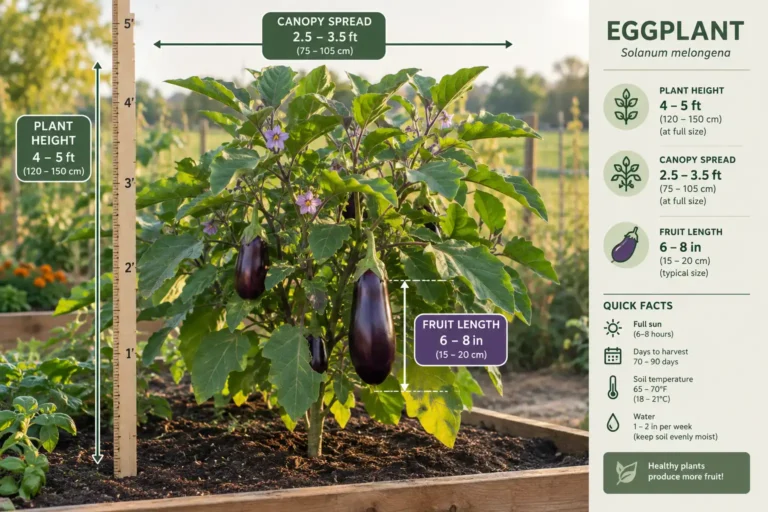
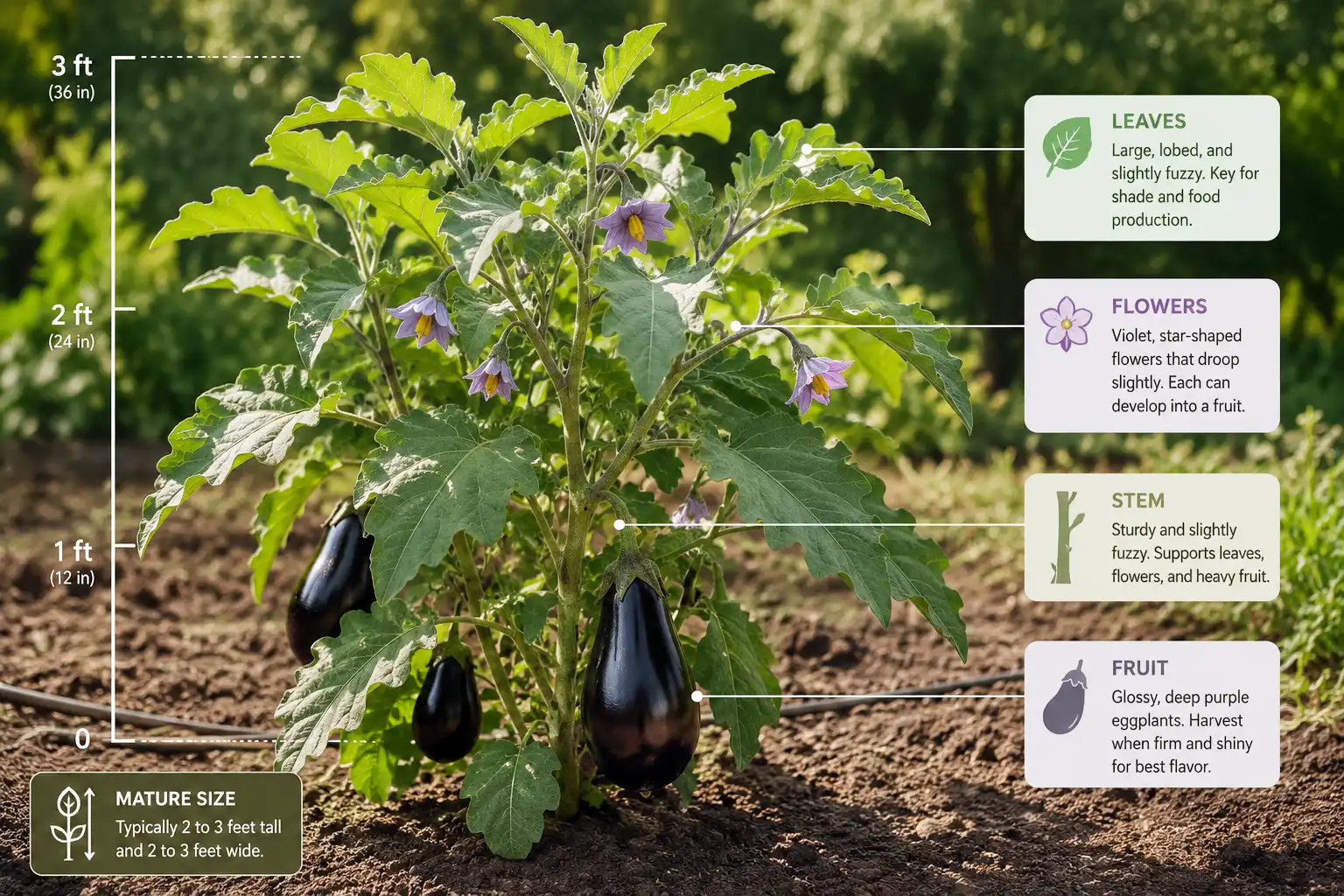
An eggplant plant looks like a bushy, semi woody shrub 2 to 4 feet tall. Leaves are large, lobed, and fuzzy gray green. Flowers droop, star shaped and violet. Fruit hangs glossy below a green calyx.
What Does an Eggplant Plant Look Like When Fully Grown?
A mature eggplant stands 2 to 4 feet tall and spreads almost as wide. The frame reads like a small shrub rather than a vine. One thick main stem rises from the soil, then splits into several branches partway up. That branching gives the plant its rounded, top heavy shape.
The base turns woody and tan by midsummer. Upper stems stay green or carry a purple flush. Big leaves overlap into a dense canopy, so you rarely see bare soil under a healthy plant by July.
Height varies with the type. Compact varieties such as Fairy Tale hold at 18 to 24 inches. Full size globe types push past 3 feet in good ground. UF/IFAS notes some reach 6 feet in long warm seasons. Black Beauty plants usually finish near 32 inches.
Eggplant is Solanum melongena, part of the Solanaceae or nightshade family. Tomatoes, potatoes, and peppers are close relatives. That family link explains the fuzzy foliage and the star shaped blossom shape you see on all of them.
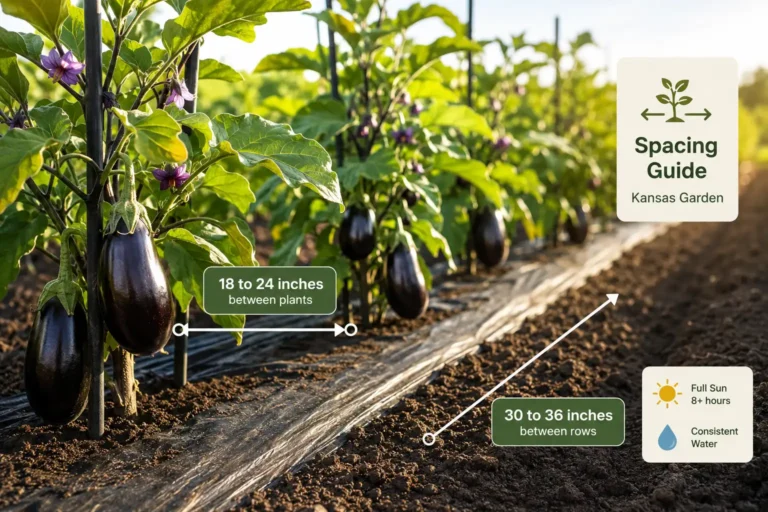
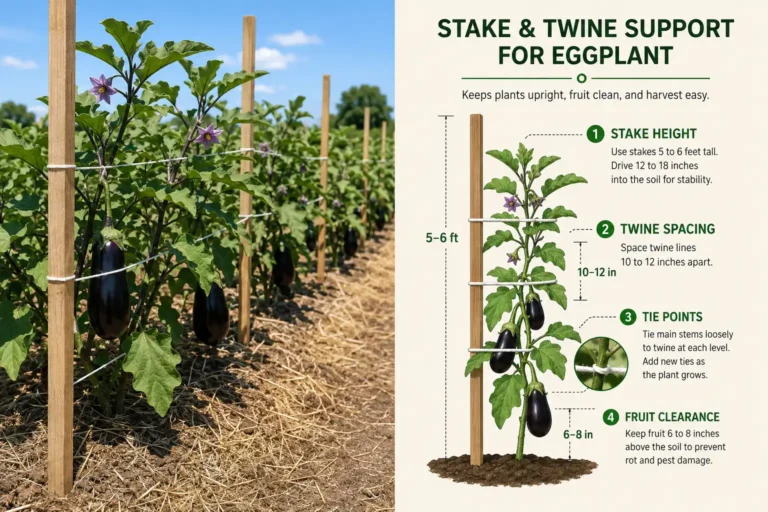
Loaded plants lean. Once three or four large fruit hang on one side, the stem tips over unless you stake it. Set a single stake at transplanting and tie the main stem twice as it grows.
Learn more: How Big Do Eggplant Plants Grow
What Do Eggplant Leaves Look Like?
Eggplant leaves are large, oval, and coarse, with wavy lobed edges and a felt like fuzz on both sides. They run 4 to 8 inches long and 2 to 4 inches wide on full size types. Each leaf sits alone on the stem, alternating side to side rather than growing in pairs.
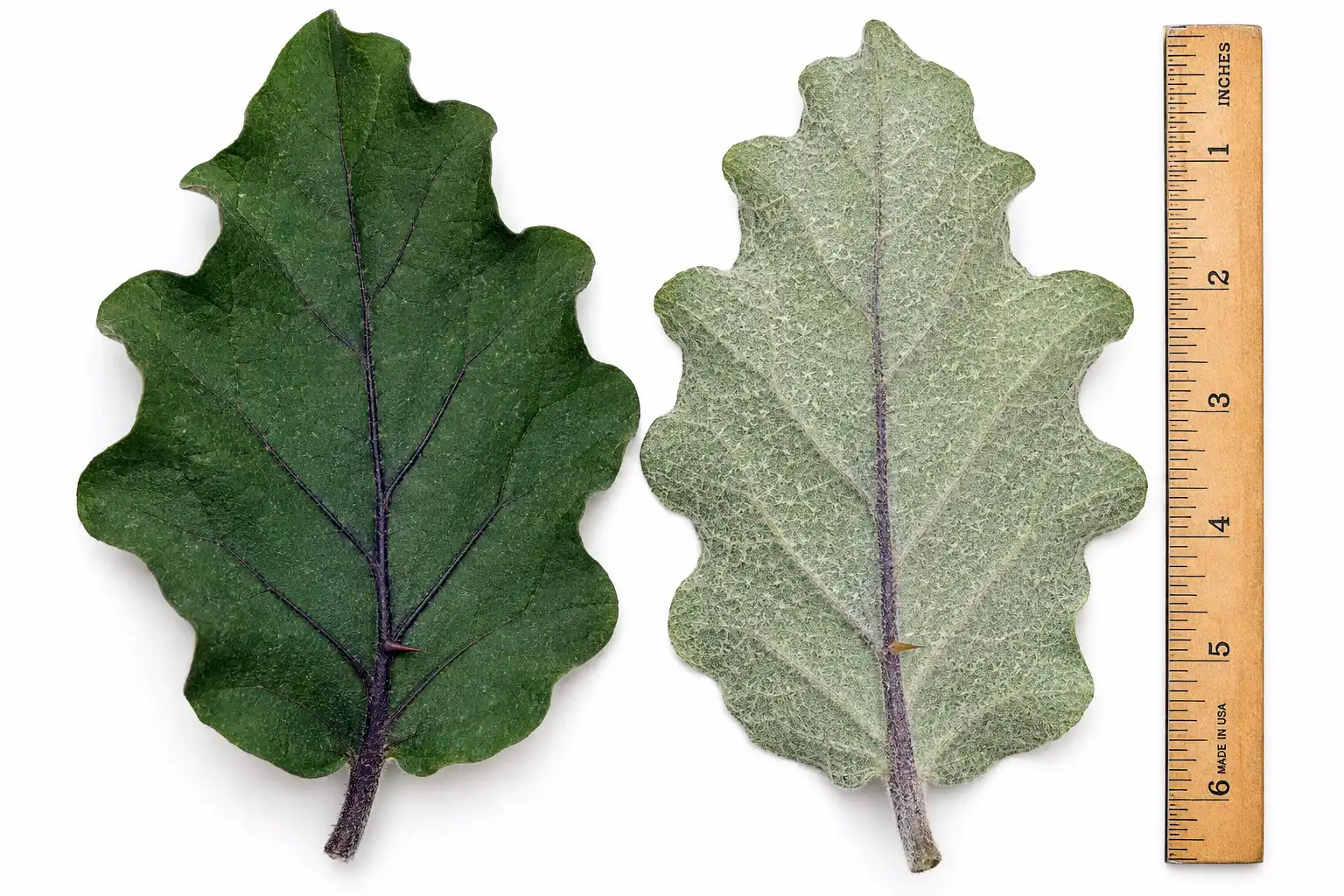
The color is a dull gray green, not the bright green of a pepper. Veins often carry a purple tint, strongest on the midrib and petiole. Undersides look paler and feel fuzzier than the tops.
Run your thumb across one and it feels like fine sandpaper. That texture comes from star shaped hairs covering the surface. Clemson Extension and NC State both flag it as a quick eggplant marker. Some varieties also carry small prickles along the midrib and petiole, so wear gloves when pruning.
Leaf edges matter most for identification. Eggplant margins wave in shallow, rounded lobes. They never show the sharp saw teeth of a tomato leaf, and they never split into separate leaflets. One leaf stays one piece.
Older lower leaves yellow and drop through the season. That happens on healthy plants too, especially after heavy fruit set. Judge plant health by the top third of the canopy instead.
What Do Eggplant Flowers Look Like?
Eggplant flowers are drooping violet stars about 1 to 2 inches across, with a bright yellow cone of anthers at the center. Five or six petals fuse at the base and flare into points, which gives that clean star outline.
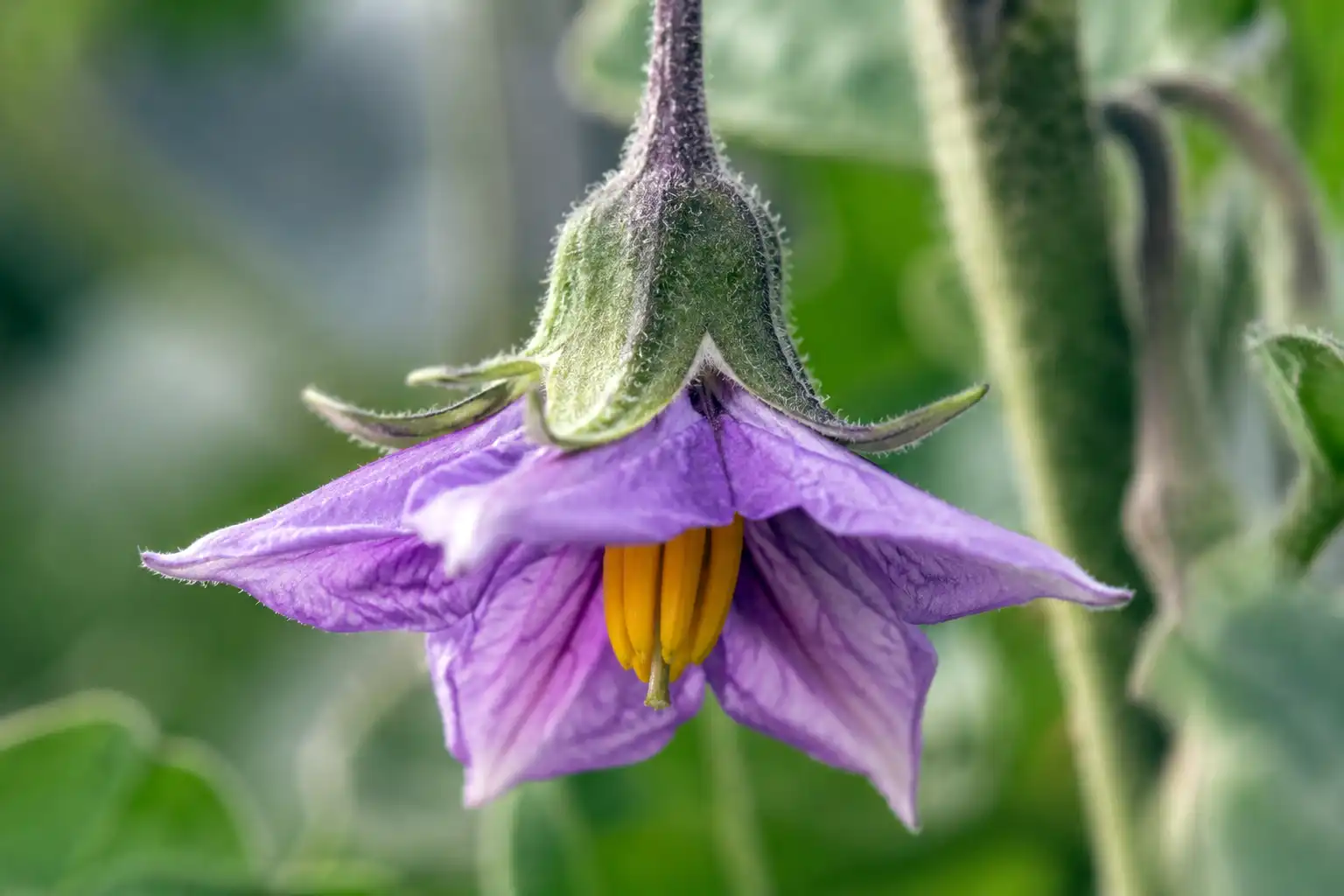
Color runs from pale lavender to deep violet depending on variety. White fruited types such as Casper often bloom nearly white. The petals feel thin and papery, and they bruise easily.
Blossoms hang face down on short stalks. Some appear alone, while others form small clusters of two to seven. Behind each flower sits a green fuzzy calyx, and on prickly varieties that calyx carries short spines.
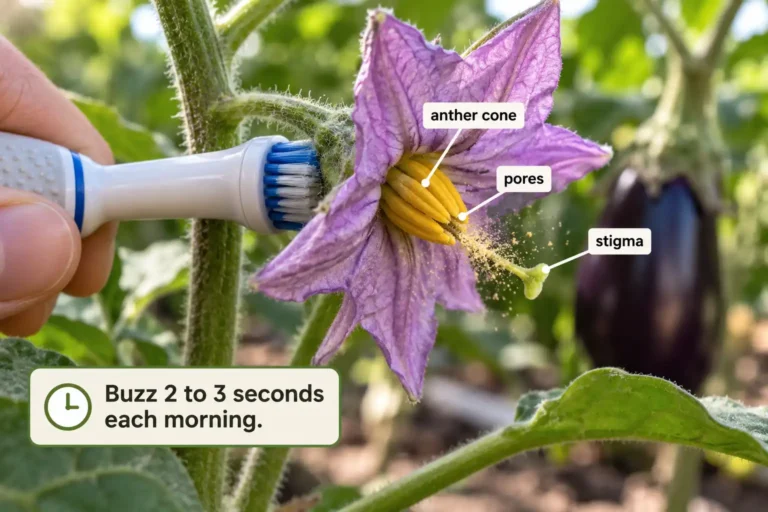
Eggplant flowers self pollinate. Bumblebees still work them hard because buzz pollination shakes pollen loose from the anther pores. Extra bee traffic improves fruit set, so keep flowering weeds along the field edges.
First blooms usually open 6 to 8 weeks after transplanting. Nights below 60°F cause buds to yellow and drop before opening. That is the most common reason a healthy looking plant carries no fruit. Waiting for warm nights fixes most of it. Our notes on eggplant planting timing cover the soil temperature targets in Kansas.
What Does the Stem and Branching Pattern Look Like?
An eggplant stem starts slender and green, then thickens into a woody stalk up to an inch across at the base. Bark like tan color creeps up from the soil line as the season goes on. Fine hairs cover the younger green sections.
Branching follows a simple pattern. The main stem grows straight for 8 to 14 inches, then forks. Each fork splits again, so the plant builds a Y on Y frame. Flowers and fruit form at those forks and in the leaf axils just below them.
Purple streaking on stems is normal, not a disease sign. The same genes that reduced prickles in modern cultivars also raised anthocyanin levels in stems and leaves. Deep purple stems on an Ichiban plant mean nothing is wrong.
Prickles show up on stems, leaf stalks, and calyxes in older heirlooms and most Thai types. Modern hybrids carry few or none. Check before you reach into the canopy bare handed.
What Do Eggplant Seedlings Look Like?
Eggplant seedlings start with two long, narrow seed leaves with slightly pointed tips. Those cotyledons look nearly identical to tomato and pepper seedlings, so labels matter at that stage. The stem below them often shows a purple tint.
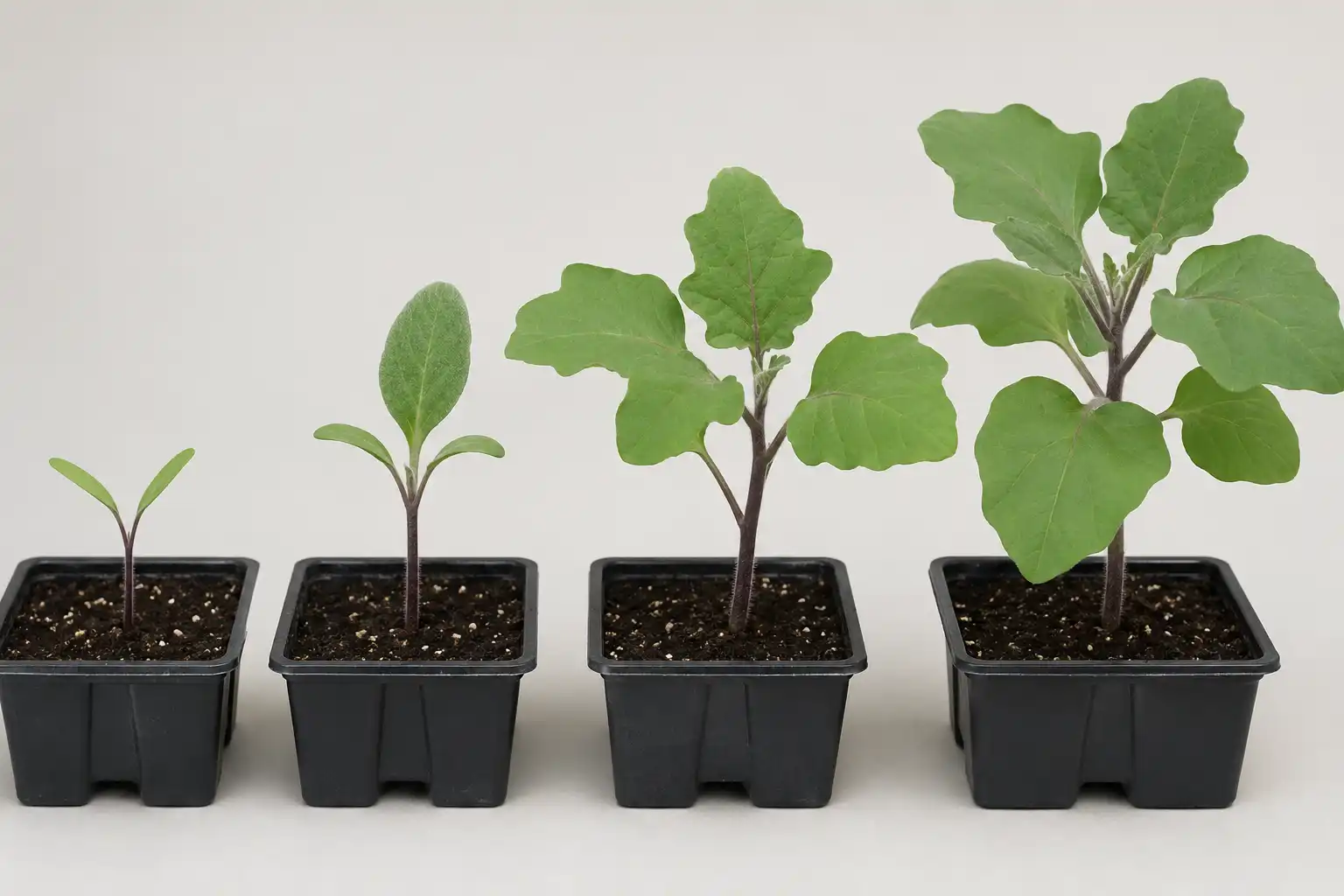
True leaves settle the question. The first pair emerges oval, dull, and clearly fuzzy, with no serrated edge. By the third or fourth true leaf, the wavy lobed margin of a mature eggplant leaf shows up plainly.
Growth is slow compared with tomatoes. Seed germinates in 8 to 12 days at 75°F to 90°F soil. Plants then need 6 to 8 weeks to reach transplant size, at 5 to 8 inches tall. A ready transplant looks stocky, with a thick stem and four to six true leaves.
Pale, stretched seedlings with long gaps between leaves signal weak light, not disease. Nightshade starts want strong overhead light from the day cotyledons open. Our guide to eggplant seed starting walks through the tray setup and heat used.
How Do You Tell an Eggplant Plant From Tomato and Pepper Plants?
Look at leaf edges and flower color first. Eggplant leaves stay whole with wavy lobes, and the flowers are violet. Tomato leaves split into toothed leaflets with yellow flowers, while pepper leaves are smooth, glossy, and pointed with white flowers.
| Feature | Eggplant | Tomato | Pepper |
|---|---|---|---|
| Leaf shape | One whole oval leaf, wavy lobes | Divided into toothed leaflets | Smooth oval, pointed tip |
| Leaf feel | Coarse, sandpaper fuzz | Sticky, hairy | Smooth, glossy |
| Leaf color | Dull gray green | Medium to dark green | Bright green |
| Flower color | Violet to lavender | Yellow | White to greenish white |
| Stem | Thick, woody, sometimes prickly | Hairy, hollow with age | Slender, smooth, brittle |
| Crushed leaf smell | Faint, grassy | Strong and sharp | Mild, peppery |
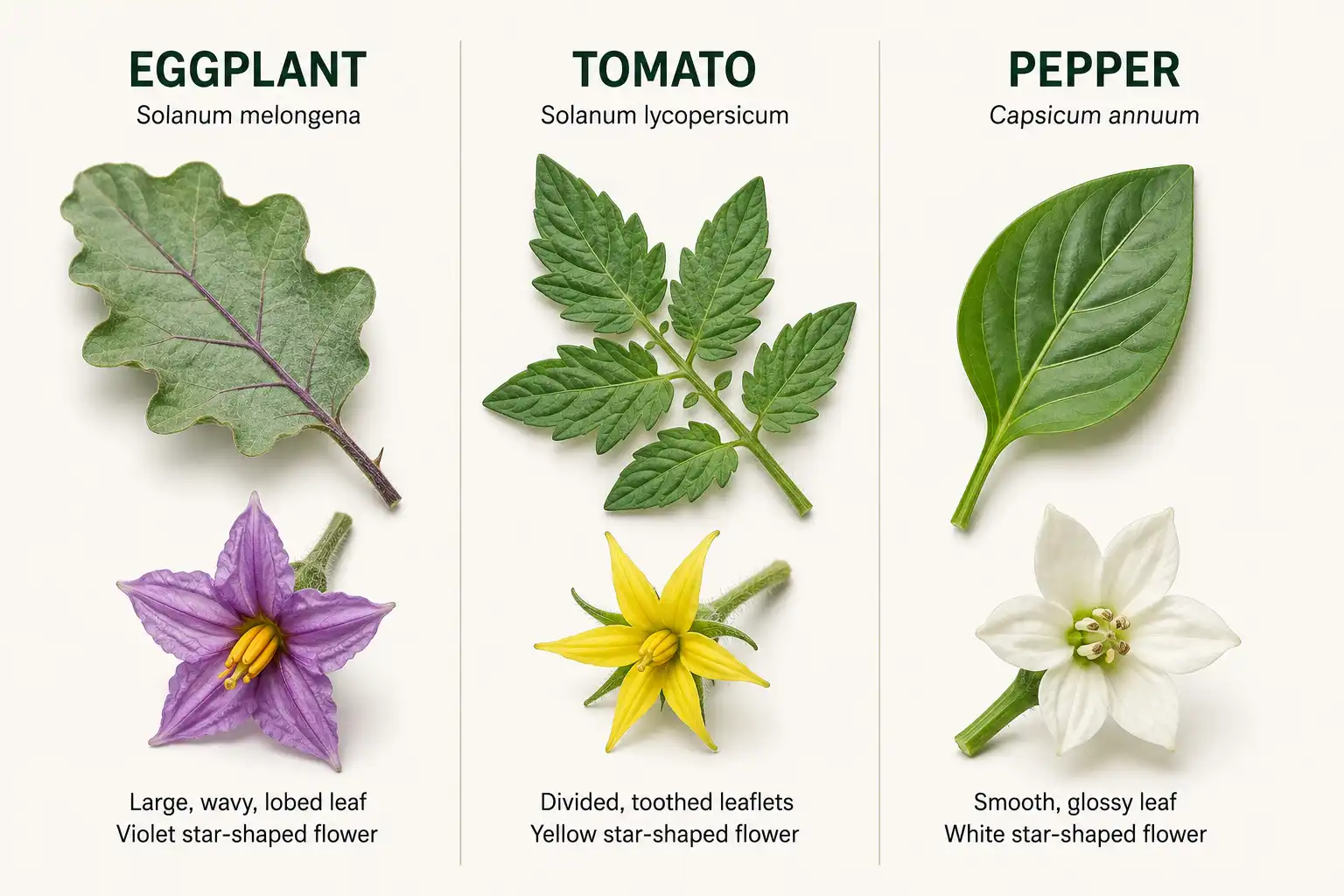
Two more tells help in the field. Tomato stems root wherever they touch soil, while eggplant stems stiffen and stand. Pepper plants also branch into a tighter, more upright form than eggplant, which sprawls outward.
Growers often set these three side by side, since they share spacing and water needs. If you run them in the same bed, our notes on pairing eggplant with tomatoes explain the disease spacing to keep between nightshades.
What Does Eggplant Fruit Look Like as It Develops?
Fruit starts as a small green swelling at the base of a pollinated flower, no bigger than a pea. Petals shrivel and drop within a few days. The little fruit then sits under the green calyx and starts to stretch.
Young fruit skin looks slightly dull and faintly fuzzy. As it sizes up, that fuzz wears away and the skin turns smooth and mirror glossy. Gloss is the harvest signal, since the flesh is tender while the shine holds.
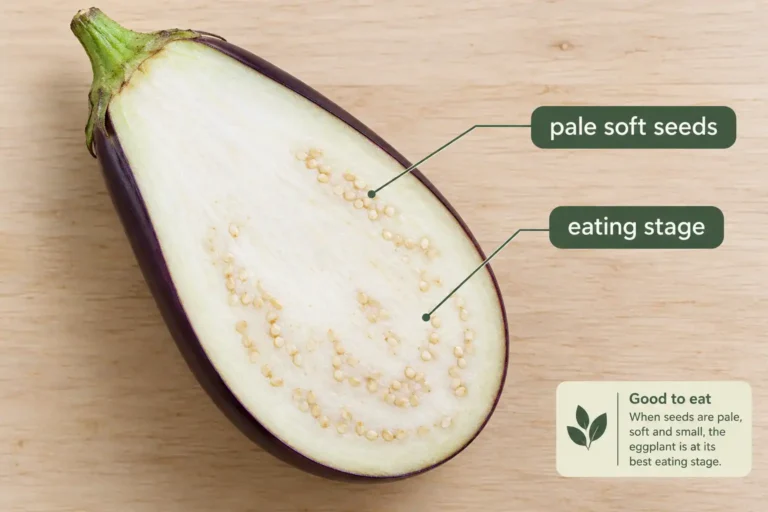
Botanically the fruit is a berry. Cut one open and you find dense white flesh with many small, soft, pale brown seeds. Those seeds stay pale and barely noticeable at eating stage.
Overripe fruit changes look fast. Skin dulls and often bronzes or yellows. The surface gives under thumb pressure, and the seeds darken to brown and turn hard. Flesh browns near the seed cavity at that point.
Every fruit hangs below a green, leafy calyx that grips the shoulder. On prickly varieties the calyx carries sharp spines, so cut fruit with pruners rather than pulling by hand.
Do All Eggplant Varieties Look the Same?
No. Plant frames differ, and fruit shape and color vary widely across cultivars. Foliage stays recognizable in every case, so leaves and flowers remain the reliable identification points.
| Variety | Plant look | Fruit look |
|---|---|---|
| Black Beauty | Broad, bushy, 30 to 36 inches | Large teardrop globe, near black purple |
| Ichiban | Taller, narrower frame, purple stems | Long slender fruit, 8 to 10 inches, dark purple |
| Ping Tung Long | Open and leggy, needs staking | Very long and thin, light purple |
| Rosa Bianca | Medium bushy, broad leaves | Round and ribbed, lavender fading to white |
| Listada de Gandia | Sprawling, often prickly | Oval with purple and white stripes |
| Casper | Compact, pale green foliage | Smooth ivory white ovals |
| Thai Green | Wiry, very prickly stems | Small round fruit, green with white streaks |
| Fairy Tale | Dwarf, 18 to 24 inches | Small striped purple and white fingers |
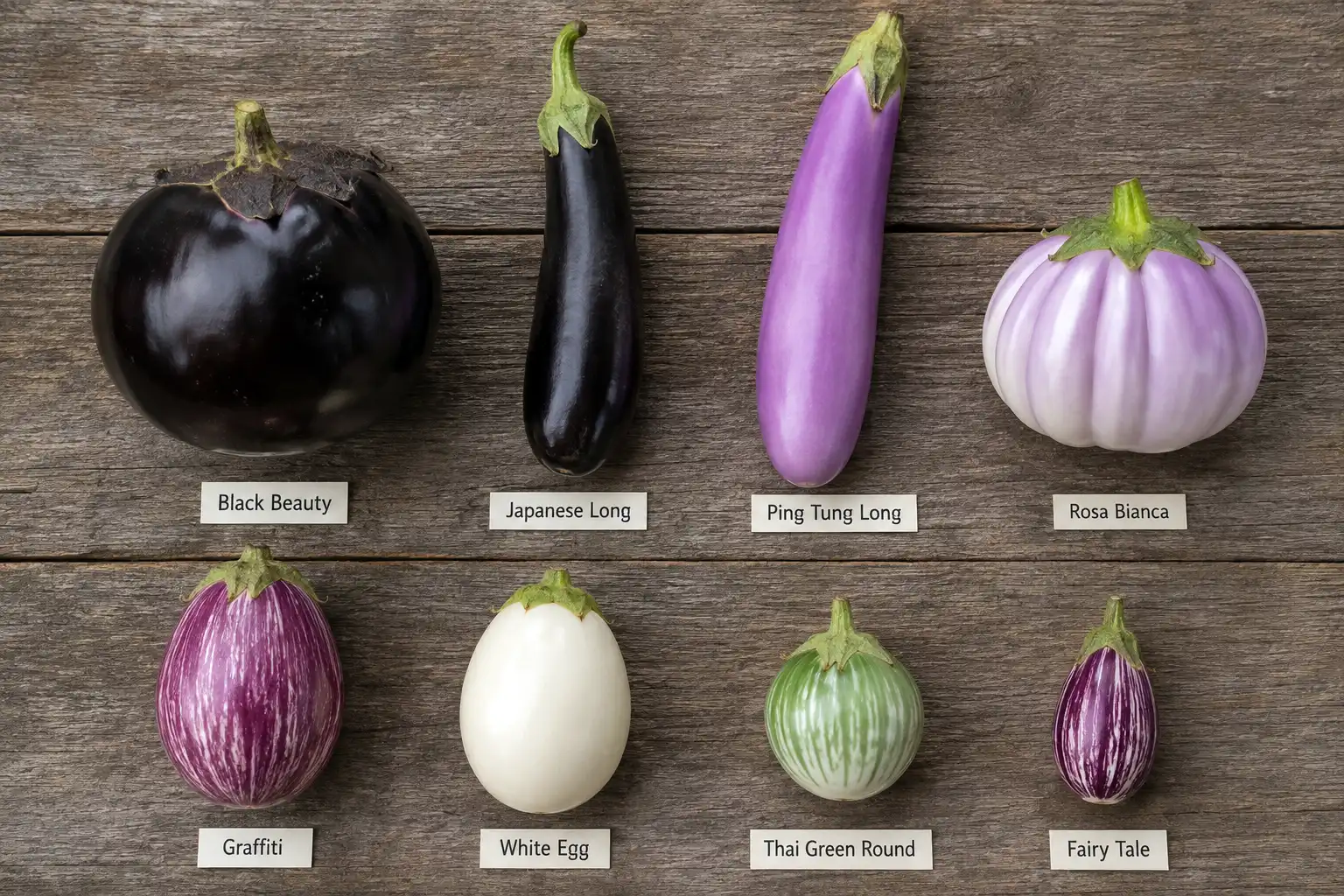
Ornamental types confuse people. Easter egg eggplant, sold as a bedding plant, grows small white egg shaped fruit on a low bush. It looks like a vegetable eggplant, though the fruit turns bitter and hard early.
Fruit color also shifts with maturity, not just genetics. Purple types darken as they size, then dull when past prime. Judge readiness on gloss and firmness, not shade alone.
What Does the Root System Look Like?
Eggplant grows a short central taproot plus a spreading mat of fibrous side roots. Most feeding roots sit in the top 12 inches of soil. The taproot itself can reach 2 to 3 feet in loose ground. Healthy roots look white to cream and hold soil tightly.
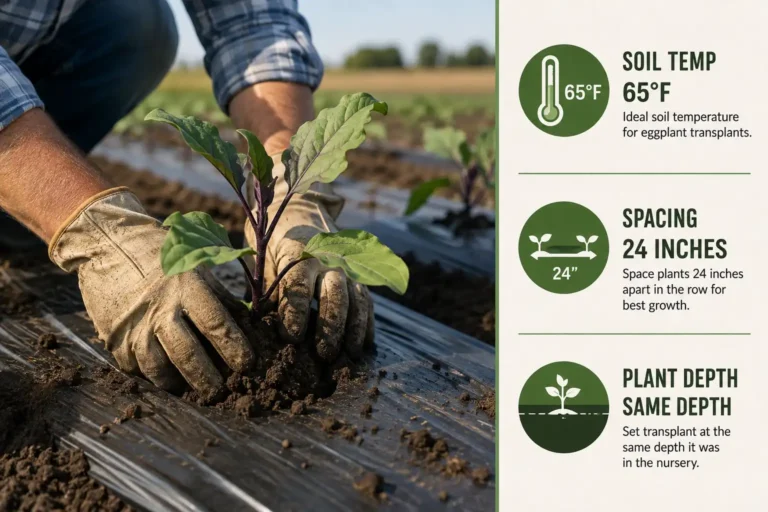
Buried stem sections form extra roots. That is why potting up transplants deeper builds a stronger plant, the same trick that works on tomatoes.
Brown, soft, or slimy roots point to rot from wet soil or cold ground. Roots also stay stunted and knotted when plants sit in cool soil after transplanting. Eggplant simply stops growing below 65°F at root depth, and checking soil temperature with a thermometer beats guessing from the calendar.
What Does a Healthy Eggplant Plant Look Like Compared With a Stressed One?
A healthy plant shows even gray green color, leaves held flat and firm, a thick upright stem, and glossy fruit. Stress changes the foliage before it changes the fruit, so leaves give you the earliest read.
| What you see | Likely cause |
|---|---|
| Small round shot holes across young leaves | Flea beetles, worst on plants under 12 inches |
| Yellow stippling with fine webbing underneath | Twospotted spider mites in hot dry weather |
| Pale stippled patches with dark specks below | Eggplant lace bugs |
| Ragged chewed edges and missing leaves | Colorado potato beetle larvae and adults |
| One branch or one leaf side yellowing first | Verticillium wilt, caused by Verticillium dahliae |
| Whole plant wilts by afternoon, recovers overnight | Heat and moisture stress, not disease |
| Pale lower leaves with slow growth | Nitrogen shortage |
| Yellowing between veins on upper leaves | Micronutrient shortfall, often iron or manganese |
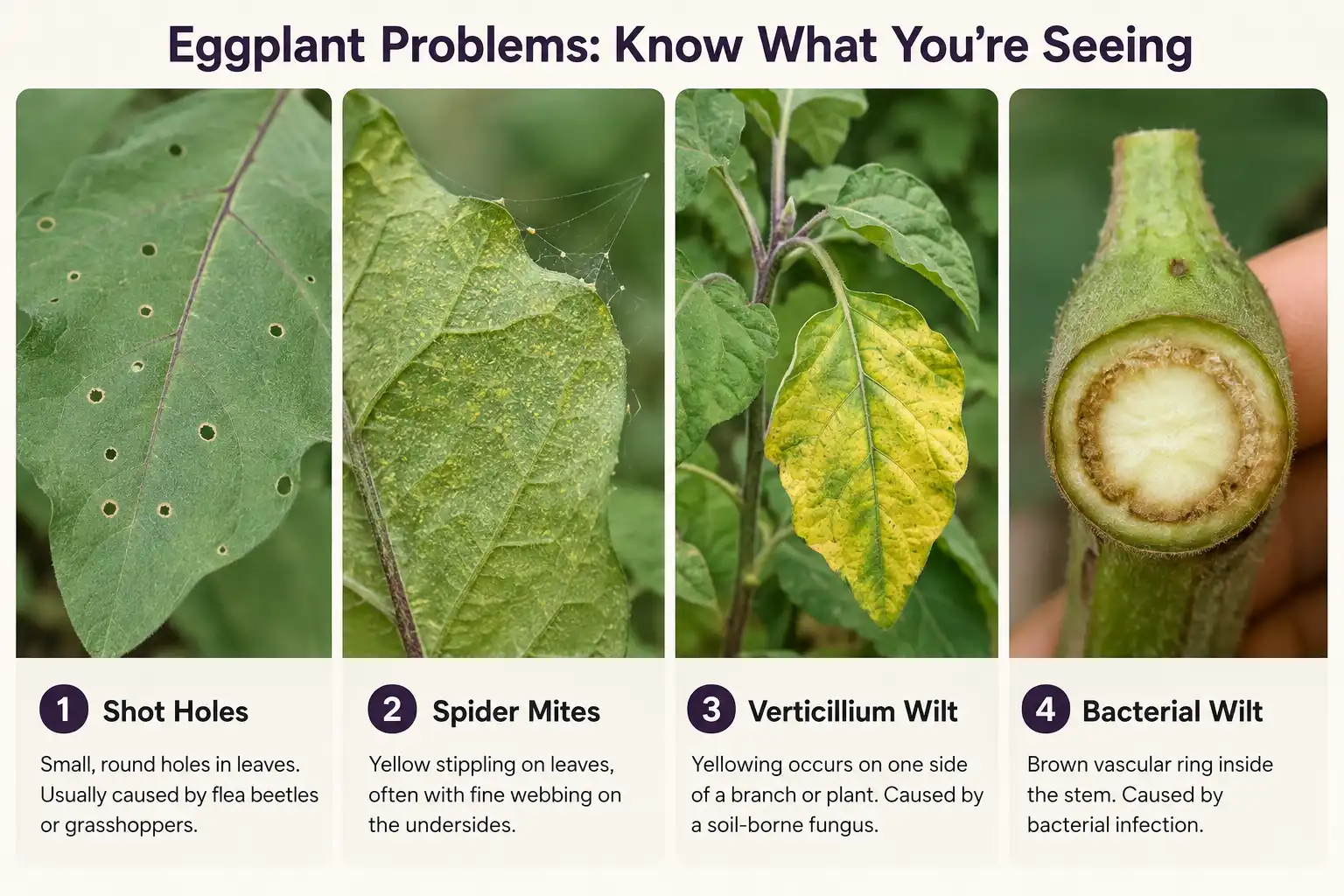
The wilt test settles the hard case. Cut a suspect stem across and look for a brown ring inside the wood. Verticillium leaves that stain, while heat stress leaves the stem clean and green.
Rotating nightshades off the same ground for three or four years keeps that fungus from building. Its resting bodies survive years in soil without a host. Our rundown of crop disease pressure covers the rotation logic across the fields.
How Does an Eggplant Plant Change Week by Week?
The plant changes shape in clear steps, so the calendar tells you what to expect. Below is the general pattern for USDA hardiness zone 6a, which includes the Topeka, Kansas area, during a typical season.
| Stage | Timing | What the plant looks like |
|---|---|---|
| Germination | 8 to 12 days after sowing | Two narrow pointed seed leaves, purple tinted stem |
| Early seedling | Weeks 2 to 4 | One to three fuzzy oval true leaves, 2 inches tall |
| Transplant ready | Weeks 6 to 8 | Stocky, 5 to 8 inches, four to six lobed leaves |
| Canopy building | 2 to 4 weeks after transplant | Main stem thickens, first branches fork out |
| First flowers | 6 to 8 weeks after transplant | Violet stars at branch forks, base turning woody |
| Fruit sizing | 2 to 3 weeks after each bloom | Glossy fruit hanging, plant leaning under weight |
| Full canopy | Midsummer onward | Dense 2 to 4 foot shrub, staked, fruit at several stages |
Fruit and flowers overlap once the plant hits stride. A single eggplant carries open blossoms, pea sized fruit, and harvest ready fruit at the same time in August. That mixed load is normal and shows the plant is working.
Are Eggplant Leaves and Flowers Safe to Handle?
Handle them freely, but do not eat them. Eggplant foliage and flowers contain nightshade alkaloids, the same class found in tomato and potato leaves. UF/IFAS lists the leaves and flowers as poisonous, while the fruit stays perfectly safe.
Prickles are the practical hazard. Spines on stems, leaf stalks, and calyxes scratch easily, and those scratches sting in hot weather. Gloves and long sleeves handle it.
How to Identify an Eggplant Plant
You can identify an eggplant plant by three main traits. First, coarse gray green leaves with wavy lobes. Second, drooping violet stars with a yellow center. Third, glossy fruit hanging under a green calyx. Nothing else in a vegetable garden combines those three.
Check leaf edges first when a plant is young, and check flower color once buds open. Those two checks separate eggplant from every nightshade neighbor. After that, watch the top third of the canopy for color and hold. Trouble always shows there first. This full walkthrough on growing eggplant through the season picks up from there.