How to Grow Eggplant: Soil Temps, Spacing, and Harvest Timing
Eggplant wants more heat and a longer warm stretch than almost anything else in the garden. Learning how to grow eggplant comes down to soil temperature, steady water, and picking fruit before the seeds harden.
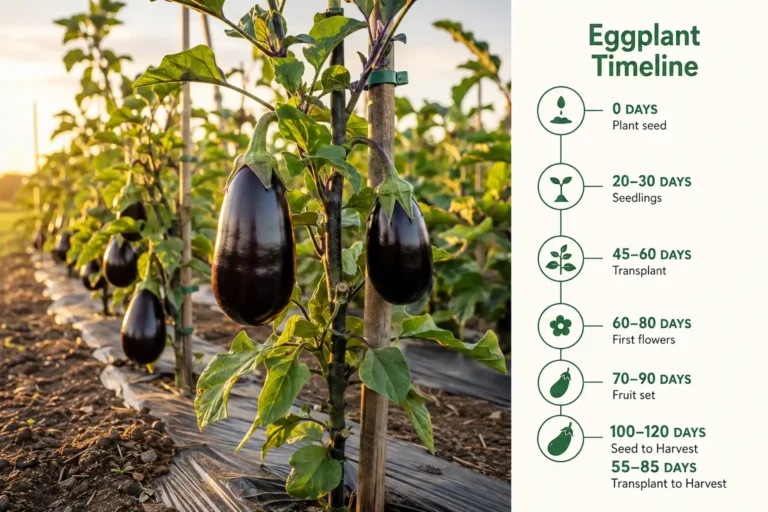
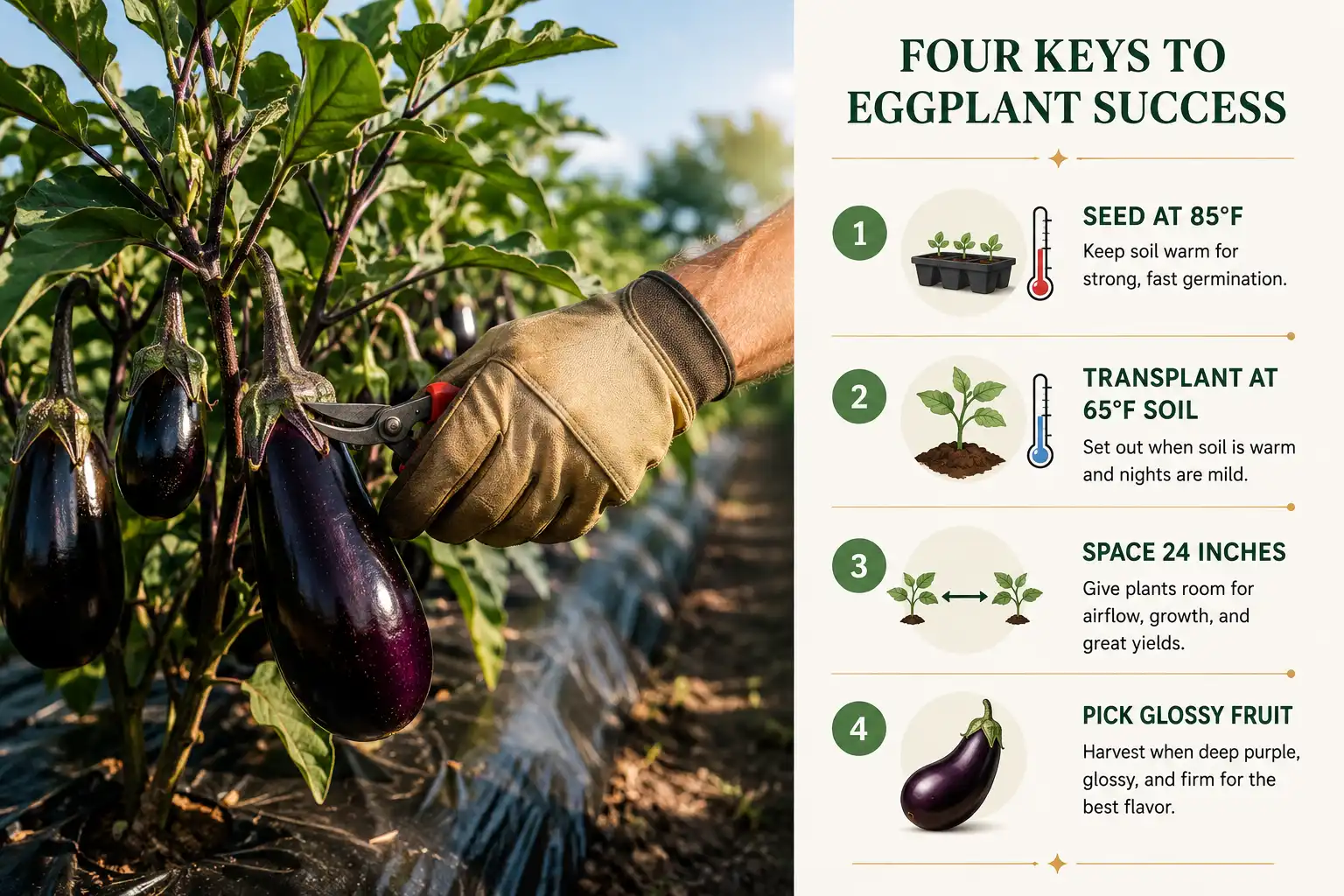
Grow eggplant comes down to heat. Start seeds indoors 8 weeks early at 80°F to 85°F. Transplant once soil hits 65°F with nights above 60°F, then space plants 18 to 24 inches apart.
What Does Eggplant Need to Grow Well?
Eggplant needs full sun, warm soil, and steady moisture. Give it eight hours of direct sun and a soil pH between 6.0 and 6.8. Cold ground causes most of the trouble in Kansas. A transplant set into 55°F soil just sits there. It rarely catches back up.
Work 2 to 3 inches of finished compost into the top 6 inches of the bed. Roots run 12 to 18 inches deep, so break up any compacted layer while you are in there.
| Requirement | Target |
|---|---|
| Sunlight | 8 or more hours daily |
| Soil pH | 6.0 to 6.8 |
| Germination soil temp | 80°F to 85°F |
| Soil temp at transplant | 65°F to 70°F at 4 inches |
| Day temps for fruit set | 70°F to 90°F |
| Night temps for fruit set | Above 60°F |
| Water | 1 to 1.5 inches per week |
| Spacing | 18 to 24 in. in row, 30 to 36 in. between rows |
| First harvest | 55 to 80 days from transplant |
| Yield | About 20 lb per 10 ft of row |
Pull a soil sample the fall before if you can. Then you set phosphorus and potassium rates from real numbers instead of guessing.
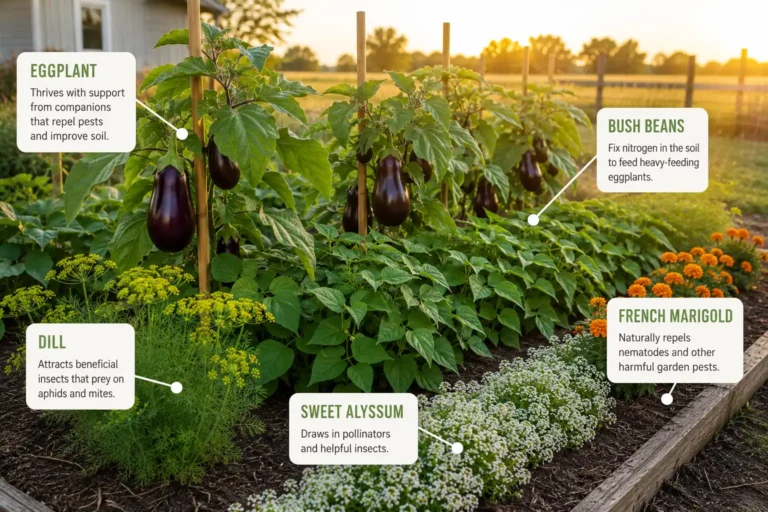
Learn more: What to Plant With Eggplant in a Garden
Which Eggplant Varieties Grow Best?
The right variety depends on how long your warm season runs. Slender Japanese and Chinese types mature fastest, so they fit short seasons and cool summers. Large Italian globe types need more heat and more days on the plant.
| Type | Examples | Days from transplant | Notes |
|---|---|---|---|
| Italian globe | Black Beauty, Nadia, Traviata | 65 to 85 | Big teardrop fruit, needs a full season |
| Japanese and Chinese | Ichiban, Orient Express, Millionaire | 55 to 65 | Slim, thin skinned, earliest to pick |
| Small specialty | Fairy Tale, Patio Baby | 50 to 65 | Best choice for pots and short seasons |
| Heirloom | Rosa Bianca, Listada de Gandia | 75 to 90 | Excellent flavor, slower to mature |
| White and green | Casper, Thai Long Green | 65 to 85 | Mild flavor, less bitterness risk |
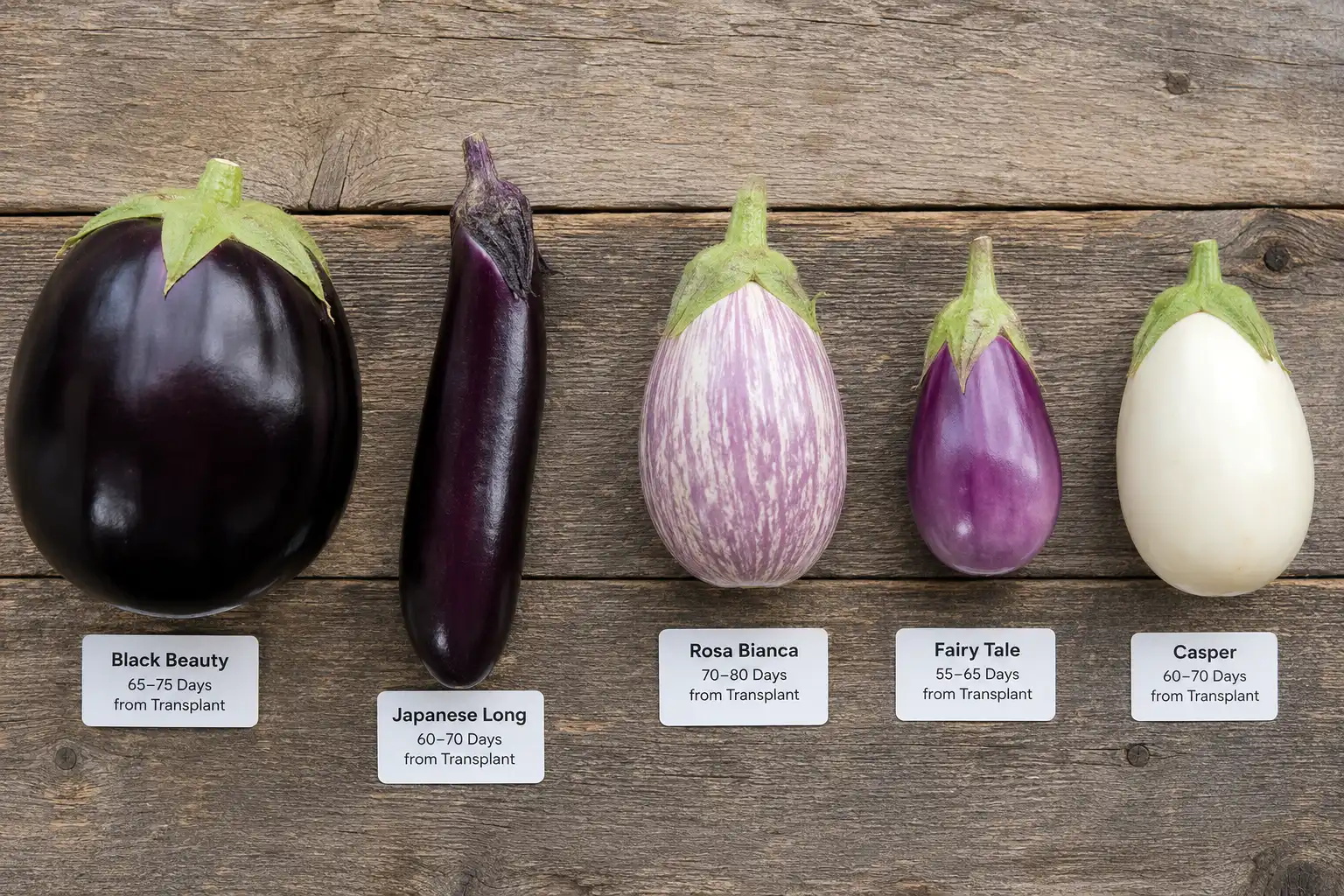
In USDA hardiness zone 6a, Orient Express suits early picking, and Nadia works well for the main crop. Nadia holds its shine through August heat. If you have a wilt history in that ground, buy varieties listed with Verticillium tolerance.
How Do You Start Eggplant Seeds Indoors?
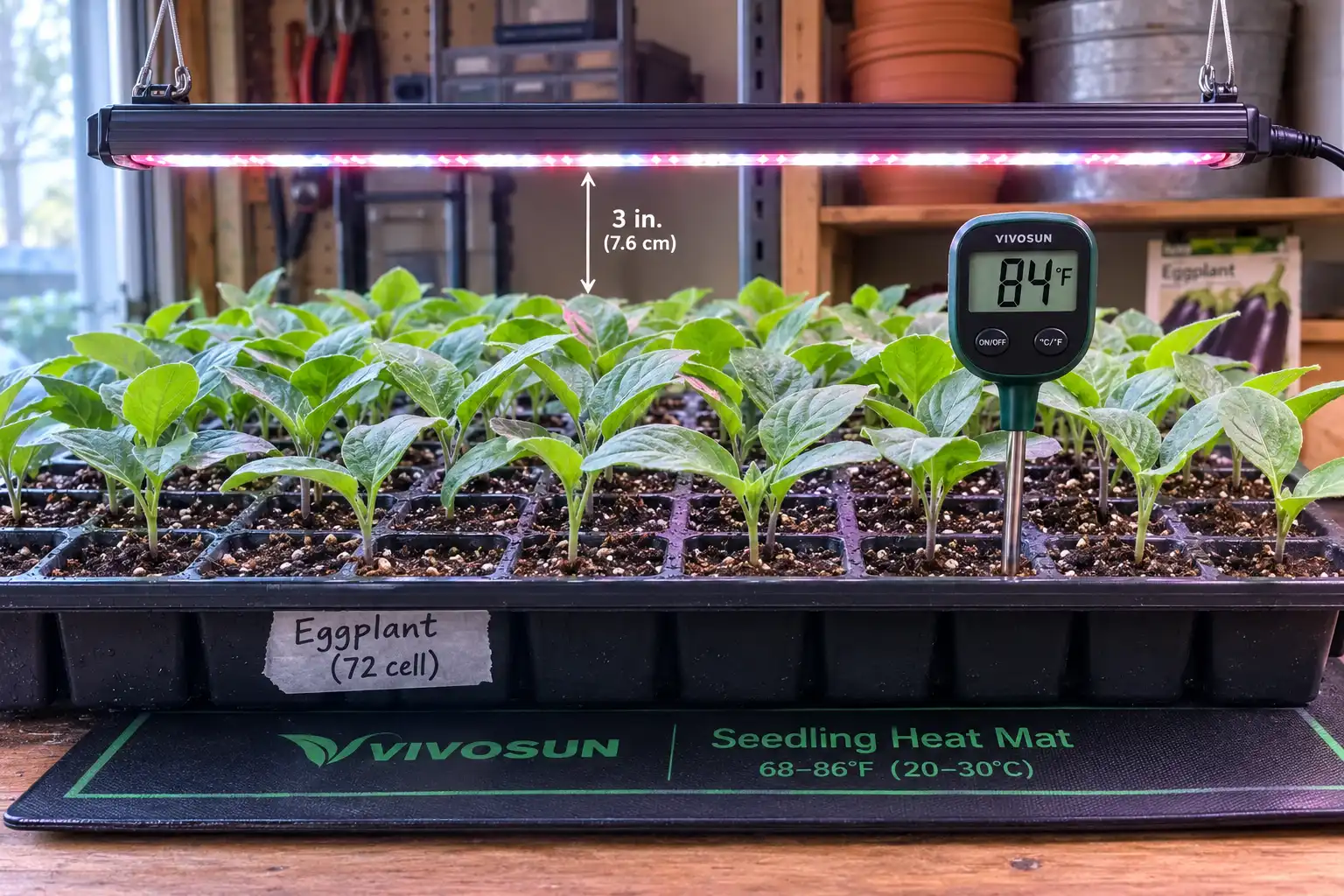
Start eggplant seeds indoors 8 weeks before your target transplant date, and hold the mix at 80°F to 85°F. Bottom heat matters more than room temperature, because seed will not sprout below 60°F.
- Fill cells with sterile seed starting mix, then moisten it before you seed.
- Sow two seeds per cell at 1/4 inch deep, then thin to the stronger seedling.
- Set the tray on a heat mat and hold 80°F to 85°F until emergence.
- Expect sprouts in 7 to 14 days. Cool mix stretches that out to three weeks.
- Drop to about 70°F after emergence, then run grow lights over the tray 14 to 16 hours a day, 2 to 3 inches above the leaves.
- Pot up into 3 or 4 inch pots once the first true leaves open, since crowded seedlings stretch fast.
- Feed a half strength liquid fertilizer weekly after true leaves appear.
Eggplant seed loses vigor faster than most vegetable seed. Germination can fall near 50% by the third year in storage. So test an old packet on a damp paper towel before you give it tray space.
When Should You Transplant Eggplant Outdoors?
Transplant when soil at 4 inches holds 65°F and night lows stay above 60°F. Both conditions have to be true. A warm afternoon after a 50°F night is not a planting day, and eggplant answers cold soil by shutting down.
In the Topeka, Kansas area, that window usually falls between May 20 and June 5, about two weeks after tomato transplanting. Frost free dates alone will fool you here. Take the reading early with a soil thermometer in the seedbed. Afternoon surface readings run too warm.
Harden off over 7 to 10 days first. Cut water slightly and hold the plants near 60°F. Set them out for one hour on day one. Then add time each day. The same hardening off approach used for field transplants works well for eggplant
Black plastic mulch buys 5°F to 8°F of soil warmth. Lay it a week ahead of planting, then cut holes for each plant. Hold off on straw or grass clippings until soil passes 75°F, because organic mulch laid early keeps the ground cool.
How Do You Plant Eggplant Transplants?
- Broadcast pre-plant fertilizer at your soil test rate, then work it into the top 6 inches.
- Set plants 18 to 24 inches apart in rows 30 to 36 inches apart.
- Plant at the same depth as the pot. Eggplant will not root along a buried stem the way tomatoes do, so deep setting gains you nothing.
- Water each plant in with about a pint of starter solution.
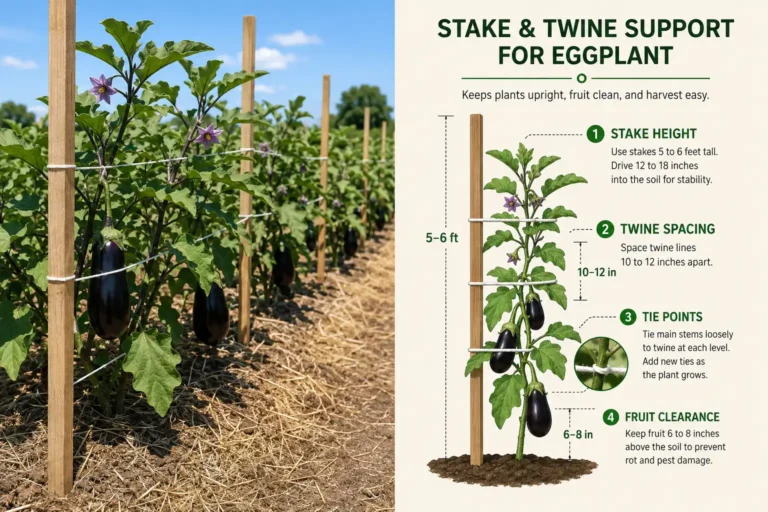
- Drive a stake beside every plant now, while roots are small.
- Float a row cover over the row until first bloom to keep flea beetles off tender leaves.
- Pinch off any blossom already open on the transplant, because a plant that fruits before it establishes stays small all season.
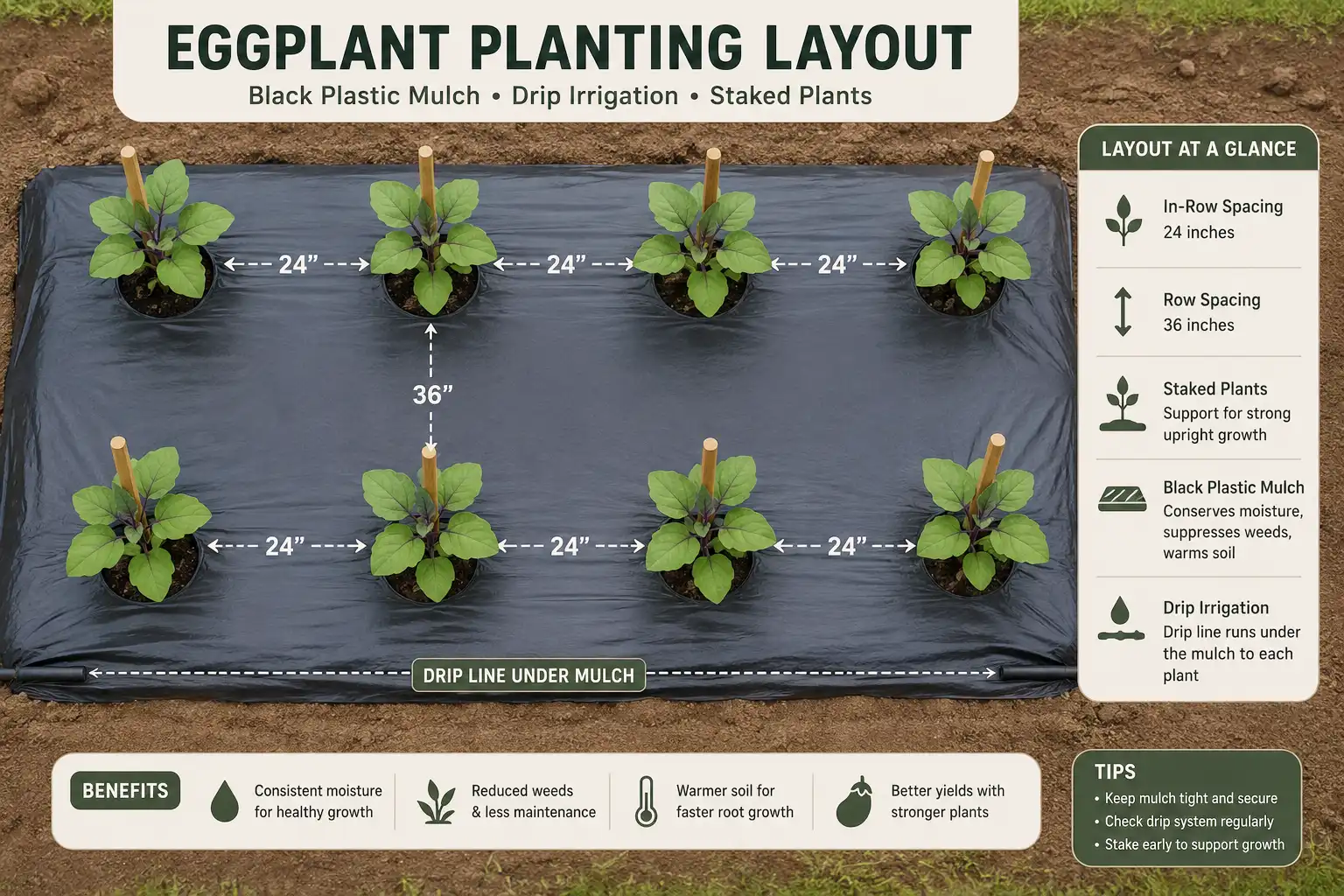
Tight spacing traps humidity around the blooms and cuts fruit set, so resist crowding. Space gets short fast when eggplant and tomatoes share one bed, and both crops feed the same soilborne diseases.
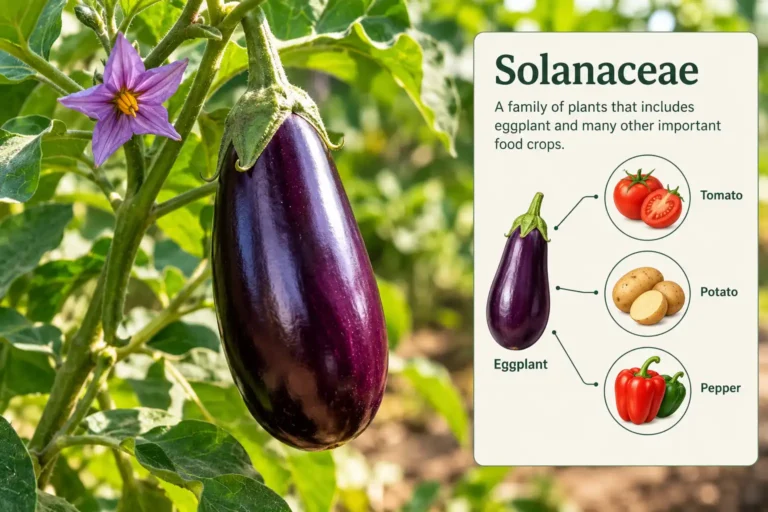
Rotation matters as much as spacing. Keep eggplant 3 to 4 years off ground that grew potatoes, tomatoes, or peppers. Everything in the Solanaceae family shares pests and wilt pathogens.
How Much Water Does Eggplant Need?
Eggplant needs 1 to 1.5 inches of water per week, and closer to 2 inches during a hot, windy stretch. Water deep enough to wet 6 inches of soil, then wait before you water again. Fruit set and fruit fill are the two critical windows.
Drip line under the mulch is the cheapest upgrade you can make. It keeps foliage dry, which lowers Phomopsis and Alternaria pressure, and it puts water where the roots actually sit.
Uneven moisture shows up in the fruit. Plants that dry down hard and then get flooded drop blossoms and make bitter, seedy fruit. So aim for steady, not generous.
How Do You Fertilize Eggplant Through the Season?
Feed eggplant at planting, then sidedress twice: about three weeks after transplanting, and again when the first fruits size up. Eggplant is a heavy feeder, though excess nitrogen backfires badly.
| Timing | Garden beds | Field rows |
|---|---|---|
| Pre-plant | 2 lb of 10-10-10 per 100 sq ft | 40 to 50 lb N per acre, plus P and K per soil test |
| 3 weeks after transplant | 1 tablespoon calcium nitrate per plant | 30 to 40 lb N per acre |
| First fruit set | Repeat the sidedress | 30 to 40 lb N per acre |
| Every 3 to 4 weeks after | Only if leaves go pale | Only if tissue tests show a need |
Season total nitrogen runs 100 to 150 lb per acre on field plantings. For a home bed, a balanced 10-10-10 blend worked in before planting covers the base. After that, add nitrogen only as the crop asks for it.
Read the plant. A dark green bush with no fruit means nitrogen ran ahead of everything else. Back the nitrogen off, keep water steady, and fruit set usually returns within two weeks.
Do Eggplants Need Staking or Pruning?
Yes on staking, light on pruning. A plant carrying 4 to 6 fruit leans or snaps in a Great Plains thunderstorm. Stake or cage every plant at transplant time.
Keep pruning simple:
- Rub off suckers below the first flower fork.
- Strip lower leaves that touch soil, which cuts rain splash and fruit rot.
- Remove any fruit that is clearly damaged or overripe.
Skip the heavy pruning you might do on tomatoes. Eggplant sets fruit on new growth, so cutting hard mid-season costs you yield.
Why Do Eggplant Flowers Drop Without Setting Fruit?
Flowers drop because pollen failed, and temperature usually causes it. Fruit abortion climbs when day highs approach 95°F. Pollen also deforms when nights fall below roughly 60°F, so both ends of the season carry risk.
Eggplant flowers are self fertile. Vibration moves pollen inside the same bloom, so bees and wind help but are not required. Tap open flowers in the morning while temperatures sit below 85°F. An electric toothbrush touched to the bloom base works even better.
Three other causes come up often.
- Too much nitrogen. A leafy bush aborts blooms. Cut the nitrogen.
- Moisture swings. Drought stress followed by a soaking drops flowers.
- Thrips in the blossoms. Shake a bloom over white paper and look for tiny moving slivers.
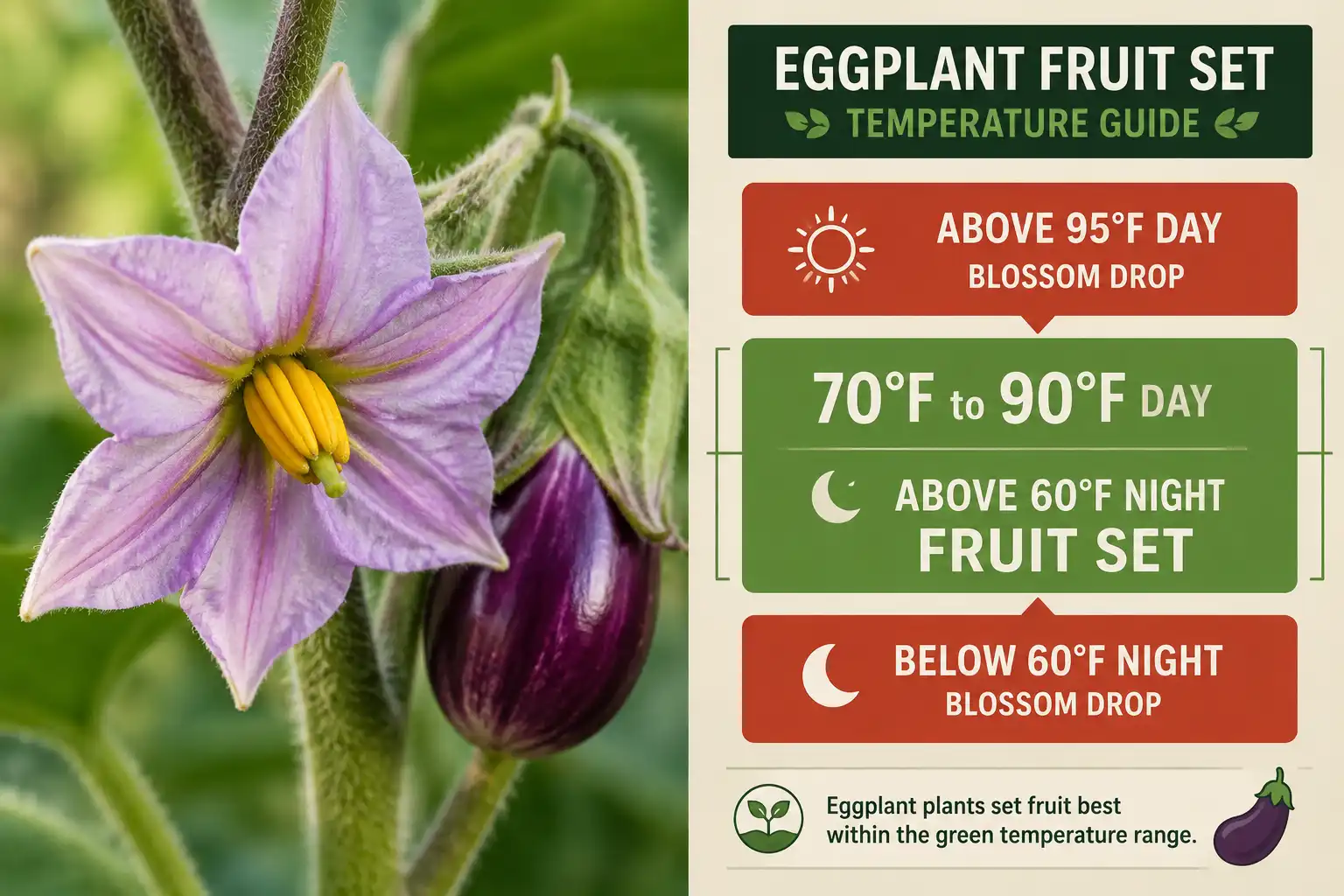
During a July heat run, 30% shade cloth over the row keeps pollen viable longer. Fruit set picks back up once nights cool into the 60s.
What Pests Attack Eggplant and What Stops Them?
Flea beetles and Colorado potato beetle cause most of the damage, and both hit hardest on young plants. Scout twice a week from transplant through first bloom.
| Pest | What you see | What to do |
|---|---|---|
| Flea beetles | Round shot holes across young leaves | Row cover until first bloom, spinosad on threatened seedlings |
| Colorado potato beetle | Leaves chewed to the ribs, orange larvae | Handpick, Bacillus thuringiensis on small larvae, rotate away from potatoes |
| Two spotted spider mite | Stippled, bronzed leaves in hot dry weather | Keep water steady, spray leaf undersides, scout weekly |
| Aphids | Curled tips and sticky honeydew | Check leaf undersides, protect lady beetles |
| Eggplant lace bug | Yellow speckling with dark specks below | Inspect lower leaves, treat early |
| Tomato hornworm | Whole leaves gone overnight | Handpick at dusk, Bt on small worms |
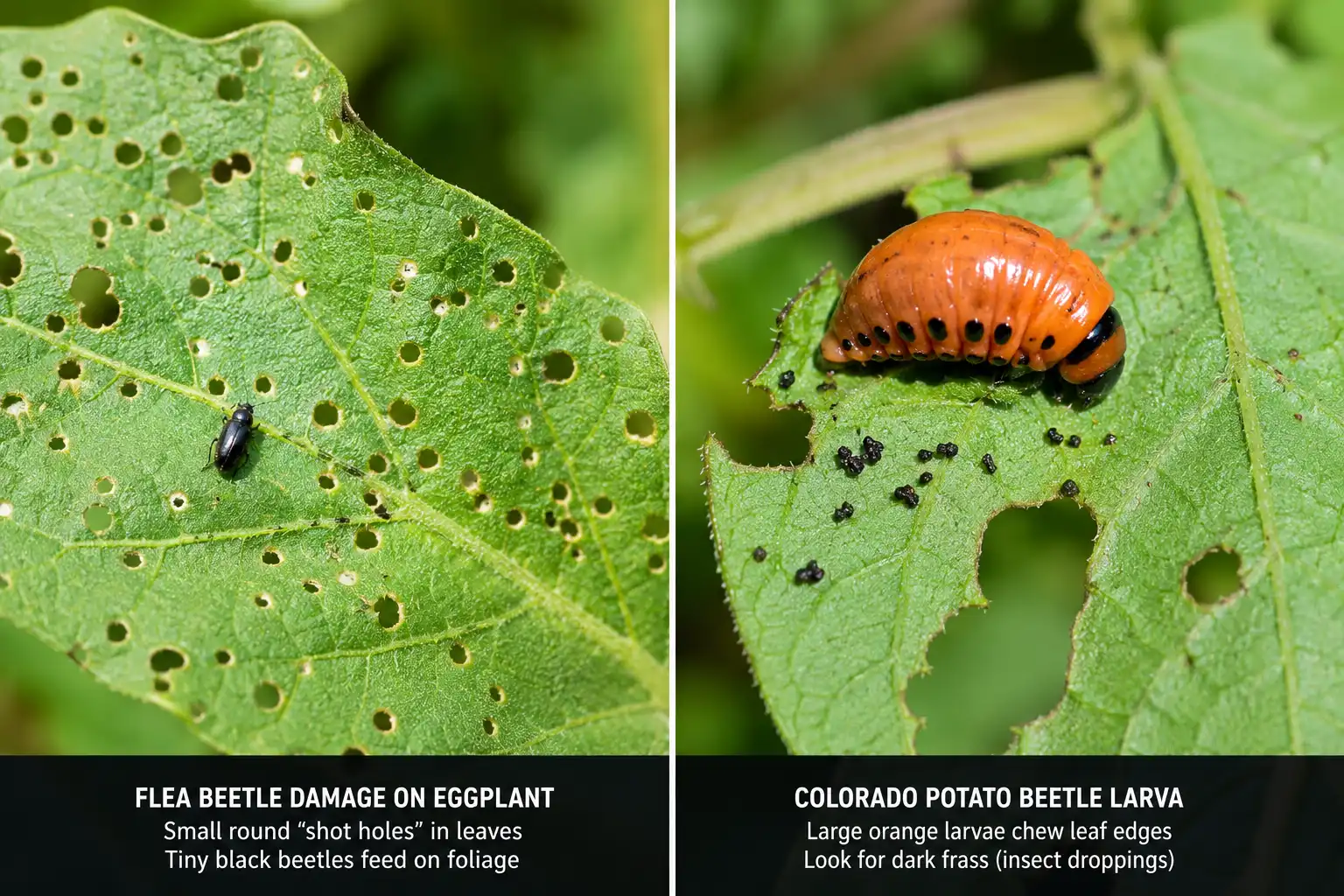
Established plants tolerate a surprising amount of flea beetle feeding by midsummer, so spraying big plants rarely pays. Seedlings are the ones that need protection. Building an integrated pest management routine around scouting, row covers, and rotation handles nearly all of it without heavy chemistry.
Which Diseases Affect Eggplant?
Verticillium wilt is the disease that ends a planting. Verticillium dahliae produces microsclerotia that survive in soil for up to 10 years. No spray helps once plants show symptoms.
- Verticillium wilt. One branch or one side of a leaf wilts first while the rest looks fine. Slice a stem and look for brown streaks inside. Rotate 4 years, choose tolerant varieties, and consider grafted plants on resistant rootstock.
- Phomopsis blight. Light leaf spots plus sunken brown fruit rot. The fungus rides on seed and lives in soil, so use treated seed, plastic mulch, and a 4 year rotation.
- Alternaria leaf spot. Target shaped spots after wet weather. Wider spacing and dry foliage keep it in check.
- Damping off. Seedlings pinch off at the soil line. Sterile mix, 80°F bottom heat, and airflow prevent it.
Sanitation carries real weight here. Pull and remove infected plants rather than tilling them under, and clean your pruners between plants when wilt shows up.
Can You Grow Eggplant in Containers?
Yes, and eggplant handles pots better than most fruiting crops. Use one plant per 5 gallon container at minimum, though 7 to 10 gallons produces noticeably more fruit.
- Choose compact varieties like Patio Baby or Fairy Tale.
- Fill with potting mix, never garden soil, which compacts in a pot.
- Water daily in July, sometimes twice on windy days.
- Feed weekly at half rate, because nutrients leach out with every watering.
- Dark pots warm fast in May but cook roots in August, so shade the pot sides at midsummer.
Container plants dry out much faster than field rows. That moisture swing is the main reason potted eggplant drops blossoms, so check the top inch of mix every morning.
When Is Eggplant Ready to Harvest?
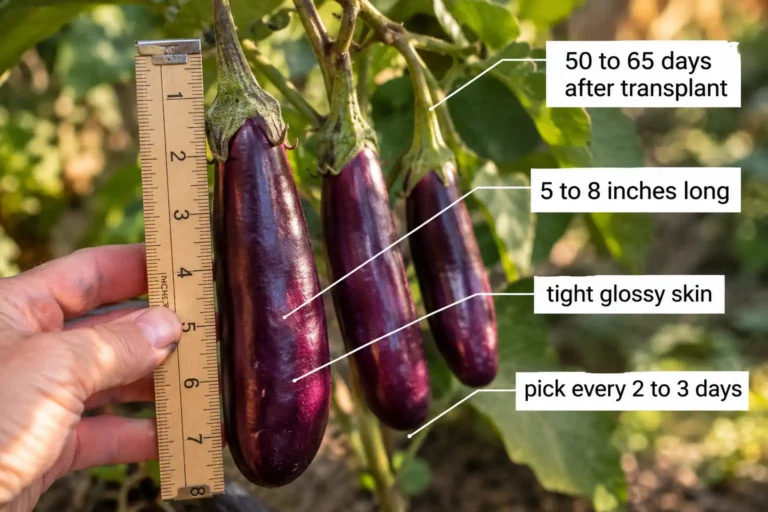
Pick eggplant when the skin is glossy and firm. Most varieties eat best at one third to two thirds of full size. Size alone misleads you. Press the side with your thumb. A dent that springs right back means ready. A dent that stays means overripe.
- Cut with shears or a knife, leaving the green calyx and about an inch of stem.
- Wear gloves, since the calyx on most varieties carries spines.
- Pick every 2 to 3 days once fruit starts sizing.
- Toss any fruit with dull skin and hard brown seeds, because those taste bitter.
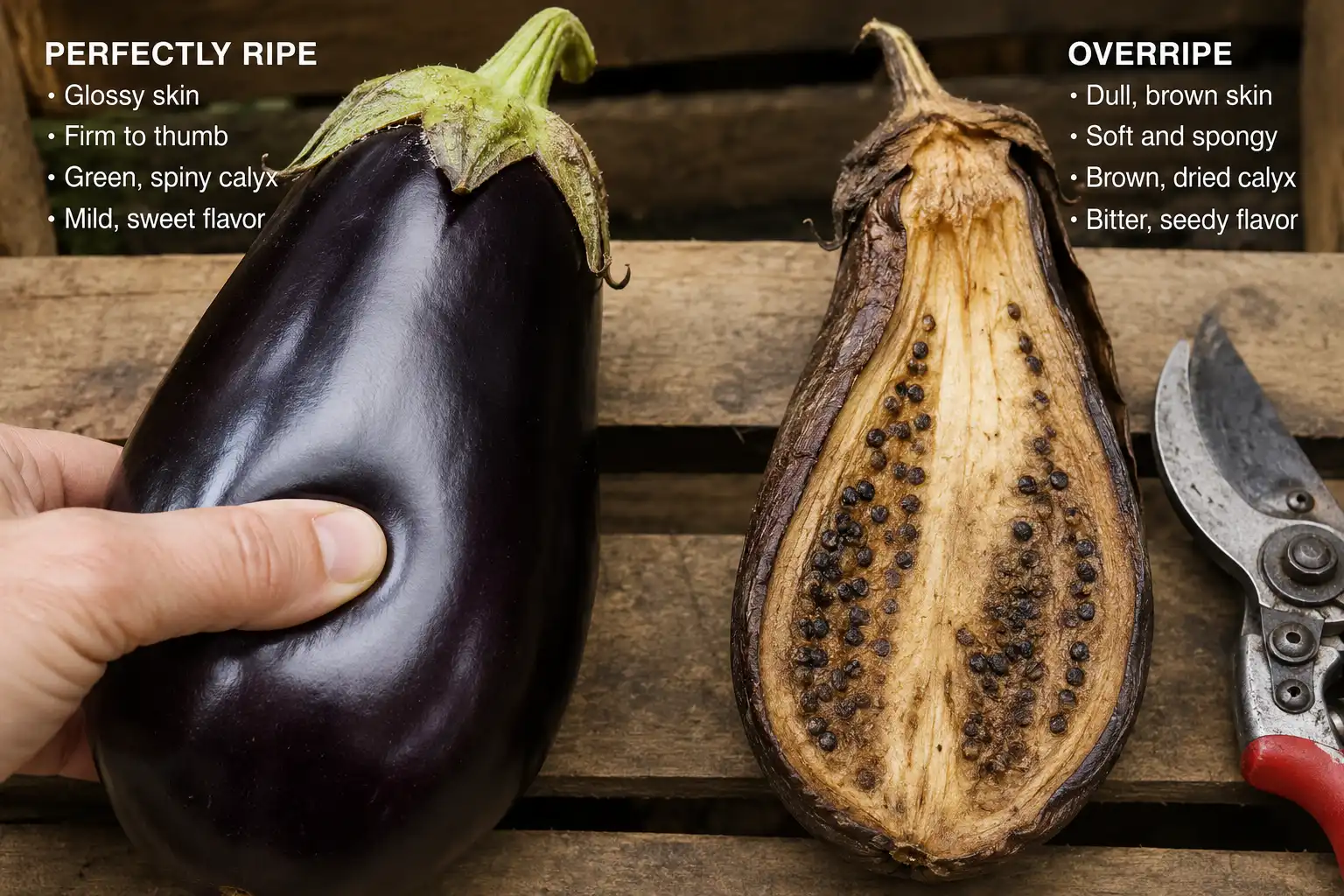
Frequent picking drives the next flush. One overripe fruit left hanging signals the plant that its reproductive work is finished, which can stall new flowers for two to three weeks. Large plants carry 4 to 6 fruit at peak, and a healthy 10 foot row returns about 20 pounds.
How Should You Store Eggplant After Picking?
Hold eggplant at 50°F to 54°F with 90% to 95% humidity, and plan to use it within 7 to 10 days. Colder is worse, not better. Below 50°F the fruit takes chilling injury, which shows up as surface pitting, bronzed skin, and browning seeds within 6 to 8 days at 41°F.
Most home refrigerators run colder than 40°F, so a cool basement or shaded pantry beats the crisper drawer for a few days. Skip washing until you cook, because surface moisture speeds decay.
Keep eggplant away from tomatoes, bananas, and apples. Eggplant reacts to ethylene, which loosens the calyx and browns the flesh faster than normal.
Key Points on Growing Eggplant
Heat and timing run this crop. Wait for 65°F soil, warm the bed with black plastic, and stake at planting so a loaded plant survives a summer storm. Keep water steady at 1 to 1.5 inches weekly, hold nitrogen back once flowers open, and cover young plants against flea beetles until first bloom. Then pick glossy fruit every two or three days. That harvest rhythm does more for total yield than anything else you do all season.