How to Grow Zucchini: Plant at 60°F, Pick in About 55 Days
Zucchini grows best from seed sown in warm soil and full sun, with steady water and regular harvests. Most failures come from cold soil, tight spacing, or late picking. Below, you’ll find how to grow zucchini step by step, with exact depths, spacing, soil targets, and problem fixes.
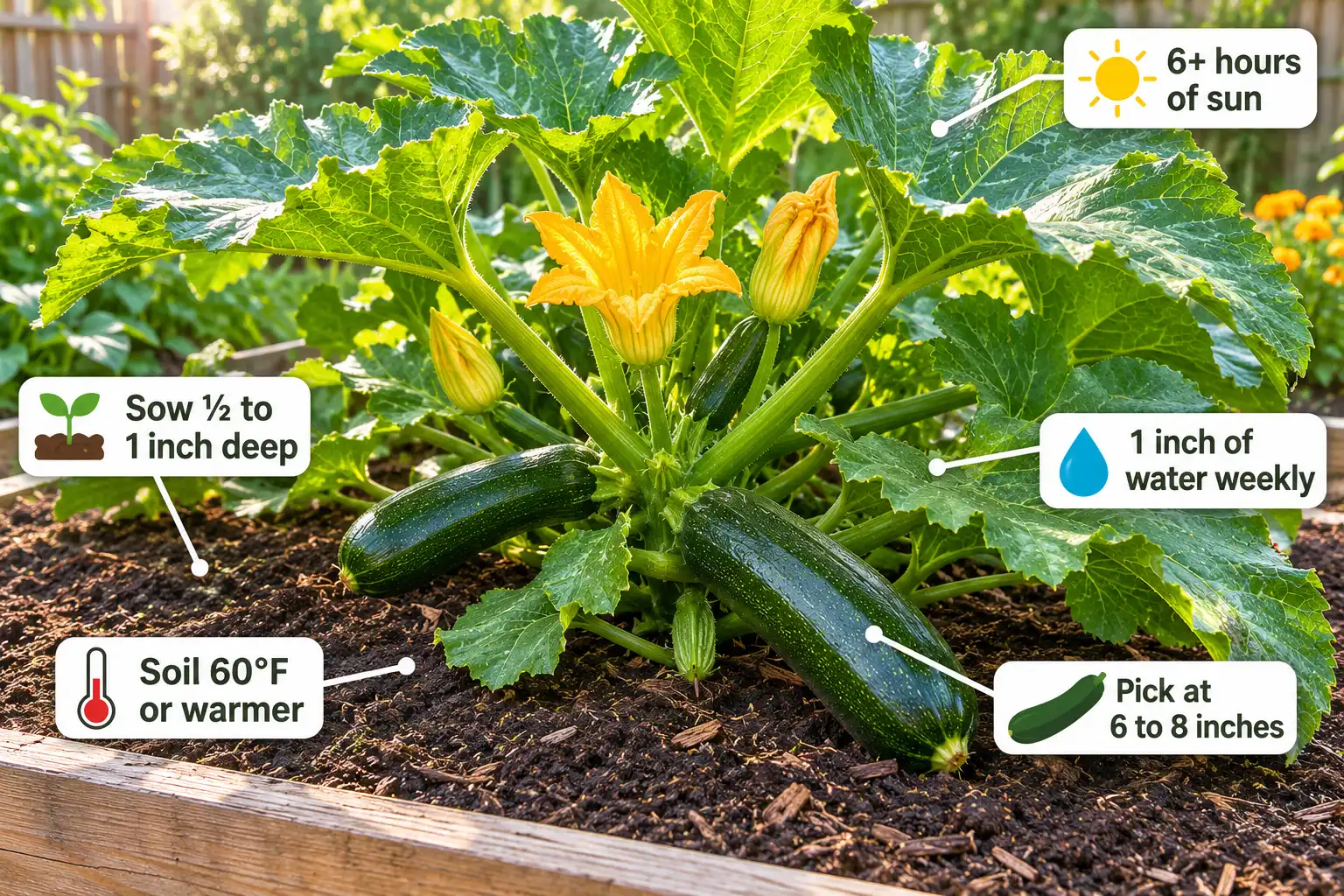
To grow zucchini, sow seeds ½ to 1 inch deep after the last frost, once soil reaches 60°F. Plants need full sun, loose fertile soil, and 1 inch of water each week. Harvest starts about 55 days after planting.
When to Plant Zucchini
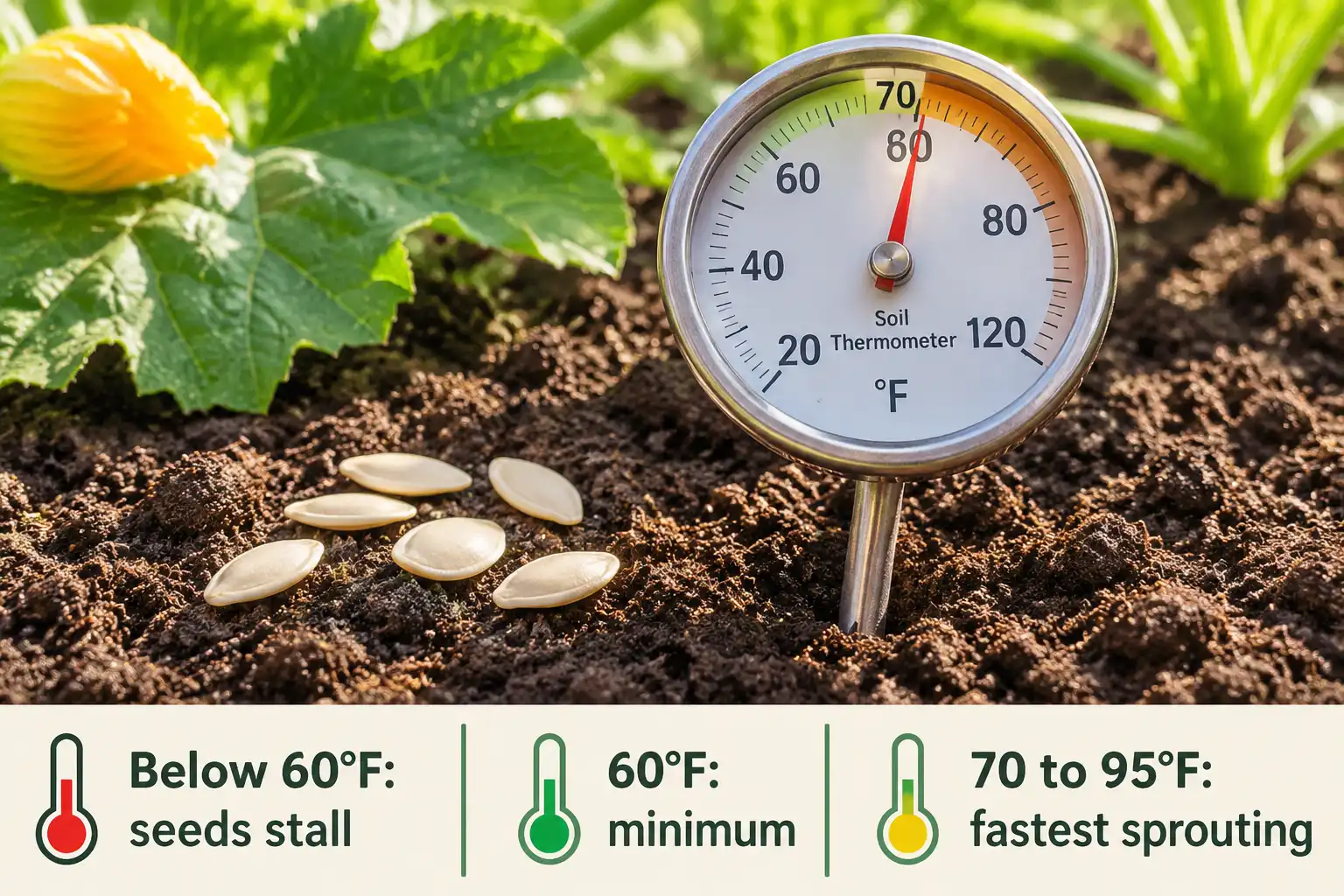
Plant zucchini after the last spring frost, once the soil has warmed. Clemson Cooperative Extension sets the minimum at 60°F, measured 4 inches below the surface. University of Minnesota (UMN) Extension aims higher, at 70°F at a 2-inch depth. So treat 60°F as the floor and 70°F as the target. Check the reading with a probe-type soil thermometer in the morning, when soil is coolest.
Warm soil matters because squash seed stalls and rots in cold ground. Germination research published by Oregon State University Extension lists 60°F as the squash minimum. It puts the optimum range at 70°F to 95°F.
Planting dates shift by region:
| Region | Spring planting | Fall planting |
|---|---|---|
| Coastal South Carolina | March 15 to July 31 | August 1 to 31 |
| Piedmont South Carolina | April 15 to July 31 | July 15 to August 15 |
| Minnesota | Late May to early June | None listed |
The dates come from Clemson Extension and UMN Extension. For a longer harvest, sow part of the crop first. Then finish the planting about three weeks later, as UMN Extension suggests.
Direct Sow or Start Transplants?
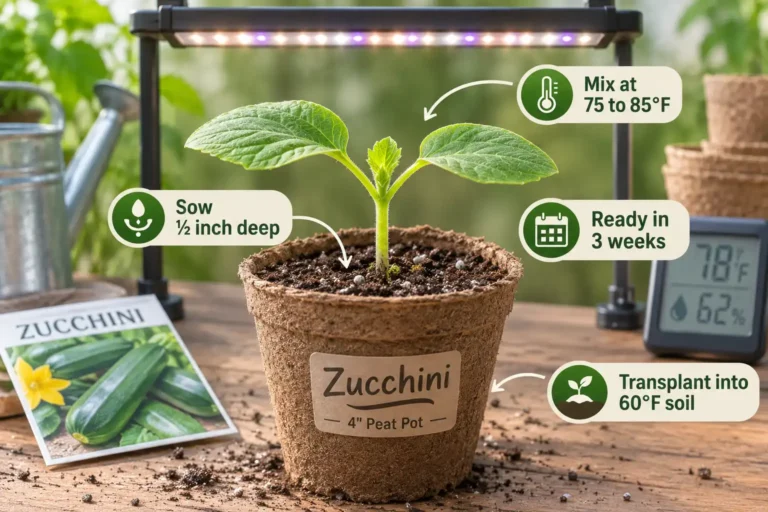
Direct sowing works best for zucchini. UMN Extension prefers it because transplanting often damages squash roots. Transplants set into cold soil also grow poorly. For an earlier start, sow seed indoors in individual pots about three weeks ahead. Then set transplants 15 inches apart, the spacing Clemson Extension uses.
How Much Sun Does Zucchini Need?
Zucchini needs full sun, which NC State Extension defines as 6 or more hours of direct sunlight a day. More sun means more flowers and more fruit. So give zucchini the sunniest spot in the garden.
Shade slows growth and cuts flowering. It also keeps leaves damp longer, and damp, crowded foliage invites powdery mildew. Also, watch for sweet corn or trellised pole beans that will shade the bed by midsummer.
Temperature matters too. Clemson Extension notes that summer squash grows best when average temperatures stay between 65°F and 75°F. In hot Southern summers, plants still need full sun. However, long stretches of extreme heat slow fruit set, so steady watering becomes even more important.
What Is the Best Soil for Zucchini?
The best soil for zucchini is loose, well-drained loam rich in organic matter, with a pH of 6.0 to 6.5. Both UMN Extension and Clemson Extension cite that pH range. UMN Extension adds that the soil should hold moisture yet still drain freely.
Prepare the bed before planting:
- Test the soil. A lab soil test shows exactly how much lime and fertilizer the bed needs.
- Add organic matter. Work compost or well-rotted manure into the top 6 to 8 inches.
- Skip fresh manure. UMN Extension warns that it can carry harmful bacteria and add weed problems.
- Fix poor drainage. Raised beds help on heavy clay or low ground, and UMN Extension recommends them for vine crops.
- Adjust pH only when needed. Apply lime only if the soil test calls for it.
Heavy clay that stays wet after rain is the main soil to avoid. Seeds rot in it, and roots struggle to spread. So loosen it with compost or build raised beds before you sow.
How to Fertilize Zucchini
Fertilize zucchini based on a soil test whenever possible. Without one, Clemson Extension suggests a 5-10-10 blend at 3 pounds per 100 square feet, worked in before planting.
Next, side-dress just before the vines start to run. Clemson Extension lists 1 pound of 34-0-0 or 2 pounds of calcium nitrate (15.5-0-0) per 100 feet of row. UMN Extension offers another option: ½ cup of 46-0-0 per 100 feet of row.
Go easy on nitrogen. Excess nitrogen pushes vine growth at the expense of fruit, Clemson Extension warns. Still, sandy soils and heavy rains may call for a second side-dressing. Also, beds amended with generous compost may need little or no extra fertilizer, according to UMN Extension.
How Big Do Zucchini Plants Get?
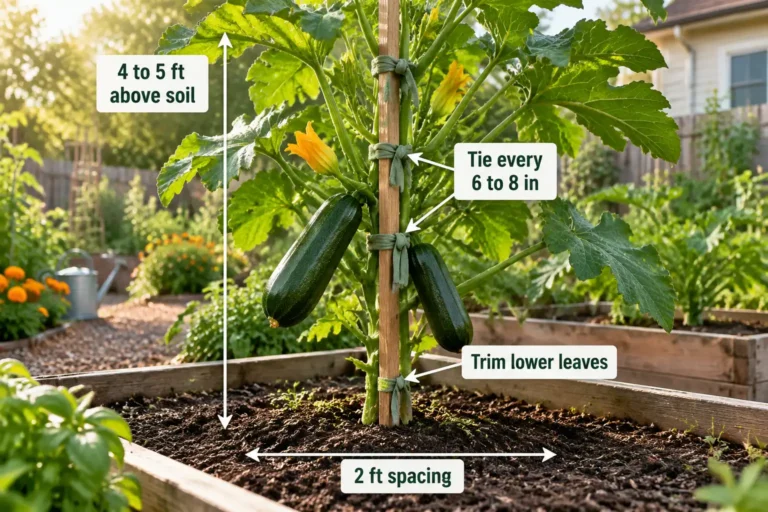
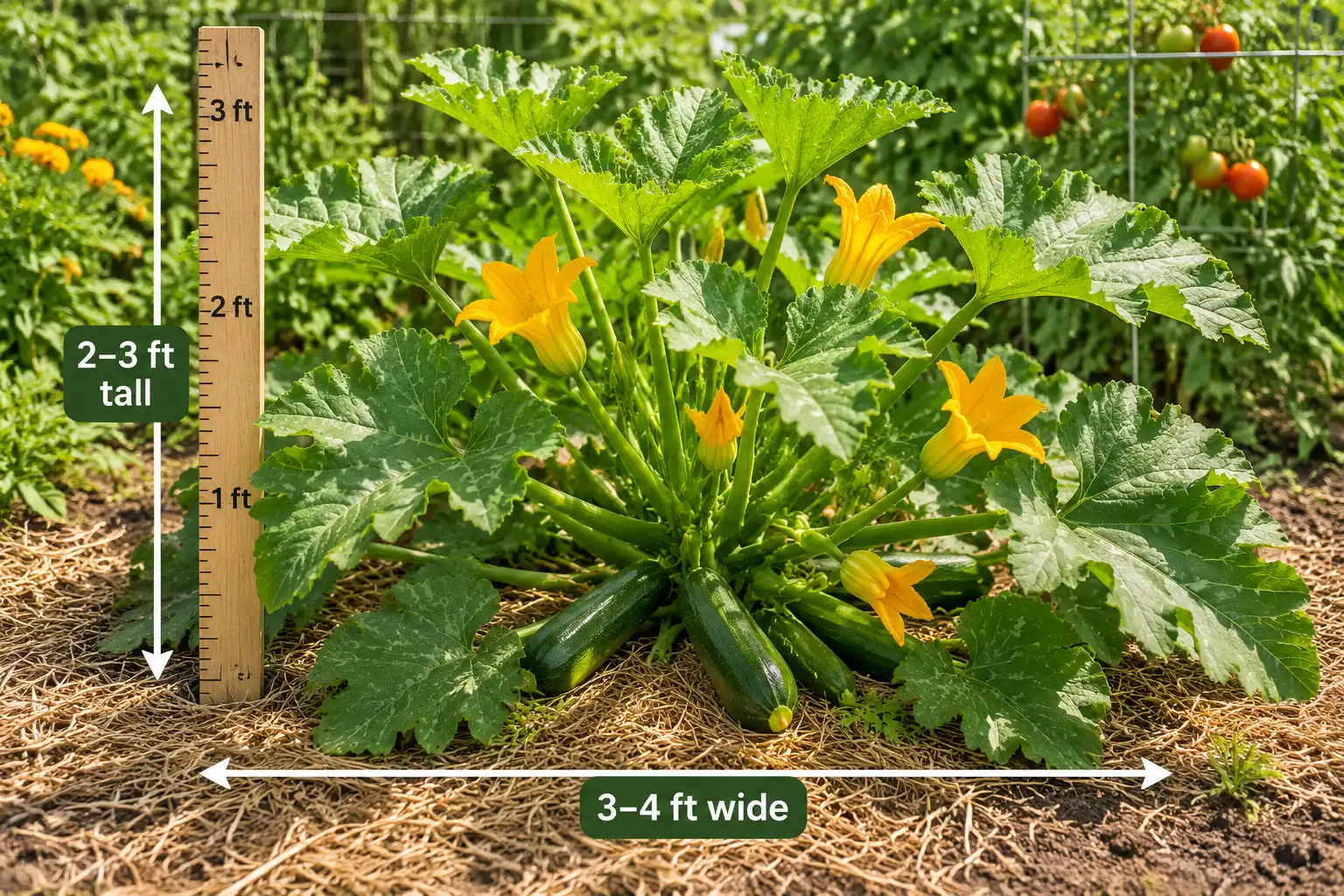
Most bush zucchini plants grow 2 to 3 feet tall and spread 3 to 4 feet wide. Individual leaves often reach a foot or more across. Vining summer squash types grow larger still, sending runners several feet in every direction.
That size drives spacing. UMN Extension spaces bush types 2 to 3 feet apart between rows or hills. In contrast, it allows 5 to 6 feet between hills for vining types. Crowded plants trap humidity and develop powdery mildew sooner.
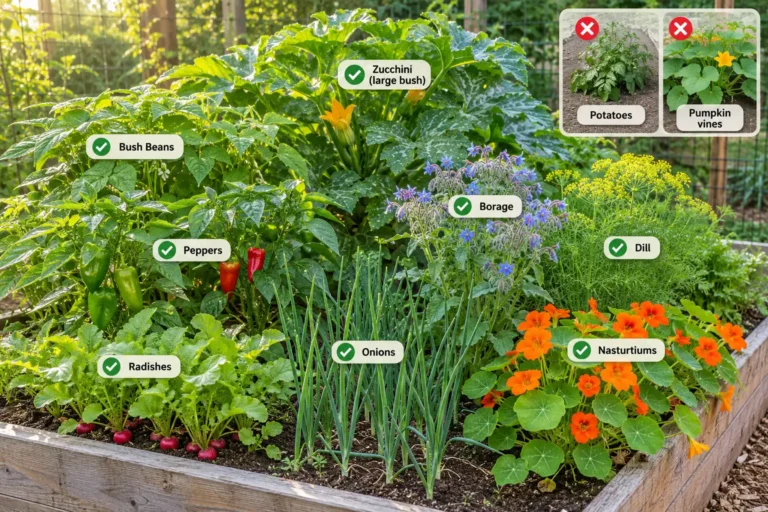
Plan companion plantings with that spread in mind. If you’re planting zucchini near tomatoes, leave extra room, because both crops fill their space by midsummer.
Best Zucchini Varieties to Grow
Choose a variety by garden space, fruit shape, and disease pressure. Clemson Extension recommends ‘Black Beauty’, ‘Eight Ball’, ‘Elite’, ‘Embassy’, ‘Senator’, and ‘Spineless Beauty’ for home gardens. Oregon State University Extension adds ‘Raven’ and the yellow ‘Gold Rush’.
| Variety | Fruit | Why growers pick it |
|---|---|---|
| Black Beauty | Dark green, straight | Open-pollinated classic, introduced in the 1920s |
| Eight Ball | Round, dark green | Compact plant; fruit suits stuffing |
| Spineless Beauty | Glossy green, straight | Spine-free stems make picking easier |
| Raven | Dark green, straight | Compact habit; grows well in large containers |
| Gold Rush | Golden yellow | Bright fruit is easy to spot under leaves |
Hybrids such as ‘Raven’ often add vigor and uniform fruit. Open-pollinated types like ‘Black Beauty’ let you save seed, as long as no other Cucurbita pepo crops bloom nearby. If powdery mildew strikes every year, look for “PM” resistance codes in seed catalogs.
How to Plant Zucchini Seeds Step by Step
Sow zucchini in rows or in hills. Rows suit long beds and market plots, while hills suit small gardens and vining types.
- Warm the bed. For an earlier start, lay black plastic mulch after preparing the soil. Then cut slits and sow through it.
- Sow the seed. For rows, Clemson Extension places seeds ½ inch deep and 4 to 6 inches apart, in rows 3 feet apart. For hills, sow 2 or 3 seeds per hill. Space hills 3 to 4 feet apart, in rows 4 to 6 feet apart.
- Water deeply. Soak the soil to about 6 inches. After that, keep the surface moist until seedlings emerge.
- Thin early. At the one to two true-leaf stage, thin row plantings to 12 to 15 inches apart. In hills, keep the strongest one or two plants. Snip extras at the soil line instead of pulling them, so the keeper’s roots stay intact.
- Cover if needed. Lightweight row covers guard seedlings against cold nights and early beetles. However, remove them once flowering begins so bees can reach the blooms, as UMN Extension advises.
How Deep to Plant Zucchini Seeds
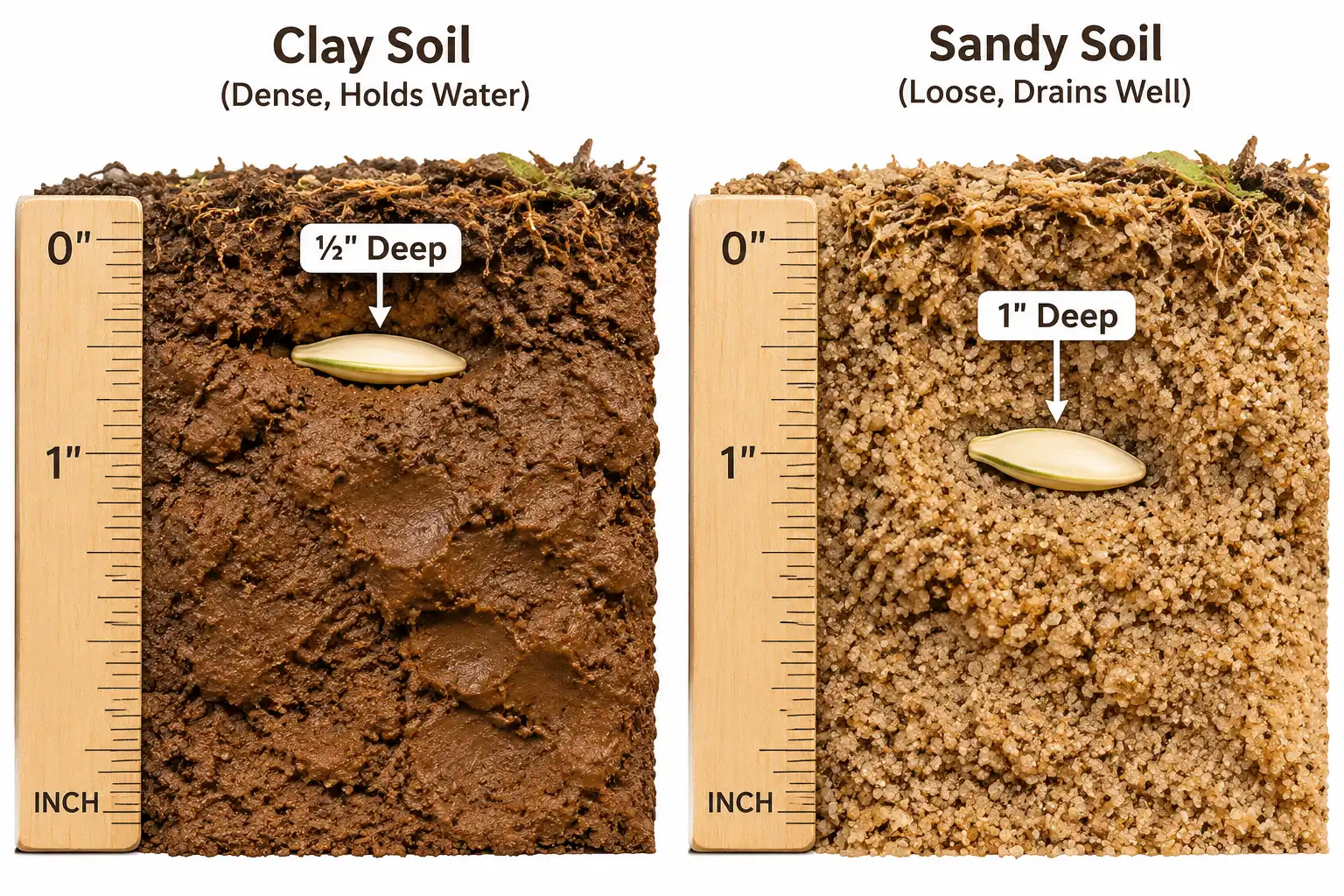
Plant zucchini seeds ½ to 1 inch deep. Clemson Extension and UMN Extension both use about ½ inch for home gardens. That shallow depth suits cool, heavy, or wet soil, where deeper seed tends to rot.
In light, sandy soil that dries fast, go closer to 1 inch. Commercial growers often plant deeper still. For example, University of Georgia (UGA) Extension’s commercial production guide lists 1 to 1.5 inches. In a cool spring garden, though, seed placed deeper than 1 inch emerges more slowly.
| Soil condition | Seed depth |
|---|---|
| Cool, heavy, or wet soil | ½ inch |
| Light, sandy soil | About 1 inch |
| Commercial field seeding | 1 to 1.5 inches |
After sowing, firm the soil gently with your hand. That way, each seed makes full contact with moist soil.
What Do Zucchini Seedlings Look Like?
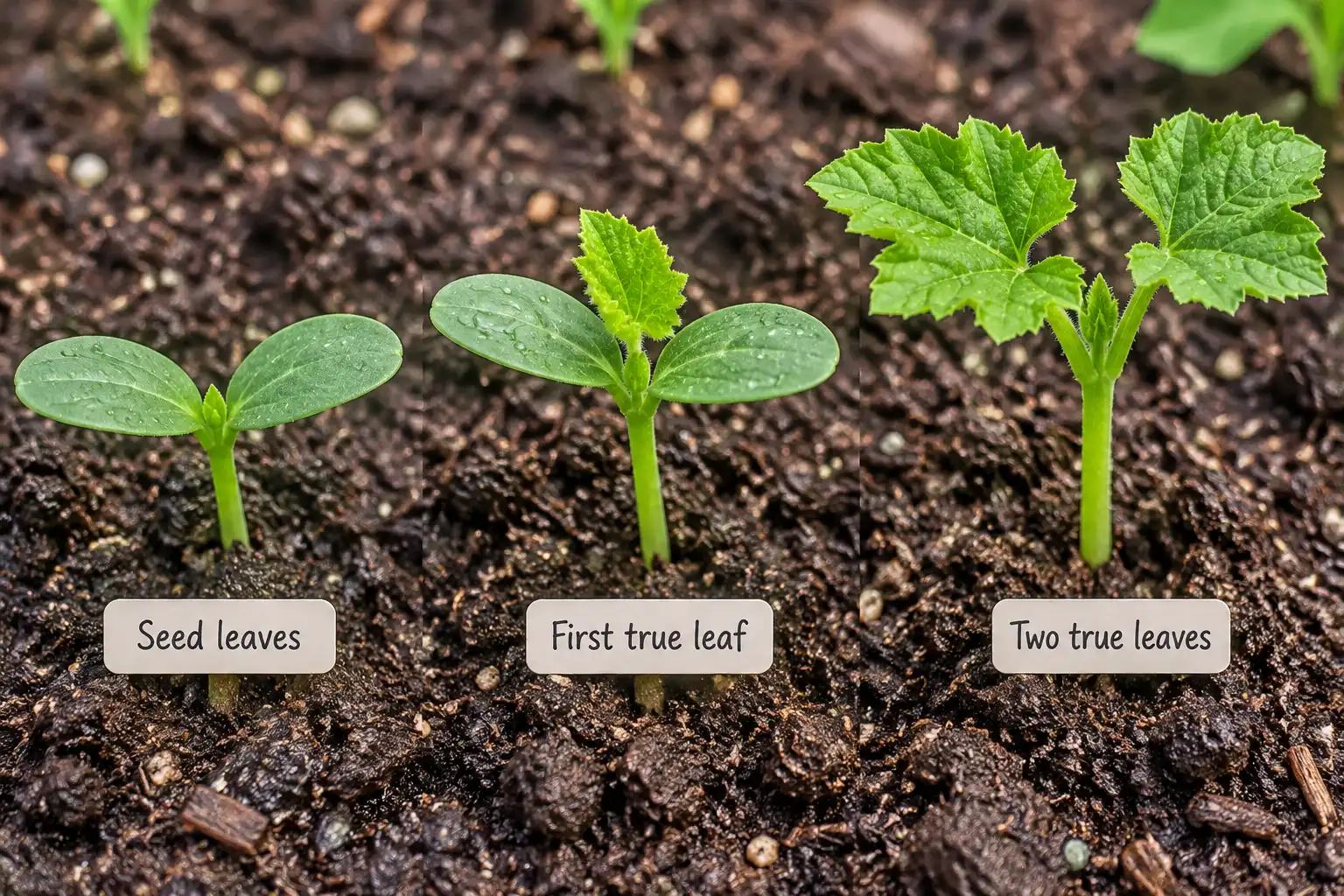
Zucchini seedlings first show two smooth, oval seed leaves called cotyledons. These seed leaves are thick and noticeably larger than tomato or pepper seed leaves. About a week later, the first true leaf appears between them. It feels rough and slightly prickly, with jagged, lobed edges.
As plants mature, many zucchini varieties develop silvery patches along the leaf veins. That pattern is normal. In contrast, powdery mildew forms white, dusty spots that rub off and spread across the whole leaf.
Seedlings that pinch at the soil line and topple over point to a soilborne disease. Moderate watering and good drainage help prevent damping-off in young seedlings.
How Long Does Zucchini Take to Grow?
Zucchini takes about 45 to 55 days from seeding to first harvest. UGA Extension gives that range, and Clemson Extension puts first harvest at about 55 days after planting. Warm, sunny weather shortens the timeline, while cool weather stretches it.
Seeds emerge in 5 to 10 days in warm soil, according to NC State Extension. Once female flowers open, fruit grows fast. Iowa State University Extension lists just 3 to 4 days from flowering to harvest size for zucchini.
| Growth stage | Time after sowing | What you see |
|---|---|---|
| Emergence | 5 to 10 days | Two oval seed leaves |
| First true leaves | 2 to 3 weeks | Rough, jagged leaves |
| Vines begin to spread | 3 to 4 weeks | Time to side-dress |
| First flowers | 5 to 6 weeks | Mostly male blooms |
| First harvest | 45 to 55 days | Fruit 6 to 8 inches long |
| Peak harvest | 7 to 10 weeks | New fruit every 1 to 2 days |
The middle stages are approximate. They shift with temperature, variety, and planting date.
How to Grow Zucchini Through Summer: Water and Mulch
Zucchini needs about 1 inch of water per week from rain or irrigation, according to UMN Extension. Soak the soil deeply each time. Clemson Extension recommends wetting the soil to about 6 inches, since light sprinkling builds shallow roots. Water in the morning so leaves dry before evening.
Keep the foliage dry whenever possible. UMN Extension advises drip hose or soaker hose and warns against sprinklers. For larger plantings, choosing drip lines over overhead sprinklers also cuts disease pressure and wasted water. Sandy soils need water more often, in smaller amounts.
Moisture matters most during fruit set and fruit development, Clemson Extension notes. Uneven watering at that stage can trigger blossom-end rot.
Mulch helps hold that moisture steady. Clemson Extension suggests 2 to 3 inches of grass clippings, pine straw, or leaves. However, UMN Extension says to wait until the soil reaches 75°F before adding straw or compost mulch. Organic mulch slows soil warming. Until then, hoe weeds shallowly so you don’t cut the spreading roots.
Zucchini Flowers and Pollination
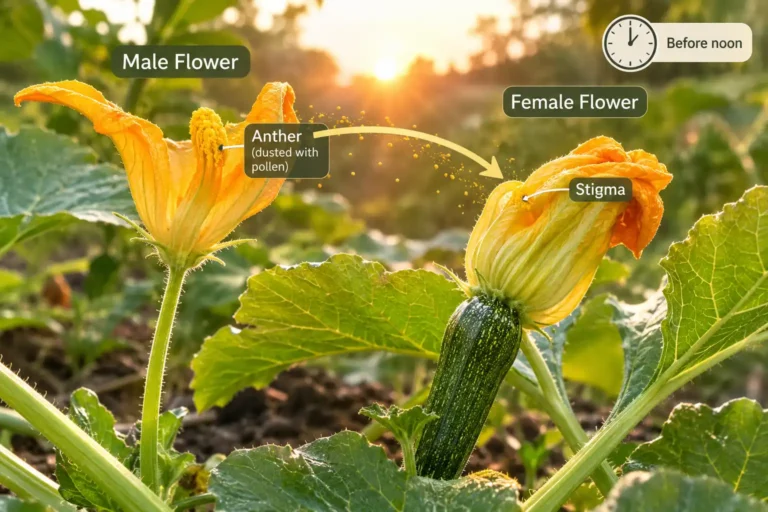
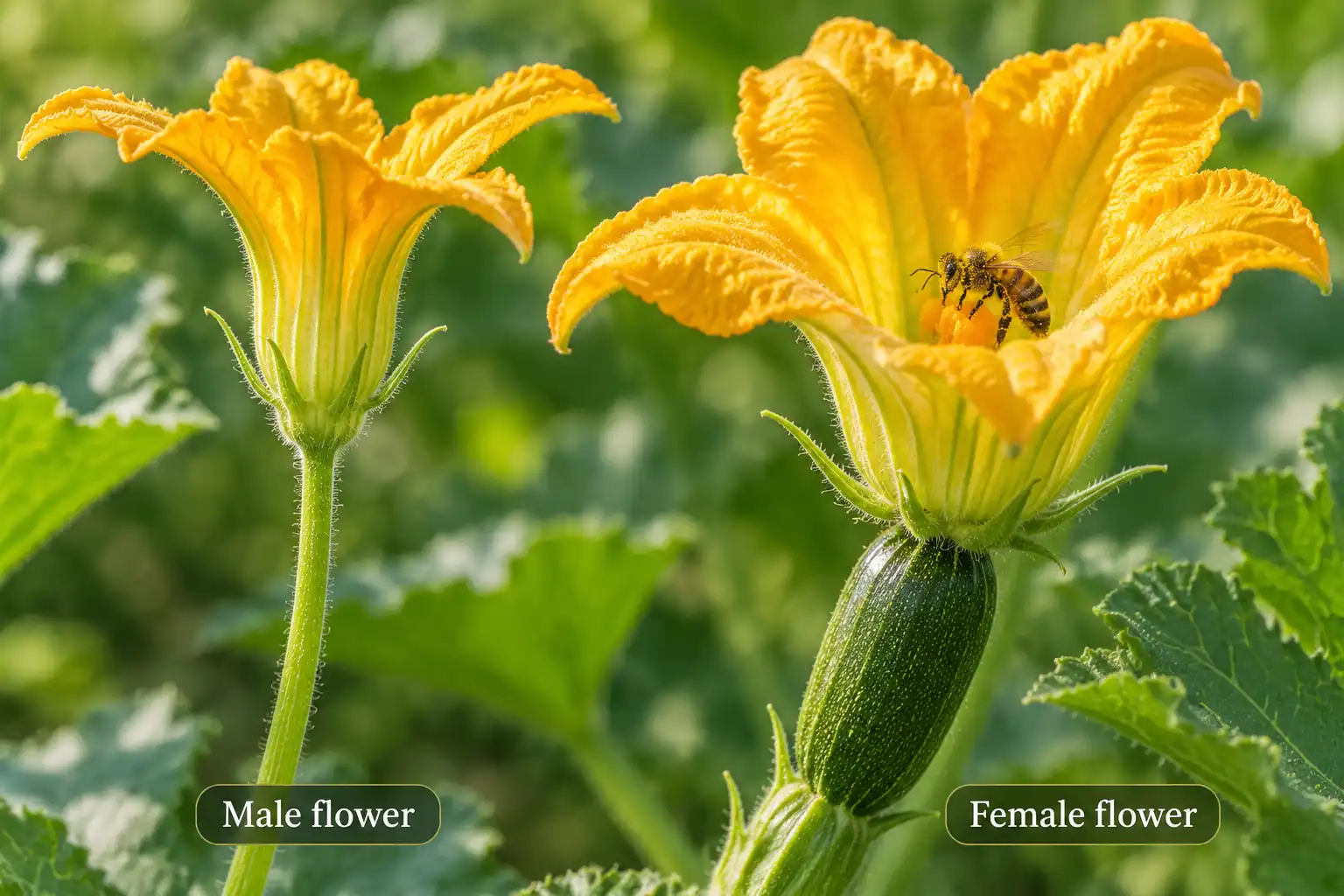
Zucchini plants make separate male and female flowers. The first flowers are usually male, so early blooms often drop without setting fruit. UMN Extension notes that this is normal. Female flowers open later and carry a tiny, unfertilized fruit at their base.
Bees carry pollen from male flowers to female flowers. Without enough visits, young fruit shrivels or grows misshapen, Clemson Extension notes. Cold, rainy, or cloudy weather also reduces bee activity and fruit set.
If bees are scarce, hand-pollinate in the morning:
- Pick a freshly opened male flower.
- Peel back its petals to expose the pollen-coated center.
- Brush that pollen onto the center of an open female flower.
- Repeat with each new female bloom.
Protect pollinators while you manage pests. Clemson Extension recommends applying insecticides and fungicides late in the evening, when bees are less active.
Common Zucchini Problems and Fixes
Match each symptom below to its likely cause.
| Symptom | Likely cause | What to do |
|---|---|---|
| Whole plant wilts suddenly; sawdust-like debris at the stem base | Squash vine borer | Plant early, cover young plants, and inspect stem bases in early summer |
| White, powdery spots on leaves | Powdery mildew | Space plants widely, water at the soil line, and grow tolerant varieties |
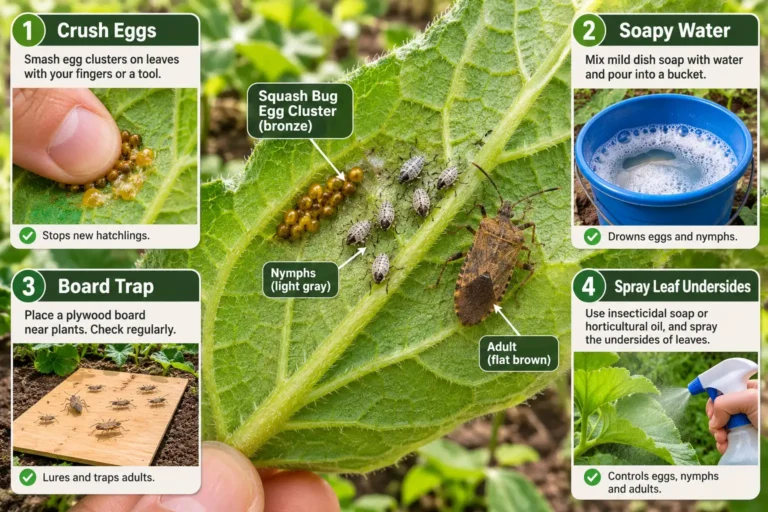
| Ragged leaves, gray bugs in clusters, bronze eggs between leaf veins | Squash bugs | Crush egg clusters and hand-pick adults |
| Holes in leaves and flowers; striped or spotted yellow beetles | Cucumber beetles | Use row covers until flowering |
| Tiny fruit turns yellow and shrivels | Poor pollination | Hand-pollinate and plant flowers that draw bees |
| Dark, dry rot at the blossom end of the fruit | Blossom-end rot | Water evenly, mulch, and avoid excess nitrogen |
| Twisted, mottled, or off-color new growth | Cucurbit virus | Pull infected plants and control aphids |
Squash vine borers burrow into the crown and can collapse an entire plant, according to UMN Extension. Clemson Extension advises planting early, since vine borers and pickleworms build up later in summer. It also notes that aphids spread viruses to squash. So scout leaf undersides twice a week. Then combine scouting, row covers, and tolerant varieties, following integrated pest management basics.
How to Harvest Zucchini
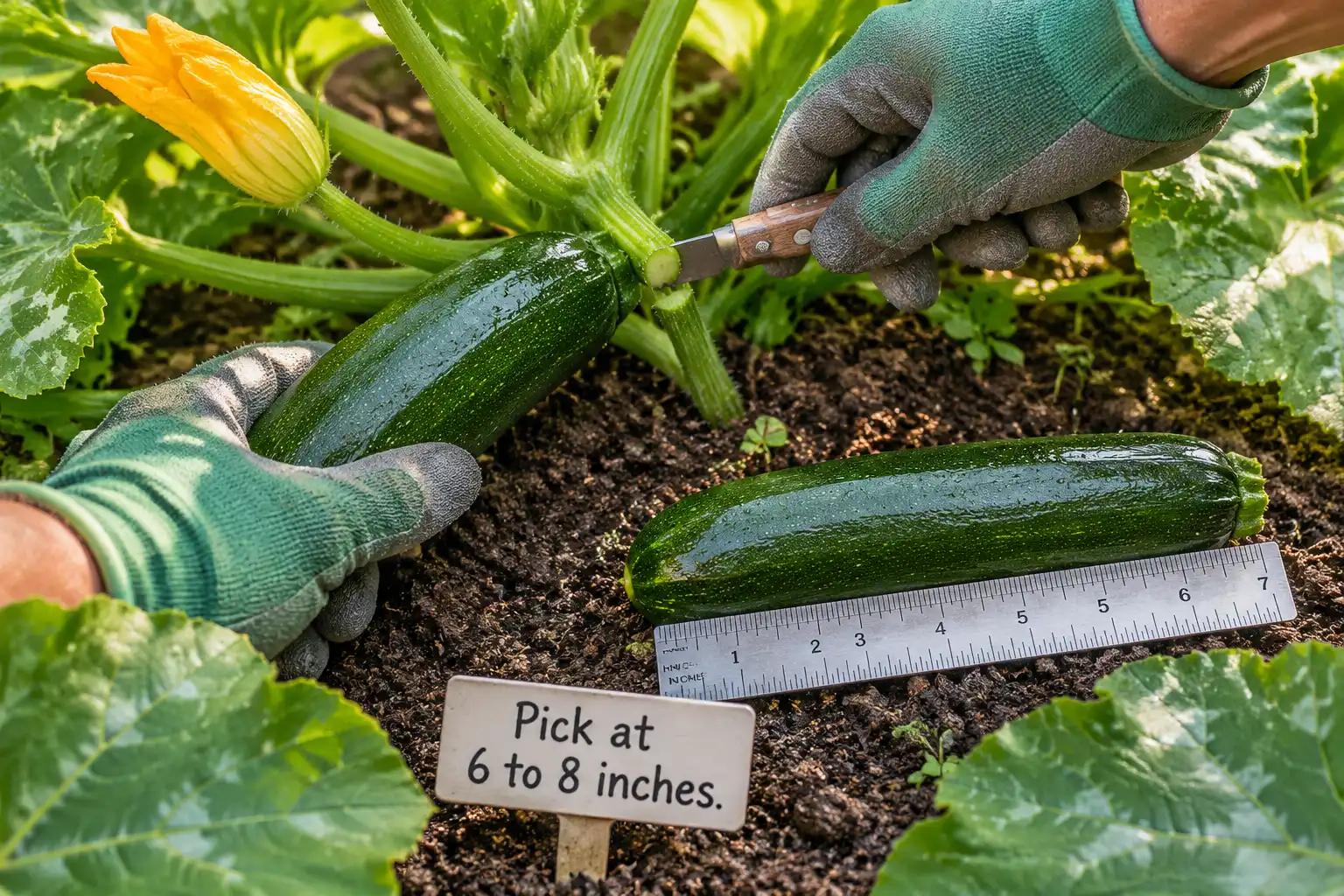
Harvest zucchini when the fruit is 6 to 8 inches long and 1½ to 2 inches thick. Iowa State University Extension recommends that size for long-fruited summer squash. Clemson Extension suggests 7 to 8 inches and looks for skin that is still shiny.
Pick every day or every other day during peak season. Oversized fruit left on the vine slows new fruit set, Clemson Extension notes. So remove giant zucchini even if you won’t eat them.
Follow these harvest habits:
- Cut fruit with a sharp knife, leaving a short stem attached.
- Skip picking when vines are wet, since that spreads disease, per UMN Extension.
- Handle fruit gently, because the thin skin bruises easily.
- Pick male blossoms for cooking if you like; UMN Extension says this doesn’t reduce yield.
Store unwashed zucchini in a plastic bag in the refrigerator. Use it within about 4 days for best quality. After that, cold storage causes pitted skin and watery flesh, according to UMN Extension.
FAQs about Zucchini Growing
Is zucchini an annual or perennial?
Zucchini is a warm-season annual, and NC State Extension lists Cucurbita pepo with an annual life cycle. The plant sprouts, fruits, and dies in one season, so frost ends it and you replant seed each spring.
Can you plant zucchini in the fall?
Yes, in warm regions a mid to late summer sowing still ripens fruit before the first frost. In South Carolina, Clemson Extension lists fall sowing from mid-July through the end of August.
Can you grow zucchini in a container?
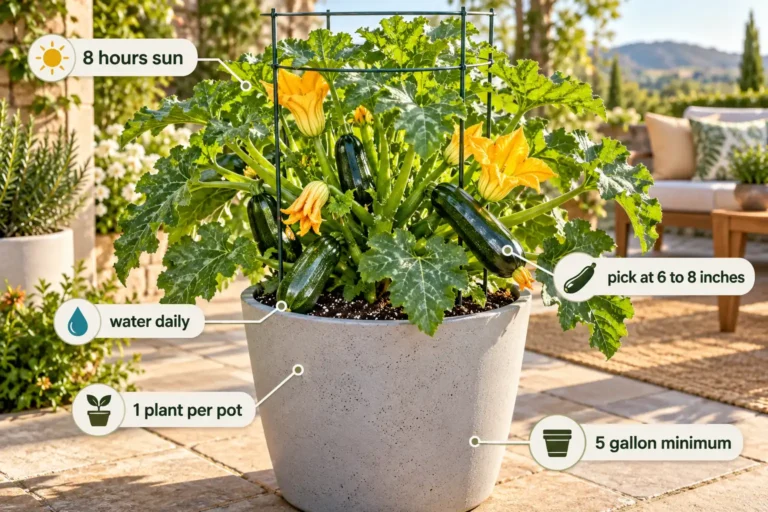
Yes, as long as you choose a compact bush variety and a large pot with drainage holes. Oregon State University Extension lists ‘Raven’ for large containers; fill it with rich potting mix and water daily in summer.
Do zucchini plants need a trellis?
No, bush zucchini grows fine sprawled on the ground without any support. Vining types save space on a sturdy trellis, but UMN Extension notes trellised plants may need more frequent watering.
Key Points to Carry Into the Field
Wait until soil reaches at least 60°F, and ideally 70°F, before sowing seed ½ to 1 inch deep. Give bush plants 2 to 3 feet of space, full sun, and 1 inch of water weekly. Once flowers open, check plants daily and pick fruit at 6 to 8 inches. Those few habits prevent most zucchini failures.