Plant Spacing for Crops: 7 Fast Steps to Set Planter Spacing Right

Plant spacing for crops sets how each plant shares light, water, nutrients, and air with its neighbors. Good spacing builds a uniform stand, closes canopy on time, and leaves enough room for cultivation, irrigation hardware, and harvest traffic. Tight spacing raises plant competition and humidity in the canopy. Wide spacing wastes sunlight and invites weeds between plants. The “right” spacing comes from one simple target: the plant population you want per acre or per bed, matched to the crop’s growth habit and your equipment.
After you learn the basics here, it helps to keep your whole planting setup consistent with your other field decisions like seedbed prep, fertility, and irrigation. Our main pages on crop farming irrigation and irrigation and water management line up well with this spacing work.
What does “plant spacing” mean in a field or garden bed?
Plant spacing means the distance between rows and the distance between plants in the row. Row spacing controls equipment fit, cultivation space, airflow lanes, and canopy closure timing. In-row spacing controls how much root zone and leaf area each plant gets.
Farmers manage spacing in three common layouts.
- Row planting puts one line of plants on each row center.
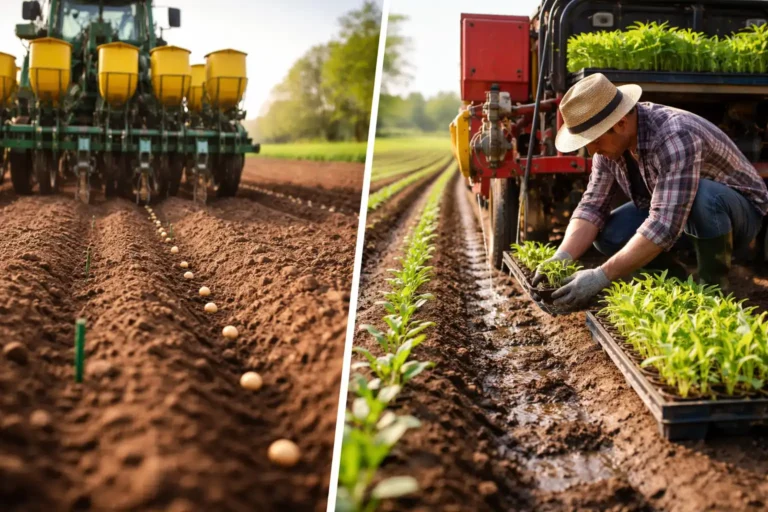
- Bed planting puts two to four rows on a shaped bed, then leaves a wheel track or furrow between beds.
- Grid planting sets equal spacing both directions, which fits hand work and small plots.
Read seedling damping off prevention when tight spacing and consistently wet soil keep the seed line humid and slow to dry.
Why does plant spacing change yield and disease pressure?
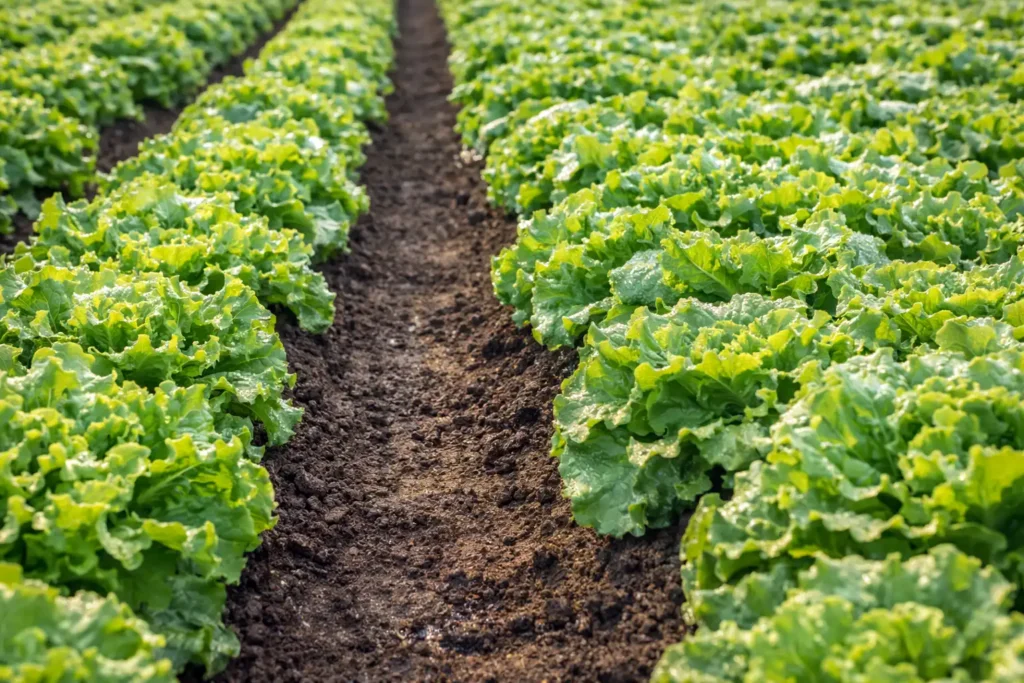
Plant spacing changes yield by changing competition and light capture. Plants packed too tight compete early for moisture and nitrogen, then fight later for light. Plants set too wide leave sunlight on bare soil, and weeds use it first.
Plant spacing changes disease pressure by changing air movement and leaf drying time. Leafy crops and dense canopies hold humidity longer when plants sit too close. Utah State Extension notes that spacing that allows air movement helps reduce common leafy-green diseases such as Botrytis, Rhizoctonia, and Sclerotinia.
Spacing also changes weed control. Narrower rows often close canopy sooner, which shades the row middles and reduces late weed flushes. Iowa State Extension highlights faster shading and reduced weed competition as advantages that can come with narrower corn rows, depending on environment and system.
What factors decide the “right” spacing for a crop?
Crop growth habit decides the base spacing
A carrot makes one root and a small top, so it accepts tight in-row spacing after thinning. Utah State’s carrot guidance uses 2–3 inches between plants and 12–18 inches between rows.
A staked tomato grows tall and needs airflow around leaves and fruit clusters. Penn State Extension puts staked tomatoes at 18–24 inches between plants.
Your equipment sets a practical row width
Planters, cultivators, sidedress rigs, sprayers, and harvesters all carry a “comfortable” row spacing. Changing row width often means changing more than one machine.
Your production goal sets the plant population
Fresh-market quality, processing contracts, forage yield, storage bulb size, and tuber size grades all push plant population in different directions.
Soil moisture and fertility change how tight you push
A high-water, high-fertility field supports higher population without stress. A dryland slope punishes crowding fast.
Read mulching for farming to shade the row middle when wider spacing leaves bare soil that weeds like to claim first.
How do you calculate in-row spacing from a target population?
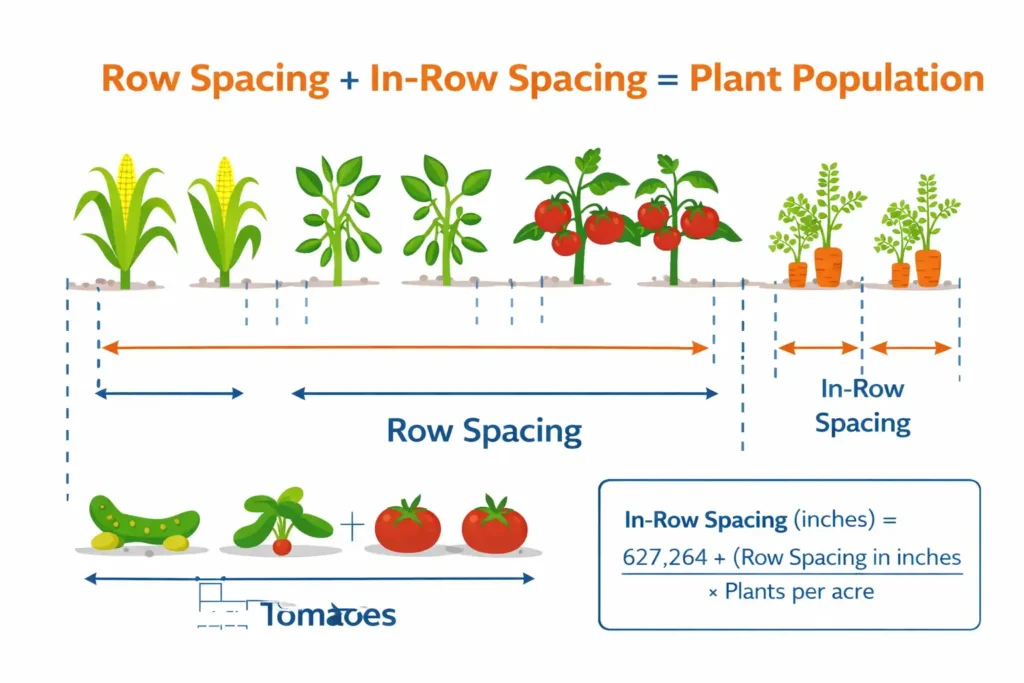
Use a population target (plants per acre) and your row spacing (inches). The basic relationship is:
In-row spacing (inches) = 627,264 ÷ (row spacing in inches × plants per acre)
That constant comes from square inches per acre.
If you prefer a ready reference, Colorado State Extension publishes a table that links row width and average seed spacing to a seeding rate. For example, they show that 5.5 inches between seeds on 30-inch rows equals 38,016 seeds per acre.
Practical tip: set population with your planter settings, then confirm it with a short tape-measure stand check after emergence. Uniformity matters as much as the average.
What spacing works for common crops?
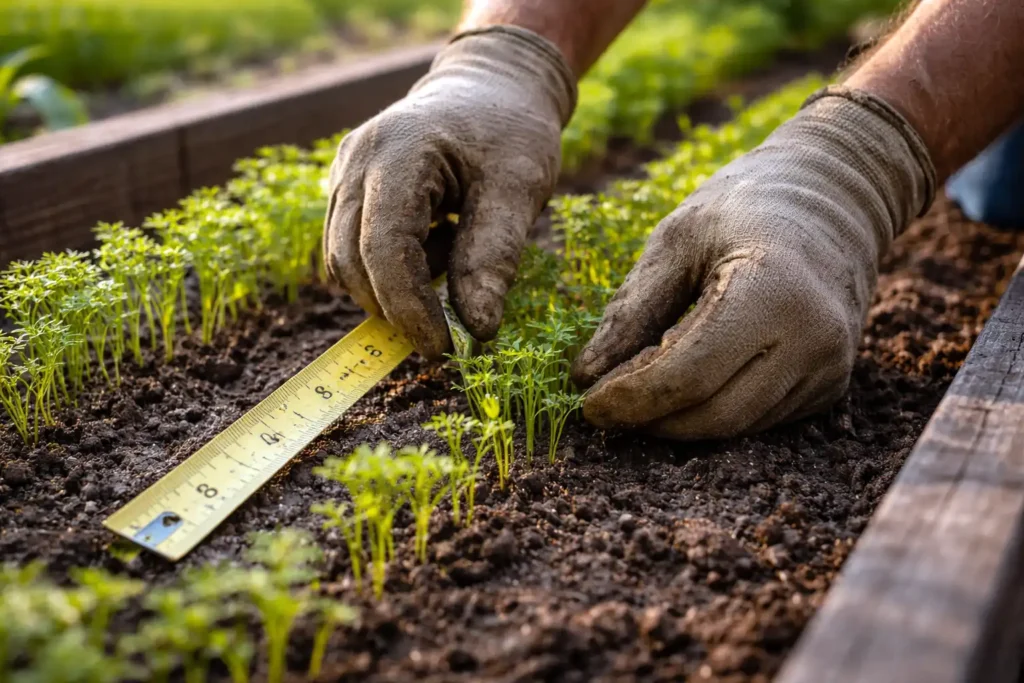
These are common starting points pulled from Extension and production handbooks. Treat them as baselines, then adjust for your cultivar, bed system, and harvest method.
Carrots
Utah State Extension: 2–3 inches between plants and 12–18 inches between rows.
Carrots often start thicker and get thinned to final spacing.
If you grow carrots as a root crop, you will also like the planting notes in this site’s carrot crop guide once you set your spacing.
Onions
University of Maryland Extension lists standard onion spacing as 1–8 inches in-row and 12–24 inches between rows, and it also mentions 4 inches by 4 inches for block planting.
Utah State Extension gives a clear field-style starting point: 3–4 inches in-row with 8–16 inches between rows.
Onions respond strongly to spacing because spacing drives bulb size. Tight spacing produces more small bulbs and more green onion potential. Wider spacing produces fewer, larger bulbs.
Lettuce
For protected or intensive production, a 2024 extended-season lettuce factsheet lists:
Bibb lettuce at 8–10 inches in-row and 8–12 inches between rows; Romaine and Batavian at 10–12 inches between plants and between rows.
Lettuce spacing ties straight into airflow and leaf disease risk, so keep your irrigation method and canopy humidity in mind. If you want a crop-specific walk-through, use the lettuce crop guide after you pick a spacing target.
Tomatoes (staked or trellised)
Penn State Extension: 18–24 inches between plants in the row for staked tomatoes.
New Hampshire Extension adds that staked or caged tomatoes commonly run 18–24 inches between plants with rows wide enough for access, and it separates spacing by growth habit and pruning.
Tomato spacing also depends on training style. A tight in-row spacing works better when you prune and keep vines vertical.
See the tomato crop guide when you want to match spacing to pruning and support choices.
Potatoes
North Dakota State potato planting tips note an average potato row spacing around 36 inches, with common variation around 34 and 38 inches, and they explain that within-row spacing changes seed quantity and plant population.
Utah State Extension adds that close in-row spacing (6–8 inches) reduces tuber size and increases tuber count.
Potato spacing is a size-grade lever. Closer spacing pushes smaller tubers and more sets. Wider spacing pushes fewer, larger tubers.
Use the potato crop guide to line this up with your variety and market grade.
Soybeans
Purdue Extension summarizes research that supports narrow rows for yield, and it recommends 7.5 to 15 inches as a row spacing range for maximum yield, with 30-inch rows averaging lower in their cited research.
Iowa State Extension also discusses soybean row spacing as a management decision, with consistent yield advantages in many studies for rows under 30 inches.
Soybean spacing decisions also connect to weed control and canopy closure. This ties directly into your herbicide plan and cultivation plan, so keep your weed control strategy aligned with your row width.
Corn (row width and within-row uniformity)
Iowa State Extension summarizes that corn yield response between 20-inch and 30-inch rows varies by environment and year, and it notes several system-level advantages for narrower rows in some cases.
For planting math, Colorado State Extension provides the population-by-spacing table that makes it easy to check planter settings against seeds per acre.
Corn spacing lives and dies on uniformity. North Carolina Extension reports yield loss tied to uneven within-row spacing, which is one reason a tuned planter and consistent seed depth matter.
If you want crop-specific setup, the corn crop guide helps you line spacing up with population, fertility, and water.
Wheat and small grains (row spacing reality)
Most grain drills plant wheat in narrow rows. University of Wisconsin notes that most drills seed in 6- or 7-inch row widths, and it discusses narrower widths as a research topic.
Michigan State also reports winter wheat work that includes narrow row spacing (including 5-inch in trials) as part of yield-focused planting decisions.
With small grains, row spacing is often “what your drill is built for,” and the bigger lever becomes seeding rate and placement consistency.
Rice (drilled row width)
The Arkansas Rice Production Handbook lists recommended drill row widths for rice between 4 and 10 inches, with similar yields under many conditions inside that band.
How does row spacing change field operations?
Row spacing is not only a biology choice. It is a traffic and tool choice.
Narrow rows speed canopy closure and shade the row middle sooner. That supports weed suppression and soil shading.
Wide rows leave more room for inter-row cultivation tools, furrow irrigation patterns, and some harvest systems.
If you bed up ground for irrigation or traffic, align bed width with your implement spacing and wheel tracks. Keep your whole system consistent through the season, from planting to harvest.
How do you adjust spacing for beds, high tunnels, and intensive plots?
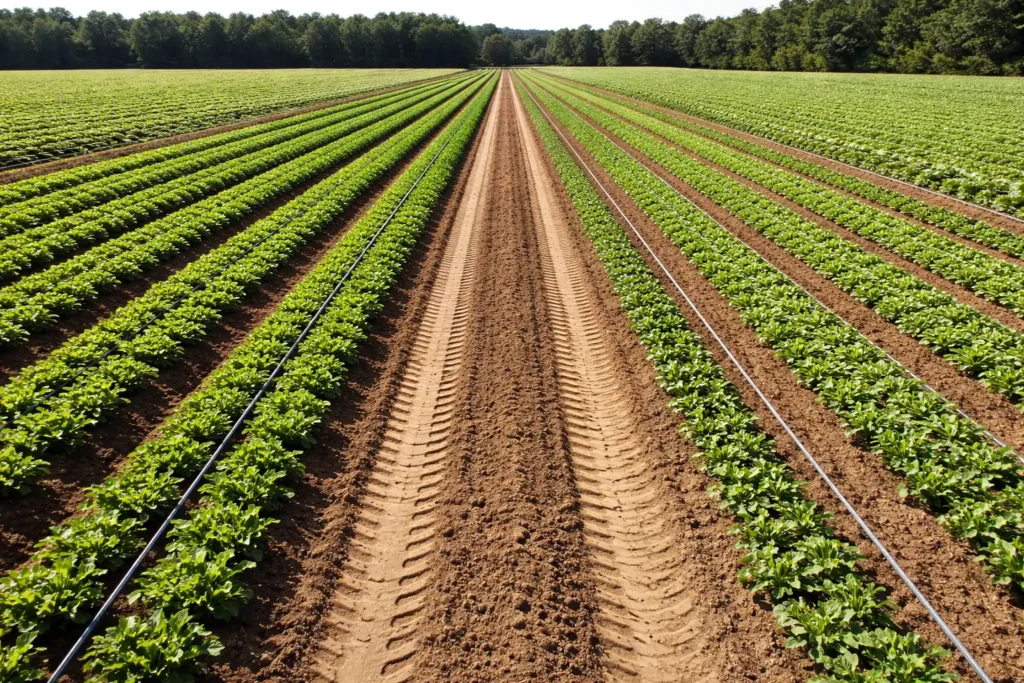
Bed systems often place multiple rows per bed and then manage traffic in furrows or wheel tracks. A protected-agriculture density guide from Virginia Tech notes that planting density varies widely across species, and it emphasizes that both in-row spacing and bed layout drive final density.
In practice, bed spacing work goes like this:
- Pick bed width and wheel-track width that fits your tractor and cultivator.
- Pick rows-per-bed that keeps airflow and access workable.
- Set in-row spacing to hit your target plants per square foot or per acre.
This bed approach is a clean match with drip irrigation and plastic mulch, because the tape layout often locks in row placement.
What are the most common plant spacing mistakes?
Planting tight with no airflow plan raises leaf wetness time and disease pressure in leafy crops. Utah State’s leafy green guidance points straight at airflow as a disease management factor.
Planting wide without a weed plan leaves sunlight on bare soil, and weeds use that gap first. Pair wide rows with timely cultivation or a strong residual herbicide program.
Chasing “more plants” with no water plan stresses the stand first during heat and dry spells. Match population to irrigation capacity and soil water holding.
Ignoring within-row uniformity costs more than most farmers expect. North Carolina Extension highlights yield loss tied to spacing deviation in corn.
How do you check spacing and stand quality after planting?

Measure it, then fix what you can early.
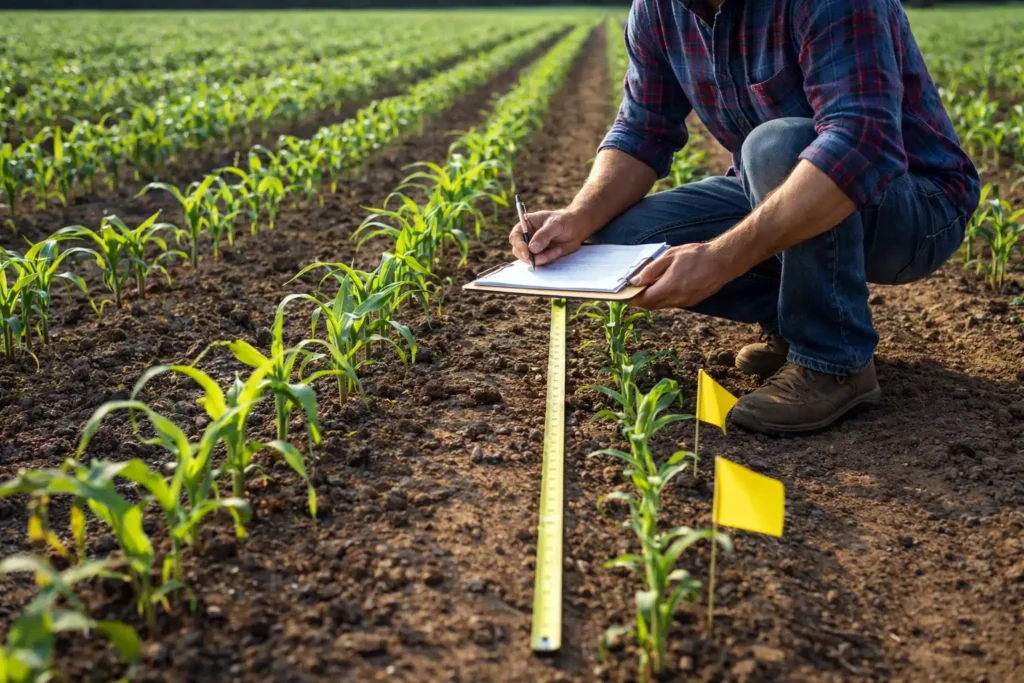
In-row spacing check: measure 17 feet 5 inches in a 30-inch row and count plants to estimate population, or use your preferred field-count method.
Emergence uniformity check: look for skips, doubles, and delayed plants.
Row-to-row consistency check: confirm your planter units track true and your markers or GPS lines stay tight.
If you find a problem, the fix is usually mechanical:
Planter depth control, downforce, closing wheels, seed singulation, and ground speed.
What safety practices matter when you change spacing or planter settings?
Spacing changes often mean equipment changes. Treat every change like a new setup.
- Shut the tractor off and remove the key before you work on meters, chains, sprockets, or closing wheels.
- Relieve hydraulic pressure before you work around lifted implements.
- Keep hands clear of pinch points around drive chains and gauge wheels.
- Block raised equipment solidly if you need to work under it.
If you are building your safety kit, this site’s farm safety and PPE section is a good place to standardize gloves, eye protection, and lockout habits for shop and field.
How do you pick a spacing that stays “right” all season?
Good spacing is the spacing you can manage from planting to harvest with your water, fertility, pest plan, and equipment.
- Start with a trusted baseline for your crop (examples above).
- Match the row width to your equipment and weed-control plan.
- Match the plant population to your field yield environment and moisture supply.
- Then focus hard on stand uniformity, because uneven spacing steals yield even when the average looks right
Bottom Line
Plant spacing works best when it matches your crop’s growth habit, your equipment, and your water and fertility capacity. Start with proven baselines, set a realistic population, then protect uniformity with a good planter setup and quick stand checks.