Best Grain Moisture Tester 2026: 8 Picks and Safe Storage Targets
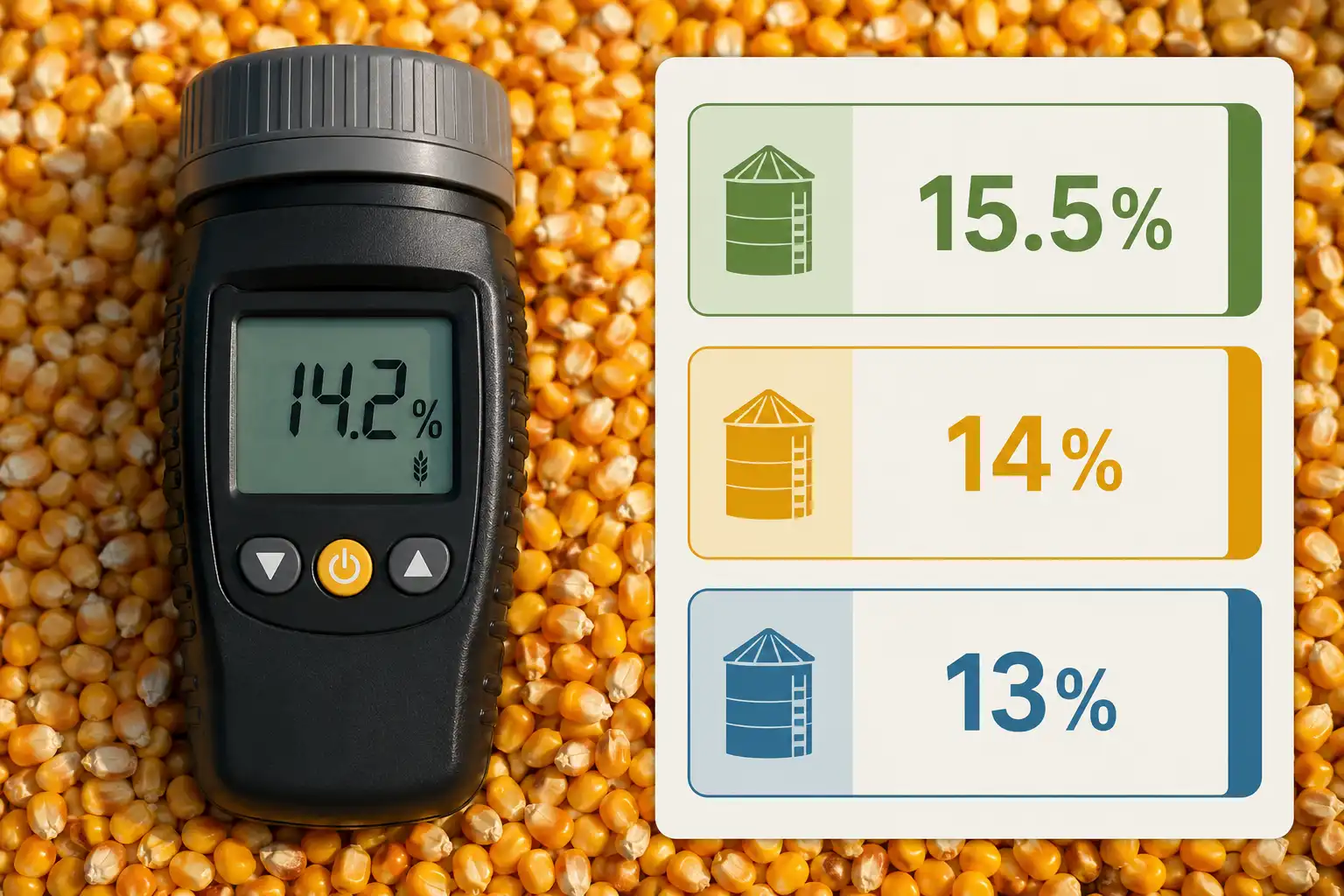
Wet grain costs money twice: once to shrink at the scale, and again to spoilage in the bin. The right grain moisture tester turns that risk into a number you can act on. You get it before the load leaves the field, not after the ticket prints.
The best grain moisture tester for most farms is the AgraTronix MT-PRO. It carries 40 grain scales and stated accuracy of plus or minus 0.5%. The MT-16 covers 16 grain scales for less. JOANLAB suits labs needing halogen heating results.
Top 8 Grain Moisture Testers at a Glance
| # | Model | Type | Crop scales | Best for |
|---|---|---|---|---|
| 1 | JOANLAB Automatic Analyzer | Benchtop halogen | Method based | Commercial labs and feed mills |
| 2 | AgraTronix MT-PRO | Handheld capacitance | 40 | Mixed-crop farms |
| 3 | AgraTronix MT-16 | Handheld capacitance | 16 | Core row crops |
| 4 | AgraTronix Ag-MAC PLUS | Portable capacitance | 20 plus | Tightest stated accuracy |
| 5 | AMTAST MT-22 | Handheld capacitance | 22 | Multi-crop on a budget |
| 6 | TOTITOM Smart Meter | Bench-side with balance | 24 | Fast shop checks |
| 7 | GOYERRNES Professional | Portable capacitance | Multi-crop | Moisture plus density |
| 8 | Brolangt LDX-G1 | Handheld capacitance | 25 | Built-in recordkeeping |
What Is a Grain Moisture Tester?
A grain moisture tester is an electronic meter that reports the water in a grain sample as a percentage. That figure is your current grain moisture content. You load a small sample and select the crop. The meter then reads capacitance or electrical resistance, applies temperature compensation, and returns a moisture figure.
That number drives three decisions: harvest timing, drying, and safe grain storage. Accurate readings cut mold risk, shrink loss, dockage, and rejected loads. That protects grain quality and margin. Treat the meter as routine measurement, not an occasional check.
Why Grain Moisture Content Is Critical for Farmers
Moisture is the number that follows your grain from the header to the scale ticket. It decides whether you store safely, dry efficiently, and deliver a load that buyers accept.
Three pressures pull in different directions:
- Marketability: Buyers set moisture limits and enforce them with their own meters. Wet grain triggers shrink, dockage, delayed unloading, or outright rejection. The University of Nebraska-Lincoln reports fairly consistent discount thresholds across buyers. Corn sits at 15.0%, soybeans at 13.0%.
- Storage safety: High grain moisture for storage drives heat and respiration in the bin. That raises the odds of mold growth, quality loss, and bin hotspots. Sound grain spoilage prevention also guards against mycotoxins, which turn into a feed or delivery problem fast.
- Drying decisions: Drying is a profit decision, not a habit. Over-drying pushes crop weight loss, while under-drying pushes storage risk. The optimal grain moisture level depends on the crop and holding period. Either way, grain drying costs climb once grain is already in the system.
Those trade-offs land straight on the balance sheet. So moisture belongs in any honest look at farm margins, not just harvest-day notes.
Safe Storage Moisture by Crop and Holding Period
Target moisture depends on the crop and how long you hold it. Purdue Extension publishes maximum safe moisture by storage length, which gives you a concrete number to test against.
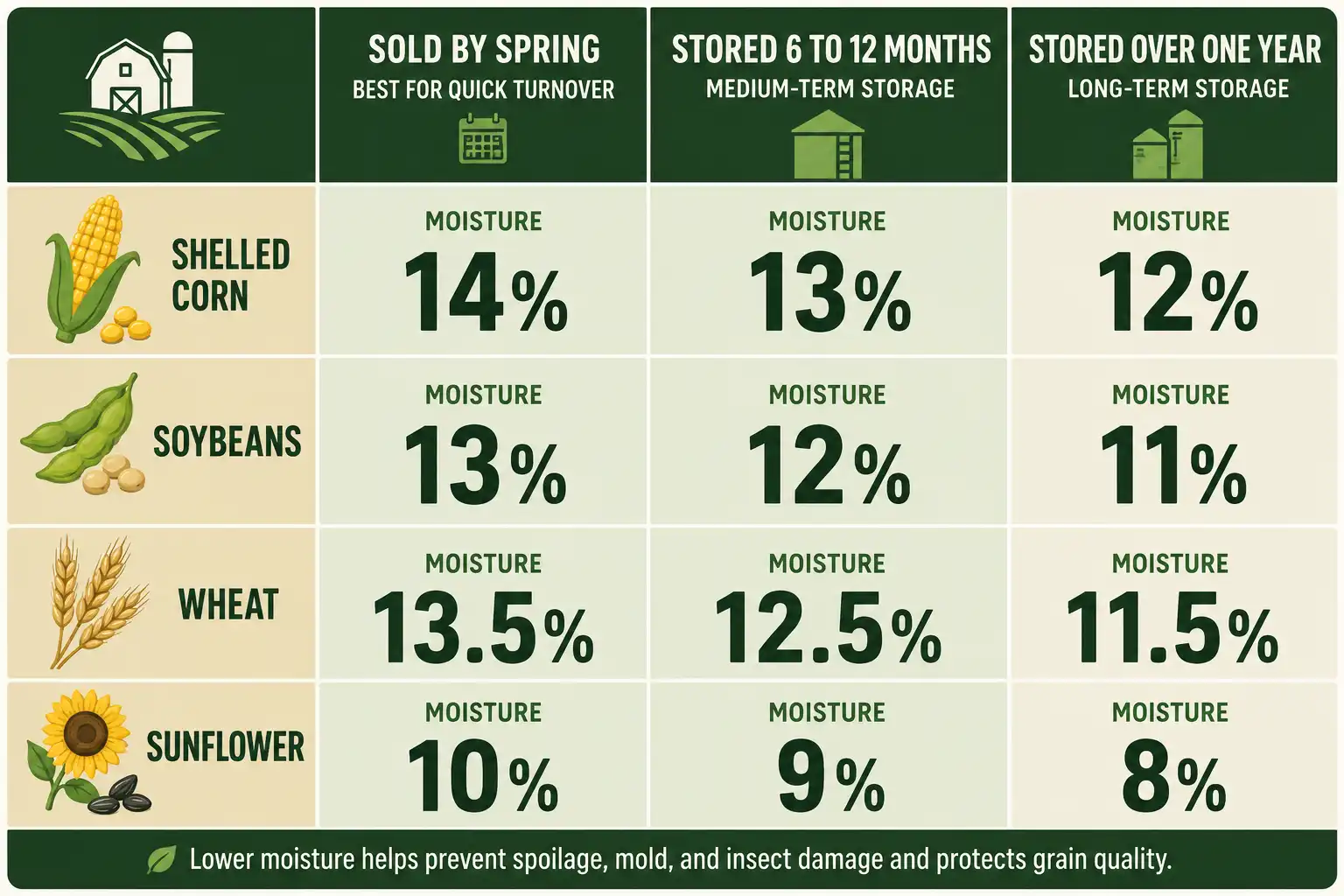
| Crop | Sold by spring | Stored 6 to 12 months | Stored over 1 year |
|---|---|---|---|
| Shelled corn and sorghum | 15.5% | 14% | 13% |
| Soybeans | 14% | 12% | 11% |
| Wheat, oats, barley | 14% (to 6 months) | 13% | 13% |
| Sunflower | 10% (to 6 months) | 8% | 8% |
NDSU Extension sets tighter targets for grain held through summer heat. Wheat and corn drop to 13.5%. Grain sorghum sits at 13%, barley at 12%, and soybeans at 11%. Broken kernels and pest-damaged grain need a full point more drying than sound grain.
Iowa State University Extension notes that soybeans run about two points drier than corn. Their oil content makes them spoil faster. Seed stock held past one planting season should sit at 12% or less. So how long stored soybeans hold quality comes down to hitting those numbers before the bin fills.
How Long Will Grain Keep at a Given Moisture?
Allowable storage time falls fast as moisture and temperature climb. According to NDSU Extension, corn at 15% moisture keeps roughly 240 days at 60°F. That drops to about 125 days at 70°F. At 80°F it falls to about 70 days.
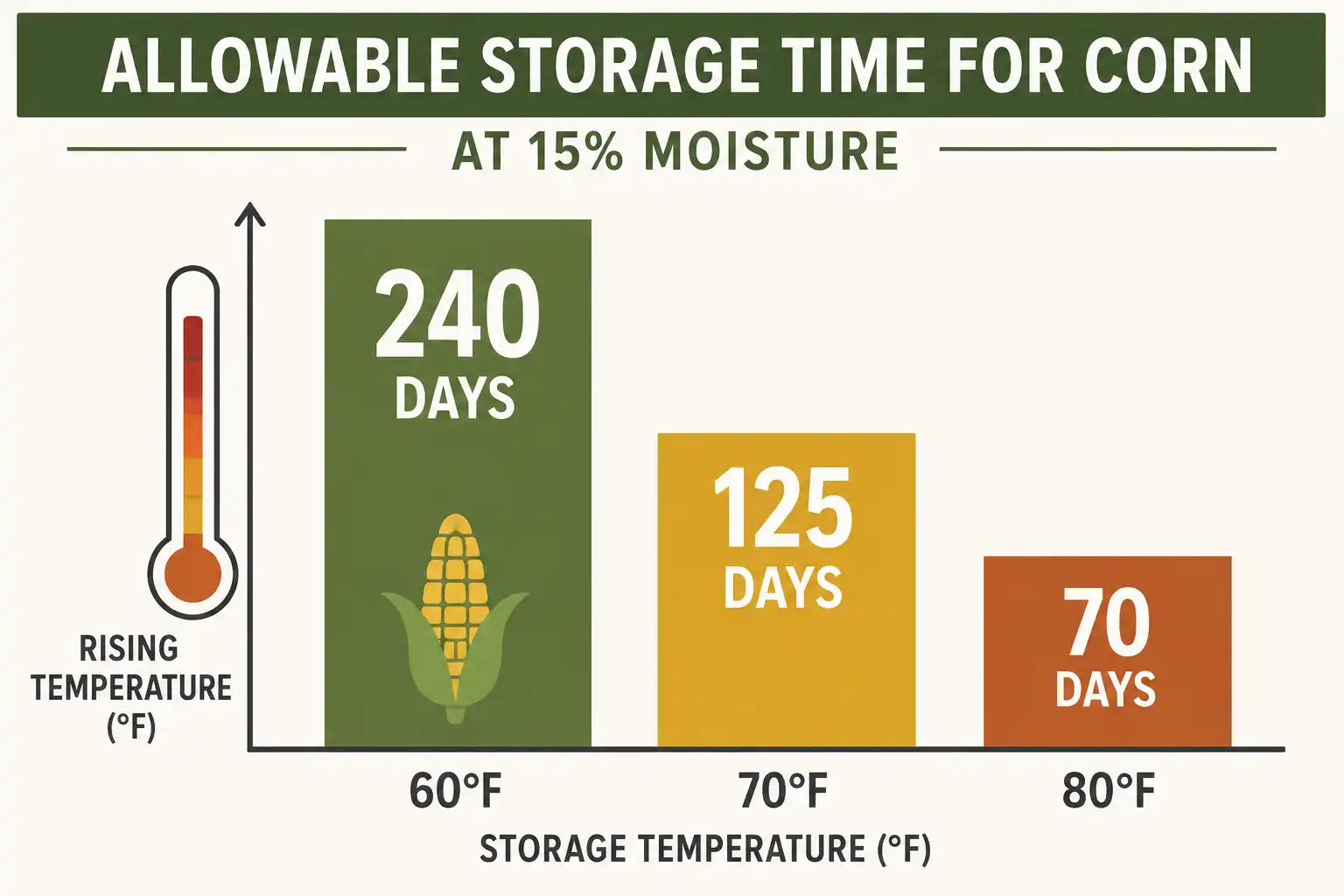
Two rules make that usable. Every 10°F rise in grain temperature cuts allowable storage time roughly in half. Meanwhile, every point of moisture removed stretches storage life by 50% to 75%. Drop 15% corn to 14% and you move from about 125 days to about 200 days at 70°F.
What Wet Grain Costs at the Scale
Buyers discount above a set moisture line, then deduct shrink on top of it. NC State Extension calculates that drying corn from 25% to 15.5% removes 11.24% of the delivered weight. That is about 112 pounds out of every 1,000.
Over-drying costs too. Buyers stop crediting weight below the base moisture. So grain delivered drier than 15.5% gives away bushels you already paid to dry.
Field drying is the cheapest dryer you own, though it slows as the season closes. Iowa State University Extension puts typical corn drydown near 4.5 points per week in September. October drops to 2.5 points, November to 1.0, and December to 0.5. Iowa State also warns against natural air drying corn above 22%. Spoilage risk runs high before the bin finishes. Those rates drive field corn harvest timing more than the calendar does.
Types of Grain Moisture Testers: Which One Is Right for You?
Grain moisture testers fall into two practical categories. One fits in your pocket at harvest. The other sits on a bench and acts like a small lab.
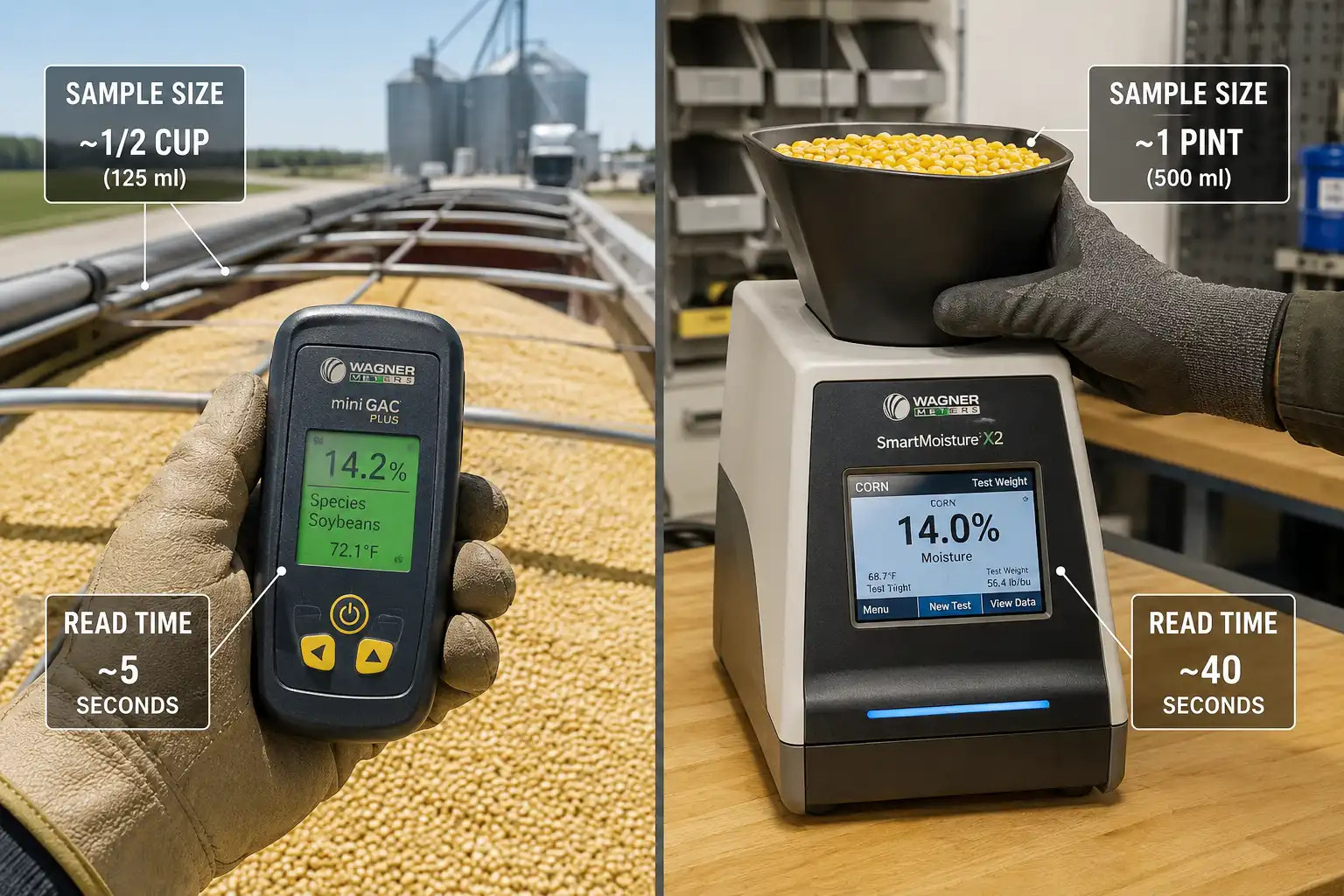
Portable and Handheld Grain Moisture Testers
A portable grain moisture tester gives a fast reading right where decisions happen. These suit harvest, bin checks, and truck-side questions.
A good handheld unit typically brings:
- Battery power and a compact body for field moisture testing
- A simple workflow on a handheld grain moisture meter
- A durable grain tester with carry case that lives in the pickup
The trade-off is consistency versus convenience. Bench units hold tighter accuracy, but a portable unit wins on speed and cost. For most small to mid-size operations, a handheld grain moisture tester keeps work moving when weather closes in. The same judgment shapes deciding when a crop is ready. A fast reading beats a perfect one taken too late.
Benchtop and Stationary Grain Moisture Testers
A benchtop grain moisture tester is a stationary unit built for repeatability and throughput. These show up at a grain elevator, in feed mills, and in operations running many loads that need consistent tickets.
This category often includes:
- Larger sample handling and tighter repeatability, where a commercial grain moisture analyzer earns its keep
- Models labeled NTEP-approved for trade use in regulated settings
- Calibration programs that reference state or USDA calibration practices
| Factor | Portable handheld | Benchtop |
|---|---|---|
| Sample size | Small, often under 200 grams | Large, several hundred grams |
| Read time | Seconds | Seconds to minutes |
| Where it lives | Pickup, combine cab, bin pad | Shop, office, elevator |
| Repeatability | Good with careful loading | Higher by design |
| Trade use | Not legal for trade | Some models certified |
Selling across multiple buyers changes the math. If you want your on-farm reading to track the scale house, a benchtop unit fits.
How Does a Grain Moisture Tester Work?
A grain moisture tester measures an electrical property of the sample. The meter then converts that signal into a moisture percentage using a calibration curve for that crop. No farm meter weighs water directly.
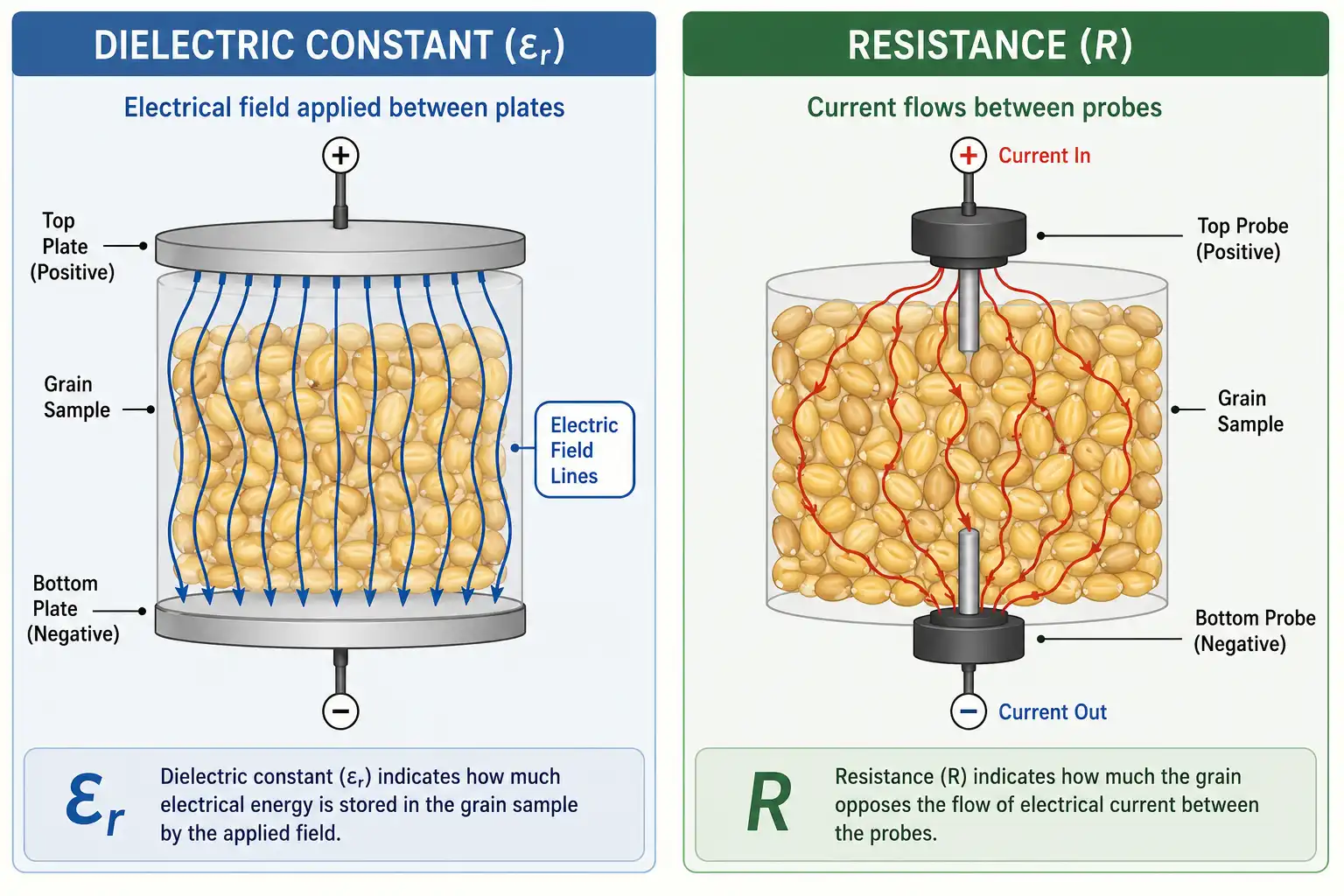
Two technologies dominate farm and elevator meters.
Capacitance-Based Moisture Meters
A capacitance grain moisture meter reads how grain changes an electrical field. Water shifts the dielectric constant far more than dry grain does. So the meter sees a clear signal change as moisture rises.
This style works well when you:
- Use a consistent sample size
- Follow the same packing or compression method each time
- Treat grain water content measurement as a repeatable test, not a one-off guess
Capacitance meters usually read fast, which makes them popular during harvest.
Resistance and Conductance-Based Moisture Meters
A resistance moisture meter pushes a small current through the sample and measures how strongly the grain resists that flow. More water lowers resistance, because moisture improves conductivity.
You will also hear this described as:
- electrical conductivity grain testing
- A conductance-type grain meter
This approach shows up often in handheld units, since it supports quick readings with simple hardware and small samples.
What the Official System Actually Uses
The USDA Federal Grain Inspection Service treats air-oven methods as the official moisture reference. Every commercial meter calibration traces back to those ovens. FGIS also built the Unified Grain Moisture Algorithm, the basis of UGMA technology. It reads dielectric constant near 149 MHz, applies density and temperature correction, then runs one calibration equation.
One practical point follows. FGIS requires UGMA-compatible meters to average within plus or minus 0.15% of the air-oven reference. Only a short list of certified benchtop models qualifies. None of the nine testers below is an official trade meter. Use them for your own decisions, and expect the elevator number to govern the ticket.
Key Factors to Consider When Buying the Best Grain Moisture Tester
This is the part that saves money. The right meter matches your crops, your workflow, and how closely you need to track elevator results.
Accuracy and Calibration
The best moisture meter for grain starts with published specs and a plan to keep it on track. Look for stated grain moisture tester accuracy near plus or minus 0.5%. That figure assumes correct use and proper calibration for the grain. Read the qualifier too. AgraTronix states that figure for the MT-PRO in the normal stored-grain range, not across the full 5% to 40% span.
Calibration matters because grain types behave differently in a meter. A good unit includes:
- Crop-specific grain calibration scales for the grains you handle
- Clear instructions for moisture meter calibration checks and updates
Calibration language splits into two ideas. Primary calibration is the reference standard that establishes the moisture curve. Secondary calibration covers the day-to-day adjustments that align your readings with that reference. Keep recalibration on the calendar. Annual checks protect readings once the season gets hectic. Use the manufacturer, a lab, or a state weights and measures program.
Grain Types Supported
The best moisture meter for grains supports your crop mix without workarounds. Before buying, confirm the meter covers:
- A grain moisture tester for corn if corn is a major crop
- A wheat moisture meter if wheat sits in your rotation or your bins
- A multi-grain moisture tester if you rotate several commodities or buy grain from neighbors
Entry-level meters list around 16 grains. Premium meters list 40, 100, or more. Match the list to what you actually handle. Add rice and sunflower if those appear in your storage plan. You cannot add a missing scale later.
Temperature Compensation
Grain temperature changes meter behavior. Cold grain and hot dryer grain both skew readings when temperature goes ignored.
Look for:
- Automatic temperature compensation so the meter adjusts without manual math
- An explanation of the grain temperature effect on moisture in the manual or spec sheet
- A clear display of a temperature-corrected moisture reading so the working number stays obvious
Watch the operating window as well. The MT-PRO spec sheet lists 32°F to 113°F, and readings outside that band are not reliable.
Portability and Ease of Use
Testing location controls the purchase. Field testing needs speed and ruggedness. Office or shop testing needs consistency. Usability counts as a feature, because it saves time during harvest:
- A handheld grain moisture meter easy to use reduces misreads at the end of a long day
- A portable grain tester with LCD display helps at night or inside a bin pad shed
- A fast grain moisture reading keeps the combine, truck, and dryer moving
This is where the best grain moisture meter separates itself. The better unit feels predictable. It reads the same way every time and works with gloves on.
Extra Features Worth Considering
Extras matter when they replace another tool or reduce paperwork:
- Grain test weight measurement, which removes a separate scale from the routine
- A moisture tester with data storage for averaging and tracking load-to-load shifts
- A Bluetooth grain moisture meter for logging readings without writing them down
Those count as real grain moisture tester features once you manage multiple fields, bins, or contracts. A clean trail of numbers pays off at contract time.
The 8 Best Grain Moisture Testers: Reviews
1. JOANLAB Lab Automatic Moisture Analyzer Feed Grain Moisture Tester
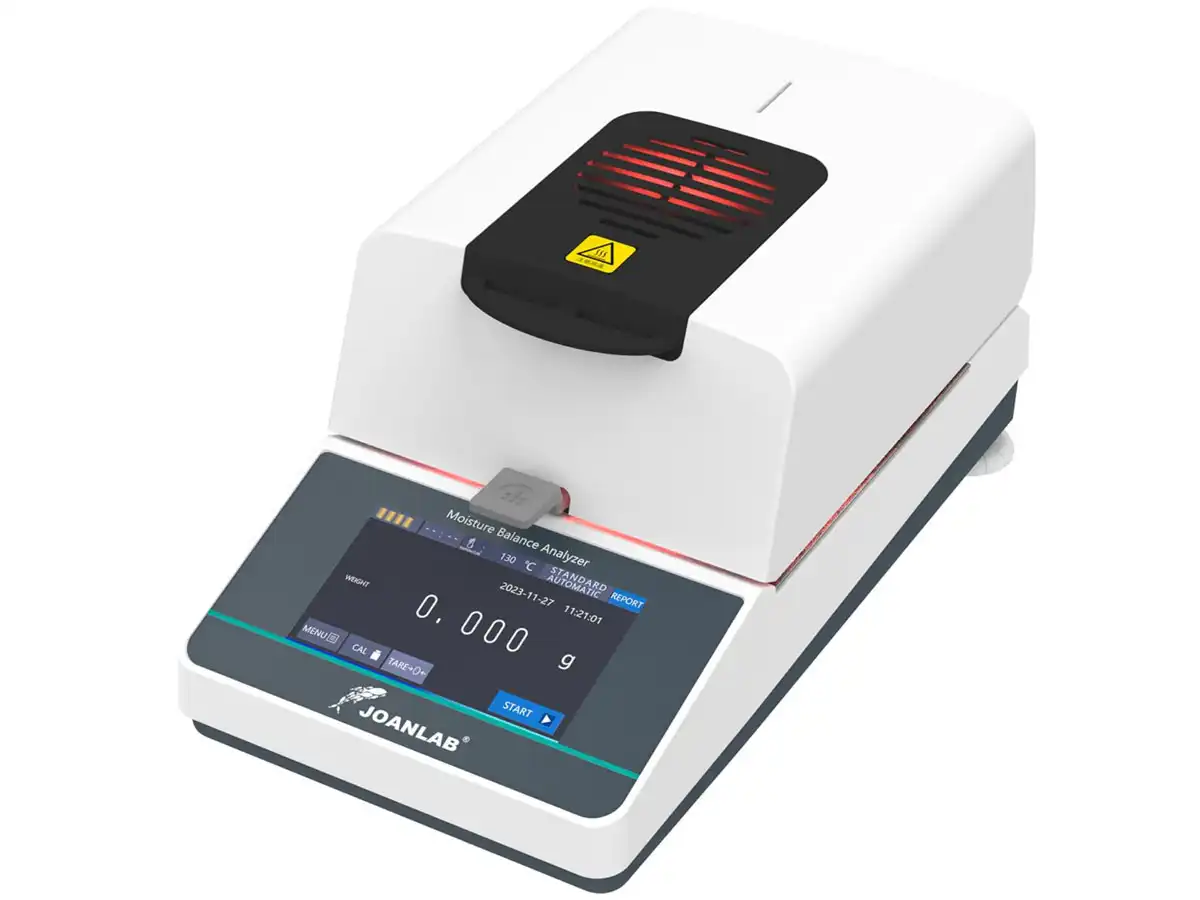
This JOANLAB unit is a lab-style analyzer for grain and feed. It uses halogen heating to dry a sample and calculate moisture from weight loss. That follows the air-oven reference principle. So it sits in a different class from the capacitance handhelds below.
It works as a laboratory-grade moisture analyzer built for feed mills and commercial operations rather than casual farm use. Operations testing large sample volumes daily, and needing certified, documented results, get the most from it. The draw is very fine readability (0.001%) and method repeatability. The 5-inch color touchscreen, wide heating range, and 110 g capacity read as proper bench equipment. Stored methods and RS232 output round it out.
PROS
- Oven-principle direct measurement
- Very fine stated readability
- Stores up to 20 methods
- Serial output for records
CONS
- Heat-based testing needs careful handling
Specs:
- Heating range: 104°F to 320°F
- Sample capacity: 110 g
- Stated readability: 0.001%
- Output: RS232, 5-inch touchscreen
Quality: Bench-grade build intended for daily laboratory duty.
Owner evidence: Owner reports consistently note repeatable results when pans stay clean and sample size holds constant.
Best for commercial grain processors and feed mills needing lab-level accuracy with full data logging every day.
2. AgraTronix MT-PRO Portable Moisture Tester
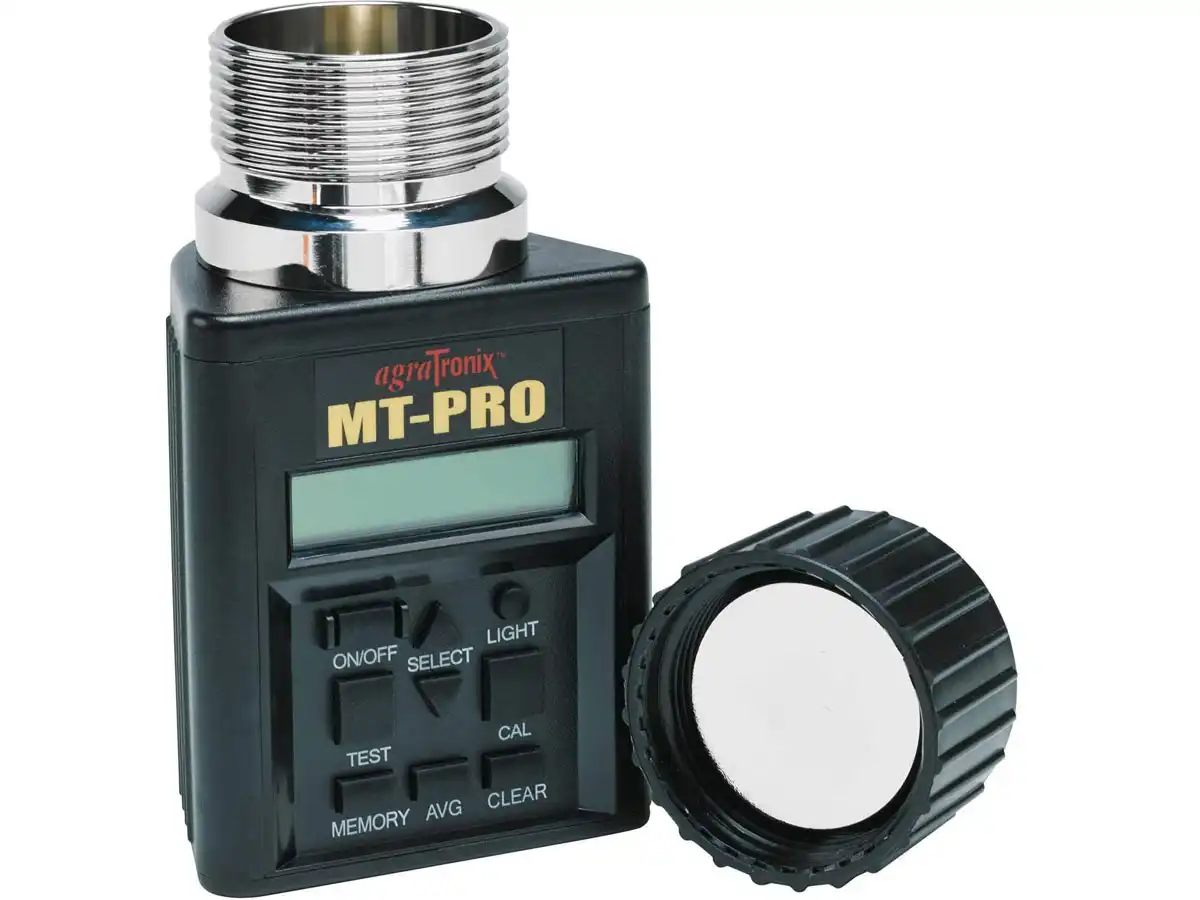
The AgraTronix MT-PRO is a true handheld grain moisture tester built for fast harvest calls. AgraTronix manufactures moisture sensing instruments in Streetsboro, Ohio. The company publishes full spec sheets, so the numbers below come from manufacturer documentation.
You get direct readout for 40 grain scales and a backlit multilingual display. A higher-frequency capacitive circuit aims at better accuracy. Multi-point calibration tunes specific moisture ranges instead of shifting the whole curve. That is what keeps on-farm numbers close to local elevator results. The stated accuracy and 5% to 40% moisture range cover most stored-grain decisions. A carry case with shoulder strap matters when the meter lives in a pickup.
PROS
- Forty direct-readout grain scales
- Multi-point calibration adjustment
- Backlit multilingual display
- Case with shoulder strap
CONS
- Two 9V batteries not included
Specs:
- Moisture range: 5% to 40% by grain
- Operating temperature: 32°F to 113°F
- Accuracy: plus or minus 0.5% in normal stored-grain range
- Display resolution: 0.1% moisture
Quality: Well-built farm instrument backed by a two-year manufacturer warranty.
Owner evidence: Owner reports consistently note entering an offset after a side-by-side check to match local elevator readings.
Best for mixed-crop harvest, because the 40 scales and calibration options help you stay close to elevator numbers.
3. AgraTronix MT-16 Portable Grain Moisture Tester
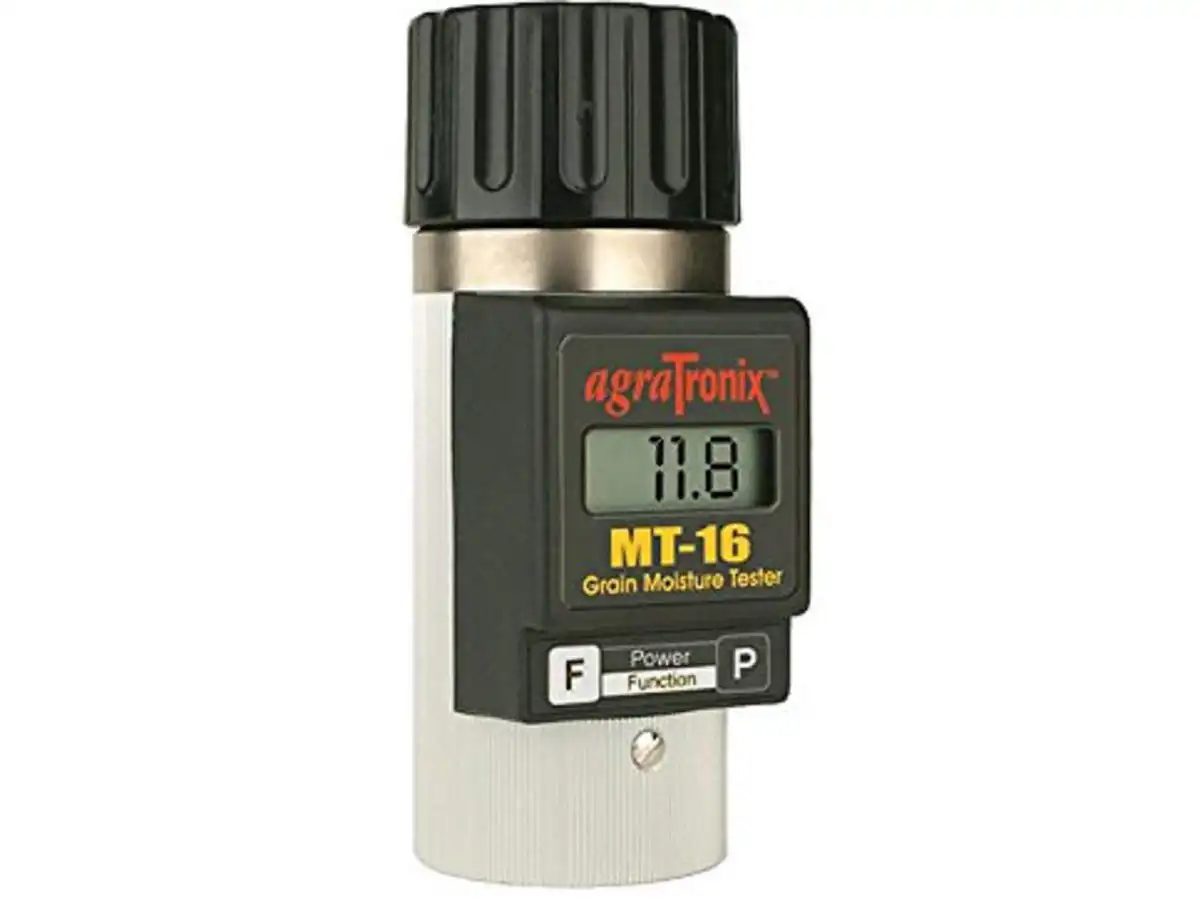
The MT-16 is the simpler sibling, built as a practical grain moisture tester for the core crops. It trims the crop list and keeps the controls that matter during harvest.
It carries 16 grain scales. Those cover corn, wheat, soybeans, sorghum, oats, canola, barley, rye, beans, paddy rice, flax, and sunflower oilseed. The backlit multilingual display works in low light. You can run basic mode or step up to advanced calibration to match your elevator. The ability to average up to 99 tests is the standout. Averaging turns a variable field into one dependable number.
PROS
- Sixteen calibrated grain scales
- Averages up to 99 tests
- Basic or advanced calibration modes
- Backlit multilingual display
CONS
- Fewer crop profiles than premium units
Specs:
- Grain scales: 16, including paddy rice and flax
- Calibration: basic mode plus elevator matching
- Test averaging: up to 99 readings
- Display: backlit, multilingual
Quality: Straightforward build focused on the major grains.
Owner evidence: Owner reports consistently note simple operation and results that track other farm meters closely.
Best for straightforward row-crop farms, since it covers the big grains without paying for features that go unused.
4. AgraTronix Ag-MAC PLUS Grain Moisture Meter
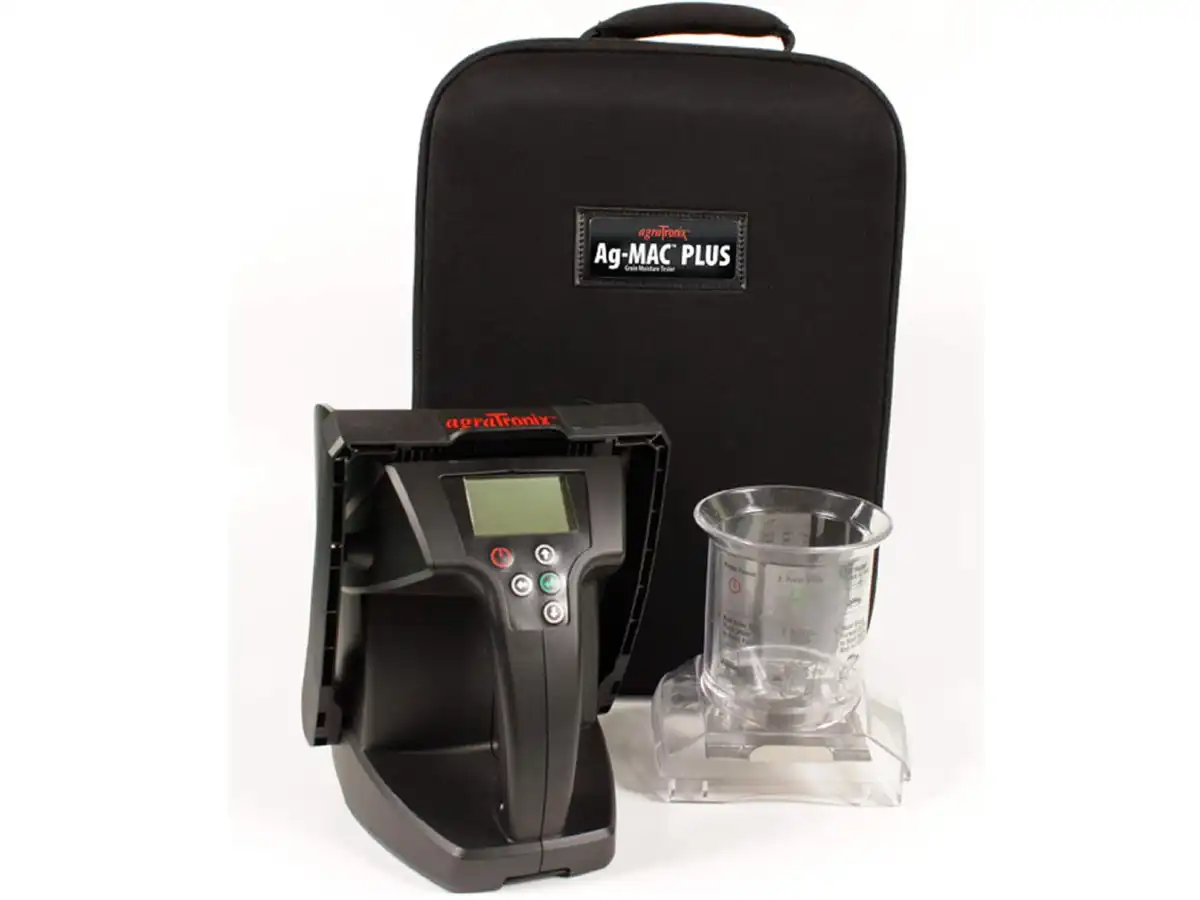
The Ag-MAC PLUS is the higher-end portable in the AgraTronix line. It targets growers who want a tighter number at delivery.
The standout is a stated accuracy of plus or minus 0.3% paired with an accurate temperature compensation circuit. That combination helps on-farm readings hold steady when grain temperature swings between a cool morning and a hot afternoon. It supports 20+ grain types, runs a multilingual LCD display, and ships with a hopper and case. The hopper matters more than it sounds, because consistent filling is half of repeatability. A USB port handles updates and diagnostics, which is useful given that meters drift over time.
PROS
- Tighter stated accuracy figure
- Temperature compensation circuit
- USB port for updates
- Hopper and case included
CONS
- Highest cost among the portables
Specs:
- Stated accuracy: plus or minus 0.3%
- Grain types: 20 plus
- Display: multilingual LCD
- Connectivity: USB for updates and diagnostics
Quality: Upper-tier portable aimed at high-volume sellers.
Owner evidence: Owner reports consistently note closer agreement with elevator results than entry-level meters deliver.
Best for farmers selling a lot of grain, where tighter accuracy and temperature compensation reduce surprises at the scale.
5. AMTAST High Precision Grain Moisture Tester
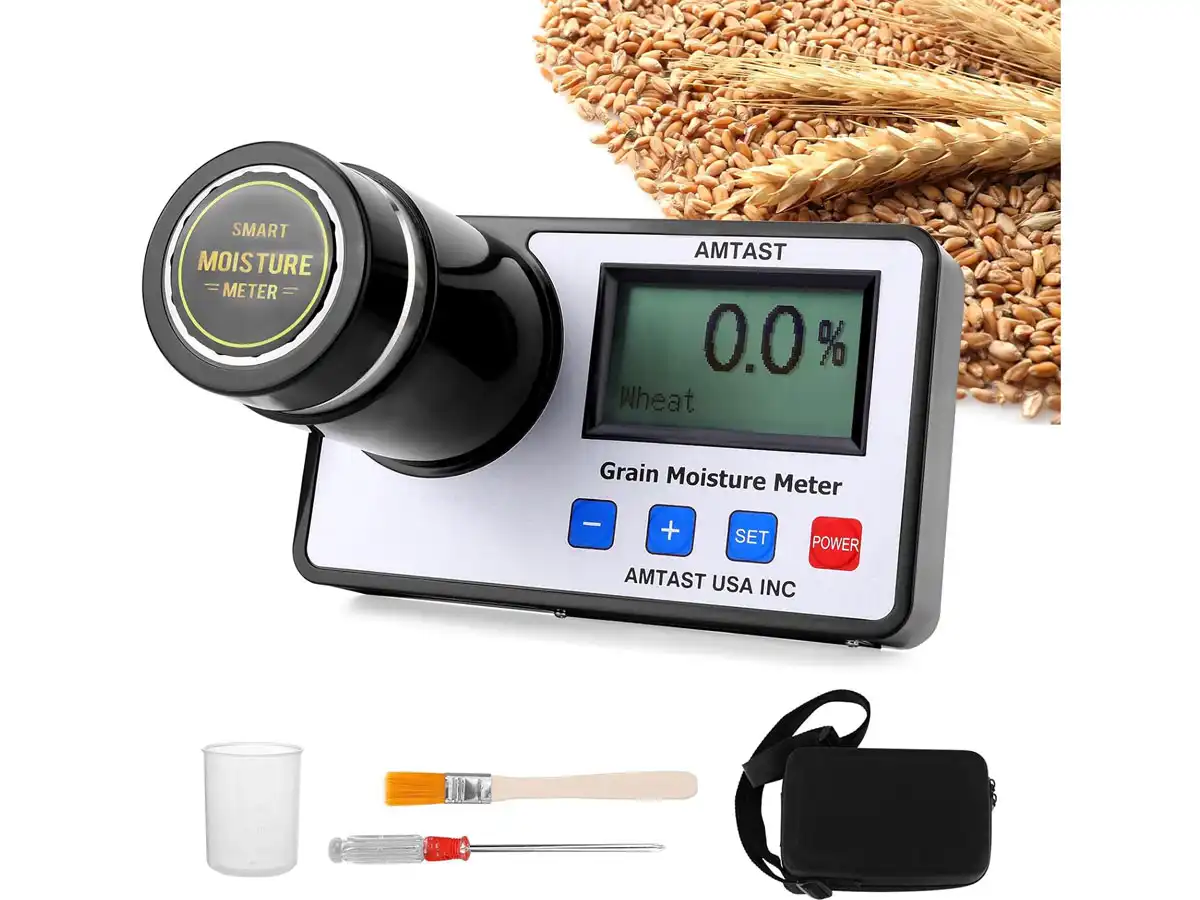
This AMTAST tester measures moisture across 22 grain types. The design focus falls on calibration and stable readings rather than extras.
It includes multi-point calibration, automatic temperature compensation, large range error correction, and a clear LCD display. The power setup stays practical: a single 9V battery with auto shutoff, and long stated battery life. For a grower rotating several commodities, the crop coverage lands above what the position suggests. Data export is the trade-off.
PROS
- Twenty-two grain calibrations
- Multi-point calibration support
- Automatic temperature compensation
- Auto shutoff saves battery
CONS
- Service support not documented
Specs:
- Grain types: 22
- Compensation: automatic temperature
- Power: single 9V battery with auto shutoff
- Display: backlit LCD
Quality: Functional mid-range build without premium finish.
Owner evidence: Owner reports consistently note stable readings when the same fill method gets used every time.
Best for budget-minded multi-crop testing, since it covers 22 grains and includes ATC without premium pricing.
6. TOTITOM Smart Grain Moisture Meter
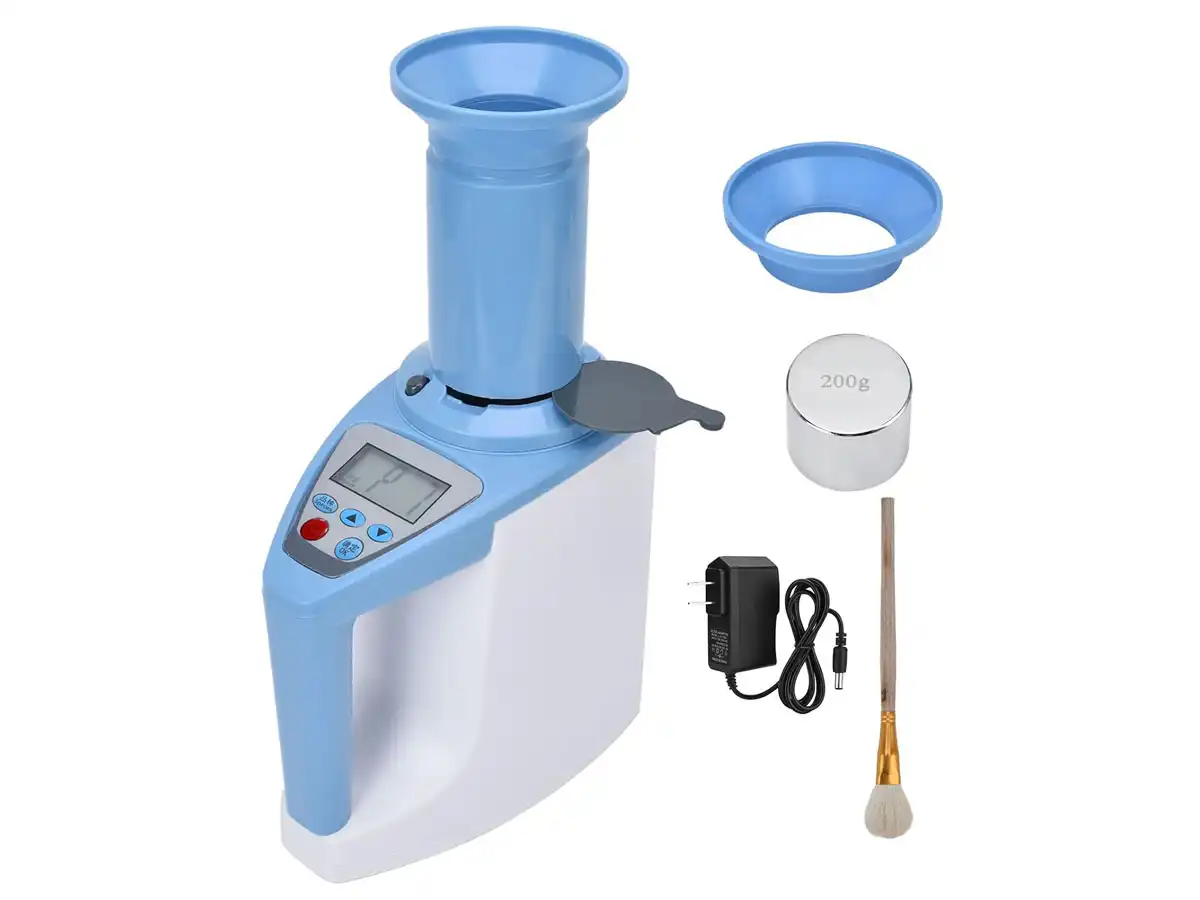
The TOTITOM is a smart-style meter that reads quickly. It suits a shop table or receiving spot more than a combine cab.
It returns results in about 2 seconds using a metal sensor, plus a touch panel, automatic weighing, and temperature compensation. Built-in weighing removes a step from the routine, which speeds up repeat checks. It supports 24 grain types and runs on dual power, either AC or 4 AA batteries. The big-font backlit screen helps when several people share the meter across a shift.
PROS
- Roughly two-second readings
- Automatic weighing built in
- Large backlit display
- AC or battery power
CONS
- Internal balance needs a level surface
Specs:
- Grain types: 24
- Read time: about 2 seconds
- Power: AC or 4 AA batteries
- Features: touch panel, temperature compensation
Quality: Bench-style build that trades ruggedness for speed.
Owner evidence: Owner reports consistently note quick throughput when several operators share one meter.
Best for quick shop-side checks, where fast read time and built-in weighing speed up routine decisions.
7. GOYERRNES Professional Grain Moisture Meter
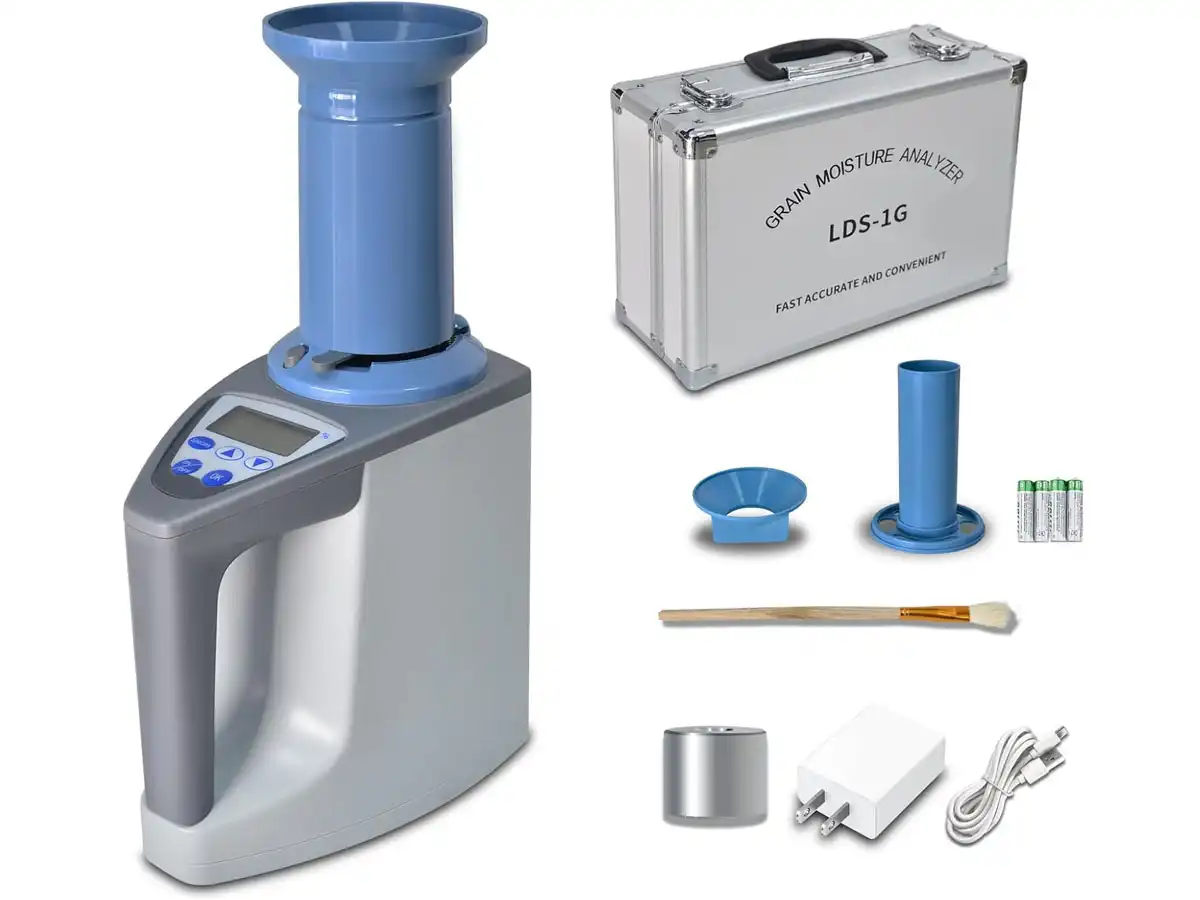
This GOYERRNES unit measures more than moisture. That gives it a role in storage checks a moisture-only meter cannot fill.
It reports moisture, weight, density, and temperature across a 3% to 35% moisture range. Stated accuracy is plus or minus 0.5%. Repeatability runs 0.2% or better in about 10 seconds. It uses variable-frequency capacitive sensing with thermistor compensation. The kit includes a 200 g calibration weight, case, sampler, and brush. Density readings pair naturally with grain test weight thinking. Lightweight or immature grain shows up there first, before any moisture number moves.
PROS
- Density reading included
- Thermistor temperature compensation
- Calibration weight supplied
- Flexible power options
CONS
- Caps at 35% moisture
Specs:
- Measures: moisture, weight, density, temperature
- Moisture range: 3% to 35%
- Stated accuracy: plus or minus 0.5%
- Calibration weight: 200 g
Quality: Solid mid-range build with broader measurement scope.
Owner evidence: Owner reports consistently note density readings helping flag lightweight or immature grain.
Best for grain handling and storage checks, since moisture plus density in one test can catch quality shifts early.
8. Brolangt LDX-G1 Agriculture Portable Meter
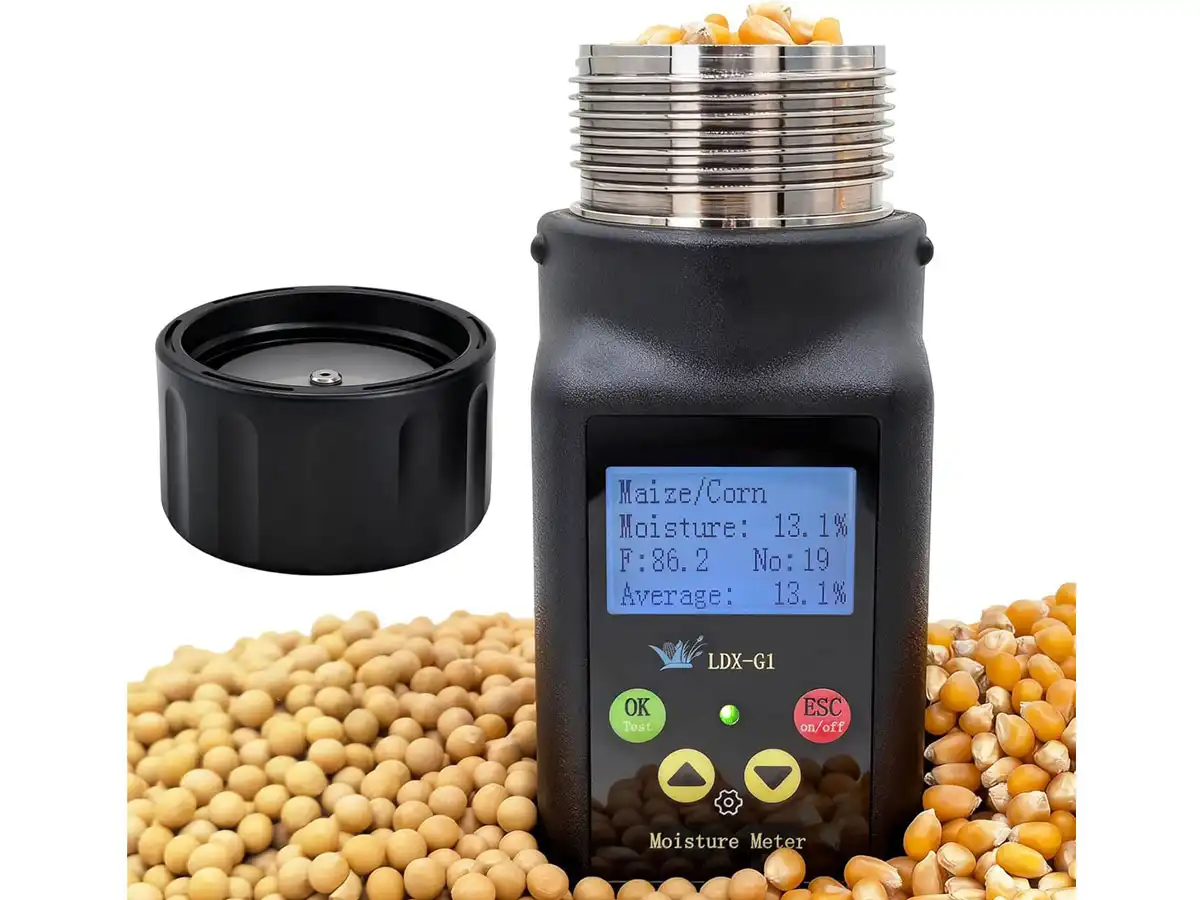
The Brolangt LDX-G1 is a compact handheld built for routine field and warehouse checks, with memory as its main advantage.
It lists accuracy of plus or minus 0.5%, automatic temperature compensation, and a backlit LCD. A tri-color LED gives an at-a-glance grain condition cue. It supports 25 crop profiles and stores 240 records with max, min, and average values. It also offers 10 languages, which matters when more than one operator runs it. At roughly 0.95 lb it carries easily. Stored averages turn routine checks into a trend you can read across a drying cycle.
PROS
- Stores 240 records
- Max, min, average display
- Tri-color condition indicator
- Light at under one pound
CONS
- Batteries not included
- No USB or wireless export
Specs:
- Crop profiles: 25
- Stated accuracy: plus or minus 0.5%
- Record storage: 240 readings
- Weight: about 0.95 lb
Quality: Compact build suited to repeat checks rather than rough handling.
Owner evidence: Owner reports consistently note stored averages helping track bins through drying.
Best for tracking drying and bin management, where built-in memory shows trends instead of single readings.
Tips for Getting Accurate Readings
An accurate grain moisture tester depends on technique as much as hardware. Purdue Extension guidance on the proper use of moisture meters sets out the sequence below. It answers how to use a grain moisture tester in a way that produces accurate grain moisture readings.
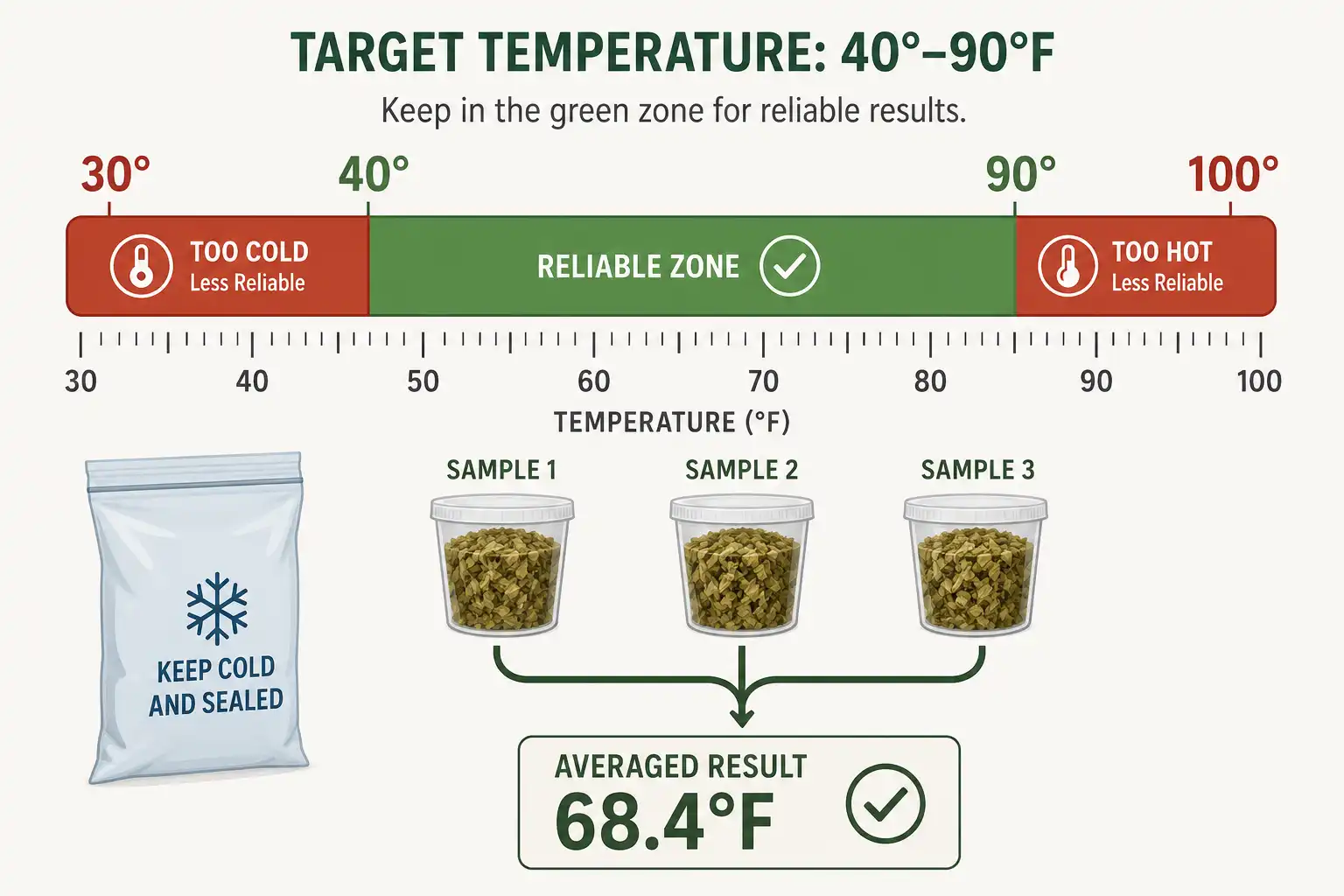
Use these as quick-hit grain moisture testing tips:
- Take a representative sample. Mix grain from several spots in the truck or auger stream before testing. Growers usually underestimate standing-crop moisture, so hand pick and shell kernels from several plants across the field, not the outside rows.
- Manage cold grain. Purdue notes that cold grain brought indoors collects condensation on the kernel surface, which reads erroneously high. Seal the sample and let it reach room temperature. NDSU Extension adds that meters are generally unreliable below about 40°F, so sample temperature deserves attention before the reading.
- Manage hot dryer grain. Let hot grain cool in a sealed container first. Purdue states that meters cannot test grain above 90°F with any accuracy, even with compensation switched on.
- Run multiple tests. Take 3 to 5 readings and average them. One reading is a guess, even on a good meter.
- Keep the meter clean. Brush out fines and wipe contact surfaces. Good moisture meter maintenance keeps sensors and sample chambers consistent.
- Compare to your buyer. Recalibrate annually and spot-check against the local elevator. A regular grain elevator calibration comparison keeps your on-farm number close to the scale house number.
Troubleshooting Common Reading Problems
| Symptom | Likely cause | What to do |
|---|---|---|
| Reads high after coming indoors | Condensation on cold kernels | Seal sample, warm to room temperature |
| Reads low on dryer-hot grain | Sample above the meter range | Cool in a sealed container first |
| Repeats scatter over 1% | Inconsistent fill or fines | Brush chamber, use one fill method |
| Steady offset from elevator | Different calibration base | Run side-by-side test, enter offset |
| No reading returned | Sample outside instrument range | Send to a lab for oven testing |
Moisture readings only pay off when the rest of the handling matches. So pair them with storing grain safely after harvest. The meter is one input, not the whole plan.
Sampling Safety Around Bins
Never enter a bin alone to pull a sample. The Purdue Agricultural Safety and Health Program documented at least 48 agricultural confined space cases in 2025. Those included 21 grain entrapments. In total, 22 cases proved fatal.
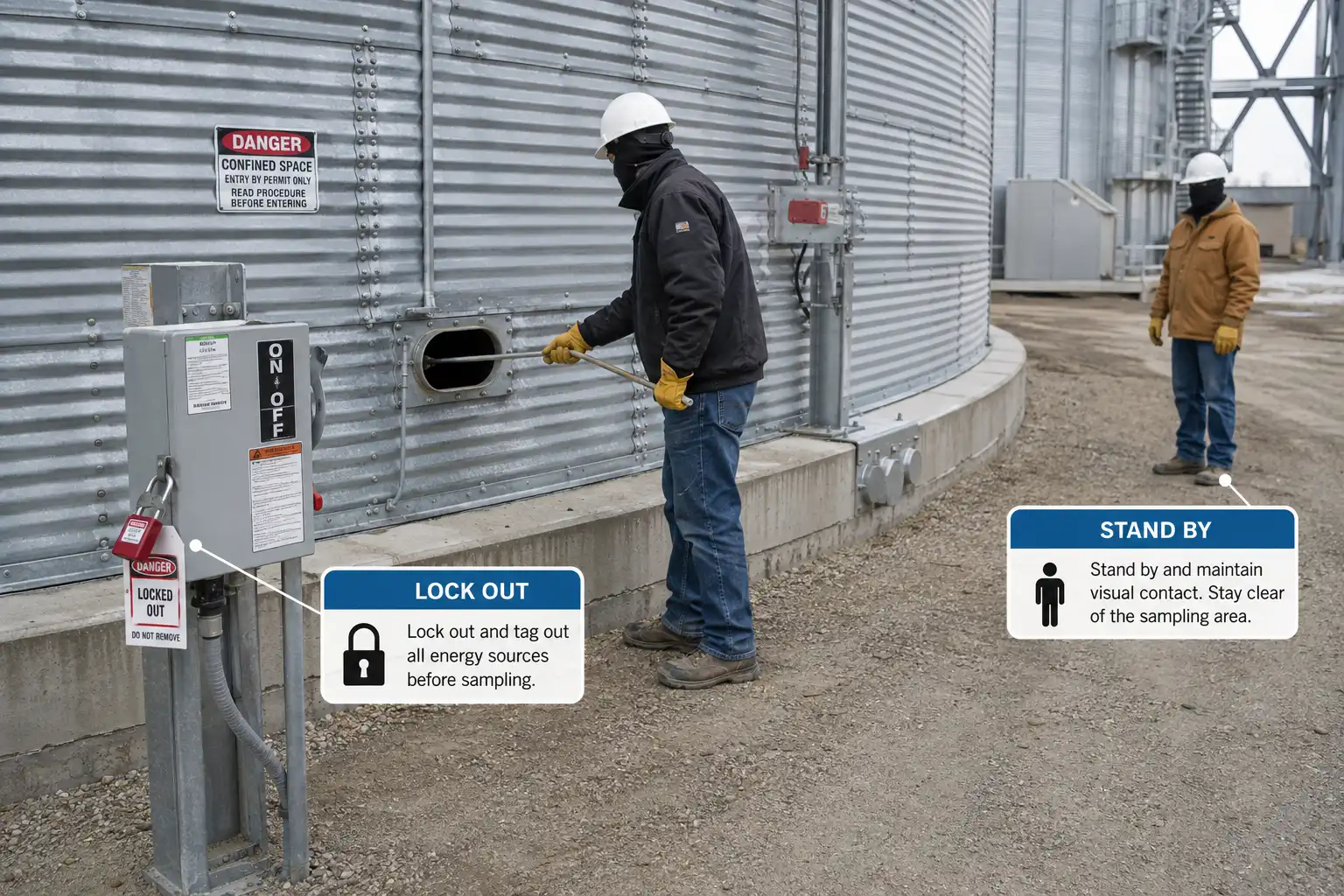
Purdue researchers point out that entrapments often begin when stored grain goes out of condition. Someone then enters to break up a crust or clear a plugged auger. Flowing grain behaves like a fluid and can pull a person under in seconds, so self-rescue is rarely possible. Probe from outside the bin when you can. Shut off and lock out unloading equipment before entry. Always keep a second person present.
FAQs About Grain Moisture Testers
What is the ideal moisture level for storing grain?
What is the difference between a portable and a benchtop grain moisture tester?
How accurate are handheld grain moisture meters compared to elevator tests?
How often should a grain moisture tester be calibrated?
Does grain temperature affect moisture tester readings?
What moisture is best for harvesting corn?
Can one meter cover corn, soybeans, and wheat?
Key Points to Carry Into Harvest
Choosing the best grain moisture tester comes down to fit. Pick the meter by crop list, temperature range, and stated accuracy. Then calibrate it against the buyer who writes your checks. Test a mixed sample three times rather than once. Treat this grain moisture meter buying guide as a filter for accuracy, calibration, and temperature correction. Those three protect grain quality, farm profitability, and crop storage outcomes. Dry to the storage duration you actually plan on, not the number that avoids a discount today. Soybean growers should tie those targets to soybean harvest timing. Beans need to reach the bin at a moisture they can hold.