How to Fertilize Sweet Corn: A Simple 3-Stage Feeding Plan
Sweet corn is a heavy feeder, and nitrogen is what it wants most. Get the timing wrong and you get pale stalks and half-filled ears. Knowing how to fertilize sweet corn comes down to feeding it at the right growth stages with the right amount.
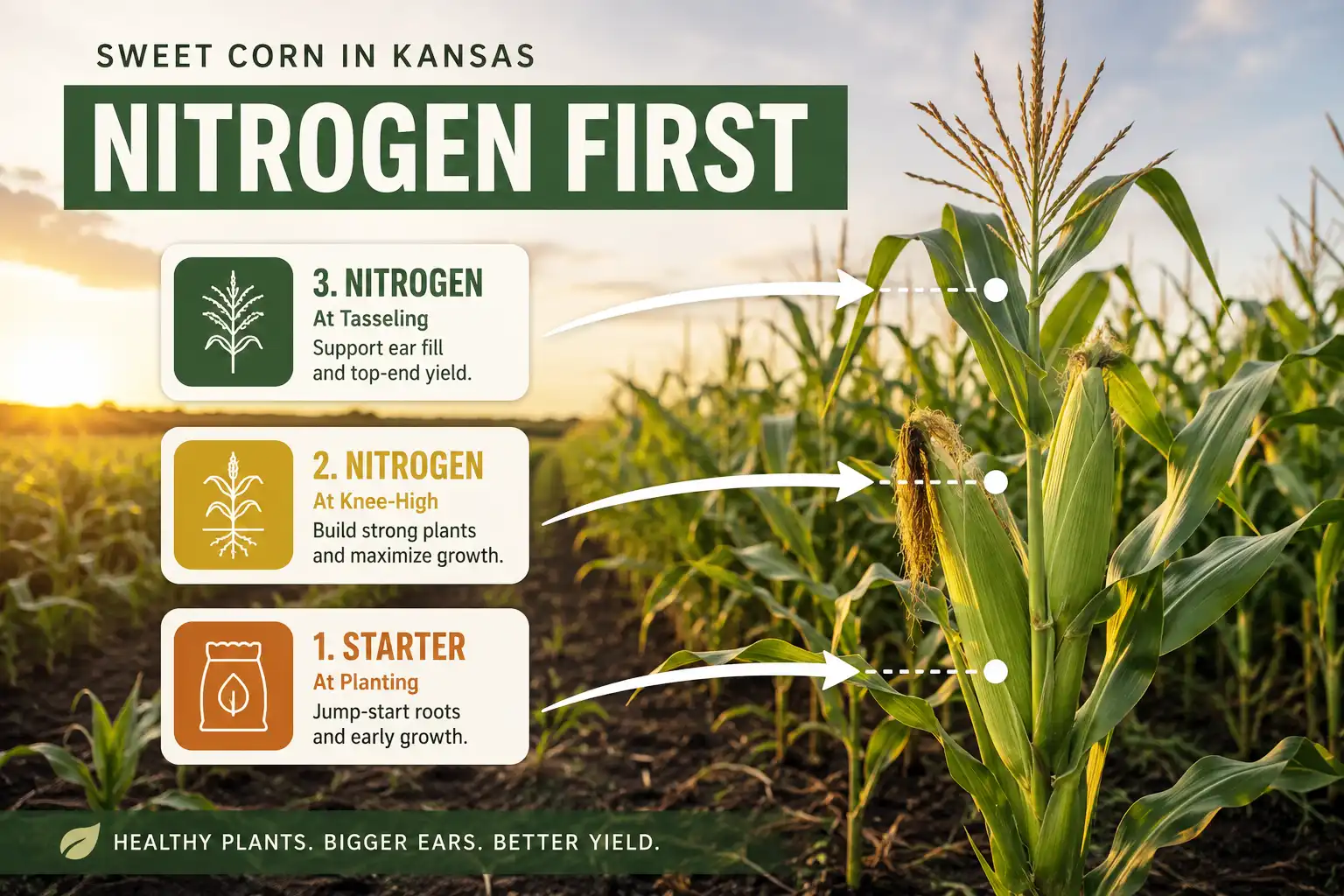
Fertilize sweet corn in three feedings. Give a starter at planting, a nitrogen side-dress at knee-high, and a final nitrogen boost at tasseling. Nitrogen drives yield, so time each one and keep granules off the leaves.
What Nutrients Does Sweet Corn Need Most?
Nitrogen is the nutrient sweet corn needs most, followed by phosphorus and potassium. Corn is a grass, and grasses run on nitrogen. It builds the tall stalks and green leaves that feed the ears.
Here is how the big three work in the plant:
- Nitrogen (N) drives leaf and stalk growth. Short supply means pale, stunted plants and small ears.
- Phosphorus (P) fuels early root growth and energy transfer. It matters most in the first few weeks.
- Potassium (K) strengthens stalks and helps kernels fill. It also improves drought and disease tolerance.
Corn also pulls more zinc than most garden crops. Cool, wet soils can lock up zinc early in the season. Magnesium matters too, mostly on sandy or low-pH ground. The N-P-K numbers on a fertilizer bag tell you the ratio of these three, so read them before you buy.
Learn more: Guide to Know How Much Potassium Does Corn Require Per Acre
Should You Soil Test Before Fertilizing Sweet Corn?
Yes. Test your soil before you spread anything. A soil test tells you your pH plus your phosphorus and potassium levels. Then you feed what the crop needs instead of guessing.
Sweet corn likes a soil pH between 6.0 and 6.8. Below 6.0, phosphorus and magnesium get harder for the roots to reach. So if your pH runs low, work in lime the fall before planting. Lime reacts slowly, and spring liming rarely helps the same season.
Many soils already hold plenty of phosphorus. If your test does not call for more P, pick a low-phosphorus or nitrogen-only fertilizer. Potassium varies more by field, so let the test set that rate. Run a soil test before planting every couple of years on each block. This can reduce fertilizer costs by avoiding unnecessary applications.
Know more: Grow Corn Indoors
When Do You Fertilize Sweet Corn?
Fertilize sweet corn at three points: at planting, when the plants are knee-high, and again at tasseling. Nitrogen uptake starts slow and then races upward, so you match your feeding to that curve.
Here is why timing matters so much. By the six-leaf stage, corn has taken up only about 10 percent of its season-long nitrogen. The big pull comes from the eight-leaf stage through tasseling. Feed too early and rain leaches the nitrogen away before the roots want it. Feed too late and the ears never catch up. Land-grant extension recommendations generally emphasize a nitrogen-focused fertilization schedule. That runs from Minnesota’s guidance to K-State.
Also know: Nitrogen Does Corn Need Per Acre
At Planting (Starter Fertilizer)
At planting, put down a starter that runs higher in phosphorus and lower in nitrogen. Phosphorus feeds the young roots while the soil is still cool. A balanced blend like 10-10-10 worked into the seedbed does the job for most gardens.
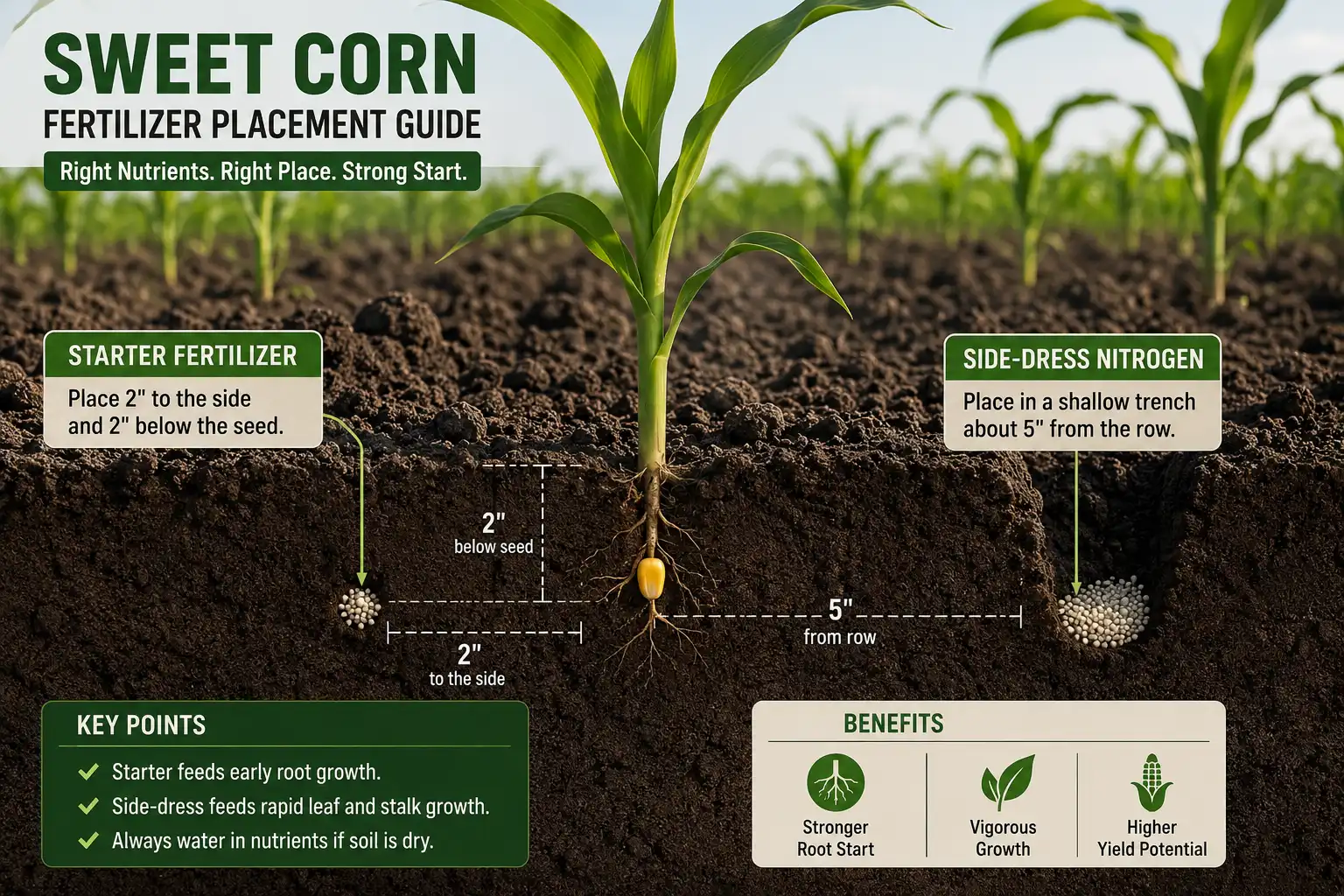
Keep the fertilizer off the seed itself. Band it about 2 inches to the side and 2 inches below the seed. Sweet corn is sensitive to fertilizer salt. A heavy band on the seed can burn it and thin your stand.
When the Corn Is Knee-High (First Side-Dress)
When the plants stand about knee-high, roughly the six- to eight-leaf stage, side-dress with nitrogen. This is the feeding that carries the crop. Corn is climbing into its fastest growth now, and the roots grab nitrogen quickly.
Use urea (46-0-0) or ammonium nitrate (34-0-0) here. Apply it in a shallow band a few inches to the side of the row, then water it in. On sandy ground, split this into two lighter passes so less nitrogen leaches out.
At Tasseling (Final Feeding)
When the tassels push out the top, give the crop one last shot of nitrogen. The plant is setting and filling kernels now, and dark green husks come from steady nitrogen through this stage. Skip it and you risk pale husks and lighter ears.
Keep granules out of the leaf whorls at this point. Urea sitting in a whorl burns the leaf. So drop it on the soil beside the row and irrigate it in. After the ears fill, the plant stops pulling much nitrogen, and a later feeding just wastes fertilizer.
How Much Fertilizer Does Sweet Corn Need?
Over a full season, sweet corn uses roughly 150 pounds of nitrogen per acre. In a garden, that works out to about 1 to 1.25 pounds of actual nitrogen per 100 feet of row. You split that total across your feedings rather than dumping it all at once.
For a small plot, here is a simple plan that works:
- At planting: about 25 pounds of 10-10-10 per 1,000 square feet, or 6 pounds per 100 feet of row, worked into the soil.
- First side-dress (knee-high): 2 to 3 pounds of ammonium nitrate (34-0-0), or about a half cup of urea (46-0-0), per 100 feet of row.
- At tasseling: repeat the side-dress rate.
Aim to have 50 to 60 pounds of nitrogen per acre available at planting, then side-dress the rest. Sweet corn stunted early by short nitrogen may never fully recover. So do not skimp on that first feeding.
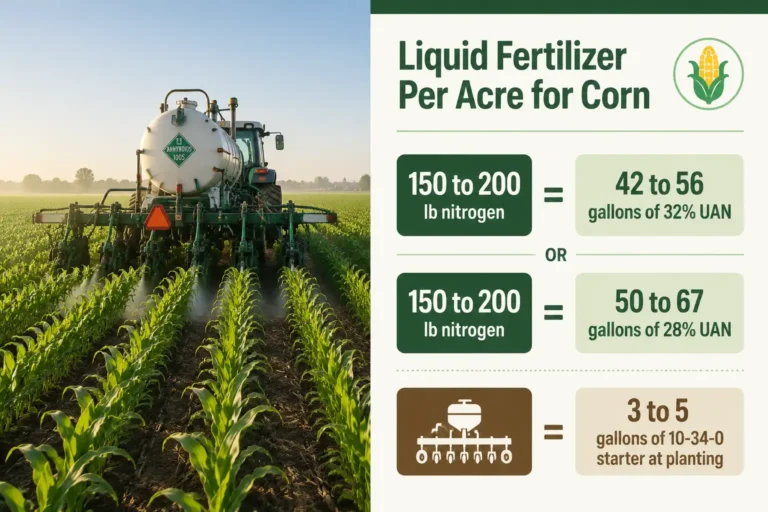
Farming corn by the acre changes the math. If you run a dry blend, our guide to 19-19-19 rates per acre breaks down the pounds. For a liquid side-dress, liquid fertilizer rates per acre article gets you close.
How Do You Apply Fertilizer to Sweet Corn?
Apply fertilizer where the roots can reach it without burning the plant. That means banding at planting and side-dressing along the row later. Placement matters as much as the amount.
At planting, band the starter 2 inches to the side and 2 inches below the seed. Never drop it in the furrow with the seed. To side-dress, scratch a shallow trench 4 to 6 inches from the row. Lay the fertilizer in and cover it with soil. Then water it in so it moves down to the roots.
Two mistakes cost growers a crop every year. First, letting urea granules sit in the leaf whorl, where they scorch the plant. Second, spreading surface nitrogen and not watering it in. Warm, dry conditions can lose up to a third of surface urea to the air within a couple of weeks. So a quarter inch of rain or irrigation soon after spreading keeps that nitrogen in the ground.
Can You Fertilize Sweet Corn Organically?
Yes, sweet corn grows well on organic nitrogen if you plan for slower release. Compost, aged manure, and legume cover crops build the base. Fast organic nitrogen sources then cover the side-dress feedings.
Work 2 inches of finished compost or well-rotted manure into the plot before planting. Never use fresh manure, since it can carry bacteria and weed seed. Blood meal (about 12 percent N) and feather meal (about 14 percent N) both act fast. They cover the nitrogen side-dressings. Cottonseed meal, soybean meal, and fish products work too.
A legume cover crop like clover, turned under before planting, adds free nitrogen from the season before. If you want to compare feeding styles, the breakdown of organic and synthetic fertilizer covers the trade-offs. Either way, the timing holds. Corn still wants a strong start plus a push at knee-high and tasseling.
How Do You Know If Sweet Corn Needs More Fertilizer?
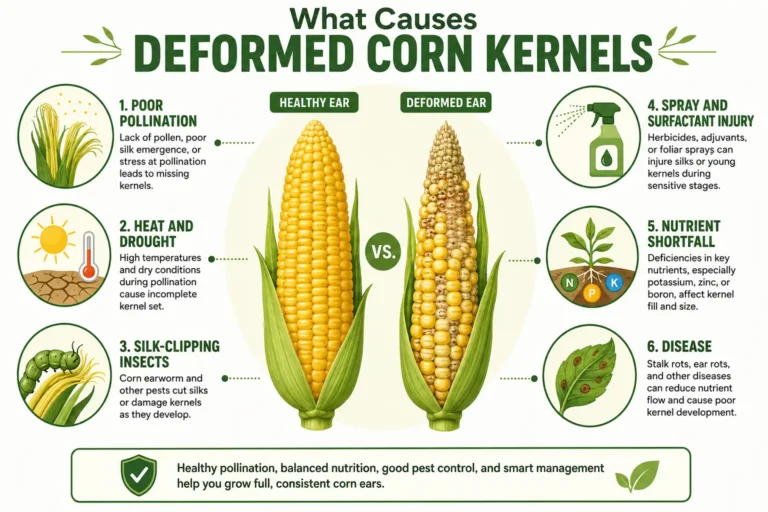
Read the leaves. Sweet corn shows you what it is short on, and each nutrient leaves its own mark. Catching it early lets you fix it with a side-dress before yield drops.
- Nitrogen shortage: older, lower leaves yellow first, starting at the tip and running down the midrib in a V shape.
- Phosphorus shortage: plants stay small and dark green, often with reddish-purple leaf edges.
- Potassium shortage: outer leaf margins yellow and brown from the tip back, and stalks may lodge.
- Zinc shortage: pale stripes between the veins on young leaves, common in cool, wet spring soils.
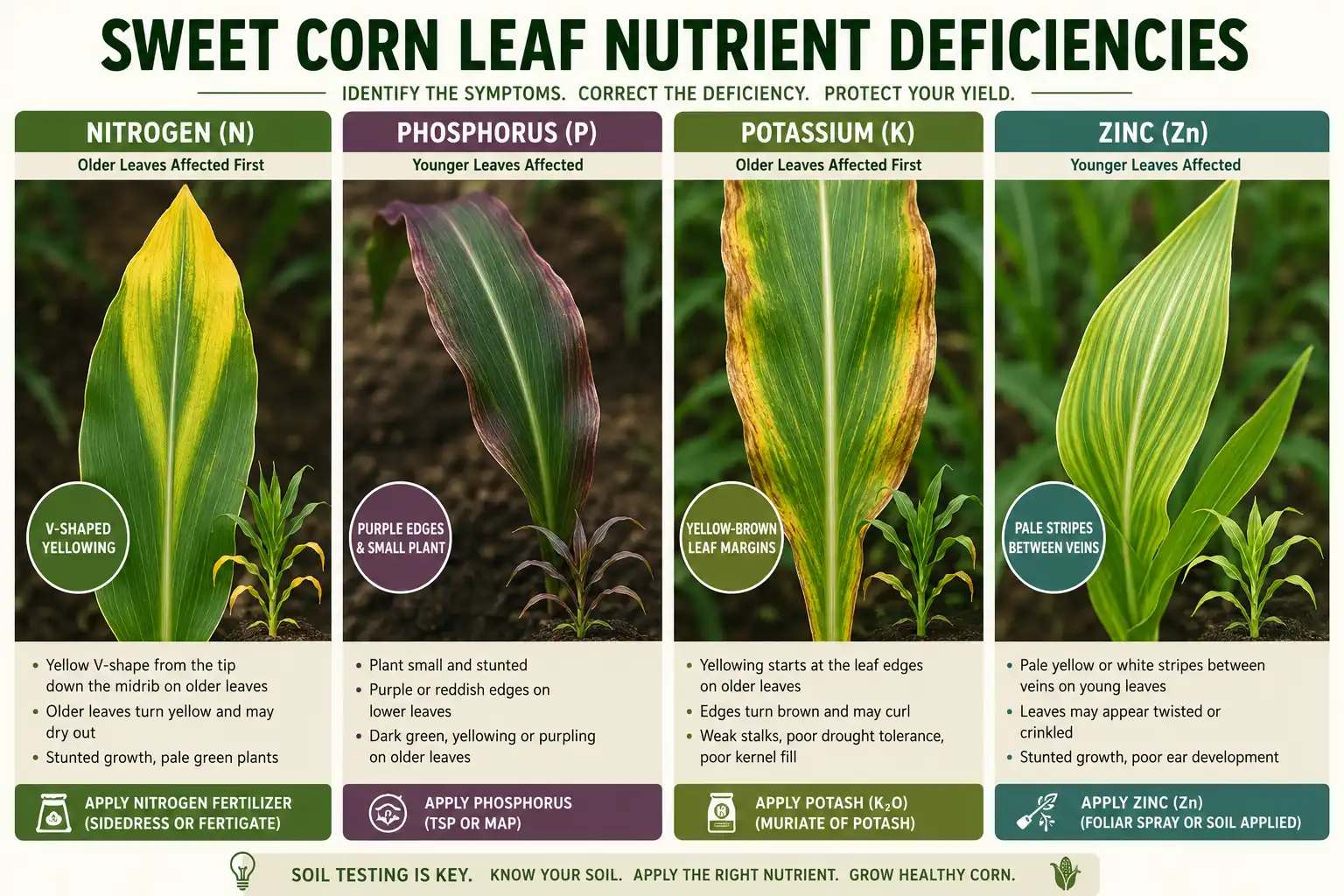
Some symptoms overlap, so a leaf-color problem is worth confirming against a soil or tissue test. The article of common nutrient shortages in plants shows what each one looks like in the field.
One more warning. Never use a “weed and feed” lawn product on sweet corn. The herbicide in it kills the crop. Too much nitrogen brings its own trouble too, pushing tall, floppy stalks that lodge in a Kansas wind.
How to Feed Sweet Corn
On ground, keep it simple. Band a balanced starter at planting. Apply a nitrogen side-dress when plants reach knee height, followed by additional nitrogen near tasseling if needed. Soil testing should be completed first to avoid applying phosphorus where existing soil levels are already sufficient.
Get the nitrogen timing right and the rest falls into place. Feed the start, feed the fast growth, feed the fill. Do that, water it in, and your ears come in full and sweet.