How Many Corn Plants Per Acre? Field and Sweet Corn Targets
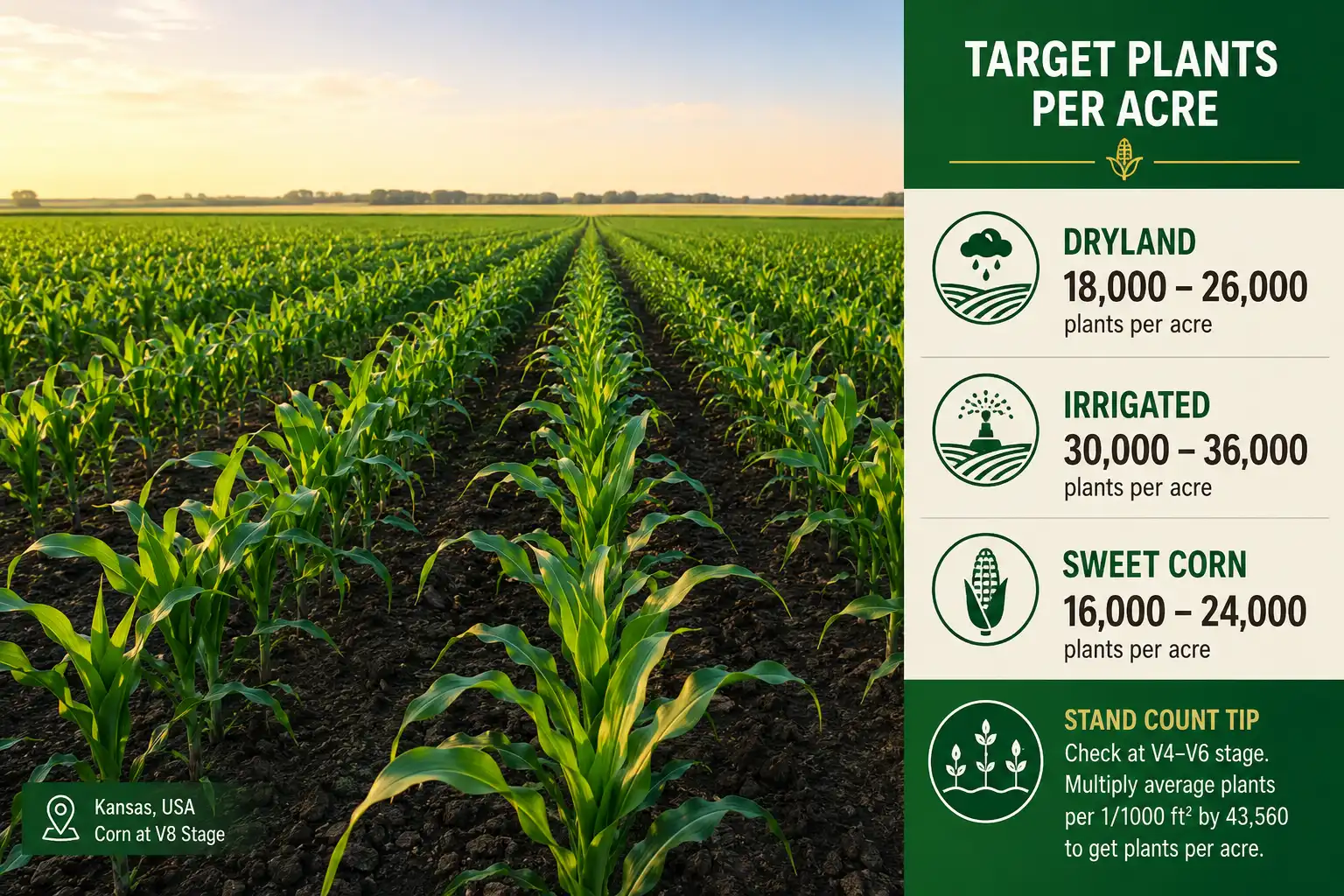
Plant too thin and you leave yield in the field. Plant too thick and you get barren stalks and lodging. So before the planter rolls, one number should be settled first: how many corn plants per acre are actually needed.
Most field corn targets 28,000 to 36,000 corn plants per acre at harvest. Dryland fields run lower, near 18,000 to 26,000, while high-yield irrigated ground tops 36,000. Sweet corn stays lighter, around 16,000 to 24,000.
How Many Corn Plants Per Acre Should You Plant?
Most grain corn does best at 28,000 to 36,000 plants per acre. Where you land in that range comes down to moisture and your yield goal. Wetter, higher-yielding ground rewards more plants. Dry ground punishes them.
That range is a modern number. Old open-pollinated corn could not handle crowding, so growers ran 8,000 to 12,000 plants back in the day. Today’s hybrids stand tighter, root stronger, and hold ears under stress. Because of that, populations across the Corn Belt have climbed for decades.
On the Great Plains, this breaks down into three buckets. Solid dryland ground sits near 22,000 to 26,000. Tough or shallow dryland drops to 16,000 to 22,000. Full irrigation or the best bottom ground climbs to 30,000 to 36,000. Sweet corn always runs lighter than grain corn, covered further down.
Is Seeding Rate the Same as Plants Per Acre?
No. Seeding rate is how many seeds you drop; final stand is how many plants actually reach harvest. Those two numbers are never equal, because not every seed makes a plant.
K-State Research and Extension figures final stand at roughly 85 percent of the planting rate. Cold soil, crusting, wet spots, and seedling disease all trim that number. Plan on 5 to 15 percent more seeds than the target stand. To finish near 34,000 plants, drop closer to 37,000 to 40,000 seeds per acre.
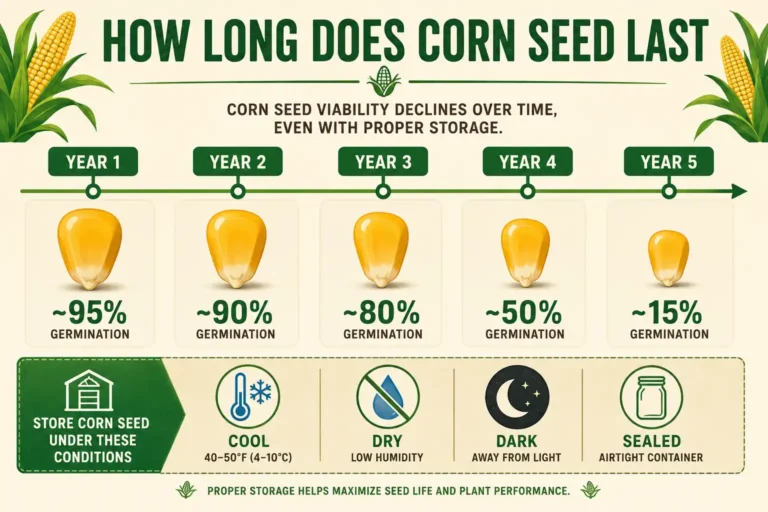
Some folks plan seed by weight, not by count. For that, our guide covers the pounds of seed corn to run per acre in a separate piece. Seed also comes in an 80,000-kernel unit. So it helps to know how many acres a bag of seed corn covers before you order.
How Do You Count Corn Plants Per Acre in the Field?
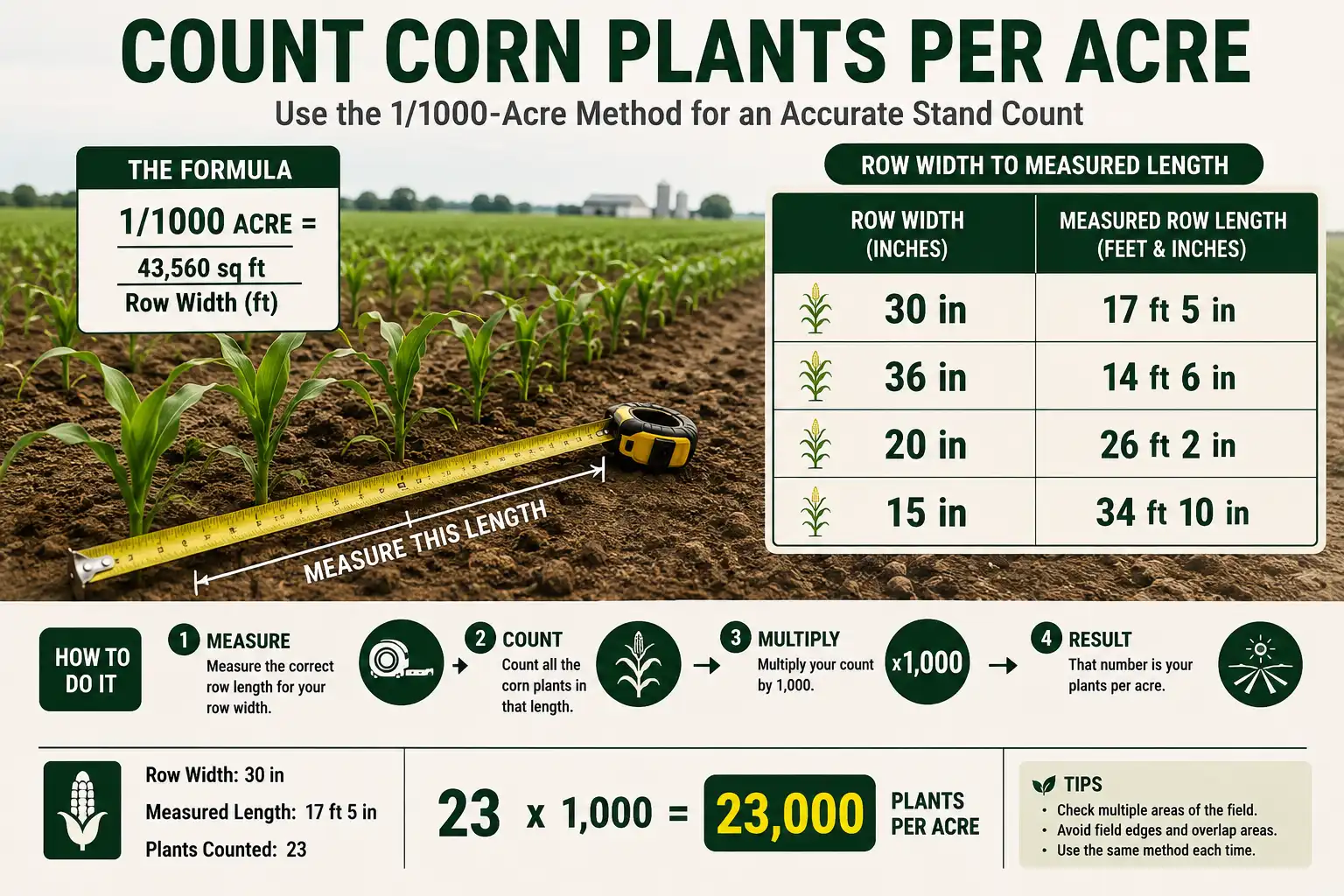
Count the plants in 1/1000th of an acre, then multiply by 1,000. That gives you plants per acre in about a minute per spot.
The row length for 1/1000th of an acre depends on your row width:
- 30-inch rows: 17 feet 5 inches
- 36-inch rows: 14 feet 6 inches
- 22-inch rows: 23 feet 9 inches
- 20-inch rows: 26 feet 2 inches
- 15-inch rows: 34 feet 10 inches
In 30-inch rows, a tape stretched to 17 feet 5 inches can be used to count every healthy plant. A count of 32 puts the stand at about 32,000 per acre. That count should then be repeated in 5 or 6 spots across the field and averaged. Skip the temptation to dodge gaps; count the bad spots too, or your number reads high.
Wait until most plants are up, usually around the V2 to V3 leaf stage, before you count a final stand. Count only plants that look healthy enough to make an ear.
What Population Fits Dryland vs Irrigated Corn?
Dryland corn runs lower because it lives on stored soil moisture and in-season rain. Push the stand too high on dry ground and plants compete for water they never get. The result is barren stalks and small ears.
In western Kansas dryland, K-State suggests populations in the 16,000 to 24,000 range. On-farm studies in central Kansas found the best dryland populations sat near 18,000 to 24,000. Eastern Kansas and irrigated fields carry more, often 24,000 to 34,000. Under limited irrigation, growers back off to 16,000 to 25,000 based on well capacity and soil type.
Match the population to a realistic yield goal. Colorado State University and Illinois research point to a simple rule. For every 10 bushels of expected yield above your base, add about 800 plants per acre. Check your profile-available water at planting too. In a dry spring, almost any rate can be too high.
How Does Plant Population Affect Yield?
Yield climbs with population up to a plateau, then flattens or drops. Each plant makes a little less as the field gets crowded. But total yield per acre keeps rising until water or light runs short.
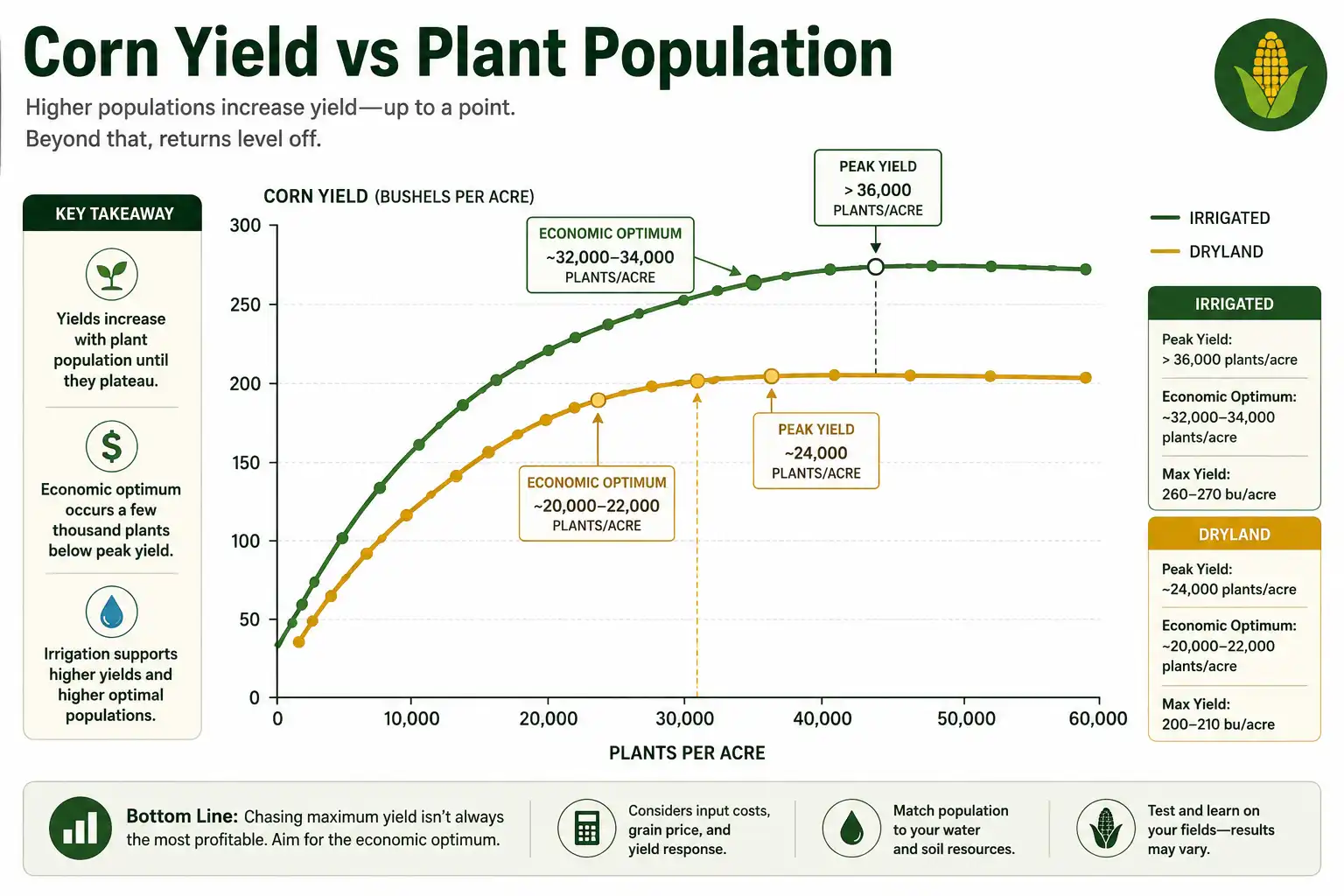
University of Minnesota trials show how thin stands cost yield:
- 26,000 plants/acre: about 96% of maximum yield
- 23,000 plants/acre: about 92%
- 20,000 plants/acre: about 87%
- 17,000 plants/acre: about 81%
So thin stands cost you, but the loss stays modest in moderate ranges. Over-populated dryland shows its stress fast. You see barren stalks, ears tipped back with bare cobs, thin stalks, and more lodging by fall.
If most ears fill clear to the tip, you probably had room for more plants. If more than about 5 percent of stalks go barren, you likely planted too heavy. Corn sets its kernel number early, around the V5 to V6 stage and again through pollination. Stress at those windows hits yield hard. That loss of per-plant vigor also drives ears per stalk lower on crowded corn.
One more point on the money. The economic best population usually runs a few thousand plants below the agronomic best, because seed costs real dollars. Plant for net return, not for the tallest yield bar.
Does Row Spacing Change Plants Per Acre?
Row spacing changes how you space seeds, not the target population itself. You can hit 34,000 plants per acre in 30-inch, 20-inch, or 15-inch rows. The math just moves the seeds around.
The formula is plants per acre equals 43,560 divided by (row spacing in feet times in-row spacing in feet). For 34,000 plants in 30-inch rows, seeds land about 6 inches apart. Drop to 20-inch rows and the same population spaces plants near 9 inches apart. In 15-inch rows, plants sit roughly 12 inches apart at that stand.
Narrow rows spread the canopy, capture a little more light, and can add yield on high-population, high-yield fields. On dryland, the payback shrinks. Either way, taller hybrids fill a canopy faster. So it helps to know how tall corn stalks get before you crowd the rows.
How Many Sweet Corn Plants Per Acre?
Sweet corn runs lighter than field corn, roughly 16,000 to 24,000 plants per acre. It sets fewer ears under crowding and needs good pollination to fill every kernel. So pack it like grain corn.
Space sweet corn rows 30 to 36 inches apart, with plants 8 to 12 inches apart in the row. Tighter spacing pushes the count toward 24,000; wider spacing settles near 16,000. Supersweet types tolerate a touch more density than older sugary varieties.
For good pollination, sweet corn needs plenty of neighbors close by. That is why planting corn in short blocks beats a single long row for filling out ears. Short on space? Growing corn in a raised bed works fine for small spaces. Just keep the block at least three rows wide so pollen reaches every silk.
Bottom Line for Your Field
Set your target by moisture and yield goal first, then trust the planter to place the seed. Dryland ground in Kansas likes 18,000 to 26,000 plants per acre. Irrigated ground earns its keep at 30,000 to 36,000. Sweet corn stays down around 16,000 to 24,000. Once the crop is up, count your stand in a few spots and check it against your target. That five-minute walk tells you whether the planter did its job, and it saves guesswork at harvest.