How Much Liquid Fertilizer Per Acre for Corn: 28% vs 32%
Corn pulls more nitrogen than any crop. So when growers ask how much liquid fertilizer per acre for corn they need, start with pounds of nitrogen, not gallons in the tank.
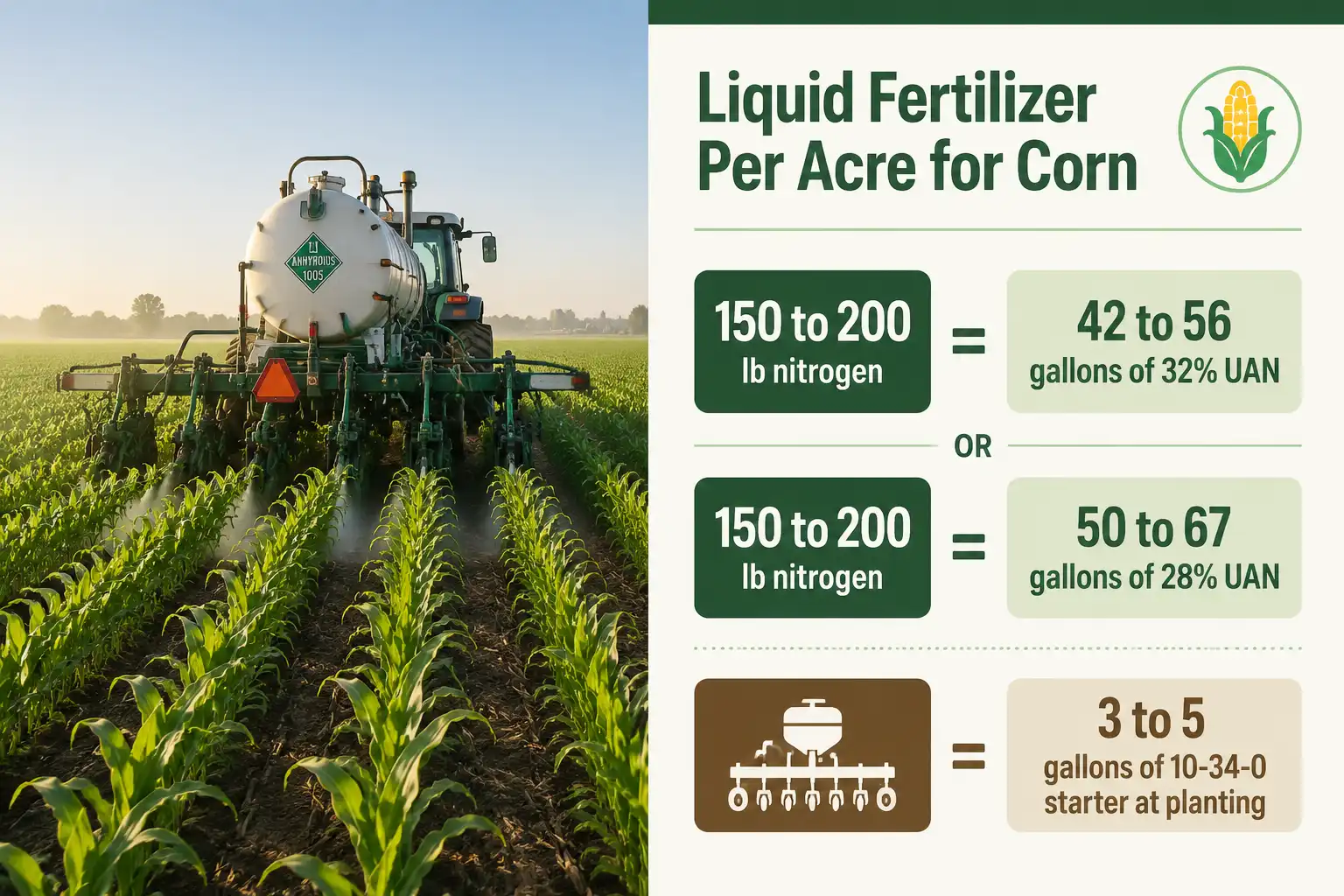
How much liquid fertilizer per acre for corn comes down to nitrogen. Most fields need 150 to 200 pounds per acre. That equals 42 to 56 gallons of 32% UAN, or 50 to 67 gallons of 28%.
How Much Liquid Fertilizer Per Acre for Corn Do You Actually Need?
Most cornfields need 150 to 200 pounds of nitrogen per acre. That covers grain yields in the 180 to 230 bushel range. In gallons, that’s 42 to 56 of 32% UAN, or 50 to 67 of 28%. Dryland corn at lower yield goals needs less, often 100 to 140 pounds.
Gallons alone tell you nothing. Dealers sell liquid fertilizer by analysis and weight. So the NPK numbers on the jug mean pounds of nutrient per 100 pounds of product. Because of that, two tanks with the same gallons can carry very different nitrogen. Always work backward from pounds of nitrogen to gallons of product.
How Many Pounds of Nitrogen Are in a Gallon of UAN?
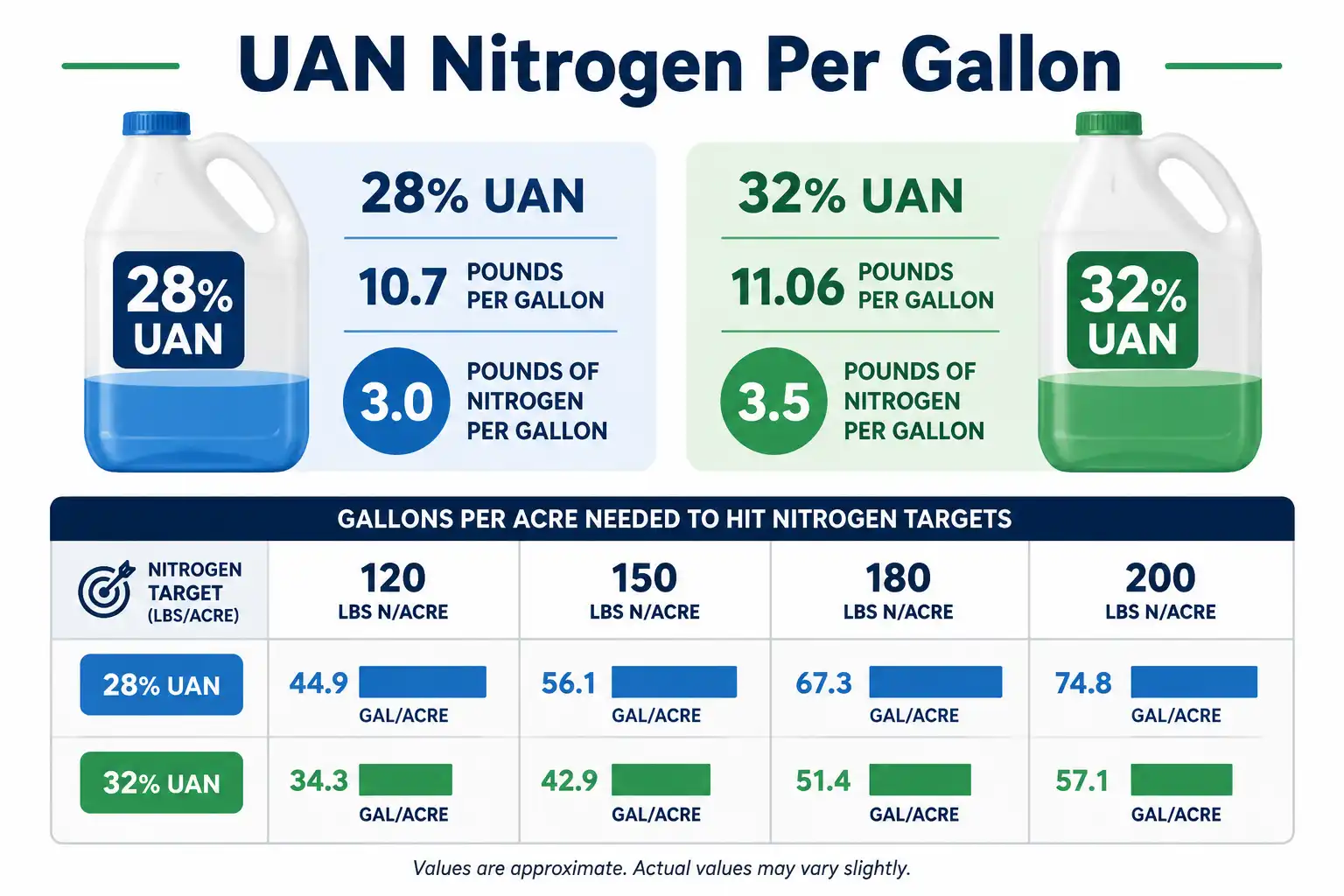
A gallon of 28% UAN carries about 3 pounds of nitrogen, and a gallon of 32% carries about 3.5 pounds. The math is simple. UAN 28 weighs 10.7 pounds per gallon, so 10.7 x 0.28 = 3.0. UAN 32 weighs 11.06 pounds per gallon, so 11.06 x 0.32 = 3.5.
| Product | Weight per gallon | Nutrients per gallon |
|---|---|---|
| 28% UAN (28-0-0) | 10.7 lb | 3.0 lb N |
| 32% UAN (32-0-0) | 11.06 lb | 3.5 lb N |
| 10-34-0 starter | 11.65 lb | 1.2 lb N + 4.0 lb P2O5 |
Then divide your target nitrogen rate by the pounds per gallon.
| Target nitrogen rate | Gallons of 28% UAN | Gallons of 32% UAN |
|---|---|---|
| 120 lb N | 40 | 34 |
| 150 lb N | 50 | 43 |
| 180 lb N | 60 | 51 |
| 200 lb N | 67 | 57 |
For example, 30 gallons of 28% is only 90 pounds of nitrogen. Growers have shorted corn 20 pounds by pricing gallons instead of pounds. So run the division every time.
How Do You Set the Nitrogen Rate for Your Field?
Set the rate from a soil test and your state’s recommendation tool, not from a coffee shop number. Fields differ too much for one blanket rate. Two systems cover most corn country, so start with the one your state uses.
How Does the K-State Yield Goal Formula Work?
K-State Research and Extension figures corn nitrogen at 1.6 pounds per bushel of yield goal, minus what the soil supplies. That’s the system. The credits are specific. Knock off 20 pounds for every 1% of soil organic matter. Then subtract whatever a 24-inch profile nitrate test finds, plus any manure or legume nitrogen. Pull that profile sample in fall or early spring, before you book fertilizer.
Here’s the math on a 200 bushel irrigated goal. Start at 320 pounds (200 x 1.6). Subtract 50 for 2.5% organic matter. Subtract 60 for profile nitrate. You land at 210 pounds of nitrogen, or 60 gallons of 32% UAN. A 130 bushel dryland goal follows the same steps and usually lands between 100 and 130 pounds. K-State also caps the rec at 230 pounds on dryland and 300 on irrigated ground. Those credits only count if you test, though. A steady soil testing program puts real numbers behind them.
What Is the MRTN Rate for Corn?
MRTN stands for maximum return to nitrogen, the rate where the last pound of fertilizer still pays for itself. Seven Corn Belt states set corn rates this way instead of using yield goals. The list: Illinois, Iowa, Indiana, Michigan, Minnesota, Ohio, and Wisconsin. Their tool is the Corn Nitrogen Rate Calculator at cornnratecalc.org, built on hundreds of nitrogen rate trials.
Punch in your state, your rotation, and current nitrogen and corn prices. The calculator returns the most profitable rate plus a range around it. Most outputs land between 130 and 190 pounds for corn after soybeans, and 170 to 200 for corn on corn. Those numbers already include the soybean credit, so skip taking it twice. When nitrogen gets expensive, the rate drops. When corn prices climb, it rises.
Either way, keep the yield goal honest. Match it to your water and your ground, just like you match corn seed rates per acre to conditions. If you sidedress, a pre-sidedress nitrate test (PSNT) at V4 to V6 fine-tunes the last pass. Get the pounds right, and how much liquid fertilizer per acre for corn turns into simple division.
How Much Liquid Starter Goes On at Planting?
Cap in-furrow starter at 5 gallons of 10-34-0 per acre on 30-inch rows. In most fields, 2.5 to 3 gallons does the same job for less money. Five gallons of ammonium polyphosphate (10-34-0) delivers about 5.8 pounds of nitrogen and 19.8 pounds of phosphate. It sits right where seedling roots find it.
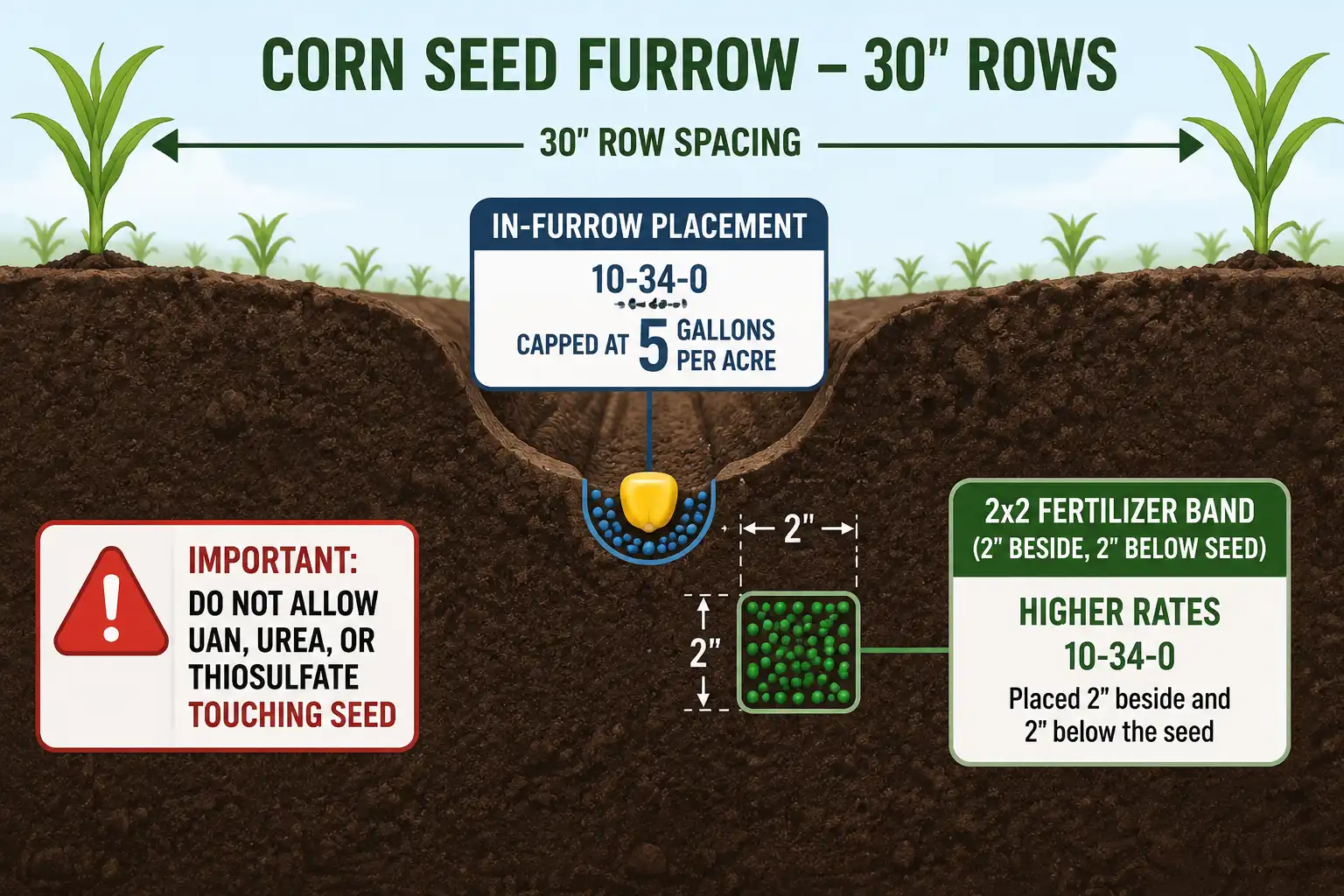
The cap exists because of salt index. K-State research puts the seed-contact limit at 6 to 8 pounds of nitrogen plus potash per acre on 30-inch rows. Past that, salt injury thins stands. Cut in-furrow rates in half on sandy ground or into a dry seedbed. And never put UAN, urea, or ammonium thiosulfate in the furrow at any rate. The urea converts to ammonia and kills seedlings.
Need more up front? Move to a 2×2 band, two inches beside and two inches below the seed. That placement handles 10 gallons of 10-34-0 without stand loss. It also takes 20 to 30 pounds of nitrogen as a UAN blend. A quart of chelated zinc can also be added to the starter. High-pH Kansas soils run short on zinc more than any other micronutrient. If your co-op only handles dry blends, the 19-19-19 rate math for corn covers that route instead.
When Do You Sidedress Liquid Nitrogen on Corn?
Sidedress between V4 and V8, and treat V6 as the sweet spot. Corn barely touches nitrogen before V5. Then uptake takes off, and the plant pulls its biggest share between V8 and tasseling. Feeding just ahead of that surge keeps nitrogen out of the loss window and inside the crop.
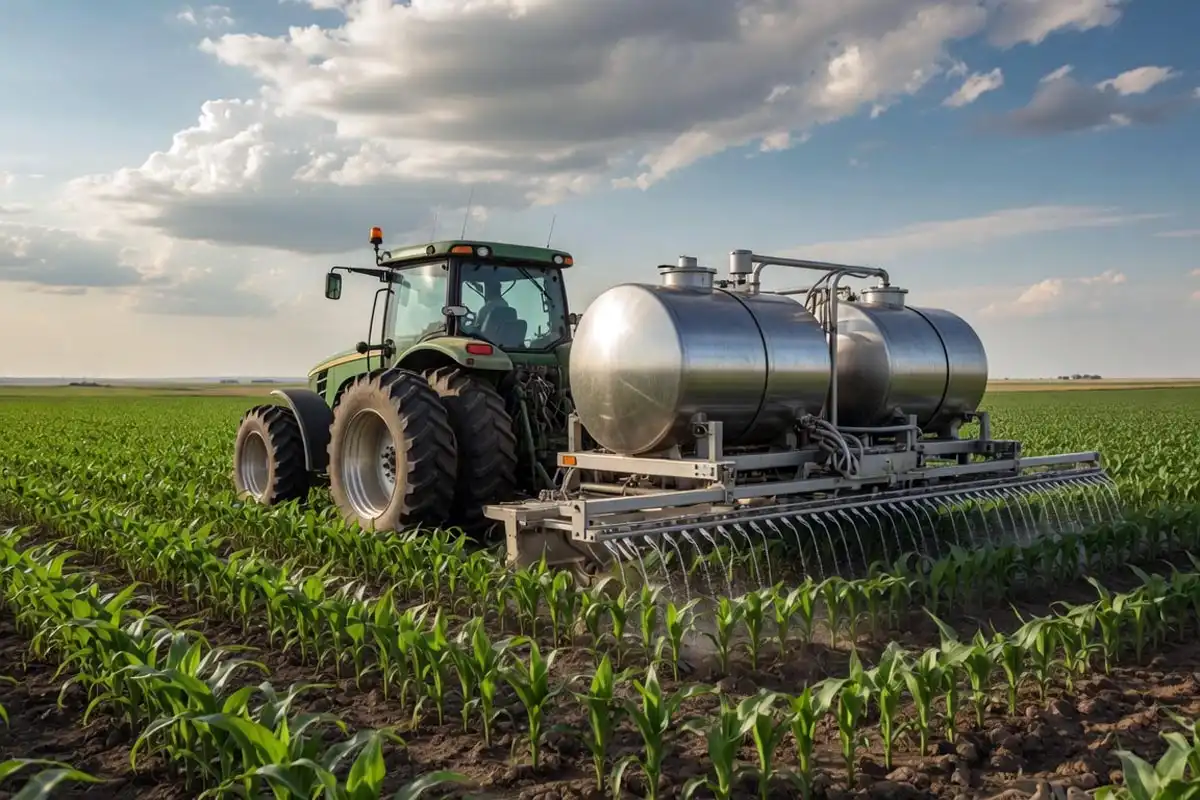
Split looks like this: 30 to 50 pounds of nitrogen near planting, then the balance at sidedress. Injecting UAN with coulters three to four inches deep between rows is the cleanest method. Finish injection passes by V6, because knives start pruning roots after that. Surface dribble bands between rows work too, but they need a half inch of rain or irrigation to move in. In warm, dry weather, a urease inhibitor helps hold that surface nitrogen.
Keep UAN off the leaves. Broadcast spraying over the canopy burns corn, and the burn gets worse as plants grow. Corn shrugs off a light shot before V4. After that, keep every drop on the soil with streamer bars or drop nozzles. On irrigated fields or after a wet spring, Y-drop applicators earn their keep. The 360 Y-DROP style places UAN at the base of the plant clear up to pre-tassel. So you can still feed tall corn without frying it.
Should You Blend Sulfur or Zinc Into Liquid Nitrogen?
Yes. Sulfur pays on more corn acres every year, because cleaner air deposits less of it for free. Blend 3 to 5 gallons of ammonium thiosulfate (12-0-0-26) into your sidedress UAN. That adds roughly 9 to 15 pounds of sulfur plus a little extra nitrogen. Keep ATS in the sidedress band only, never near the seed, since its salt index runs high.
Zinc belongs in the starter, not the sidedress. Foliar products fill small gaps after a tissue test flags one. Rates run a quart to a couple gallons per acre. But foliar feeding only tops off a program. It never replaces the base nitrogen plan.
What About Sweet Corn Patches and Small Plots?
Scale the same math down. A rate of 150 pounds of nitrogen per acre equals about 3.5 pounds per 1,000 square feet. That’s close to one gallon of 32% UAN for the season on that space. Split it in thirds: planting, knee-high, and tassel.
Most gardeners skip UAN and feed with a water-soluble product through a hose-end sprayer instead. That works fine. Just hold the pounds-of-nitrogen target steady, and water each feeding in so the roots get it.
Bottom Lines
East of Topeka, the program runs like this. In-furrow: 5 gallons of 10-34-0 plus a quart of zinc chelate. Near planting: about 40 pounds of nitrogen dribbled with the pre pass. Sidedress: the rest goes in as 32% UAN at V5 to V6, with ATS in the blend. A fall profile nitrate test sets the total, and the pounds-per-gallon math sets the gallons. Soil test first, set pounds second, divide by pounds per gallon last. Do that, and your tank mix stops being a guess.