Can You Grow Corn Indoors? What Works and What Doesn’t
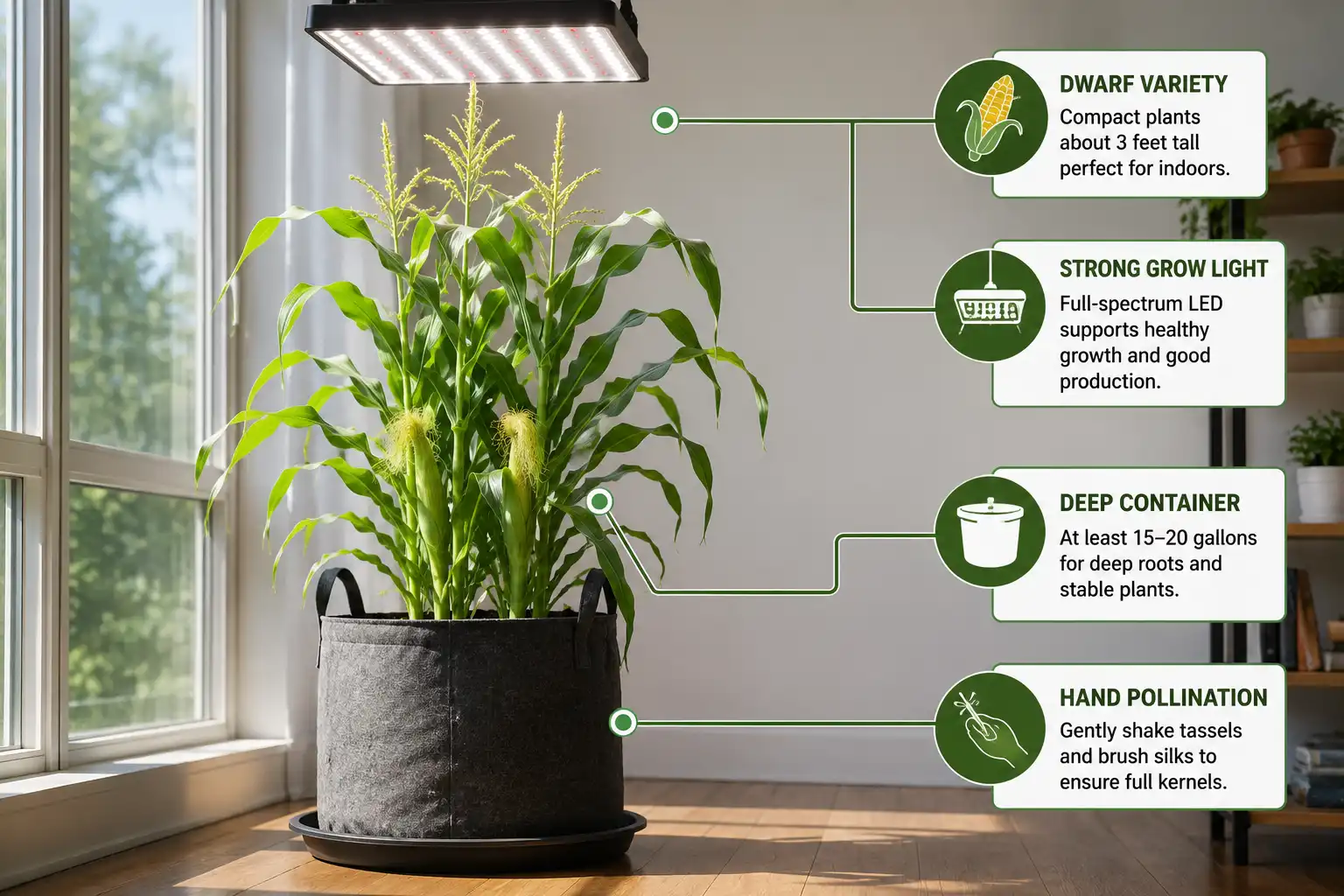
Corn is one of the hardest crops to raise inside four walls. Yes, you can grow corn indoors. But it takes a dwarf variety, a deep container, a strong grow light, and hand pollination.
Yes, you can grow corn indoors, but it rarely pays off. Corn needs 8 to 10 hours of strong light, hand pollination, and a big deep pot. Dwarf varieties under a full-spectrum LED work best.
Why Is Corn So Hard to Grow Indoors?
Corn fights indoor growing on four fronts: light, height, pollination, and yield. Each one is a real hurdle, and together they make corn one of the toughest crops to raise inside.
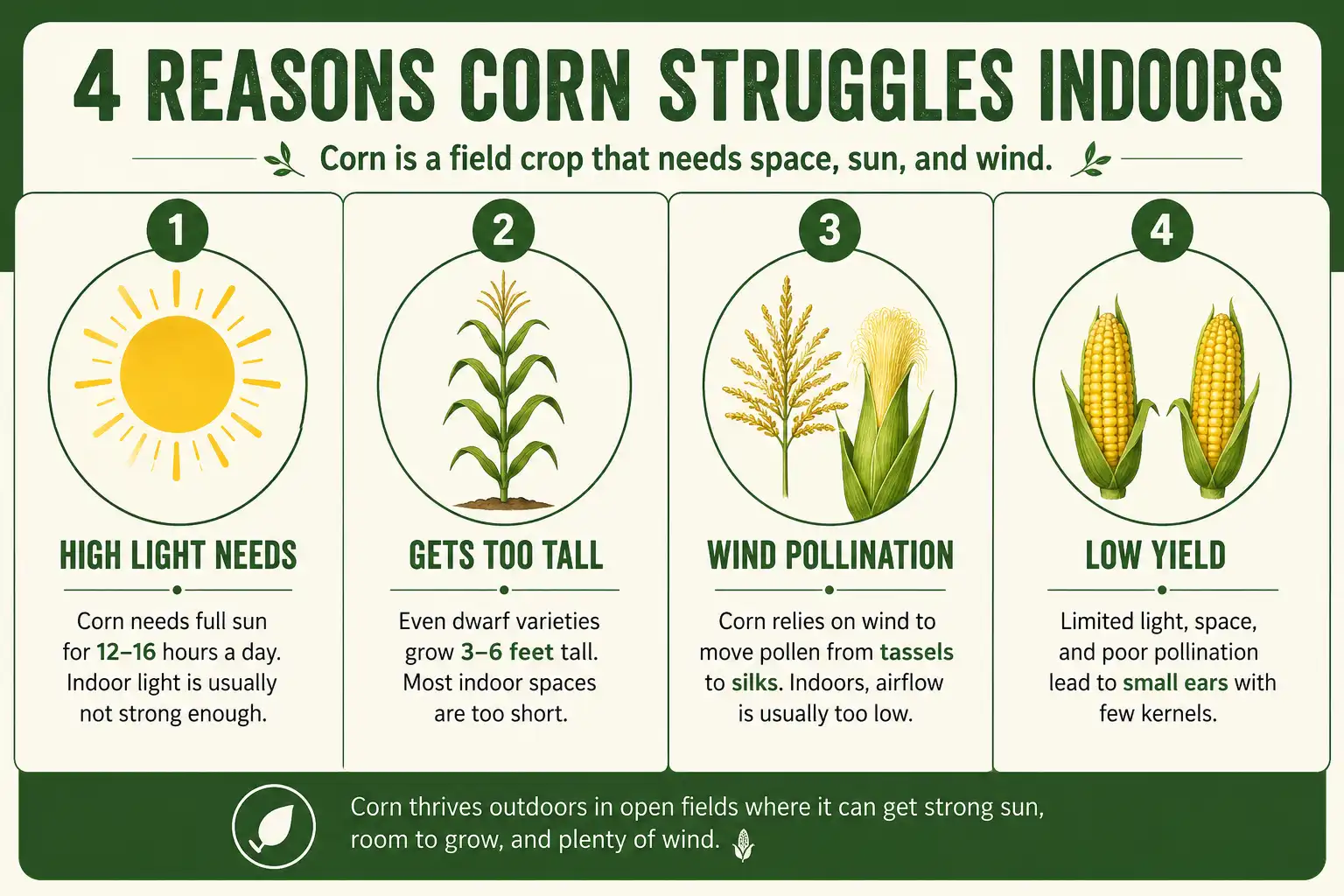
First, corn is a sun hog. In Kansas, field corn wants 8 to 10 hours of direct sun every day. And 6 hours is the floor. A bright windowsill gives you maybe 3 or 4 hours of weak, angled light. So that alone falls far short.
Second, corn gets tall. Even short types reach 3 to 5 feet, while standard sweet corn hits 6 to 8 feet. That is a lot of plant to fit and light under a ceiling. If you want the full picture on height, our guide covers how tall corn stalks get in a separate post.
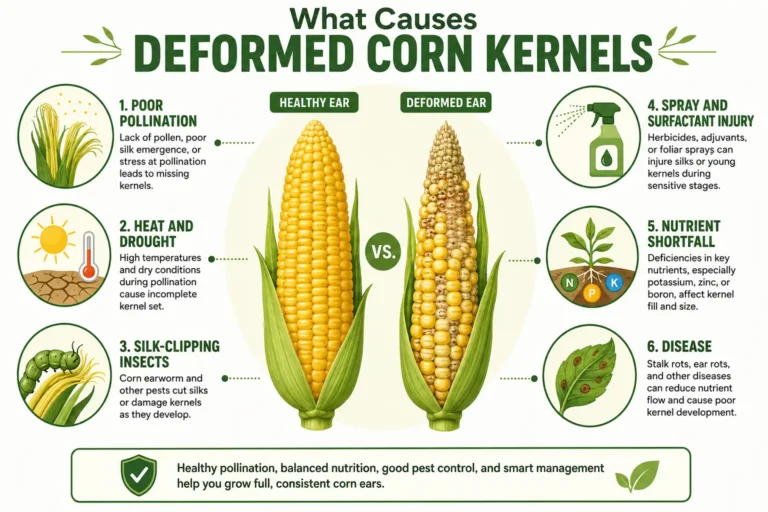
Third, corn is wind-pollinated. No wind blows inside your house, so you become the wind. Because of that, every plant needs hand pollination or the ears come out with gaps and bare tips.
Fourth, the payoff is small. One stalk gives one or two ears. So to feed a family you need dozens of plants, which means dozens of pots and a wall of lights.
What Do You Need to Grow Corn Inside?
You need a dwarf variety and a deep container at least 12 inches across. You also need a full-spectrum LED and a warm room near 70°F. Miss any one of these and the crop stalls. So let me walk through each piece.
Which Corn Varieties Work Best Indoors?
Dwarf and container types work best because they stay short and mature fast. Standard field or sweet corn grows too tall for most indoor setups.
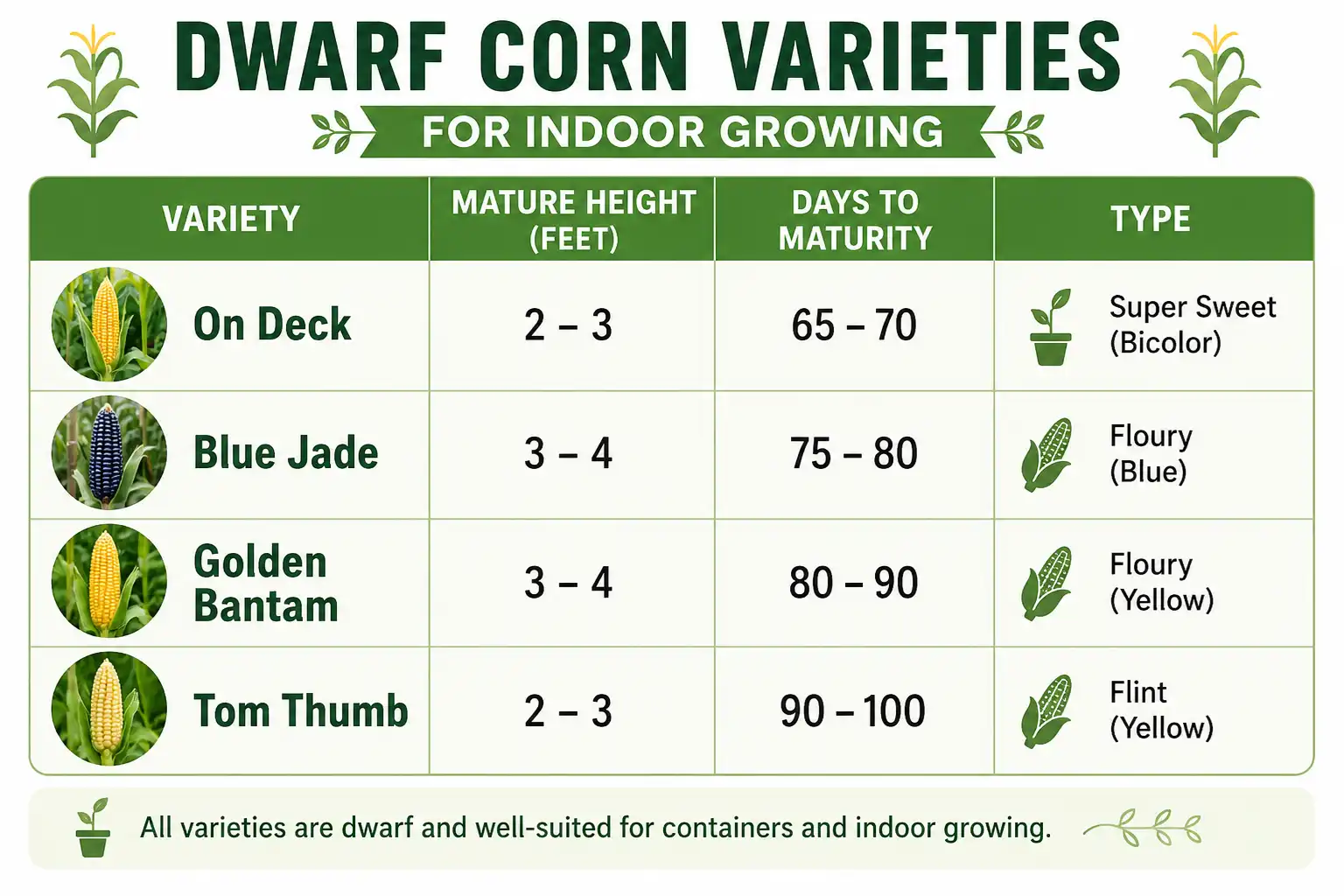
Here are the ones.
- On Deck: a compact sweet corn for pots, about 4 to 5 feet, ready in 60 to 65 days.
- Blue Jade: an heirloom that tops out near 3 feet and holds up in a container. Its kernels turn steel-blue when cooked.
- Golden Bantam: an old open-pollinated sweet corn, a bit taller but dependable.
- Tom Thumb: a popcorn that stays around 3 feet, so it is one of the shortest options going.
Stick with one variety at a time. Corn (Zea mays) crosses easily, so mixing a sweet type with a popcorn ruins the kernels on both.
How Big a Container Does Corn Need?
Corn needs a deep, wide container because the roots spread fast and the tall stalk needs an anchor. Go with at least 12 inches deep and 18 to 20 inches wide. Bigger is always better here.
A 5-gallon bucket holds two or three dwarf plants. Meanwhile, a large fabric grow bag in the 15 to 25 gallon range fits several more, which helps pollination. Drainage holes are a must, since corn hates soggy roots but still drinks a lot.
How Much Light Does Indoor Corn Need?
Indoor corn needs a strong full-spectrum LED. Run it 14 to 16 hours a day to make up for weak indoor light. Field corn soaks up 8 to 10 hours of direct summer sun. That sun is far brighter than anything a window gives you.
A windowsill alone will not grow a real ear. So you need grow lights made for seedlings, hung close over the tops and raised as the plants stretch up. Keep the panel 12 to 24 inches above the leaves so it feeds the plants without cooking them.
What Temperature Does Corn Need Indoors?
Corn wants a warm room between 60 and 95°F, with the sweet spot near 70 to 85°F. It is a warm-season crop, so a cold basement corner will stall it.
For germination, the potting mix needs to sit at 60°F or warmer. Below 50°F the seeds rot before they sprout. A seedling heat mat under the pot speeds things up and gives you even emergence.
How Do You Grow Corn Indoors Step by Step?
Start dwarf seeds in a deep pot of warm mix. Give strong light 14 to 16 hours, feed heavily, then hand pollinate once the tassels shed. Here is the order.
- Fill a deep container with rich, well-draining potting mix. Then work in compost, since corn is a heavy feeder.
- Plant seeds 1 to 1.5 inches deep. Drop several per pot so you can grow a block for pollination.
- Keep the mix at 60°F or warmer. Seeds sprout in about 7 to 12 days at the right temperature.
- Hang a full-spectrum LED close overhead and run it 14 to 16 hours daily. Raise it as the stalks climb.
- Water often to keep the mix evenly moist, never bone-dry and never swampy.
- Feed with a nitrogen-rich fertilizer every couple of weeks until the tassels form.
- Hand pollinate once the tassels release yellow dust and the silks show. More on that next.
- Harvest about 3 weeks after the silks appear, once they turn brown and dry.
How Do You Hand Pollinate Corn Indoors?
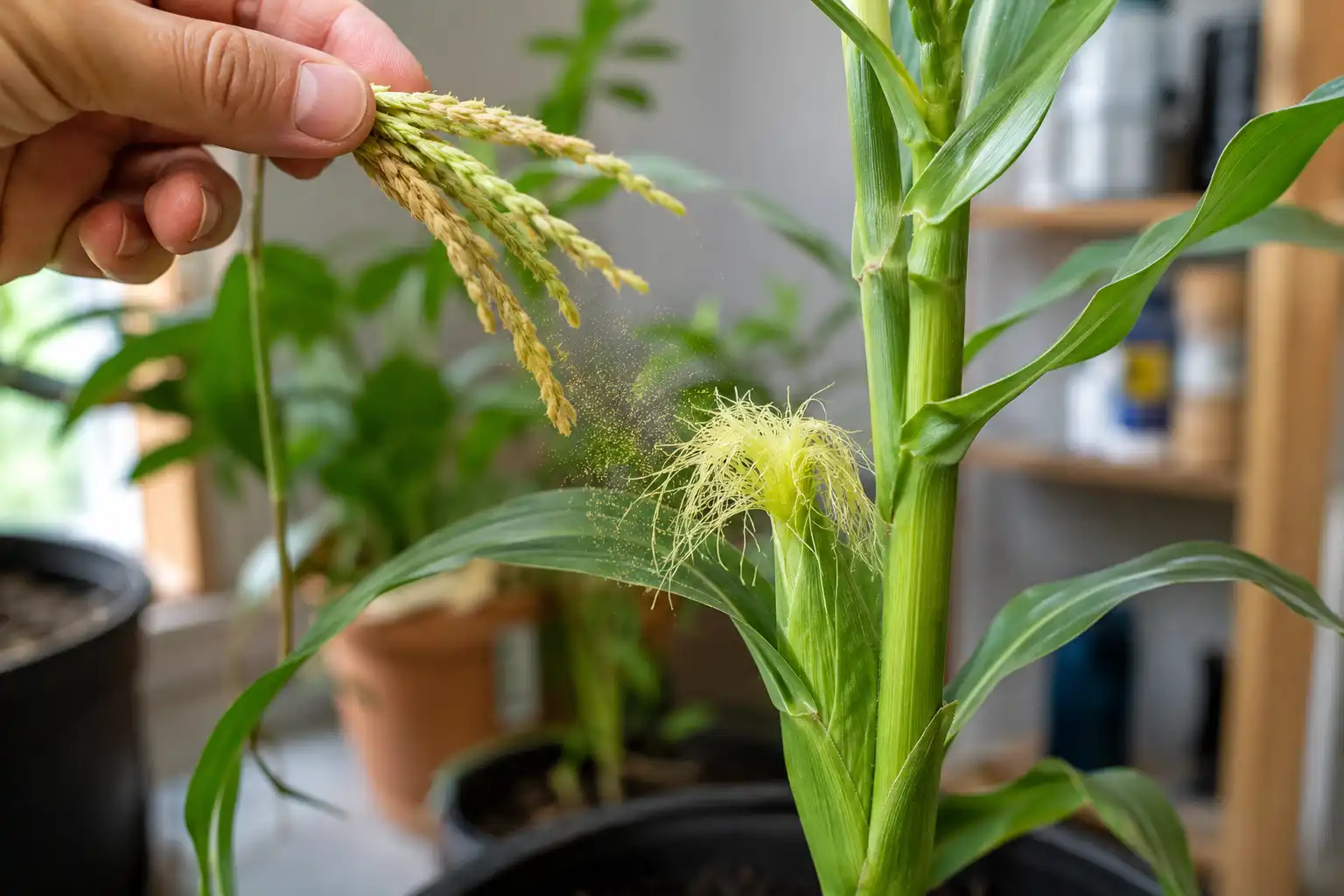
Since no wind blows inside, you move the pollen yourself from the tassels to the silks. This step is not optional indoors. Skip it and you get cobs with scattered kernels and bare patches.
The tassel at the top is the male flower, and the silk strands on each ear are the female parts. Every single silk connects to one kernel, so each one needs a dusting of pollen. That is why grouping plants in a block matters even inside. It is the same reason planting corn in blocks works so well outdoors.
Here is how to do it. First, wait until the tassels drop yellow pollen when you tap them. Then snip a tassel and shake it right over the silks of every ear. Do this in the morning, every day or two, for a week or so while the tassels keep shedding. A soft brush works too if you would rather dab pollen straight onto the silks.
How Much Corn Can You Actually Harvest Indoors?
Expect one to two small ears per stalk, so a few plants give you a snack, not a meal. Dwarf ears run shorter than field ears, often 4 to 6 inches. That is the honest math on indoor corn.
Say you fit six dwarf plants under one light. Then at best you pull 8 to 12 little ears over the season. That is a fun harvest for a windowsill, but it will never fill a freezer. So knowing how many ears a stalk carries helps you set fair expectations before you start.
Is Indoor Corn Worth It, or Should You Start Seedlings and Move Them Out?
For most growers, starting corn indoors and moving it outside beats trying to finish a crop inside. Corn evolved for open sun and wind. So it rewards you far more in the ground or a sunny patio pot.
Here is the smarter path. Start your seeds inside 2 to 4 weeks before the last frost to get a jump on the season. Once nights stay warm and the seedlings hit 4 to 6 inches, transplant those seedlings outside into a sunny spot. Corn roots bruise easily, so move the whole root ball without breaking it.
No yard? You can still get real ears. Just try growing corn in a raised bed or a big deck container out in full sun. That way you keep the head start of indoor sowing. Then real sunlight and a breeze carry the load on light and pollination.
Bottom Lines
You can grow corn indoors, but go in clear-eyed. Give a dwarf variety like Blue Jade a deep pot, a strong LED, and steady hand pollination. You will get a few small ears. It is a neat project and a fine way to learn the plant. For a harvest worth eating, though, start your seedlings inside and finish them out in the sun. That is what to do. And it is common advice given to anyone who asks at the co-op.