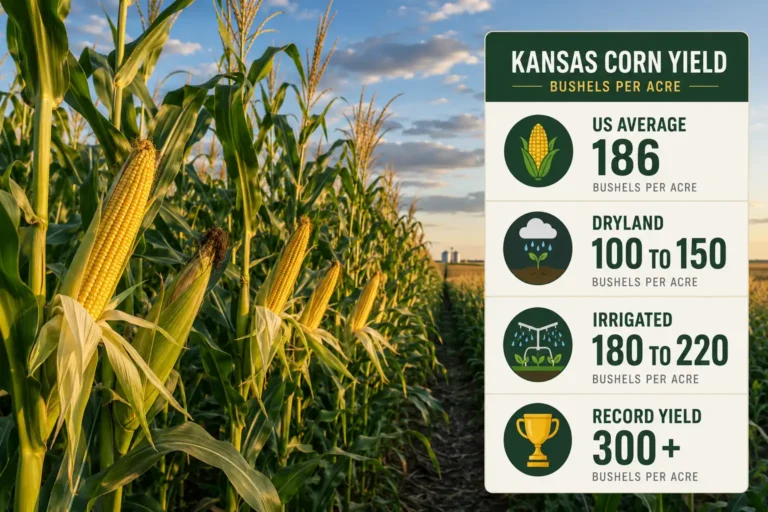
How Much Fertilizer Per Acre for Corn (2026 N-P-K Rates by Yield)
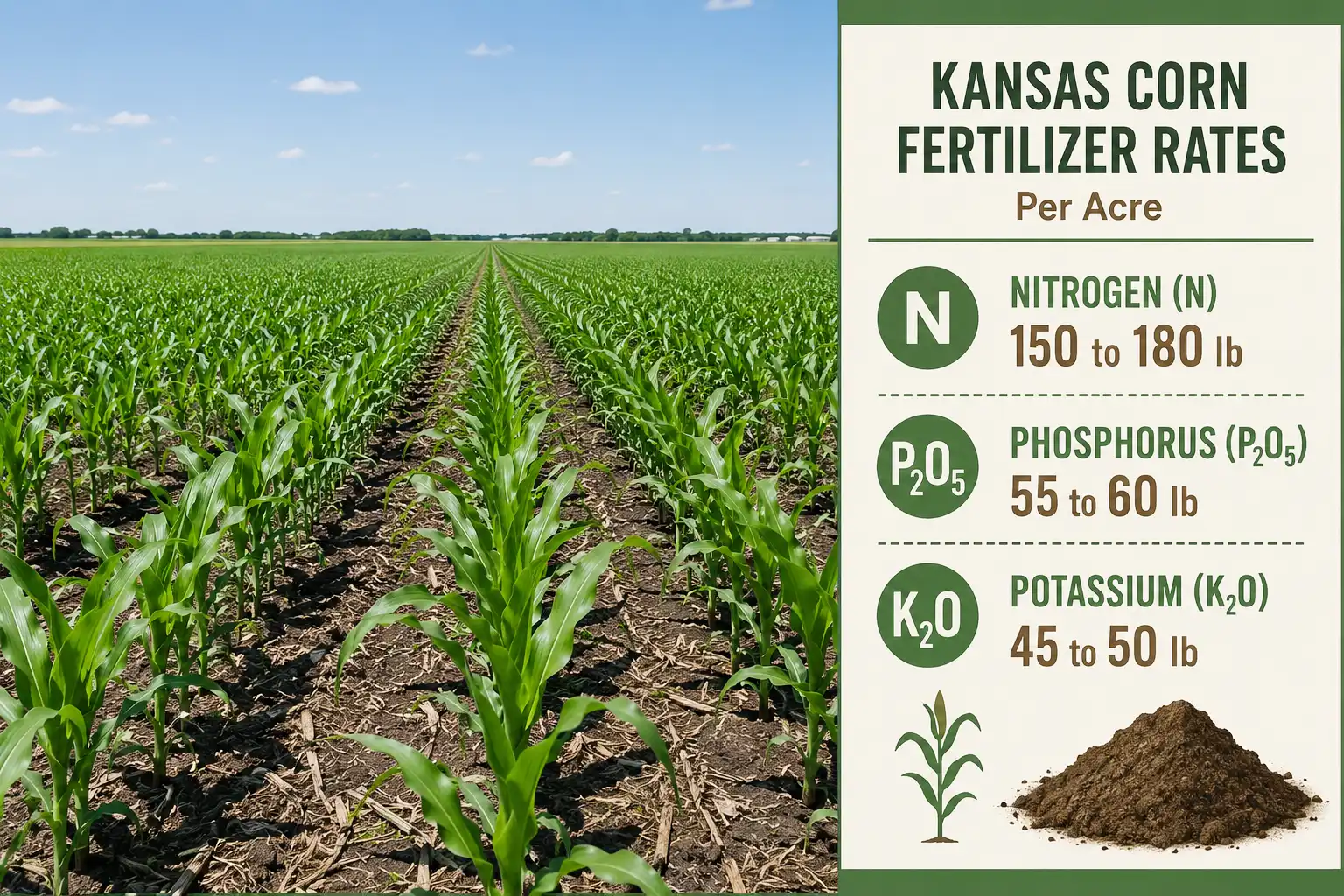
Corn is a heavy feeder, and the right rate decides both your yield and your fertilizer bill. How much fertilizer per acre for corn depends on your yield goal, soil test, and rotation.
Plan on 150 to 180 lb of nitrogen, 55 to 60 lb of P2O5, and 45 to 50 lb of K2O per acre for a 180-bushel crop. That is how much fertilizer per acre for corn most fields need.
How Much Fertilizer Per Acre for Corn Do You Need?
Corn needs three main nutrients per acre: nitrogen (N), phosphorus (P2O5), and potassium (K2O). Nitrogen sets your yield. Phosphorus and potassium follow your soil test. On average, a 180-bushel dryland crop takes about 150 to 180 lb of N per acre. It also needs 55 to 60 lb of P2O5 and 45 to 50 lb of K2O.
Four things move that number up or down:
- Yield goal. More bushels need more of every nutrient.
- Soil test. A high test can drop your P or K to zero.
- Rotation. Corn after soybeans needs less nitrogen than corn after corn.
- Organic matter. Richer soil mineralizes more free nitrogen for the crop.
Here is a quick reference by yield goal. The nitrogen ranges are net rates after typical credits. The P2O5 and K2O values are crop-removal (maintenance) rates for medium-testing soil.
| Yield goal (bu/acre) | Nitrogen (lb/acre) | P2O5 (lb/acre) | K2O (lb/acre) |
|---|---|---|---|
| 120 | 100 to 130 | 40 | 31 |
| 150 | 120 to 160 | 50 | 39 |
| 180 | 150 to 180 | 59 | 47 |
| 220 | 180 to 220 | 73 | 57 |
Corn also uses sulfur and zinc, and it needs the right soil pH to use any of it. Our guide covers those below.
How Much Nitrogen Per Acre for Corn?
As a rule of thumb, corn needs about 0.8 to 1.0 lb of nitrogen for every bushel of yield goal. So a 180-bushel goal points to roughly 150 to 180 lb of N per acre. Credits then pull that number down. Corn after soybeans lands lower. Continuous corn lands higher.
K-State Research and Extension starts with your yield goal times 1.6, then subtracts credits. Those credits add up fast:
- Soil organic matter: about 20 lb of N per 1 percent. Kansas averages near 2 percent, so about 40 lb.
- Previous soybean crop: about 40 lb of N.
- Previous alfalfa or legume: 80 to 100 lb of N.
- Manure or irrigation water: credit the tested value.
- Profile nitrate test: subtract the nitrogen already in the soil.
A worked example makes it clear. A 150-bushel goal starts at 240 lb. Subtract 40 for organic matter, 40 for last year’s soybeans, and about 30 for profile nitrogen. You land near 130 lb of N per acre, or just under a pound per bushel.
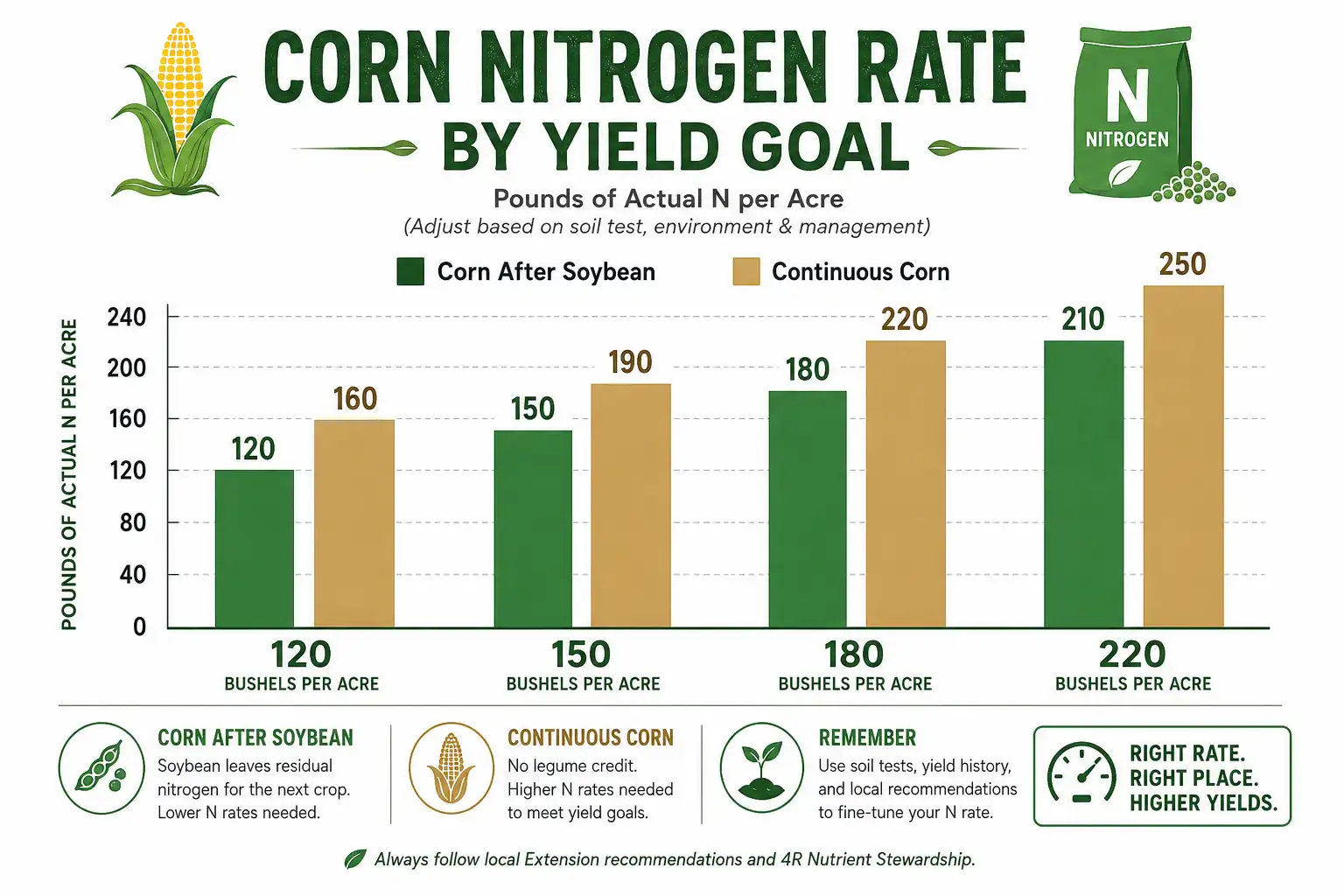
Set a exact goal first. Guessing high just burns money. USDA pegs the national corn average near 175 to 180 bushels, but your own field history matters more. Once you know what your ground can yield per acre, the rate follows.
Old guides said 1.2 lb of N per bushel. That is too high for most fields today. Iowa State reports many growers now target 0.7 lb per bushel or less. Modern hybrids simply use nitrogen better. Across the Corn Belt, the MRTN method (Maximum Return to Nitrogen) sets the economic-optimum rate from trial data. Under MRTN, corn after soybeans often runs 120 to 150 lb of N per acre. Continuous corn runs higher, near 175 to 200 lb.
Water raises the ceiling. K-State caps nitrogen at 230 lb per acre for dryland corn and 300 lb for irrigated corn. On dryland Great Plains ground, moisture usually caps yield first, so rates should stay realistic. Your source changes placement, not total pounds. Common ones are anhydrous ammonia (82-0-0), urea (46-0-0), and UAN (28-0-0 or 32-0-0). If you run liquid, the pounds stay the same. The gallons depend on the product, so check your liquid nitrogen rates before you fill the tank.
How Much Phosphorus (P2O5) Per Acre for Corn?
Base phosphorus on your soil test and crop removal. Corn removes about 0.33 lb of P2O5 per bushel of grain. So a 180-bushel crop pulls near 60 lb per acre. Match the rate to your soil test:
- Low (under 20 ppm Bray-P): apply removal plus extra to build the level up.
- Medium: replace what the crop removes.
- High (over 30 ppm): you can skip phosphorus for the year.
Pull a soil test every two to three years so you are not guessing. Phosphorus barely moves in the soil, so placement matters. Starter phosphorus pays off most in cold, wet springs and no-till fields. Dry sources like DAP (18-46-0) and MAP (11-52-0) work well banded near the seed.
How Much Potassium (K2O) Per Acre for Corn?
Corn removes about 0.26 lb of K2O per bushel of grain. So a 180-bushel crop needs near 47 lb per acre for maintenance. Set the rate by soil test, just like phosphorus. High-testing soils may need none. Low soils, under about 130 ppm exchangeable K, respond well to potash (0-0-60).
Silage changes this a lot. Corn stover holds most of the plant’s potassium, and a grain harvest leaves that residue in the field. So chopping the whole plant for silage removes three to four times the K2O of grain. If you cut silage, plan on a much higher potassium rate.
Don’t Forget Sulfur, Zinc, and Soil pH
These three quietly decide whether the rest of your fertilizer works. Corn responds to 10 to 15 lb of sulfur per acre on sandy or low-organic-matter soils. Sulfur shortages have grown common, because cleaner air now deposits far less of it. AMS (21-0-0-24S) or gypsum both supply it, and it can be added with the sidedress on lighter ground.
Zinc matters on high-pH, eroded, or heavily-tilled fields. Corn is sensitive to zinc, so a shortage shows as pale stripes on young leaves. If a soil test flags it low, add 1 to 2 lb banded or about 10 lb broadcast. That fixes it for several seasons.
Soil pH ties it all together. Corn does best between pH 6.0 and 6.8. Below 6.0, nitrogen and phosphorus get harder to take up, and lime pays back more than extra fertilizer. Test pH with the same sample, and lime early so it has time to react.
How Do You Turn Nutrient Pounds Into Bags of Fertilizer?
Divide the nutrient pounds by the percent in the bag. Every fertilizer label shows three numbers, the N-P-K analysis, as percentages by weight. So urea reads 46-0-0, which means 46 percent nitrogen. To get product pounds, use one line of math: nutrient needed divided by the percent as a decimal.
Say you need 150 lb of N, 50 lb of P2O5, and 47 lb of K2O per acre. Here is the product math with common single-nutrient sources:
| Nutrient needed | Source | Analysis | Product per acre |
|---|---|---|---|
| 150 lb N | Urea | 46-0-0 | 150 ÷ 0.46 = 326 lb |
| 150 lb N | Anhydrous ammonia | 82-0-0 | 150 ÷ 0.82 = 183 lb |
| 50 lb P2O5 | DAP | 18-46-0 | 50 ÷ 0.46 = 109 lb |
| 47 lb K2O | Potash (MOP) | 0-0-60 | 47 ÷ 0.60 = 78 lb |
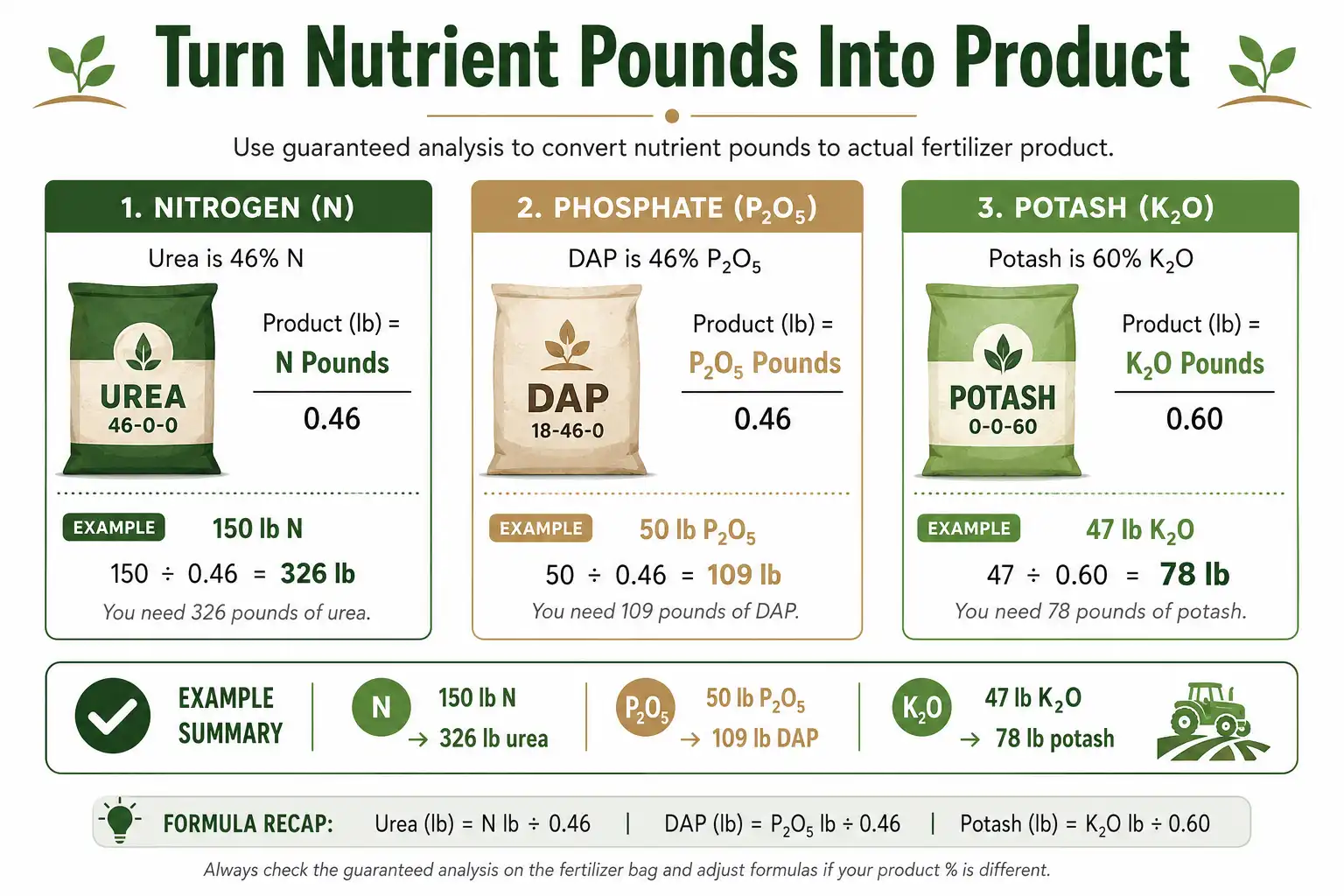
DAP also carries nitrogen, so count that 20 lb against your urea. If you would rather spread one product, a balanced 19-19-19 blend covers all three at once. That suits smaller fields and gardens. New to the N-P-K numbers on the bag? Those three figures are pounds of nutrient per 100 lb of product, not pounds of fertilizer.
How Do You Calculate Fertilizer Per Acre for Your Field?
Work four steps: set a yield goal, pull a soil test, subtract your credits, then convert to product. Here is a Kansas example for 150-bushel dryland corn after soybeans.
- Yield goal. Use your five-year field average, not your best year. Say 150 bushels.
- Soil test. The lab reports P and K and gives a rate. A home soil test kit gets you close between lab samples.
- Nitrogen. 150 times 1.6 is 240 lb. Subtract 40 for organic matter, 40 for soybeans, and 30 for profile nitrogen. That leaves about 130 lb of N.
- Phosphorus and potassium. On medium soil, 150 times 0.33 is about 50 lb of P2O5, and 150 times 0.26 is about 39 lb of K2O.
Your target: about 130 lb of N, 50 lb of P2O5, and 39 lb of K2O per acre. Then convert each one to product with the math above.
When Should You Apply Corn Fertilizer?
Split your nitrogen, and put phosphorus near the seed. A common plan puts 40 percent of the N at or before planting, then 60 percent as sidedress around V6. Splitting can lift nitrogen use by 15 to 25 percent on high-yield fields. It also cuts leaching in wet springs. Apply most of your phosphorus and potassium before or at planting.
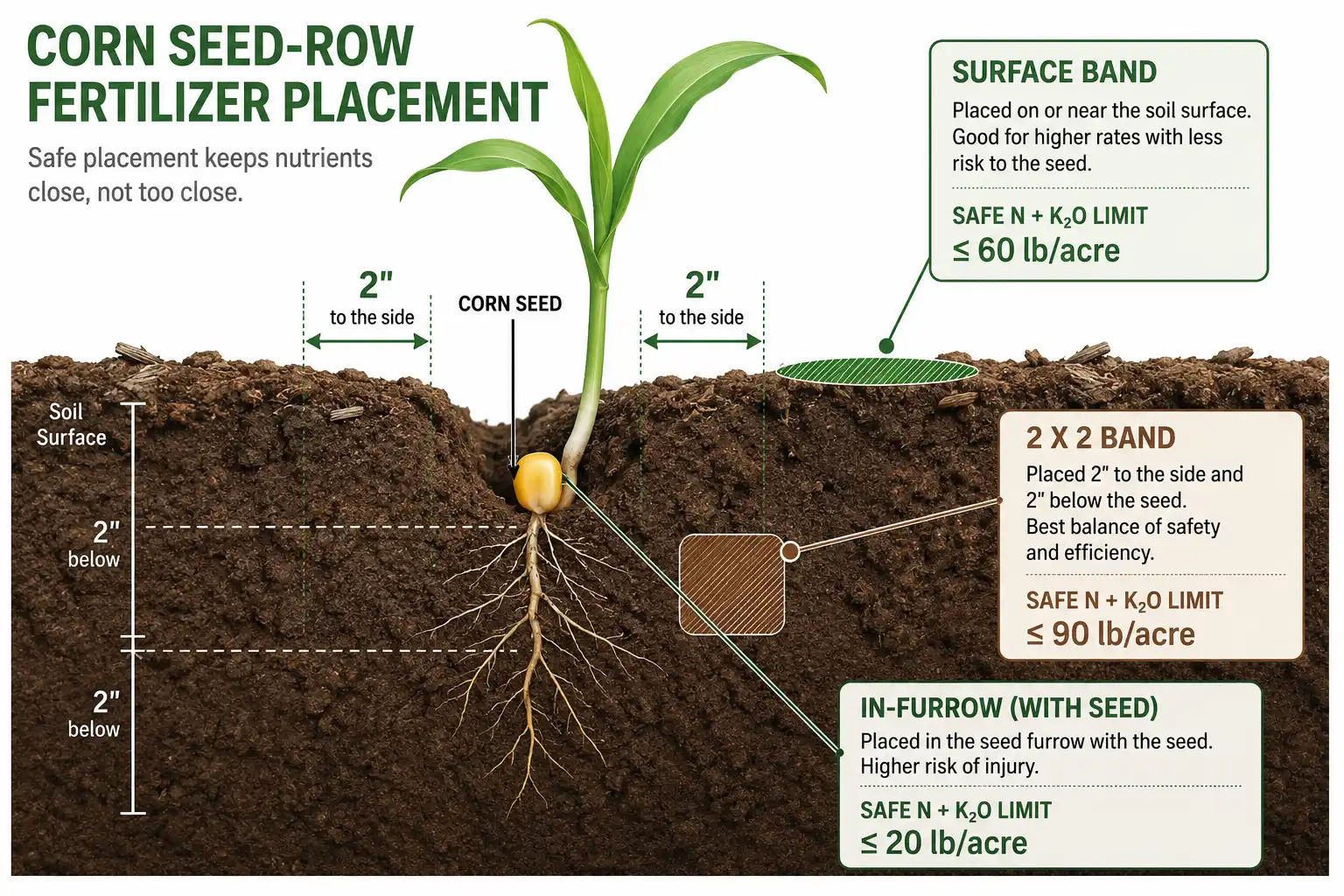
Starter fertilizer needs care near the seed. On 30-inch rows, keep no more than 6 to 8 lb of N plus K2O in direct seed contact. More than that risks salt injury and thin stands. Never place urea or UAN in the furrow, since it turns to ammonia and burns the seedling. A 2 by 2 band, two inches to the side and two inches below, is far safer. K-State trials near Scandia got strong responses from a 2 by 2 band. Rates up to 30 lb of N and 15 lb of P worked well there.
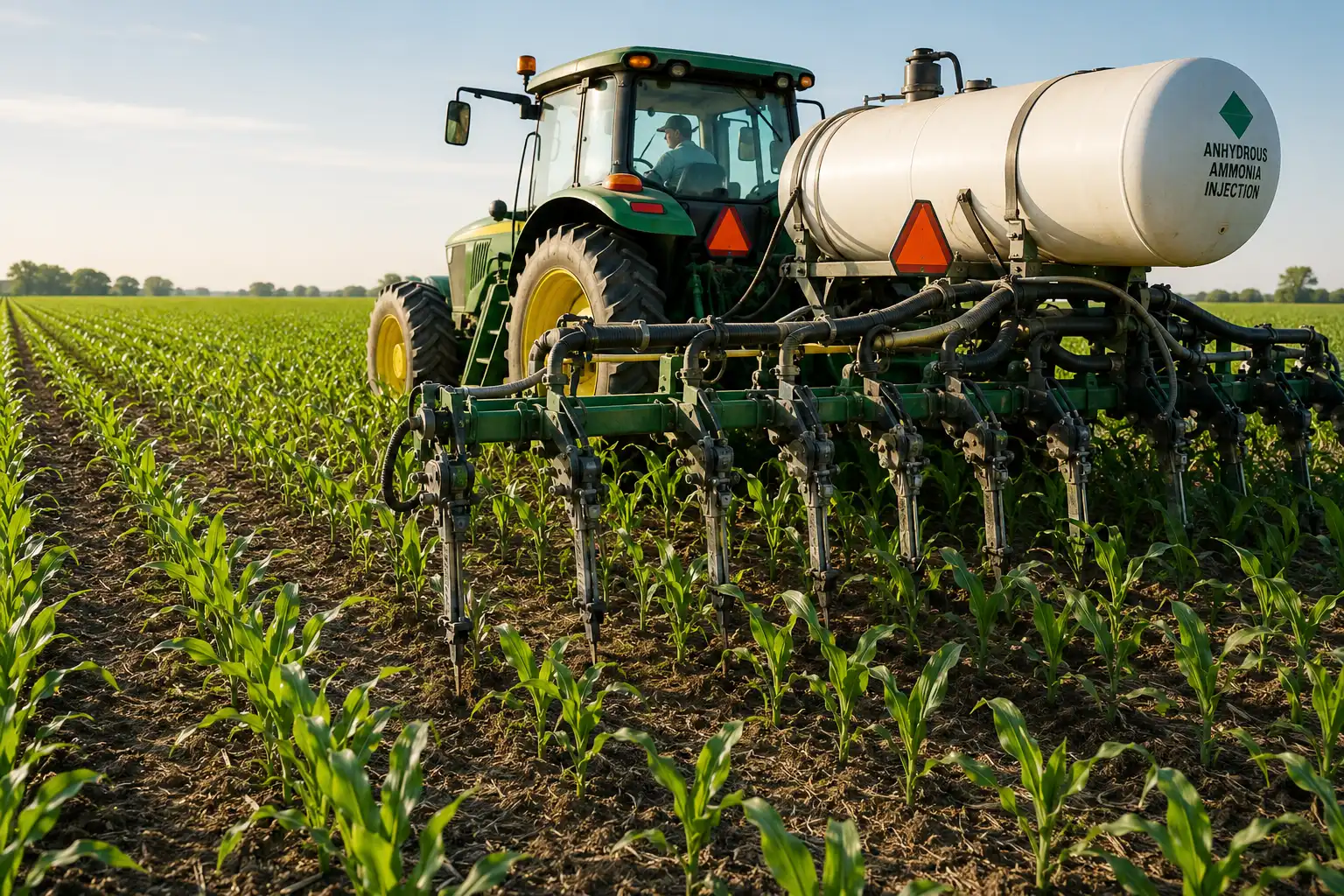
Fall nitrogen is tempting, but treat it with caution. Only anhydrous ammonia belongs in a fall program, since urea and UAN convert to nitrate too fast and leach away. Wait until the 4-inch soil temperature drops below 50 degrees and keeps falling, then add a nitrification inhibitor like N-Serve. Skip fall N on sandy or poorly-drained ground. In Kansas, K-State does not recommend fall ammonia south of I-70, because soils rarely stay cold enough. Near that line by Topeka, spring and sidedress N is the better lean.
If a wet spring steals your nitrogen, a rescue shot can still pay. Apply 30 to 60 lb of N before or at tasseling (VT). The crop can then recover most of its yield. After pollination the kernel count is set, so earlier is always better.
3 Fertilizer Mistakes to Avoid Every Year
Three errors cost growers yield and money almost every season.
- Skipping the soil test. Guessing at P and K either wastes fertilizer or starves the crop. A cheap test settles it.
- Fall-applying nitrogen on light soil. Warm winters and sandy ground let that nitrogen leach away before corn ever wakes up.
- Ignoring potassium on silage fields. Grain removal is modest, but silage strips potassium fast, and the soil test slides in a hurry.
FAQs on Corn Fertilizer Per Acre
How much nitrogen does one acre of corn need?
How much urea per acre for corn?
Is 100 lbs of nitrogen enough for corn?
Does dryland corn need less fertilizer than irrigated corn?
When should I apply fertilizer to corn?
How to Set a Corn Rate Each Spring
Every spring should start with a soil test and last year’s yields, not a fixed recipe. Match nitrogen to a realistic yield goal, then trim it for rotation and organic matter. Phosphorus and potassium follow the soil test, sulfur goes on sandy ground, and lime keeps pH in range. Each nutrient is then converted to bags and the nitrogen is split. That routine keeps corn fed and the input bill honest.